Design and asymmetric war today
(Part Two)
Following on from Part One*, it bears adding that Ukrainian drone designers deployed, constantly recalibrated and redirected design, retested, and redeployed during actual war. It is an argument for high pressure creation of innovative solutions in, as it is in this case, the direst possible circumstances.
Ukraine may yet win their defensive war with Russia. Vladimir Putin’s ability to replace dead soldiers (sent to battle with minimum preparation and even less motivation) is next to nil at this point. This year’s big annual Victory Day parade in Moscow, that usually featured Brobdinagian armaments rolling in front of the Kremlin, had to be severely scaled down.
Putin essentially admitted to a precautionary mutedness of tone, because of the possibility of a Ukrainian drone attack. In Red Square. In the heart of Moscow.
Volodomyr Zelensky has prosecuted a war against Russian aggression that has relied on a startlingly successful combination of imagination and discipline. Right now, many of these drones can hit targets even during defensive electronic fogs.
Right now, Ukraine’s ability to make, use, and sell drones has lessened its dependence on the help of the US. And right now, it is collaborating with Germany on an analogue to the US MIM-114 Patriot system against Russian ballistic missiles.
The nature of warfare at this juncture of world history has unexpectedly changed.
This change was detectible quite early in this Russo-Ukrainian War. Cheap, almost toy drones allowed Ukrainian civilians to slip quickly into significant roles in the war as savvy drone operators.
LEGO AGIT-PROP
A similar change is less detectible in the current war between Iran and the United States. But it is no less startling.
“Iran has done to the US what Ukraine did to Russia,” says the globally respected Iranian-Swedish political analyst Trita Parsi. Iran has been upping investments in Unmanned Aerial Vehicles (UAVs), a.k.a drones.
As early 2019, the US Defense Intelligence Agency reported that “UAVs are Iran’s most rapidly advancing air capability.” This development had apparently been in play for a decade before the US attacked this year and the drones have been making up for the shortfall in the number of replacements to aging military aircraft.
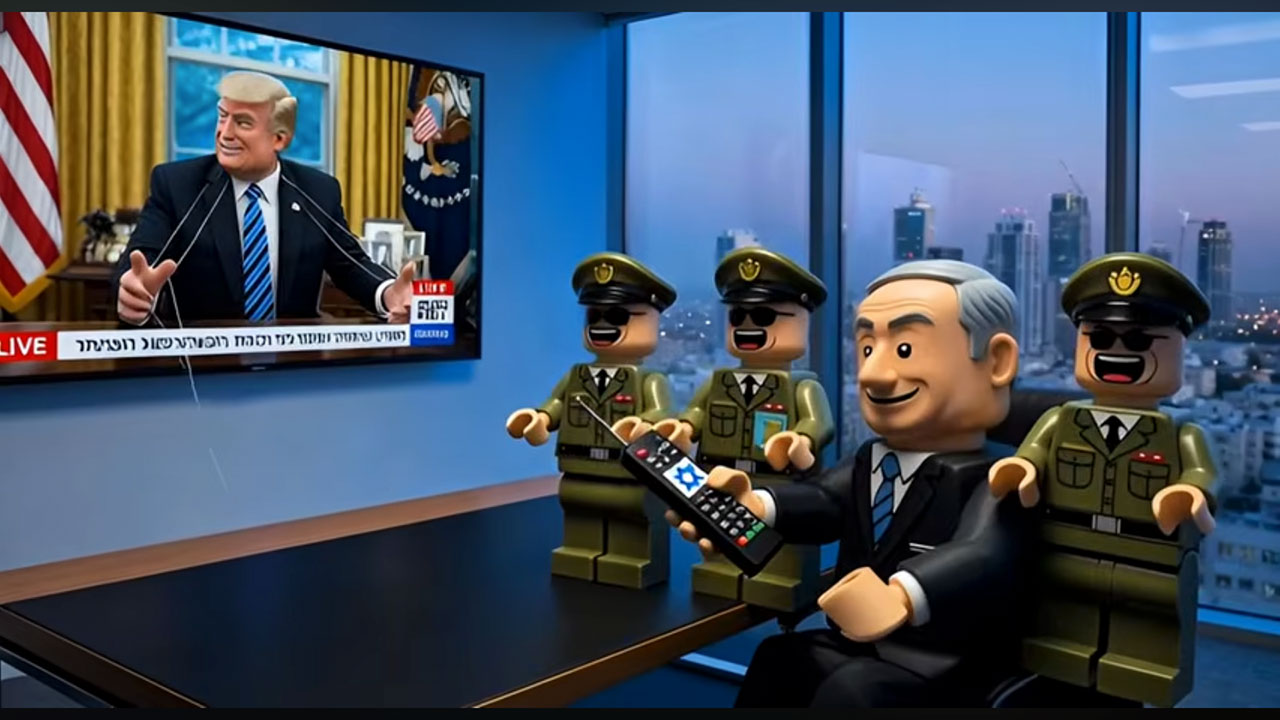
But there is something more inventive and extremely new in Iran’s arsenal, and it is defensive as well as offensive. It is the use of Lego animation in online anti-US agit-prop.
Almost everyone online has seen the videos. As many as a billion views have been generated by the mini narratives making dark fun of the foibles of President Donald Trump, his Secretary of Defense, and the US itself.
These quickly produced, current events-targeted, anime-infused videos are switching the Western-produced tropes about a terrorist, bloodthirsty Iran for fresh story: technologically savvy visual storytellers in universally understood languages of satire and mockery are also Iran.
The monster Lego videos are so funny and piercing; they travel across global digital networks without subtitles and translation.
They are dangerous on multiple levels, firstly, to a US whose leadership has no sense of humor and is vulnerable to Grand Guignol as child’s play.
But also, the videos erode the resistance of the democratic world to propaganda that is masking understanding of the Iranian Revolutionary Guard and Iran’s ayatollah-led government as extraordinarily violent to many of Iran’s citizens.
SUPERPOWER TURGIDITY
For the first time since 2003, America has three aircraft carriers in the Gulf. The carriers guarantee the deadlock at the Gulf of Hormuz; but this impasse also traps the US in an unresolved war.
While the US is thus trapped, the superpower is obliged to face its depleted military stockpile and its inability to replace it fast. More importantly, under Trump, the US’ technological might — including the digital technology superiority that is also declining — has not contributed anything imaginative to US prospects.
It seems impossible now for either the US or Russia to liberate cultural forces to find a way out of the quagmires its leaders stuck them in.
There is something turgid about superpower impunity. Trump’s completely transparent indifference to the difficulties he has visited on Americans, including his MAGA constituency, forecloses inventiveness.
Putin’s stomach for sending Russians to their deaths in Ukraine will not foster imaginative agility.
Putin’s attempted conquest of Ukraine, or parts of it, has now taken longer than the Russian fight against the Nazis in World War 2, the victory over which is celebrated on Victory Day. Trump’s bungling attempted decapitation of the Iranian leadership has worked to entrench the theocratic-militarized prior status quo.
Without in any way drawing similarities between Iran and the Ukraine, except underdog status at present, the agile ways these two countries have shamed a hegemon deserve attention.
Specifically, attention to design — the term used broadly to include inventiveness powered by both skill and sharp reading of the cultural possibilities in technological developments — is attention to political and military outcomes.
*Read Part 1 here: https://tinyurl.com/239cgjtr
Marian Pastor Roces is an independent curator and critic of institutions. Her body of work addresses the intersection of culture and politics.