Weaving? There’s an app for that
PTRI is saving designs for weaving communities and posterity
IF ALL goes well, in a span of a few years, a person will be able access an entire library of Philippine textiles right from their phone.
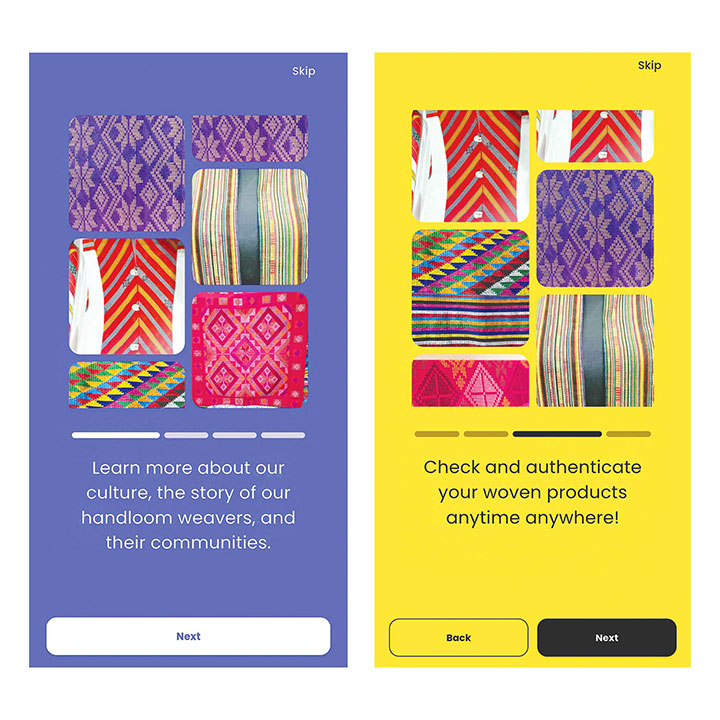
The Department of Science and Technology – Philippine Textile Research Institute (DoST-PTRI) talked about its new app, SalinHABI, at the J. Amado Araneta Foundation’s (JAAF) traditional weaving fair “Hibla: Tradition Woven Forward.” The fair was held from May 15 to 17 at Araneta City’s Gateway Mall 2.
Jennelu Caya, supervising science research specialist at the DoST-PTRI, estimates that the institute has been working on the digitalization project since 2022. Since that year, PTRI has been tracking down weavers and weaves. The project’s goal is twofold: while onboarding, filing, and uploading the works of the weavers (and allowing them to be contacted for business and research purposes), they are also saving the work for future use.
The weaves are preserved using high-resolution images. These are fed to software that analyzes color, thread counts, thickness, and other variables, and it is then recreated using PTRI’s digital looms, allowing the manufacture of what Ms. Caya calls “digital twins.” From this process, the method and matrices of the woven products are saved and can be recreated once again. She likens this to making sheet music: “Sa piano piece, meron ka nang notes (you’ll already have the notes).”
Access, however, is restricted, and the public can view only the finished product through the app. As for weavers, “If the community is the original weaver of that pattern, we will share it with them.”
Ms. Caya shared the successes of the digitalization project. Since 2022, they have scoped and identified about 5,000 weavers from all across the country. They are still working on getting them all on the app, however: “We are now able to commit 1,400 plus, plus weavers in the platform.” They have also managed to preserve woven works that have become extinct: there are some samples of Philippine textiles in the Field Museum in Chicago which are the only ones left of that specific pattern. After feeding images of these to their software, they have managed to recreate the patterns again using the digital looms, and their matrices can be made available again to the communities that had once woven them.
Being on the app can also help in weeding out the fakes that have proliferated: machine-woven textiles using indigenous patterns have been spreading in the market and being passed off as the real thing. “Kapag nakita mo iyong community sa SalinHABI, 100%, alam mo na producers sila ng handloom wovens,” she said.
Interested parties can download the SalinHABI app from Google Play and the App Store. — Joseph L. Garcia