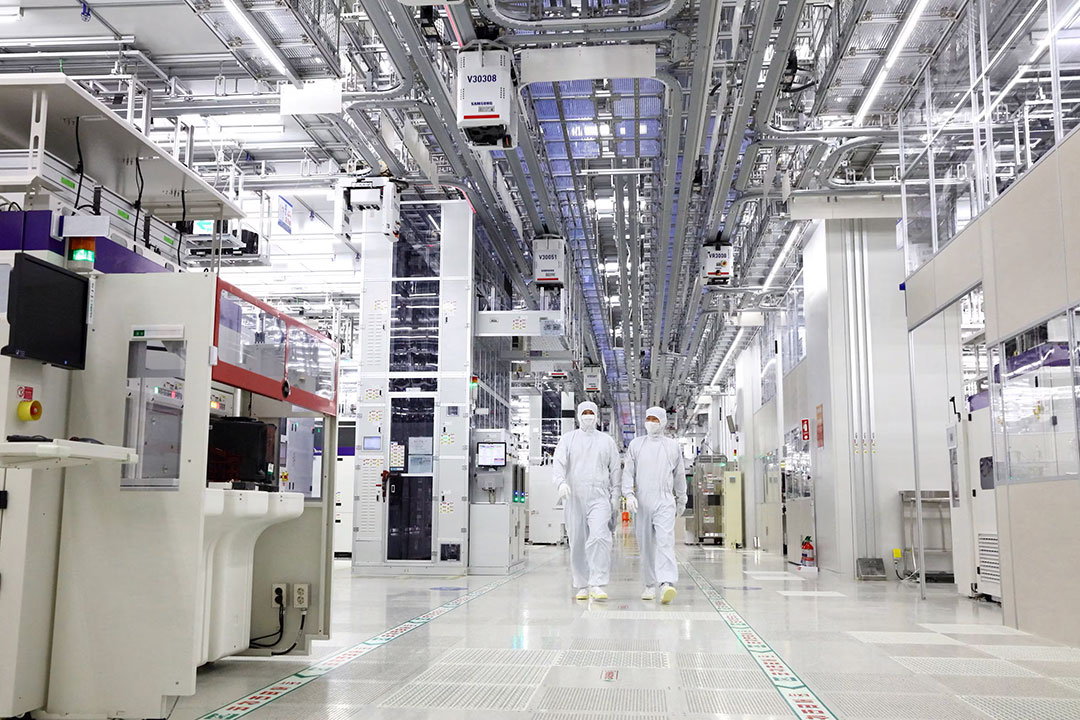
SEJONG — Some 48,000 Samsung Electronics workers are set to walk off the job on Thursday after talks on bonus payments broke off without a deal – a strike which threatens the health of South Korea’s economy and could hit global chip supply.
Hopes for a deal in the not-too-distant future were kept alive, however, after discussions resumed late Wednesday afternoon, now mediated by Labor Minister Kim Young-hoon.
Earlier in the day, union leader Choi Seung-ho told reporters that the union had accepted a final proposal presented by the head of the National Labor Relations Commission, but the 18-day strike would go ahead as management had not come round on one remaining sticking point.
“I would like to apologize to the public for not being able to produce a good result despite making as many concessions as possible,” he said, bowing and holding back tears.
“We will not cease our efforts to reach a deal even during the strike.”
SAMSUNG SAYS DEMANDS ARE UNACCEPTABLE
Samsung said in a statement that the union had insisted on “unacceptable demands” that included the size of bonuses for loss-making units.
“The reason an agreement could not be reached …. is that accepting the labor union’s excessive demands would undermine the fundamental principles of company management,” it said.
Samsung shares ended up 0.2% and have lost 2.8% for the week to date. Some investors have said they are more concerned about the prospects of a permanent spike in labor costs than they are about the one-off costs of the strike.
EMERGENCY ARBITRATION OR NOT?
Much attention will now turn to whether the government will step in and order emergency arbitration as it warned it might do at the weekend, citing the potential damage the strike could inflict on the economy.
Samsung accounts for almost a quarter of South Korea’s exports and is also the world’s largest memory chip maker so production disruptions are likely to further fuel price rises at a time when the AI boom has caused shortages.
An emergency arbitration order, which has been rarely employed, would put the strike on hold for 30 days while the government mediates talks.
But a South Korean government official said on Wednesday that talk of emergency arbitration is premature and that there was still time for dialogue.
CRITICISM FROM PRESIDENT LEE
The precise nature of the remaining sticking point was somewhat unclear.
The union has demanded that Samsung abolish a cap on bonuses that stands at 50% of annual salaries, allocate 15% of annual operating profit to bonuses and that these changes be formalised beyond one year.
The two sides have been at odds over how performance bonuses would be distributed between the conglomerate’s hugely profitable memory business and loss-making logic chip businesses, Reuters has previously reported.
On Wednesday, South Korean President Lee Jae Myung, while regarded as friendly towards unions, also said that a certain union was “crossing the line” when it claimed a share of a company’s operating profit even before income tax is paid.
FRUSTRATED BY PAY GAP WITH SK HYNIX
Samsung remains one of the most sought-after workplaces in Korea, but employees are furious about the pay gap with smaller rival SK Hynix, which took the lead in supplying high-bandwidth memory for AI chip units to Nvidia.
Samsung’s union says SK Hynix workers last year received bonuses more than three times higher than those of Samsung workers, resulting in an exodus of Samsung employees to SK Hynix and a surge in union membership.
The 48,000 employees who plan to strike account for 38% of Samsung’s domestic workforce.
The strike could in a worst-case scenario shave 0.5 percentage points off a forecast 2.0% expansion for the South Korean economy this year, according to an official from the country’s central bank, who declined to be named.
Gary Tan, a portfolio manager at Allspring Global Investments, said the impact on supply chains should remain limited unless the strike goes longer than 18 days.
“The bigger effect is on market sentiment and longer-term memory industry pricing structure, reinforcing cost pressures,” said Mr. Tan, whose fund holds Samsung shares.
A court on Monday partially granted Samsung’s request for an injunction, ruling that essential staffing levels at some production facilities must be maintained to prevent production materials and facilities from being damaged during any industrial action. Samsung has notified the union that this will require 7,087 workers to report for work.
Union leader Mr. Choi said last week Samsung had, in preparation for a strike, started reducing its deployment of wafer carriers capable of adding 36,000 wafers to automated systems. Samsung declined to comment on the size of the potential production loss. — Reuters