Senate shields Senator Bato from arrest as ICC pursues drug war case
By Erika Mae P. Sinaking, Reporter
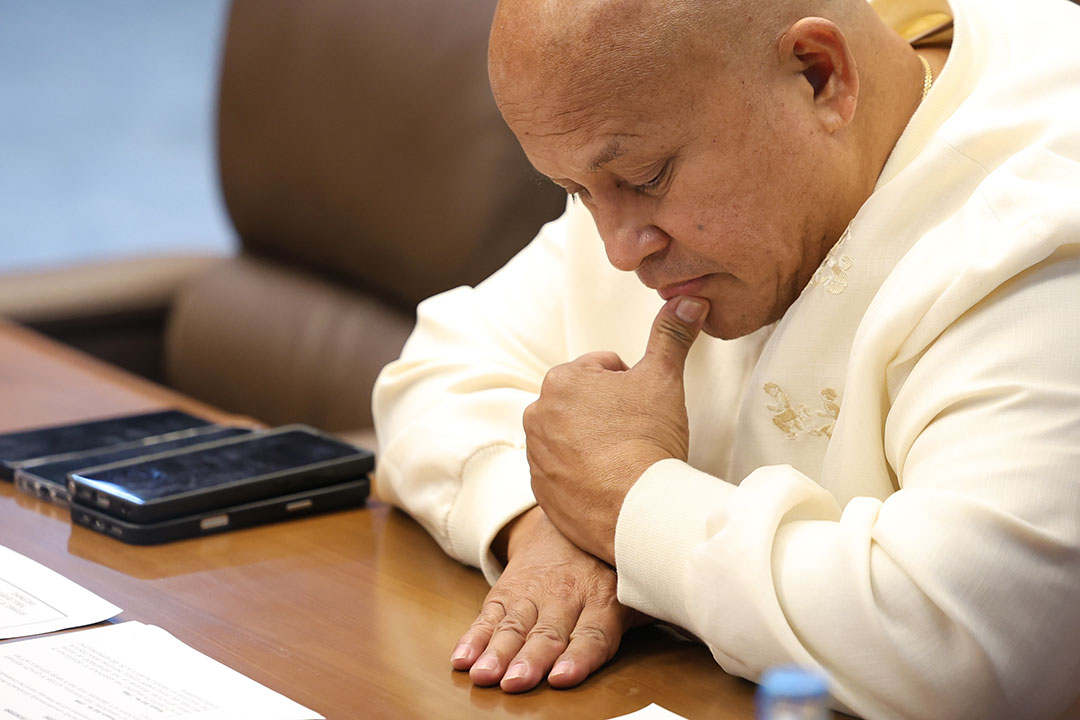
SENATOR Ronald “Bato” M. dela Rosa is now staying in the Senate after a high-stake standoff on Monday prompted the chamber to place him under protective custody, shielding him from arrest for his role in the Duterte administration’s deadly war on drugs.
Analysts on Tuesday said the Senate should not allow Mr. dela Rosa to evade a valid arrest warrant issued by the International Criminal Court (ICC), citing international treaty obligations and domestic legal provisions governing cooperation with the tribunal.
Mr. dela Rosa, who served as police chief of former President Rodrigo R. Duterte, on Tuesday denied he ordered the killings of drug war victims, claiming that evidence held by the ICC was “fabricated.”
“My only role is that I led [the drug war] but that doesn’t mean I ordered to kill them all. Of course, if the lives of the cops are in danger, they should save themselves,” Mr. dela Rosa told reporters in mixed English and Filipino.
Mr. dela Rosa also maintained that he will only answer to local authorities, saying that they will present themselves should there be a local complaint filed against him.
“Because if this is not politics, why don’t they file a case against me in local courts?” he said. “If they want accountability, file a complaint against me here in the Philippines.”
The Senate on Monday placed Mr. dela Rosa under protective custody, based on Senate Resolution No. 44, barring authorities from entering its premises.
The senator had been absent since reports of a possible ICC arrest warrant surfaced in November, reappearing on Monday just as National Bureau of Investigation agents attempted to arrest him.
NOT A SAFE HOUSE
Ephraim B. Cortez, president of the National Union of Peoples’ Lawyers, said that invoking “protective custody” to keep the senator inside the Senate premises amounts to effectively blocking the enforcement of an international legal process.
“By providing him with protective custody, the Senate is shielding him from arrest. So he has to stay inside the Senate building. The protection will not be extended outside the Senate building,” Mr. Cortez told BusinessWorld via a Viber chat.
“The Senate Resolution extending such protection has no binding effect and is not a legal basis for preventing the issuance of the warrant of arrest,” he said.
He added that the measure has no legal effect against international obligations, noting that domestic resolutions cannot override treaty-based commitments.
Jose Sonny G. Matula, Nagkaisa chairman and Federation of Free Workers president, likewise said “protective custody” should not be used as a “magic phrase” to defeat a lawful arrest.
“Protective custody usually means custody for a person’s safety, not custody to make the Senate a safe house from legal process,” Mr. Matula said in a separate Viber chat. “If it means Senator dela Rosa will stay in the Senate to avoid arrest, then that is not protective custody — that is political shelter.”
He pointed out that under Article VI, Section 11 of the Constitution, senators are immune from arrest only for offenses punishable by not more than six years while Congress is in session, a limit that does not apply to crimes against humanity.
The ICC on Monday made public an arrest warrant for Mr. dela Rosa for the crime against humanity of murder, identifying him as an alleged indirect co-perpetrator with Mr. Duterte.
The warrant revealed that judges of the ICC’s Pre-Trial Chamber I found reasonable grounds to believe the former Philippine National Police chief was involved in a common plan targeting alleged criminals in the context of the anti-drug campaign.
Specifically, the chamber linked the criminal liability finding to incidents between July 3, 2016 and end-April 2018, during which at least 32 persons were killed.
“It is now for the national authorities to arrest and surrender the suspect to the ICC,” ICC spokesperson Oriane Maillet said in a video statement late on Monday evening.
Ranhilio C. Aquino, dean of the San Beda Graduate School of Law, argued that ICC warrants do not require domestic judicial issuance for enforcement.
“Article 127 of the Rome Statute OBLIGATES the Philippines to cooperate with processes of the ICC — including the service of warrants of arrest… This, coupled with the aforecited Section 17 of Republic Act No. 9851, provide the legal warrant for the arrest of Bato dela Rosa,” he said on a Facebook post.
He described the Senate’s actions as “coddling someone charged with one of the most egregious of crimes that can be committed.”
Victims’ groups, Rise Up for Life and for Rights, and human rights lawyers also called for immediate compliance with the ICC process, warning that failure to act would undermine international accountability mechanisms.
“Dela Rosa is now considered a suspect-at-large by the International Criminal Court… He must be arrested on the strength of the ICC warrant, served by the proper Philippine authorities,” the group said.
“Dela Rosa cannot only show up for work only when convenient, and he cannot hide in the Senate from the enforcement of laws that the Senate has approved,” they added.
NULLIFY SENATE RESO
Also on Tuesday, the Supreme Court has been asked to nullify a legislative resolution for allegedly obstructing the judicial process and violating the doctrine of separation of powers.
John Barry T. Tayam, a senior high school teacher from Las Piñas City, filed a petition for certiorari and prohibition, arguing that Senate Resolution No. 44, also known as the Filipino Protection from Extraordinary Rendition Resolution, is unconstitutional and was issued with grave abuse of discretion.
Mr. Tayam said that the resolution — which mandates the exhaustion of domestic remedies before a Filipino is surrendered to a foreign entity — effectively turns the Senate into a “sanctuary” for Mr. dela Rosa amid an ICC warrant.
“A Senate Resolution is an internal expression of sentiment and cannot legally override a statute,” part of the complaint read.
“To allow the Senate to shield its members from judicial process under the guise of institutional integrity would be to create a privileged class above the law. The Court, as the final arbiter, must reaffirm that no institution is so sacred that it may operate outside the reach of the Constitution,” it added.
Mr. Tayam invoked the Doctrine of Transcendental Importance, urging the High Court to resolve the “constitutional crisis” and clarify the limits of parliamentary privilege.
PIECE OF PAPER
Mr. dela Rosa’s legal counsel Israelito P. Torreon said that the Philippine National Police cannot automatically enforce any foreign arrest warrant, noting that it should undergo local processes.
“I hope and pray that they will follow the rule of law that any foreign warrant is not automatically enforceable here in our country. We are an independent country, and their processes must be confirmed in our country first,” Mr. Torreon told reporters, adding that the Philippines is not an extension of the ICC.
The Philippines withdrew from the tribunal in March 2018, with the withdrawal of the Rome Statute taking effect a year after the notification.
While the Philippines is no longer a member of the ICC, the judicial body still has jurisdiction on the crimes against humanity of murder committed from Nov. 1, 2011 to March 16, 2019.
“What I know is that the only warrant of arrest [that is] immediately effective here in the Philippines is the warrant issued by our local judges,” Mr. Torreon said.
He said that he is hoping that the Supreme Court will grant their request for a temporary restraining order against the ICC warrant against Mr. dela Rosa.
Ferdinand S. Topacio, Partido Demokratiko Pilipino deputy spokesperson, said that the ICC arrest warrant is a “piece of paper” in the country.
“We cannot give power to a foreign court and say that they are a court of competent jurisdiction. We have the authority to do that,” he told reporters in a mix of English and Filipino.
Meanwhile, the Palace said the Philippine government will afford protection to every Filipino after an embattled Mr. dela Rosa asked for protection from President Ferdinand R. Marcos, Jr.
Palace Press Officer Clarissa A. Castro said the senator’s plea for protection will be met according to the law.
“Even those extrajudicial killing victims are also asking for protection from the government,” she told a briefing in Filipino, referring to drug war victims. “So, an accused like Senator Bato is asking for protection; everyone will be given protection according to the law.”
“If he is arrested, all rights as an accused will be granted to him,” said Ms. Castro.
Former President Mr. Duterte was arrested last March 2025 for his war on drugs, which killed thousands of Filipinos, mostly urban poor, without due process. He is currently detained in The Hague, the Netherlands and is awaiting trial. — with Kaela Patricia B. Gabriel and Chloe Mari A. Hufana