More Filipino innovations may go global with rollout of national testing, evaluation system — DoST
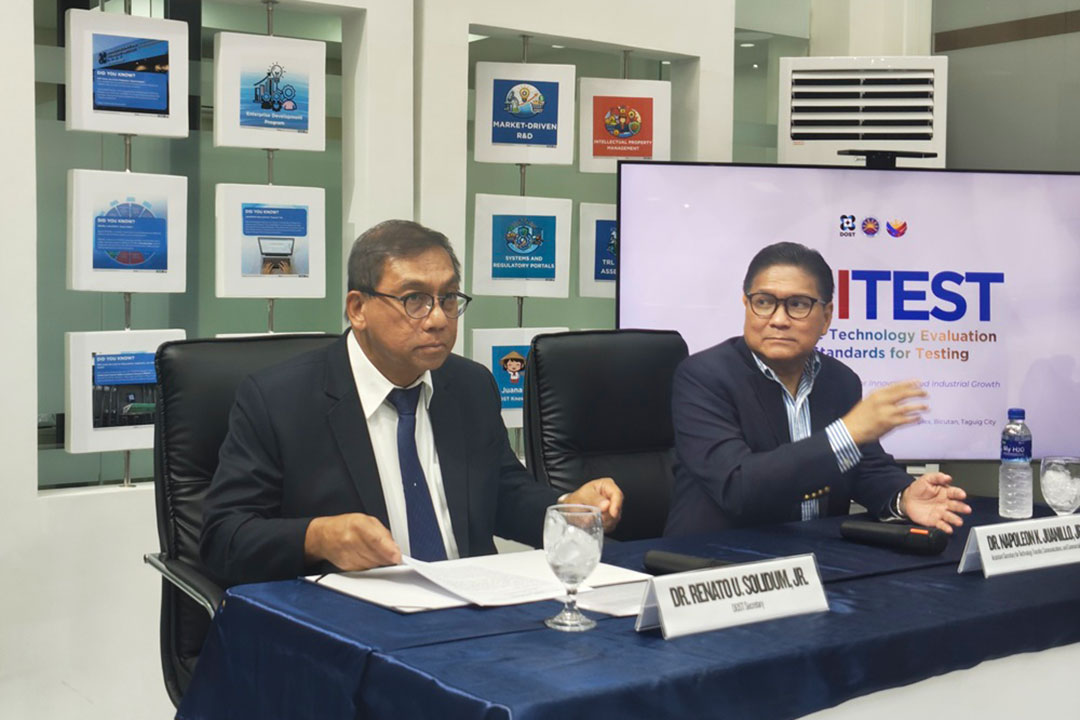
More Philippine innovations are eyed to reach global market with the implementation of Philippine Technology Evaluation and Standards for Testing (PHITEST), a national system that ensures that technologies are tested, validated, and trusted globally, according to the Department of Science and Technology (DoST) on Tuesday.
DoST Secretary Renato U. Solidum Jr. said that PHITEST address the challenge on how local innovators and researchers move from innovators in laboratory to the marketplace.
“Essentially, it builds a unified national system for testing, evaluation, and make sure that standards development are created to make sure that Filipino technologies are not only innovative but also reliable, safe, and globally competitive,” Mr. Solidum said during the PHITEST implementation announcement on Tuesday.
PHITEST will operate as a networked testing and evaluation platform lead by DoST and Commission on Higher Education (CHED). It will also work with testing centers and industry partners.
The initiative covers priority technology domains, including semiconductors and electronics, biopharma and health technologies, agri-aqua technologies, renewable energy and circular economy, electric vehicles and aviation, and climate change and resilience technologies.
Its testing and evaluation activities include performance benchmarking, durability and reliability testing, safety assessment, interoperability checks, and compliance verification across these sectors.
As for its implementation, the DoST said that PHITEST comes in two phases.
The first phase focuses on developing 60 master PHITEST trainers through two sequential cohorts from January to June 2026 and from July to December, covering priority sectors such as semiconductors and electronics, biopharma and health technologies, among others.
Participants will undergo global benchmarking and immersion in leading international institutions to align local standards with international practices.
This phase will conclude with the certification of trainers and the nationwide rollout of PHITEST across 113 state universities and colleges and select private higher education institutions, where master trainers will lead the development and certification of validators.
The second phase will focus on training and certifying 700 PHITEST validators at lead sites, with cascading deployment to state universities and colleges and select private higher education institutions nationwide.
It will also establish inter-laboratory reproducibility for globally comparable testing and an integrated PHITEST registry as a “proof-to-trust” system.
The initiative is supported by a P35-million funding from the CHED, intended to support the training of master trainers and master students, Napoleon K. Juanillo Jr., assistant secretary for technology transfer, communications, and commercialization at DoST said.
With the rollout of PHITEST, DoST aims to increase validated, market-ready Filipino technologies and strengthen confidence in local innovations.
It likewise eyes to speed up technology adoption in public and private sectors, and align research outputs with industry and regulatory requirements.
Over five years, DoST said it aims to validate between 755 and 1,200 technologies across six priority domains. — Edg Adrian A. Eva