UP launches research, innovation office
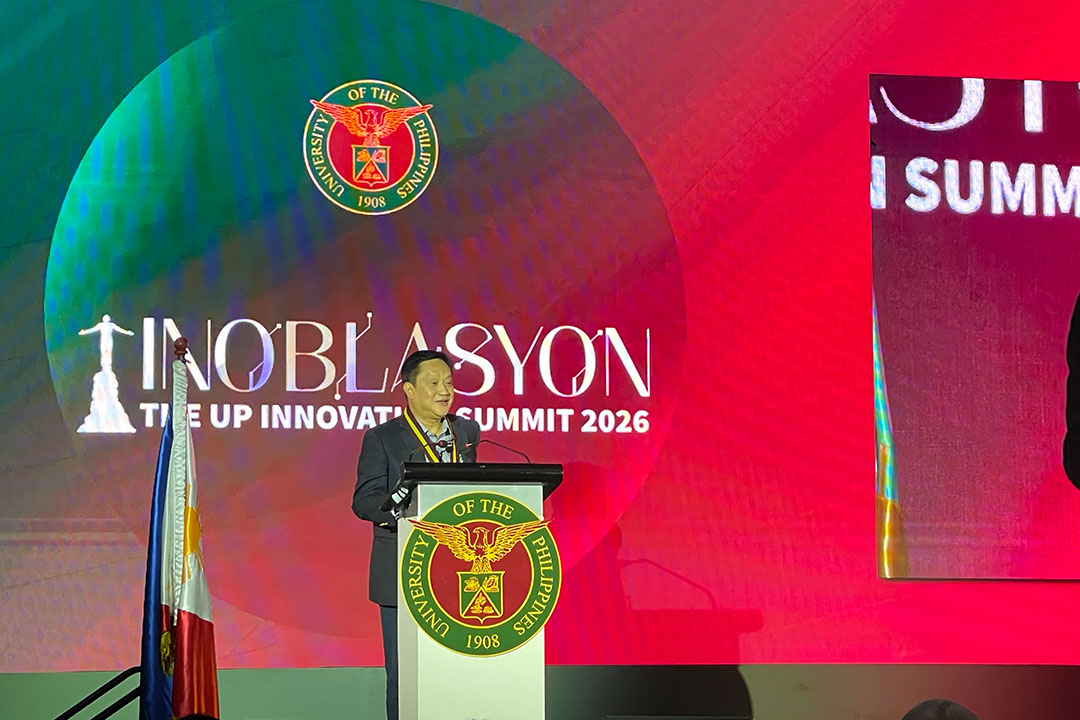
The University of the Philippines (UP) said on Tuesday that expanding its science and technology initiative through its new office for research and innovation will help create a societal impact.
“Our ambition is way, way bigger, and it’s to create a scientific field, a strong industry based on science in the Philippines, as a guarantee for development,” UP President Angelo A. Jimenez told reporters in a briefing.
“As we said before, we want to make science attractive to young people,” he added. “In other words, make science sexy so that people will aspire to become a marine biologist, a physicist, a nuclear engineer.”
During the launch of UP’s first innovation summit, Inoblasyon, the university also formally launched the UP System Office of the Vice President for Research and Innovation.
The new office will help coordinate the institution’s systemwide technology development and partnerships aimed at supporting national priorities.
“We separated it from the academic affairs to now focus on curriculum and faculty development and teaching,” Mr. Jimenez said. “Now we have a focused office for research and innovation.”
Along with its science and technology efforts, the university said it plans to create an “ecosystem” for research and innovation in the Philippines.
“We want to build an ecosystem around research and innovation, which includes entrepreneurship, intellectual property protection, and support for startups,” the university president said.
“From research to coming up with a proof of concept up to prototyping, and then finally assisting in business,” he added. “What we’re trying to come up with is an ecosystem like Silicon Valley that will really attract investors, financiers, and startups… So that’s the vision.”
Data from the university’s innovation portfolio last year showed that it has produced 45 technology licensees, 24 spinoff companies, 68 technology transfer leaders, 152 research partnerships, and 1,428 intellectual property registrations.
The majority of the ventures are in health (34), agri-aqua and food (25), and climate and environment (10). Other innovation sectors include creative industries, circular bioeconomy, digital technology, digital governance, and energy and mobility.
“If you ask me, is this a lot? This is not a lot. This is just a drop in the bucket of what we have in mind,” Mr. Jimenez said. “The idea is to become an impact university, as we have said this before, and we want to target our communities as well.
“We want to solve problems that are actually felt by communities, prioritizing on communities that are around UP.. . Of course, the entire country as well,” he added. — Almira Louise S. Martinez