Home Blog Page 9989

US Treasury’s 20-year reboot drives troubleshooting across yield curve

THE US TREASURY’S plan to reboot its 20-year bond clarified how the government will fund a $1-trillion deficit, but also raised questions about the decision’s ramifications elsewhere in the market.

Traders took a stab at providing some answers in the immediate aftermath, reshaping the yield curve. The extra yield on 30-year bonds versus 2-year notes rose almost 3 basis points on Friday, the biggest increase since late December.

While some see this move auguring a steeper curve longer term, much will depend on how the Treasury department rejiggers its lineup of issuance. And that in turn will depend on when the sales begin, and their size, analysts say.

Wall Street dealers seem generally of the view that the new issue will lead to only marginal cuts, if any, to other coupon-bearing auctions. At UBS, strategist Chirag Mirani says the market pricing has already adjusted to the prospect of new supply, and he sees the recent cheapening in longer-dated Treasuries as a buying opportunity.

But Jim Caron at Morgan Stanley Investment Management sees cuts closer to the front end of the curve, which should help widen the gap between short- and longer-end yields.

“We like the curve steeper, so this is a welcome thing,” Mr. Caron said Friday.

Most dealers anticipate the new 20-year bonds to debut in May. Waiting until around midyear reduces the need to shave auction sizes that are historically large, which has left the Treasury well-funded for now.

But the federal budget deficit is set to surpass $1 trillion, and the US also has to deal with a wall of debt starting to mature later this year. As a result, any move to shrink offerings of other coupon-bearing maturities to make room for the 20-year would soon have to be reversed. And if the Treasury does take that step, bills are seen as the most likely candidate.

“The key reason for Treasury to introduce the 20-year now is that it gives it a warm-up period,” said Jim Vogel, a strategist at FHN Financial. “It will be absolutely necessary later on for larger auction sizes overall,” so cuts now would only be temporary.

For decades, the Treasury has sought a regular and predictable approach to issuance, which it sees as fostering investor demand and reducing the cost to taxpayers. That approach has meant that officials prefer not to make abrupt or frequent changes to their auction slate.

One reason to expect a supply-driven steepening in the curve is looking shakier: The decision to reboot the 20-year, which the US stopped issuing in 1986, appears to put on ice for now the prospect of even longer maturities. Treasury Secretary Steven Mnuchin has been pondering that step since he took over in 2017. The 20-year idea seemed to gain traction last quarter.

There’s another key reason analysts say the Treasury can wait a few months to introduce the two-decade maturity. Its financing position is getting a boost from the Federal Reserve’s monthly purchases of $60 billion in T-bills, a program aimed at increasing reserves. As those securities mature and the central bank rolls them over, it reduces the amount the government needs to borrow from the public.

“Based on the current auction sizes and projections for the deficit, it seems unlikely to us that Treasury will start issuing the 20-years in February, but they will likely announce in May the actual start of sales,” said Zachary Griffiths, a rates strategist Wells Fargo Securities. “And at that time, Treasury could start 20-years a bit smaller than its full annual run-rate plans, or if not, just cut the 30-year auctions by a few billion.”

It will likely leave the 10-year alone, because its role as the world’s borrowing benchmark means it needs to be highly liquid, according to Mr. Griffiths.

Well Fargo forecasts that when the 20-year is fully up and running, Treasury will sell about $39 billion quarterly, or about $150 billion to $160 billion each year. The Treasury Borrowing Advisory Committee has recommended that the government issue $140 billion annually.

More information on the 20-year will come at Treasury’s next quarterly announcement of longer-dated debt sales, on Feb. 5, the department said in a statement. In its regular quarterly survey released Friday, Treasury asked dealers about the maturity, including their view on the minimum auction size and total issue size necessary to ensure benchmark liquidity.

“Treasury will likely do this in a way to limit adjustments needed in other coupon maturity sizes, or even prevent any from occurring at all,” said Mark Cabana, head of US interest rates strategy at Bank of America Corp. — Bloomberg

Animation industry poised for transition from outsourcing to original content

By Jenina P. Ibañez

THE 5,000 EMPLOYEES of the Philippine animation industry, though toiling in obscurity, make up part of the production line for some of Disney or Cartoon Network’s biggest hits.

Over the past three decades, Filipinos have hunched over drawings of hits like The Emperor’s New Groove and Big Hero 6 as talented but cost-effective outsourced workers.

But the animation industry is now strong enough to contemplate expansion beyond the US production line to Filipino original content.

To achieve that, the industry’s dilemma is how to nurture its top draw — talent — in an environment where student-level training has its shortcomings, while also ensuring that workers’ rights are protected and pay is good enough to fend off overseas offers.

GROWING INDUSTRY
Automation, protectionism, and geopolitical shifts have seen the Philippine Information Technology and Business Process Management (IT-BPM), an industry association, tempering its goals, though the animation sector remains somewhat robust.

The compound annual growth rate for the revenue of the combined animation and game development sectors up to 2022 was projected at 14% in 2016, according to the Information Technology and Business Process Association of the Philippines.

This year, Animation Council of the Philippines, Inc. (ACPI) President Juan Miguel del Rosario now projects the animation sector’s growth in the “low double digits,” but above the overall industry’s 3.5% to 7.5% target.

Mr. del Rosario said that the specialized creative sector is largely exempt from the immediate threat of automation. It also makes up a small fraction of the over one million-employee, $20 billion IT-BPM industry.

“The qualifier is we’re a really at a low base compared to the whole IT-BPM industry, so we’re looking at only about $20 million revenue collectively,” he said.

He attributes the sector’s growth to accelerated demand for animation, as video on-demand and over-the-top platforms become more accessible.

“(There is an) opening up of a whole distribution channel — Netflix, Amazon Prime — that has created demand that we’ve never seen before… Netflix alone is putting so much money in creating so much content.”

Netflix and the increased adult demand for cartoons have brought new work for Filipino animators, with Mr. del Rosario’s Toon City animation studio helping produce the first two seasons of Rick and Morty.

He said the Philippine animation industry is now headed to creating original content — a venture that will require support from the government.

“Creative economies that are supported by their governments (make up) 12% of GDP (in some countries),” he said.

He added that the entire creative industry could grow between 12–15% a year, with the animation sector mirroring that growth.

But getting there would mean addressing the sector’s current challenges.

EDUCATION GAP
Animation outsourcers are attracted to the Philippines, Mr. del Rosario said, because Filipino animators speak English and understand Western culture and humor.

This eases the production process, because Filipino animators need less instruction and feedback on portraying how Americans gesture or behave.

Three decades ago, Filipino comic book and billboard artists were recruited and trained into producing cartoons for the industry.

Animation schools later sprouted, but have not kept up with industry needs.

Recent graduates are not production-ready, Philippine Animation Workers Association (PAWA) Vice-President for Internals Adel S. Garangan said.

“There are many production studios who have to train extensively before they even let the employees get into production with any TV shows.”

He and PAWA Assistance Committee member Hali Navarro said that there is a gap between the pace and depth of what is taught in the college classroom and what is needed on the job. Even the software used in training may not match industry needs.

Technical Education and Skills Development Authority (TESDA)-certified training institutions sometimes bridge that gap, with some students opting out of university for six-month in-depth training directly from the animation companies.

The education gap can prove to be a bigger problem as the industry attempts to shift to original content.

Philippine animation, said Mr. Garangan, is like a factory line assembling shoes.

“We don’t design the shoes. We just do the assembly. They (US animation studios) finish up — they stamp it for themselves because they have the IP (intellectual property).”

Filipino animators replicate backgrounds and interpret character movements for already-designed films and TV shows.

Original content development will require more skills, from storyboard production to sound design.

Mr. del Rosario said: “That’s something we still need to level up as far as skill is concerned.”

FREELANCE-DRIVEN INDUSTRY
Trained animators tend to leave the country.

Mr. del Rosario said that Filipino animators go to work at studios in Singapore or Malaysia because of better pay — “it’s really economic more than anything else.”

The industry has recently received online attention for its freelance work arrangements.

Mr. Navarro of PAWA said there is a vague and non-standardized definition of freelance versus in-house work in the industry.

“In freelance, you should set your rates; you set your own time. But in their contracts, there are required days you come into the office,” he said in Filipino, describing pay reductions for absences and lunch breaks that exceed an hour.

He said that for the most part, only directors, assistant directors, and other high-ranking employees are regularized. Most other animators work as freelancers.

Mr. Navarro also described a set retainer fee below minimum wage from a certain studio. Rates are added according to seconds of animation produced.

He also noted how freelance animators are not protected from blacklisting by studios.

“Compensation is not very high,” Mr. Garangan said in Filipino. “The reality of animation is that you cannot support a family.”

Mr. Del Rosario said that studios work with animators on a freelance basis because the skillset and style needed for different shows also differ, which means studios hire by matching skill to particular shows.

“You have to hire people who are tailor-fit for the style of animation that is demanded of you by the client,” he said.

He added that he sees the attendance requirement for freelancers as a responsibility. “You have to produce a certain number of scenes in a certain time — so it’s just logical that you have to be there all the time for you to be able to deliver.”

Employees leaving for other countries have decreased in recent years, Mr. del Rosario said, noting that the industry has improved in terms of fair treatment and on-time payment of salaries.

Speaking for his company, he said that salaries don’t dip below minimum wage, and skilled employees make an average of P40,000 to P50,000 a month.

The two PAWA members however agree that young animators in many studios are treated as “disposable,” with newer employees getting lower pay rates per second of animation produced.

“Every year there are all these animators who are eager to join a big studio, work in a show — they don’t run out,” Mr. Garangan said.

CREATIVE ECONOMY
Organized earlier this year, PAWA aims to educate young animators about their labor rights.

The association’s Facebook page currently informs animators about work contracts, after they noticed that some employees don’t take home copies of their contracts.

Mr. Garangan said that he hopes to push for a Magna Carta for Animators that standardizes work and basic pay.

PAWA is also closely following updates on the proposed Freelance Workers Protection Act, which would require written contracts between the company and freelance worker to protect against exploitation.

Mr. del Rosario, in his bid to support the creation of more original content, is hoping the government would provide incentives to attract more investment. He said that the Philippines competes with Canada, Malaysia, and Singapore — countries that provide financial incentives to their creative industries.

“We are only competing on the basis of price and talent. Can you imagine if the government understands the magnitude of giving incentives to attract people to come in? If they open the floodgates, I’m sure we will have enough work for us.”

He said incentives will not likely be offered given the government’s current push to rationalize tax incentives. But he said he appreciates the government’s support for industry outreach to other countries and the drafting of a creative economy road map.

“It is high time the government takes notice of the potential of the creative economy,” he said.

He sees the creative industry as “the next BPO (business process outsourcing),” not in terms of magnitude, but as a sunrise industry — a burgeoning sector that rapidly grows and attracts investment.

The Joint Foreign Chambers of Commerce of the Philippines last year released policy recommendations on Philippine creative industries, urging the government to declare the economy as a national priority, to incentivize creative hubs, and to develop a creative education task force.

Mr. del Rosario is hoping to attract pre-production outsourcing jobs such as storyboard creation. The industry is also looking into working with Japanese animation, but is running into challenges in terms of pricing and working with Japanese production requirements.

Beyond outsourcing, he said original content would create a large industry that could expand to merchandise and video game sales.

He said the increased global demand for animation is spilling over from the US-dominated industry to Canadian and European storytelling.

Filipino animation can be a part of that, he said, with content taking two to three years between conceptualization to investment.

“We’re developing that because we think we have a lot of stories to tell.”

Virtual lenders dip their toes in the banking waters

By Luz Wendy T. Noble

LONG QUEUES are a familiar scenario for bank clients transacting over-the-counter. Avoiding this waiting time, and the ability to transact during off hours, have long been a selling point for the online banking industry. The question for this age of improved connectivity, broader smartphone penetration, and an up-and-coming digital-first generation is whether a point of no return has been reached, giving the industry critical mass.

Twenty-three-year-old Adrien Aleksey I. Benitez has no plans for now to close his savings account with a bricks-and-mortar bank, an account he has held since high school. But Mr. Benitez has tried out virtual lenders, which he thinks offer him a better chance to save money and attain his goal of buying a franchise business someday.

Hindi ko pa talaga na-plan ’yung future ko. Pero parang gusto kong mag-franchise. Eh minimum nu’n eh half a million. Kaya habang di ko pa abot ’yun, nasa higher-yielding bank deposits sa online banks (I haven’t really planned for my future yet. But it looks like I want to buy a franchise someday. The minimum is half a million pesos. In the meantime, I’ll keep my money in a higher-yielding bank deposit account with an online bank),” he told BusinessWorld in December.

Mr. Benitez said he was attracted by an online bank’s mall promotion, which offers a gift certificate for those opening accounts.

The Bangko Sentral ng Pilipinas (BSP) started licensing fully digital banks in 2018. CIMB Bank and ING NV officially launched their operations in 2019, seeking out clients like Mr. Benitez through promotional offers and interest rates of up to 4% per annum.

THE DIGITAL BANKING WAVE
Elsewhere in Asia, virtual banks have been gaining momentum. This year, the Monetary Authority of Singapore (MAS) said that it will accept applications for digital bank licenses open even for nonbanks and technology firms. The MAS will issue up to three wholesale bank licenses and up to two retail licenses.

Two virtual only-banks are operating in South Korea — K Bank, operated by telecommunications firm KT Corp. and Kakao Bank, operated by the parent company of messaging app KakaoTalk.

Lee Hyejeong, speaking to BusinessWorld in a video call, said it was a “no-brainer” to open an account with KakaoBank. Most of her friends are using the service, which among other benefits allows her and her friends to split bills digitally when going out.

“It’s very convenient and we can do payments to other users through KakaoTalk. There’s an icon in the app where you just have to click to send money to another person,” she said.

This level of convenience is what makes an all-online bank account attractive for its users, according to Bangko Sentral ng Pilipinas deputy governor Chuchi G. Fonacier.

“Digital-only banks enable customers to perform a wide range of (transactions) using their phones, tablets and similar devices without the need to physically go to brick-and-mortar branches. Moreover, the concept of banking hours has become (irrelevant) as customers can access mobile banking applications anytime, anywhere,” she said.

In the Philippines, the application process to become a virtual lender is the same as the licensing process for a traditional bank, and may have to stay that way for some time.

“At this point, we see no pressing need to formulate and implement a separate virtual banking licensing framework since offering digital-only services is already covered by existing regulatory frameworks,” Ms. Fonacier added.

According to Ms. Fonacier, BSP’s main concern for digital-only banks is the same as its approach with traditional banks — to ensure “safety and soundness, governance, consumer protection and compliance with prudential requirements including anti-money laundering.”

“But since the operations of digital-only banks are largely driven by technology, we put greater focus on cyber and operational resilience, availability, scalability and interoperability,” she added.

Among the virtual bank operators is ING, a Dutch lender that had a presence on the Philippines’ wholesale banking market before its foray into retail banking via its virtual bank.

“As a new brand, we not only look at the growth in customer base but also place a lot of attention on other metrics such as usage and customer experience. On that, we are also bullish with the level of interactions we have with our customers since the launch,” ING said in an e-mail in response to a BusinessWorld query.

The bank said that it has more than 1.5 million interactions with customers and a rating of above 4 from the App Store and Google Play apps, which it takes as a positive development despite being new to the scene.

ING’s entry product, a savings account, charges no fees for registration, requires no maintaining balance and pays out 4% worth of interest if certain conditions are met.

ING Country Head and Managing Director Hans B. Sicat estimates that the people who have downloaded the app and put money into their accounts number in the six figures.

“(It) is indicative of Filipinos wanting to save more. The interest rate helps… We started out with 2.5% per annum earlier this year, which is either infinitely larger or 10 times more than what you would get from a brick-and-mortar bank,” he told reporters on the sidelines of a bank Christmas event at Bonifacio Global City.

BSP’s Ms. Fonacier said that digital-only banks’ top propositions are geared towards “removing friction for onboarding clients and retaining them by offering greater and easier access to information and services.”

Such “friction” is removed by partnering with other entities that are already widely used by consumers, according to CIMB Bank Philippines Chief Executive Officer Vijay Manoharan.

“Imagine being able to use your bank account from another app, which then makes it much more convenient to the customer,” he said.

The bank’s most prominent tie-up has allowed GCash Users to access GSave, where their savings can earn up to 4%.

“We are not just a stand-alone digital bank, we are a platform bank. So we work with partners across multiple ecosystems across multiple industries,” he said in an interview with BusinessWorld in December.

Aside from GSave, CIMB also offers an UpSave Account which is what Mr. Manoharan recommend “to inculcate savings behavior,” calling it the service’s highest-yielding product. It also has a Fast Plus account suited for “transactional” use as it comes with a Visa debit card that can stand in for an ATM, online shopping and overseas transaction card.

BUT WHAT ABOUT THE LOANS?
Banks traditionally make money by lending, not attracting deposits — which are technically liabilities because depositors have to be paid for keeping money in their accounts. So how do the online banks propose to go about their loan business? The answer involves ease of approval, enabled by fintech to determine which applicants are good credit risks without the tedious credit-evaluation process.

CIMB offers unsecured personal loans which, Mr. Manoharan said, take about 10 minutes to process.

The lender has tapped Singapore-based fintech firm CredoLab to streamline loan applications to enable “instant” credit scoring of clients. Mr. Manoharan said loans have been growing by about 15-20% each month since the product’s launch in May.

“We use very complex algorithms but all with customer consent… to assess customers’ creditworthiness,” he said.

CIMB offers loans of one to five years and borrowing amounts of between P50,000 and P2 million.

ING’s Mr. Sicat said the bank hopes to introduce its loan product lineup by the second half of 2020. The lending process will involve app-based credit applications.

“I hope (the application process can) be done in a very short period, literally minutes. We’re still calibrating the appropriate levels and we’ll give you the details in time,” he said.

ING’s priority for 2020 is the payments business, as a means of driving deposit numbers.

“We also know that with the payment proposition, the deposit numbers as well as those who hesitated to put maybe huge amounts will actually put in more because they will be dealing with daily banking on the platform,” he said.

THREE’S A CROWD?
So far, only foreign lenders have secured licenses from the BSP to operate online-only banks. But this may soon change with Rizal Commercial Banking Corp. setting its sights on the industry.

RCBC Executive Vice-President and Chief Innovation and Inclusion Officer Angelito M. Villanueva told reporters in November that the bank can compete at deposit interest rates of up to 4% with a business model geared towards mass-market scale.

Asked whether the bank has submitted an application to the BSP, Mr. Villanueva said: “Not yet. It is something that I think will happen by January.”

Because the BSP has no specialized licensing process for digital banks, Mr. Villanueva said the process could involve applying for a rural bank license en route to setting up a virtual-only platform. The group already has universal and thrift-bank operations with brick-and-mortar networks.

Ms. Fonacier said that one bank, which she did not identify, is in the process of applying to become a virtual bank.

“Interest of both incumbent and new players for setting up digital-only banks is very high particularly in the past two years,” she said.

With two incumbents and one looking to come aboard, banking continues to evolve to beyond more than just the savings and loan business. Pair this up with the bricks and mortars, lenders at the end of the day should look into how to carry out a mission to bring into their system the seven in 10 Filipinos that have yet to own and access their own formal account.

Mindanao bus firm re-elects top official

LEO Rey V. Yanson has been re-elected as president of Mindanao Star Bus Transport, Inc., a sister company of Vallacar Transit, Inc.

In a statement e-mailed to reporters over the weekend, the bus company said an annual stockholders’ meeting was held on Saturday “where they elected their board of directors, who subsequently re-appointed Leo Rey V. Yanson as the president of the company.”

The stockholders, the company also said, elected Mr. Yanson, Ginnette Y. Dumancas, Charles M. Dumancas, Arvin John Villaruel and Rey C. Ardo as members of the board of directors.

They will serve for one year until January next year “or until their successors shall have been duly elected and qualified.”

The company, which is part of the Yanson Group of Bus Companies that operates throughout the country, said Mr. Yanson presided the meeting with Olivia V. Yanson, matriarch of Yansons, as corporate secretary and treasurer.

“Following the election of the directors, the board held an organizational meeting and re-appointed Leo Rey Yanson as the president and CEO of the company and Yanson matriarch Olivia V. Yanson as treasurer and corporate secretary,” it added.

In a stockholders’ meeting in December last year, Mr. Yanson was likewise re-elected as president of Vallacar Transit.

The stockholders of Vallacar Transit also elected their board of directors during the meeting. The elected officials will be serving for a year until December 2020, the company said.

The Vallacar Transit said it has 15 bases of operations in Bacolod, Iloilo, Dumaguete, Cebu, Cagayan De Oro, Butuan, Davao, Pagadian, Dipolog, Bohol and Batangas. — Arjay L. Balinbin

US Fed signals lighter touch on bank supervision, foreign bank oversight

WASHINGTON — The US Federal Reserve on Friday signaled it would take a lighter touch when supervising banks, in another win for the industry which has long complained that the regulator’s closed-door supervisory process is opaque and capricious.

In particular, foreign lenders Deutsche Bank, Credit Suisse, UBS and Barclays should no longer be held to the same supervisory standard as big US banks after shrinking their combined US assets by more than 50% over the past decade, said Fed Governor Randal Quarles.

“We have been giving significant thought to the composition of our supervisory portfolios and, in particular, to whether and how we should address the significant decrease in size and risk profile of the foreign firms,” Mr. Quarles, who is also vice chair for Fed supervision, told a Washington conference.

His comments come as the Fed pivots from rewriting a raft of rules introduced following the 2007-2009 global financial crisis, to reviewing the way it puts them into practice.

While regulation draws bright lines on what lenders can and cannot do, Fed supervisors have discretion as to how those often highly complex rules are interpreted and implemented daily by each institution depending on their business profile.

Banks have complained that the Fed’s supervisory process, which is confidential, is too inflexible and applied unevenly and have lobbied for greater transparency and predictability.

The Fed supervises institutions according to different buckets, with the eight riskiest US banks and UBS, Credit Suisse, Deutsche and Barclays, subject to the strictest scrutiny.

On Friday, Mr. Quarles said it no longer made sense to hold those foreign lenders to the same standard as the likes of Wells Fargo and Citigroup because their riskiness has declined. He suggested supervising them in line with regional banks such as PNC or Capital One, potentially changing the competitive landscape for firms in that bucket.

In addition, Mr. Quarles outlined a number of “incremental” changes to the broader supervisory system that he said should “increase transparency, accountability and fairness.”

These include allowing banks to share confidential supervisory information with third parties, such as consultants, to make it easier for them to fix issues; limiting the number of written slaps on the wrist the Fed dishes out to banks for minor lapses; and increasing the transparency of models it uses to test banks’ resilience to potential economic shocks. — Reuters

Trade deal not expected to affect China’s other agriculture suppliers

BEIJING — China’s other suppliers of agricultural commodities will not be impacted by the Sino-US trade deal since buying will be based on market principles, Vice Premier Liu He said, according to a report from state-owned CCTV on Thursday.

Liu was speaking on Wednesday at a press briefing after signing the Phase 1 trade deal with US President Donald Trump. The agreement includes a pledge by China to buy an additional at least $12.5 billion worth of agricultural goods in 2020, and at least $19.5 billion more than the 2017 level of $24 billion in 2021.

Chinese companies will import US agricultural goods according to consumers’ need, and demand and supply in the market, Liu told the reporters, according to state-owned CCTV.

“The China market is a very important part of the international market now. It is not that like any country can export as many products (to China) as they want. Rather you need show the competitiveness of the product,” he said.

Liu’s comments underscore the uncertainty that remains about the deal and how China will implement the uptick in US imports after an 18 month trade dispute that caused Chinese agricultural buyers to shift their supply chains.

To reach the purchase target, China will need to increase its buying by intervening in the agricultural products market without upsetting its current trade partners, said a China-based grains trader with an international trading firm who is not allowed to speak to the media.

“The government will intervene to some extent, like asking state firms to buy or providing some quotas,” but China is basically letting all nations compete and offer better priced products, the trader said.

Under the deal, Beijing did not reduce or remove additional tariffs on US farm products introduced in retaliation to US tariffs.

Competition between US and Brazilian soybean supplies will be a focus as there are concerns China could cancel some Brazilian imports to bolster its US purchases.

China buys about 80% of Brazil’s soybean exports.

US soybean imports are expected to be 35 million tonnes in 2020 as it has already bought soybeans from Brazil for the year, Li Qiang, chief analyst with Shanghai-based consultancy JC Intelligence said.

China uses soybeans to crush into cooking oil and soymeal for animal feed. Demand has declined as the African swine fever disease has decimated its pig herd.

“[China will] probably get some tariff exemptions for pork and soybeans going forward,” INTL FCStone Senior Asia Commodity Analyst Darin Friedrichs said in a note to clients. However, he believes the phase 1 agriculture purchases are difficult to achieve.

Other analyst believe China can implement the pledge.

“If some US products do not have advantage in price or do not have enough output, there are many other US agriculture products available that China can increase imports of, like meats, and ethanol,” Li from JCI said. — Reuters

Lunar New Year Style

Gucci releases Lunar New Year Mickey Mouse styles

GUCCI celebrates the Year of the Mouse with a dedicated collection of special items that feature Walt Disney’s Mickey Mouse. Mickey, the most iconic of Disney’s characters, has been playfully incorporated into a full range of items, from shoes and bags to small leather goods, scarves and clothing. Many new designs appear among an array of classic Gucci pieces. The collection has a vintage spirit, where Disney’s timeless star seems to have hijacked many of the House motifs. Mickey is already found in Gucci’s autumn/winter collections for men and women, where he features on a number of items, from T-shirts and sweatshirts, to dresses, tops and trousers, and on a bomber jacket and windbreaker. He also makes a guest appearance on some Gucci prints. However, for the Lunar New Year, a whole collection around Mickey has been made in honor of the Year of the Mouse. The Lunar New Year collection includes the Mini GG Supreme canvas with Mickey Mouse print, a beige and ebony fabric that features a vintage Mini GG print with Mickey Mouse in varying scale. This print has been introduced in reference to a House fabric from the 1980s, and the original pattern, color and look of this has been reproduced through the use of high-definition digital printing. A protective coating and embossing give the appearance and texture of linen. These items often include inside a brown leather tag that identifies this as an official collaboration with Disney. For handbags there is a small shoulder bag in Mini GG Supreme with a small Mickey in a repeat pattern. A small bucket bag in the same fabric has a large Mickey Mouse standing on the front panel. There is a version of this in plain beige leather too, also with a large Mickey in the same position. All the handbags have ochre leather trim, as do the small leather goods, which also come in the new Mini GG Supreme fabric featuring Mickey Mouse as a repeat pattern. For women there are continental and zip-around wallets, two card cases, a mini bag, a mini backpack and a passport case. For men, there are classic wallets and a pouch. Matching iPhone covers come in different sizes for different models of phone. For luggage, the cartoon character is rendered as a small repeat pattern on the Mini GG background on backpacks, a double shoulder tote, a top handle tote, a round shoulder bag and a belt bag. There are also soft and rigid luggage sets in the same fabric including trolley cases, as well as a small and large hat case and even a hard guitar case. A new Gucci Tennis 1977 women’s sneaker, a slip-on sneaker, a rubber-soled slide and the Princetown slipper with lambswool lining, all come in Mini GG Supreme fabric with Mickey multiplied in miniature all over. In addition, the Ace sneaker is presented in the same material with a larger single Mickey. Men have the styles plus a high-top sneaker. For both men’s and women’s shoes, a single, large, lying down Mickey Mouse appears on an ivory leather base in both the Ace and Rhyton trainer styles. Every women’s and men’s ready-to-wear item in the Lunar New Year collection will be sold with a special green label and swing ticket featuring Mickey Mouse and “Disney x Gucci” text. The Lunar New Year collection has its own dedicated packaging. In the Philippines, Gucci (exclusively distributed by Stores Specialists, Inc.) is located at Greenbelt 4 and Shangri-La Plaza East Wing.

Keds has Lunar New Year shoes

KEDS KICKS off the New Year with an update to its Kickstart silhouette. The iconic sneaker brand drops its Chinese New Year Exclusive, Year of the Rat sneaker just in time for the New Year festivities. The shoe features supple leather, shining gold-toned detail and hardware. This special Keds Kickstart has gold eyelets and a removable rat charm and is made with the brand’s Dream Foam insole. Keds stores are located at Glorietta 3, U.P. Town Center, SM North EDSA The Block, SM Megamall, Robinsons Magnolia, Robinsons Manila, Festival Alabang, SM City Baguio, Robinsons Ilocos, Ayala Center Cebu, SM City Bacolod, SM City Iloilo, Gaisano Mall Davao, and Centrio Cagayan De Oro. Keds are also available in Complex Lifestyle Stores at Shangri-La Plaza Mall, TriNoma Mall, Eastwood Mall, Fairview Terraces, Uptown BGC, Glorietta 5, Alabang Town Center, Festival Supermall, Solenad-3 Nuvali, Marquee Mall, and Robinsons Galleria Cebu.

Michael Kors and the Lunar New Year

FOR Lunar New Year gifting, Michael Kors suggests ultra-luxe Cece bag with a special jeweled clasp, eye-catching gold and red jewelry pieces, and the Maci watch with a chic embossed leather strap in a lucky red hue. And this year’s money envelopes are embossed with the Michael Kors Signature logo pattern and are available in select stores worldwide. In the Philippines, Michael Kors is exclusively distributed by Stores Specialists, Inc., and is located at Central Square in Bonifacio High Street Central, Greenbelt 5, Newport Mall, Power Plant Mall, Rustan’s Makati, and Shangri-La Plaza Mall.

Peugeot to offer free inspection, car wash

WITH the recent volcanic activity of Taal Volcano resulting in extreme ashfall covering most of Metro Manila and the Southern Part of Luzon, Peugeot Philippines is offering free inspection and car wash to all their clients. The inspection will specifically cover the AC and engine systems together with some external vehicle operational functions, ie. wiper blades, tires, brakes, etc. And as an additional service to Peugeot owners, Peugeot Philippines will also provide free car wash after the inspection.

Protecting cars and upholding the stellar performance of Peugeot vehicles has always been a top priority for Peugeot. Volcanic ash has a high tendency to damage cars from the exterior appearance such as the paint and windshield and the mechanical overall health including but not limited to the engine and AC system as the main concerns. The inspection will also help lessen the chance of any road accidents by improving the quality of the tires, brakes as well as other external and internal issues.

Peugeot Philippines prioritizes its customers’ safety. This free inspection program is the company’s way of ensuring that the car and the driver are given the care and attention that they deserve. Motion and Emotion come hand in hand with the services of Peugeot Philippines. The free inspection and car wash will start on Monday, Jan. 20, 2020 and will be available at the Peugeot Pasig and Peugeot Alabang dealerships.

Shares to trade sideways ahead of Q4 GDP data

By Denise A. Valdez
Reporter

TRADING at the stock market is seen to stay quiet until the government’s scheduled release of its gross domestic product (GDP) report this week.

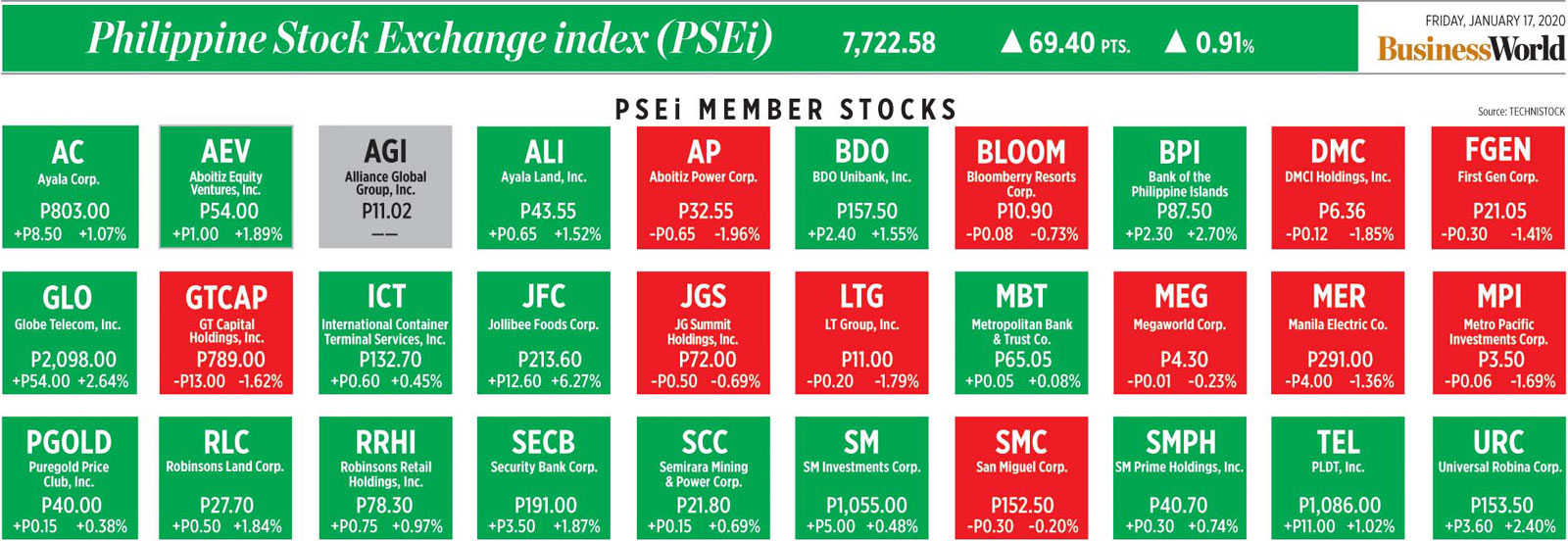
The benchmark Philippine Stock Exchange index (PSEi) climbed 69.40 points or 0.90% to close at 7,722.58 on Friday. However, the main index fell 54 points or 7% on a weekly basis due to the muted four-day trading.

“Taal Volcano’s unexpected eruption that spewed ashes as far as the metropolis kept investors on tentative note for most of the week, shrugging off the signing of phase one US-China trade accord,” online brokerage 2TradeAsia.com said in a market note.

While average value turnover last week improved 25% to P7 billion, net foreign selling also expanded to P1.4 billion from P1.2 billion in the week prior.

“[T]he main index could not seem to catch a break ending lower, marking its second consecutive week of losses. However, it was able to close the week above the 7,700 key support level after breaking below it several time throughout the week,” AAA Southeast Equities, Inc. Research Head Christopher John Mangun noted.

Heading into the new week, Mr. Mangun said investors are likely to stay silent amid the fading of their “new year’s optimism” and the continuous threat of a bigger natural calamity in Taal.

“The new year’s optimism that most investors had is slowly vanishing as the market continues to move sideways. Coupled with the threat of a major disaster, as the Taal volcano rumbles, investors have turned cautious again as no one wants to be holding the bag if things get worse,” he said.

But Mr. Mangun said investor interest may improve because of the release of the fourth-quarter GDP report by the Philippine Statistics Authority.

“This will prove if the government’s fiscal policy in the last twelve months has effectively spurred economic growth,” he said.

The Philippine Statistics Authority will report official fourth quarter and 2019 GDP data on Jan. 23.

AAA Southeast Equities is expecting GDP growth in the fourth quarter of 2019 to have come in at 6.5% at least.

For 2TradeAsia.com, this week’s trading will still largely take cues from the Taal volcano events. “In an extreme explosion scenario, it is…worth to note fiscal pump-priming follows next,” it said.

It also said the market may still enjoy some positive investor sentiment from the signing of the US-China phase one deal last week, which it noted should be seen as a “work-in-progress.”

“The list of attractive companies have already expanded, and it only takes a matter of time before these take notice. Position gradually on dips and hold. Immediate support is 7,600 resistance, 7,850-7,950,” 2TradeAsia.com said.

How PSEi member stocks performed — January 17, 2020

Here’s a quick glance at how PSEi stocks fared on Friday, January 17, 2020.


NEDA TWG studying road congestion pricing

THE government is evaluating at technical working group (TWG) level a proposal for a peak hours congestion pricing system in key parts of Metro Manila, a Transportation department official said.

The Department of Transportation (DoTr) said it submitted its proposal to impose congestion charges in Metro Manila’s business districts.

“It was submitted to NEDA (the National Economic Development Authority) for their initial evaluation, and it is with a NEDA technical working group. We are doing this in partnership with the Singapore government,” Transportation Undersecretary Mark Richmund M. de Leon told in BusinessWorld in an interview on Jan. 7.

He said the government of Singapore is providing both the concept and the technology to implement the congestion-pricing scheme.

Kung ma-approve na ’yun sa NEDA, tuloy-tuloy na ’yung proyekto (Once NEDA approves it, the project will go ahead),” he said, referring to the proposal which was submitted to the agency in “November or December.”

He said the proposal covers congestion charges in business districts during peak hours.

“The objective of the proposal is to remove the congestion in central business areas (CBAs), so you pay. If you want to use your car during peak hours, you pay a certain amount,” Mr. De leon said.

He noted that there is an oversupply of cars on Metro Manila’s roads. “Regardless of how good our bus system is, there’s terrible traffic along EDSA, vehicles are not moving, so what we need is to reduce cars,” he added.

According to the Chamber of Automotive Manufacturers of the Philippines, Inc. (CAMPI) and Truck Manufacturers Association (TMA), auto sales in 2019 totaled 369,941 vehicles, up 3.5%.

Current legislation aimed at discouraging the proliferation of automobiles include a proposed Proof of Parking Space Act, which would bar auto purchases if the buyer does not own a place to park. Car owners without parking sports or garages typically park on the street, hampering traffic flow.

A September study by the Asian Development Bank (ADB) found Metro Manila to be the “most congested” city in developing Asia.

The bank said rapid growth in car ownership and the demand for road capacity that it generates has given rise to congestion in many Philippine cities. — Arjay L. Balinbin

Taal Volcano agricultural damage exceeds P3 billion, led by fisheries

CROP DAMAGE due to Taal’s eruption was estimated at P3.17 billion a week after the volcano started emitting ash, with the fisheries sector accounting for more than half of the total, the Department of Agriculture (DA) said.

In a bulletin issued Saturday night, the DA noted that the ashfall damaged 43,772 metric tons (MT) of agricultural commodities, over 15,790 hectares of land in CALABARZON, which is composed of Cavite, Laguna, Batangas, Rizal, and Quezon.

It also “caused the death of 55,881 head of various farm animals. The large increase in animal deaths was due to the additional reports from validated areas in Batangas and Cavite.”

Fisheries accounted for 50.5% or P1.6 billion equivalent to 6,000 fish cages. Affected municipalities include Talisay, Laurel, Agoncillo, and San Nicolas, Batangas.

The pineapple industry accounted for 16.6% or P527.25 million. This covers 862 hectares and 21,079 MT of pineapple, mainly affecting General Trias, Amadeo, and Silang, Cavite.

Coffee damage was P360.5 million, or 11.4% of the total, over 4,309 hectares, equivalent to 8,240 MT of damaged production. Areas affected include Taal, Agoncillo, Lemery, San Nicolas, Laurel, Balete, and Talisay, all in Batangas; Calamba and Cabuyao in Laguna; and Amadeo and Silang in Cavite.

Damage to the coconut crop was P188 million or 5.9% of the total, affecting 8,700 hectares in Batangas.

Damage to the banana crop was P138.59 million, or 4.4% of the total, over 821 hectares with 7,338 MT of damaged production. Affected areas were San Nicolas, Batangas and Amadeo, General Trias, and Silang, Cavite.

Damage to the fruit and vegetable crop was P124.13 million, or 3.9% of the total, covering 197 hectares and 1,453 MT of production. Areas affected include Tanauan, San Nicolas, Balete, Cuenca, Alitagtag, Taal, Santa Teresita, Calaca, Agoncillo and Laurel in Batangas, and Silang, Amadeo, General Trias, and Magallanes in Cavite.

Corn damage was P88.9 million and livestock P20.1 million. — Vincent Mariel P. Galang

ADVERTISEMENT
ADVERTISEMENT