Home Blog Page 9977

JPMorgan Chase says ‘oui’ to Paris expansion post-Brexit

JPMORGAN Chase & Co. is looking to expand to Paris. — REUTERS

PARIS — JPMorgan Chase & Co. is the latest investment bank to significantly expand its Paris hub as part of plans to relocate some services from London after Britain’s exit from the European Union (EU), snapping up new premises in the French capital.

JPMorgan would have said “No” to a Paris move back in 2016, its French executive told Reuters, but government-led labor law and taxation reforms made it review its stance.

The US bank said it plans to buy a building in central Paris from France’s BNP Paribas to house up to 450 staff in coming years, allowing it to keep operating in the EU once the current unfettered two-way direct access between Britain and the bloc comes to an end in December following a Brexit transition period.

The expansion is expected to make the French capital, where it currently has 260 staff, its second-largest base in Europe behind London, where there are 10,000 staff, JPMorgan said.

It currently has 600 staff in Luxembourg and 450 in Frankfurt.

The bank will initially transfer sales teams, followed by trading staff depending on the timing of Britain’s full withdrawal from the EU, Kyril Courboin, JPMorgan’s CEO of France, told Reuters.

“Paris is going to be the second pole for our market activities in Europe,” he said. “London will still be number one because we are only transferring euro activities.”

He declined to disclose the purchase price of the new building, which is close to JPMorgan’s existing Paris offices on the prestigious Place Vendome.

The move is part of a wider trend of banks shifting selected activities to euro-zone cities ahead of Brexit, without calling into question London’s dominance as Europe’s premier financial center.

MORE TO FOLLOW?
Large international banks and investors could relocate around 4,000 jobs to Paris, the French financial lobby Paris Europlace said, citing data from “Choose Paris Region,” which helps international companies set up business in Paris.

“In addition to the new announcements made by American banks…Asian investors, from Hong Kong and Singapore…confirm their wish to strengthen their activities in Europe, in particular in Paris,” Arnaud de Bresson, chief executive of Paris Europlace, told Reuters.

Wells Fargo, which currently has three job openings in Paris, said in October it had chosen the city as its European hub for post-Brexit trading activities. Bank of America also plans to move more than 400 jobs into a new office in central Paris.

An Elysee official said JPMorgan was one of several large banks who have been considering a move to Paris, without naming others, leaving open the possibility that more jobs will be relocated to the “city of lights.”

The building purchase by JPMorgan was announced on Sunday as part of the “Choose France” drive, an annual investment event created by President Emmanuel Macron to draw business leaders to France en route to the World Economic Forum in Davos each January. — Reuters

Art & Culture (01/22/20)

2 exhibits at Silverlens

SILVERLENS has opened two exhibits to start the year: Eric Zamuco’s Cosmic Grounds and Syaiful Garibaldi’s Sudor. Cosmic Grounds takes off from the objects the artist stumbled upon during his routes around his neighborhood and family province. In the two years since his last exhibit, the artist has slowly built a personal archive of items found while he was in transit — a broken vase, a headless heron, a termite-eaten pillar, and roofing shingles, among others. While not initially drawn to the material himself, Zamuco’s fascination with the objects came from their discarded and shattered state. For Sudor, Garibaldi introduces a new body of work that looks at the corporeal from the perspective of human perspiration under different environmental conditions. Under high magnification, the skin’s surface appears like mysterious, extraterrestrial landscapes, with emergent bodies of water that ebb and flow. The two exhibits are on view until Feb. 15 at Silverlens, 2263 Don Chino Roces Ave. Ext., Makati City. For inquiries, contact info@silverlensgalleries.com or call 8816-0044.

Francisco at Robinsons

IN CELEBRATION of National Arts Month, Robinsons Land Corp. will hold two major events: the formal launch of ARTablado (art + entablado) and the one-man exhibit of Angono’s Carlo “Totong” Francisco II, from Feb. 1 to 15 in Robinsons Galleria. Regular patrons of Robinsons Galleria will be able to view not only paintings in the new space, ARTablado, but other forms of art, be it sculptures, the spoken word and others. In February, ARTablado presents Revival, Mr. Francisco’s one-man exhibit. The artist, who hails from Angono, Rizal, is the grandson of the renowned muralist and National Artist, Carlos “Botong” Francisco. What differentiates him from his grandfather is his style, having been deeply influenced by Abstract Expressionism. This is first solo exhibit since 2011. As part of Revival, for the first time, some of the most cherished art pieces of Botong Francisco, such as framed sketches, will be displayed in Robinsons Galleria. Revival will run from Feb. 1 to 15 at the Level 3, Veranda of Robinsons Galleria.

Aussie printmaker in Manila

CHILD’S PLAY, one of the most popular works of Australian master printmaker, curator, and educator Michael Kempson was recently gifted by the artist to the De La Salle-College of Saint Benilde. The collection, a 17-piece set of etching and aquatint prints that tackle the geopolitical issues of the 21st Century, features adorable animals as commercialized national symbol of different countries. Child’s Play was initially installed as part of the By Hand: Rediscovering the Art of Printmaking travelling exhibit by Benilde Center for Campus Art in 2018 before finding its home at the newly renovated office of the School of Diplomacy and Governance of the College. Kempson is currently a Senior Lecturer and Convenor of Printmaking Studies at the University of New South Wales Art & Design in Sydney, Australia and a visiting Professor at the Xi’an Academy of Fine Art in Xian, China. He was the International Member-at-Large for the US-based Southern Graphics Council International from 2014 to 2016. His works have been showcased in 26 solo exhibits and has participated in over 200 group exhibitions around the world.

Full cast of The Band’s Visit

ATLANTIS Theatrical Entertainment Group has announced that musical theater performers Jep Go, Dean Rosen, Steven Conde, Rhenwyn Gabalonzo, and Leanne Mamonong complete the cast of the Tony and Grammy Award-winning musical The Band’s Visit which opens in March at the Carlos P. Romulo Auditorium, RCBC Plaza, Makati. They join previously announced cast members Menchu Lauchengco-Yulo, Rody Vera, Mark Bautista, Nino Alejandro, Reb Atadero, Bibo Reyes, Jill Peña, Maronne Cruz, and Floyd Tena. The Band’s Visit opened on Broadway in 2018 and went on to win 10 Tony Awards including Best Musical. Based on the acclaimed film, The Band’s Visit tells the story of an Egyptian Police Band that arrives in Israel to play a concert. After a mix-up at the border, they are sent to a remote village in the middle of the desert. With no bus until morning and no hotel in sight, these unlikely travellers are taken in by the locals and their lives become intertwined in the most unexpected ways. It features music and lyrics by David Yazbek and a book by Itamar Moses, and will mark its International Premiere in Manila. It runs from March 13 to 29 at the Carlos P. Romulo Auditorium, RCBC Plaza, Makati City. Tickets are now available at www.ticketworld.com.ph.

SMC waives toll fees at SLEx for relief operations

VIEW of a portion of South Luzon Expressway (SLEx) at Bilibid area, Muntinlupa City as of April 2014. — WIKIPEDIA.ORG

SAN MIGUEL Corp. (SMC) said no fees would be collected at the South Luzon Expressway (SLEx) and Southern Tagalog Arterial Road (STAR) for vehicles involved in relief operations in areas affected by the Taal Volcano eruption.

In a statement e-mailed to reporters on Tuesday, SMC said it has “waived” toll fees at the two toll gates it operates “for both government and private vehicles involved in ongoing relief efforts, following the eruption of Taal Volcano.”

SMC also announced last week that it would not collect toll fees from “southbound government vehicles” that carry volunteers, equipment, and relief supplies.

“Private vehicles being used to deliver relief goods were also allowed to pass for free, with proper advance coordination with tollway management,” it added.

Vehicles that carry relief goods can now pass through the toll gates for free without the need for advance coordination with the SMC tollway management.

SMC said they can stop at the following sites for inspection: SLEX Southbound (Petron Silangan/KM 44, Mayapa Entry, Batino Entry, Calamba/Real Entry); STAR Southbound location (Sto. Tomas Entry); and all STAR Northbound entry locations (Batangas, Ibaan, Lipa, Toribio, Malvar, and Tanauan).

SMC President Ramon S. Ang said: “This is part of our wide-ranging efforts across the San Miguel Group to help our countrymen, through our own relief operations, and by supporting and enabling others who also want to help.”

“Yet again, we are seeing the best of Filipinos—helping and lifting each other up in times of great need,” Mr. Ang added.

Renato U. Solidum, Jr., director of the local volcanology agency, has warned of a sudden explosive eruption as gas continued to build up beneath Taal Volcano.

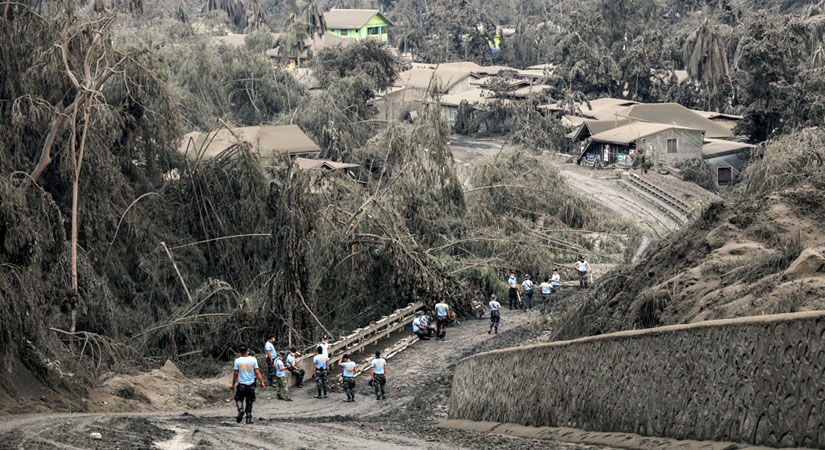
Taal Volcano in Batangas province forced thousands of residents to flee after it emitted a thick ash column on Jan. 12.

The ashfall covered cities near the capital, forcing financial markets to suspend trading and the Manila airport to close.

About 50,000 families in Batangas, Quezon, Laguna and Cavite had been affected by the eruption as of 6 a.m. of Monday, according to the local disaster agency’s report. — Arjay L. Balinbin

Chinese regulator tightens overseas derivative trading rules for state-owned firms

SHANGHAI/SINGAPORE — China’s state asset regulator on Monday urged central government-owned companies to better manage risks in overseas derivative trading as it increases regulatory oversight to prevent future trading losses.

The State-owned Asset Supervision and Administration Commission (SASAC) said as of now Beijing-controlled state companies can only use financial and commodities derivatives to hedge risks, and any form of speculative activities are banned.

On its website, SASAC said firms must set up an effective risk-management system, and report derivative trading activities to the regulator on a regular basis.

SASAC said it is strengthening its rules after finding unidentified cases of mismanagement regarding overseas derivative trading, such as “irregular procedure of trade executions, incentive-motivated speculation, and delay and inaccurate reporting (of trading positions).”

“Companies’ derivative businesses have undergone new trends and new changes in recent years, the current regulatory mechanism may be outdated to meet the real demands,” the regulator said.

The new rules come a year after state refiner Sinopec Corp. lost nearly $700 million in late 2018 in one of China’s largest derivatives trading losses in nearly a decade.

Sinopec has so far provided no further details beyond suspending two senior officials and blaming “inappropriate trading strategies” in crude oil hedging. It didn’t immediately respond to requests for comment on the new SASAC rules.

Under the new rules, SASAC caps hedging volumes at 90% of companies’ annual turnover of physical transactions and production. Hedging activities for trading purposes should not exceed 80% of the physical volumes under the new regulations.

A Beijing-based official at one state company, who declined to be named as he’s not authorized to speak to the media, welcomed the change.

“The new rules reflect an improvement by removing previous archaic regulations (in 2009) which set rigid, text-book style restrictions in hedging volumes and products that are in reality hard to achieve,” he said.

SASAC also called on companies to set up an internal risk management system comprising three layers: the company’s board of directors, the designated business subsidiary and the team that carries out the actual trades. — Reuters

How PSEi member stocks performed — January 21, 2020

Here’s a quick glance at how PSEi stocks fared on Tuesday, January 21, 2020.


Stocks extend decline on Ayala group’s woes

By Denise A. Valdez, Reporter

THE MAIN INDEX continued its decline on Tuesday due to regulatory risks that are hounding the Ayala group.

The benchmark Philippine Stock Exchange index (PSEi) gave up 85.95 points or 1.13% to close at 7,466.65 yesterday, while the broader all shares index lost 39.56 points or 0.88% to 4,434.71.

“The market breached the 7,500 level despite foreigners becoming net sellers today, mainly due to index heavyweights AC (Ayala Corp.) and ALI (Ayala Land, Inc.) dragging the market with them as investors continued their selloffs because of President Duterte’s tirades against them over the weekend,” Timson Securities, Inc. Trader Darren T. Pangan said in a text message on Tuesday.

ALI and AC were two of the most actively traded stocks on Tuesday, with shares in each losing 2.47% and 4.67% at the close of the market, respectively.

This follows the government’s threat of probing the contract between ALI and the University of the Philippines for UP-Ayala Land Technohub in Quezon City due to alleged underpayment.

ALI said it is open to any review of the partnership, but it claims it is paying UP P171 per square meter per month, contrary to the statement of Presidential Spokesperson Salvador S. Panelo that the company is paying less than P20 per square meter.

Another factor that affected the market’s decline was Moody’s lowering of its ratings for Hong Kong to AA3 from AA2 amid concerns of political unrest due to continuous protests in the region.

“Philippine shares became collateral damage from Moody’s downgrading HK rating to AA3 from AA2 but changed outlook to ‘stable’ from ‘negative,’ citing the absence of tangible plans to address the concerns of the people,” Regina Capital Development Corp. Head of Sales Luis A. Limlingan said in a mobile message.

Other Asian markets also closed lower yesterday: Japan’s Nikkei 225 and Topix indices fell 0.91% and 0.53%, respectively, Hong Kong’s Hang Seng index collapsed 2.81%, China’s Shanghai SE Composite index slumped 1.41% and South Korea’s Kospi index shed 1.01%.

Back home, all sectoral indices remained losers, led by financials which dropped 28.55 points or 1.56% to 1,797.19. Holding firms declined 96.14 points or 1.31% to 7,214.76; services fell 14.22 points or 0.91% to 1,539.56; property reduced 25.68 points or 0.66% to 3,853.61; industrials erased 52.61 points or 0.56% to 9,313.72; and mining and oil decreased 15.51 points or 0.19% to 8,029.73.

Some 741.11 million issues valued at P7.76 billion switched hands yesterday from the 913.66 million issues worth P6.28 billion seen on Monday.

Decliners reached 132, outpacing advancers which stood at 67, while 38 names ended unchanged.

Foreigners turned bullish to record net purchases of P422.45 million, a turnaround from Monday’s net foreign selling of P512.9 million.

Peso drops ahead of GDP

peso dollar
THE PESO weakened further ahead of key local data. — BW FILE PHOTO

THE PESO continued to weaken on Tuesday due to uncertainties from regulatory risks and as the market awaits data on the country’s economic growth in the fourth quarter.

The local unit ended trading at P51.015 against the greenback, weakening by four centavos from its Monday finish of P50.975 per dollar.

The peso opened at its Monday close of P50.975 versus the dollar. Its weakest showing for the day was at P51.10, while its intraday best was at P50.975 against the greenback.

Dollars traded slipped to $1.35 billion from $1.559 billion on Monday.

A trader attributed the peso’s weakness to “cautious” trading before the gross domestic product (GDP) growth report this week.

“The peso depreciated above the P51 level as market participants remained cautious ahead of the Philippine GDP (gross domestic product) growth report this Thursday,” the trader said in an e-mail.

The Philippine Statistics Authority is set to report the fourth quarter and full-year 2019 GDP growth data on Jan. 23.

Economic growth quickened to 6.2% in the third quarter after logging a pace of 5.6% and 5.5% in the first and second quarters, respectively. This brought average growth for the first nine months to 5.8%.

The government targets at least a six percent GDP growth for 2019. Socioeconomic Planning Secretary Ernesto M. Pernia last week said GDP growth for the last quarter of 2019 might have ended around 6.6-6.7%.

Meanwhile, Rizal Commercial Banking Corp. Chief Economist Michael L. Ricafort said the peso depreciated alongside the decline in the local stock market due to some regulatory risks.

“The peso exchange rate closed the weakest in more than three weeks and in nearly three months after the recent regulatory risks,” he said in a text message.

“Peso [is] also weaker amid the latest decline in the local stock market, to new one-year lows for the PSEi (Philippine Stock Exchange index) still partly due to the regulatory uncertainties,” he added.

Ayala Land, Inc (ALI). and Ayala Corp. were two of the most actively traded stocks on Tuesday, with shares in each losing 2.47% and 4.67% at the close of the market, respectively.

This follows the government’s threat of probing the contract between ALI and the University of the Philippines for UP-Ayala Land Technohub in Quezon City due to alleged underpayment.

For today, the trader sees the peso playing around P50.90 to P51.10 while Mr. Ricafort gave a forecast range of P50.80 to P51.10. — L.W.T. Noble with Reuters

House may go over and above P30-B calamity budget request

REUTERS

THE HOUSE of Representatives said it will assign the “highest priority” to President Rodrigo R. Duterte’s request to fast-track approval of a P30-billion supplemental budget for communities affected by the Taal Volcano eruption, and signalled a willingness to provide even more.

“Under the leadership of Speaker Alan Peter Cayetano, we assure that the House of Representatives would give the highest priority to the request of President Duterte for Congress to fast-track the approval of a P30-billion supplemental budget for areas affected by the Taal Volcano eruption” House Majority Leader Ferdinand Martin G. Romualdez said in a statement Tuesday.

Mr. Romualdez also said that the House leadership is willing to increase the budget up to P50 billion “for the sake of our kababayans (countrymen) there.”

“The House is committed to show malasakit (compassion) and provide families displaced by the explosion of Taal Volcano long-term and permanent solutions to their woes. We are going to coordinate with the Palace to get the full details of the supplemental budget” Mr. Romualdez said.

Speaker Alan Peter S. Cayetano said that the chamber will work with the Department of Budget and Management (DBM) to pass the proposed supplemental budget and ensure “effective and responsive” execution of the relief program.

On Monday, President Rodrigo R. Duterte called on Congress to pass a P30-billion supplemental fund for the rehabilitation of communities affected by the Taal Volcano eruption and to build evacuation centers in high-risk areas. — Genshen L. Espedido

Senate studying how to fund supplemental budget for Taal aid

THE SENATE is verifying possible funding sources for the P30-billion supplemental budget after President Rodrigo R. Duterte sought to expedite emergency aid for local government units (LGUs) affected by the Taal eruption.

“We will have to find out how much is readily available in calamity funds of the national government, (the National Disaster Risk Reduction and Management Fund) and the (Local Disaster Risk Reduction and Management Fund),” Senator Panfilo M. Lacson, Finance Committee Vice Chairman, said in a statement Tuesday.

Mr. Duterte on Monday asked the 18th Congress to pass a supplemental budget to fund government efforts to provide relief from Taal.

Mr. Duterte also directed Congress to pass a measure for the construction of permanent evacuation centers in disaster-prone areas.

Mr. Lacson cited the Philippine Disaster Risk Reduction and Management Act of 2010, Republic Act No. 10121, which requires LGUs to allocate at least 5% of their income to the LDRRMF (Local Disaster Risk Reduction and Management Fund).

“Counting five years backwards from January 2020 when Taal erupted, as RA 10121 mandates that unexpended LDRRMF shall accrue to a special trust fund solely for the purpose of supporting disaster risk reduction and management activities of the LDRRMCs within the next five years, I can imagine they still have sufficient funds,” he added.

Senator Risa N. Hontiveros-Baraquel proposed that the supplemental budget earmark P30,000 worth of cash assistance to each family that sustained damage to their homes.

She said beneficiaries may be classified by the damage obtained by their houses, or as may be recommended by the rehabilitation plan the government is drafting. — Charmaine A. Tadalan

Over 214,000 Metro Manilans emerge from poverty in 2018

By Lourdes O. Pilar, Researcher

MORE THAN 200,000 Filipinos in Metro Manila made it past the poverty threshold in 2018, according to new data derived from poverty incidence estimates by the Philippine Statistics Authority (PSA).

In a news conference, the PSA’s National Capital Region (NCR) office announced further findings from the government’s poverty survey released in December, showing that around 214,200 Metro Manila residents exited the category of people classified as poor, as estimated from the decline in the poverty incidence rate to 2.3% from 4.1% in 2015.

Poverty incidence measures the proportion of those whose incomes fall below the poverty threshold.

The incidence rates suggest that in 2018, around 308,600 Filipinos in Metro Manila did not earn enough to buy basic needs, compared to 522,800 Filipinos in 2015.

Poverty incidence among Filipino families, or the proportion of those whose incomes fell below the poverty threshold, fell to 1.5% from 2.8% three years earlier. In 2018, this corresponded to around 48,400 Filipino families that remained poor, from 86,100 previously.

The subsistence incidence — or the proportion of those whose incomes fell below the monthly food threshold — fell to 0.4% in 2018 from 0.7% in 2015.

The subsistence incidence among families — or the proportion of those in extreme poverty — fell to 0.2% from 0.4%.

The food threshold is defined as the minimum income required to meet basic food needs and satisfy the nutritional requirements “for economically necessary and socially desirable physical activities.”

The poverty threshold is defined as the minimum income needed to meet basic food and non-food requirements.

The poverty threshold for a family of five in 2018 was P11,951 per month in Metro Manila, as compared to P10,495 per month in 2015.

Meanwhile, the monthly food threshold per family was P8,345 against P7,329 in 2015.

In an e-mail, UnionBank of the Philippines, Inc. Chief Economist Ruben Carlo O. Asuncion said economic growth was the “number one reason” for the decline in Metro Manila’s poverty incidence.

“Increasing incomes and more job opportunities have contributed to this decline in poverty incidence,” he said.

Mr. Asuncion noted that further poverty reduction in Metro Manila can be achieved if economic growth can average “higher than 6% or even 7% by 2021.”

“However, this should also be approached with caution regarding the quality of poverty reduction. Economic growth should be shared by as many as possible,” he said.

In a separate e-mail, Security Bank Corp. Chief Economist Robert Dan J. Roces cited “higher wage and salary incomes” due to better employment opportunities as the top contributor in reducing the NCR’s poverty incidence, as well as the “initial effects of tax reforms” that may have led to an increase in take-home pay.

Mr. Roces however noted that Metro Manila exhibits low growth elasticity in poverty reduction — meaning that the percentage reduction in poverty rates associated with changes in mean income do not closely align — with the region still suffering from “systemic difficulties” in alleviating poverty.

“[T]he poor and those in the threshold will be the first to suffer during high inflation periods, for instance… and absent financial inclusion and financial literacy, plus lack of social safety nets, income inequality might remain and the level of the poverty threshold will be a concern,” Mr. Roces said.

DA provides P2.7M worth of aid to farmers in 3 Batangas towns

THE government has awarded an initial P2.708 million worth of assistance to farmers and fisherfolk in Batangas affected by the Taal ashfall.

“President (Rodrigo R.) Duterte and Agriculture Secretary William (D.) Dar awarded an initial P2.708 million worth of assistance including crop insurance, livelihood, seed and seedlings, and farm machinery, among other donations to the affected farmers and fisherfolk of Talisay, Tanauan, and Sto. Tomas,” the Department of Agriculture (DA) said in a statement Tuesday.

Some P160 million worth of assistance was also given elsewhere in Batangas, including Agoncillo, San Nicolas, Lemery, Laurel, Lipa City, San Jose, Nasugbu, Mataas Na Kahoy, Balete, Cuenca, Alitagtag, Padre Garcia, Malvar, and Taal.

The government is planning to put together a P30-billion package to respond to the damage caused by the Taal Volcano eruption.

The DA has said it will set aside P357 million from its Quick Response Fund for rehabilitation and recovery programs. The DA Field Office in Region IV-A also provided P22 million worth of assistance like equipment, seed, planting materials, and fingerlings.

Assistance amounting to P1.9 million was given by the Philippine Coconut Authority to affected coconut farmers, including seedlings and fertilizer. The Bureau of Plant Industry will also distribute coffee, cacao, mango, lanzones, rambutan, jackfruit, corn, squash, and cowpea seedlings.

The Agricultural Credit Policy Council will also provide P10 million for the use of the DA Taal Livestock Care Emergency Operations Center “to pay owners who wish to pawn their animals at 50% of their market value.”

Damage to agriculture due to the eruption and ashfall has been estimated at P3.33 billion, with the fisheries sector accounting for the about 50%. The damage counts 16,150 hectares of farmland, and caused the death of 55,881 farm animals. — Vincent Mariel P. Galang

Cold storage inspections authorized to control ASF

THE Department of Agriculture (DA) has instructed quarantine officers to inspect non-accredited cold storage warehouses and container vans to prevent the entry of African Swine Fever (ASF)-infected pork products.

“All Veterinary Quarantine Officer and Inspectors are hereby authorized to inspect all NMIS (National Meat Inspection Service) non-accredited private cold storage warehouses and container vans or any items that are possible carriers of the African Swine Fever virus at the ports of entry (1st border) and cold storage warehouses (2nd border),” the DA said in Memorandum Order No. 3, series of 2020.

The measure supports the National Zoning Plan authorized by Administrative Order No. 12, series of 2019, which sets guidelines for the movement of pork and pork products across the country, and Food and Drug Administration (FDA) Order No. 2019-183, which also authorizes designated officers from the NMIS and the Bureau of Animal Industry (BAI) to inspect all imported pork and pork products.

This order is in effect until Dec. 4, 2020, unless the FDA revokes the order earlier.

In October, branded and unbranded pork products were confiscated at Calapan Port in Oriental Mindoro, which tested positive for ASF. It was later confirmed that branded processed pork products were made by Pampanga-based Mekeni Food Corp.

Two cargo containers from China were also apprehended in the Port of Manila in the same month. These were declared to be containing tomato paste and vermicelli, but were later discovered to be containing meat products like dimsum, dumplings, and minced vegetables with meat.

The government has banned the entry of pork and pork products from countries suffering from ASF outbreaks, like China, Belgium, Bulgaria, Cambodia, Hungary, Laos, Moldova, Poland, South Africa, and Indonesia.

The BAI estimates the number of culled pigs at 147,334 as of Dec. 15, of which 18% or 26,077 head were confirmed to be infected by the virus. — Vincent Mariel P. Galang

ADVERTISEMENT
ADVERTISEMENT