Home Blog Page 9974

Women’s group helps revive Samal coral areas with Reefbuds

BATTERED CORAL areas in the island city of Samal are getting help for revival through a technology called Reefbuds being deployed by a women’s organization. The Innerwheel Club of Parañaque, headed by Ann Margaret San Antonio who is also the national secretary of the Innerwheel Clubs of the Philippines Inc., started with an initial 13 Reefbuds planted over the weekend in the waters off Barangay Balet, one of the dive sites in Samal. Ms. San Antonio said they have committed 100 of the artificial reefs in the area, which they aim to complete by June. This is our first program the 100 Reefbuds in the specific location in Balet infront of big Ligid Island,” she said in an interview. “The basic idea with this… when you drop it in the water since it is porous, it quickly absorbs water. Kaya yung mga (That’s why the) rooting plants grow fast,” said Benjamin Tayag Jr., who patented the Reefbuds based on a concept by an Austrian geoscientist, the late Dr. Harald Kremnitz. He explained that once the Reefbuds are deployed, the natural marine ecosystem will generate itself faster. Ms. San Antonio said the project is expected to benefit the fishing community of Balet, an adopted village of the Innerwheel Parañaque since 2013. Aside from improved catch, the men of the village have also been tapped to produce the Reefbuds. To ensure the project’s sustainability, the group will monitor the deployed Reefbuds through geotagging. “We put a geotag on each of the Reefbuds and put a nameplate of each company that sponsored,” Ms. San Antonio said. — Maya M. Padillo

Duterte satisfaction rating hits record

PRESIDENT Rodrigo R. Duterte’s satisfaction rating hit a record +72 in the past quarter, according to the latest Social Weather Stations (SWS) poll.

SWS said 82% of Filipinos were satisfied with the President’s performance, while 10% were dissatisfied.

His “excellent” net rating was better than his “very good” +65 score in September and his previous “very good” record of +68 a quarter before that.

The SWS poll found that 52% of Filipinos thought Mr. Duterte would fulfill his campaign promises before his term ends in 2022.

Among his promises was ending the illegal drug menace through his deadly war on drugs that has killed thousands.

Mr. Duterte also promised to end job contractualization, for which Congress passed a bill that he vetoed last year.

SWS also said 72% of Filipinos worry about his health, which has been the subject of speculations.

The polling firm interviewed 1,200 adults in December for the poll, which had an error margin of ±3 points. — Gillian M. Cortez

Nationwide round-up

Foreign secretary firm on ‘eye for an eye’ resolution in Kuwait worker’s murder

FOREIGN AFFAIRS SECRETARY TEODORO L. LOCSIN, JR. — PHILSTAR

FOREIGN AFFAIRS Secretary Teodoro L. Locsin, Jr. has reiterated his position of an “eye for an eye” approach in the murder of Filipino overseas worker Jeanelyn Villavende, even as the Philippines and the Kuwaiti government have began meeting to settle issues. “I am interested first and foremost in an eye for an eye, two lives for the life they took. I won’t settle for less. The rest is a sideshow,” Mr. Locsin said in a social media post late Tuesday. “I will not trade that poor woman’s torment for some… concession on labor rights.” The Philippine Embassy in Kuwait reported upon meeting with the Kuwaiti government on Jan. 19 that the latter has agreed to allow the Philippines to investigate Ms. Villavende’s murder. “To show Kuwait’s commitment in the case, Deputy Foreign Minister (Khaled) Al-Jarallah said that his government is willing to allow investigators from the Philippines to join the investigation in Kuwait,” the embassy said in a statement on Tuesday. The embassy also said the Kuwaiti government is expected to release the full reports of the police investigation and autopsy “soon.” The Joint Committee Meeting on the 2018 Philippines-Kuwait Agreement on the Employment of Domestic Workers is also set to convene. President Rodrigo R. Duterte last week approved the total deployment ban on OFWs to Kuwait, covering both household workers and skilled workers. The ban was recommended by Labor Secretary Silvestre H. Bello III and the Philippine Overseas Employment Administration after the re-autopsy report, conducted by the Philippine’s National Bureau of Investigation, showed Ms. Villavende was physically and sexually abused. The government had previously declared a deployment ban to Kuwait in 2018, which lasted four months, over the murder of domestic helper Joanna Demafelis. In May 2019, It sought to review its memorandum of agreement with the Kuwaiti government after the killing of another Filipina, Constancia Dayag. — Charmaine A. Tadalan

P2B budget eyed for judicial marshal service

THE SENATE committee on Justice and Human Rights is eyeing a P2-billion budget allocation for the creation of the Philippine Judicial Marshal Service. Senator Richard J. Gordon, who chairs the panel, is pushing the measure that will strengthen the security of judges in the country and avoid compromising their service. “Ang legislative (budget) malaki, ang Presidente, lalong malaki. Bakit hindi natin pu-proteksyunan ang judges (The legislative budget is big, the President’s even higher. Why wouldn’t we protect our judges)?” he said in a briefing, noting the judiciary is a “co-equal branch of the government.” He added that he is ready to recommend as much as P5 billion, should a higher amount be required to cover 2,700 judges in the country. In the last 10 years, 31 judges have been killed, of which six of cases were dismissed, while some are still pending. The proposed judicial marshals will provide security as well as gather intelligence on possible threats to judges. Mr. Gordon said the committee will be holding one final hearing to finalize the measure, before it sponsors the bill for plenary consideration. — Charmaine A. Tadalan

Nation at a Glance — (01/23/20)

News stories from across the nation. Visit www.bworldonline.com (section: The Nation) to read more national and regional news from the Philippines.

Nation at a Glance — (01/23/20)

No to ERP

ERP or Electronic Road Pricing is a mechanism presently used in a number of countries that charge motorists a certain amount for passing a particular road at a particular hour. It is similar to a toll fee, but pricing is determined primarily by “congestion” and time of use. The fee is higher when one chooses to pass a main road at “peak” hours.

For example, in the case of EDSA, with an ERP system, each motorist passing this main highway will be made to pay a fee or charge of, say, P50 if they go through in the hours of 6-9 a.m., and 5-9 p.m. Outside these hours, there won’t be any charges. This is to encourage motorists to seek alternate routes during peak hours, to decongest EDSA. Simply put, ERP is usage-based taxation. Motorists will be taxed for using a particular road at a particular time. This “usage” tax may be likened to the consumption tax or excise tax that Filipinos currently pay for buying or using oil or fuel, automobiles, jewelry, cigarettes and other tobacco products, and beer and other alcoholic drinks.

One argument against ERP is that other than having already paid income taxes to help pay for building more public roads, the government will also charge people for using that road. This is an addition to the various “taxes” or fees people already pay for buying and using cars, like the excise tax on cars as well as the road user’s tax or motor vehicle user’s charge.

In the case of Singapore, where ERP has been in place since 1998, the system is said to have helped manage vehicular traffic in the city state — although various studies available to the public indicate mixed results. In my opinion, however, if the system does not work, then the Singapore government would not have kept it in place for over 20 years now.

I first saw the ERP at work in its early years, during an observation tour hosted by the Singapore government. Back then, I recall having written about the positive attributes system for this paper. But now that there is talk that something similar to ERP may be introduced here, particularly on EDSA, I cannot help but think that local enthusiasm for ERP may be misplaced.

I believe that the ERP works for Singapore for a number of reasons. One, Singapore is good at planning and implementing. Two, they have reliable government systems. Three, their people are accustomed to conforming with government regulations. Four, they effectively fight government corruption. And five, they have reliable, efficient, and comfortable public transportation.

These, I believe, are important factors that helped make the ERP a “success” in Singapore. However, I believe these factors or necessary elements are not present here. For instance, there is much left to be desired as far as our public transportation system is concerned. If only efficient and comfortable light rail and rapid bus transits were available here, people would surely opt to leave their cars at home, and effectively decongest our roads.

The Singapore ERP is now fully automated, using computer algorithms that take into account a number of factors in determining the price of passage at particular hours. It reportedly uses historical traffic data and real-time feeds with flow conditions from several sources to predict the levels of congestion up to an hour in advance. They determine road pricing by estimating prevailing and emerging traffic conditions. The ERP system is also integrated with all other traffic systems that are in place.

Vehicles have RFID units similar to those now in use in our tollways to automatically debit road charges from motorists as they pass certain roads. In short, without these RFID modules, one cannot go through roads where ERP is in effect. Pricing is variable, and changes depending on traffic volume and flow.

Singapore implemented a comprehensive effort, with ERP as just one of the tools, to better manage vehicular traffic on the city-island-state. Other than ERP, which “taxes” roads use, Singapore also reduced vehicle ownership taxes; automated the ERP system and adjusted ERP rates depending on vehicle speed; set equitable road use prices that take into account vehicle size (bigger vehicles pay more); and, most important, continue to make improvements in public transportation.

Locally, for policymakers who are now contemplating the use of the ERP system for EDSA and other main roads in Metro Manila, what are the other elements of their comprehensive traffic masterplan? Are they looking into ERP as just a one-off effort, or will it be part of a bigger plan to fully automate and link all existing traffic systems and introduce other reforms in taxes and registration? What further improvements will be done in the public transportation system?

Already, we have our hands full grappling with issues involving motorcycle taxis. Previously, it was an issue over transport networks Uber and Grab. Our bus system is still problematic, and even our taxis leave much to be desired. We are still in a quagmire with jeepneys and tricycles, and our light rail transit is still not 100% efficient and reliable.

By taxing road use through ERP, without complementing initiatives to encourage mass transit use and to implement a comprehensive traffic masterplan, then the ERP will just be an additional burden for private motorists and public transportation operators (for they will not be exempted). Yes, the government can expect to collect fees in the billions of pesos. But other than additional government revenues, the ERP will not achieve any of the intended results with respect to congestion.

At the onset, perhaps it can make a difference. However, once people get used to the system, then its benefits will dwindle. Then people can expect periodic increases in road pricing. Remember how cigarettes taxes have to be increased periodically to sustain its impact on cigarette consumption? Expect the same from a local ERP initiative.

Moreover, ERP might simply displace or distribute the problem rather than solve it. In the case of EDSA, with ERP in place, motorists may opt for alternative routes which will just congest roads other than EDSA. So, while EDSA traffic moves faster, the rest of the metropolis is gridlocked. Ultimately, that gridlock will also spill over to EDSA since there is just nowhere else to go.

The government cannot keep building more roads. Land is a finite resource, and we can allocate only so much land or real estate for public works or road use. Motor vehicle ownership will also continue to increase over time. Road pricing is only as effective as other measures that are implemented along with it to tackle this complex problem. Efficient, comfortable, affordable, and cost-effective mass transit still remains to be the most viable solution to the problem of congestion. Without it, road pricing cannot be effectively and equitable implemented.


Marvin Tort is a former managing editor of BusinessWorld, and a former chairman of the Philippines Press Council.

matort@yahoo.com

Coal, gas, renewables, and growth

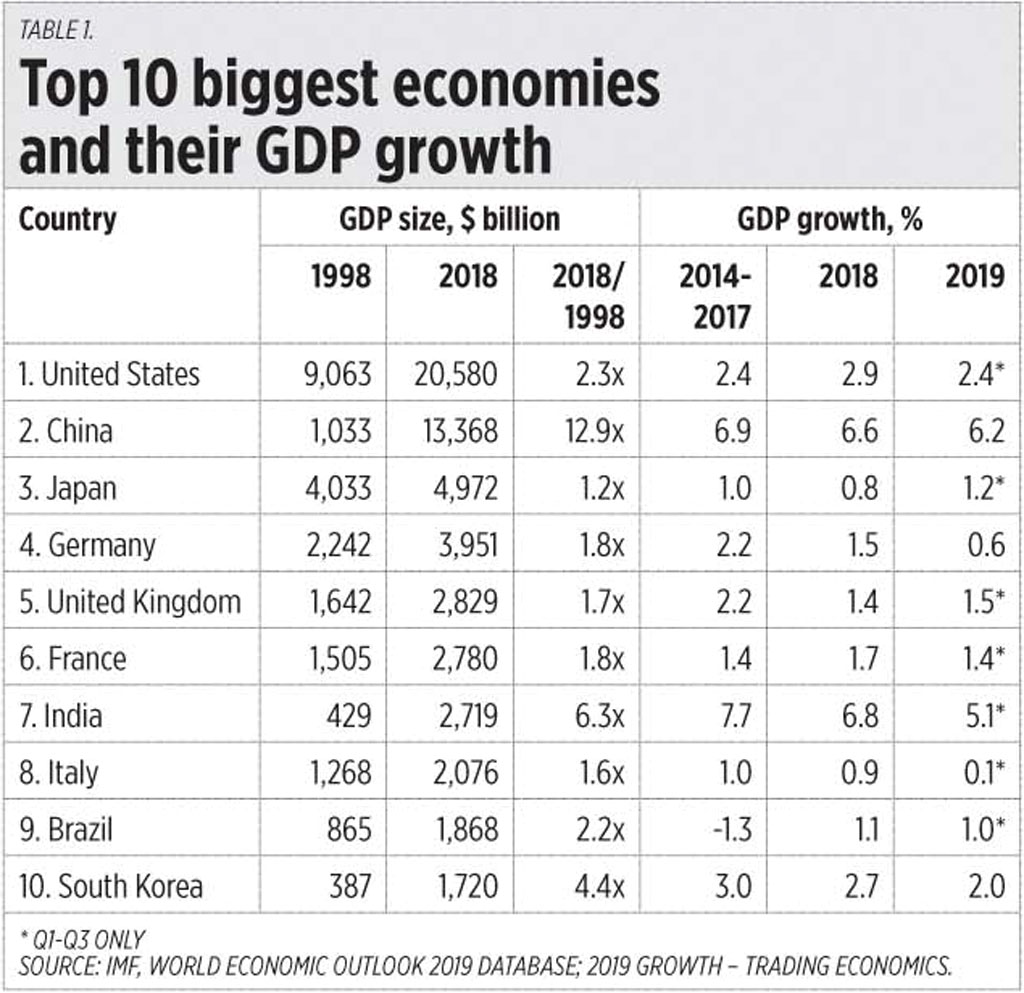
Recently it was reported that the growth rate of Germany, Europe’s largest economy and the world’s fourth largest, fell to only 0.6% in 2019. This caught my attention because it is a significant drop from 1.5% in 2018 and 2.2% average for 2014-2017. The UK and France managed to grow 1.4% in Q1-Q3 2019 so far, while Italy has crawled to only 0.1% growth (see Table 1).

From 1998 to 2018, or two decades, China, India, and South Korea have managed to expand their GDP size from four to 13 times while others have expanded only by 2.3 times at most. So we may ask, what are the “secrets” of China, India, and South Korea for the big expansion of their GDP sizes?

There are a dozen plus factors, but for this paper, I want to test the hypothesis that “stable, cheaper energy is stable growth.” Thus, I will leave out other factors (rule of law, property rights protection, global openness, lower taxes, etc.) for now.

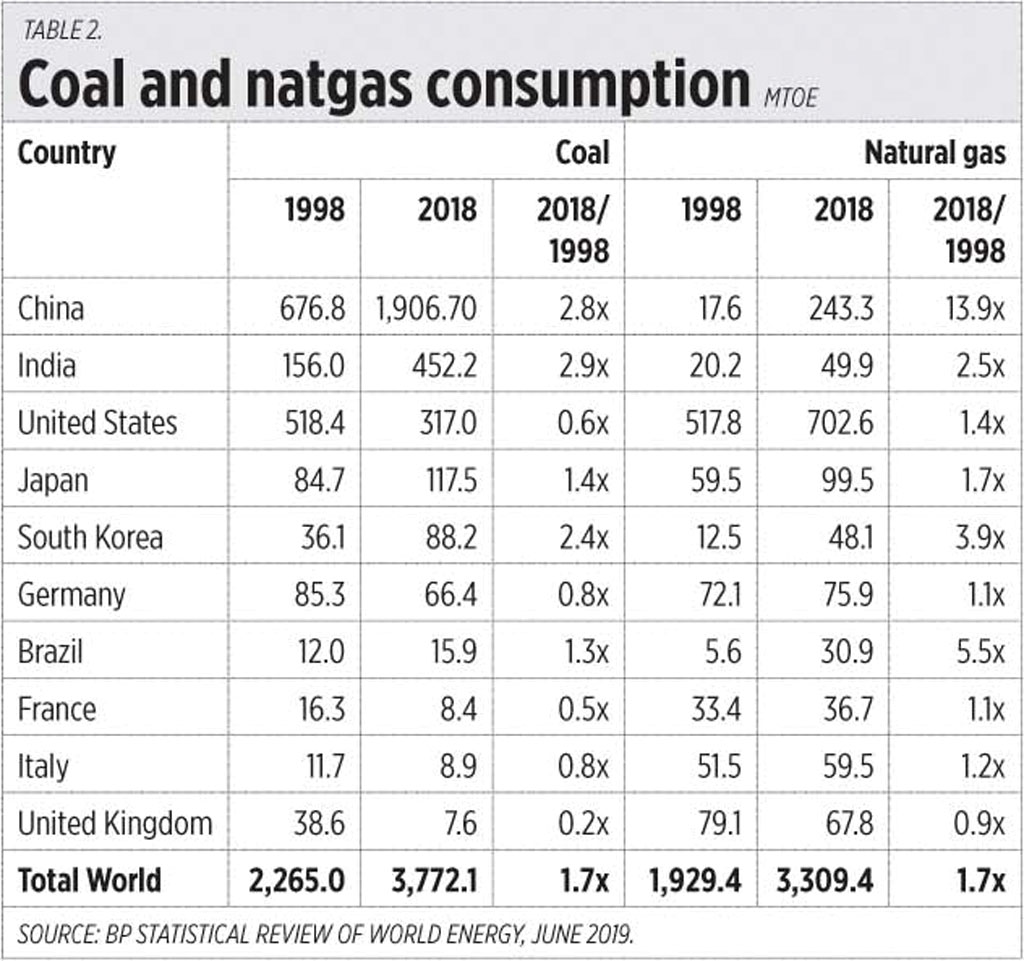
First I checked the consumption of fossil fuels coal and natural gas — stable, predictable, dispatchable on demand — in power generation, units in million tonnes oil equivalent (mtoe).

China, India, and South Korea have indeed expanded their coal capacity by 2.4 times to 2.9 times while the four Europeans and the US have decreased their coal consumption. But the US has increased its already high consumption of natural gas while China and South Korea have also expanded their gas use but not at the level of the US (see Table 2).

Then I checked their consumption of intermittent, unstable, and non-dispatchable energy sources like wind and solar. China, the US, and Germany are the world leaders, with India, Japan, and the UK trying to catch up (see Table 3).

The total consumption of wind and solar, despite their rapid expansion in recent years, remain very small compared to use of coal and gas for many countries. For instance, the wind and solar of China (123 mtoe), India (20.6 mtoe), and South Korea (2.6 mtoe) in 2018 were only 6.4%, 2.8%, and 2.9% respectively of their coal consumption. The US’ wind and solar (84.8 mtoe) in 2018 was only 12.1% of its natgas consumption.

It is safe to say that the reason why China, India, and South Korea have expanded their economies faster than the other seven large economies is partly (or largely) because they relied more on stable and cheaper fossil fuels especially coal, and never relied on intermittent, unstable wind and solar in their continuing march towards modernization and industrialization.

The US has escaped the anemic growth pattern of the Europeans because it increased its reliance on natgas, also a fossil fuel, even though its coal use has declined.

US President Donald Trump is correct in his opening speech at the ongoing 50th World Economic Forum (WEF) in Davos, Switzerland, that US will pursue its energy independence (and dominance) in fossil fuels and not be swayed by climate scare and doom stories, and embrace the energy of low and anemic growth — wind and solar and other variable renewables.


Bienvenido S. Oplas, Jr. is the president of Minimal Government Thinkers.

minimalgovernment@gmail.com

Taking sport management seriously

This article is an excerpt from the author’s paper on “Athletes beyond sports: A research proposal to explore the determinants of sport entrepreneurship in the Philippines” that she presented at the 7th National Business and Management Conference.

Opportunities abound to develop or exploit underdeveloped industries such as agriculture and technology, given the right enablers and government support. Sport is one such sector that is gaining increased attention, especially with the recently concluded Southeast Asian Games 2019.

We can trace the phenomenon of the modern-day Olympics as having precipitated the commercialization of sports, which today impacts various businesses such as broadcasting, fitness, tourism, and retail. According to KPMG, the global sports industry is estimated at $600 to 700 billion, with compounded annual growth rates upwards of 4.3% since 2014, with the largest share from participatory sports. In 2017, the sports sector accounted for roughly 3% of the US economy, comprising sport consumption, sport investments, government expenditures, and net exports.

No other industry is probably as socially intertwined as sports is, due to the deep, at times, irrational and emotional attachment of fans to their athletes and teams — truly, a veritable marketer’s dream. A Social Weather Stations survey in 2019 reveals that “95% of Filipino adults feel proud when the Philippines does well at international sport competition.” Even the UNESCO has acknowledged the developmental role that sport participation plays in health, education, and inclusion in at least six of the 17 goals crafted in the 2030 Agenda for Sustainable Development.

But despite the avowed enthusiasm and untapped consumerism of Filipinos toward sports, one wonders why sport management remains nascent or limited to stereotypical images of sport agents and basketball. While one may rationalize that “management is management” regardless, any particular sector necessarily operates within a different set of contextual factors.

Hence, there is an imperative to professionalize sport management and boost sport management education. By definition, sport management involves the business and management of products and services related to sport and physical activity in its various organizational settings. It has given rise to evolving specialties in the areas of sport marketing, sport law, sport finance, as well as sport entrepreneurship — with unparalleled innovation that puts mainstream businesses to shame.

Formal sport management education began in 1966 at the Ohio University, in response to the growing demand for managing sport. In 2011, the Commission on Higher Education, through its Memorandum Order No. 23, outlined the policies and standards for a “hybrid” physical education degree with sports and wellness management (BPE-SWM). To date, at least 10 local schools offer this degree, albeit a pale comparison with the United States’ 521 schools offering bachelor’s degrees in sport management, and with the likes of ASEAN neighbors such as Thailand, which have master’s and doctorate programs.

Great athletes — even Michael Jordan — cannot become great coaches without osmosis and technical know-how. Uninitiated sport leaders who have assumed positions through privilege rather than through merit run the risk of making decisions based on hubris and self-interest rather than on stewardship, discernment, and proper governance. As the euphoria surrounding the 149 gold medals that our country won during the SEA Games 2019 is slowly dissipating, we are jolted by discoveries of excesses and opportunity losses that even the unprecedented budget could not hide. As in any venture, sporting events should be strategic, not only for the collective “feel-good” but also for long-term value creation.

The socialization value, economic significance, and psychic income of sport legitimize its importance in the spheres of public and private agenda. Therefore, sustainable and lucrative success will depend on our having the skill sets for, and the knowledge of the nuances of, managing sport. Otherwise, we will set ourselves up for colossal blunders.


Geraldine Go-Bernardo lectures on Sport Management and Strategic Management at the Management and Organization Department of the Ramon V. Del Rosario College of Business of De La Salle University. She is a businesswoman as well as a former team captain of the National Women’s Dragon Boat Team and Executive Director of the Philippine Sports Commission.

geraldine.bernardo@dlsu.edu.ph

Abolish the travel tax

In the era of tax reforms that are meant to simplify life for taxpayers, streamline tax collection effort. and enhance revenues for government, the Philippine travel tax that is imposed on departing Filipinos for abroad (with exemptions) in the amount of P1,620 per person is outdated at best and illegal at worst.

This travel tax was first imposed in 1956 when Magsaysay was our president and Singapore was part of Malaysia. Its purpose was to prevent unnecessary foreign travels and to conserve precious foreign exchange. It was meant to promote domestic tourism that required only pesos, not dollars.

At first, the tax was a fixed charge based on the cost of the ticket. In a series of Presidential Decrees up to 1984 when Marcos was still the President and Southeast Asia’s first rail line LRT 1 opened, it was amended to travel class whether business or economy, to a percentage of the fare with a cap, until it ended up with what we have today in 2020 — P1,620 for economy and P2,700 for business.

There is no basis for these amounts. Neither is there a rationale anymore on their imposition on the traveling public. It used to be imposed on arriving passengers too. We have a liberalized foreign currency regime and can freely travel with hard foreign currency or credit cards. Fares today can be as cheap as one peso gimmicks or as expensive as a car but the tax remains the same. It is inflexible and government actually loses revenues that may be collected if a well-studied tax base is used.

For example, levying 1% on the base fare is a start. For those who can afford higher ticket classes, the tax is proportionately higher. It will be effective and progressive. The reduced rates and exemptions can all be removed. The travel tax can be certain and simple.

This single tax is collected by a single agency, the Tourism Infrastructure and Enterprise Zone Authority (TIEZA). It is a highly inefficient manner to raise revenues. By design, it should be a systematic way for agents to collect and remit to the Bureau of Internal Revenue directly using the same channel of payment.

Travel tax by TIEZA is administratively costly, a waste of time, and burdensome for travelers who end up queuing one more time online or at TIEZA counters. It is more red tape for exempted persons to secure an exemption certificate for such amounts or to ask for their refunds that worsen the travel experience. It is also prone to abuse that requires a separate effort by state auditors that eats up additional resources. Remember the TIEZA Teo controversy.

JESHOOTS.COM/UNSPLASH

There is also a problem with how the travel tax is allocated. Its collection is usually justified for the promotion of tourism projects (50% goes to TIEZA) and the support of education (40% goes to the Commission on Higher Education) and culture (10% goes to the National Commission for Culture and the Arts).

Tax reform is ready to remove these cross-subsidies and directly allocate the amounts in the agency’s national budgets for accountability, transparency, and utility. It will simplify the national accounts and lessen compliance issues.

What is not obvious is that from the 50% share of TIEZA, fully 45% of the funds are used for administrative expenses. It is a waste of taxpayer’s money. The better solution is to provide an agency budget for TIEZA that is determined by standard planning cycles and expenditure programs that all other government agencies undergo. It will make it fair.

The track record for the 55% for tourism projects needs to be checked. Government does not spend scarce resources on investments that the private sector will gladly enter into. Tourism is such an industry — markets are free, barriers to entry are low, and margins are high.

There is the Constitutional right to travel. Article III, Section 6 of the Constitution states that “The liberty of abode and of changing the same within the limits prescribed by law shall not be impaired except upon lawful order of the court. Neither shall the right to travel be impaired except in the interest of national security, public safety, or public health, as may be provided by law.”

The imposition of a fixed tax on traveling Filipinos financially burdens the taxpayer. This is especially true for short international destinations on budget airlines for cost-conscious passengers whose plane fare may be less than the tax. It is regressive and anti-poor. It is administratively inefficient and downright wasteful with one tax being collected by one agency that relies on it to fund its operations. No wonder it makes it difficult for travelers to claim exemptions. It is unfair for state agencies for the separate effort required and to TIEZA that requires a regular budget.

It is time to abolish an archaic tax.

Ideas, seismic activity, dinner, and the CCP

By Marian Pastor Roces

THE OUTRAGE spiked social Geiger counters. The Imelda Marcos re-appearance at the Cultural Center of the Philippines (CCP), upon the invitation of its Board to be honored as founder, set off rumblings at a time of heightened seismic activity. Even if low intensity, the bubbling-over is as much produced by pent-up steam as Taal’s.

Taal of course comes to mind because the dinner organizers gave a post facto justification: a volcanic eruption relief drive. The weak spin did not merit rebuttal.

Nevertheless, there are matters to bother with, concerning the cocktail that includes Imelda, the CCP, imprudent parties, and volcanic eruptions. All of it is to do with ideas whose time is past.

The most obvious of these is that which supposes that “politics” can and should be separated from “art.” The party is about “art”; the “politics” can be left at the Little Theater entrance. The former is supposed to be ethereal and elevated. In this view, the latter is muddy stuff that art shirks from.

This effete idea has not been in play in art, globally, for at least a century. Its persistence in the Philippines can only be attributed to its usefulness to Imeldific sorts who need this separation to keep skeletons in closets, maneuvers in shadows, and silverware in their proper places.

By boxing out art from how power is distributed in a society, art is kept airless and bloodless. And it is inevitably just show. Art that’s just show will not be neutral. It is available to nefarious purpose.

Less obvious but more insidious is the idea that art is soft. Software and soft power are among the too-easy metaphors that facilitate the injection of vile politics into art’s muscle, rendering it flaccid and manipulable. Buying into this idea of softness allows spurious cultural explanations and hard political manipulation to escape attention.

For example, one pundit opines that utang na loob (debt of gratitude) attributed to CCP employees explains the continuing goodwill that somehow warrant the party. But whether or not this cultural proclivity produced the impetus for the event, is hardly as important as the re-entry strategy of the Marcos family into the realm of political legitimacy through the area they believe soft and vulnerable to penetration: art.

It does not do Filipinos any good to appeal to cultural explanation where straightforward political explanation is gets quicker to the heart of the matter. In fact, attributing political steps backward — to backward politics in general — to purported cultural flaws has the effect of concealing brazen play. This event is part of the Marcos family juggernaut back into deceptively soft-shelled hard power.

The CCP party was because Marcos. It was not because culture. And certainly not because flawed culture.

A third fatuous idea comes to surface at this intersection of culture and politics. It is the notion that art’s relationship to democracy is exactly the same as art’s relationship to autocracy. Few artists — even the avowedly apolitical — think this. But the country’s leadership from even before Marcos have entertained this misconception.

Still, it is the Marcos family in 1969, and them again in 2020, that represents the ghoulish tenacity of this vision of art as ethically neutral. The CCP as an institution began under its weight; unburdened itself of it, post 1986; and is now dealing with its undertow.

The Imeldific CCP did not last long. Her considerable force that pushed this illusory picture of art had dissipated well before the Marcos forced evacuation to Hawaii in 1986. Her apologists’ claims about the value of her arts infrastructure have since been collapsed by sheer commonsensical appreciation of artistic production engaged in political process. More than half of CCP’s institutional life (34 years) transpired with artists articulating evolving relationships between art and the Philippine democratic project; and with global political tremors.

The CCP does not belong to this fat old woman, and never to her svelte earlier self and her vanities about art; nor to her scheming children. But, yes, there is an undertow pulling the institution to the past. Its retrograde energy issues from the fantasy of apolitical art; its hallucinatory power, from actual power exercised by the retooled Marcos political infrastructure that is heavily invested in cultural rehabilitation. These power mongers need the CCP.

The use of Taal’s sulfur-smelling eruption to try to perfume the odious dinner shows up the cynicism of the Marcos rehab managers. It is remarkably uncreative (and quite inappropriate to a cultural center) and insulting to artists, cultural workers, rescuers, relief workers, victims, on and on. However, it is equally insulting to read comments about the CCP as unchangeably Imeldific. The CCP is more than its founders and leaders past and present; more than its early history; and more than its mix of ideas about art.

The CCP is 50 years old. It is a number that occasions more than celebratory gestures. In this half century, the Philippines’ complex community of artists and cultural workers has re-shaped it in directions the Marcoses cannot conceive. Among other stuff that happens as a matter of course, the CCP outgrew its beginnings. The dinner would have produced protestation: the Marcoses and their friends inside and outside the CCP smell old and decayed. A profusion of fresh flowers did not mask the smell of decomposition that wafted out of the building.

But just as the Philippines can now happily expect opposition to the use of the CCP as a stage for attempted Marcosian resurrections, the country can rely on the CCP’s broad constituency and stakeholders to sustain a trajectory away from the unworthy ideas that gave birth to it.


Marian Pastor Roces is an independent curator and critic whose research interests include international art events, museums, identity politics, cities, and clothing. She is the founder and principal of TAO, Inc., a museum and exhibition development corporation. More of her critical texts can be found in Gathering: Political Writing on Art and Culture, the first collection of Roces’s essays co-published in 2019 by the Museum of Contemporary Art and Design and ArtAsiaPacific Foundation.

Davos seeks a better world, but who’s going to pay for it?

By Nir Kaissar

IF INVESTORS want a better world, they’ll have to pay for it.

The world’s uber-elite converged on Davos, Switzerland, on Tuesday for the World Economic Forum’s annual meeting. The group of more than 2,000 is worth an estimated $500 billion and includes at least 119 billionaires. This year’s theme is “Stakeholders for a Cohesive and Sustainable World” and includes panels such as “Averting a Climate Apocalypse” and “Balancing Domestic and Global Inequality,” so you can count on plenty of chatter about the world’s most pressing problems.

Aside from the obvious point that no one wants to hear about wealth inequality and climate change from a gaggle of billionaires whose carbon footprint dwarfs that of an ordinary person, the gathering comes amid growing suspicions that many of the corporate titans expected at Davos aren’t just casual observers of the world’s ills but actively perpetuate them in the pursuit of profits.

Corporate executives seem to be coming to that realization themselves. The Business Roundtable, an association of US CEOs, abandoned the principle of shareholder primacy last August, pledging instead to “lead their companies for the benefit of all stakeholders,” including customers, employees, suppliers, and communities. The move is an implicit — if not explicit — admission that, as my Bloomberg Opinion colleague Joe Nocera put it last week, “Shareholder value has caused much harm in the three decades since it became the core value of American capitalism: diabetics who can’t afford insulin; students ripped off by for-profit universities; patients gouged by hospital chains; and so much else.”

That singular focus on profits has also been an undeniable windfall for shareholders of US companies. Consider that from 1871 to 1979, earnings per share for the S&P 500 Index grew 3.4% a year, according to numbers compiled by Yale professor Robert Shiller. In the late 1970s and early 1980s, a new generation of executives, including most famously General Electric Co.’s Jack Welch, made profit maximization their single-minded priority. Since 1980, earnings have grown 5.6% a year.

Earnings are the invisible hand that drive stock returns. The S&P 500 returned 11.8% a year during the four decades from 1980 to 2019. Of that, nearly half came from the 5.6% of earnings growth. Dividends contributed 3% and change in valuation kicked in the remaining 3.2%, as measured by change in the 12-month trailing price-to-earnings ratio. Earnings have been even more of a workhorse in recent years as dividend yields have declined and — contrary to popular perception — investors have been reluctant to pay more for stocks. Of the 13.6% annual return from the S&P 500 from 2010 to 2019, a whopping 10.2% came from earnings growth and just 3.4% came from dividends and change in valuation.

It’s hard to see how that pace of earnings growth — and the return from stocks by extension — is sustainable if companies decide that shareholders are no longer their only concern. Sure, some efforts to broaden the base of stakeholders may contribute to future growth, or at least not detract from it. Germany, for example, has a decades-old tradition of co-determination in which workers are represented on corporate boards, and German companies have generated higher earnings growth than their US counterparts since Germany enacted co-determination in 1976.

But the scale of the problems contemplated at Davos this week is likely to require more drastic intervention. Taking on inequality is likely to mean retraining millions of workers for higher-value jobs and paying them accordingly. Confronting climate change will require significant spending on research and in some cases abandoning whole lines of business. Those costs will be borne by shareholders big and small, from the bigwigs gathered at Davos to university endowments to pension funds to ordinary retirement savers.

And not just in the US. The swell of protest and populist movements around the world is in part a reaction to the negative effects of shareholder primacy. Executives appear to be listening. Days after the Business Roundtable ditched shareholder primacy in the US, Business for Inclusive Growth, a coalition of 34 multinational companies, announced an initiative to tackle inequality with help from the Organization for Economic Cooperation and Development.

There will be no shortage of observers calling the gathering at Davos an empty gesture this week, but the billionaires are right about one thing: Ignoring inequality and climate change is no longer an option. Now let’s see who’s willing to pay for it.


BLOOMBERG OPINION

Rotary Club of Makati West and Rotary Club of Manila hold 2nd joint meeting in 2020

The Rotary Club of Makati West (RCMW) and the Rotary Club of Manila (RCM) held Thursday its second joint meeting for the year with no other than Department of Finance (DOF) Secretary Carlos Dominguez III as guest of honor and speaker. The joint meeting held at the Philamlife Tower in Makati was jampacked with RCMW President Eric B. Tensuan and RCM President Jackie Rodriguez leading the roster of attendees from the two distinguished rotary clubs.

A fellow Rotarian, Sec. Dominguez presented the “Status of Tax Reform and its Impact on Both Small and Large Domestic and International Businesses.” He expressed confidence that the Congress could pass this year the remaining packages of the comprehensive tax reform program (CTRP), which he considers a “foundational plank” of the government’s socioeconomic agenda, and an indispensable element in bankrolling its priority programs.

Package 2 of the CTRP – the proposed Corporate Income Tax and Incentives Rationalization Act (CITIRA) – aims to gradually lower the corporate income tax to 20% from the current 30%, as well as rationalize the fiscal incentives system to create a level playing field especially for new businesses.

“The sooner Congress passes the bill, the quicker potential investors will discard their wait-and-see attitude and bring more business to the country. This will have incalculable benefits for our economic growth,” Dominguez said.

The two rotary clubs held their first joint meeting for 2020 on 9 January with BSP Gov. Benjamin Diokno as their guest of honor and speaker.

A devoted mother, a compassionate leader

‘Mompreneur’ Monica San Gabriel on making smart decisions and choices in life

In an interview with BusinessWorld, Bag Tag Inc. President, Founder and Product Developer Monica San Gabriel was asked how she’s been handling stress given all the tasks on her shoulders. “Count one to 10,” she replied in jest. After a short pause, she blithely added: “I just drink, because if you keep complaining, it will attract negativity.”

From the way she answers a serious question and turns each conversation in a very casual tone, one can already figure out how Ms. San Gabriel is taking life lightheartedly. For whatever roles she plays — from taking good care of her family to managing a bag tag empire — this ‘mompreneur’ manages to enjoy what life has to offer by coming up with smart decisions and choices.

A HUMBLE ENTREPRENEURIAL JOURNEY
It was in 2001 when Ms. San Gabriel, together with her husband, started a luggage label empire. They merely started selling PVC bag tags in bazaars until a local airport offered them some retail space, which paved the way for shopping giants to notice their humble business.

For Ms. San Gabriel, venturing into a bag tag business is a smart choice since it caters to a broad spectrum of market. “We really saw its potential since everybody has a bag that you have to mark as yours. So, it’s not just for traveling, it’s also for school, work or gym,” she said.

At present, Bag Tag has nine stores located in shopping malls across Metro Manila, including SM Megamall where it has two branches. Its product offerings expanded to embroidered and leather bag tags, urban straps, luggage wraps and traveling accessories, among others.

According to Ms. San Gabriel, the success of Bag Tag has helped them fund their children’s education and meet some of the expenses of the family at home.

LEADING WITH A NOBLE HEART
Ms. San Gabriel actually comes from a family of entrepreneurs. Her family has been involved in different ventures including dermcare, hair care, and F&B. In fact, she considered her interest in running a business as something she acquired from her dad.

“My dad molded us to be an entrepreneur. So he started with restaurants, and then he got into skin care and hair care. From there, he taught us lot of things in business,” she said. “Up to now, we consult him for business decisions or plans.”

Even her sympathetic approach in leadership, particularly in managing a team of 20 people scattered all across production, marketing and sales, is something she obtained from her dad.

“I don’t get mad. Si daddy kasi malumanay lang (My dad is soft-spoken),” she said. “Positive vibes only, chill. I don’t allow myself to be stressed.”

LIVING A WELL-BALANCED LIFE
Aside from Ms. San Gabriel’s carefree demeanor, what’s fascinating about her is how she attains work-life balance in the form of pastimes that enrich her and keep her fulfilled.

Reading and drinking alcoholic beverages are some of her guilty pleasures, as she shared. She even professed to having a 25-book target by year’s end. When she’s not out drinking with her friends, on the other hand, she just stays on her balcony and enjoys a bottle or two at night – a moment that she considers as her “me time.”

Despite juggling tasks between being an entrepreneur and a mom-of-three, Ms. San Gabriel is still able to take leisure seriously. She still finds her way to simply sit back and watch her favorite shows on Netflix and HBO, as well as share time with her family over dinner. From time to time, she also joins her husband in biking around the country. And just recently, she took the responsibility of being a judge secretary in the girl’s gymnastics division in the recent Southeast Asian Games, an obvious consideration given her experience judging meets in the past.

MAKING A SWITCH
Considering all the duties and responsibilities that her roles demand, it is truly essential for Ms. San Gabriel to take good care of her wellbeing by embracing some lifestyle shifts that allows her the habitual pleasure she craves with less of the harm it usually brings. Her choice to adopt a smoke-free nicotine alternative, coupled with the way she gave priority to herself first, brought her closer to the proper mindset needed to face the duties her roles demand and to pursue interests that let her live her life to the fullest.

“I switched to IQOS in 2017. My friend introduced me to this heated tobacco alternative. When I went to Japan, I bought three right away-one for me, one for my brother, and one for my friend. I’ve been smoking since college and I’ve only ever quit when I’m pregnant.”

Three years later and she still feels grateful for switching to IQOS. “I no longer get smoker’s cough in the morning. There’s no more phlegm, no more smell. When I wake up I no longer feel like I have to catch my breath.”

When asked for advice to smokers, she has this to say: “Cold turkey, for me, is still the best play. It worked with my brothers as they have successfully curbed their smoking habit. But for those who can’t quit like me, it’s nice that we have less harmful alternatives available.”

Monica San Gabriel is part of a new breed of women who defy preconceived notions of who a mother or a lady boss should be. But don’t get it wrong, Monica still goes to work during the day, she makes it a point to gather her family for dinner at night, and once a month, she takes them out on trips. It’s just the way she keeps her social life buzzing, her interests nurtured, and her physical endeavors actively pursued that, all in all, makes her distinctly inspiring.

ADVERTISEMENT
ADVERTISEMENT