
Home Blog Page 9909

How PSEi member stocks performed — February 7, 2020

Here’s a quick glance at how PSEi stocks fared on Friday, February 7, 2020.


No coronavirus symptoms among 32 repatriates

NONE OF the 32 Filipinos repatriated from Wuhan, the center of the outbreak of the novel coronavirus from China, showed symptoms of the virus upon arrival, according to the Department of Health (DoH).

“All 32 repatriates landed safely and free of any signs and symptoms, hence, they were all sent to New Clark City for close observation and monitoring for 14 days,” the DoH-Central Luzon Center for Health Development (DoH-CLHCD) said in a statement Sunday.

The repatriated Filipinos, mostly overseas workers, went through three levels of screening before coming home, the DoH explained.

They were initially checked for fever, cough and colds, and only those who were asymptomatic were allowed to be repatriated.

They were monitored during the flight and again checked for symptoms after landing.

Last week, DoH said around 40 to 50 Filipinos were expected to be repatriated.

Should anyone among the repatriates begin exhibiting symptoms, the patient will immediately be transferred to a designated hospital.

The repatriates were flown in through a chartered plane that landed at the Haribon Hangar in Clark Air Base, the Department of Foreign Affairs (DFA) said in a statement.

“Upon their arrival, the Filipinos were safely and swiftly transferred from the plane into their dedicated buses, and brought to the Athlete’s Village in New Clark City in Tarlac which will be their home for the 14-day quarantine period.”

The repatriates were assisted by a ten-member team from the Philippine Consulate General in Shanghai, DFA Office of the Undersecretary for Migrant Workers’ Affairs, and the DoH.

As of Feb. 8, the DoH said the number of persons under investigation in the country rose to 267, of which 230 are admitted, 13 refused admission, 19 have been discharged, while the remaining two have died of other causes.

The Philippines has so far had 3 confirmed cases: a 38-year old Chinese man, who later died; his partner, a 44-year old Chinese woman; and a 60-year old Chinese woman.

MISINFORMATION BATTLE
Meanwhile, the World Health Organization (WHO) on Saturday said they are closely monitoring the spread of misinformation on the coronavirus, which has so far affected more than 34,000 people globally.

“At WHO, we’re not just battling the virus; we’re also battling the trolls and conspiracy theorists that push misinformation and undermine the outbreak response,” WHO Director General Tedros Adhanom Ghebreyesus said in a briefing.

He said the WHO Information Network for Epidemics (EPI-WIN) will be cracking down on misinformation online and already coordinating with social media companies to filter out false data on the virus.

EPI-WIN will also be working to deliver accurate data to a wider audience. — Charmaine A. Tadalan and Gillian M. Cortez

Usec Rio willing to stay at DICT

By Arjay L. Balinbin
Reporter

DEPARTMENT OF Information and Communications Technology (DICT) Undersecretary Eliseo M. Rio, Jr. is not withdrawing his resignation letter despite the bigger role given to him by Secretary Gregorio B. Honasan II.

“No, I am not withdrawing my resignation. It’s really up to the President to accept it or not. I will not withdraw, I will not withdraw,” Mr. Rio told BusinessWorld in a telephone interview on Sunday.

Mr. Rio said the DICT chief signed last Friday a department order designating him to be in charge of the National Broadband Plan Backbone and Free Wi-Fi Internet Access in Public Places.

“I’ve been doing all of these, but when Secretary Honasan came in, he put new people to do these. I requested him if I can get back because nothing seems to move on, so he gave me the chance,” Mr. Rio said.

He added that he has yet to meet with President Rodrigo R. Duterte regarding his resignation letter and if it is turned down, he will be happy to do the job.

“I’m waiting for his call, for his schedule. I talked to Executive Secretary (Salvador S. Medialdea). He told me that the President has not acted on my resignation and he’s scheduling a meeting for me,” Mr. Rio said.

He also explained that there is no issue between him and his “childhood friend” Mr. Honasan.

“I am okay with him. In fact, we are childhood friends. My family and his family, the Honasans and the Rios, are friends…. We were also almost neighbors for 12 years,” he said.

“However, the individuals he brought to the DICT, for some reason, got all the jobs that we have been doing. Maybe, yes (they are better) because they think that there are things that they can improve — and that’s okay. In fact, we welcome them because they are young minds…. But well, nothing seems to move,” he added.

Mr. Rio also said that he has been working in government since his service with the Philippine Army.

“I’m 75 years old. I thought it’s now time to really spend time with my family.”

Initial reports of Mr. Rio’s resignation cited him as saying that it was because of questionable disbursements from the DICT’s “confidential funds.”

But Mr. Rio has since explained that he has “no first-hand knowledge on whatever anomaly” in the department.

“That report did not come from me. What I said is that as far as I am concerned, the DICT (does not have) any confidential or intelligence funds because it is not in its mandate to conduct intelligence activities,” he said in an interview on ANC.

To clarify the matter, Messrs. Honasan and Rio issued a joint statement last Friday saying “the disbursement of the confidential expense was lawful and legitimate.”

“We would like to stress that the confidential expense is a line item allocated under the 2019 GAA (General Appropriations Act) that went through the rigorous process of approval by both houses of Congress and ultimately by the President himself,” they said.

ECoP says mandatory 14th month pay to hurt micro businesses

THE HEAD of the Employers Confederation of the Philippines (ECoP) said the proposed mandatory 14th month pay for workers will affect micro enterprises, but exempting them would be unfair to other businesses.

“The problem is, ang tatamaan ‘yung mga (those who) can’t afford it. Alam mo naman ‘yung mga micro natin have been surviving, maraming nagbubukas, maraming nagsasara. Every year ganun ang storya nila (those that will take the hit are those who can’t afford it. You know how our micro [businesses] have been surviving, many open, many close. Every year, that is their story),” ECoP President Sergio R. Ortis-Luis, Jr. told BusinessWorld in phone call on Thursday when sought for comment.

ACT-CIS Party List Representative Eric G. Yap filed House Bill 6198 on Wednesday, which seeks to require the 14th month pay for both government and private sector workers. A counterpart bill has also been filed at the Senate.

Under the current law, a 13th month pay is mandatory.

Mr. Ortis-Luis noted that large businesses actually “over comply” with the required bonuses for employees, and that it would be unfair if they are the only ones who will be required to comply with another month’s pay.

“Many even give 16th month so ‘di problema ‘yun (that is not a problem), they can afford it. Ang problema (The problem is), when you pass a law like that, hindi naman pupwede na sila lang (it can’t be that they would be the only ones covered).”

He added, “It doesn’t make sense because those who can afford it are already paying even more than that. Those who cannot afford it are the ones who is the problem.”

Micro enterprises constitute 88.45% of total establishments in the country, followed by small enterprises at 10.58%, and medium enterprises at 0.49%, based on Department of Trade and Industry 2018 data. — Genshen L. Espedido

Capas mayor gives support to use of NCC as quarantine site

CAPAS Mayor Reynaldo L. Catacutan has reversed his stance on the use of the Athletes Village at the New Clark City (NCC), located in his town, as quarantine site for Filipinos repatriated from Wuhan, the center of the outbreak of the novel coronavirus. In a statement posted on social media Sunday, he apologized for the local government’s opposition to the plan. Last Friday, the Capas municipal council passed a resolution expressing their opposition, citing threat of contamination among residents. “Now that the national government has finally decided to use Capas as the quarantine area for our returning kababayans (fellow-Filipinos), Capas can only move forward and throw its all-out-support to this nationally-led endeavour,” Mr. Catacutan said. — Gillian M. Cortez

City gov’t considers extended Baguio Blooms expo as main Panagbenga events postponed

THE BAGUIO City government is “inclined” to approve the proposed extension of the Baguio Blooms Exposition and Exhibition by another month in consideration of the impact of the novel coronavirus threat, Mayor Benjamin B. Magalong said in a statement posted on Saturday. Mr. Magalong said the “city government understands the plight of the exhibitors” and that an extended operation will allow them to “recover their investments in the activity,” which is one of the highlights of the annual Panagbenga Flower Festival. The Blooms expo opened February 1 and originally set until March 8. The festival’s opening parade on Feb. 1 was cancelled to avoid the risk of the coronavirus spread.

POSTPONED
Meanwhile, the mayor also announced Friday the decision to postpone the festival’s main events scheduled Feb. 29 and March 1 following consultations with health authorities and stakeholders. The Cordillera Administrative Region office of the Department of Health (DoH) reported that as of Feb. 6, there were four persons under investigation (PUIs) for coronavirus, all confined in a health facility. DoH Regional Director Amelita M. Pangilinan said in a press briefing last Friday that the patients, three female and one male aged two, 27, 23 and 57, are in stable condition. They are Filipinos, unrelated, with two from Benguet, and one each from Baguio City and Mt. Province. They all have recent travel history to Hong Kong as tourists. Mr. Magalong also assured tourists that the local government as well as the Hotel and Restaurants Association of Baguio have put in place preventive as well as response measures for the virus threat. Ricardo B. Runez, Jr., director of the government’s Baguio General Hospital and Medical Center (BGHMC), said all local hospitals have been readied to handle suspected coronavirus cases. BGHMC is also one of the facilities that is expected to receive next week a machine that can verify the virus affliction within one hour while parallel testing at the Research Institute for Tropical Medicine is being conducted. — MSJ

Bohol is latest stop for Cebu Pacific’s sustainable tourism campaign

THE ECONOMY of Bohol — home to the Chocolate Hills, tarsier, white-sand beaches, and various cultural and heritage sites — has been driven largely by tourism. And that comes with the strains to the island province’s environment. “Tourism is the number one source of revenue in the province… In fact, the impressive drop of poverty incidence of 50.2% in 2000 to 15.2% this year is primarily attributed to the growth of our tourism industry,” said Provincial Administrator Kathyrin D. Piquinto in an interview Friday during the launch of Cebu Pacific’s campaign on sustainable tourism. Ms. Piquinto said Bohol is fortunate to have various and unique natural attractions, but it must also continuously take measures to ensure their protection and avoid the pitfalls of overtourism. “Bohol is one of the best island-destinations in the world, and one of CEB’s (Cebu Pacific) most popular destinations. There is still time to preserve its beauty by flying in tourists who are aware of the impact they create when they travel,” said Candice A. Iyog, the budget airline’s vice president for marketing and customer experience.

BALANCE
The company’s “Juan Effect” campaign, introduced earlier in Siargao and Boracay, engages the local community, local government, and tourism stakeholders in educating travelers about their responsibilities as tourists. In Bohol, the program was started with the installation of signages at the most visited spots to remind visitors to take care of the island’s natural beauty. The signs, made in part using wood from old boats left as trash along Panglao’s beaches, are in English, Korean, Japanese, Chinese. “We acknowledge that tourism can be a great economic driver creating jobs and opportunities for people across all demographics. But we also recognize that this can have unintended consequences like pollution, environmental degradation, disregard local cultures, among others,” Ms. Iyog said. Tourism Undersecretary Arturo P. Boncato Jr. said the Department of Tourism’s goal is finding the balance between increased arrivals and sustainable tourism. He said, “We are now faced with this challenge of a balance of increasing tourists while we are protecting the environment… We would like to increase that (arrivals) but we would like to bring you to destinations that are ready for you.” — Maya M. Padillo

Surigao, Davao provinces settle boundary dispute

THE PROVINCES of Davao Oriental and Surigao del Sur have finalized the settlement of a two-decade old boundary dispute in the towns of Boston and Lingig. Officials of the two provincial governments, in a joint session held in Davao City last week, issued a common ordinance defining the political boundary in the contested area. “The new political boundary shall be drawn according to the output map utilizing the coordinates in delineating the area to be ceded to the Province of Davao Oriental. Provided, however, in the delineation process, the existing build-up areas belonging to Barangay Rajah Cabungsuan of Lingig (under Surigao del Sur) shall be excluded in the compromise agreement,” a provision in the ordinance reads. Davao Oriental Vice Governor Niño Sotero L. Uy Jr., in a press statement Thursday, explained that part of a property that used to belong to Surigao del Sur “will now become part of the municipality of Boston (in Davao Oriental).” The exception for built-up portions is intended to ensure “that there will be no confusion in the part of the communities settling in the areas,” he added. With the settlement, 2,600 hectares of the 6,000-hectare disputed land will now be under Davao Oriental’s jurisdication.

IRA HIKE
Mr. Uy said this means the province will be getting an increase in its Internal Revenue Allotment (IRA), the share that local government units (LGU) get from the national fund. The IRA is computed based on the LGU classification, land area, and population. “There will be adjustments in the IRA subject to computation by the Department of Budget and Management and the Department of Finance. But definitely there will be an increase in the IRA for Davao Oriental,” he said. The dispute started about 20 years ago when Surigao del Sur questioned the authority of Davao Oriental after then governor Rosalind Y. Lopez issued several small-scale mining permits for an area it claims to be under Lingig town. In 2015, then governors Corazon N. Malanyaon of Davao Oriental and Johnny T. Pimentel of Surigao del Sur, both of whom are currently congressional representatives, agreed in principle to settle the dispute. — Carmelito Q. Francisco

Nationwide round-up

DoLE starts inspection of establishments with alien workers

THE DEPARTMENT of Labor and Employment (DoLE) is again doing the rounds of establishments that employ foreign nationals, including Philippine Offshore Gaming Operators (POGOs), starting this month to June 30 to check for compliance with local and national laws. “(T)he labor department has resumed its special inspection of alien-employing establishments by deploying anew over 300 labor inspectors in key areas to inspect and verify the legitimacy of employment of foreign nationals,” DoLE said in a statement on Sunday. During the inspection, labor and employment officers will check the company’s business permit, Securities and Exchange Commission registration, and application for Alien Employment Permits (AEP) to certify them for the hiring of foreign nationals. Foreign employees will also be checked for work permits. DoLE last conducted these inspections last Oct. 31 to Dec. 15. — Gillian M. Cortez

Salceda to file bill on education reform

A LEGISLATOR is filing a bills for a “comprehensive education reform agenda” in response to President Rodrigo R. Duterte’s directive to the Department of Education (DepEd) to study changes to the K to 12 program. “In the coming days, I will be filing the most comprehensive education reform agenda ever introduced in Congress after the People Power Revolt,” Albay Rep. Jose Maria Clemente S. Salceda said in a statement on Friday. Education Secretary Leonor M. Magtolis-Briones recently discussed with Mr. Duterte the results of the Programme for International Student Assessment (PISA), which showed that Filipino students ranked the lowest among 79 countries in reading comprehension, and second to the lowest in math and science. Mr. Salceda’s proposed 10-point agenda for education are: equitable funding for all schools; teacher-supportive, teacher-empowering education system; expanded after-school and remedial education program; universal access to nutrition; expanded school-community relations; “Build, Build, Build” for education; safer schools for students and teachers; empowering special education facilities; Comprehensive Workforce Development; and optional adoption of mother-tongue-based learning. “This country’s most valuable resource, its most productive asset, is the Filipino people. And education is the greatest investment you can make on your people,” he said. — Genshen L. Espedido

Waste and means

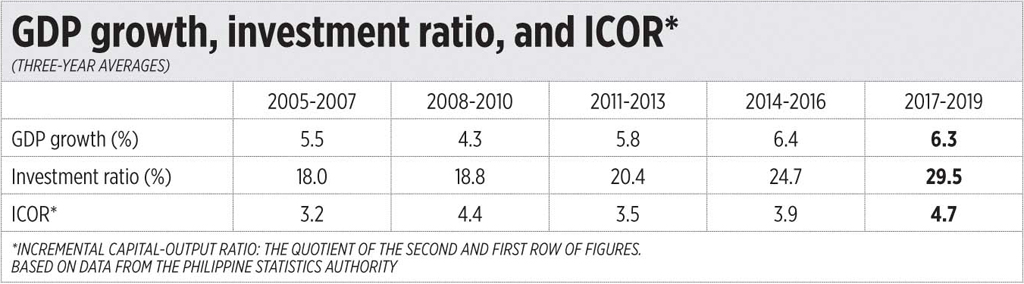
One of the bright spots of the economy under Duterte is said to be the rise in the investment ratio. In the last three years (2017-2019), the average proportion of investment to GDP approached 30%. Compare this with the previous six-year period (2011-2016) when the same ratio averaged 22%.

Conventional wisdom attributes much of this to the administration’s “Build, Build, Build” infrastructure drive. Indeed, the government under Duterte now accounts for 25% of total construction spending (versus 20% under Aquino, again using period-averages), which contributes 2.6% of GDP compared to 1.8% in the previous six years.

There is a halo around investment in the public mind — including among business people — that almost gives government carte blanche to spend on it. Indeed, infrastructure spending is the big cudgel the government uses to beat down those who object to its massive program of tax increases, even if these may weigh heavily on the poor or disrupt business. All debate and complaint is shut down once the sacred mantra of “Build, Build, Build” is intoned.

Above the sacred cow of investment hovers the notion that building roads and buying machines is “productive” in a way that other types of spending are not — as exemplified, say, by consumption by households (e.g., mundane food and clothing) or by government (e.g., folders and paper clips). Through taxation, government essentially lays its hands on money that households and firms would have spent one way in order to use it in ways government judges as more worthy and urgent.

It was J.R. Hicks however who gave the most generic definition of investment as “a use of current income to increase the production and consumption possibilities of the next period.” The simplicity of this statement shows up the imperfection and part-fallacy in the conventional definition of investment. Viewed through this fundamental lens, for example, what people spend on education or on medical care — both of which, after all, increase future capabilities and social productivity — are no less forms of investment than the government building a road or a bridge. For that matter, even foregoing income to preserve the natural environment might in principle qualify as a form of investment to the extent that (like keeping inventories) it expands the consumption possibilities of future generations. A more obvious value-comparison however is between a private investment project and a public one — say, between a new water treatment plant a private business might have built using profits from an “onerous contract” versus a government project that uses the confiscated profits to build a road to nowhere (more on this below). Both count as investments, but which is the more socially relevant? The point is that on principle, the value of the government’s infrastructure priorities cannot be taken as self-evident. Those priorities must always be measured against the urgency and worth of the investments (and indeed even consumption) that households and businesses must forego because their incomes are sequestered by having to pay taxes.

A second misconception about investment is the loose notion that its main value lies in stimulating the economy. When the government excuses its inability to meet its own growth targets (i.e., not hitting 7% even once), for example, it points to the failure to pass budgets on time, with a special tear shed for the delayed release of funds for infrastructure.

To be clear, however, there are two benefits from investment and particularly infrastructure spending: a Keynesian and a Smithian one. Like other forms of spending, government infrastructure investment raises current GDP immediately because it employs people and creates income. But it is not really unique in this function. The economy could just as easily have been stimulated by raising take-home pay or by reducing taxes on households or firms (i.e., by stoking household consumption or private business investment, or both). This spending effect is the reason Keynes sardonically suggested it would be just as effective a stimulus if government buried bank-notes in unused mine shafts, filled these with city garbage, and invited private business to dig them up “on well-tried principles of laissez-faire.” In short, spending to stimulate the economy does not even have to be productive or prudently chosen. The real distinction — recalling Hicks — between investment and other spending stimuli is that the former is undertaken not mainly to create income today but to raise income for the future.

So, just how good has infrastructure spending been in Duterte’s first three years? Was it based on the prudent selection of projects to implement in order to yield maximal social returns in the future? Or was it motivated primarily by a need to goose the economy in the short term by any means?

FREEPIK

No final answer can be given at this point but facts and data and casual observation give enough grounds for concern.

First, some facts. Senator Franklin Drilon’s recent exposé revealed — and the government has not really denied — that only nine out of 75 of the administration’s originally planned major projects had even started more than halfway into Duterte’s term. Understandably, though this should have been anticipated, perennial problems such as right-of-way acquisition, the technical deficit in government agencies, political lobbying, and issues in bidding and contracting reared their ugly heads. The government subsequently “improved” its reported progress simply by drawing up a new list of “flagship” projects, dropping slow-moving ones and adding “less ambitious” and “more doable” ones and some already in progress. This effectively changes both numerator and denominator. Thus, rather than resolve to remove structural obstacles to major projects, the government simply changed its priorities to avoid those obstacles. Smart move.

Still, how does this square with the sizeable increase in public infrastructure spending noted earlier? Well, if it was not flagship projects that were moving, it can only mean projects of lesser importance and lower priority were those being implemented. Indeed, in lieu of movement in “game-changing” flagship projects, the government instead touts its spending on bread-and-butter items such as roads, bridges, and irrigation systems constructed or rehabilitated. All this is well and good in creating employment and prodding the economy today, but — remembering what investment is — how much more productive of future output are they?

Some statistics. A crude but readily available measure of the efficiency of investment is the incremental capital-output ratio (ICOR), which is roughly how much of an investment buck is required for a given bang in growth. On this measure, it turns out that investment during the first half of Duterte’s term has been the least efficient in producing growth (see Table). The ICOR of 4.7 for 2017-2019 is the highest it has been over the past 15 years. This strengthens the suspicion that, at least thus far, exigency and the need to shore up short-run growth has been the driving force of infrastructure spending. Keynes not Smith has been the patron saint of Build, Build, Build.
Or then again, take some casual observation. Bonny Serrano Street in Quezon City, runs alongside Camp Aguinaldo. There has since been a lane added to it. It is a fine, concrete addition. The only problem is that no vehicle can use it, since it was simply carved out of the camp grounds and leads nowhere. One must wonder how much extra social output this infrastructure has produced since it was completed. A similar infrastructure project can be seen on the stretch of Katipunan Avenue that runs behind the UP Diliman Campus. Again, an extra southbound lane has been added and cut out from UP land. Unfortunately, except for the odd tricycle and jeepney that makes a right turn on C.P. Garcia, that nice concrete road is largely unused since it ends in an asymmetrical bottleneck on the rest of Katipunan Avenue. Actually, without meaning to sound ungrateful coming from UP, the same question may be asked regarding the whole project of concrete-paving the lightly used internal campus streets. One must ask how urgent a priority that must have been in terms of increasing future output. (I can attest its effect on scholastic performance will not be that great.) Meanwhile, heavily used roads are only periodically, partially (and badly) patched with asphalt. Such examples can be multiplied country-wide. While all these projects undoubtedly raised current income, their impact on future output must be placed in doubt.

In Smith’s words: “In every such project, though the capital is consumed by productive hands only, yet, as by the injudicious manner in which they are employed, they do not reproduce the full value of their consumption, there must always be some diminution in what would otherwise have been the productive funds of the society.”

But don’t take Adam Smith’s word for it. Listen to the opinion of a provincial mayor who at some point also saw the problem for himself when he said, “Sabi ko sa kanila hindi ko kailangan ’yung build, build, build. Do not give me that kind of shit. I want build, use, build, use, build, use.”

(E, alam din pala niya.)


Emmanuel de Dios is professor emeritus at the UP School of Economics.

A reform long overdue

Much fuss has been raised about the proposed Corporate Income Tax and Incentives Rationalization Act or CITIRA (the erstwhile Tax Reform for Attracting Better and High-Quality Opportunities or TRABAHO Bill), with claims that it affects the mood of investors who now choose to wait and see. What’s not emphasized enough is that much of the uncertainty results from the long-winded process the discussion on this reform takes. Proposals to rationalize fiscal incentives have been filed since the 10th Congress, mostly in the Lower House, with the Senate joining the fray starting in the 13th Congress. The push for the reform has been gaining momentum over time, getting much-deserved attention starting the 17th Congress. It has been more than two decades. The issue has clearly peaked, indicating that the reform is bound to happen. It will serve all sectors better the sooner the law is passed.

When one searches the Internet for information on taxation in the Philippines, its complexity is often a highlight. Recent tax reform efforts, while not perfect, have contributed a lot in simplifying the system, improving efficiency and fairness, and directing behavioral change (e.g. healthier lifestyles) through taxation. CITIRA will add to this, specifically by modernizing our investment incentives regime.

Incentives are privileges given to entice investors to locate their operations in the country. The Philippines gives fiscal incentives, or incentives that allow investors to pay lower taxes. These come in the form of tax holidays (or a period of time that no taxes are paid), reduced or special tax rates, exemptions (for instance, on import duties) and allowable deductions that lower the taxable base. Inasmuch as they help direct investments to critical sectors and geographical areas, fiscal incentives are a good handle for industrial and development policy.

However, while incentives erode our tax base, the evidence is weak on their effectiveness in attracting investments and their contribution to economic and social ends. The Oct. 6, 2019 edition of “Yellow Pad” by Filomeno S. Sta. Ana III discussed this at length. CITIRA tries to address this by sharpening the focus of the incentives and aligning them to broader goals. First, it eliminates the distinction between foreign and domestic investors, so that investors receive incentives based on qualifications other than their nationality. Second, it offers more targeted incentives that lower costs and promote desirable economic activities (e.g. additional deductions for research and development, training, employment). Third, it prescribes performance criteria and a graduation period for the enjoyment of incentives, so that there is clear basis for their award and that the incentives expire, to encourage innovation and promote strategic investment areas. Fourth, it introduces administrative reforms for simplicity and greater transparency.

The first-level test for CITIRA is whether or not the ends it promotes are worthy. Only after that should second-level issues, like the types of cost-based incentives or performance criteria come in. And more specific third-level issues, like the rate of deduction or the length of time for the enjoyment of incentives, follow. While expected behavior, one looks extremely self-centered if the main opposition to the reform rests on the basis of a couple of percentage point increase in the tax rate or because the transition period from the old system to the new is too short. These matters are the easiest to negotiate and to arrive at workable solutions on. But reform should not be held hostage just because a single lobbyist couldn’t get his way.

One element that merits greater attention in CITIRA is the shift from gross to net income taxation.

In the current regime, after tax holiday, qualified firms enjoy a special tax rate of 5% on gross income earned (GIE), proceeds of which are shared by the national government (3%) and the local government unit (2%). Gross income is defined in the IRR of the PEZA Act as “gross sales or gross revenues… net of sales discounts, sales return and allowances and minus costs of sales or direct costs.”

Allowable deductions are broad and generous. For ecozone export enterprise, they include: direct salaries, wages or labor expenses; production supervision salaries; raw materials used in the manufacture of products; goods in process (intermediate goods); finished goods; supplies and fuels used in production; depreciation of machinery and equipment; rent and utility charges associated with building, equipment and warehouses, or handling of goods; and, financing charges associated with fixed assets. For ecozone developers/operators, and facilities, utilities and tourism enterprises, allowed deductions are: direct salaries, wages or labor expenses; service supervision salaries; direct materials, supplies used or resold to another ecozone enterprise; depreciation of machinery, equipment and buildings owned and/or constructed; financing charges associated with fixed assets; and, rent and utility charges for buildings and capital equipment. Aside from administrative expenses, the main difference from net income are deductions permitted for losses and bad debts, and the carrying over of net operating loss.

Given the slim difference, shifting the tax to net income from gross income earned should be easy. A special (read: lower) tax rate on net income can be adjusted to approximate what qualified enterprises would have gotten under a GIE regime, so the issue of benefit can be addressed. The primary advantage of the shift will be increased transparency, and less vulnerability in defining what constitute direct costs. It will also make seamless the eventual graduation to the regular CIT regime once the incentive expires.

The shift does not necessarily mean higher tax takes, which is a different matter altogether that can be addressed by just increasing the rate whether on net or gross income earned. The main benefit is more simplicity and transparency in the system in the long run.

Finally, on the other element of CITIRA, one should still keep caution about the speed and rate of reduction of corporate income tax. Absent due restraint and proper timing, what could be recovered in terms of tax base through the rationalization of incentives, and even the gains of previous tax reforms, would easily be wiped out by a careless CIT reduction. Action for Economic Reforms maintains that only a modest and paced reduction in CIT by at most four percentage points (from 30% to 26%) is warranted. Further reduction can only be done if it is proven that we have the fiscal space to do so, and that the economy is seeing the benefits of lower corporate taxes.

In the end, most important in evaluating reforms are the broad goals they are supposed to achieve. CITIRA has those down pat. It is time to buckle down and get to the specifics.


Jenina Joy Chavez is a trustee of Action for Economic Reforms, and heads its industrial policy program.

www.aer.ph

What now?

Perhaps the question to be asked is not simplistically whether the Visiting Forces Agreement (VFA) is good for us or bad for us, but rather do we need a defense treaty with the US at this time, regardless of feelings over the fact that the US has some strategic advantage for itself by bonding with us? We have to be realistic about our status and capabilities before we thump our chests and bellow to be left alone to our own little devices against the big, cruel world.

Under the Mutual Defense Treaty (MDT) between the Republic of the Philippines and the United States of America signed in 1951, both nations declared support for each other if either the Philippines or the United States were to be attacked by an external party. But because of US initiatives and aggressive participation in world conflicts and threats — communism in the 1950s-1960s; the Vietnam War and other wars in Asia in the 1970s; the rise of dictatorships through the 1980s, exacerbated by pandemic financial/economic problems and rising oil crises — anti-US sentiments rose worldwide and so also in the Philippines, maybe in instinctive fear of the too-powerful US.

Was it eerie coincidence that Mt. Pinatubo erupted in furious rage in June 1991, when the Military Bases Agreement of 1947 was expiring, and the Philippine Senate was studying possible renewal or termination of the agreement? Clark Air Base, the biggest US military establishment in the Philippines, was practically the center of the calamity. Yet the Senate voted not to ratify the new treaty proposed by the administrations of Corazon Aquino (Philippines) and George H. W. Bush (US), and, prodded by the emergency wrought by Pinatubo, all US military personnel in the Philippines were removed from the US bases by the end of November 1992.

The cut-clean removal of US bases in the record time of a year clearly amputated the Philippine military, which at that time relied heavily on American military training and equipment. A modus vivendi had to be designed for a smoother flow to total independence from the US physical presence, while minding the patriotic and ambitious (and indubitably noble) goal of the Philippine military and political governance for identity and self-sufficiency. Thus was the VFA installed for this in February, 1998.

The VFA defines the treatment of American military personnel when they are in the Philippines. A counterpart agreement which deals with the treatment of Filipino military personnel in the US was signed in October 1998. It complements the Mutual Defense Treaty (MDT), the mother agreement between the Philippines and the US which guarantees that the two countries will provide military aid to each other in case their metropolitan areas or their territories in the Pacific are attacked by a foreign force.

The general terms of the VFA are:

“The agreement provides that the Philippines will take primary jurisdiction over US military personnel who commit or are accused of a crime in the country, unless the offense is related to US security or is only punishable under US law. On the other hand, the US takes primary jurisdiction over their personnel if they commit offenses against US property or security or against fellow US personnel and their property. They also have primary jurisdiction over their personnel in offenses committed in the performance of official duty” (CNN Philippines, “The Explainer,” Jan 28, 2020).

The matter of jurisdictions was tested and strongly protested by anti-bases and human rights activists in two cases: in 2006 when four US servicemen were accused and convicted of a gang rape in Subic Bay Base, and in the 2014 slaying of Jennifer Laude by 19-year-old Private First Class Joseph Scott Pemberton, who had been unaware that Laude was transgender.

Among the other provisions of the VFA are relaxed reciprocal visa and passport policies for US and Filipino military personnel, tax-free importation of equipment, materials and supplies by the US government, and free entry of US military aircraft and vessels into the Philippines.

The constitutionality of the VFA has always been an issue for nationalists and lawmakers, and public discussion has been roused in every change of political administration. Whether the VFA transgressed rights and liberties in the Constitution was officially challenged twice: in 2000, the case of which was dismissed, and in 2007, the case of which was finally decided by the Supreme Court en banc in 2009, upholding the VFA constitutional. Yet protests against the VFA will not die, led by the socially-focused and other human rights groups.

But this year, as Taal volcano erupted in January, the VFA issue burst forth to rival attention thanks to the fiery anger of the President of the Philippines himself who announced that he would terminate the VFA immediately — and for what reason? According to presidential spokesman Salvador Panelo, “President Rodrigo Duterte is serious in terminating the (VFA) agreement due to the US government’s cancellation of the visa of Senator Ronald dela Rosa, under whose term as Philippine National Police (PNP) chief ‘Oplan Tokhang’ (the tactical operations for Duterte’s War on Drugs) was launched,” the Philippine Star of Jan. 25 reported. The background for this is that the US Senate declared support for the release of detained opposition Senator Leila de Lima by withholding travel visas to Philippine government officials who helped put her in jail for allegations of drug trafficking when she was Secretary of Justice.

“Good move. Visas fall under US Justice Department in the Executive Branch. Either they’re serious about US-PH military alliance or not. They can have De Lima after her trial. In fact, they can pass a law making her a US citizen and part of US military so she is covered by VFA,” Foreign Secretary Teodoro Locsin, Jr. said on Jan. 25 referring to Duterte’s announcement of immediate VFA termination (Ibid.). How jarring, when on Feb. 6, at a Senate foreign relations committee meeting, Locsin declared a change of heart and said he favors a review of the VFA before termination can be discussed (Philippine Star, Feb. 7).

The Star also quoted Locsin as afterward saying that abrogating the VFA would render the Mutual Defense Treaty (MDT) and the Enhanced Defense Cooperation Agreement (EDCA) “nothing but pieces of paper… When you abrogate the VFA, the MDT can remain and so with EDCA but both will be nothing but merely pieces of paper… as the VFA is the implementing document,” Locsin said upon questioning by Senate Minority Leader Franklin Drilon.

Initially, Locsin said the MDT and EDCA can remain without the VFA, but Drilon advised him to review the Supreme Court jurisprudence, which basically stated that the EDCA can only exist with the VFA, the Philippine Star pointed out on Feb. 7.

The Armed Forces is silent on this latest disturbingly confusing and frightening, dizzyingly changing to-and-fro on such a critical issue as the country’s defense and survival. The AFP knows they need the VFA as yet, for the sake of the Filipino people whom they must protect with their lives if need be.

What now? Our leaders must rise above petty personal concerns and vanities and humbly submit to constraints in our common reality, for the common good.


Amelia H. C. Ylagan is a Doctor of Business Administration from the University of the Philippines.

ahcylagan@yahoo.com

ADVERTISEMENT
ADVERTISEMENT