Home Blog Page 987

Who wants to kill the habal-habal?

BW FILE PHOTO

By Rene S. Santiago

ACROSS the Philippines, the humble habal-habal — those two-wheeled lifelines threading through dirt roads and mountain trails — has become the most accessible ride for millions. But this unsung hero of rural mobility is now staring down a legislative guillotine. House Bill No. 10242, the 19th Congress’ consolidated attempt at regulation, nearly crossed the finish line. Had it passed, this “chariot of the masses” would’ve slipped into the shadows — to be hunted by those who wear uniforms.

The bill sought to brand habal-habal as a public utility needing a franchise — to be regulated by the same bureaucracy that mangled the country’s public transport system. Fueling the bill is a misguided belief that the ordinary Filipino cannot be trusted to do what is right in their personal lives.

A SYMBOL OF FILIPINO RESILIENCE (AND IMPROVISATION)
It had its humble origins, more than 20 years ago, as a ride-share on the dusty roads of Mindanao. It then spread to the Visayas and evolved into a for-hire business. Only when it invaded Metro Manila streets under the guise of Ride Hailing Apps (RHAs) that this “trusty steed, a motorcycle of humble breed” invited the ire of control freaks. It was not their creation; a middle finger pointed at them.

The lack of mobility options and employment opportunities fueled its rapid growth as a popular mode of travel. A product of Filipino resilience and government’s neglect, albeit not unique to the Philippines. Xe-om in Vietnam, Ojek in Indonesia, Motodop in Cambodia, Motor-sai rap chang in Thailand, Okada in Nigeria, Boda-boda in Kenya, and Moto-taxis in Latin America. A two-wheeled improvised public transport with many names and variations. None of the countries succeeded in regulating this mode of transport. Not even Vietnam, whose institutions are far more effective than the fumbling hands of the Philippines’ bureaucracy.   

While legislators deliberate over franchises and frameworks, a two-wheeled savior climbs a muddy incline in Bukidnon — with no license, no applause, and no alternative in sight.

HOW MANY ARE THERE?
Hard to say, because they are not supposed to exist. The official data on registered number of motorcycles (MCs) showed 8.71m in 2024. That is odd. From 2015 to 2024, the domestic producers of MCs reported sales totaling 14m, against 19.9m new MC registrations — implying imports at 5.9m. Add that to the starting base of 4.9m in 2015, and you get 19M (not 8.7m) by 2024, assuming no attrition. For the numbers to make sense, at least one in 4.4 MCs is being “retired” every year. That runs counter to the Filipino’s penchant to use and re-use vehicles as long as possible, but jives with neglect of non-renewal of registrations. My guess: about 5m MCs are “missing.”

At 8.71m, MCs comprised 60% of total MVs; most probably 70% if the missing 5m+ is included. Tricycles is the segment of MC class equipped with sidecars. They function as the main public transport in more than 1,500 (out of 1,600+) local government units (LGUs) of the Philippines.

With a low density of 123 MCs per 1,000 population (vs Indonesia’s 466), MCs in the Philippines has plenty of room to grow.   

URBAN-RURAL DIVIDE
To regulate or not to regulate? That is the question.

Many developing countries tried, failed, then retreated. The Philippines is doing the opposite, fantasizing success where others have failed.

By regulation, we mean the economic kind that entails franchising, fare control, and the like. An outmoded model that the Land Transportation Franchising and Regulatory Board (LTFRB) considers sacred. Not unlike requiring all food establishments selling hamburgers to secure a permit from a government-owned McDonalds or Jollibee.

Outside of “imperial” Manila, there is overwhelming support for habal-habal. No strident call to franchise, control, much less ban, the service. An accidental business that has carved out a loyal clientele outside the traditional modes, in some cases easing out the jeepneys. To reign in a sector that dares to rise without its imprimatur, the government created a faceless technical committee (aka Technical Working Group or TWG) — ostensibly to study and formulate a response to the mode. Had a TWG done its homework, it would have peered into the economic theory of regulation and conceded that government’s proffered hand is unnecessary, and futile. There is no problem to fix. No doubt riding a motorbike is risky, but requiring a franchise would simply escalate the risk into a cat-and-mouse game that would ensue on the streets.

THE BASICS OF REGULATION
By no stretch of imagination can habal-habal fit into the mold of a monopoly business or characterized with increasing economies of scale. Therefore, it should not be franchised, like electric or water utilities. Why require an extra layer of permit for a MC owner to earn an extra buck? 

To be effective, economic regulation should be able to do: screen out the bad from the good, monitor performance, resolve complaints easily and rapidly, enable 2-way feedback between customers and sellers. A tall order for any government agency, especially for a digitally challenged agency. And yet, most of these functions are already being performed — by RHAs (like Angkas, Grab, MoveIt, and Joyride), albeit limited so far to urban areas. And RHAs can offer much more — if only the government does not stand in the way.

WHAT SHOULD (AND CAN) THE GOVERNMENT DO?
Do not interfere. Let the market work its magic. It has been so in the last three decades, and users and providers are none the worse. Regulating them as envisaged under HB#10242 will force millions of habal-habal to go underground. Road safety will worsen, rather than improve.

A big help is to remove its legal ambiguity — by rescinding a provision against it under an archaic law (RA#4136). Or treat MC-Tx as a private business that also serves the public. It is impossible to tax and would shrink naturally when Filipinos get better jobs and better public transit.

But if the government wants to strut its “big brother” cred, it could take a cue from Maribojoc, in Bohol that enacted in 2005 a velvet-glove ordinance for habal-habal. Or from self-help habal-habal association in a barangay in Bukidnon. Or from Cebu City, which enacted an ordinance on habal-habal in July 2024. After all, it is a form of local public transport mode that is best left to LGUs who are already performing that role over the sibling of MC-Tx, the tricycles-for-hire.

CONCLUSION
The habal-habal has outlasted neglect, outwitted regulation. It thrives not because it’s sanctioned, but because it is essential — woven into the daily lives of Filipinos whom planners forgot. Whether the government deems it legitimate or not, it will keep running. No law can erase what necessity breeds.

And as for public transport “modernization”? It is comatose hooked up to press releases. The supposed flagship is floundering under the care of interns masquerading as reformists. Ten more years won’t fix it. The people ride what works. And what works wears no franchise.


Rene S. Santiago is an international consultant on transport development, past president of the Transportation Science Society of the Philippines, and fellow of the Foundation for Economic Freedom and the Philippines Institute of Civil Engineers.


Peso may climb further vs dollar on Fed bets after soft jobs data

PHILIPPINE STAR/KRIZ JOHN ROSALES

THE PESO could climb against the dollar this week as soft US labor data bolstered bets of a US Federal Reserve rate cut this month.

On Friday, the local unit closed at P56.915 per dollar, strengthening by 6.5 centavos from its P56.98 finish on Thursday, data from the Bankers Association of the Philippines showed.

Week on week, the peso also climbed by 15 centavos from its P57.13 close on Aug. 29.

The peso rose against the dollar on Friday following the release of Philippine inflation data for August, which supported expectations of another cut by the Bangko Sentral ng Pilipinas (BSP) this year as it remained below the 2-4% target, Rizal Commercial Banking Corp. Chief Economist Michael L. Ricafort said in a Viber message.

“The dollar-peso initially rallied to P57.04 as higher inflation data supported more monetary easing from the BSP. However, profit taking dragged the peso ahead of US NFP (nonfarm payrolls) to be released overnight,” a trader said in a phone interview.

Philippine headline inflation picked up to a five-month high of 1.5% in August from 0.9% in July, the government reported on Friday.

This was slightly higher than the 1.3% median estimate in a BusinessWorld poll of 16 analysts, but was slower than 3.3% in the same month a year ago and was within the BSP’s 1%-1.8% forecast.

It also marked the sixth straight month that the consumer price index was below the central bank’s 2-4% annual target.

For the first eight months, headline inflation averaged 1.7%, matching the BSP’s forecast for the year.

The Monetary Board last month slashed the target reverse repurchase rate by 25 basis points (bps) for a third straight meeting to 5%. It has now lowered borrowing costs by 150 bps since it began its easing cycle in August 2024.

BSP Governor Eli M. Remolona, Jr. said the move puts the policy rate at a “sweet spot” in terms of both inflation and output, signaling that the central bank is nearing the end of its rate-cut cycle.

However, he said they could cut one last time within this year to support the economy if needed.

The Monetary Board’s last two meetings this year are scheduled for Oct. 9 and Dec. 11.

Meanwhile, US job growth weakened sharply in August and the unemployment rate increased to nearly a four-year high of 4.3%, confirming that labor market conditions were softening and sealing the case for a Federal Reserve interest rate cut later this month, Reuters reported.

The Labor department’s closely watched employment report on Friday also showed the economy lost jobs in June for the first time in four and a half years, fanning fears of economic stagnation. Job growth has slowed since April, with economists blaming President Donald J. Trump’s policies, mainly tariffs on imports, an immigration crackdown and mass firings of public workers.

Nonfarm payrolls increased by only 22,000 jobs last month after rising by an upwardly revised 79,000 in July, the Labor department’s Bureau of Labor Statistics said. Economists polled by Reuters had forecast payrolls would rise by 75,000 jobs after a previously reported gain of 73,000 in July.

Revisions to the establishment survey data also showed payrolls declined by 13,000 jobs in June, the first drop since December 2020, rather than rising by 14,000, as had been reported last month.

Financial markets expect the Fed will deliver a quarter-percentage-point rate cut at its Sept. 16-17 policy meeting, with two more such moves at its remaining two meetings in 2025. The central bank has kept its benchmark overnight interest rate in the 4.25%-4.5% range since December.

The unemployment rate edged up from 4.2% in July to the highest level since October 2021. The household survey from which the jobless rate is derived showed 436,000 people entered the labor force, but employment only increased by 288,000.

Economists were skeptical of the labor force increase. The Trump administration has terminated temporary legal status for hundreds of thousands of immigrants. More people experienced long bouts of unemployment in August.

The average duration of joblessness jumped to 24.5 weeks, the longest since April 2022, from 24.1 in July. There were more people who have permanently lost their jobs.

For this week, the trader said the market will react to the US nonfarm payrolls report released late on Friday.

Mr. Ricafort said soft US jobs data have affected the dollar recently as these increased the chances of a 25-bp cut by the Fed this month.

Both the trader and Mr. Ricafort see the peso moving between P56.70 and P57.20 against the dollar this week. — A.M.C. Sy with Reuters

PLDT shares decline as market awaits Konektadong Pinoy IRR

PHILSTAR FILE PHOTO

PLDT INC.’S shares fell last week as investors awaited regulatory clarity on the Konektadong Pinoy Act.

The telecommunications giant ranked seventh among the week’s most actively traded stocks. A total of 869,470 shares worth P980.95 million changed hands from Sept. 1 to 5 on the local bourse.

PLDT closed at P1,125 per share, down 2.9% from the previous Friday’s P1,159 close, worse than the service sector’s 0.4% growth and the Philippine Stock Exchange index’s (PSEi) 0.1% contraction.

Year to date, the stock has dropped 13.1%, underperforming the sector’s 5.9% growth and the PSEi’s 5.8% decline.

The Konektadong Pinoy bill lapsed into law on Aug. 24, seeking to expand internet access through deregulation and increased competition in the telecommunications industry.

Department of Information and Communications Technology (DICT) Secretary Henry Rhoel R. Aguda earlier said the agency had invited PLDT, Globe, Converge, and DITO to help finalize the law’s implementing rules and regulations (IRR).

Mr. Aguda said the final IRR is expected to be released within 60 days.

Jeff Radley C. See, head trader at Mercantile Securities Corp., said in a Viber message that the market “is still waiting for the IRR finalization… to have a clearer picture.”

“The stock might move sideways with a bearish bias due to the Konektadong Pinoy Act, which poses negative sentiment,” Mr. See said.

Jasper Timoteo A. Ondap, equity analyst at Regina Capital Development Corp., compared the regulatory pressure to recent challenges faced by the gaming industry.

“Just like what happened to the gaming industry which faced regulatory challenges, Konektadong Pinoy Act puts the same pressure on telcos,” Mr. Ondap said in an e-mail.

Mr. Ondap added that Globe hit six- to seven-year lows while PLDT touched one-year lows following news of the law.

However, Peter Louise D. Garnace, equity research analyst at Unicapital Securities, Inc., said in a separate e-mail that the law “is not necessarily a pure headwind.”

“It represents a structural shift that may challenge the old-economy legacy business models, while creating opportunities through wholesale and digital inclusion plays.”

Mr. Garnace added that PLDT faces moderate risk as data liberalization will erode its market leadership and pricing power as value-sensitive users switch to lower-cost alternatives.

Despite headwinds, PLDT continues to expand through strategic technology deployments and investments. The company said in a media release last Monday that it plans to deploy Google Taara laser communication technology to reach remote areas without traditional fiber costs.

“Since a big chunk of PLDT’s service revenues comes from mobile and fiber broadband, any meaningful contribution depends on roll-out speed, pricing, and monetization capacity,” Mr. Garnace said.

Mr. Ondap described the technology deployment as “a good development and strategy” that could propel revenue growth.

“But [it’s] too early to tell in the upcoming two to three years. The telco’s performance lately just reflects how sticky the Konektadong Pinoy Act is.”

PLDT also executed a subscription agreement for additional shares in Kayana Solutions, a data-powered digital experience company.

“PLDT’s increased stake in Kayana Solutions is a strategic move to strengthen its position in the digital transformation space,” Mr. Garnace said.

“Earnings impact may likely be modest in the near term, while risk to execution and scaling may play a huge role in the bigger picture of the investment,” Mr. Ondap said regarding the subscription agreement.

PLDT reported consolidated revenues of P54.30 billion for the second quarter, up 1.8% from P53.36 billion a year earlier. Net income attributable to equity holders increased 6.1% to P9.11 billion from P8.59 billion.

First-half consolidated revenues grew 1.9% to P109.57 billion from P107.58 billion, while net income slipped 1.5% to P18.14 billion from P18.41 billion.

Analysts identified the IRR release as a key catalyst for the company’s performance.

“At least right now, investors should really be on the lookout for developments in Konektadong Pinoy,” Mr. Ondap said.

For technical levels, Mr. See and Mr. Garnace placed PLDT’s support at P1,100 and resistance at P1,200.

Mr. Ondap pegged support at P1,090-P1,130 and resistance at P1,165-P1,225.

“Short-term price targets to look out for include P1,125 and P1,325 levels,” he added. — Pierce Oel A. Montalvo

Shoppers hunt for vintage Armani after designer’s death

LONDON — Online searches for vintage Armani clothes have surged since Italian fashion designer Giorgio Armani died on Thursday, as shoppers scoured second-hand outlets for his styles.

Mr. Armani, who led his eponymous company and remained in control of designs right up until his death at 91, was prolific, producing everything from expensive high-end suits to more modestly priced jeans and sportswear under the Emporio Armani brand.

Searches containing the word “Armani” on Vinted, Europe’s biggest second-hand clothing marketplace, were almost three times higher than average on Thursday following the news of Mr. Armani’s passing, a spokesperson for Vinted told Reuters.

US luxury resale site The RealReal said searches for Armani were up 212% on Thursday compared to Wednesday. And Google searches for “vintage Armani” also spiked on Thursday, according to Google Trends data, with interest particularly high in Mr. Armani’s native Italy and in the UK.

On second-hand fashion app Vestiaire Collective, users across Europe listed their Giorgio Armani pieces for sale on Friday, including a black 1990s silk blazer for £245 ($330.97) and a leather and rabbit fur jacket from 2002 for £571 ($771.36).

Ammar Boulai, who runs luxury second-hand menswear boutique Chez Ammar in Paris, said he would not be surprised to see an uptick in demand for Armani suits from the 1970s and 80s, on the back of the current trend for retro styles with wide trousers and fluid fabrics.

“Four or five years ago, these ’80s style suits were impossible to sell. Now they are really in vogue, but impossible to find,” said Mr. Boulai.

“It’s hard to tell how much is in stocks and will re-enter the market. Armani produced a lot, had many sub-brands, so there must be a lot out there… maybe people will open their drawers now,” he added. — Reuters

Schaeffler unveils first Repxpert Mobile Technical Training Van in PHL

From left are Vehicle Lifetime Solutions Philippines Head Maynard Lorenzo, Schaeffler Philippines Country Manager Jay Durante, Vehicle Lifetime Solutions for Japan and Southeast Asia President Chatchawan Somjeen, Vehicle Lifetime Solutions Asia-Pacific Director of Digitalization Saliadda Tubpinthong, and Schaeffler Repxpert Global’s Michael Wolf. — PHOTO FROM SCHAEFFLER

THE VEHICLE Lifetime Solutions division of motion technology company Schaeffler unveiled its first Repxpert Mobile Technical Training Van in the Philippines — only the second of its kind in Southeast Asia. The move is part of Schaeffler’s commitment to support the independent aftermarket in the region, following successful development in Thailand. The technical training van will aid independent garages with premium OEM repair information and knowledge in vehicles that are becoming increasingly complex, said the company in a release.

Vehicle Lifetime Solutions for Japan and Southeast Asia President Chatchawan Somjeen stated, “The Repxpert Mobile Training Van brings advanced knowledge and practical skills directly to the independent garages across the Philippines. It features Schaeffler’s comprehensive repairing solutions for engine systems under the INA brand, transmission systems under the LuK brand, chassis systems under the FAG brand, and maintenance solutions under Schaeffler TruPower brand.”

The Repxpert training van brings Schaeffler’s interactive learning experience directly to garage mechanics and offers hands-on exposure to real-world repair solutions. “Guided by expert technical trainers, participants can deepen their practical knowledge, stay current with the latest technologies, and enhance their service capabilities. This initiative not only empowers mechanics to grow professionally but also strengthens community ties, helping garages build greater trust and loyalty among their customers,” reported Schaeffler.

Schaeffler Philippines Country Manager Jay Durante said that the move is also an investment in Filipino talent. “This mobile platform gives our local mechanics access to real-world training and trusted OEM solutions, helping them stay competitive in a fast-changing market. It’s a testament to Schaeffler’s belief in empowering the independent workshop community and supporting sustainable growth in the Philippines’ automotive aftermarket sector,” he averred.

The Repxpert garage portal and mobile application additionally serve as a digital hub for independent workshops. It offers easy access to detailed technical information, repair solutions, and support for Schaeffler’s product brands.

For more information, visit www.repxpert.ph. The Repxpert mobile app is free to download for all iOS and Android devices.

Singapore thrived in a US-led world. Now what?

STOCK PHOTO | Image by Danny de Groot Firm from Unsplash

By Hal Brands

IF YOU WANT a glimpse of a changing global order, go to Singapore. That’s what I did last month, when I served as the S. Rajaratnam Professor of Strategic Studies at the Rajaratnam School of International Studies and met extensively with leading thinkers and government officials.

Singapore is a mind-blowing success story that reminds us how distinctive America’s post-World War II global project was — and how much uncertainty today’s more unilateral, abrasive superpower is creating for smaller states.

Singapore gained its independence unwillingly in 1965, after being booted from the larger Malaysian Federation. It was immediately at risk of being engulfed by the radicalism convulsing the region. Yet it went on to become a hub of trade and technology with living standards among the highest in the world. Its small but tough military, and its strategy-minded elite, have helped Singapore punch above its global weight. The island has become a model for other nations that aspire to be “the Singapore of” somewhere — small states that somehow make it big.

The country’s rise reflected potent advantages: its strategic location, near the Strait of Malacca, at the confluence of the Pacific and Indian Oceans; the stability of its governance, rooted in a unique blend of Eastern and Western traditions; and the visionary leadership of founding prime minister Lee Kuan Yew. But the country’s leaders also recognize that Singapore might not have survived, let alone thrived, absent a global system led by the US.

Lee long argued that America’s war in Vietnam was a bloody success: By holding the line for a decade, the US bought crucial time for Singapore and its neighbors to stabilize themselves both economically and politically. More broadly, America secured the seas, discouraged violent aggression, underwrote free trade and globalization, and provided public goods that a micro-state could hardly have secured alone.

When the Pentagon lost access to air and naval bases in the Philippines in the 1990s, Singapore quietly welcomed US forces. A close security partnership with Washington remains a cornerstone of its foreign policy and a counterweight to Chinese power.

That balancing act is tricky, given that Singapore has an ethnic Chinese majority and Beijing is its largest trade partner: When I visited, I saw plenty of electric vehicles made by BYD. Changes in US policy aren’t making things any simpler.

Singapore has been buffeted by President Donald Trump’s tariffs — applied even though America has a trade surplus with Singapore — and threats to seize territory from weaker countries. Many Singaporean observers are bemused by a president who talks about making America great again, but attacks its university ecosystem, the capacity of its governing institutions, its system of checks and balances, and other pillars of American strength.

In April, Singapore’s then-defense minister declared that America had shifted from being a system-manager to acting like “a landlord seeking rent.” In his speech marking Singapore’s 60th birthday last month, Prime Minister Lawrence Wong bluntly said that it is now “every country for itself.”

There’s a consensus, among Singaporean leaders, that the age of a US-led international order is over. There’s less certainty about what comes next.

One relatively favorable possibility is that a more narrowly self-interested, transactional America would still compete with other big actors, thereby preserving some space for the world’s smaller states. An uglier scenario is an aggressively acquisitive America shredding international norms, such as the prohibition on territorial conquest, as well as the rules-based trading system that Singapore has banked on, and using its power for more nakedly exploitive ends. Or perhaps America could simply turn inward, leaving the field to others and unleashing conflict and nuclear proliferation across Asia. Regardless of the outcome, Singaporean leaders are preparing their population for a very different world.

The country is hardly helpless. A more transactional America will still want some partnership with Singapore because the island has things — military access, help in securing pharmaceutical and semiconductor supply chains — that America needs. Singapore is already a standout on military spending, allocating around 3% of GDP to defense.

The government is making a virtue of technological upheaval by integrating artificial intelligence into the workings of government and seeking to train one of the world’s most AI-literate workforces. Singapore is also doubling down on ties with neighbors: A special economic zone in Johor will give Singapore-based multinationals access to Malaysian workers and space. But near-term optimism about Singapore’s prospects is clouded by some larger, longer-term concerns.

Singapore is a case study in demographic degradation: Its Total Fertility Rate (TFR) has long been near the world’s lowest. Immigration helps but also strains the social fabric. Given that many recent immigrants are Chinese, this poses geopolitical complications as well.

Not least, the world that enabled Singapore’s rise is passing, and what comes next may be less benign. The Singapore story is remarkable. But in a shifting global landscape, the next chapter may be harder than the last.

BLOOMBERG OPINION

Amendments being readied for coconut levy fund law

PHILSTAR FILE PHOTO

THE Department of Finance (DoF) will propose legislation to amend the coconut levy fund that will expedite the release of funds to farmers.

“We will propose amendments for easier access and faster disbursement of coco levy funds. Because there are challenges now in accessing it,” Finance Undersecretary Maria Luwalhati Dorotan-Tiuseco told BusinessWorld on the sidelines of Senate hearing last week.

The proposed amendments aim to establish “practical rules” aligned with the fund’s objectives. She gave no further details.

“We will address the bottlenecks (in the fund),” she added.

The Coconut Farmers and Industry Trust Fund Act or Republic Act No. 11521 was signed into law by President Rodrigo R. Duterte in 2021.

It placed coconut levy assets into a trust fund intended to support the rehabilitation and modernization of the coconut industry.

Mr. Duterte also issued Executive Order No. 172, which created the Coconut Farmers and Industry Development Plan.

According to a yearend report issued by the Philippine Coconut Authority board, the fund’s cash assets amount to P49.1 billion, with non-cash assets at P6.1 billion.

The trust fund earned P3.7 billion in income between 2021 and September 2024, it said.

The revamp of the coco levy fund was set into motion by President Ferdinand R. Marcos, Jr. during his State of the Nation Address (SONA) in July.

Mr. Marcos urged Congress to revise the law to make it more responsive to farmers’ needs.

Palace Press Officer Clarissa A. Castro said the amendments may involve stepping up seedling cultivation and replanting efforts.

Agriculture Secretary Francisco P. Tiu Laurel, Jr. said the current law restricts the full use of the fund for its intended mandate of enabling “perpetual replanting” to refresh ageing coconut tree stock.

“The fund should have been focused on continuous replanting, but outstanding issues have prevented the funds from being tapped,” Mr. Laurel said during the post-SONA discussions in July. Replanting is needed because “Our coconut trees have become senile.”

He noted that the old trees produce 40 nuts annually, while younger ones typically bear 80-100 nuts.

With 3 million farmers working on 3.6 million hectares of coconut plantations, the Philippines is the world’s second-largest coconut producer and exporter after Indonesia.

The Marcos administration set a target of planting 100 million coconut trees by 2028.

Albay Rep. Raymond Adrian E. Salceda has filed House Bill No. 2260 to align fund utilization with industry expansion and farmer needs.

Mr. Salceda said the bill aims to assign fixed percentages to national agencies to implement replanting, enterprise development, insurance, healthcare, scholarship, infrastructure, research, and credit programs.

The proposed bill has been with the committee on agriculture and food since July.

The coco levy fund stems from the collection of a levy from coconut farmers in the 1970s. The funds were diverted by associates of President Ferdinand E. Marcos, Sr. to purchase corporate assets, including a majority stake in San Miguel Corp.

The Supreme Court ruled in 2012 that the assets were owned by the government. — Aubrey Rose A. Inosante

PHL stands at K-12 crossroads as learning crisis deepens

PRESIDENT Ferdinand R. Marcos, Jr. visited students of the Epifanio delos Santos Elementary School in Manila on the first day of school, June 16. — PHILIPPINE STAR/NOEL B. PABALATE

By Almira Louise S. Martinez, Reporter

As it falls short of delivering on its promise of producing employable graduates, the case for the K-to-12 program is further called into question amid the persistent learning crisis in the country.

No less than President Ferdinand R. Marcos, Jr. himself said in June that the program has failed to provide students with any real advantage, leaving it for lawmakers to decide whether its abolition is in order. Education experts, however, assert the program should stay.

“I will be the first to say it is not a perfect program, but it is a good program,” Armin B. Luistro, the former Department of Education (DepEd) secretary who oversaw the implementation of the K-12 program, told BusinessWorld in an interview.

The administration of former President Benigno S. Aquino III enacted the Universal Kindergarten law in 2012 as part of the phased implementation of the 13-year curriculum, followed by the enhanced K-12 program for Grades 1 to 7 in 2013. By 2014, the Senior High School (SHS) curriculum was finished and operationalized nationwide in 2016.

“The basic minimum requirement for K-12…, beginning in Kindergarten, was there,” Mr. Luistro said. “Were we 100% prepared? Obviously not, and we said that.”

“Obviously we were rushing it because this was the biggest reform in the educational system since the pre-American period,” Mr. Luistro said. “We needed to do it within the six-year period of a president.”

Mr. Luistro said its implementation was a “judgment call,” noting that changes in administration could disrupt long-term initiatives, such as the implementation of a new curriculum.

Before the K-12 implementation, the Philippines was the only country in Asia, and one of the three countries globally, with a 10-year pre-university cycle consisting of six elementary years and four years of high school.

The SHS component of the K-12 curriculum is designed to cover three exit points: higher education, middle-level skills development, and employment or entrepreneurship, according to the Philippine Institute for Development Studies (PIDS). 

The additional two years to the 10-year curriculum was expected to produce graduates ready to enter employment and entrepreneurship — a major selling point of the program. PIDS, however, found that more than 70% of graduates prefer to pursue higher education rather than enter the labor market.

“Most students believed that employers consider educational qualifications, technical skills, soft skills, and attitude when hiring,” the study said. “They also expected to receive a minimum wage appropriate to their qualification as SHS graduates.”

The study added that among the roles commonly available to SHS graduates, such as bakery worker, barista, carpenter, cashier, encoder, clerk, online jobs, service crew, and welder, being a call center agent is the only one perceived to have better pay.

Data from the local statistics agency in April showed that unemployment among those aged 15 and above increased slightly to 2.06 million from 1.93 million in March 2025.

FLAWED CURRICULUM
The unemployment rate among SHS graduates is caused by a combination of structural and systemic issues, including job-skills mismatch, lack of decent and regular jobs, contractualization and outsourced labor schemes, employer bias, weak post-graduation support, and lack of coherent government planning, said Federation of Free Workers (FFW) President Jose Sonny G. Matula.

“Despite being theoretically ‘job-ready,’ SHS graduates are frequently passed over in favor of college-educated applicants,” Mr. Matula told BusinessWorld in a Viber message.

In a June 18 podcast, President Marcos raised the same concern, saying that while the curriculum that has added financial strain to families, it has yet to show its desired outcome.

To address the lack of career options for SHS graduates, Mr. Matula said students must not be treated as disposable labor. “They deserve decent work and a dignified future.”

Education Secretary Juan Edgardo “Sonny” M. Angara also highlighted the role the government has to play as the forerunner in hiring SHS graduates.

“The government has to set an example. It has to send a clear message,” Mr. Angara said during the launch of the Quality Basic Education Development Plan (QBEDP) 2025-2035.

The DepEd has said that the excessive number of subjects could be overwhelming for students, which hampers their focus and job readiness. Additionally, Alliance of Concerned Teachers (ACT) National Capital Region President Ruby Bernardo said that the K-12 curriculum is harder for students because it uses the Spiral Progression Approach and assumes students are “independent learners.”

“It was already assumed that students were proficient in reading, writing, and arithmetic once they entered school,” Ms. Bernardo said in an interview. “It does not hone critical and independent thinkers.”

She added that by focusing on the Key Stage 1 (KS1) or the foundational years, it could help improve the literacy and competency of learners.

Other academically high-performing countries, such as Singapore, also focused on strengthening students’ foundational years, said INNOTECH Centre Director Majah-Leah V. Ravago. “They have very few subjects that focus on the foundation, and so the students’ learning is very deep.”

The department has started work on decongesting and recalibrating the program, through the MATATAG curriculum, the Philippines’ revised basic education curriculum, launched in 2023. The reform aims to strengthen the foundational skills of students, particularly in language, literacy, mathematics, nationalism, and good manners and right conduct.

The first phase of the MATATAG curriculum was rolled out in school year (SY) 2024-2025 for Kindergarten, Grade 1, Grade 4, and Grade 7. Meanwhile, the implementation for Grades 2, 3, 5, and 8 began this school year.

Aside from MATATAG, the pilot implementation of the strengthened SHS curriculum in over 900 schools nationwide also started this school year. Under the revised program, core subjects in Grade 11 were reduced to only five from 15 per semester. Tracks were also reduced to Academic and Technical Professional (TechPro). Grades 11 and 12 students were also allowed to select their elective subjects regardless of their chosen track.

Despite these initiatives, some critics have petitioned reverting to the 10-year basic education cycle to alleviate the financial burden and address the poor learning outcomes associated with the current curriculum.

Among them is Senate President Pro Tempore Jose “Jinggoy” Ejercito Estrada, who refiled his proposal to remove Grades 11 and 12, under Senate Bill No. 72, the Rationalized Basic Education Act. At the House of Representatives, Leyte Rep. Richard I. Gomez filed House Bill No. 374, proposing to repeal Republic Act No. 10533, the Enhanced Basic Education Act of 2013.

Former DepEd Secretary Luistro, however, asserted that an infrastructure like the K-12 will always have flaws and weak points — whether it’s in the curriculum itself, teachers, or in the implementation.

“There are gaps when we started, there are gaps now, and there will still be gaps in the future,” Mr. Luistro said.

“The 10-year program was not working either,” he added. “Is the K-12 better? Well, at least this is a global standard.”

Removing the SHS curriculum could also jeopardize the Philippine Qualification Framework (PQF), which aligns the country with member states of the Association of Southeast Asian Nations (ASEAN), an analyst said.

PQF, aligned with the ASEAN Qualifications Reference Framework (AQRF), standardizes the levels of educational qualifications and learning achievements in the country. It supports policy and planning formulation by comparing qualification frameworks with other ASEAN countries, which in turn fosters mutual recognition arrangements between the nations.

“In that framework, it states that our basic education should be K-to-12,” University of the Philippines Diliman (UPD) College of Education Dean Joel C. Javiniar said in Filipino. “So if we were to remove Grades 11 and 12, what would happen to the Philippine Qualifications Framework?”

“Are we going to turn our backs on our agreements with ASEAN?” he added.

BEYOND CURRICULUM
Critics have linked the gaps in the curriculum to the poor performance of Filipino students in international assessments, which exposed just how severe the learning crisis is in the Philippines.

Filipino students were among the world’s weakest in math, reading, and science, according to the 2022 Programme for International Student Assessment. The country also ranked 77th out of 81 countries and performed worse than the global average in all categories.

But, while it is easy to blame the curriculum, Ms. Ravago told BusinessWorld in an interview that the problem goes beyond the K-12 program.

“There is also the function of resources, the budget being put into the education, and with that it’s also preconditioned on the capacity to spend,” she said.

A report by the Second Congressional Commission on Education (EDCOM II) in January said that the budget for the education sector still fails to meet the demands for global standards. EDCOM stated that the Philippines allocated an average of 3.2%, lower than the recommended 4% to 6%, of its gross domestic product (GDP) to education.

Ms. Ravago also factored in the function of teachers and leadership, and the overall challenge posed by the pandemic.

“You cannot attribute the low learning outcomes solely to K-to-12,” she said.

BPI strengthens 370 microbusinesses in Rizal and key VisMin provinces

SEAL-BETA entrepreneurs proudly showcase their products and innovations, highlighting the program’s role in fostering growth, creativity, and community impact.

The Bank of the Philippine Islands (BPI), through its social development arm, BPI Foundation (BPIF), rolled out Small Enterprise Acceleration Lab-Business Expansion through Training and Application (SEAL-BETA) in various provinces across the country, empowering microbusinesses to accelerate their business and elevate their industry strategies.

In partnership with BPI Direct BanKo and DTI-Philippine Trade Training Center-Global MSME Academy (PTTC-GMEA), BPIF provided comprehensive business training and mentorship sessions to 370 microbusinesses from the provinces of Rizal, Cebu, Negros Occidental, Leyte, Samar, and South Cotabato.

According to the Department of Trade and Industry, micro, small, and medium (MSME) enterprises account for 99.63% or 1,241,733 of the business establishments in the country as of 2023. Micro enterprises comprise 90.43% of total establishments, followed by small enterprises at 8.82%, and medium enterprises at 0.38%.

BPI SEAL-BETA is a project specifically designed for micro enterprises to undergo intensive training that covers product diversification, digital payments, costing and pricing, negotiation, and entrepreneurial finance — aligned with BPI’s advocacy to help marginalized communities achieve financial wellness.

“We carried out this initiative recognizing that our microbusinesses, especially those situated in local barangays, have the potential to thrive when equipped with suitable training tailored to their needs. By empowering them to grow and innovate, we believe they can become self-sustaining and deliver services to their customers well,” said Carmina Marquez, BPIF Executive Director.
The implementation of the program also provided access to market by showcasing participants’ products and services during a market fair, which generated a total of P2,250,000 in sales across six provinces. As part of the program, participants pitch their products and services, applying the knowledge gained from the training. Select entrepreneurs were awarded pitch grants of P25,000 and booth setup awards of P20,000. 

As of 2024, BPIF has supported 514 enterprises under SEAL-BETA.

Through providing practical learning and application to microbusinesses, BPI affirms its commitment to creating lasting and inclusive impact through sustainable financial education.

For more information, visit https://www.bpifoundation.org/. Follow BPI Foundation on Instagram (@bpifoundationinc) and Facebook (@BPIFoundation) for updates.


Spotlight is BusinessWorld’s sponsored section that allows advertisers to amplify their brand and connect with BusinessWorld’s audience by publishing their stories on the BusinessWorld Web site. For more information, send an email to online@bworldonline.com.

Join us on Viber at https://bit.ly/3hv6bLA to get more updates and subscribe to BusinessWorld’s titles and get exclusive content through www.bworld-x.com.

Debt yields slip as market consolidates

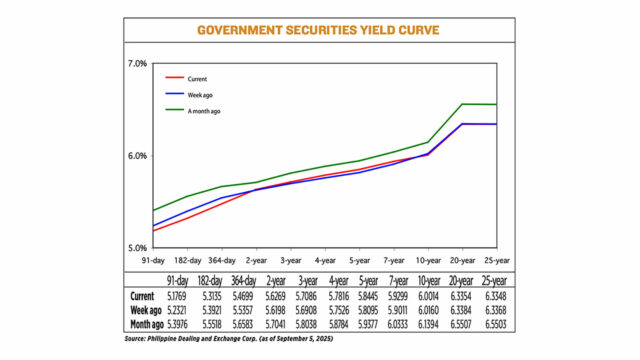
YIELDS on government securities (GS) were mixed last week as the market consolidated ahead of the release of key US and Philippine economic data.

GS yields, which move opposite to prices, inched down by 0.92 basis point (bp) on average week on week, based on PHP Bloomberg Valuation Service Reference Rates data as of Sept. 5, published on the Philippine Dealing System’s website.

At the short end, the rates of the 91-, 182-, and 364-day Treasury bills (T-bills) declined by 5.52 bps, 7.86 bps, and 6.58 bps week on week to 5.1769%, 5.3135%, and 5.4699%, respectively.

Meanwhile, at the belly, yields climbed across all tenors. The rates of the two- three-, four-, five- and seven-year Treasury bonds (T-bonds) rose by 0.71 bp (to 5.6269%), 1.78 bps (5.7086%), 2.9 bps (5.7816%), 3.5 bps (5.8445%), and 2.88 bps (5.9299%), respectively.

Lastly, at the long end, the 10-, 20-, and 25-year debt saw their rates go down by 1.46 bps (to 6.0014%), 0.3 bp (6.3354%), and 0.2 bp (6.3348%), respectively.

GS volume traded was at P63.87 billion on Friday, significantly lower than the P86.05 billion recorded a week earlier.

Noel S. Reyes, chief investment officer for Trust and Asset Management Group at Security Bank Corp., said in the Viber message that the GS market mostly consolidated at the start of the week following the Bureau of the Treasury’s (BTr) bond auction and as investors awaited the release of key US jobs data.

“This was due to a good run so far of yield movements the previous week and a correction of US bond yields that also gave some influence. Midweek, we saw some recovery and buying that lasted until the end of the week given increased confidence for a US rate cut this month from a cooling labor sector,” Mr. Reyes said.

Alessandra P. Araullo, chief investment officer at ATRAM Trust Corp., added in a Viber message that yield movements last week were mostly driven by positioning.

“The August CPI (consumer price index) print came in broadly as expected, comfortably within the BSP’s (Bangko Sentral ng Pilipinas) 2-4% target band, underscoring a still-benign inflation environment despite a modest pickup from July. On the supply front, the Bureau of the Treasury successfully raised P30 billion through its seven-year reissuance, with strong participation reflecting sustained investor appetite and improving confidence in local macro fundamentals,” Ms. Araullo said. “Taken together, these developments anchored sentiment and helped steady the curve, with market players treating the week’s moves more as positioning opportunities rather than a shift in underlying expectations.”

“Attention remains centered on the US labor market. The upcoming NFP (nonfarm payrolls) release will be key in shaping the Federal Reserve’s policy trajectory, and by extension, emerging market bond flows. A softer-than-expected print could reinforce rate cut expectations and extend support to local bonds, while a stronger print may reintroduce volatility via a repricing of US yields.”

The BTr on Tuesday raised P30 billion as planned from its offer of reissued 10-year bonds, that have a remaining life of seven years and 13 days at an average rate of 5.939%.

Meanwhile, Philippine headline inflation quickened to a five-month high of 1.5% in August from 0.9% in July, the government reported on Friday.

This was slower than 3.3% in the same month a year ago and was within the BSP’s 1%-1.8% forecast. It also marked the sixth straight month that the CPI was below the central bank’s 2-4% annual target.

For the first eight months, inflation averaged 1.7%, matching the BSP’s forecast.

On the other hand, US job growth weakened sharply in August and the unemployment rate increased to nearly a four-year high of 4.3%, confirming that labor market conditions were softening and sealing the case for a Federal Reserve interest rate cut later this month, Reuters reported.

Nonfarm payrolls increased by only 22,000 jobs last month after rising by an upwardly revised 79,000 in July, the US Labor department’s Bureau of Labor Statistics said on Friday. Economists polled by Reuters had forecast payrolls would rise by 75,000 jobs after a previously reported gain of 73,000 in July.

Revisions to the establishment survey data also showed payrolls declined by 13,000 jobs in June, the first drop since December 2020, rather than rising by 14,000, as had been reported last month.

Financial markets expect the Fed will deliver a quarter-percentage-point rate cut at its Sept. 16-17 policy meeting, with two more such moves at its remaining two meetings in 2025. The central bank has kept its benchmark overnight interest rate in the 4.25%-4.5% range since December.

For this week, Mr. Reyes said GS yields may continue to move with a downward bias.

“Inflation, though higher than expected, remains within the government’s 2-4% comfort range. Furthermore, our local bond market would continue to be influenced by the first policy cut of the Fed in two weeks given the weakness in all their key job indicators,” he said.

Ms. Araullo added that yield movements could be driven by the BTr’s T-bond offering this week as this will test the market’s appetite for duration. The Treasury will auction off P30 billion in reissued seven-year T-bonds on Tuesday that have a remaining life of four years and 10 months.

“Additionally, a sizable P288-billion bond maturity will inject fresh liquidity into the market, which may further fuel demand across the curve,” she said.

“However, investors should remain cautious of potential inflation surprises and renewed global volatility from fiscal or trade-related headlines. These dynamics suggest that while the near-term backdrop is supportive, positioning should remain nimble, with an eye on both domestic supply conditions and offshore catalysts.” — Abigail Marie P. Yraola with Reuters

ACMobility reaps global and local HR awards

From left are ACMobility Learning and Talent Management Head Mark Relova, business partner Telene Hirang, ACMobility Organization Development and Total Rewards Head Yeng Salatamos-Udtohan, HREA Judge and Presenter Mary Margaret Tan, ACMobility Chief People Officer Ariane Nava, ACMobility Culture and Employee Experience Head Jowee Jael-De Leon, ACMobility Employee Shared Services Head Cecile Hernandez, ACMobility Organization Development and Performance Management Head Trisha Ramos, and business partner Pete Suba. — PHOTO FROM ACMOBILITY

IN ITS FIRST full year of transformation since launching in March 1 last year, ACMobility is already being recognized on both local and global stages for “reshaping the future of mobility with purpose.”

In 2025 alone, the company achieved a series of milestones. At the HR Excellence Awards held in Manila last August, ACMobility was honored with the Excellence in Business Transformation award, while its CEO Jaime Alfonso Zobel de Ayala was named Most People-Focused CEO, a testament to the company’s human-centered approach to transformation. On the global stage, ACMobility was awarded Bronze for Best Transformation Strategy at the Stevie Awards for Great Employers in New York this September, joining leading organizations from around the world.

Earlier this year, the Employees’ Compensation Commission commended ACMobility in March for its Return-to-Work Assistance Program supporting Persons with Work-Related Disabilities (PWRDs), underscoring the company’s commitment to inclusivity and care.

“These recognitions affirm that transformation begins with people. By building a culture of inclusion, well-being, and growth, we empower every ACMobilizer to bring their best selves to work and to our customers. This is what makes our movement real and what will carry us forward as we shape a sustainable mobility ecosystem,” said ACMobility Chief People Officer Ariane Nava.

Mr. Zobel de Ayala added, “Being recognized in our first full year of transformation reflects the dedication of our people and our commitment to redefining mobility and reshaping the experience. At ACMobility, transformation is not just about business, it’s about empowering people, creating sustainable solutions, and leading the way for the industry,”

Since its rebranding, ACMobility has made bold strides in both its business and people agenda. Organizational growth was evident as headcount rose from 1,370 in 2023 to over 1,600 by mid-2025, with a target of surpassing 1,700 by yearend, driven largely by the expansion of the BYD brand and the Mobility Infrastructure Group. Business results also accelerated, with market share climbing from 4.9% in 2024 to 8% in the second quarter of 2025, proving that people transformation directly fueled business growth.

Most notably, ACMobility became the first automotive company in the Philippines to be certified as a Top Employer for 2025, affirming the global competitiveness and sustainability of its people-first strategy.

US independent director Jim Jarmusch proves surprise Venice winner

A scene from Father Mother Sister Brother. — LABIENNALE.ORG

VENICE — US indie director Jim Jarmusch unexpectedly won the coveted Golden Lion at the Venice Film Festival on Saturday with Father Mother Sister Brother, a three-part meditation on the uneasy ties between parents and their adult children.

Although his gentle comedy received largely positive reviews, it had not been a favorite for the top prize, with many critics instead tipping The Voice of Hind Rajab, a harrowing true-life account of the killing of a five-year-old Palestinian girl during the Gaza war.

In the end, the film directed by Tunisia’s Kaouther Ben Hania took the runner-up Silver Lion.

Divided into chapters set in New Jersey, Dublin, and Paris, Father Mother Sister Brother features an ensemble cast including Tom Waits, Adam Driver, Mayim Bialik, Charlotte Rampling, Cate Blanchett, Vicky Krieps, Indya Moore and Luka Sabbat.

Each installment drifts gently through domestic encounters where nothing much happens, but small gestures and silences sketch out the generational awkwardness that can beset families.

“All of us here who make films, we’re not motivated by competition. But this is something I truly appreciate, this unexpected honor,” said Mr. Jarmusch, who made his name in the 1980s with offbeat, low-budget works such as Down by Law.

In other categories, Italy’s Toni Servillo was named best actor for his wry portrayal of a weary president nearing the end of his mandate in La Grazia, directed by his long-time collaborator Paolo Sorrentino.

China’s Xin Zhilei won best actress for her role in The Sun Rises On Us All, a drama directed by Cai Shangjun that delves into questions of sacrifice, guilt, and unresolved feelings between estranged lovers who share a dark secret.

The Venice festival marks the start of the awards season and regularly throws up big favorites for the Oscars, with films premiering here over the past four years collecting more than 90 Oscar nominations and winning almost 20.

GAZA TO THE FORE
Venice has often been seen as the most glamorous and least political of the major film festivals, but in 2025 the movies that made the strongest impact focused on current events, with the ongoing Israeli invasion of Gaza casting a long shadow.

As he unveiled his own picture last weekend, Mr. Jarmusch acknowledged that he was concerned that one of his main distributors had taken money from a company with ties to the Israeli military.

The Voice of Hind Rajab, which uses the real audio of a young girl’s desperate pleas for help as her car comes under Israeli gunfire, was the fan favorite, winning a record 24-minute standing ovation at its premiere.

“Cinema cannot bring Hind back, nor can it erase the atrocity committed against her. Nothing can ever restore what was taken, but cinema can preserve her voice, make it resonate across borders,” Ben Hania said on Saturday night.

“Her voice will continue to echo until accountability is real, until justice is served.”

The best director nod went to Benny Safdie for The Smashing Machine, which starred Dwayne “The Rock” Johnson in the role of the real-life mixed martial arts pioneer Mark Kerr.

“To be here amongst the giants of the past and the giants here this year, it just blows my mind,” said Mr. Safdie, who has previously co-directed films with his brother Josh.

The special jury award went to Italy’s Gianfranco Rosi for his black-and-white documentary Below the Clouds, about life in the chaotic southern city of Naples, marked by repeated earthquakes and the threat of volcanic eruptions.

Among the movies that left Venice empty-handed were a trio of Netflix pictures, Kathryn Bigelow’s nuclear thriller A House of Dynamite, Guillermo del Toro’s re-telling of Frankenstein, and Noah Baumbach’s comedy-drama Jay Kelly.

No Other Choice by South Korea’s Park Chan-wook also failed to secure an award, despite strong reviews, likewise Bugonia by Yorgos Lanthimos, which starred Emma Stone.

The main jury was chaired by US director Alexander Payne, joined by fellow filmmakers Stéphane Brizé, Maura Delpero, Cristian Mungiu and Mohammad Rasoulof, alongside actresses Fernanda Torres and Zhao Tao.

AND THE WINNERS ARE…

GOLDEN LION: Father Mother Sister Brother directed by Jim Jarmusch (USA, Ireland, France production)

SILVER LION GRAND JURY PRIZE: The Voice Of Hind Rajab directed by Kaouther Ben Hania (Tunisia, France)

BEST DIRECTOR: Benny Safdie for The Smashing Machine (USA)

BEST ACTRESS: Xin Zhilei for The Sun Rises On Us All (China)

BEST ACTOR: Toni Servillo for La Grazia (Italy)

BEST SCREENPLAY: Valerie Donzelli and Gilles Marchand for A Pied D’Oeuvre (France)

SPECIAL JURY AWARD: Below the Clouds directed by Gianfranco Rosi (Italy)

BEST YOUNG ACTOR/ACTRESS: Luna Wedler for Silent Friend (Germany, France, Hungary) — Reuters