Home Blog Page 9868

Marikina River project could include basin to store excess floodwater — World Bank

THE PROPOSED $700-million Pasig-Marikina River Basin Flood Management Project for Metro Manila’s flood control system could feature a retention basin to boost its climate resilience, the World Bank said, citing preliminary design studies.

The World Bank, which will partially finance the project, said completion of the design is targeted for the end of June, along with other feasibility studies for the flood control project such as a flood forecasting and early warning system for Metro Manila and its surrounding areas, as well as the design of the institutional arrangements for sustainable flood management.

It said the retention basin with a capacity to impound about 12 million cubic meters of floodwater will “boost climate resilience” as the proposed Marikina Dam alone is deemed insufficient to rule out flooding in the event of a 100-year rainfall event.

It said the proposed Marikina Dam to be constructed across the Marikina River will be an 81-meter high concrete gravity dam with a 350-meter crest and a 90 million cubic-meter gross storage capacity.

“The primary function of the proposed dam should be flood management, which is a public good, and public resources should be used for this. The dam is designed to reduce the maximum river discharge of a 100-year rainfall event in the catchment by about 85% from an inflow of 3,460 cubic meters per second to an outflow of about 600 cubic meters per second by temporarily storing flood waters for regulated discharge after the storm event. This will require the reservoir to be almost empty during the rainy season to capture floods,” the bank said.

The proposed Pasig-Marikina River Basin Flood Management Project will be implemented by the Department of Public Works and Highways.

The World Bank will provide $400 million of the total project cost of $700 million by next year, while the $35 million will come from other sources, leaving a funding gap of $265 million.

“Although Metro Manila constantly has issues related to urban flooding, it also began to experience water scarcity since March 2019. Inadequate and intermittent water supply affects customers in many parts of Metro Manila. Delays in developing additional water sources and increasing demand for water due to population growth have contributed to the water supply crisis, which needs to be addressed along with flood reduction measures,” it said. — Beatrice M. Laforga

House panel, BoC form TWG to address import valuation

THE HOUSE COMMITTEE on Ways and Means and the Bureau of Customs (BoC) have formed a technical working group (TWG) to address concerns relating to the National Value Verification System (NVVS).

“Committee and BoC form NVVS TWG to thresh out issues,” Rep. Jose Ma. Clemente S. Salceda of Albay’s second district, who chairs the panel, told reporters in a phone message Monday.

The Committee earlier flagged the NVVS implementation as illegal, considering it allowed the imposition of unequal levies on similar goods.

The NVVS is not authorized by the Customs Modernization and Tariff Act.

Rep. Jericho Jonas B. Nograles, a Ways and Means Committee member and PBA party-list legislator, said Sunday that Customs Commissioner Rey Leonardo B. Guerrero could be liable for graft and corruption if he continues to implement the System.

The Bureau has twice been asked by the Committee to stop implementing NVVS.

Mr. Guerrero had asked the Committee to reconsider its proposal to suspend the system, while the Bureau is in the process of putting in place measures that will improve the system.

“These measures are included in the Customs Modernization Project sponsored by the World Bank, which is already subject to approval of the National Economic Development Authority (NEDA),” Mr. Guerrero said in a Feb. 12, 2020 letter to the Committee.

He said the Committee that the continuation of the NVVS operation will “not be used to violate the law and our international commitments to customs valuation,” he added. — Charmaine A. Tadalan

Second chance at tax amnesty on delinquency

If you failed to qualify for the tax amnesty on delinquencies, there may be a second chance for you.

On Valentine’s Day last year, the President signed the Tax Amnesty Act (Republic Act No. 11213) which included the Tax Amnesty on Delinquencies (TAD). The Bureau of Internal Revenue (BIR) then issued the Implementing Rules on TAD (Revenue Regulations No. 4-2019) on April 8, 2019, which became effective on April 24. Although it is not as generous as the vetoed general tax amnesty, it was still a welcome development. As the saying goes, beggars can’t be choosers and, after all, tax amnesty is a privilege and not a right.

Unlike the more forgiving general tax amnesty that could have been availed of by most taxpayers with unpaid taxes and penalties, TAD covers only taxpayers with delinquent accounts as of April 24, 2019. Taxes covered include all internal revenue taxes for the taxable year 2017 and prior years.

A delinquent account, as defined in the implementing rules, pertains to tax due arising from a BIR audit that has been issued Assessment Notices [final assessment notice (FAN)/ final letter of demand (FLD)] that have become final and executory due to the following instances: (a) failure to pay the tax due on the prescribed due date provided in the FAN/FLD and for which no valid protest, whether a request for reconsideration or reinvestigation, has been filed within 30 days from receipt thereof; (b) failure to file an appeal to the Court of Tax Appeals (CTA) or an administrative appeal before the Commission of Internal Revenue (CIR) within 30 days from receipt of the decision denying the request for reinvestigation or reconsideration; or (c) failure to file an appeal to the CTA within 30 days from receipt of the decision of the CIR denying the taxpayer’s administrative appeal to the Final Decision on Disputed Assessment (FDDA).

Based on the discussion above, taxpayers who would have wanted to avail of the amnesty, but protested the assessment within the time allowed by law as of April 24, 2019 would have missed their chance.

The TAD implementing rules triggered many questions from interested taxpayers, which is why on May 22, 2019, a few months after the issuance of RR No. 4-2019, the BIR issued Revenue Memorandum Circular (RMC) No. 57-2019, clarifying the frequently asked questions of taxpayers on TAD. Interestingly, one of the clarifications under RMC No. 57-2019 provided that tax liabilities covered by a FAN that was timely protested, yet the protest was withdrawn on or before April 24, 2019, shall be considered a delinquent account qualified for tax amnesty. It was as if there was no protest filed, provided that the delinquent accounts pertain to taxable year 2017 and prior years and that the period to protest lapsed on or before April 24, 2019.

However, the clarification was issued on May 22, 2019 — way past the April 24 deadline. Hence, many taxpayers were unable to avail of the opportunity to withdraw their protest.

Fortunately, there is a second chance.

On Feb. 6, 2020, the BIR issued RMC No. 11-2020, amending the clarification to extend the withdrawal of the protest until April 23, 2020 to qualify their assessments as delinquent accounts. RMC No. 11-2020 provided that, if the protest or appeal was withdrawn on or before April 23, 2020 and the FAN/FLD or FDDA was received on or before March 25, 2019, the effect is as if no protest or appeal was filed. Therefore, the assessment will have become final and executory as of April 24, 2019, because then the 30-day period counted from the receipt of the FAN, within which the taxpayer is allowed to file a protest or appeal, would have already lapsed. This gives taxpayers a second chance at withdrawing their protest.

In addition to an opportunity to withdraw the protest, RMC No. 11-2020 also reminded taxpayers that the protest may actually be invalid in the first place, and consequently qualifying the assessment notice as final and executory and the assessment, therefore, delinquent. RMC No. 11-2020 provided the following instances when a protest is invalid: (1) the protest to FAN/FLD was filed beyond 30 days from receipt of the FAN/FLD; (2) the appeal to the FDDA was filed beyond 30 days from receipt of the FDDA; (3) the protest to FAN/FLD was not fled with the duly authorized representative of the CIR who signed the FAN/FLD; (4) the appeal to the FDDA (i.e., motion for reconsideration) was not filed with the office of CIR; (5) the protest/appeal failed to state the applicable law, rules and regulations, or jurisprudence on which it is based; and (6) the request for reinvestigation did not specify the newly discovered or additional evidence that the taxpayer intends to present, as required in a valid protest.

If the protest filed by the taxpayer is invalid, the taxpayer will qualify for tax amnesty after the lapse of the 30-day period provided by law to protest the assessment. This means that the FAN/FLD/FDDA should have been received by the taxpayer on or before March 25, 2019 so that the assessment will become final and executory on or before April 24, 2019.

RMC No. 11-2020 also provided an extended period of 30 days to submit the complete documentary requirements to fully comply with the availment of the tax amnesty, provided that the taxpayers have already secured the Certificate of Tax Delinquencies (CTD)/Tax Liabilities and endorsement of the Acceptance Payment Form (APF) and paid the amnesty tax due on or before April 23, 2020, the last day of the availment period.

A word of caution, however, for those who plan to withdraw their protest: taxpayers should consider the costs and benefits of withdrawing the protest to avail of the tax amnesty, because this is a ‘touch-move’ decision. The taxpayer should try to assess which would result in more cost savings, because there is a possibility that the amnesty could actually be higher than what the taxpayer could have settled if the assessment was closed through the usual assessment process. This is true especially if the assessment is significantly higher and far from the true deficiency of the taxpayer. For instance, the basic tax assessed is P50 million, but the actual deficiency is only P2 million, as supported by legal grounds and documents presented by the taxpayer. The 40% amnesty tax amounting to P20 million may be too much. Furthermore, for taxpayers who have partially settled the assessment, the amount paid cannot be credited against the tax amnesty, as computed. The basis for computing the tax amnesty rate is the basic tax assessed less the amount already paid.

Another thing taxpayers need to watch out for is the timeline for availing of tax amnesty. Taxpayers should ensure that they allot ample time to process the withdrawal of protest, file the Tax Amnesty Return, secure the Certificate of Tax Delinquencies/Liabilities and the approved Acceptance Payment Form, and settle the tax amnesty due on or before April 23, 2020. Even if the taxpayer withdraws the protest on April 23, 2020, it would already be too late for the application. With only a few months away from the deadline, seeking professional advice before making a critical decision may be a good investment.

Let’s Talk Tax is a weekly newspaper column of P&A Grant Thornton that aims to keep the public informed of various developments in taxation. This article is not intended to be a substitute for competent professional advice.


Juvy H. de Jesus is a manager of Tax Advisory & Compliance division of P&A Grant Thornton, the Philippine member firm of Grant Thornton International Ltd.

pagrantthornton@ph.gt.com

Peso inches lower on virus fears

THE PESO traded sideways against the greenback on Monday with the United States on holiday and as the market looked out for developments related to the coronavirus disease 2019 (COVID-19) outbreak.

The local unit ended trading at P50.57 versus the dollar on Monday, weakening by a centavo from its Friday finish of P50.56.

The peso opened the session at P50.58 per dollar. Its weakest showing for the day was at P50.61, while its strongest was at P50.52 against the greenback.

Dollars traded rose to $971.5 million from $831.5 million on Friday.

“US is on a holiday today so not much data today… It was headline trading that followed COVID 2019 developments,” a trader said in a phone call on Monday.

“Due to additional cases reported since this morning, nag-weaken on emerging markets (emerging markets weakened),” the trader added.

US markets were closed in observance of Presidents’ Day.

Meanwhile, Reuters yesterday cited data from China’s National Health Commission which reported that the death toll in the mainland grew by 105 to hit 1,770 as of end-Sunday.

Confirmed infections in the country also increased by 2,048 to 70,548 cases, of which 10,844 people have already been treated and released from the hospital.

More than 94% of the new cases on Sunday were in the central province of Hubei, where the outbreak was born. The province also saw 100 deaths on Feb. 16.

Meanwhile, another trader said the slightly weaker local unit came on the back of recent dovish signals from the central bank.

“The peso slightly weakened amid dovish signals from BSP (Bangko Sentral ng Pilipinas) Governor [Benjamin E.] Diokno and as participants remained cautious amid lingering coronavirus concerns,” the second trader said in an e-mail.

On Friday, Mr. Diokno said the BSP may cut rates by another 25 basis points (bps) as early as the second quarter following the 25-bp reduction it announced on Feb. 6.

Rates on the BSP’s reverse repurchase, overnight lending and deposit facilities currently stand at 3.75%, 4.25%, and 3.25%, respectively.

The first trader said the peso-dollar market will continue to track headlines related to COVID-19 on Tuesday.

“The local currency might weaken on market positioning ahead of likely less dovish cues from the Federal Reserve policy meeting minutes due to be released later this week,” the second trader said.

For today, the first trader expects the peso to play around the P50.50-P50.80 band, while the second trader gave a forecast range of P50.50-P50.70. — L.W.T. Noble with Reuters

PSE index ends higher as worries over virus ease

By Denise A. Valdez, Reporter

THE MAIN INDEX closed higher on Monday as investor worries over the coronavirus disease 2019 (COVID-19) started to wane and bargain hunters flocked the market in anticipation of corporate earnings.

The benchmark Philippine Stock Exchange index (PSEi) added 44.85 points or 0.61% to end at 7,326.85 yesterday, while the broader all shares index increased 19.59 points or 0.45% to 4,338.70.

“Local shares notched a gain to start the week, as COVID-19 new cases declined sharply…,” Regina Capital Development Corp. Head of Sales Luis A. Limlingan said in a mobile message Monday.

Reuters reported over the weekend that the number of confirmed cases of COVID-19 cases in China dropped 21.6% on Saturday, citing the country’s health commission, which said it is a result of its efforts to stop the spread of the virus. Mr. Limlingan said this helped temper worries of investors over the economic impact of the epidemic.

But for Christopher John Mangun, research head at AAA Southeast Equities, Inc., the general sentiment of investors is still “extremely cautious despite the lack of panic selling.”

“Minor gains in several blue chips allowed the PSEi the end slightly higher despite average trading volumes and more foreign outflows… Most investors are on the sidelines waiting for a better environment,” he said in an e-mail.

Some PSEi members that gained yesterday were Metro Pacific Investments Corp. (3.58%), SM Investments Corp. (2.32%) and Aboitiz Equity Ventures, Inc. (2.13%).

Philstocks Financial, Inc. Senior Research Analyst Japhet Louis O. Tantiangco said bargain hunters also helped lift the market yesterday. “Investors took opportunities from Friday’s dip in anticipation for the upcoming 2019 full year earnings reports (of listed firms),” he said in a text message.

He added the expected rate cut from the central bank in the second quarter also helped improve market sentiment yesterday.

Sectoral indices were mixed at the close of trading. Holding firms improved 95.26 points or 1.35% to 7,147.23; industrials advanced 54.66 points or 0.61% to 8,991.30; and financials added 5.66 points or 0.32% to 1,744.61.

On the other hand, mining and oil lost 28.56 points or 0.40% to 7,030.08; services dropped 4.36 points or 0.30% to 1,435.94; and property slipped 1.77 points or 0.04% to 3,926.88.

Value turnover stood at P7.84 billion with 782.60 million issues changing hands, up from the previous session’s P6.45-billion worth of 888.41 million issues.

Advancers beat decliners, 107 against 77, while 49 names closed unchanged.

Net foreign selling declined to P336.82 million yesterday from Friday’s P864.82 million.

COVID-19: Not just a global public health emergency

The World Health Organization (WHO) declared the 2019 novel coronavirus (2019-nCoV) disease outbreak as Public Health Emergency of International Concern (PHEIC) on Jan. 30. The WHO International Health Regulations (IHR, 2005), 3rd edition defines PHEIC “as an extraordinary event which is determined, as provided in these Regulations (i) to constitute a public health risk to other States through the international spread of disease and (ii) to potentially require a coordinated international response.” Public health risk is defined as “a likelihood of an event that may affect adversely the health of human populations, with an emphasis on one which may spread internationally or may present a serious and direct danger.” WHO Director-General Dr. Tedros Adhanom Ghebreyesus explained during a news conference at WHO’s Geneva headquarters that the declaration of 2019-nCov outbreak as PHEIC was made because of “the potential for the virus to spread to countries with weaker health systems, and which are ill-prepared to deal with the disease outbreak.” At the time of the declaration, the WHO recorded 7,834 confirmed cases, including 7,736 in China, and 98 cases in 18 countries outside China, plus eight cases of human-to-human transmission in four countries: Germany, Japan, Vietnam, and the United States of America. WHO also recorded 170 deaths all in China due to the outbreak.

The 2019-nCov was first reported from Wuhan, China on Dec. 31, 2019. Almost six weeks later, on Feb. 11, the WHO announced an official name for the disease. The disease caused by 2019-nCov was officially named COVID-19, where “CO” stands for “corona,” “VI” for “virus,” and “D” for “disease” while “19” was for the year the outbreak was first identified in December 2019.

Ghebreyesus explained that under agreed guidelines between WHO, the World Organisation for Animal Health, and the Food and Agriculture Organization of the United Nations, there was a need “to find a name that did not refer to a geographical location, an animal, an individual or group of people and which is also pronounceable and related to the disease.” Based on “WHO Best Practices for the Naming of New Human Infectious Diseases” document dated May 2015, the aim is “to minimize unnecessary negative impact of disease names on trade, travel, tourism or animal welfare, and avoid causing offence to any cultural, social, national, regional, professional or ethnic groups.”

Almost two weeks after being declared as PHEIC, COVID-19 has already infected 42,708 people in China and 393 people in 24 countries worldwide. There have been 1,017 deaths in China, mostly in Wuhan in Hubei province, while one death of a Chinese national outside China was reported in the Philippines. A second death due to COVID-19 was reported in Hong Kong.

During the news conference wherein the coronavirus outbreak was declared as PHEIC, Ghebreyesus congratulated China “for the extraordinary measures it has taken to contain the outbreak despite the severe social and economic impact those measures are having on the Chinese people.” But has China succeeded in containing the outbreak? And didn’t WHO’s declaration of the disease outbreak as PHEIC and renaming of the disease come a little too late?

The numbers of confirmed cases and deaths keep on increasing despite global and national responses to COVID-19. As of Feb. 160, the “WHO Coronavirus disease 2019 (COVID-19) Situation Report — 27” recorded 51,857 laboratory-confirmed cases (1,278 new) globally; 51,174 laboratory-confirmed cases (1,121 new), and 1,666 deaths (142 new) in China; and 683 laboratory-confirmed cases (157 new) in 25 countries and three deaths (one new) outside of China.

Various international news services have documented how China’s lockdown of a number of its cities has caused misery among its own people and caused a flared up of old anti-government sentiments. Outside China, the effects of COVID-19 are quite alarming.

In what seemed like an outbreak of anti-China and anti-Chinese hatred and revulsion, anti-China and anti-Chinese posts, messages, and tweets flooded cyberspace in almost every part of the world. Since the outbreak, international and national news reports were never empty of anti-Chinese incidents and confrontations in public places, including in institutions of higher learning.

While containing the COVID-19 outbreak remains high on the global and national agenda, COVID-19 has created or is creating another outbreak, inciting “moral panic” across the globe resulting in increased feelings of fear and anxiety exacerbated by feelings of lack of protection and certainty.

Who is manipulating the COVID-19 outbreak to cause moral panic across the globe? What is there to gain for these manipulators of moral panic or these moral entrepreneurs?

In his 1972 book Folk Devils and Moral Panics, known moral panic theorist Stanley Cohen defined moral panics in the following manner:

“Societies appear to be subject, every now and then, to periods of moral panic. A condition, episode, person or group of persons emerges to become defined as a threat to societal values and interests; its nature is presented in a stylized and stereotypical fashion by the mass media; the moral barricades are manned by editors, bishops, politicians and other right-thinking people; socially accredited experts pronounce their diagnoses and solutions; ways of coping are evolved or (more often) resorted to; the condition then disappears, submerges or deteriorates and becomes more visible. Sometimes the object of the panic is quite novel and at other times it is something which has been in existence long enough but suddenly appears in the limelight” (p.9).

Is there a justified cause for moral panic among us?

At the State level, the COVID-19 outbreak revealed not only the increased vulnerabilities of States, particularly those with weak public health infrastructures, it also intensified citizens and media’s increased demand for transparency and accountability from their governments in spite of governments’ increased call for tolerance and calm from their citizens and media.

At the global level, COVID-19 re-opened debates on the question, “Is the world better prepared?” In terms of a global public health response, COVID-19 resurrects debates about the weaknesses or limitations of the existing global health security regime. But have we created a global security regime? Empirical evidence shows that the answer is a “No.”

First, the WHO is considered as the supranational health authority. Despite its tremendous success in new Health Emergencies Programs and revised International Health Regulations (IHR 2005), all aimed at enabling a faster, more effective response to outbreaks and emergencies, the organization faces financial capacity limitations that affect the effectiveness of its organization and operations.

Second, the IHR (2005) requires all countries to develop, strengthen, and maintain eight core public health capacities, namely: 1.) national legislation, policy and financing; 2.) coordination and national focal point communications; 3.) surveillance; 4.) response; 5.) preparedness; 6.) risk communication; 7.) human resources; and, 8.) laboratory. However, the document “Lessons learnt from implementation of the International Health Regulations: a systematic review,” submitted to the WHO in 2017, revealed that “[g]iven varying levels of health and socioeconomic development across countries, there have been challenges in implementing these requirements… [b]y the original deadline of June 2012, only 42 (22%) of the 192 WHO Member States had met the core capacity requirements” (p. 110).

Third, issues of State sovereignty clash with the WHO’s mandate and its global legislation in the form of the IHR. The IHR 2005 has strengthened WHO’s position as a central global force with authority and accountability in the field of international health. But WHO’s position is constrained when States assert their national sovereignty.

The challenges are real as captured by former WHO Director-General Dr. Margaret Chan in her report, titled, “Ten years in public health 2007 — 2017” (2017) — “the factors that govern global health security extend well beyond the mandate of WHO and its capacity to respond… [m]uch responsibility falls to countries… affected countries need to report unusual disease events promptly and openly… [and] countries move out of the sanctuary of national sovereignty in the interest of common good” (p.26).

If not WHO, who will lead the charge of reforming the existing global health security regime? If the concept of WHO as a supranational health authority is evolving, then is the global health security regime still in the making? How many more disease outbreaks and how many more lives must be lost to disease outbreaks to attain a global health security regime? Finally, is the world better prepared to face COVID-19? Or is this article contributing to moral panic around the world?


Diana J. Mendoza, PhD, is Chair of the Department of Political Science at the Ateneo de Manila University.


Why PSALM and NEA should go


Recently there was a story on the huge debt of the Power Sector Assets and Liabilities Management Corp. (PSALM) because it could not collect P59 billion from independent power producers (IPPs) and electric cooperatives (ECs). That is a big amount and PSALM continues to collect various universal charges (UC) for the various stranded costs and debts of the National Power Corp. (NPC).

The UC and PSALM were created by the EPIRA law of 2001. PSALM has three core functions: (a) privatize NPC generation and Transco transmission assets, (b) manage liabilities of NPC debts, obligations of electric coops to NEA and other agencies, and (c) administer the collection and disbursement of UC funds.

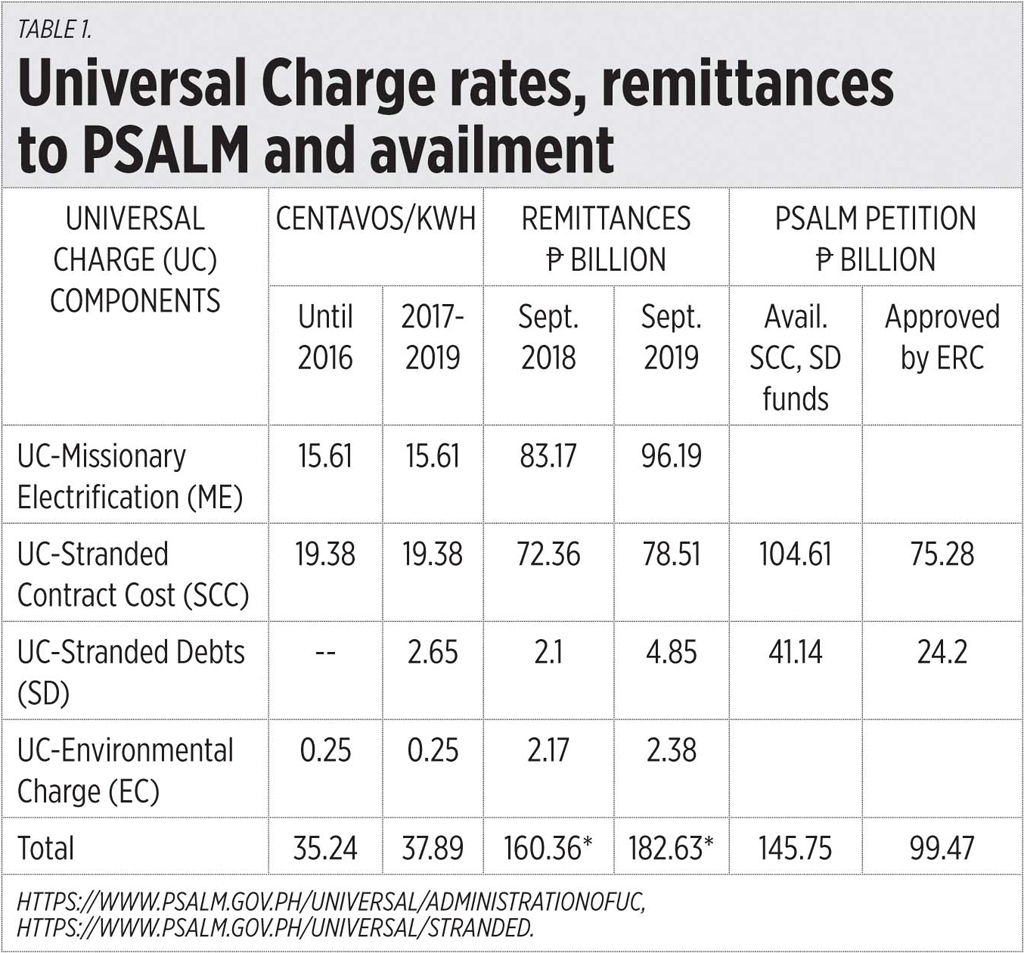
The current UC rate of nearly 38 centavos/kWh is big and UC remittances received by PSALM are big, and it petitions the ERC to avail of huge funds (see Table 1).

The four UCs components are as follows:

1. ME — a subsidy for electricity supply in small island provinces and far-flung areas.

2. SCC — excess of the contracted cost of electricity by NPC over actual selling price.

3. SD — financial obligations of NPC still unliquidated by privatization proceeds of NPC assets.

4. EC — for watershed rehabilitation and management.

PSALM is administering a huge pile of cash from us electricity consumers — P183 billion as of September 2019. Two sore thumbs sticking out here.

One, the ME subsidy for small island provinces and far away areas seem like they will go on forever when they should have been eliminated. Debureaucratize the construction of their own baseload, 24/7 power plants and just augment with big gensets running on diesel during peak hours. Then NPC-SPUG (small power utility group) can be privatized and/or eliminated as well.

Two, those old SCCs and SDs by NPC have been there since the early 1990s, and after nearly three decades they are still there and the UC rates do not seem to decline through time — Wow! PSALM, being a generation player managing and operating unprivatized NPC plants, can “sell low” power at a loss then raid the UC funds to recover its losses and appear to be financially healthy. This is lousy and creates a moral hazards problem. PSALM will have little or no incentive to hasten the privatization of the remaining NPC plants. It can become a forever bureaucracy funded by forever UC subsidies, and it can distort competition in the Philippines electricity market. PSALM should go.

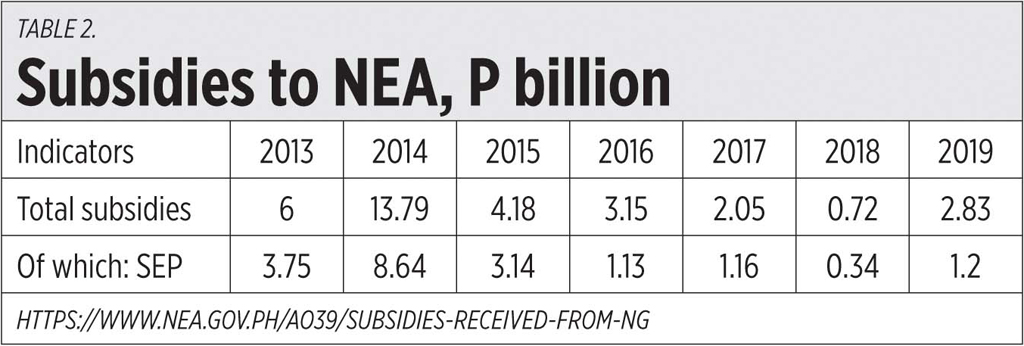
On ECs, they are created by politics via Congressional franchising, monitored and even pampered by politics via the National Electrification Administration (NEA). With such high political backing, many ECs are either mismanaged and/or remain inefficient, with persistent blackouts for their franchise areas. Some also do not pay their gencos. ECs run to the NEA for loans instead of commercial banks. There are huge taxpayers subsidies given to NEA annually, mostly for sitio electrification program (SEP, see Table 2).

Around 2017, the Department of Energy identified 17 ECs that are chronic failures when it comes to providing satisfactory services to their customers — ALECO (Albay), CASURECO III (Camarines Sur), FICELCO (Catanduanes), MASELCO (Masbate), OMECO (Occidental Mindoro), ORMECO (Oriental Mindoro), and PALECO (Palawan). Other problematic ECs are PELCO (Pampanga), BASELCO (Basilan), LASURECO (Lanao), SULECO (Sulu), and ZAMCELCO (Zamboanga), DANECO (Davao del Norte).

All ECs should become corporations and depoliticized, and be registered with the Securities and Exchange Commission and not with NEA. We now have one-person corporations, so how come these big ECs cannot be corporatized? NEA as regulator-bureaucracy should go, at least its monitoring function of ECs.

Last week, I saw one article entitled “MVP’s monopoly of power and water supply.”

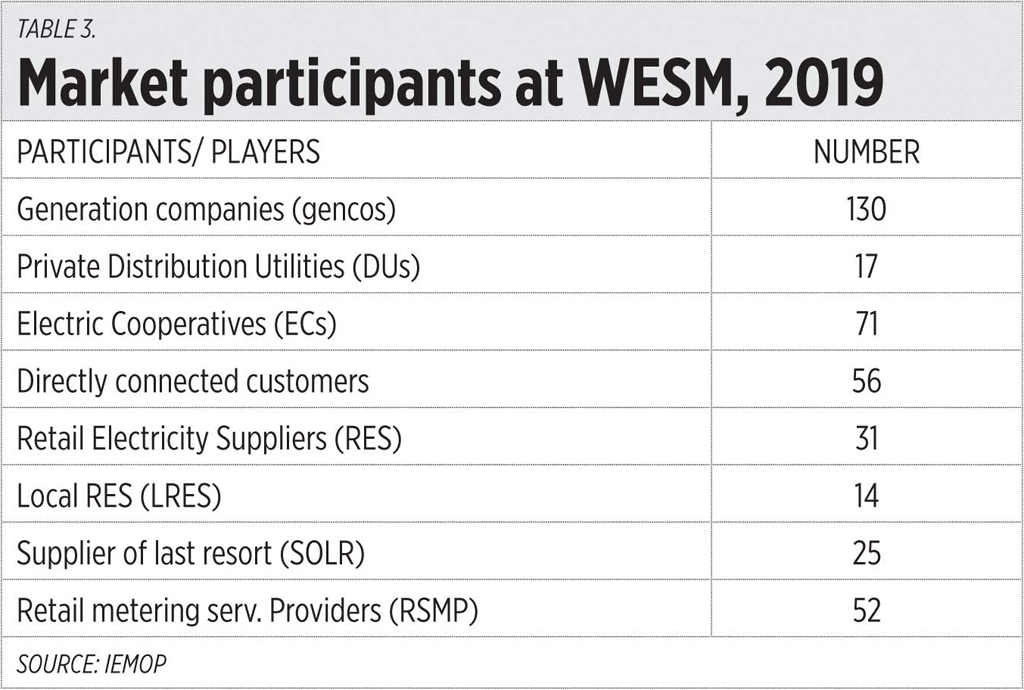
Fake news. There is no such thing as a “monopoly of power,” whether by MPIC or San Miguel or Ayala, etc., whether in power generation, in power distribution, or retail supply. See the list of players at the Wholesale Electricity Spot Market (WESM) for the Luzon and Visayas grids only (see Table 3).

Nationwide, including the Mindanao grid, there are a total of 155 electricity distributors: 21 DUs, 11 Ecozones, and 123 ECs. And to say there is a “monopoly of water supply” is also fake news. There are 584 water distributors nationwide.


Bienvenido S. Oplas, Jr. is the president of Minimal Government Thinkers.

minimalgovernment@gmail.com

Has DICT Undersecretary Rio decided to stay on the tiger?

On Feb. 3, Undersecretary of the Department of Information and Communications Technology (DICT) Eliseo Rio, Jr. told CNN Philippines, “I filed my resignation and (am) awaiting acceptance of the President.” He said he sent his letter to Malacañang on Jan. 31.

He gave as the reason for his resignation his conflict with other officials in the department. “I cannot work with the undersecretaries and assistant secretaries. I’m supposed to be Undersecretary of Operations, but they are not involving me in decisions. Operations and intelligence work are very close, so whatever intel we get, Operations must be involved. I might as well get out, the salary being given to me would be a waste.”

Mr. Rio also questioned the need for a P400 million confidential fund for the agency in 2019 — an amount which DICT Secretary Gregorio Honasan put in the DICT’s budget when he was still a senator. “As far as I’m concerned, DICT does not need any confidential funds. It is not our mandate to conduct surveillance and intelligence activities. I would rather have it given to the National Bureau of Investigation and the police,” Mr. Rio said.

In an interview over ANC on the same day, Mr. Rio said, “I feel that I’m no longer needed in DICT. Now I’m 75. I thought that now would be time to really spend my time with my family. Secretary Honasan has brought in young people and maybe they should be given more chance to work.”

Mr. Rio is a licensed electronics and communications engineer. He placed 4th in the 1971 board exams. He held various positions in the Armed Forces of the Philippines, including as head of the AFP Research and Development Center Communication-Electronics R&D Group, group commander of Military Intelligence Group 21 and Electronics Technical Intelligence Group of the Intelligence Service, Assistant Chief of Staff for Communication, Electronics and Information System of the Philippine Army, Chief of the Armed Forces of the Philippines Communication, Electronics and Information Systems Service, and Deputy Chief of Staff for Communications, Electronics and Information Systems. He retired from the Armed Forces as Brigadier General in October 2000.

Because of his extensive background in Communications, he was appointed to the National Telecommunications Commission in 2001 and, beginning September 2017, was the DICT officer-in-charge. On Oct. 10, 2017, following the resignation of Rodolfo Salalima as DICT Secretary, he was appointed officer-in-charge of the department upon the instructions of President Duterte. He was then elevated to Acting Secretary of the department in May 2018. People expected him to be appointed Secretary of DICT. To their surprise, the President announced that Mr. Honasan, who is not an electronics engineer nor a communications professional, would be the DICT Secretary upon the expiration of his term as senator in June 2019.

President Duterte still has to act on Mr. Rio’s resignation. If the President accepts it, he would be the first member of the Duterte Cabinet to resign on the basis of irreconcilable difference with his superior. He would be included in that honorable class of past Cabinet members who resigned on the basis of principle: Marcos’ Executive Secretary Rafael Salas, Arroyo’s Ombudsman Simeon Marcelo, Secretaries Corazon Soliman of Social Welfare, Florencio Abad of Education, Cesar Purisima of Finance, Juan Santos of Trade and Industry, Emilia Boncodin of Budget and Management, Rene Villa of Agrarian Reform, and Benigno Aquino III’s Transportation and Communications Secretary Jose de Jesus.

However, on Feb. 7, Messrs. Honasan and Rio released a joint statement. Here are excerpts of it:

“We, Secretary Gregorio B. Honasan II, and Undersecretary Eliseo M. Rio, Jr., issue this statement to put to rest any question on the integrity of the Department of Information and Communications Technology.

“We assure the Filipino people and the members of our DICT family that we have reassessed the situation, and have mutually agreed to settle our differences. The Confidential Expenses and its use in support of your DICT’s mandate are not in question. In fact, it was Undersecretary Rio who proposed the inclusion of the Confidential Expense item in the 2019 General Appropriations Act. Let it also be clarified that Undersecretary Rio’s resignation was due to personal reasons, and not due to any rift with the Secretary. The use of the Confidential Expense is for lawful monitoring and surveillance of systems and network infrastructure only.

“Undersecretary Rio stands behind the Secretary and gives his full support to your DICT’s programs and projects.”

It is supposed to be a joint statement of Mr. Honasan and Mr. Rio but it reads like the statement of Mr. Honasan alone as it refers to Mr. Rio as a third person. Parts of the statement are contradictory. “Undersecretary Rio’s resignation was… not due to any rift with the Secretary” runs counter to “We have ….mutually agreed to settle our differences.” That Mr. Rio resignation was due to personal reasons is in conflict with what Mr. Rio had told media. In the interview with CNN Philippines he said, “I cannot work with the undersecretaries and assistant secretaries…. they are not involving me in decisions. I might as well get out” To ANC he said, “I feel that I’m no longer needed in DICT. Secretary Honasan has brought in young people and maybe they should be given more chance to work.”

The use of the Confidential Expense for lawful monitoring and surveillance of systems and network infrastructure is precisely what Mr. Rio questioned. The sentence “Undersecretary Rio stands behind the Secretary” betrays who the real writer of the statement is.

Mr. Rio said that if President Duterte turns down his resignation, he would accept the position offered him by Secretary Honasan: Head of the National Broadband Plan Backbone and Free Wi-Fi Internet Access in Public Places. There is a Chinese idiom “Ride a tiger” which means that once one finds himself in a dangerous situation, getting out of it can be detrimental to one’s career or aspirations, even threatening to his life. It comes from the phrase “he who rides the tiger is afraid to dismount or finds it hard to get off it.” Has Mr. Rio realized the consequence of resigning from the Duterte Cabinet for the reasons he has stated that he has decided to stay on the back of the tiger?

However, US President John F. Kennedy left words of wisdom regarding riding a tiger. On his inauguration as president, he said, “Remember that in the past those who foolishly sought power by riding the back of the tiger ended up inside.”


Oscar P. Lagman, Jr. is a retired corporate executive, business consultant, and management professor. He has been a politicized citizen since his college days in the late 1950s.

Resilience and out-of-process events

I had lunch with Gina. She was diagnosed 10 years ago at age 40 with breast cancer. Stage 3c, meaning advanced. Nineteen of the 25 lymph nodes the doctors found were malignant. She underwent surgery, six sessions of chemo, and 33 radiation sessions. Each chemo session left her sick and nauseous for a week. It left a metallic taste in her mouth, and she could not eat anything.

“What was the toughest part of all this?” I asked. “The day I found out!” she replied. “My heart fell to the floor. I cried. And cried some more. Then, it stopped there. I told myself. I already have cancer. I am not going to make it worse by feeling sorry for myself. I am going to do this. I am going to get myself well.” That is resilience.

Resilience is the ability to deal with, recover, and grow from adversity. In a corporate setting, it is the ability to deal with, recover, and grow from “out-of-process” events. Any organization has out-of-process events. These are events for which a process has not been defined. For example, an overturned bus blocking delivery vans can mean no food to sell at a fast-food outlet. This is an out-of-process event or, in our definition of resilience, the “adversity.” Resilient people, because of the way they think and behave, approach the problem to solve it. The non-resilient ones withdraw from the problem to avoid it. Company growth comes from those who habitually view out-of-process events as opportunities, and proactively step forward to solve them.

There are several drivers of resilience. One model for workplace resilience identifies four component skills: confidence, adaptability, purposefulness, and social support (Robertson, 2015).

The US Army and the University of Pennsylvania’s Positive Psychology Center have jointly designed a resilience model for the US Army Master Resilience Trainer course. This 10-day program teaches resilience skills for soldiers. The program develops six core competencies to build resilience and prepares one for adversity (Reivich and Seligman, 2011). These competencies work not only for soldiers preparing for war but also for you and me going through work and life’s troughs. The competencies are:

“(a) self-awareness — identifying one’s thoughts, emotions, and behaviors, and patterns in each that are counterproductive;

(b) self-regulation — the ability to regulate impulses, thinking, emotions, and behaviors to achieve goals, as well as the willingness and ability to express emotions;

(c) optimism — noticing the goodness in self and others, identifying what is controllable, remaining wedded to reality, and challenging counterproductive beliefs;

(d) mental agility — thinking flexibly and accurately, perspective taking, and the willingness to try new strategies;

(e) character strengths — identifying the top strengths in oneself and others, relying on one’s strengths to overcome challenges and meet goals, and cultivating a strength approach in one’s unit; and

(f) connection — building strong relationships through positive and effective communication, empathy, willingness to ask for help, and willingness to offer help” (Reivich and Seligman, 2011).

I define a resilience model with five elements. This model identifies the factors that enhance personal resilience:

1. Purposefulness — having a purpose worth pursuing makes you resilient.

2. Optimism — believing in your ability to bring about a better future outcome makes you resilient.

3. Flexibility — being able to assess challenges from different perspectives, find opportunities in them, and solve them creatively makes you resilient.

4. Self-control — being able to regulate thoughts, feelings, and behavior makes you resilient.

5. Social support — being able to rely on support from others makes you resilient.

Resilience is a trait that uniquely sets us apart from robots and their artificial intelligence algorithms. Resilient people are the ones who push an enterprise forward to deliver and grow.

Organizations should, therefore, invest in resilience-building programs. Resilience is good for people, and it is good for business.

The article reflects the personal opinion of the author and does not reflect the official stand of the Management Association of the Philippines or the MAP


Cliff Eala is the Founder and CEO at energy efficiency firm Synerbyte Ltd. and author of the book Sh*tty Places & Selfish People: 7 Rules of Engagement which is now available online at

www.cliffeala.com/books.

cliff.eala@synerbyte.com

map@map.org.ph

http://map.org.ph

Big Data won’t save you from coronavirus

By David Fickling

HOW OFTEN do you see a piece of economic or financial information revised upward by 45%? And how reliable would you regard a data set that’s subject to such adjustments?

This is the problem confronting epidemiologists trying to make sense of the novel coronavirus spreading from China’s Hubei province. On Thursday, the tally there surged by 45% — or 14,480 cases. The revision was largely due to health authorities adding patients diagnosed on the basis of lung scans to a previous count, which was mostly limited to those whose swab tests came back positive.

The medical data emerging from hospitals and clinics around the world are invaluable in determining how this outbreak will evolve — but the picture painted by the information is changing almost as fast as the disease itself, and isn’t always of impeccable provenance. Just as novel infections exploit weaknesses in the body’s immune defenses, epidemics have an unnerving habit of spotting the vulnerabilities of the data-driven society we’ve built for ourselves.

That’s not a comforting thought. We live in an era where everything seems quantifiable, from our daily movements to our internet search habits and even our heartbeats. At a time when people are scared and seeking certainty, it’s alarming that the knowledge we have on this most important issue is at best an approximate guide to what’s happening.

“It’s so easy these days to capture data on anything, but to make meaning of it is not easy at all,” said John Carlin, a professor at the University of Melbourne specializing in medical statistics and epidemiology. “There’s genuinely a lot of uncertainty, but that’s not what people want to know. They want to know it’s under control.”

That’s most visible in the contradictory information we’re seeing around how many people have been infected, and what share of them have died. While those figures are essential for getting a handle on the situation, as we’ve argued, they’re subject to errors in sampling and measurement that are compounded in high-pressure, strained circumstances. The physical capacity to do timely testing and diagnosis can’t be taken for granted either, as my colleague Max Nisen has written.

Early case fatality rates for Severe Acute Respiratory Syndrome were often 40% or higher before settling down to figures in the region of 15% or less. The age of patients, whether they get sick in the community or in a hospital, and doctors’ capacity and experience in offering treatment can all affect those numbers dramatically.

Even the way that coronavirus cases are defined and counted has changed several times, said Professor Raina MacIntyre, head of the University of New South Wales’s Biosecurity Research Program: From “pneumonia of unknown cause” in the early days, through laboratory-confirmed cases once a virus was identified, to the current standard that includes lung scans. That’s a common phenomenon during outbreaks, she said.

Those problems are exacerbated by the fact that China’s government has already shown itself willing to suppress medical information for political reasons. While you’d hope the seriousness of the situation would have changed that instinct, the fact casts a shadow of doubt over everything we know.

How should the world respond amid this fog of uncertainty?

While every piece of information is subject to revision and the usual statistical rule of garbage-in, garbage-out, epidemiologists have ways to make better sense of what is going on.

Well-established statistical techniques can be used to clean up messy data. A study this week by Imperial College London used screening of passengers flying to Japan and Germany to estimate the fatality rate for all cases was about 1% — below the 2.7% of confirmed ones found in Hubei province, but higher than the 0.5% seen for the rest of the world.

When studies from different researchers using varying techniques start to converge toward common conclusions, that’s also a strong if not faultless indication that we’re on the right track. The number of new infections caused by each coronavirus case has now been identified in the region of 2.2 or 2.3 by several separate studies, for instance — although that number itself can be subject to change as people quarantine themselves and self-segregate to prevent infection.

The troubling truth, though, is that in a society that expects to know everything, this most crucial piece of knowledge is still uncertain.

Google can track my every move and tell me where I ate lunch last week, but viruses don’t carry phones. The facts about this disease are hidden in the activity of billions of nanometer-scale particles, spreading through the cells of tens of thousands of humans and the environments we traverse. Big data can barely scratch the surface of solving that problem.


BLOOMBERG OPINION

Badminton Asia Manila successfully concludes

By Michael Angelo S. Murillo
Senior Reporter

INITIALLY in peril to get going over concerns on the novel coronavirus (COVID-19), the 2020 Badminton Asia Manila Team Championships successfully concluded its six-day run at the weekend with Indonesia and Japan retaining their respective titles.

Took place from Feb. 11 to 16 at the Rizal Memorial Coliseum, Badminton Asia Manila reached the end point with deserving winners after having to go through a redraw of groupings prior to the start of the tournament with teams like China and Hong Kong having to abandon their bids because of the COVID-19.

To date there is still a travel ban imposed on said country by the Philippine government to avert the further spread of the highly contagious respiratory disease.

Wuhan in Hubei province in China is the ground zero of COVID-19, with the disease having spread to other parts of China and the world, including the Philippines.

Indonesia and Japan ruled their respective divisions in the 2020 Badminton Asia Manila Team Championships, with the former winning its third straight men’s title and the latter taking the women’s crown anew.

Indonesia defeated regional rival Malaysia, 3-1, in the finale of the men’s joust on Sunday.

Mohammad Ahsan and Fajar Alfian powered their team to the title, clinching the match-winning set.

The two shook off Ong Yew Sin and Teo Ee Yi in the first game of the second doubles match, 21-18, before taking control of the second, 21-17, to take the tie and keep Indonesia’s place at the top of the biennial meet.

World number five player Anthony Ginting got the winning going for Indonesia but not after having made to sweat by Lee Zii Jia in the opening frame, 22-20.

He then took firmer control of the second set, winning, 21-16, to hand Indonesia a 1-0 lead.

The Indonesian tandem of Marcus Gideon and Kevin Sakamuljo made it a 2-0 lead for their squad after taking down Aaron Chia and Soh Wooi Yik, 22-20, 21-16.

Malaysia got the break in the third match care of Cheam June Wei, who shook off several title-clinching points from reigning Asian Games gold medalist Jonatan Christie, taking the deciding frame to keep Malaysia in the battle, 21-16, 17-21, 24-22.

It was short-lived though as Messrs. Ahsan and Alfian went for the closeout the following set.

The Indonesian men’s doubles tandem of Mohammad Ahsan and Fajar Alfian powered their team to the title at the Badminton Asia Manila Team Championships. — BADMINTON ASIA

“We are very happy and now we’re focused on the next Thomas Cup,” said Mr. Alfian, the second-ranked doubles player in the world, referring to the 2020 Thomas Cup in Aarhus, Denmark, later this year where they qualified for after topping the Manila team championships.

They will be joined at the Thomas Cup by runner-up Malaysia and bronze winners Japan and Korea.

The Philippines reached the quarterfinals of the men’s tournament before losing to Indonesia, 3-0.

WOMEN’S SIDE
Meanwhile, Japan sustained its dominant run on the women’s side, sweeping Korea, 3-0, in the finals earlier on Sunday.

Singles player Sayaka Takahashi stepped up once more and brought Japan its second consecutive title by stopping Sung Ji Hyun, 21-16, 21-12, in the third set, which turned out to be the final one for the match.

Former world number one player Akane Yamaguchi was first to plunge into action for Japan and encountered some trouble before holding on to win, 21-18, 19-21, 23-21, to put Japan on the board after the opening singles match.

Then Yuki Fukushima and Sayaka Hirota later fended off Lee Seo Hee and Shin Seung Chan in the lone doubles match to put the eventual champions at the 2-0 lead, 21-16, 21-16.

“I was very confident that we can be champions with this team,” Ms. Takahashi shared. Adding, “I’m happy that we became champions. It was a good experience for the next ones to come.”

Next for Japan is the 2020 Uber Cup scheduled from May 16 to 24 in Aarhus, Denmark.

It will be joined there by Korea and bronze winners Malaysia and Thailand.

The Philippine women’s team finished last in the Manila tournament but was grateful still for the opportunity to compete with some of the best teams in the world where it learned valuable lessons which it could use moving forward.

The Badminton Asia Manila Team Championships was organized by the Philippine Badminton Association and was backed by Smart Communications Inc., MVP Sports Foundation, Leisure and Resorts World Corp., Cignal and TV5.

Team LeBron beats Team Giannis 157-155

CHICAGO — Team LeBron beat Team Giannis by two points at the 69th NBA All-Star Game on Sunday at a packed United Center that fell silent for eight seconds before tip-off as about 21,000 fans joined hands to pay their respects to global sports icon Kobe Bryant.

The silence was broken by a string of thunderous “Kobe, Kobe, Kobe,” chants that rocked the stadium as the crowd honored Bryant, who wore the No. 8 and No. 24 during a 20-year career with the Los Angeles Lakers that was highlighted by five National Basketball Association championships.

The stirring pre-game tribute began with Laker great Magic Johnson rousing the crowd and paying homage to Bryant, killed along with his 13-year-old daughter Gianna and seven victims in a helicopter crash in Calabasas, California, on Jan. 26.

“We will never see another basketball player quite like Kobe,” Johnson said, highlighting his work with the Los Angeles community along with the love he had for his family. “This is a tough time for the whole NBA family.”

Johnson also paid tribute to former NBA Commissioner David Stern, who oversaw explosive growth in the popularity of the game during his 30-year tenure. Stern died on Jan. 1.

Before tip-off, the singer and actor Jennifer Hudson, who is a Chicago native, sang with a montage of photos of Bryant and his daughter in the background.

The game was a culmination of a weekend filled with tributes to the former Los Angeles Lakers star who was an 18-time All-Star and won the All-Star game’s MVP award four times.

On Friday, Bryant, who is fourth all-time in league scoring, was named a finalist to the Basketball Hall of Fame. On Saturday, the league’s commissioner, Adam Silver, announced that the league’s All-Star Game Most Valuable Player Award has been permanently named for Bryant.

Bryant made his NBA All-Star Game debut in 1998 at age 19 — the youngest player to ever play in an All-Star Game. His 18 All-Star selections are the second-most in NBA history, behind Kareem Abdul-Jabbar, at 19.

Players in Sunday’s All-Star game wore No. 2 and No. 24 on their jerseys to honor Kobe and Gianna Bryant, while the game’s format paid homage to Bryant.

The team with the most points after three quarters needed to score 24 points to win, while the trailing team had to score 24 plus the number of points it was down.

Team Giannis held a nine-point lead over Team LeBron after three quarters, but the LeBron James-led side had the last laugh, outscoring Team Giannis 33-22 in the final period to clinch a 157-155 victory.

Team Giannis was headed by Giannis Antetokounmpo of the Milwaukee Bucks.

Team LeBron’s Kawhi Leonard was named All-Star MVP after scoring 30 points, including eight three-pointers. — Reuters

ADVERTISEMENT
ADVERTISEMENT