Home Blog Page 9791

2020 Go Negosyo Women Summit

The Go Negosyo Woman 2020 Entrepreneurship Summit at the World Trade Center was a full house of about 8,000 participants. The summit highlighted women’s contribution in the Philippines and ASEAN with wonderful lessons in entrepreneurship, agriculture, style and substance, tourism, diplomacy, finding confidence and in life!

DELIA ALBERT, PHILIPPINES AWARDEE FOR WOMAN OF IMPACT
Delia Albert was the first Woman Career Diplomat to be Secretary of Foreign Affairs in Asia. Delia is always well dressed, prepared and exudes confidence. When asked how do you develop self confidence, Delia’s response was “you need to have content.”

Delia believes in being in the right place at the right time with the right people and being always prepared. “All my life,” she said, “it seems that I was always preparing for the next challenge even if I had no idea what that would be.” Dream, desire, direction, determination, dedication and service to others summarizes Delia’s life.

As SGV senior adviser, her mandate from Washington Sycip was “to continue serving the country by helping convince foreign investors to invest in the Philippines and create jobs.” This she does and more until today. Congratulations Delia, you are truly deserving of the 2020 Women of Impact award!

Can someone as beautiful, talented and as popular as Miss Universe 2018 Catriona Gray have insecurities? “Yes,” she says “And it’s okay, it makes us more human.”

“All of us need encouragement,” she said, for “we are not perfect.” Has she achieved her dream? She said, “keep on dreaming because it’s like climbing a mountain. As you have climbed one, you realize there are many other more mountains to climb or new dreams coming up.”

Charo Santos of ABS-CBN was a breath of fresh air with her feet fully grounded. She exuded success but bared her heartaches as well, showing how vulnerable one can be. She said “Believe in yourself, you can always bounce back.”

Doris Magsaysay of Magsaysay Shipping has made a big mark in shipping, a man’s world. She attributes this to her dad who was passionate about shipping. Her dad had a progressive outlook and treated all his children equally. Once, she was ready to quit, thinking she can’t make it, but her dad told her, “You can do it. Just be yourself.” Today, her company is not just into shipping but has expanded to other services as well, such as manpower, etc.

I was privileged to be an intervenor together with Agnes Asuncion of Agnes Dragon Cactus Herbal Soaps and Lolita Gumapos of Gumapos Farms in the “Women of the Earth” Forum which featured inspiring women in agriculture.

Rosalind Wee of W Group, the “Seaweed Queen,” continued to amaze me. Despite the challenges she faced with her eyesight, she is always cheerful and has a positive outlook. Indeed, she was very “groovy” with her silver rubber shoes and millennial denims.

Rachel Renucci-Tan’s story was so inspiring. She was able to convince her French husband to help Leyte and stay here after typhoon Yolanda. “Can you sip champagne, watch the iconic Eiffel Tower if your province-mates are dying,” she asked? Rachel is the owner of successful Chen Yi Agventures, Inc.

Millennial Dalareich Polot, manager of Dalareich Food Products in Bohol, came from humble beginnings and she had a dream. So she studied and innovated products from the backyard tablea. Now she is known as “Bohol’s Chocolate Princess.”

I’m a big fan of Cherrie Atilano of Agrea. She is definitely a shining star as the UN Ambassador of Agriculture and Scaling Up Nutrition (SUN) Movement. If we can only clone her to get more competent young people in agriculture.

Veronica Colondam of Ycab Foundation, a Woman of Impact awardee from Indonesia, emphasized the importance of education.

Iloisa Romaraog-Diga of Session Groceries simply taught the Benguet farmers to be business minded. To know their products, their production cost, price accordingly with a markup and helped market their product. So a farmer was able to buy land and a jeep, among others.

The Women of the Earth panel was ably moderated by Nicole Cordoves, 2016 Miss Grand International Philippines. Special guests during this segment were Department of Agriculture (DA) Secretary William Dar and Department of Trade and Industry (DTI) Secretary Ramon Lopez who spoke on the financial and technical assistance by the DA and DTI to farmers and small enterprises.

So many insights to learn from the fora of Women of Impact, Women of Legacy, Women of Style and Substance, Women of the Earth, Women of the World and Women of the Future! Truly an amazing gathering of empowered women, a day well spent! Thank you to the organizers — Go Negosyo in partnership with the ASEAN Business Advisory Council Philippines led by Presidential Adviser Joey Concepcion. And happy 15th anniversary!!


Flor G. Tarriela is the Chairman of the Philippine National Bank. She is former Undersecretary of Finance and the first Filipina Vice President of Citibank N.A. She is a Go Negosyo 2018 Woman Intrapreneur Awardee. She is a trustee of FINEX Foundation and FINEX Academy; and an Institute of Corporate Directors (ICD) Fellow. Contact her at ftarriela@yahoo.com.

Hold order sought on nod for ABS-CBN extended operation

A LAWYER asked the Supreme Court to stop the National Telecommunications Commission (NTC) to issue a provisional authority to extend the operation of ABS-CBN Corp. when its franchise lapses on May 4.

In a 20-page petition for prohibition, lawyer Lorenzo G. Gadon asked the court to issue a temporary restraining order to restrict NTC Commissioner Gamaliel A. Cordoba to comply with the House of Representatives’ letter, asking the commission to allow ABS-CBN’s operation after expiration of its franchise.

He also asked the court to compel House Speaker Alan Peter S. Cayetano House committee chair on legislative franchise Franz E. Alvarez to recall their letter enjoining the NTC to issue provisional authority to ABS-CBN for their continued operation.

Mr. Gadon said the NTC has no authority or jurisdiction to issue a permit to operate to ABS-CBN as its functions are “merely regulatory and supervisory.”

“The supposed authority of the NTC to extend an existing broadcast franchise, or to issue a provisional permit to operate sans a valid franchise, is nowhere in the said mandate,” he stated.

He said that NTC can only issue a Certificate of Public Convenience if there is valid franchise.

The lawyer said that the principle of separation of powers is infringed when NTC, which is under the executive branch, was given the authority by the Congress to allow the broadcast company’s operation beyond its franchise.

“NTC cannot usurp the power of Congress to grant or extend ABS-CBN’s legislative franchise. It is only Congress, which can extend ABS-CBN’s franchise,” he said in his petition.

“This is tantamount to extending the franchise of ABS-CBN, through an undue delegation of powers,” he added.

Mr. Gadon said that if the two lawmakers wanted to extend or renew ABS-CBN’s franchise, “they could have done it by conducting the proper committee hearings.”

While he is not affected by the issue on the franchise, Mr. Gadon said that the issue is of “transcendental importance.”

The House of Representatives late last month asked the NTC to issue a provisional authority to ABS-CBN for continued operations pending the application for franchise renewal in Congress.

Justice Secretary Menardo I. Guevarra in a Senate hearing last month on ABS-CBN’s franchise said the Congress may pass a concurrent resolution authorizing the NTC to issue provisional authority for the operation of ABS-CBN during the pendency of its franchise renewal.

Mr. Gadon said he does not agree with the position of the Justice secretary.

“A franchise is a law. You cannot replace it with just a resolution,” he told reporters during the filing, adding that he hopes the petition could urge the Congress to tackle the application for franchise renewal.

The Office of the Solicitor General has also filed with the Supreme Court a quo warranto petition against ABS-CBN Corp. and its unit ABS-CBN Convergence, Inc. to cancel their legislative franchises over violations of the law. — Vann Marlo M. Villegas

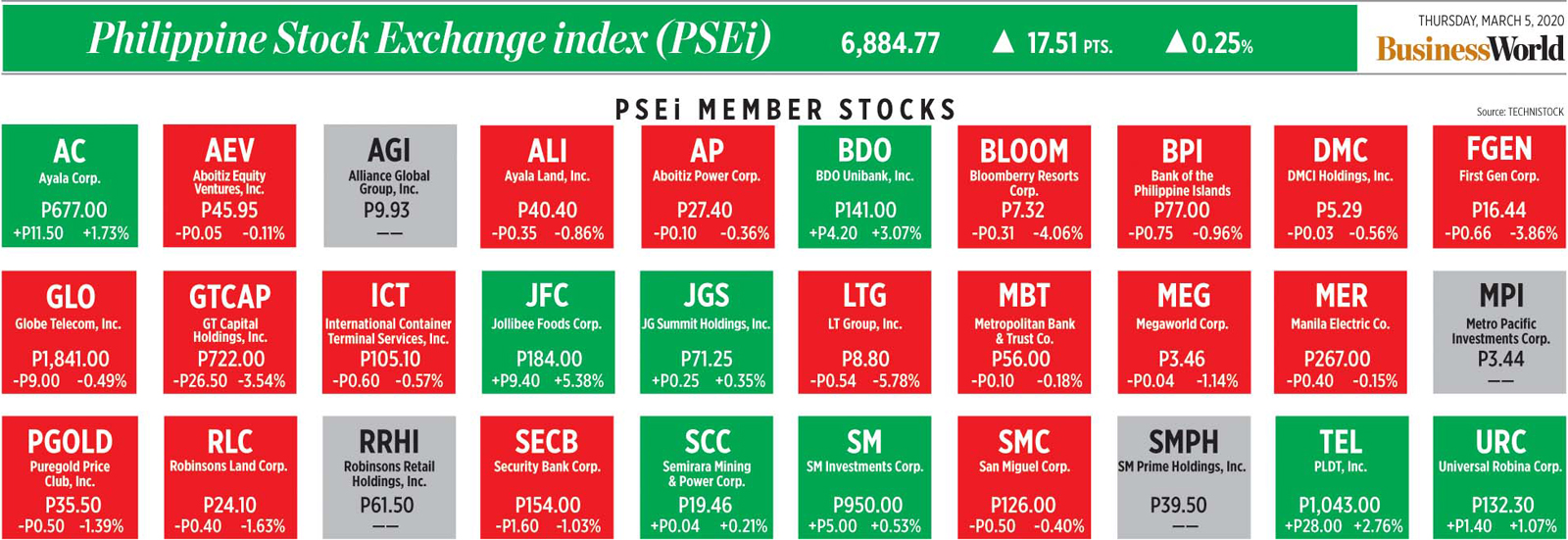
How PSEi member stocks performed — March 5, 2020

Here’s a quick glance at how PSEi stocks fared on Thursday, March 5, 2020.


Regulators chided for late probe of ‘POGO money’

SENATORS rebuked financial regulators on Thursday for failing to promptly investigate the entry of P19.7 billion ($389.6 million) — suspected to have been laundered by Chinese criminal syndicates — into the Philippine financial system last year.

“This is bureaucracy at its worst form,” Senator Richard J. Gordon told regulators during a hearing investigating the transactions and their links to Philippine offshore gaming operators (POGO).

The lawmaker said the Anti-Money Laundering Council (AMLC), which is headed by Bangko Sentral ng Pilipinas Benjamin E. Diokno, did nothing even after more than 800 transactions.

He also said regulators looked into the money transfers in the first quarter of this year when they happened in the first quarter of last year.

“The money had been spent and circulated around the world and you did nothing,” Mr. Gordon said. “You defeat the purpose of the law.”

Various travelers carried the foreign currencies — $336 million, HK$215 million and 2.7 million yen — and entered the Philippines through the Ninoy Aquino International Airport, the senator said, citing AMLC records.

Aside from the almost P20 billion that entered the country in the first quarter of last year, about $633 million (P32 billion) also suspiciously came in from September last year to March this year, Mr. Gordon said, citing Bureau of Customs data.

The Philippines requires travelers to declare money worth more than $10,000 to airport Customs.

Customs officials must submit the declaration forms to the council within 10 days after the end of every month, AMLC Executive Director Mel Georgie B. Racela told the Senate blue ribbon committee headed by Mr. Gordon.

“We do not have any authority to arrest them or seize the cash,” he said. “They are just subject to further investigation should they violate other existing laws,” he added.

“Wouldn’t you say that the continuous unabated entry of millions and millions and millions of dollars — wouldn’t that be suspicious?” Mr. Gordon asked.

‘BUREAUCRACY’
Opposition Senator Franklin M. Drilon said this “defeats the purpose” of the Anti-Money Laundering Act, which also requires banks, insurance companies, casinos and other covered entities to report transactions worth at least P500,000 and suspicious transactions to the AMLC.

Under the law, all transaction records must be kept for at least five years, while financial institutions must observe due diligence in dealing with their clients.

“What happens is these are reported and that’s the end of it because of our bureaucracy,” Mr. Drilon said. “Hundreds of millions can be spent and transmitted within a few seconds and it takes us a few months? I think something is wrong with that.”

Mr. Racela said the process takes months because “intelligence information cannot be shared without validating some facts.” “We cannot establish money laundering if we cannot establish the unlawful activity.”

But Mr. Gordon said the AMLC should have at least questioned frequent carriers of large amounts of cash.

The law has a “suspicious transaction provision” that allows the regulator to probe individuals bringing in huge amounts of cash, Mr. Drilon said.

President Rodrigo R. Duterte will support the Finance department’s push to lift the secrecy of bank deposits for tax evasion and money laundering cases, his spokesman Salvador S. Panelo said at a briefing yesterday.

“If that is the position of the Department of Finance, then certainly the President will support it,” he said.

Mr. Duterte had not decided on whether to ban offshore gaming companies here, Mr. Panelo said.

“If there is anything wrong with the POGO system, then we have to review it, evaluate it and then streamline it, improve it and all the agencies involved must do their job so that any corruption, any unlawful acts can be either neutralized or completely stopped,” he added.

Mr. Gordon earlier said offshore gambling companies here were probably being used as fronts for Chinese spies.

The Immigration bureau earlier said it had revamped workers at Terminals 1 to 3 of the international airport in Manila after the “recent resurgence of unauthorized activities and irregularities” there.

The agency relieved 19 officials and employees allegedly involved in a bribery scheme that allowed the illegal entry of Chinese nationals who end up working in POGOs.

Senator Risa N. Hontiveros -Baraquel had shown a video of incoming Chinese nationals being escorted to an office at the international airport in Manila.

She also showed screenshots of Viber messages among Immigration officers discussing the bribery scheme, as well as a worksheet containing the P10,000 paid by each of the tourists.

An immigration officer earlier told a separate Senate committee some blacklisted foreigners had been granted entry for as much as P200,000.

The Immigration bureau asked the Justice department and National Bureau of Investigation last month to probe corrupt practices at the airport, including human trafficking and escort services. — NPA and Charmaine A. Tadalan

Third Filipino in HK tests positive for virus

ANOTHER Filipino in Hong Kong tested positive for the new coronavirus strain, bringing the total confirmed cases to three, the Department of Foreign Affairs (DFA) said on Thursday.

“The Filipino national, who is currently confined in a hospital in isolation and undergoing tests, is said to be asymptomatic,” DFA said in a statement.

The Philippine Consulate General (PCG) in Hong Kong said the patient had asked that her identity be kept confidential.

The two other Filipinos earlier reported to have been infected have recovered and would be discharged. All three Filipinos contracted the virus from their employers.

“This brings the total active coronavirus disease 2019 (COVID-19) positive Filipinos in Hong Kong down to one,” the agency said.

Meanwhile, DFA is coordinating with the PCG in San Francisco after reports that the US Centers of Disease Control will place about 100 guests and crew members of Princess Cruises under further tests.

“We’re confirming the details with the companies involved and with our consulate in San Francisco,” Foreign Affairs Assistant Secretary Eduardo Martin R. Meñez told reporters by teleconference.

In a March 4 statement, Princess Cruises said the US agency had identified guests and crews, including those in transit, who have experienced flu-like symptoms and those under care for respiratory illness.

“To facilitate this testing, the US Coast Guard will deliver sampling kits to the ship in the morning of March 5 via helicopter,” it said in statement posted on its website.

“Our onboard medical team will administer the test and the samples will be sent in batches by helicopter to a lab in Richmond, California, across the bay from San Francisco.”

Princess Cruises’ M/V Diamond, which carried more than 500 Filipinos, had been placed on a 14-day quarantine in Yokohama.

The Philippines has not reported a coronavirus infection for weeks and only three people have been confirmed to have been infected, all Chinese nationals from Wuhan City, where the virus was first detected.

Two of the patients have recovered and one has died, according to the local Health department.

The virus has killed more than 3,200 people and sickened about 95,000 more, mostly in China, according to the World Health Organization. — Charmaine A. Tadalan

House Speaker promises equitable budget for next year

THE House of Representatives will distribute next year’s national budget “equitably” among local government units, congressional districts and agencies, Speaker Alan Peter S. Cayetano said.

The House of Representatives with the help of the Senate and Executive branch would enforce “federalism in the budget to make sure that there is no province, city or municipality that’s left behind,” he told reporters.

“Federalism is more sustainable because it is more equitable,” Mr. Cayetano said. “There should be no excuse that remote rural areas would have no electricity or water supply,” he said.

Mr. Cayetano also said the House would ensure that enough funds are allotted to President Rodrigo R. Duterte’s Build, Build, Build infrastructure program.

He said the chamber’s budget reforms require “a change of approach, including the timeline” in the budget enactment process.

“It’s too tedious,” he said. “The President proposes the budget in July, we are done with the deliberations in the House in October, the Senate finishes its own consideration of the proposal in November, and we finally approve it and the President signs it in December.”

Mr. Cayetano said economic managers were mulling a budget of P4.6 trillion for next year, about P500 billion more than this year’s budget.

Congress approved the 2020 appropriations bill before 2019 ended and Mr. Duterte signed it at the start of the New Year.

The enactment of the 2019 budget was delayed by at least three months due to wrangling between the House and Senate over alleged budget insertions.

Mr. Cayetano said last year’s deliberations on the P4.1-trillion 2020 spending program had been transparent.

“During the bicameral conference, in the spirit of transparency, it was the first time that the Senate gave us their proposed changes and we gave them our proposed amendments,” he said.

He claimed the House proposals “were not pork,” including the P1-billion camp development fund congressmen gave to the Armed Forces and Philippine National Police.

“Is that pork? I do not even know which camp will benefit from the appropriation,” he added.

He said the Interior and Local Government department would be the one to decide where the money would be spent. — Genshen L. Espedido

Gov’t ordered to explain ex-Maoist leader’s detention

THE SUPREME Court has ordered the government to explain the detention of a former communist leader charged with 15 counts of murder.

In a notice, the court ordered the state to bring Rodolfo C. Salas to court on March 12, when a hearing had also been set.

Jody S. Salas, his son, last month filed a habeas corpus lawsuit, asking the court to order his release.

He accused the state of violating the rights to due process of his father, whom he said had been barred from participating in the case’s preliminary probe.

Mr. Salas was arrested on Feb. 18 over murder charges filed in 2007. He was accused of being part of a communist effort to cleanse the ranks of local and regional committees of the Communist Party of the Philippines of suspected enemies.

He was being detained at the Manila City Jail and had been denied bail based on an arrest warrant issued by a Manila court.

The son said a 1991 plea bargain protects Mr. Salas from being prosecuted for common crimes to promote the communist rebellion, which became the basis of his conviction that year.

The former Maoist leader’s arrest now also violated his right against double jeopardy, which bars a person from being charged twice for the same offense, he said. — Vann Marlo M. Villegas

House OK’s bill hiking road user’s tax

THE HOUSE of Representatives has approved on second reading a bill that will increase the road user’s tax and expand funding for the government modernization program for public utility vehicles.

“The cross-party consensus of the House, including the progressive groups and the minority, to move the bill forward validates the exhaustive efforts we have done to ensure that this is the most progressive transport tax in recent history,” ways and means Chairman and Albay Rep. Jose Maria Clemente S. Salceda said in a statement on Thursday.

Under the measure, there will be a 30% annual rate increase for passenger cars, both public and private, for three years.

The rates for all other vehicles namely utility vehicles, sport utility vehicles, buses, trucks and trailers will be based on a per kilogram of gross vehicle weight: 1.40/kilo of GVW in the first year, 2.50/kilo in the second year, 3.40/kilo in the third year.

The measure also seeks to cut the road user’s tax on vehicles for hire to 50% of the tax for private and government vehicles.

An 5% annual increase will be imposed by Jan. 1, 2023 through revenue regulations issued by the Finance secretary to ensure inflation “does not erode the value of revenues,” Mr. Salceda said.

He said the rich would primarily pay for the tax. — Genshen L. Espedido

Main index climbs further as Feb. inflation slows

By Denise A. Valdez
Reporter

THE MAIN INDEX marked its third day of increase yesterday amid the Philippine government’s report of slower inflation last month.

The 30-member Philippine Stock Exchange index (PSEi) gained 17.51 points or 0.25% to close at 6,884.77 on Thursday. The broader all shares index also added 5.81 points or 0.14% to 4,094.87.

“The market extended its gains today as investors’ show appreciation for our latest economic figures: the slowdown in February inflation rate to 2.6% and the stable employment rate at 94.7%,” Philstocks Financial, Inc. Senior Research Analyst Japhet Louis O. Tantiangco said in a text message on Thursday.

In its report yesterday, the Philippine Statistics Authority attributed the improving inflation in February to the easing of food, transport and utility prices. Employment rate in January was also steady year-on-year.

For Regina Capital Development Corp. Head of Sales Luis A. Limlingan, the improvement in the local market yesterday was also driven by better investor sentiment following the US Federal Reserve’s reduction of interest rates.

“Philippine shares climbed today, warming finally to the Federal Reserve’s surprise interest rate cut and support from other central banks…,” he said in a mobile message on Thursday.

The US Federal Reserve on Tuesday announced an emergency rate cut of 50 basis points, resulting in a rally in US markets on Wednesday, as the Dow Jones Industrial Average, S&P 500 and Nasdaq Composite indices rose 4.53%, 4.22% and 3.85%, respectively.

Back home, five of six sectoral indices ended in green territory. Industrials improved 74.70 points or 0.91% to 8,229.32; mining and oil advanced 57.01 points or 0.90% to 6,384.68; financials rose 12.69 points or 0.78% to 1,628.52; holding firms gained 13.13 points or 0.19% to 6,705.66; and services picked up 0.62 point or 0.04% to 1,343.54.

The sole declining index was property, which gave up 15.18 points or 0.40% to 3,762.79.

Some 978.55 million issues valued at P6.02 billion switched hands on Thursday, increasing from the 652.14 million issues worth P6.08 billion seen on Wednesday.

Advancers outpaced decliners, 97 against 76, with 57 ending unchanged. Foreign investors snapped their nine-day selling streak yesterday to record net purchases worth P940.79 million, a reversal of the P724.48 million in net sales last Wednesday.

“The PSEi is up 1.4% for the week and unless we see a massive drop tomorrow, the main index will end the week with gains,” AAA Southeast Equities’ Mr. Mangun said on Thursday.

But for Philstocks’ Mr. Tantiangco, it might be too early to be confident on the market’s performance.

He said the net value turnover yesterday is still below last year’s average of P6.3 billion, “showing lack of conviction in trades as most investors choose to stay on the sidelines amid the present headwinds.”

Peso weakens slightly on February inflation report

THE PESO traded sideways on Thursday on slower-than-expected February inflation which could push the central bank to cut rates sooner rather than later.

The local unit closed at P50.585 against the dollar, depreciating by 3.4 centavos from its Wednesday finish of P50.551.

The peso opened at P50.60 against the greenback. Its weakest showing for the day was at P50.64 while its intraday best was at P50.575 per dollar.

Dollars traded declined to $945.45 million from $1.187 billion on Wednesday.

UnionBank of the Philippines, Inc. Ruben Carlo O. Asuncion said a major factor that affected currency trading on Thursday was inflation data.

“The peso was steady today was just affirming the lower-than-expected February inflation data,” Mr. Asuncion said in a text message.

“Even amidst the continuing uncertainty due to the COVID-19 (coronavirus disease 2019) outbreak outside China, the local currency moved sideways as global support for the global economy continued through various stimulus programs,” he added.

Rizal Commercial Banking Corp. Chief Economist Michael L. Ricafort also attributed the peso’s movement to inflation data, saying this could result in a possible easing in the near term.

“The peso exchange rate closed slightly weaker…after lower-than-expected inflation data that could increase the chances of a further cut in local policy rates by at least 25 basis points (bps) as early as this month,” Mr. Ricafort said in a text message.

The Philippine Statistics Authority reported yesterday that headline inflation in February slowed to 2.6% from 2.9% in January, on the back of easing food, transport, and utility prices.

The figure is close to the lower end of the 2.4-3.2% estimate range for the month of the Bangko Sentral ng Pilipinas (BSP).

BSP Governor Benjamin E. Diokno yesterday said the emergency 50-bp rate cut by the US Federal Reserve and the February inflation data “will serve as inputs” for the Monetary Board’s (MB) second policy-setting meeting for the year on March 19.

“One thing is certain: there will be no off-cycle MB move to cut policy rates,” Mr. Diokno said.

The BSP slashed rates by 25 bps on Feb. 6, reducing the rates on the BSP’s overnight deposit, overnight reverse repurchase, and overnight lending facilities to 3.25%, 3.75% and 4.25%, respectively.

For today, both Mr. Asuncion and Mr. Ricafort gave a forecast range of P50.40 to P50.70

Most Asian currencies also weakened on Thursday as the dollar recovered, with investors now awaiting clarity on further monetary easing measures and uncertainty around coronavirus to reduce before taking on riskier bets.

Upbeat jobs data and the resurgence of Joe Biden as the potential Democratic nominee for US Presidential elections offered support to the dollar overnight, although gains were capped as markets still priced in further monetary easing — L.W.T. Noble with Reuters

Reinventing EDSA 1986

Perhaps the most outlandish lie ever concocted by one of the most notorious disinformation hirelings of the Duterte regime is that the Marcos kleptocracy was overthrown in 1986 because of the “fake news” that the communists and the “yellows” had supposedly been spreading about Ferdinand Marcos, his wife, his family and his government.

The same huckster says the nuns who faced tanks, machine guns and attack helicopters for four days on Epifanio de Los Santos Avenue (EDSA) did so for “dramatic effect” and were in no real danger.

To these attempts to denigrate EDSA 1986, regime trolls as well as its media hacks and mercenaries add that only the Aquino family benefitted from the EDSA uprising. The late Senator Benigno “Ninoy” Aquino, Jr. was no hero, they falsely contend, and was the founder of the New People’s Army (NPA).

The mindless advocates of authoritarian rule in the vast social media apparatus the Duterte regime orchestrates daily say that with his huge collection of medals for fighting the Japanese during Wold War II, it was Marcos who was the real hero. He was also a true patriot, who, by declaring martial law in 1972 ushered in a “golden age” of peace, prosperity, and freedom.

They ignore, or are completely unaware of those medals’ having been exposed as fraudulent by both the US military and by the late Congressman and former military intelligence officer Bonifacio Gillego. Marcos was indeed no hero, and neither was the martial law period a golden age, but an era of conflict and war, mass poverty, and brutal repression.

Marcos’ own family members nevertheless chime in by excusing the human rights violations that so characterized their late patriarch’s regime by saying that they were few and far between and only the doing of rogue members of the military. They claim without an iota of evidence that the torture, the rapes, the enforced disappearances, and the summary executions were not driven by government policy but were aberrations carried out by overenthusiastic members of State security forces who were moved by their desire to keep the country safe. To this, the death penalty zealots and the other monsters to whom human rights and lives have no value add that those who were tortured, raped, killed, etc. nevertheless deserved it because they were communists subverting the democracy that Marcos had already destroyed.

Add to this litany of lies and plain imbecilities a more recent falsehood: that what EDSA 1986 was about was the Filipinos’ collective desire for peace. This was the theme of the commemoration at the EDSA Shrine in Quezon City of the 34th anniversary of that momentous event — a theme that was either a concoction due to the ignorance of the Catholic Church-based organizers or a deliberate attempt to reinvent EDSA 1986 as an innocuous and benign event far removed from what it really was.

What makes the latter more likely is the Philippine institutional Church’s refusal to confront and hold the Duterte regime to account for the extrajudicial killings, the human rights violations, the lawlessness, corruption and deceit, and even the attacks on its priests and bishops, the Pope and God Himself. By reinventing the EDSA “revolution” as something practically meaningless, it is in grave danger of being complicit with the despotism it should instead be combating.

Hardly an event that materialized out of nothing, the civilian-military mutiny of 1986 was the culmination of a 14-year struggle by the loose coalition of armed and unarmed groups of democratic personalities, journalists, human rights defenders, farmers and worker leaders, and political activists to overthrow the brutal, corrupt, and murderous conspiracy against the Filipino people by the bureaucrat capitalists whose military thugs and foreign partners in crime were keeping in power.

Part of the fiction is also the presumption that EDSA 1986 is solely the legacy of the Catholic Church. The lives of the nuns, priests and seminarians who confronted tanks, armored personnel carriers, machine guns, and attack helicopters were in real danger, and if only for that the Church was indeed part of it. But there were other groups and sectors as well as hundreds of thousands of ordinary folk who had had enough of the Marcos despotism to resist it in various ways. EDSA 1986 is the Filipino people’s legacy to the nation and themselves.

Information was crucial in the making of the resistance that overthrew the Marcos tyranny. But if anyone was spreading false information, it was the dictatorship itself. It had total control over the media, which during the first years of martial rule consisted of newspapers owned by Marcos cronies and relatives, over which the regime created a system of censorship to prevent the dissemination of information contrary to its version of events. Filipinos were thus unaware of the gargantuan dimensions of the country’s foreign debt, the energy crisis, the food blockades on communities that supposedly supported the NPA, the human rights violations, and the raging wars not only in southern Philippines but in many other areas of rural Philippines.

So effectively did the system spread disinformation that it took more than 10 years before some Filipinos acquired, through clandestine publications, lightning rallies and demonstrations, enough knowledge and understanding of the depths to which the country had fallen before they massed at EDSA and elsewhere in the country in 1986.

The sacrifices not only of such authentic heroes and people’s martyrs as Benigno Aquino, Jr. but also of the poets, journalists, artists, students, academics, farmers, workers, nuns and priests, and professionals who risked their lives and fortunes and, in many instances, lost them, also made a difference. Hence the current attempts to dismiss their efforts as meaningless by the minions of a regime that in so many ways is replicating the Marcos tyranny.

While all these were happening, the institutional Church remained committed to its policy of “critical collaboration” with the regime, primarily because it approved of and supported its US-sanctioned and -abetted anti-communism. Only in the latter years of the dictatorship did the critical part of its martial law era policy assume more prominence as the princes of the Church realized that they were in danger of losing the allegiance of the clergy who had been politicized by the suffering and injustice to which they were bearing witness daily.

The Church managed to regain the trust of both its rank-and-file and the faithful only in the final years of the Marcos regime. It should have learned from that period the signal lesson that it has to repudiate its identification with, and links to, the Philippine power elite to remain relevant. But if its approach to the 34th anniversary of EDSA 1986 and its indifference to the need to combat the threats to what little remains of Philippine democracy are any indication, it is once again engaged in pandering to the powers-that-be by reimagining that event as a quest for peace rather than the overthrow of a hated regime through direct people’s action.

As flawed as the legacy of the EDSA “revolution” has been, it nevertheless returned the country to the long and narrow path towards authentic democracy. Like American conquerors and Japanese invaders, Marcos and company diverted the country from that path during their years in power, and the current regime of Marcos idolators is trying to do the same thing. That and the possibility that it can happen again are what make EDSA 1986 meaningful and still relevant 34 years after.


Luis V. Teodoro is on Facebook and Twitter (@luisteodoro).

www.luisteodoro.com

Growing old sucks

Actually, the title should have been “growing old sucks ass.” But I flaked out. A sign perhaps that I am not hopelessly old yet, as apparently bits of filter still linger in my head. But, like Ricky Gervais, sometimes I just don’t care anymore.

The response from last week’s article (“Don’t believe them: getting old is horrible”) deserved an encore rant. Growing old certainly does. So here goes.

You know you’re old because you’re constantly reminded of it. Even before you wake up in the morning. Nights are filled with constant marches to the bathroom. Or your spouse telling you to tone down your snoring. Me, I know for a fact I don’t snore. I once stayed up all night to see if I did and I didn’t.

Waking up. Unlike before, when you required 10 (or 20) punches of the snooze button, now you’re the alarm clock’s bitch: up at the first ring. Or, worse, even before! So you lie there, like an idiot, eyes wide open, asking why you’re alive.

But, must get out of bed!

That is, if you can get out of bed: bones creaking, joints knocking, muscles groaning. You’re now a flabby musical instrument. Getting up is so stressful you actually need rest after sleeping.

In younger days, all you needed to get out of the house was a wash, a shirt, and fingers through the hair. Now every technological, cosmetic, and medical breakthrough is needed just to make you seem human. Feeling human though is another matter.

Breakfast. Some of us are still in denial: eggs, rice, tapa or crispy pork, strong dark coffee. Many though have resignedly accepted the inevitable: bowls of oatmeal with a “demi-cafe” (i.e., half coffee and half warm water). Yummy. You’ve gone full circle. Baby food to steak to baby food.

Brad Pitt once retorted when asked if he was suicidal (in Ocean’s 11): “Only in the morning.” Actually, it’s easy to feel suicidal at this twilight age. It’s just that killing yourself takes energy. And energy is what I don’t have. Writing that alone makes me want to take a nap.

The bathroom is hell. You go to the mirror and think: “Not bad. Still looking good.” Then you put on your glasses and shriek: “Who the hell are you!?”

That’s probably why you lose your eyesight as you get older. It’s nature’s way of hiding from you the fact you look terrible.

The drugs: vitamins, maintenance meds, fiber supplements… ugh. Ever wonder why old people in commercials are so happy and full of vitality? It’s because they’re drugged out of their minds.

The outside world brings its own set of horrors. Bump into a friend and the conversation inexorably turns to medicine discounts. Otherwise, you’re cornered by flat-tummied youngsters pretending to ask for your advice regarding their bright future.

Bwisit.

At 50, anything fun is considered bad.

Evil irony: unlike college, you now have the money to buy a motorcycle and the time to spin it around. But you’re not allowed to buy a motorcycle because a.) you’re old, b.) you’re irresponsibly possibly leaving behind a widow and know-it-all college kids homeless and hungry, and c.) because for everyone else, the only conceivable reason you want to have fun at 50 is you’re having a mid-life crisis.

You can’t even feel good and have a sense of humor without being humiliated. Tell jokes? Make witticisms? The kind that got you tagged before as charming? They’re now met with respectful (“respectful”!) half-hearted laughs, along with “katawa po, mam/ser (You are being funny, ma’am/sir).”

Po.” That one syllable word telling you your life is over.

And for heavens sake, please stop yourself from speaking youthspeak. “Bae”? “Deins”? Forget it. There’s no way you can mouth those words without looking stupid. The young meant it that way. Leave them be. Just accept you are no longer cool. If you ever were cool.

And don’t even think of having flirtatious fun. Not that you should anyway if you’re married. But at least the unmarried older guys of generations past had the Mad Men and Rat Pack era. We have the #MeToo movement, specifically designed against old men. Young (richer) men are persistent, old men harass.

Out of revenge you try reciting your creed of younger days: the Trainspotting monologue. But of course your memory fails. So you google it. Naturally, by typing with the old tuldok (two-finger) method:

“Choose a job. Choose a career. Choose a family. Choose a fucking big television… Choose life… But why would I want to do a thing like that?”

Of course, you stupidly chose life. So what to do to combat regret? See that liquor store down the corner? You drink it!

That’s a line borrowed from Supernatural. Which adds to the depression as Sam and Dean are now obviously older too.

Anyway, cheer up. As someone once said: “it’s always darkest just before it goes totally black.”


Jemy Gatdula is a Senior Fellow of the Philippine Council for Foreign Relations and a Philippine Judicial Academy law lecturer for constitutional philosophy and jurisprudence.

https://www.facebook.com/jigatdula/

Twitter @jemygatdula

ADVERTISEMENT
ADVERTISEMENT