Home Blog Page 9756

Forecasting in a time of radical uncertainty

On Thursday night, President Rodrigo Duterte, upon the recommendation of health officials, announced that for 30 days starting March 15, Metro Manila will be put under “community quarantine,” a term that he said means a lockdown. The measure was in response to the rapidly rising number of COVID-19 infections in the last 10 days, increasing from only three (with one dead) to 140 (with 12 deceased) per the latest count (as of March 15).

The quarantine of Metro Manila is accompanied by guidelines that may lead to a widening of quarantines to other local government units and/or their smaller political subdivisions depending on the spread of COVID-19 cases. Other “stringent social distancing measures” have also been imposed including the suspension of classes and mass gatherings and most work in the executive branch of government. Nevertheless, it will not be a total lockdown as certain retail outlets will remain open and public transportation systems will continue to operate. Also reported excluded are deliveries in and out of Metro Manila, and workers who live outside Metro Manila will be allowed entry/exit.

The measures at first glance are quite drastic considering the relatively low number of COVID-19 infections but on further thought appear necessary given the high likelihood that many more cases remain undetected and the fact that the health department has only a limited supply of test kits. Panic buying in supermarkets also became the norm before the lockdown.

Clearly, our last brief downgrading our 2020 economic growth forecast had not anticipated a lockdown situation and of Metro Manila no less, which accounts for close to 40% of Philippine GDP. Moreover, with the global transmission of the virus worsening, now recognized as a pandemic by the World Health Organization, the impact of the coronavirus on domestic activity will surely be higher than the 0.5ppt cut to GDP growth we considered early this month.

At this time though, we have more questions than answers on how exactly government will carry out the quarantine and are awaiting more detailed guidelines, currently being drafted. Given plunging stock prices, which government is trying to prop up by ordering state pension institutions to double their daily stock purchases, we think that aside from the direct impact on worker and business incomes from the lockdown, the thing to watch out for is how the developments will affect consumer and business sentiments.

We will be looking more closely at the numbers and what the likely impact on growth will be. While we agree with former Governor of the Bank of England Mervyn King that in this time of “radical uncertainty,” it would be quite impossible to attach probabilities to the range of possible outcomes, we will still try to hazard a guestimate, although our main objective would be to get a more solid grasp of the risks and channels of transmission and their importance to the domestic economy. For now, we note the following likely changes to our forecast numbers.

1. The impact on consumption will be much higher. First, the spread of the virus and the lockdown will mean that relying on local tourism to make up for the foreign travel bans is no longer viable, which means that tourism-related sectors (transport, retail, hospitality) will be hit harder. Reduced demand will have knock-on effects on firm profitability, especially for small businesses, that can be expected to lead to job losses or pay cuts for workers. Add to this are fears of infection as well as self and community quarantines that will keep more people home. Another consideration is that although wage and salaried workers may be able to rely on some safety nets (e.g., paid leaves or publicly provided but limited unemployment benefits), the self-employed, who make up close to 30% of employment, will be at greater risk, and fear of income losses may worsen infection rates if those with minor symptoms (or the asymptomatic) opt to continue working.

2. Private investments are unlikely to recover under this environment as businesses try to cope with the many new challenges. Some firms, in order to minimize the risk of infection and manage restrictions during the lockdown, have opted to temporarily downsize operations.

3. With the global growth outlook turning bleaker, the export sector is facing even more headwinds quite apart from supply chain disruptions. Remittances may also be affected more than expected by a synchronized global slowdown, especially if employers themselves are crippled by the expected downturn in international tourism.

4. Although economic managers have acknowledged that the budget deficit will be higher this year (3.6% of GDP estimate) and additional funding for the COVID-19 outbreak is expected to come through off-budget support, we also worry that the spread of the virus will affect the pace of government’s Build, Build, Build infrastructure program.


Romeo L. Bernardo was finance undersecretary during the Cory Aquino and Fidel Ramos administrations.

romeo.lopez.bernardo@gmail.com
Evolving viruses and innovator drugs

The bad news is that the Wuhan virus — a.k.a. severe acute respiratory syndrome coronavirus 2 or SARS-CoV-2 which causes coronavirus disease 2019 or Covid-19 — continues to expand worldwide. The good news is that humanity is a survivor of many deadly viruses in the past and modern and innovator medicines and vaccines keep coming.

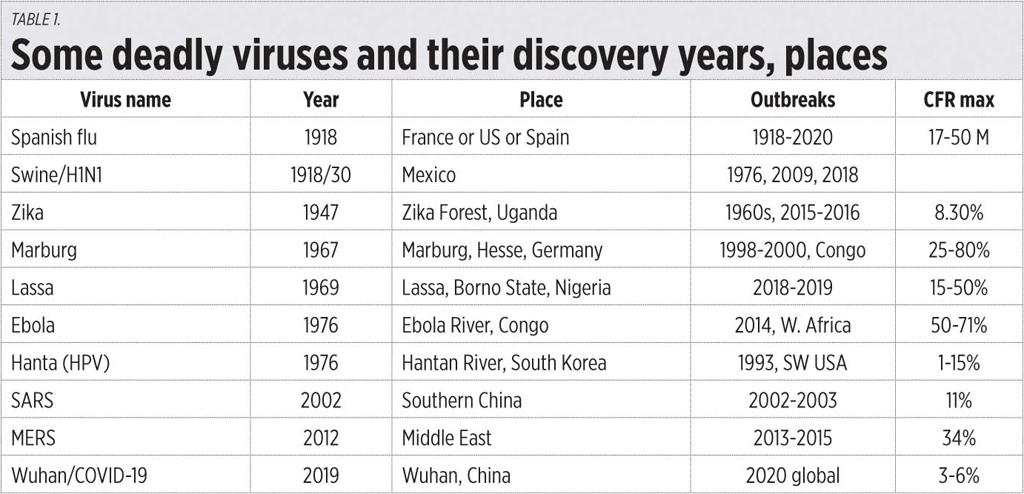
It is also not “racist” to call it the Wuhan virus because for most viruses, they are named for the places where they first appeared or were discovered. Below shows some major viruses that humanity has overcome and their estimated case fatality rate or CFR (see Table 1).

Other known deadly viruses are rabies, dengue, and HIV, with the latter having estimated to have killed 32 million people, mostly in Africa.

The US Centers for Disease Control and Prevention (CDC) estimated that global fatality from ordinary flu is up to 646,000 deaths per year, excluding pandemics. If we keep this in mind, fatalities of 5,000+ from the Wuhan virus worldwide does not appear to be so alarming. Its CFR of up to 6% also pales in comparison to the CFR of viruses like SARS and Ebola.

But hysteria has prevailed worldwide. The Philippines has policies like the Metro Manila quarantine, sometimes called “lockdown,” from other provinces, a curfew from 8 p.m. to 5 a.m., sending fully armed police and soldiers to man checkpoints. These policies have expanded the hysteria instead of reducing or calming it.

For now there is no existing vaccine or medicine against the Wuhan virus. Humanity has survived past evolving viruses via evolving medicines and vaccines. Viruses are living microorganisms that mutate and evolve through time as there are many potential carriers like pigs, chickens, bats, and other wild animals. It is important that humanity should recognize the importance of evolving medicines that need to be invented.

So President Rodrigo Duterte’s recent Executive Order (EO) 104, issued last February, imposing drug price control via maximum wholesale price (MWP) and maximum retail price (MRP) that targeted mostly innovator, newly invented, and still patented drugs is unwise and irresponsible.

The Cheaper and Quality Medicines Act of 2008 or RA 9502 and its implementing rules and regulations (IRR) specified only MRP, no mention or reference to MWP, and yet the EO targeted MWP or penalizing the manufacturers of innovator medicines. The average retailers’ assured margin is about 40% for the 122 molecules covering 205 medical preparations.

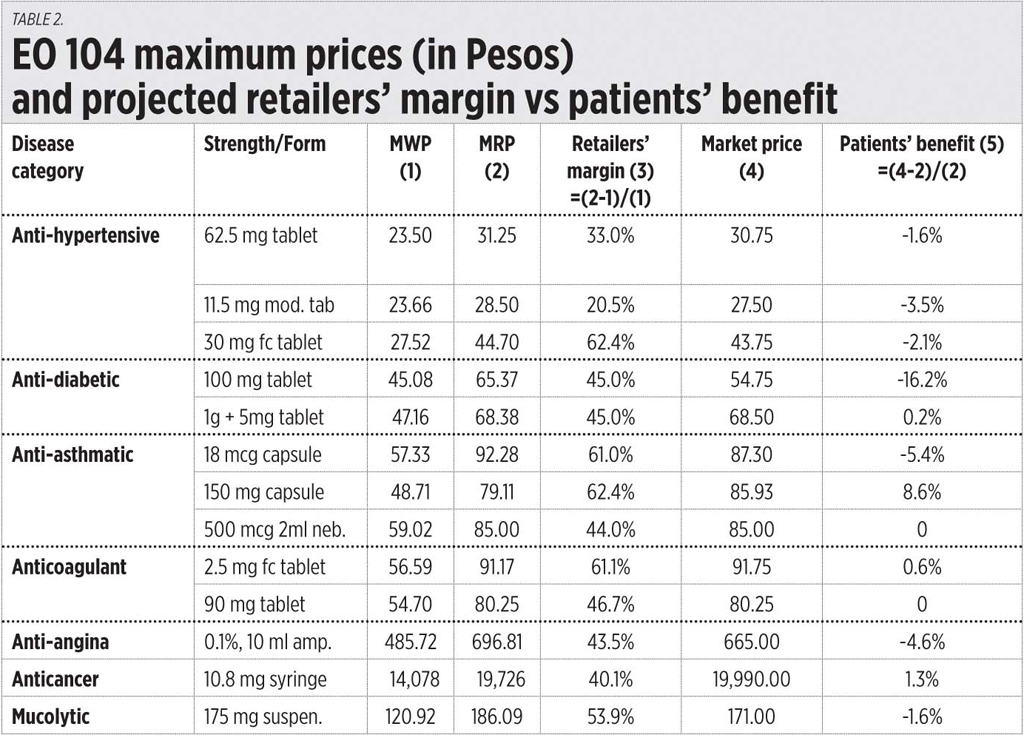
I asked a friend who works for a drugstore chain in Manila to give me the existing market prices of certain medicines and I compared those with the MWP and MRP which are contained in EO 104. The result is ugly: for some medicines that I chose, the retailers’ margin is high, up to 62%, but projected patients’ benefits are either low/zero, or even negative, meaning the proposed MRP is even higher than existing retail prices (see Table 2).

Going back to the Wuhan virus or COVID-19 — we need effective and safe medicines against this dreaded disease to reduce the hysteria and save lives, and these medicines are done only by innovator pharma and biotech companies and laboratories, not generic companies.

EO 104 has sent wrong signal to innovator firms, so if some of them finally invent a good treatment vs COVID-19, they may hesitate to bring it in the Philippines. This situation can be remedied if the Department of Health and Office of the President silently pull out that EO, and tell innovator firms that they will not be penalized here. They can help save lives and calm the hysteria in the Philippines.


Bienvenido S. Oplas, Jr. is the president of Minimal Government Thinkers.

minimalgovernment@gmail.com

Commentaries on the One Person Corporation under the Revised Corporation Code

(Last of five parts)

The conversion of an Ordinary Stock Corporation to a One Person Corporation (OPC) is explained in Section 131.

Under Section 131, when all the shares of record of an ordinary stock corporation are acquired by a single stockholder (who must be a natural person):

1.) He/she “may apply for conversion into” an OPC, and subject to the submission of such documents as the SEC (Securities and Exchange Commission) may require; and

2.) If the application for conversion is approved, the SEC shall issue a Certificate of Filing of Amended Articles of Incorporation reflecting the conversion.

3.) Rule on Succession of Liabilities: The OPC converted from an ordinary stock corporation shall succeed the latter and be legally responsible for all the latter’s outstanding liabilities as of the date of conversion.

Under the draft SEC Guidelines on the Conversion of an Ordinary Stock Corporation into a One Person Corporation, it is provided that:

(i) Only domestic corporations organized as a stock corporation may be converted into an OPC;

(ii) After a natural person of legal age, a trust, or an estate has acquired all of the outstanding capital stocks of an ordinary stock corporation may the latter apply for its conversion into an OPC;

(iii) Applications for conversion to an OPC will be processed as an amendment of the AOI/Bylaws to comply with the requirements as to corporate name, one director, indication of the Nominee and Alternate Nominee, and removal of such other provisions that are distinctive to ordinary stock corporations, etc.;

(iv) Conversion to OPC shall take effect upon SEC’s approval of the amended AOI through the issuance of a Certificate of Filing of Amended Articles of Incorporation, with the OPC retaining the SEC Company Registration Number with the addition of “OPC” at the end thereof; and

(v) The OPC shall succeed to all the outstanding liabilities and obligations of the converted ordinary stock corporation as of the date of approval of the conversion.

It is clear from the permissive language of Section 131 (“may apply for conversion”) that it is within the rights of the single stockholder of an ordinary stock corporation not to apply with the SEC for the conversion of the corporation into an OPC.

Since the Revised Corporation Code (RCC) seems to tolerate the existence of an ordinary stock corporation with a single natural-person-stockholder, this would show that the rule under the last paragraph of Section 10 (Number and Qualifications of Incorporators) that “A corporation with a single stockholder is considered a One Person Corporation as described in Title XIII, Chapter III of this Code,” is clearly a “rule of incorporation” and not a default rule that would set all corporations with a single natural-person-stockholder to all being governed by Chapter III of Title XIII of the RCC. In other words, if at the point of incorporation of a stock corporation it is provided that it shall only have one natural-person-stockholder, there is no choice but to incorporate it as an OPC.

In a situation where all of the shares of stock of an ordinary stock corporation are acquired by a single natural-person-stockholder, would the SEC allow a formal amendment of the AOI, not to convert into an OPC, but rather to reduce the number of Board members to just one? Under such a scenario, the single natural-person-stockholder would be the sole Director and the President of the corporation, while the Corporate Secretary and the Treasurer would be officers who need not be members of the Board.

If such a scenario would be allowed, then there would be no impetus for the single natural-person-stockholder to formally convert into an OPC which is saddled with the burden of showing that is adequately financed to be able to apply the doctrine of limited liability.

It is our expectation that the Supreme Court will eventually develop a unifying doctrine on the application of the doctrine of limited liability for both the OPC and an ordinary stock corporation with a single natural-person stockholder.

CONVERSION FROM OPC TO AN ORDINARY STOCK CORPORATION
Under Section 132 of the RCC, an OPC may be converted into an ordinary stock corporation by:

1.) Due notice to be filed with SEC, within 60 days from the occurrence of the circumstances leading to the conversion into an ordinary stock corporation;

2.) Compliance with all other requirements for stock corporations; and,

3.) When all requirements have been complied with, SEC shall issue a certificate of filing of amended articles of incorporation reflecting the conversion.

4.) Succession of Liabilities: The ordinary stock corporation converted from an OPC shall succeed the latter and be legally responsible for all the latter’s liabilities as of the date of conversion.

Since the language of the first paragraph of Section 31 is permissive (an OPC “may be converted into an ordinary stock corporation”), is it within the statutory intent that even when an OPC has become constituted of more than one natural-person-stockholder (e.g. the Single Stockholder sells some of his shares to other individuals), it remains governed by Chapter III of Title XIII of the RCC?

Since indication that a corporation is an “OPC” is a clear requirement under the RCC, it seems that even when an OPC becomes constituted of several stockholders, it remains bound by the provisions of Chapter III of Title XIII for the protection of its creditors. It may be the reason why when an OPC becomes constituted of several stockholders, there is every commercial reason to formally convert into an ordinary stock corporation; otherwise, the registered stockholders run the risk of being unlimited liable for the debts and other liabilities of the corporation.

CONVERSION/DISSOLUTION OF AN OPC IN CASE OF DEATH OF THE SINGLE STOCKHOLDER
Under the second paragraph of Section 132, in case of death of the Single Stockholder:

1.) Within seven days from the receipt of either: (i) An Affidavit of Heirship or Self-Adjudication executed by a sole heir; or (ii) Any other legal document declaring the legal heirs of the Single Stockholder; the Nominee or Alternate Nominee shall transfer the shares to the duly designated legal heir or estate and notify SEC of the transfer;

2.) Within 60 days from the transfer of the shares, the legal heirs shall notify the SEC of their decision to either: (i) Wind-up and dissolve the OPC; or (ii) Convert it into an ordinary stock corporation.

The language of the second paragraph of Section 132 seems mandatory in character. When the Single Stockholder dies, it is mandatory for the Nominee (Alternate Nominee) to transfer the shares of the OPC to the sole heir or the estate (if there are several heirs), and to notify the SEC.

It seems from the language of Section 132, that if there is only one heir, the OPC can remain subsisting with the only sole heir as the new Single Stockholder. But even when there are several heirs, and the shares are transferred to the estate of the decedent, can the OPC not continue to subsists with the “estate” (i.e., the administrator of the estate) as the Single Stockholder?

The article reflects the personal opinion of the author and does not reflect the official stand of the Management Association of the Philippines or the MAP


Cesar L. Villanueva is Chair of the MAP Corporate Governance Committee, the Founding Partner of the Villanueva Gabionza & Dy Law Offices, and the former Chair of the Governance Commission for GOCCs (GCG).

cvillanueva@vgslaw.com

map@map.org.ph

http://map.org.ph

Countdown to Zero challenges big polluters

By Clara Ferreira Marques and David Fickling

OIL MAJORS and big miners have been falling over themselves to promise better behavior when it comes to greenhouse gases. A significant number now say they are targeting zero emissions. Unfortunately, not everyone agrees on exactly what that means. It leaves investors clear on good intentions, but far less so on how to price transition risk, compare strategies and judge success.

The real trouble sits with the widest and most significant category of emissions — those that don’t come directly from operating a well or mine, but are produced indirectly when oil, gas, iron ore, or coal is burned or processed by customers. For outfits like BP Plc and BHP Group, these so-called Scope 3 emissions can add up to as much as 90% of their total footprint. They’re also far harder to control, as they aren’t produced by the reporting companies themselves.

Resources giants, even poorly performing oil majors, have the scale and financial clout to manage a transition to a carbon-light economy — should they choose to. The rapid destruction of value in segments of the coal sector has left few in doubt of how quickly they could be left behind if they ignore such downstream emissions. Last week’s collapse in oil prices is another memento mori for carbon-intensive businesses.

That doesn’t mean everyone has embraced the idea of targeting Scope 3 emissions. Rio Tinto Group, for one, has said it can’t set targets for its clients, though it will engage in as yet unspecified projects with the likes of China Baowu Steel Group Corp. BHP will produce numbers later this year. Others, like BP, have promised to eliminate Scope 3 emissions where they’ve drilled the oil, but won’t commit to doing the same if they’re only doing the refining. Spain’s Repsol SA is among the few to be promising an absolute zero target for all three sets of emissions.

In this flurry of green activity, what should investors be demanding?

The first thing should be transparency. Many of the biggest emitters have yet to make full Scope 3 disclosures, including such pillars of developed-market stock indexes as Exxon Mobil Corp., Anglo American Plc, and Fortescue Metals Group Ltd. At this point, that decision is almost churlish: It isn’t hard for investors to do their own calculations. Those that don’t face up to the reality of decarbonization will increasingly be treated like any other business that’s careless about its medium- and long-term liabilities.

A second point is comparability. Although the overwhelming majority of Scope 3 emissions for resources companies come from the processing and combustion of their products, the standard incorporates a range of other activities such as waste disposal, product distribution, and even business travel and staff commuting.

To add to that complexity, companies can replace the standardized emissions factors used to produce the figures with bespoke ones if their customers operate particularly efficient plants. Without full transparency about where those savings come in, companies could reduce their footprint by leaning on overly generous assumptions, and claim credit that more rigorous competitors would miss out on.

There is also the unsolved question of how to manage double-counting, when, for example, coking coal and iron ore are sold to a producer that will use both in making steel.

Investors should demand the means to measure progress, and success. Laying out ambitions for emissions 30 years hence is all but meaningless unless you’re also describing a path to get there. If investors are to take these numbers seriously, they’ll want to see plans for the steps along the way.

That won’t be easy. For oil majors, it will require nothing less than a reinvention of their entire businesses, moving into industries that have historically produced lower returns than fossil fuels, as former BP Chief Executive Officer Bob Dudley has pointed out.

Mining giants that have depended on revenues from high-volume bulk commodities such as coal and iron ore will have to either push their customers to switch to new technologies such as hydrogen-reduced steel, or depend on less lucrative base metals, specialty commodities, and agricultural inputs.

Providing too much detail about the road ahead risks disclosing a company’s business strategy, too, or tilting the market. How much of the reductions will come, as with Glencore Plc, from allowing mines and wells to deplete naturally as their reserve base is used up? How much will depend on selling assets, such as BP’s near-20% stake in Rosneft? How much will rely on technology that exists, but is not yet used on a wide scale, like carbon capture and storage?

The last point on fund manager wish lists should be consistency. Investors will benchmark talk of long-term ambitions against performance on actual, shorter-term activity.

Gabriel Wilson-Otto, head of stewardship, Asia Pacific, at BNP Paribas Asset Management, suggests that will mean keeping an eye on capital spending: Projects that generate downstream emissions decades into the future should be attracting more scrutiny. Similarly, corporate lobbying will be monitored for evidence it is allowing organizations to flash up green ambitions but still campaign against action on climate.

None of this should be a burden on good governance. The CDP, a nonprofit research group that pushes for greenhouse disclosure, found in 2014 that the return on investment for companies that do so was 67% higher than for those that didn’t.

The winds of decarbonization are blowing through the commodities industry. Companies that don’t bend in the face of these changes will break.


BLOOMBERG OPINION

Peso sinks further as coronavirus continues to spread

THE PESO dropped on Monday and settled at the P51-per-dollar level for the second straight day as more investors opted for safer havens amid fears due to the spread of the coronavirus disease 2019 (COVID-19), which has now triggered an “enhanced community quarantine” for the whole of Luzon island.

The local unit finished trading at P51.50 per dollar, plunging by 47 centavos from its P51.03 close on Friday.

The peso opened the session at P51.25 per dollar. Its weakest was its close of P51.50, while its intraday best was at P50.99 against the greenback.

Dollars traded dropped to $769.39 million from the $1.416 billion seen last Friday.

Analysts said the local unit was tracking the general sentiment of the market which was filled with fears amid the prolonged spread of the COVID-19 that has already triggered a lockdown of the country’s capital.

Rizal Commercial Banking Corp. Chief Economist Michael L. Ricafort said Monday’s close is the peso’s weakest in five months and was due to risk aversion due to the COVID-19.

“The peso was also weaker as the local stock market sharply declined and after the whole of Luzon has been put under enhanced quarantine,” Mr. Ricafort said in a text message.

President Rodrigo R. Duterte has put Luzon under enhanced community quarantine which will impose strict home quarantine and no transportation except for frontline health workers, government officials, and other relevant personnels addressing the spread.

Confirmed cases of COVID-19 in the country have hit 140, with 12 deaths recorded as of press time.

UnionBank of the Philippines, Inc. Chief Economist Ruben Carlo O. Asuncion also blamed the peso’s weakness to worries over the pandemic.

“The peso is also tracking the general sentiment around the world as major and advanced countries face this virus fight,” Mr. Asuncion said in a text message.

The US Federal Reserve again opted for an off-cycle rate cut and has announced at least $700 billion in Treasuries and mortgage-backed securities purchases in coming weeks, Reuters reported on Monday.

“The economic outlook is evolving on a daily basis and it is depending on the spread of the virus … That is not something that is knowable,” Fed Chairman Jerome Powell said at the end of an emergency Fed meeting held in place of the Fed’s regular meeting this week.

For today, Mr. Ricafort gave a forecast range of P51.25 while Mr. Asuncion sees the peso moving around P51.30 to P51.60 — L.W.T. Noble with Reuters

Stocks plunge as investors assess virus impact

By Denise A. Valdez, Reporter

LOCAL SHARES plunged on Monday as investors continue to assess the economic impact of the coronavirus disease 2019 (COVID-19) pandemic.

The 30-member Philippine Stock Exchange index lost 458.57 points or 7.91% to 5,335.37 on Monday. The broader all shares index likewise dropped 221.85 points or 6.35% to 3,271.79.

“Market has been sent into turmoil by COVID-19, same with the rest of the world,” First Metro Investment Corp. Vice-President Cristina S. Ulang said in a text message. “The volatility will subside and a recovery is possible only if and when the infection spread dissipates.”

As Metro Manila started its first working day under community quarantine yesterday, listed firms one-by-one disclosed the impact of limited operations to their businesses. This resulted in almost all PSEi member stocks hitting their 52-week lows.

The PSE also kicked off yesterday its reduced trading hours starting yesterday which will last until April 14. The local market will open at 9 a.m. and close at 1 p.m.

“With the number of cases rising, the country has added measures for more social distancing. This however would imply that growth would be cut as establishments would realize less business as a result,” Regina Capital Development Corp. Head of Sales Luis A. Limlingan said in a mobile message.

“Furthermore, stock futures plunged Sunday night even after the Federal Reserve embarked on a massive monetary stimulus campaign… [M]any investors said they would ultimately want to see coronavirus cases peaking and falling in the US before it was safe to take on risk and buy equities again,” he added.

All sectoral indices at the local bourse closed in red territory yesterday. Holding firms lost 568.49 points or 10.02% to 5,105.16; financials dropped 126.47 points or 8.93% to 1,289.19; property trimmed 232.35 points or 7.78% to 2,753.05; mining and oil shaved off 204.34 points or 4.32% to 4,523.47; industrials fell 176.21 points or 2.49% to 6,894.90; and services slipped 26.14 points or 2.20% to 1,161.47.

Some 618.19 million issues valued at P6.44 billion switched hands on Monday, down from last Friday’s 950.23 million issues worth P10.72 billion.

Declining stocks outnumbered those that gained, 145 against 46, while 40 names ended unchanged.

Foreign outflows were trimmed to a net P741.72 million from last session’s net selling worth P1.64 billion.

During these times, Ms. Ulang said it is best to have a diversified portfolio and not chase market rallies.

“If you’re light in equities, load up on high quality, high-paying dividend stock. Be selective. Secure some accrual income from government and corporate debts,” she said.

China donates 2,000 novel coronavirus test kits

THE Chinese government has donated 2,000 “high-tech fast test kits” to the Philippines to help it fight a novel coronavirus outbreak that has killed at least 12 people and sickened 128 more.

The test kits, jointly donated by the Chinese Embassy in the Philippines and China Mammoth Foundation, arrived in Manila yesterday, the embassy said in a statement. “China is ready to provide more test kits in the coming days,” it said.

The test kits, developed by the China BGI Group, can show the results in three hours. It has been exported to more than 50 countries including Japan, Thailand, Brunei, Egypt, Peru and the United Arab Emirates, according to the Chinese Embassy.

Senators on March 9 criticized health officials for failing to buy enough test kits for suspected carriers of the coronavirus disease 2019 (COVID-19).

The agency only had 2,000 kits and expected to receive 4,500 more from the World Health Organization, Alethea de Guzman, a DoH medical specialist, told a Senate hearing.

An imported COVID-19 test kit costs about P6,000.

The department was reviewing a decision it had made earlier to limit the use of test kits to travelers from countries with cases of COVID-19, Ms. Guzman said.

The Food and Drug Administration (FDA) has since approved coronavirus disease 2019 test kits developed by scientists from the University of the Philippines-National Institutes of Health (NIH) to help speed up the diagnosis.

Health Secretary Francisco T. Duque III earlier said testing 100 million people was impractical.

The virus that the World Health Organization has called a pandemic has killed more than 6,500 people and sickened about 170,000 more worldwide, mostly in China.

“China has been sharing our hard-won anti-epidemic experiences, carrying out close medical experts-level cooperation with the Philippine side,” the embassy said, adding that President Rodrigo R. Duterte and Chinese President Xi Jinping were in constant communication.

Chinese State Councilor and Foreign Minister Wang Yi on Sunday informed Philippine Foreign Affairs Secretary Teodoro L. Locsin, Jr. by phone about the donations and a plan to send medical experts to Manila.

Mr. Locsin confirmed his conversation with Mr. Wang, but said China’s planned aid to the Philippines was “much bigger” than the 2,000 test kits.

“This is not the Wang Yi undertaking, he and I talked about on the secure line. It will be much bigger,” he said in a social media post on Monday. — Charmaine A. Tadalan

Local governments a step ahead with community quarantine declarations

SEVERAL LOCAL governments around the country — mostly major cities, provinces, and even some municipalities — have declared a community quarantine to help prevent the spread of COVID-19, the new coronavirus that has infected 140 Filipinos as of March 15.

A community quarantine, by and large, means a restriction on the entry of people within their localities. The movement of goods across local borders will continue while all business and government operations will be maintained alongside the observance of set health protocols.

Such a move is actually a step ahead of guidelines issued by the Department of Health (DoH) and the Inter-Agency Task Force (IATF) on COVID-19, but local officials are choosing to err on the side of caution.

“(T)here is a need immediately to be aggressive and proactive on the impending spread of COVID-19 in Davao Region,” reads a joint statement issued on March 15 by Mayor Sara Duterte-Carpio of Davao City and Mayor Allan L. Rellon of Tagum City, the capital of Davao del Norte province.

The statement declares a “partial lockdown on all our entry and exit points” effective 7 p.m. Sunday.

Iloilo Governor Arthur R. Defensor Jr., who declared travel restrictions within the entire province from March 17 to April 14, said on Sunday, “Because of the seriousness of this situation, there is a need to raise the level of quarantine procedures and disease control prevention measures.”

Based on IATF’s Resolution 11, a localized community quarantine may be declared if there are “at least two positive cases” within either a barangay, city or municipality, or province.

There is no confirmed COVID-19 case so far in Iloilo province and the rest of the Western Visayas Region, while there is only one confirmed case in Davao Region, a patient admitted in a hospital in Tagum City.

CONTACT TRACING
The DoH guidelines for contact tracing also recommend “broad community containment measures” only after there is “evidence of sustained community transmission in a particular area.”

At this point, contact tracing would already be terminated.

But the DoH-Davao Region office assured that contact tracing procedures are ongoing for the Tagum case despite the community quarantine.

“DoH is now closely coordinating with the concerned Local Government Unit (LGU) and the hospital where the patient is admitted, for concerted actions on identifying persons who had interaction with the confirmed case, strengthening infection prevention and control protocols and for further developments arising from this health event,” DoH-Davao said in a statement.

Health Secretary Francisco T. Duque III said even with over 100 COVID-19 cases in the country, mostly within the National Capital Region (NCR), contact tracing will continue as the situation is not yet considered an “epidemic surge.”

“The transmission is not as many… so we can still do close contact tracing,” Mr. Duque told BusinessWorld in a phone interview on March 15.

Mr. Duque said at least nine teams are deployed for contact tracing in the NCR, but more teams can be tapped if needed because of the “dynamic situation.”

In other LGUs, response teams at the barangay level, the smallest administrative unit of government, have been activated not just for contact tracing but to monitor recent arrivals per household.

In Cagayan de Oro, one of the few remaining major cities that has yet to declare travel restrictions, Mayor Oscar S. Moreno has called on people to “voluntarily undergo self-quarantine” for 14 days while directing village teams to go door-to-door.

“When a Barangay Health Emergency Response Team (BHERT) visits you, please be honest and disclose important details especially if you have a history of travel,” the city government said in an advisory.

The first COVID-19 case recorded in Mindanao was a patient from Lanao del Sur who was brought to the Northern Mindanao Medical Center located in Cagayan de Oro.

Governor Gwendolyn F. Garcia of Cebu, which has the country’s second busiest airport, declared a community quarantine over the weekend — a lockdown, for all domestic land, sea, and air transport, except for cargo, for 30 days starting March 17.

“We are not prohibiting Cebuanos to go out of Cebu, but if they go out, they will not be able to come back in 30 days,” she said in a live-streamed media conference.

There is no confirmed COVID-19 case in Cebu as of March 15.

“We are looking at a full 30-day mitigation period to ensure that we shall be able to prevent the entry, and hopefully, keep out the corona (virus),” she said.

Bohol Governor Arthur C. Yap, the first among provincial chiefs to declare a community quarantine, first met with city and towns mayors before issuing the order on March 13.

As of March 15, the island province was free from COVID-19.

In a press conference on March 13 announcing the community quarantine, Mr. Yap said: “Are you sure that this disease will not come to Bohol? If it comes, are we ready?” — Marifi S. Jara with Vann Marlo M. Villegas, Carmelito Q. Francisco, and Emme Rose S. Santiagudo

Gov’t clarifies lifting of travel ban for China

THE Department of Foreign Affairs (DFA) on Monday clarified the lifting of the travel ban for mainland China, saying only returning overseas Filipino workers (OFW), holders of permanent resident visas and government officials were covered.

Students, OFWs dependents, tourists and first-time workers were still barred from going there, the agency said in a statement.

A total travel ban to Hubei Province, the center of the coronavirus outbreak, remained, it said.

President Rodrigo R. Duterte on March 12 approved a resolution issued by an inter-agency task force made up of Cabinet officials lifting the travel ban. Eligible travelers must sign a document signifying their understanding of the health risks.

DFA noted that on top of the notarized document, OFWs who opt to return to China must present valid visas and work permits, an overseas employment certificate and other documents.

“These guidelines are regularly reviewed by the Inter-Agency Task Force and any changes will be communicated in due course.”

Meanwhile, Foreign Affairs Assistant Secretary Eduardo Martin R. Meñez told reporters in a group message they were verifying reports that four Filipinos who had returned to China tested positive for the coronavirus disease 2019.

The Immigration bureau on March 13 imposed travel restrictions on passengers from Italy and Iran by requiring them to present a medical certificate issued in the past 48 hours.

This won’t apply to Filipinos, their spouse and children, holders of Philippine permanent resident visas and members of diplomatic corps, unless they are transiting passengers.

Restrictions were also imposed on foreigners arriving from China, Macau, Hong Kong, and North Gyeongsang Province, Daegu and Cheongdo in South Korea.

Filipinos were still banned from traveling to Macau and Hong Kong unless they are holders of permanent resident or student visas, or are OFWs working there. — Charmaine A. Tadalan

Expressions of hope follow as basketball grinds to a halt

By Michael Angelo S. Murillo
Senior Reporter

WITH THE coronavirus disease 2019 (COVID-19) continuing to be an ongoing and concerning threat, basketball-loving Filipinos would have to wait some time before they get their steady dose of hoop action.

As part of precautionary measures to mitigate the rapid spread of the highly contagious respiratory disease, which has affected more than a hundred countries to date, basketball leagues all over the world deemed it fit to shut down for now.

But while it is still uncertain when basketball would return, expressions of hope have been given by stakeholders, who also vowed to bring back action once the situation improves.

The National Basketball Association in a letter to its fans at the weekend said that putting a stop to its season was a tough decision to make but something that had to be done “to safeguard the health and well-being of fans, players, everyone connected to our game and the general public.”

NBA Commissioner Adam Silver in the letter said that the league hiatus will last at least for 30 days and that “we intend to resume the season, if and when it becomes safe for all concerned.”

The NBA decided to suspend its season after COVID-19 hit the league close, with some members of the Utah Jazz team contracting the disease last week.

The league initially contemplated holding the games behind closed doors but eventually reconsidered it and decided to shut down altogether just as COVID-19 cases grow in the United States.

Filipinos are a captive audience of the NBA, with the Philippines one of the more vibrant markets for it outside of North America.

While this season local NBA fans saw themselves sans a steady source of games on TV, still it did not stop them from tuning in on other platforms.

PBA AND MPBL
Local leagues, too, have stopped action but vowed to return at the soonest time possible.

The Philippine Basketball Association decided to suspend the league, effective March 11, until further notice.

It was in line with the guidelines set by the government, particularly that discouraging the holding of mass gatherings, as the state declared a public health emergency over COVID-19.

PBA Commissioner Willie Marcial reiterated that the current COVID-19 situation goes beyond basketball and the PBA as a business, and that they are adjusting their affairs, including preparing for the season extending all the way to the first quarter of next year. — ALVIN S. GO

The league is ceasing action at the very least until mid-April, putting games in the Philippine Cup on the back burner along with those in the PBA D-League and the inaugural 3×3 tournament.

In a press conference last week, PBA Commissioner Willie Marcial shared that COVID-19 has disrupted the league significantly in many forms.

But he reiterated that the current situation goes beyond basketball and the PBA as a business, and that they are adjusting their affairs, including preparing for the season extending all the way to the first quarter of next year.

The fledgling community basketball league Maharlika Pilipinas Basketball League, meanwhile, has also put a stop to action in its Lakan Cup, which is now in the divisional finals.

“Just like other sports organizations and events, the league’s primary concern is the health and safety of the public,” said MPBL Commissioner Kenneth Duremdes.

“We will be closely monitoring the national situation involving COVID-19 until it is contained,” he added.

The MPBL played its divisional finals behind closed doors before deciding to take an indefinite hiatus.

Both the best-of-three North (San Juan versus Makati) and South (Davao Occidental against Basilan) are knotted at one game apiece and the league said it would resume action once possible, taking a responsible and cautious approach to it when it comes.

The ASEAN Basketball League (ABL) moved for a suspension of conduct as well.

“The ABL, with the unanimous support of all its member teams, sees no other recourse but to halt competitions in its ongoing 10th season,” said the league in a statement late last week.

The ABL reiterated that it was a decision which stemmed from a thorough evaluation, hearing every stakeholder’s voice and concerns.

ABL Chief Operating Officer Jericho Ilagan said that they are using this unprecedented situation to learn and prepare for future events like it and for the league to be better.

Golf’s Masters postponed, English soccer suspended

LONDON/NEW YORK — Golf’s jewel in the crown The Masters and English soccer’s Premier League joined the lengthening list of elite sporting events to fall foul of the coronavirus pandemic on Friday.

Few dates on the global sporting calendar are as keenly-anticipated as the Augusta National showpiece, but organizers moved swiftly to postpone golf’s opening major, which was due to be played between April 9–12, throwing the elite championship golf schedule into a state of flux.

England’s hugely-popular Premier League announced it was suspending matches until April 4, while soccer’s European governing body UEFA said that next week’s matches in the Champions League and Europa League would not be played.

The unprecedented shutdown of world sport in response to the coronavirus spread that has infected 138,000 people and killed more than 5,000 also prompted FIFA to recommended that all international matches scheduled to be played in March and April be postponed.

Soccer’s world governing body said that clubs would not be obliged to release players for any games that go ahead.

Organizers also postponed two of the biggest running events on the calendar, the marathons in Boston and London, which regularly draw tens of thousands of participants, including some of the world’s top athletes.

This weekend’s Grand Prix season opener in Australia was cancelled hours before the first practice session.

England’s cricket players were heading home after their tour of Sri Lanka was called off, while this weekend’s Six Nations rugby match between Wales and Scotland was postponed.

France’s Top 14, the richest rugby union league in the world, was also suspended.

Cycling’s Giro d’Italia, the first Grand Tour of the season which was due to start in Budapest on May 9, has been postponed.

After two days of shutdowns and cancellations the sporting cupboard for the next two months looks bare.

On Thursday, the big American sports leagues — including the NHL, MLS and Major League Baseball — were suspended, the ATP men’s tennis tour was shut down and golf’s Players Championship was abandoned after one round.

Two members of the Utah Jazz NBA team tested positive for COVID-19, and the league suspended the season until further notice on Wednesday.

‘UNIQUE CIRCUMSTANCES’
The postponement of the Masters, won in fairytale fashion by Tiger Woods last year, sent shockwaves through golf although with the PGA Tour suspended until April 5 it was not a surprise.

“Unfortunately, the ever-increasing risks associated with the widespread Coronavirus COVID-19 have led us to a decision that undoubtedly will be disappointing to many, although I am confident is appropriate under these unique circumstances,” Augusta National Chairman Fred Ridley said in a statement.

“We hope this postponement puts us in the best position to safely host the Masters Tournament and our amateur events at some later date.”

Nearly 2,000 people have been infected across the US.

Assistant superintendent J. B. Workman waters the 18th green after the decision was made to cancel the last three days of The Players Championship because of the coronavirus Friday, March 13 in Ponte Vedra Beach, Florida. — WILL DICKEY/FLORIDA TIMES-UNION VIA USA TODAY NETWORK

Britain’s government on Thursday stopped short of banning mass gatherings of people — but that decision was quickly overtaken by events as the country’s soccer leagues reacted to the fast-moving situation by putting the season on hold.

The Premier League, the richest soccer league in the world, had stood almost alone in not suspending the season, but at an emergency meeting it was decided that the fixtures would stop until April 4 at the earliest.

The English Football League and Women’s Super League are also suspended until April 3 while England’s friendly internationals against Italy and Denmark will not take place. All matches in Scotland were also postponed.

Arsenal’s fixture with Brighton & Hove Albion this weekend had already been postponed after manager Mikel Arteta tested positive for coronavirus. Chelsea’s players were in self-isolation after forward Callum Hudson-Odoi also tested positive.

Everton, who were due to play Premier League leaders Liverpool on Monday, said one of their players was self-isolating as a coronavirus precaution.

EMERGENCY MEETING
Spain’s La Liga, Italy’s Serie A and the French Ligue 1 are all on hold and Germany’s Bundesliga followed suit on Friday.

With Europe’s top soccer leagues in limbo, the fate of the this season’s Euro 2020 championship, starting in June and hosted by 12 cities, remains unclear.

Numerous qualifying playoffs are scheduled for the end of March and on Friday the Norwegian Football Federation (NFF) said it did not plan to hold its match against Serbia as most of their squad needed to adhere to the country’s new quarantine provisions.

UEFA will hold an emergency meeting next week to discuss the fate of the tournament.

IOC RESOLUTE
Despite the spiralling impact of coronavirus, sport’s biggest showpiece, the Olympics, will still go ahead as planned, according to Tokyo organizers.

Responding to comments by US president Donald Trump that they should be delayed for a year, Japan Olympic minister Seiko Hashimoto told reporters: “The IOC and 2020 organizers are not at all considering cancelling or postponing the Games.”

Hours later the torch relay through Greece was cancelled after fears that unexpectedly large crowds on the route could spread the coronavirus.

Formula One has now lost its first four races of the season with the first-ever race in Vietnam cancelled, along with Bahrain. The Chinese Grand Prix had already been called off and this weekend’s opener in Melbourne was cancelled with all the teams already in place.

The start of the lucrative Indian Premier League Twenty20 cricket competition (IPL) has also been postponed until April 15 as a “precautionary measure,” the Indian cricket board (BCCI) said.

Some major sports events are going ahead though.

In Britain the week-long Cheltenham horse racing festival, attracting thousands of fans each day, held its blue-riband Gold Cup on Friday which was won by 10-3 favorite Al Boum. — Reuters

Senator Zubiri tests positive for COVID-19; 2 more cases reported

By Charmaine A. Tadalan and Vann Marlo M. Villegas

SENATOR Juan Miguel F. Zubiri on Monday said he had tested positive for COVID-19.

“It is with sadness that I announce that I am positive for COVID-19,” he told reporters in a group message.

The senator must undergo 10 more days of isolation, since going into self-quarantine on Wednesday, before he takes another test, he said.

The Department of Health reported two more coronavirus disease 2019 (COVID-19) infections last night, bringing the total to 142.

The latest cases are both males aged 50 and 63 years old.

It was not clear whether Mr. Zubiri, 50, was included in the DoH’s reported cases.

Meanwhile, DoH reported the first Filipino to recover from the disease, bringing the total of recovery to three.

He is a 46-year-old man, patient 14, admitted at Makati Medical Center.

“The patient is now asymptomatic and tested negative twice for COVID-19 prior to discharge,” DoH said.

“I hope my coming out will show how dangerously infectious this virus is,” he said, noting that he got infected even if he had practiced social distancing.

The Senate has been under restricted access since Thursday for disinfection, after it was reported that a resource person who attended a March 5 hearing had tested positive for the coronavirus disease 2019 (COVID-19).

Senators Sherwin T. Gatchalian and Maria Lourdes Nancy S. Binay, who were both at the hearing, have also undergone self-quarantine and were awaiting their test results.

This also prompted Senators Franklin M. Drilon, Panfilo M. Lacson, Juan Edgardo M. Angara, Ramon B. Revilla, Jr., Imee R. Marcos, Francis N. Tolentino, Francis N. Pangilinan , Ralph G. Recto and Manuel M. Lapid to undergo self-quarantine. Senator Christopher Lawrence T. Go earlier said he had tested negative.

ADVERTISEMENT
ADVERTISEMENT