Home Blog Page 9740

DA organizing LGU-based food distribution for locked-down communities

THE Department of Agriculture (DA) said it is organizing a food-supply system for locked-down communities linking produce suppliers with local government units (LGUs), which will be responsible for estimating the community’s food requirements and delivering rations to households.

Assistant Secretary for Agribusiness and Marketing Kristine Y. Evangelista said the distribution system falls under the current program known as KADIWA ni Ani at Kita.

She said the plan calls for mode-1 distribution of produce delivery to LGUs, which will then package and ship the goods to individual households. Mode-2 distribution calls for delivery of the produce to drop-off points for pickup and distribution by the LGUs.

Drop-off points being considered include the Bureau of Plant Industry in Malate, Manila; Food Terminal, Inc. in Taguig City; and the DA Central Office in Quezon City.

The DA is also studying an order system under which households notify the LGUs of their requirements, which is designed to minimize human contact, Ms. Evangelista said.

The DA listed the food items eligible for passing through checkpoints as rice, sugar, fruits including coconut, vegetables and spices aquatic produce, whether fresh, frozen, chilled, or dried, live hogs and poultry, live carabaos, cattle, goats, and sheep, chicken and duck eggs whether fresh or salted, milk and dairy products, meat whether fresh, frozen, and chilled, meat products, canned food and cooking oil.

In a media briefing, Agriculture Secretary William D. Dar said the government task force dealing with the outbreak has agreed to unhampered access for food cargoes through checkpoints, subject to the issuance of vehicle passes, random searches by police, and temperature checks for the driver and vehicle occupants.

Other farm items allowed through checkpoints are feed and feed ingredients like corn, soya, flour, rice bran, wheat, copra meal, all pre-mixes such as enzymes and probiotics, veterinary medicine and biologics like vaccines for poultry and livestock, vitamins and mineral supplements, test kits and reagents for animals and poultry diseases, and items required by farm and meat processing plants like disinfectants, chlorines, machinery, and cold storage equipment.

Fishery items to be allowed through checkpoints are fry or fingerlings, feed, and fertilizers. — Revin Mikhael D. Ochave


PCCI proposes access to cash-transfer funds to provide relief for small firms

THE Philippine Chamber of Commerce and Industry (PCCI) has proposed that micro and small businesses be given access to cash-transfer funds normally disbursed to poor households, to help them deal with the impact of COVID-19 (coronavirus disease 2019).

“If large enterprises are already reeling, the impact is magnified among micro, small and medium enterprises (MSME),” PCCI said Wednesday among a list of proposals for relief measures to affected industries and enterprises.

The proposal involves the use of the funding set aside for the Pantawid Pamilyang Pilipino Program (4Ps), which issues conditional and unconditional cash transfers to poor families. Some of the conditions for receiving assistance include keeping children in school and submitting to periodic health checks.

The chamber also proposed that the Department of Trade and Industry (DTI) offer special financing for such firms’ working capital and equipment and machinery acquisition needs.

“To say that the business sector is adversely affected is an understatement. Community quarantine means standstill on many economic activities. And for a country whose growth primarily relies on consumption, with services as a leading economic sector, community quarantine could lead to great economic costs,” the chamber said.

The government’s economic team has put together a P27.1-billion stimulus package to cushion the impact of the outbreak, which has shut down transport and kept most people at home.

Of this package, at least P1 billion was allocated to DTI’s loan program for MSMEs.

In a message to reporters, DTI Secretary Ramon M. Lopez described the performance of the Pondo sa Pagbabago at Pag-asenso (P3) program as “excellent” since it was launched in 2017.

Mr. Lopez reported that the loan program, which was created to discourage small firms from turning to usurers, has a 98% repayment rate.

This year, DTI has a P1.5-billion budget for its loan program, which serves small businesses with assets of not more than P3 million. — Adam J. Ang

Legislator seeks resumption of DSWD safety-net programs

THE LEGISLATOR chairing the House committee on poverty alleviation said he will appeal to the Department of Social Welfare and Development (DSWD) to resume the delivery of basic social services which were suspended due to COVID-19 (coronavirus disease 2019).

“Resume basic social services which were recently suspended by the good Secretary, from March 15 to April 14, 2020 including: Social Pension Program for Indigent Senior Citizens, UCT (unconditional cash transfers), 4Ps (Pantawid Pamilyang Pilipino Program) Distribution of Cash Cards, and Supplementary Feeding Program. I shall write an appeal on this to the DSWD Secretary,” Representative Dale R. Malapitan of Caloocan City said in a Viber message Tuesday.

Mr. Malapitan also proposed to the Office of the President an Executive Order granting tax breaks to manufacturing companies and suppliers of basic commodities such as water and rice.

In addition, he recommended that the DSWD advance the release of the 4Ps cash grant for February to April.

“I understand that what will be released on March 23 covers only the months of December 2019 and January 2020. I intend to recommend/appeal to DSWD Secretary (Rolando Joselito D.) Bautista to ask the DBM to release funds for advanced payout for the 4Ps beneficiaries,” he said.

The 4Ps are a cash transfer program intended to “eradicate extreme poverty in the Philippines by investing in health and education particularly in ages 0-18.”

Mr. Malapitan also urged the government to provide immediate assistance to poor and near-poor households who are not included in the 4Ps program.

The DSWD announced on Monday a month-long, nationwide suspension of its safety-net welfare programs to prevent the spread of COVID-19 and to ensure the safety of its employees.

In a statement, the DSWD said that activities requiring person-to-person contact in the following programs are suspended from March 15 to April 14: the Social Pension Program for Indigent Senior Citizens, Unconditional Cash Transfer, 4Ps Social Welfare Development Indicator, 4Ps over-the-counter pay-outs, 4Ps distribution of cash cards, Climate Change Adaptation and Mitigation, Offsite Serbisyo, Listahanan, Emergency Shelter Assistance, Supplementary Feeding Program, Sustainable Livelihood Program, Kapit Bisig Laban sa Kahirapan, and Service Delivery Assessment.

The following programs are still operational: assistance to individuals in crisis, limited to senior citizen assistance; burial and medical assistance in the form of guarantee letters; cash assistance to victims of fire; food and non-food distribution, to be delivered by the Philippine National Police and the Armed Forces of the Philippines to local government units; Centers and residential care facilities, subject to restrictions on the number of visitors; and the international social services office, which is in charge of providing DSWD services to distressed overseas Filipinos.

In the same statement, Mr. Bautista clarified that “social amelioration will not stop,” adding that, “it is during these trying times that the Department shows its compassionate care to the poor, vulnerable and marginalized,” while recognizing that “health is more valuable than anything else.” — Genshen L. Espedido

Electronic prescriptions authorized for patients vulnerable to COVID-19

FREEPIK

THE Food and Drug Administration (FDA) will allow doctors to issue electronic prescriptions to individuals deemed vulnerable to COVID-19 (coronavirus disease 2019).

The FDA issued a circular meant to minimize patient-doctor interactions as hospitals brace for large waves of possible patients during the pandemic. President Rodrigo R. Duterte also placed Luzon island under lockdown, officially called “enhanced community quarantine,” with most people ordered to stay at home and public transport suspended.

FDA Circular No. 2020-007 dated March 17 authorizes all licensed physicians to issue electronic prescriptions through e-mail or other alternative means compliant with the Electronic Commerce Act of 2000, which will be accepted as equivalent to written prescriptions.

“To ensure the continuous access of these individuals to prescription and maintenance drugs during the quarantine period, the FDA saw the need to… adopt alternative measures using electronic means of prescribing drugs for the benefit of individuals vulnerable to COVID-19,” according to the circular.

Separate electronic prescriptions are to be issued for antibiotics, anti-infectives, and anti-viral preparations, which are valid for one week after issuance.

Drugstores were ordered recognize the validity of electronic prescriptions.

Senior citizens and persons with disability will be required to issue letters of authorization and send their identification cards to people buying drugs on their behalf. — Vann Marlo M. Villegas

As virus destroys fuel demand, global refiners prepare to reduce output

NEW YORK/LONDON/SINGAPORE — Falling prices for crude oil are usually a good thing for global refiners — except when nobody is driving.

Worldwide, refineries are slowing output and contemplating extensive maintenance due to travel restrictions put in place in response to the coronavirus pandemic.

Gasoline demand in the United States, the world’s largest oil consumer, is plunging. International flights are being grounded worldwide, slamming jet fuel demand.

Margins for producing transportation fuels turned negative in Europe and Asia, and briefly did the same in the United States, in a rapid response to international and domestic travel restrictions in scores of nations worldwide.

“What we are seeing is nothing short of unprecedented,” said Tom Kloza, founder of the Oil Price Information Service, adding that demand destruction during this pandemic has exceeded what was seen in the wake of Sept. 11 and other disasters.

Crude oil prices have plunged this year, most recently after Saudi Arabia and Russia failed to reach agreement on limiting supplies. Both US crude and international benchmark Brent have tumbled below $30 a barrel.

This would have been a boon for refining margins — but prices on gasoline and jet fuel have plummeted even faster this week, sapping refiners’ profitability.

Traders, all speaking on condition of anonymity, said it was extremely difficult for refiners to plan run rates due to daily changes in the situation. On Tuesday, Phillips 66 said it was cutting production at its Los Angeles refinery due to loss of demand.

Refineries must choose between extending maintenance while margins are so poor or ramping up to take advantage of cheap crude to fill up storage with refined products. However, once storage has been filled, refining rates would have to fall sharply, due to lack of demand.

In Europe, refiners are losing nearly $7 on every barrel of gasoline they produce, an 11-year low. Differentials for jet fuel cargoes also fell to a record low.

Asian refiners are producing gasoline at a loss of 78 cents a barrel of Brent crude, lowest in 13 months.

US gasoline refining margins fell a whopping 95% on Monday to settle at 28 cents per barrel, lowest since December 2008. On Tuesday, they rebounded, but were still at a meager $2 per barrel.

Asian refining margins for jet fuel plunged to $4.71 per barrel over Dubai crude, lowest ever based on Refinitiv data going back to March 2009. They were at $7.70 on Friday. In the United States, jet fuel prices when compared with the heating oil benchmark were at lows not seen since 2011 in both New York and on the Gulf Coast.

“When crude prices fell heavily early last week, it gave an incentive to refineries to keep runs unchanged. Eventually, with the virus-related situation developing, it’s now the second time for global refineries to think of run cuts,” a Seoul-based middle distillates trader said.

BIG SPENDING, TOUGH TIMING
Numerous refiners have invested in costly large-scale projects to capitalize on projected increases in demand for low-sulfur shipping fuel in the first half of 2020 due to new maritime regulations limiting the use of high-sulfur fuels.

Now, though, those refiners may be particularly hard hit, as the virus has curtailed cruises and global shipments of goods.

“Refiners that invested in sophisticated upgrading equipment to produce low-sulfur fuel oil for ships may suffer another blow,” said Phil Verleger, a veteran oil economist and independent consultant, in a note.

For example, PBF Energy’s market capitalization fell to less than $1.3 billion on Friday, just $300,000 more than it paid for Shell’s Martinez refinery earlier this year.

Following that purchase, PBF laid off members of its commercial business development team, according to a person familiar with the matter. The team had been looking strategic projects, acquisitions and other new business opportunities for the company.

PBF did not respond to a request for comment.

Italian energy group Eni said on Tuesday all its refineries in Italy were working normally except for two that had cut volumes for maintenance.

A spokesman for Repsol said the Spanish refiner had activated a global plan two weeks ago to ensure normal operation at all its facilities. — Reuters

Telecommuting amid COVID-19

KATEMANGOSTAR / FREEPIK

The community quarantines for Metro Manila and Luzon started on March 15 and on March 17, respectively, and are expected to last until midnight of April 14. Travel in and out of the island is restricted for most forms of transport — land, sea, and air. People are advised to limit their movements and stay home as much as possible to avoid being exposed to the virus.

Companies are looking at work-from-home (WFH) setups so that their employees can still be engaged and be productive even in this environment of limited travel.

WFH is another term for telecommuting — a work setup concept that has been around for a while, but which only a few companies are implementing. Under telecommuting, employees work outside the office, often from home or a location close to home (including coffee shops, libraries, and other appropriate venues). Instead of traveling to and from and being physically present in the office, employees get in touch and coordinate with their co-workers through information and communication technology (internet, e-mail, and telephone). They may go to the office every now and then for meetings and conferences, but even these can be done remotely through teleconferencing or video-conferencing.

This setup has been proposed to help alleviate the grave traffic condition in Metro Manila as millions of workers travel within the metro every day to go to work. But not a lot of companies have adopted the scheme probably because they still prefer seeing their employees working and being productive while in the confines of the office — often with physical supervision of superiors. Other companies may not have the knowledge or the competency to set up the work scheme.

Republic Act No. 11165, otherwise known as the Telecommuting Act, declares telecommuting as an alternative work arrangement that employers may implement in agreement with their employees. Essentially, the new (2019) law sets out the rights and duties of employers and employees under a telecommuting program.

The law provides for a private sector employer to offer a telecommuting program on a voluntary basis. The terms and conditions shall not be less than the minimum labor standards set by law, and shall include compensable work hours, minimum number of work hours, overtime, rest days, and entitlement to leave benefits. Relevant, written information should guide both employers and employees. In addition, the employer shall ensure that telecommuting employees are treated in the same way as employees working on the employer’s premises. Telecommuting employees should not feel isolated from the rest of the working community, and should have the opportunity to meet with co-workers as well as access to relevant information.

Enabling the telecommuting process is the access and use of available information and communication technology facilities, which enable the employer and the employees to be connected even if they are physically separated.

Because of the community quarantine, companies are now working double time to adopt the scheme. I am sure there will be tentative steps and errors in how they carry out the process. Through time, as the learning curve for both employers and employees shortens, the adoption of telecommuting will become more efficient. It is hoped that even after the COVID-19, companies will continue to adopt telecommuting as a viable option for doing productive work. It will certainly help reduce Metro Manila traffic which, unlike COVID-19, which will run its course after a defined period, has been with us for a lot longer and does not have a foreseeable resolution any time soon. And the traffic burden has been costing the country so much in billions of pesos every day due to wasted hours and lower productivity, inefficient use of gasoline, and incessant exhaust from vehicles, which compound the metro’s pollution level. The heavy traffic makes people tired, and contributes to the degradation of their health. It lessens opportunities for families and friends to spend quality time together.

On its own, telecommuting cannot solve the traffic problem, but it will certainly help address the issues raised in the preceding paragraph.


Dr. Dennis L. Berino is an Associate Professional Lecturer with the Decision Sciences and Innovation Department of the Ramon V. del Rosario College of Business of De La Salle University.

dennis.berino@dlsu.edu.ph

Living a quarantined life

I spent some time outside the house yesterday, sitting in the driveway to get some sun. I have not done that for a long time. It was pleasant to enjoy a slight breeze, and hear birds chirping. And from where I sat, which was about 50 meters from the main road just outside our community’s main gate, I could see a few cars and motorcycles, and pedestrians passing by.

It was not something I would normally expect on a Wednesday, at mid-morning. Living in Makati City, and just beyond the central business district, I have grown accustomed to the hustle and bustle of city life. It should have been a mess out there by that time. But, in the last two days, it was unusually quiet in our place and around it. Pleasant, but unusual.

On Monday morning, many people still reported for work at the Makati CBD. Traffic was lighter, as school was already out, but there were still a lot of people moving about. By Tuesday, however, many office employees had started to work from home. Commercial establishments started shutting down, and the streets began to empty.

The hustle and bustle had moved indoors. A lot of homes had transformed into home schools and work places. For those who have them, computers, laptops, tablets, mobile phones and most other gadgets were all fired up. For those with work and studying to do, and with the technical capabilities to do them, the day was spent catching up and moving forward.

Life went on, but in a new, temporary environment. I had to squeeze a large desk into our living room, moving aside most everything else, just so my wife and I would have a suitable work station, and my son would have somewhere to do online study. It was all about making the home more conducive for what would be the norm during quarantined living. With the structure already in place, the mindset was expected to follow.

This, of course, is just one side of the situation. I cannot pretend to know how the other side is coping. I can only imagine their stress and concern arising from being cooped up in small urban poor spaces, the lack of public transportation, the loss of daily wage, and the limitations on their access to food and services — which require some form of transportation and payment.

They do not have the luxury of knowing the joys of staying home, of telecommuting, or going back to unfinished home projects, or taking up new hobbies. But they are forced to exercise creativity and ingenuity in providing for meals and sustenance for their households. The joy of cooking is replaced by the urgency of surviving.

COVID-19 and the community quarantine, and everything else that came along with them are game-changers for many of us who have survived, and perhaps thrived, on the routine of home-work/school-home, repeat. Even daily wage earners had their own routines not unlike this. Daily life, as we knew it, is now life interrupted. And for how long, no one really knows.

I previously wrote that it was perhaps the loneliest, and not the fittest, that were most likely to avoid COVID-19 since “lockdowns,” social distancing, and “independent” living are nothing new to people who live isolated, hermit-like lives. They already live off-grid, away from crowds, and keep to themselves. Other than perhaps access to food and services, a quarantined life is nothing new to them.

Social distancing, or temporarily keeping away from other people, appears to be an effective way of limiting transmission of COVID-19. But it is also among the most difficult initiatives to take as people, by nature, are social beings. More than this, just to continue on living in the metropolis requires leaving the comforts of home and engaging in some form of interaction with other people. Contact is inevitable.

The way we live our lives has been temporarily changed by government and personal initiatives deemed urgent and necessary because of present circumstances. I guess we just need to make the best of this very difficult situation. A lockdown, whether just for days or for a month, will always be difficult to manage in a situation where people have different economic standings.

But what I find most ironic is that the very thing many of us parents complain about, particularly our children’s dependence on computers, gadgets, mobile devices, and the internet, and the amount of time they spend on social media and Netflix, are now the very things that are sustaining not just them but also many of us in our disrupted urban lives.


Marvin Tort is a former managing editor of BusinessWorld, and a former chairman of the Philippines Press Council.

matort@yahoo.com

More water and investments, less virus

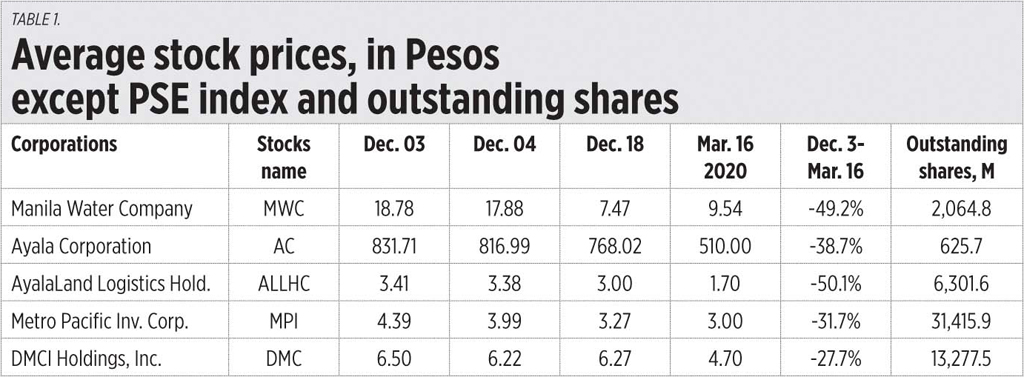
When President Rodrigo Duterte lashed out at Maynilad and Manila Water that hold concession agreements (CA) with the government via the MWSS on Dec. 3, 2019, the stock prices of both companies and their allied firms suffered significant declines starting Dec. 4, which continued until mid-December. I continued the series to last Monday, the last trading day of the Philippine Stock Exchange (PSE). The percentage decline of stock values until this week remains big, 49% and 32% for Manila Water Co. Inc. (MWC) and Metro Pacific Investment Corp. (MPI) respectively (see Table 1).

MWC has lost some P18 billion while MPI lost around P40 billion in stock value from the harassment by the President. Very irresponsible.

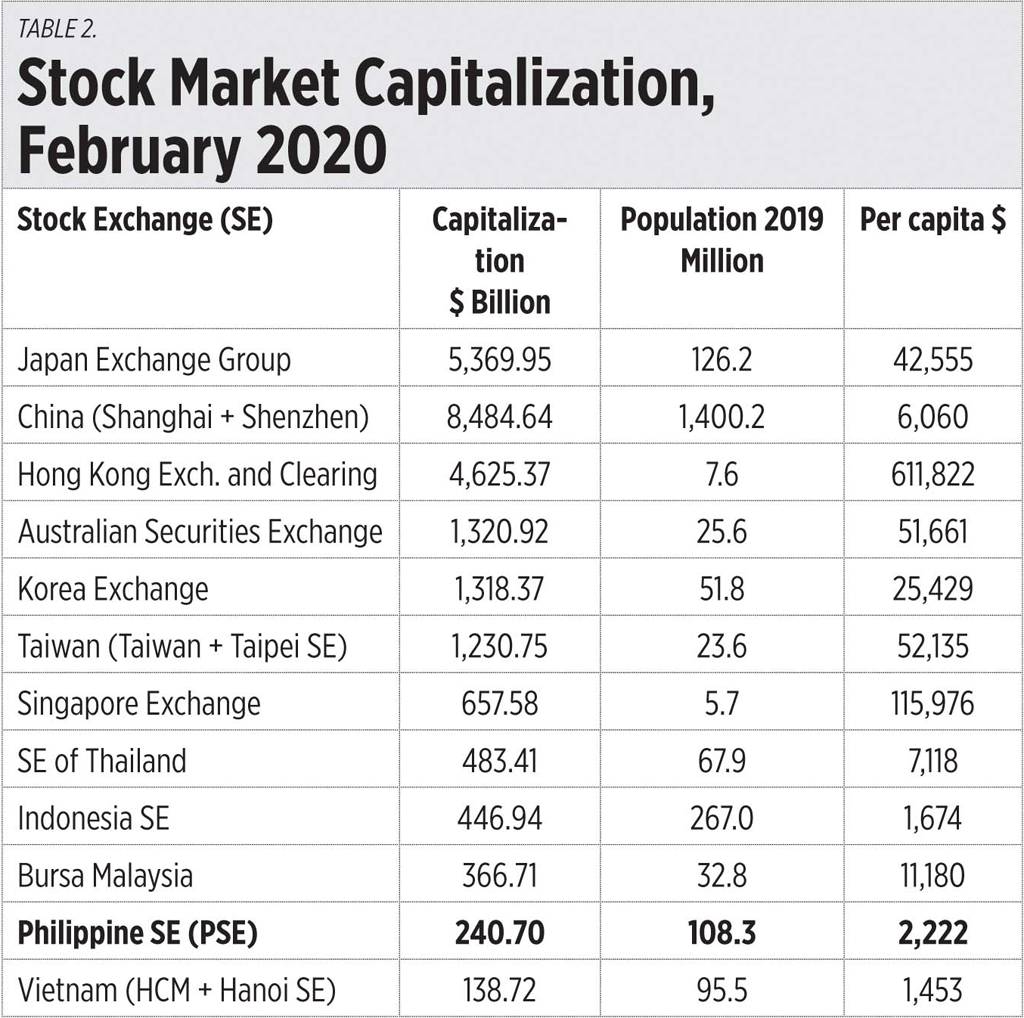
Consider also that the PSE is a lightweight in terms of market capitalization in Asia Pacific, only $241 billion as of February 2020 and our per capita capitalization was only $2,222, just a third of Thailand, a fifth of Malaysia and 1/50 of Singapore. Soon Vietnam and Indonesia might overtake us (see Table 2).

India has a market capitalization of $4.08 trillion and a higher per capita of $3,015 than us.

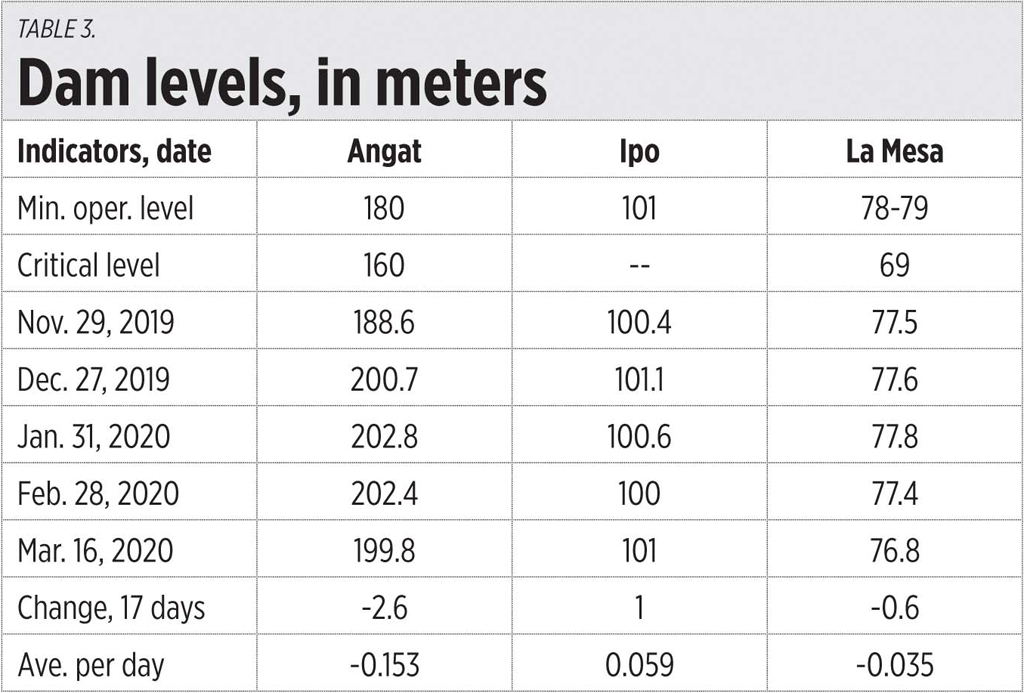
Now consider this COVID-19 or Wuhan virus, water demand is high this March as the hot season has started and people wash hands very often. I computed the decline in Angat Dam water in the first half of this month — it is 0.15 meters per day. At this rate, Angat water will reach the minimum operating level of 180 meters by around mid-May and water rationing will happen again after that (see Table 3).

It is important that the two concessionaires develop new short-term water sources and they will need even short-term loans to fund the immediate capex (capital expenditure) but banks remain hesitant to lend to them because of the Presidential harassment that hangs over them until today.

Despite these financial limitations, the Ayala and MPI groups have bent over backwards and extended billions of pesos to their employees, contractors, suppliers, lessors and customers during this virus situation. The Ayalas, for instance, extended a total of P2.4 billion for this. Payment of water bills, rentals, electricity bills have been postponed by at least one month with no penalties or disconnection notices by the two concessionaires.

The President’s political harassment should end and the original concession extension to 2037 should be honored. The Clean Water Act plus Supreme Court Mandamus have jointly raised the requirement from 50% to 100% sewerage coverage and it is estimated that this will require an investment of P458 billion until 2037.

When the political uncertainties are removed, the two concessionaires should be able to mobilize new loans to finance the huge investments needed for the remaining 17 years.

This virus scare has shown us many things, like the need for sustained hygiene and cleanliness, that requires lots of clean water flowing from our faucets to help remove the virus. May this lesson sink into the minds of the President and his officials regulating the water sector.


Bienvenido S. Oplas, Jr. is the president of Minimal Government Thinkers.

minimalgovernment@gmail.com

The benefits of being irrelevant

By Tony Samson

SHOULD OPINIONS and conversations always be about the issues of the day? Does the opinion page need to follow the events in the front page and the latest posts on the net? Can we talk about something else aside from the virus and the economic recession it seems to be causing along with the travel restrictions and their effects on the price of oil?

Can we change the topic?

If we do, there is the risk of being considered irrelevant. What’s wrong with that?

Relevance refers to being pertinent to the matter at hand. Can a person bringing up Bertrand Russell’s “In Praise of Idleness” when the topic under discussion is the disruption of the supply chain with the virus lockdown of China be summarily dismissed as irrelevant?

To rule something as irrelevant presumes that the real issue is clear and why an off-topic comment does not contribute to an understanding of it. Maybe an irrelevant topic like women’s volleyball or the social distancing caused by gadgets can jog a fresh outlook on the impact of the virus on sports events.

Lateral thinking developed by Edward de Bono holds that nothing is automatically irrelevant, just another angle to consider. He holds that approaching problems indirectly with irrelevant comments can provide different perspectives. Irrelevance is just one approach. Anyway, relevance is subjective. The effect of the virus on traffic or the workings of an art auction may be irrelevant but only to some.

Humor is considered inappropriate for serious topics, and thus automatically considered irrelevant as an approach to weighty matters. Roberto Benigni, actor and director, used a slapstick approach on a horrible human tragedy, the holocaust, and how the Italian Jews were sucked into it. His film, Life is Beautiful, a curiously light account of a painful historical event became an award-winning masterpiece. A recent movie, Jojo Rabbit, on the Hitler Youth and the Jews in Austria after the Anschluss does a similar comic take.

Still, irrelevance in literature has been practiced by Dickens and Shakespeare. The comic relief provided by Falstaff in Henry V has nothing much to do with the plot. Still, it provides a break to make the story more satisfying. Dickens’ Mr. Micawber and his little rules on life (“Income higher than expense is bliss; Income lower than expense is misery”) provides the same plot leavening of the novel, David Copperfield. This literary device is called “comic relief” as the levity and irrelevance give us a better perspective of tragedy.

The root word of relevance is Latin for lightening up, relieving, and raising up (as in levitate). Doesn’t irrelevance relieve and raise understanding? Getting too emotionally involved in an issue leads to passionate debate, taking sides, and introducing the ultimate irrelevance of name-calling.

If relevance implies pertinence to the matter at hand, isn’t it a priority to first define what the real subject is? Irrelevance has its benefits. It distracts us and provides distance for a better perspective.

Book reviews, karaoke behavior and what it reveals, delving into the intricacies of office politics, at the same time avoiding comments on dangling franchises, the spread of a virus (like panic), or the distant memory of ashfall give respite from doomsday scenarios.

Is irrelevance to be considered merely being out of touch, maybe even apathetic and unconcerned with weightier matters of life and death? Not really. Irrelevance can be refreshing as a form of social protest, even in the chat groups that can take themselves too seriously.

Reading a variety of books on history, like the execution of the Romanovs by the red forces or the instability, even the borderline lunacy, of a sitting president (of another country) can give a better understanding of current events. A reading program may be the best definition of “working from home.”

Life in the margins and how personal relationships develop and then deteriorate to hatred seem more interesting than following the rising or falling numbers of infected countries and the incidences of lockdowns.

Anyway, it’s too late to wonder how you, Dear Reader, got this far in the topic of irrelevance. It’s too late at this point to try to get back to something weighty or relevant… and definitely more gloomy.


Tony Samson is Chairman and CEO, TOUCH xda.

ar.samson@yahoo.com

The ethical way to ration coronavirus hospital care

By Faye Flam

IF COVID-19 spreads as fast as experts predict, the memories that will stick with Americans years down the road will be of desperately ill people turned away from hospitals.

The US has no capacity to cope with even a small surge in intensive care patients. There will be shortages of health care workers and equipment — especially respirators, which ran far short of the need in Italy.

But even under these terrible circumstances, there are ways to be as fair as possible about who receives care.

The public won’t tolerate rationing decisions made on the spot by governments, hospitals or hospital administrators — these will seem arbitrary and unfair. Coordination and uniformity across hospitals is critical, says Nir Eyal, a professor of bioethics at Rutgers University who has studied healthcare rationing. The alternative to a uniform plan is arbitrariness or a system where the people with the most money or the sharpest elbows get the best care. We need to allocate resources in a way that saves the most lives in the fairest way.

What’s needed are rules based on scientific and ethical principles, and put forward after long deliberation. Fortunately, the World Health Organization already has guidelines for dealing with healthcare shortages during a pandemic — drawn up in 2006, in response to the threat that an extremely deadly strain of bird flu would spread from person to person. These guidelines took weeks of collaborative work between scientists and ethicists.

“Now it’s as if there’s amnesia” says Daniel Wikler, a Harvard University professor of ethics and population health, who helped craft guidelines for the World Health Organization and the state of Massachusetts. Similar guidelines, he said, were created at a national level. But because bird flu later appeared to be a dud, he says, the world forgot about the plan.

It’s time to remember. The bird flu plan was aimed at a viral threat very much like the one we face now. That deadly virus, H5N1, jumped from birds to a few humans in the early 2000s. Some aspects of the threat were different, but the ethical principles are the same. Shortages of ICU beds or ventilators will mean that even the “least bad course of action will be awful,” he says. But we still have to implement what’s least bad.

The guidelines created for bird flu consider all lives equally valuable and seek to maximize the number saved, Wikler explains. Under those guidelines, patients would be divided into broad priority categories. In the first would be those whose deaths would cost other lives — healthcare workers, firefighters, police, and the people who keep up essential public works such as the water supply.

The next division is between the sickest and those likely to recover. Normally, the sickest people would be given first priority for intensive care treatment, but in a pandemic, priority should go to those whose lives are threatened, but who have a good chance of pulling through if treated. Those people would have priority over sicker people who have very little chance to survive even with medical care.

Those classifications won’t be enough, Wikler says. If there’s a big surge in cases, hospitals might see multiple people in the same category and beds for only half of them. If that happens, people should be chosen through random lottery. There’s more than ethical value in this approach: In scientific studies, randomization is a tool used to learn what works and what doesn’t. It sounds cruel to say we’re using people as guinea pigs, he says, but doctors can save lives down the road by learning as much as possible as they go along.

Nobody knows how big this pandemic will get or how US efforts at social distancing will help. But we do know that even in the best-case scenarios, hospital beds are scarce. The US has 12% fewer total beds than it did in 1975. According to a Kaiser Family Foundation study, quoted in the Wall Street Journal, there are 2.8 beds per 1,000 people in the US, while other developed countries such as Germany, Australia and Japan have an average of 5.4 beds per 1,000 people.

In the same WSJ piece, Harvard epidemiologist Mark Lipsitch has estimated that if things progress the way they did in Wuhan, the US will need three times as many ICU treatments as the number of ICU beds that are available.

So Americans need to plan for rationing but also seek to minimize it, though efforts to build field hospitals, or temporary hospitals in existing buildings such as hotels. The Chinese built a giant new hospital in the midst of their crisis. And the drastic changes in our lives with social distancing could help minimize a surge in cases. The object is not only to save ourselves but to save others, and save the principles of community and fairness that hold us together.


BLOOMBERG OPINION

The end of OPEC is here

By Julian Lee

OPEC may not survive to celebrate its own 60th birthday later this year. Saudi Arabia’s decision to abandon output restraint and flood the market with cheap crude signals the end for a group dubbed the world’s most successful cartel.

In a selfish bit of showmanship, Saudi Arabia, by far the biggest producer in the Organization of the Petroleum Exporting Countries (OPEC), tore up an output agreement that had lasted since the start of 2017. It did so because Russia, the largest of OPEC’s external allies, wouldn’t play ball and refused to make deeper production cuts to help prop up oil prices in the face of the economic devastation being wrought by the COVID-19 virus.

The kingdom had probably hoped to shock the Kremlin into coming back to the negotiating table, but that clearly backfired. The impact — compounded by the deadly virus’s continued spread — will be much more damaging for OPEC’s other members, from Algeria to Venezuela, than it will be for Saudi Arabia’s nemesis in the wider OPEC+ coalition.

The de facto leader of OPEC could have made other calculated choices before taking an every man for himself approach and starting an all-out oil price war. After all, Russia offered to extend the current output cuts beyond the end of March, and there was nothing to stop OPEC’s 13 members from agreeing further reductions just among themselves.

But Saudi Arabia seems to have decided that the OPEC+ pact, which started life as a temporary coming together meant to last only six months, needed to continue further into its fourth year. If the external partners weren’t prepared to cut deeper, then OPEC wouldn’t act either. And, since not everyone saw eye to eye, the current agreement wouldn’t be extended, leaving everybody free at the end of March to pump as much as they want, or are capable of.

Then, rather than wait and see, Saudi Arabia acted with a vengeance, slashing the cost of its crude for loading in April. Official selling prices — set as differentials to regional benchmarks — were cut by the most on record after the OPEC+ deal fell apart. With Brent trading around $30 a barrel and the discount for sales of Saudi Arabia’s key Arabian Light grade set at $10.25 a barrel, there is an ocean of $20 oil set to head for Europe next month. There have also been big increases in the volumes allocated to buyers in both Asia and on the U.S. Gulf coast.

Saudi Arabia’s monopoly oil producer, Saudi Aramco, says that it will supply its customers with 12.3 million barrels a day in April. That’s more than the company can pump out of the ground, even if it opens the taps fully, thus implying that it will draw down crude stored at home and in tanks in Japan, the Netherlands and on Egypt’s Mediterranean coast.

While the kingdom can partially offset the collapse in oil prices with the boost in volumes, most of its fellow OPEC members are much less fortunate. They are already pumping almost as much as they can.

In Libya, for example, production has been cut to near zero after a local warlord closed almost all of the country’s export terminals. A peace deal could increase it by more than 1 million barrels a day, but that seems remote. Iran and Venezuela could both boost output were it not for US sanctions on their oil trade, although Venezuela’s upside is limited.

For the rest of team OPEC, Nigeria is the only country outside the Persian Gulf that can boost production by more than 100,000 barrels a day. But that’s not going to get it very far. A simple back-of-the-envelope calculation shows that lifting output to capacity would only reduce the West African nation’s losses from the price drop to $30 a barrel from $60 by 6%. For Angola, the region’s second-biggest producer, the potential reduction in its loss is just 3%. By contrast, Saudi Arabia, from its kingpin perch, could recoup more than a quarter of the oil revenue it would lose as a result of the price drop by increasing supply to 12.3 million barrels a day from 9.7 million.

This is not the first time that Saudi Arabia has cast smaller OPEC producers to the wolves. As a grouping of sovereign nations, they have little leverage over the group’s biggest producer. But the kingdom’s latest actions, in the face of an unprecedented hit to global oil demand, show its true disregard for fellow members.

When OPEC was originally formed back in 1960, part of its principal aim was “safeguarding the interests of Member Countries individually and collectively.” That goal was still paramount in the revised OPEC Statue, drawn up in 2012. So too was “eliminating harmful and unnecessary fluctuations” in oil prices. Saudi Arabia’s latest actions are diametrically opposed to those goals, and have helped cause oil prices to fall by almost 40% in a little over a week. That is certainly not in the collective interests of OPEC’s members.

The oil cartel was a useful fig leaf for Saudi oil policy when it wanted to support oil prices. Now that it wants to send them tumbling, OPEC is simply an inconvenience. The group has survived seemingly irreconcilable internal differences in the past. This one might just be a step too far.


BLOOMBERG OPINION

Peso rebounds as governments work to combat COVID-19 impact

THE PESO rebounded on Wednesday as governments around the world lay out initiatives to combat the impact of the virus. — BW FILE PHOTO

THE PESO bounced back on Wednesday after a trading halt on the back of positive market sentiment, with the United States baring fiscal strategies to cushion the impact of the coronavirus disease 2019 (COVID-19) outbreak.

The local unit ended trading at P51.05 per dollar yesterday, recovering 45 centavos from its P51.50-per-dollar finish on Monday, according to the website of the Bankers Association of the Philippines (BAP).

After the trading suspension on Tuesday, the peso opened Wednesday’s session at P51.80 per dollar. Its weakest showing for the day was at P51.85, while its intraday best was at P51.01 against the greenback.

Dollars traded slipped to $712.25 million from the $769.39 million seen on Monday.

In light of the enhanced community quarantine and the curfew set in Metro Manila, the BAP has shortened currency trading hours until further notice, with afternoon trading now ending at 2 p.m. from 4 p.m. previously.

A trader attributed the local unit’s strength to profit taking as well as the dollar’s weakness following remarks from US President Donald J. Trump.

“The peso strengthened today on profit taking from the dollar’s recent strength after local trading was halted on Tuesday,” the trader said in an e-mail on Wednesday.

“Recent statements from US Pres. Trump about a probable US recession has likewise contributed to the weakness of the greenback,” the trader added.

On Monday, Mr. Trump told Americans to clear most of their social activities in the next two weeks and to refrain from mass gatherings, according to a Reuters report.

He also warned that a recession is possible as stocks continued to drop. He added he will focus on addressing the crisis, as the economy will fare better if problems are resolved.

“We’ve made the decision to further toughen the guidelines and blunt the infection now,” Mr. Trump told reporters at the White House.

Meanwhile, UnionBank of the Philippines, Inc. Chief Economist Ruben Carlo O. Asuncion said the peso’s rebound was supported by market sentiment on headlines about US stepping up its initiatives to battle COVID-19’s economic impact.

“The peso rebounded from the previous decline as the US government steps up its fiscal rescue plan as COVID-19 continues to spread in advanced economies,” Mr. Asuncion said in a text message.

Reuters reported that Mr. Trump bared a plan to release money for Americans to ease the economic shock from the virus spread.

Meanwhile, US Treasury Secretary Steven Mnuchin said he was discussing plans with congressional leaders to send checks immediately to displaced citizens, whereby Mr. Trump said that some people should get $1,000.

The trader sees the peso moving around the P51 to P51.20 range today, while Mr. Asuncion gave a forecast range of P50.90 to P51.30. — L.W.T. Noble with Reuters

ADVERTISEMENT
ADVERTISEMENT