Home Blog Page 9673

US extends $5.3M in humanitarian assistance for COVID-19 containment effort

THE US has provided $5.3 million worth of humanitarian assistance to the Philippines in support of efforts to contain the coronavirus disease 2019 (COVID-19) outbreak.

“The US government approved an additional P269 million in health and humanitarian assistance to help support the Philippines,” the US Embassy in the Philippines said in a statement Wednesday.

US President Donald J. Trump on Sunday made a phone call to President Rodrigo R. Duterte, during which he offered another round of assistance to the Philippines.

“This newest tranche of US assistance will support laboratory and specimen-transport systems and intensify case-finding and disease surveillance.”

It also intends to assist Filipino and international experts in risk communication and infection prevention, among other measures.

The Philippines earlier received $4 million worth of assistance from the US.

The previous round of funding was meant to increase testing capacity to 3,000 samples per day from 200. It also included a donation of 1,300 cots for Philippine medical facilities.

The Department of Health said as of April 14, testing was available in 15 separate centers. — Charmaine A. Tadalan

PHL raw sugar output expected to decline amid liberalization worries

RAW SUGAR output in the Philippines during crop year (CY) 2020-2021 is expected to drop, as land planted to sugarcane continues to decline and producers remain cautious about plans to liberalize sugar imports, the United States Department of Agriculture (USDA) said.

In its Global Agricultural Information Network report for the Philippines, the USDA said that raw sugar production for CY 2020-2021 is estimated at 2 million metric tons (MT), against 2.025 million MT a year earlier.

“Sugar producers remain cautious about the impact of possible deregulation, as Philippine economic managers consider further trade liberalization beyond rice, such as the sugar and corn sectors,” the USDA said.

Meanwhile, sugar demand for CY 2020-2021 is expected to increase to 2.35 million MT due to increased usage of sugar by food and beverage manufacturers.

Sugar demand could also be spurred by the recovering global economy when it emerges from the coronavirus disease 2019 (COVID-19) crisis.

The report also estimated refined sugar imports in CY 2020-2021 at 450,000 MT, while exports of sugar to the US market are expected to grow to 140,000 MT.

Land planted to sugarcane in 2019-2020 fell to 406,500 hectares from 410,000 hectares a year earlier due to poor weather conditions. — Revin Mikhael D. Ochave

BIR rewards bayanihan spirit with tax advantages

With steadily increasing COVID-19 cases, major cities on lockdown, and most businesses closed, the government has appealed to the private sector to contribute to relief efforts in the spirit of bayanihan. The Bureau of Internal Revenue (BIR) released Revenue Regulations (RR) No. 9-2020 in line with Republic Act No. 11469, otherwise known as the Bayanihan to Heal as One Act, the main objective of which is to adopt urgently-needed measures to address the novel coronavirus outbreak. In particular, RR No. 9-2020 liberalizes the grant of incentives for certain donations in response to the COVID-19 crisis.

The Tax Code grants donor’s tax exemptions and full/partial income tax deductibility for qualified donations made to the national government for NEDA-approved projects, and to accredited non-stock, non-profit organizations (NSNP) formed and operated exclusively for social welfare and charitable purposes, among other purposes.

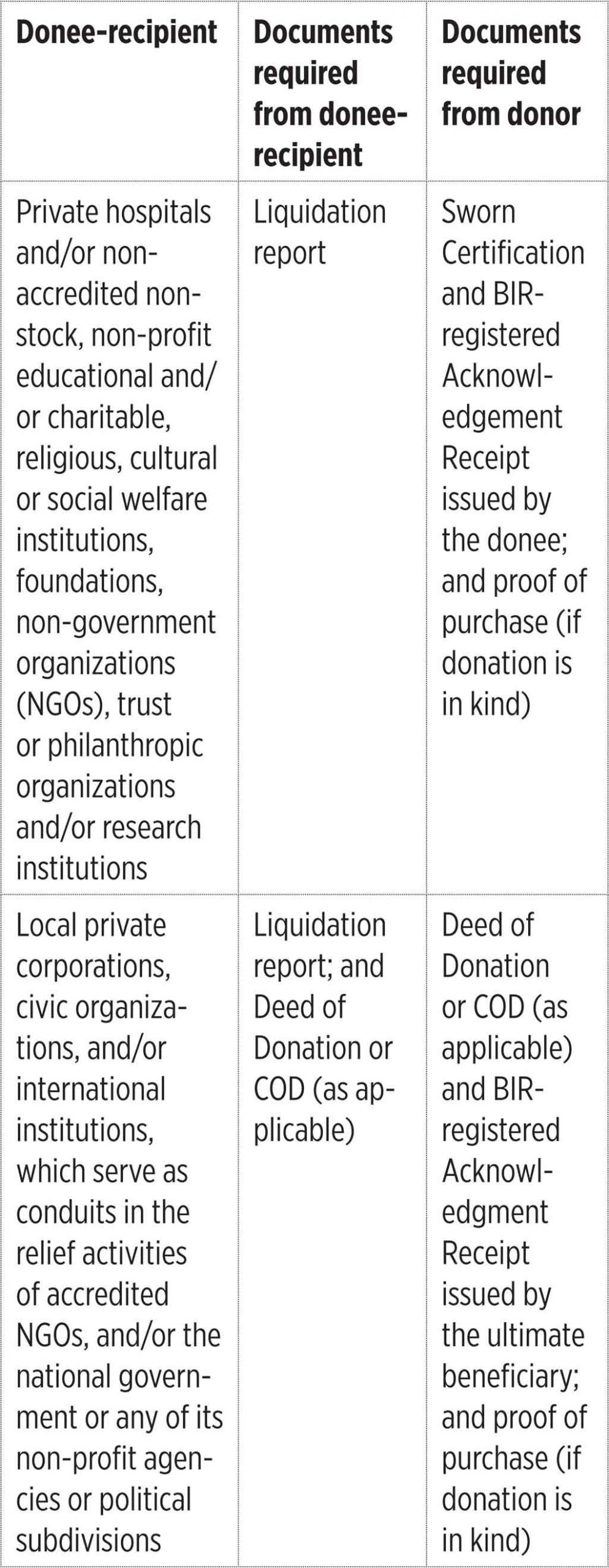
RR No. 9-2020 broadens the coverage further by granting full deductibility for COVID-19 related donations given to the national government during this state of emergency, even if not included in NEDA’s annual priority plan. More importantly, the RR allows donors to donate directly to other donees and still avail of donor’s tax exemption and full deductibility. These additional donees are: private hospitals, NSNPs (even if non-accredited); and entities which serve as conduits in the relief activities of accredited NGOs, and/or the national government.

The tax incentives under the RR cover donations for the sole purpose of combating COVID-19, given from March 16, the start of the Luzon-wide enhanced community quarantine (ECQ), until the end of the three-month effectivity period of the Bayanihan Act. The donations mentioned in the RR are not only limited to cash, but also include health care equipment or supplies, relief goods, and the use of personal and real property.

For donations in kind, the input VAT attributable to the purchase of goods may be creditable against the donor’s output VAT. Needless to say, such input VAT credits must be supported with official receipts or sales invoices. Such donations will not be treated as transactions deemed sales subject to VAT.

DOCUMENTARY SUPPORT FOR TAX-EXEMPT DONATIONS
The availment of the tax incentives is subject to the timely submission of the following required supporting documents by both the donor and donee:

As RR 9-2020 did not provide for a specific timeline, it appears that the COD must be filed by the donee with the BIR following the deadlines in other existing regulations. Normally, the COD must be filled within thirty days (30) from the receipt of the donation. Pursuant to RR No. 10-2020, the filing of the COD is extended for thirty (30) days from the lifting of the ECQ.

The donor’s obligation to file a Notice of Donation has been waived by the BIR during this period.

The above documents must be submitted by both parties within 60 days from the lifting of the ECQ to their registered Revenue District Offices.

Despite the seemingly stringent requirements, the RR leaves ample room for flexibility. For one, if the donee does not have any BIR-registered Acknowledgement Receipt, it may use the template for an acknowledgment receipt provided under the RR.

Also, the Sworn Certification may be executed by the donor, instead of the donee.

To curtail possible abuse, the BIR reiterated its right under the Tax Code to audit the exemption and deductibility of the donations by checking the documents submitted by the donor and donee.

While RR No. 9-2020 is a timely perk to taxpayers who want to join the fight against COVID-19, there is room to enhance the guidelines by clarifying a few points:

• In prescribing the documentary requirements for donations to the additional donees under Section 4, the RR appears to have erroneously included accredited NSNPs in the list. The supporting requirements on donations to accredited NSNPs are already separately discussed in Section 3 of the RR.

• The RR did not provide guidance on how the donor should determine the value of the deductible expense related to the use of his property (such as vehicles, lots, or buildings) and how this should be taken up in the liquidation report, Sworn Certification and BIR-registered Acknowledgment Receipt.

• It is not clear whether the input VAT incentive on donations in kind is also applicable to those made to the additional donees since the RR referred only to donations enumerated in Section 3.

• For donations coursed through another entity, it is not clear if the liquidation report must be filed by the donee-recipient or the ultimate beneficiary.

• It might be good if the RR can further clarify which donations may be classified as relief goods entitled to the incentives. For example, would items such as shampoo, toothpaste (or even deodorant) qualify? If not allowed, then such items may qualify for tax incentives only if donated to the National Government or accredited NSNPs.

Despite these inconsistencies which I hope will be clarified subsequently, the RR is still a welcome development to taxpayers who have aligned their resources with their values during these times. With these tax perks, hopefully more taxpayers will be encouraged to participate in social welfare initiatives.

The views or opinions expressed in this article are solely those of the author and do not necessarily represent those of Isla Lipana & Co. The content is for general information purposes only and should not be used as a substitute for specific advice.


Elyse O, Lui is a senior associate with the Tax Services Group of Isla Lipana & Co., the Philippine member firm of the PwC network.

(02) 8 845-27 28

elyse.o.lui@pwc.com

Learn about farming during quarantine

More than 60 online courses available for free at DA-ATI’s e-Learning platform

Even as the enhanced community quarantine (ECQ) contains our movements and activities at home, there are many opportunities to stay productive. Through online resources, people can make good use of their free time in expanding their knowledge and learning new skills.

Farming is among those skills one can learn during this ECQ right at their homes, and this is possible through the e-Learning for Agriculture and Fisheries of the Agricultural Training Institute (ATI), the training and extension arm of the Department of Agriculture (DA).

ATI’s e-Learning program has been offered since 2007 as an alternative means of gaining new knowledge about farming for free.

Now, with the coronavirus disease 2019 (COVID-19) pandemic pushing the need to increase food production, e-Learning is seen to boost DA’s nationwide promotion of urban agriculture and community farming under the “Plant, Plant, Plant” Program.

As DA Secretary William Dar said in a televised briefing last April 18, the “Plant, Plant, Plant” Program aims to boost the food sufficiency level of agriculture commodities such as rice, corn, fisheries, vegetables, and many others.

He stressed that one of the initiatives being rolled out under the program is introducing urban agriculture in metropolitan areas amid enough supplies coming from the provinces.

ATI’s e-Learning program currently offers more than 60 free online courses, covering crops, livestock and poultry, fisheries, social technology, and sustainable agriculture.

Some of the courses are on basic urban gardening, Good Agricultural Practices for vegetable production, and production technologies for straw mushroom, tomato, banana, citrus fruits, and yam, among others.

Basic beekeeping, goat-raising, and quail production courses are also available through the portal.

Under the social technology category, courses on product costing, marketing, food safety, and even effective human communication and community organizing may be accessed.

Sustainable agriculture practices such as the production of organic fertilizers, vermicompost, and mokusaku (wood vinegar) are also open to interested users.

Depending on one’s pace, most of the courses can be completed within a day. Upon completing a course, the e-Learner receives an electronic certificate that can be downloaded from the site.

According to ATI, the number of Filipinos currently registered in the e-Learning site hugely increased during the ECQ — from 87,200 to over 92,700 enrollees.

One of these e-Learners, Ronel De Guzman, an instructor at President Ramon Magsaysay State University in Zambales, shared to ATI that learning through their online platform is a more productive use of his internet connection and electronic gadgets.

“The main reason I tried e-Learning is that I wanted to learn more about agriculture as well as develop some skills necessary for my professional development as an agriculturist and a teacher,” Mr. De Guzman was quoted as saying in a statement.

Alberto Ang, 56 years old, must be enjoying to spend time learning from the e-Learning platform since he has finished five courses so far, most of which are on sustainable agriculture technologies.

“The e-Learning courses being offered are really wonderful. [I like that] these are short but concise courses depending on the topic. Also, if you want, you get to apply the planting techniques right away, whether you have a small or big space, and especially now that almost everyone is staying home,” Mr. Ang said.

In his backyard, he recycles plastic containers to grow vegetables like okra, tomato, and chili pepper.

Below is a complete list of e-Learning for agriculture and fisheries courses.

CROPS
1. Sweet Hairy Balls Rambutan Production
2. Juan and Coffee Talk: Robusta Coffee Production
3. LET’s Grow KAMATIS: Tomato Production Guide
4. Cassavay sa Pag-asenso: Roots of Productivity (CASSAVA1)
5. CASSAVAy sa Pag-asenso: Primary Processing and its Market (CASSAVA2)
6. Rise and Grind: Coffee Processing as an Enterprise (COFFEE3)
7. Good Agricultural Practices for Vegetable Production (GAP1)
8. Cultivating Earth’s Sweet Crop: The Sweet Potato (SweetPotato1)
9. Adlay Adds Life: Introduction to Adlay Production & Product Development(Adlay1)
10. Jackfruit Nursery Management (Jackfruit2)
11. Gold in Grains: Cultural Management for Soybean (Soybean1)
12. Queen Pineapple Production and Postharvest Technology (Pineapple2)
13. Online Course on Mechanized Rice Transplanting Technology (Mech3)
14. Basic Urban Gardening (Urban1)
15. Managing Common Diseases in Banana (Banana1)
16. Saving The Lost Harvest: Introductory Course On Rice Post Production Technologies (Mech2)
17. Abaca Nursery Establishment and Management (Abaca3)
18. Treasure in Threads: Pinya Fiber Processing (Pineapple1)
19. Cultural Management Practices of Abaca (Abaca1)
20. Abaca Pest Management (Abaca2)
21. Growing Bamboo for Profit and a Healthy Environment(Bamboo1)
22. Integrated Pest Management for Banana (Banana2)
23. Growing Banana in the Tropics (Banana3)
24. Citrus Growing: A Promising Enterprise (Citrus1)
25. Savoring the Green Brew: Arabica Coffee Production (Coffee1)
26. From Seed to Seed: Online Course on Corn Production (Corn1)
27. Growing Durian the Better Way (Durian1) [OFFLINE]
28. Production of High Value Crops in Greenhouse (Greenhouse1)
29. Jackfruit Production (Jackfruit1).
30. Go Mango, Hit the Jackpot! Online Course on Mango Production (Mango1) [OFFLINE]
31. Increasing Corn Farm Productivity through Mechanization Technologies (Mech1)
32. Straw Mushroom Growing: A Viable Agri-Enterprise (Mushroom1)
33. Growing Vanda and Vandaceous Orchids (Orchid1)
34. Yummy Yam: Ubi Production (Yam1)

LIVESTOCK
1. Basic Beekeeping (BEE1)
2. Advanced Beekeeping (BEEKEEPING 2)
3. Establishing Feed Resources for Your Goats (Goat1).
4. Starting a Slaughter Goat Enterprise (Goat2)
5. Technological Alternatives to Traditional Goat Breeding (Goat3)
6. Technological Alternatives to Traditional Feeding Management (Goat4).
7. Technological Alternatives to Traditional Herd Health (GOAT5)
8. AI at Your Cervix: Artificial Insemination Course for Raisers (GOAT7)
9. AI at You Cervix: Artificial Insemination Course for Technicians (GOAT8)
10. Meetylicious Meeh: Slaughtering and Cutting Standards for Goat (GOAT9)
11. Hail the Quail. Online Course on Quail Production (Quail1)
12. Walang Aray sa AI: Artificial Insemination in Pigs (Pig1)
13. Mastering the ABCs of Pig Production (Pig2)

MARINE AND FISHERIES
1. Taste the Creamiest Cream Dory: Online Course on the Culture and Utilization of
2. Pangasius (Pangasius1)
3. Seaweed Farming (Seaweed1)

SOCIAL TECHNOLOGY
1. Product Costing Made Easy (PTTC-COSTING1)
2. Food Safety in Trade (PTTC-FOOD1)
3. Online Course on Training Management (TM1)
4. Lika! Usap Tayo: Effective Human Communication and Human Relations (COMM1)
5. Getting the Big Bucks: Guide to Grant Proposal Writing (Writing1)
6. Changing People’s Lives Through Effective Extension Delivery (EDS1)
7. Working Together Works: An Online Course on Community Organizing (CommOrg1)
8. Basic Agricultural Marketing Extension (Agrimark1)

SUSTAINABLE AGRICULTURE
1. Growing Carrot the Natural Way (CARROT1)
2. Improving Quality of Life: Growing Rice Organically (ORICE1)
3. Climate Change 101: Understanding Climate Change in Agri-Fisheries (CC101)
4. Mokusaku: Wood Vinegar Production (WOODVIN1)
5. Online Course on Organic Fertilizer for SA (Organic1)
6. Vermicomposting: Turning Trash to Cash (Vermi1)
7. Green Farming with Integrated Rice-Duck Farming (IRDFS1)
8. DEMO COURSE- Insects Away the Alternative Way (APM1)

Interested individuals may visit www.e-extension.gov.ph/elearning to create an account and enroll in any chosen course.

For questions and concerns, chat with the ATI e-Learning team through facebook.com/atiinteractive or text the Farmers’ Contact Center at 0920-9462474. — ADRIAN PAUL B. CONOZA

Luzon lockdown may continue if coronavirus infections spike

A LUZON-wide lockdown probably won’t be lifted if coronavirus infections continue to soar, the government’s chief enforcer of policies against the pandemic said on Tuesday night.

The Philippines “cannot rush into normalcy,” Carlito G. Galvez, Jr. told a news briefing, noting that cases could enter a “second wave” similar to what happened in Singapore if the lockdown was lifted sooner.

President Rodrigo R. Duterte locked down the entire Luzon island on March 17, suspending work, classes and public transportation to contain the outbreak. The so-called enhanced community quarantine was supposed to end on April 13 but he extended it by two more weeks until April 30.

Mr. Duterte said people should stay home and go out only to buy food and other basic goods.

“We need to continue and heighten the enforcement of the enhanced community quarantine,” Mr. Galvez said in Filipino. “While doing this, it’s better if we also conduct mass testing to locate, test, isolate and cure patients.”

Presidential spokesman Harry L. Roque told Radyo Pilipinas on Wednesday Mr. Duterte was still studying his options, adding that totally lifting the lockdown was out of the question.

The government was considering limiting the lockdown to certain areas as recommended by health experts to Mr. Duterte on Monday, he said.

“The enhanced community quarantine may be enforced in the entire province, city or at the village level,” Mr. Roque said in Filipino. “That is one of the options the President is considering.”

Senator Christopher Lawrence T. Go, Mr. Duterte’s close friend and former aide has said the President would probably announce his decision on Thursday.

Also yesterday, the National Economic and Development Authority (NEDA) said a task force made up of Cabinet secretaries against COVID-19 should base its lockdown recommendations on scientific evidence.

“NEDA is recommending to make the decision based on scientific evidence on the risk of transmission of the virus if we modify or lift the enhanced community quarantine,” Acting Secretary Karl Kendrick T. Chua said in a Viber message.

Business groups have urged government to do a calibrated reopening of the economy after April 30 and allow businesses to partially operate again.

“What people want to see is hopefully for the economy to start resuming in stages for them to able to start working,” British Chamber of Commerce Philippines Executive Director Chris Nelson told the ABS-CBN News Channel yesterday.

”Companies want to be able to get their cash flow going because liquidity is important,” he said.

Mr. Chua said at a briefing it would probably be safe for people to go back to work by June or July, assuming the government can test at least 5,000 people daily.

Also yesterday, Senate President Vicente C. Sotto III called for a modified lockdown.

“We need to extend the lockdown but with modifications,” he told DZMM radio.

Mr. Sotto said areas with zero or few cases may be allowed to lift the lockdown provided social distancing measures are maintained. Places hit hard by the virus such as Metro Manila should still be locked down, he added.

Local governments may relax public transportation restrictions, Mr. Sotto said. Tricycles may be allowed to operate again but only with one passenger, he added.

Mr. Sotto on Monday attended a meeting where health experts explained lockdown options to Mr. Duterte.

Mr. Sotto said health experts had warned of a spike in infections once the lockdown is lifted.

Meanwhile, University of the Philippines professors said lifting the lockdown should be done gradually and selectively.

This first approach considers resuming mobility within the village, then within cities and municipalities, and then between cities, the academic experts said in a research paper published on April 21.

The second approach seeks to revive economic activity beginning with highly important sectors to sustain the economy in the next 18 months, they added. — Gillian M. Cortez, Charmaine A. Tadalan and Beatrice M. Laforga

DoH says COVID-19 cases now at 6,710

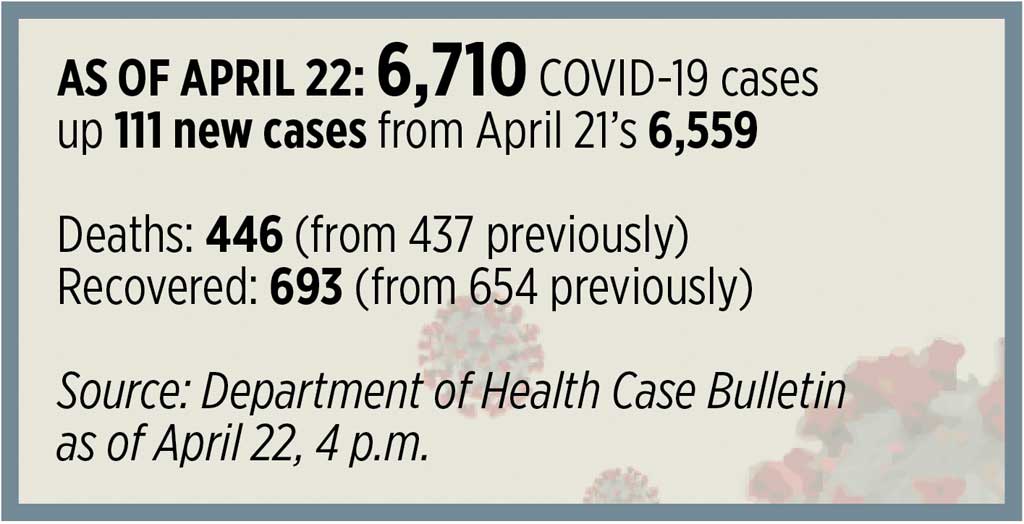
THE Department of Health reported 111 new coronavirus infections on Wednesday, bringing the total to 6,710.

Nine more patients died, raising the death toll to 446, it said in a bulletin. Thirty-nine more patients have gotten well, bringing the total recoveries to 693, it added.

Undersecretary Maria Rosario S. Vergeire told a news briefing 1,062 health care workers have tested positive for COVID-19.

At least 422 were doctors, 386 nurses, 30 medical technologists, 21, radiologic technologists, 51 nursing assistants and 152 belonging to other services such as administrative workforce and village health workers, she said.

Twenty-six of them, 19 of whom were doctors, died, Ms. Vergeire said.

She said three new quarantine facilities have started admitting COVID-19 patients. The Philippine International Convention Center has 294 beds, The ASEAN Convention Center has 150 beds and the World Trade Center has 502 beds.

She also said the New Clark City National Government Administration Center in Pampanga province, which has 688 beds had not started accepting patients pending safety inspections.

Ms. Vergeire also discussed results of contact tracing that showed the coronavirus disease 2019 spread among those who went to public places such as malls and cockfighting events.

“That’s why it’s important for us to listen to our local government units about the rules while there is an enhanced community quarantine,” she said in Filipino. “Your cooperation is a big factor in ensuring that you and your families are safe.”

The coronavirus disease 2019 has sickened 2.6 million and killed more than 178,000 people worldwide, according to the Worldometers website, citing various sources including data from the World Health Organization.

More than 700,000 patients have recovered from the virus, it added. — Vann Marlo M. Villegas

China told to pay for reef damages in disputed sea

A SENATOR on Wednesday said China should pay for damages brought by its reclamation activities in the South China Sea, adding that the Philippines could use the money in its battle against the coronavirus pandemic.

Senator Risa N. Hontiveros-Baraquel said damages in the country’s reef ecosystems in the past six years could reach P200 billion.

China should “shoulder the cost of our country’s COVID-19 response in reparations for the damage it has been doing to our reef ecosystems in the West Philippine Sea,” she told a virtual news briefing, referring to parts of the South China Sea within the Philippines’ exclusive economic zone.

The amount was based on estimates by the University of the Philippines Marine Science Institute. The institute has cited P33.1 billion in yearly losses from the destruction of reefs at the Scarborough Shoal and Spratly islands.

Ms. Baraquel said asking China for payment sends a strong statement that the Philippines holds it accountable for violating a 2016 arbitration court ruling favoring the Southeast Asian nation.

“Whether they pay or not, what’s important is we will have put on record internationally that we are seeking payment from them for violating the United Nations clause,” she said in Filipino.

The senator also criticized China’s plan to set up two districts in Paracel and Spratly Islands.

“We also shouldn’t allow China to continue declaring her so-called districts in areas of the West Philippine Sea while the world is occupied with this crisis that originated from China,” Ms. Baraquel said of the coronavirus pandemic.

The two administrative units are under the control of Sansha City, the Chinese People’s Liberation Army said on its news website on April 17. — Charmaine A. Tadalan

123 inmates in Philippine jail infected with coronavirus

A prison in the Philippines is suffering from a major outbreak of the new coronavirus with 123 infected inmates, officials said on Wednesday, adding to concerns among activists about contagion risks in some of the world’s most overcrowded jails.

The mayor of Cebu City said a new building in the prison capable of handling 3,000 people would be used as an isolation facility to contain an outbreak that accounts for 40% of cases in the Philippines’ second biggest city.

There were no details about the possible source of the outbreak. Eighteen cases have been found at a jail in Quezon City, among them nine staff members. Nineteen more inmates and a worker at a women’s prison in Mandaluyong City near the capital were also infected.

New York-based Human Rights Watch (HRW) was among several groups that called for inmates held for minor, non-violent offences, or those with health conditions, to be freed from Philippine prisons to create more space.

Activists globally have been urging governments to free political prisoners.

HRW this month warned of the likelihood of a serious coronavirus outbreak in the Philippines “threatening the lives of prisoners whose health the authorities have a duty to protect.”

The Cebu jail outbreak is among the biggest known coronavirus clusters in the Philippines, which as of Wednesday had 6,710 infections and 446 deaths. About 70% of cases are in the capital, Manila.

Philippine prisons are notoriously overcrowded due to a combination of poverty, high crime rates and a judicial system unable to cope with a huge case volume.

A shortage of public defenders, overwhelmed judges and insufficient funds to post bail means suspects typically spend long periods — sometimes years — in detention awaiting court hearings that often end up with acquittals.

As of December, nearly 90,000 people in the Philippines were detained awaiting trial, corrections bureau data showed.

President Rodrigo R. Duterte’s war on drugs has exacerbated the problem, each year adding tens of thousands to jails, with 71% of inmates held on drug-related charges.

The Supreme Court urged trial judges on Monday to free prisoners eligible for temporary or early release. — Reuters

#COVID-19 Regional Updates (04/22/20)

Partial bus, train operations up for task force approval

THE DEPARTMENT of Transportation (DoTr) on Wednesday said it was awaiting the decision of the Inter-Agency Task Force for the Management of Emerging Infectious Diseases (IATF-EID) to allow buses and trains to operate partially in Metro Manila. “Naumpisahan nang pag-usapan sa IATF ‘yan. Noong Lunes nagbigay ng statement ang bagong kalihim ng NEDA (National Economic and Development Authority), kung magbabalik-operation dapat hindi full capacity kundi 30% lang (The IATF has started addressing the matter. Last Monday, the new acting secretary of NEDA made a statement that the capacity should be limited to just 30%),” Transportation Secretary Arthur P. Tugade said in a briefing. The partial operability is for the continued enforcement of physical distancing protocol to avoid the spread of the coronavirus disease 2019, he added. Mr. Tugade also said they are exploring the possibility of resuming inter-island ferry operations. The Management Association of the Philippines has proposed to the DoTr that a “demand-driven” transport system be implemented in the National Capital Region to allow workers to “gradually” return to work and avoid business closures and layoffs. — Arjay L. Balinbin

Cebu provincial gov’t cuts exemptions as independent cities continue to record new COVID-19 cases

PERSONS exempted from border restrictions in Cebu will be reduced, the provincial government announced on Wednesday as the number of coronavirus disease 2019 (COVID-19) patients continues to increase in the independent cities of Cebu, Lapu-Lapu, and Mandaue. The Department of Health regional office in Central Visayas, where there are now 203 cases, reported 12 new cases on April 21 with seven in Cebu City, three in Mandaue, and two in Lapu-Lapu. Cebu, the business center, has the highest total cases in the region at 173. “Since it would seem that Cebu City continues to increase its numbers in the positive cases… I find it more prudent that aside from a general classification or a general sector (that are) exempted, we will now have to go down to specifics,” Gov. Gwendolyn F. Garcia said in a meeting with government line agencies, banks, telecommunication companies, utility providers, power producers, petroleum suppliers, and money remittance centers. These sectors will be submitting their list of exempted workers, which will be assessed for reduction by the provincial government. The provincial government, with its headquarters in Cebu City, will also be trimming its skeleton workforce. Members of the diplomatic corps and consulates, which are mostly in Cebu City, will no longer be exempted. “We will have to implement even stricter controls now. That is why we will go through each and every exemption and we would need your help in identifying because the province will now issue a pass,” she said. The enhanced community quarantine measures in Cebu province are on an open-ended implementation.

Zamboanga agri laboratory accredited as COVID-19 testing center

REPRESENTATIVES from the Research Institute for Tropical Medicine, World Health Organization, and Department of Health during the site inspection of the Department of Agriculture-Zamboanga Peninsula’s laboratory for accreditation as a COVID-19 testing center. — @DA-ZAMPEN

THE DEPARTMENT of Agriculture-Zamboanga Peninsula’s (DA-9) diagnostic laboratory for animal diseases has been reconfigured as a testing laboratory for the coronavirus disease 2019 (COVID-19) and is now accredited by the Department of Health (DoH). “We express our support in this endeavor knowing that we have the facility and the equipment to possibly qualify to test COVID-19. Utilizing it is in our utmost agenda right now apart from ensuring the continuous food supply in the region to help in this COVID-19 crisis,” DA9 Regional Executive Director Rad Donn L. Cedeño said in a statement on Tuesday. Mr. Cedeño signed a memorandum of agreement on April 21 with DoH Regional Director Emilia P. Monicimpo for the use of the facility with management under the Zamboanga City Medical Center, a designated COVID-19 referral hospital. DoH-9 Infectious Disease Cluster Head Maryrose B. Rendon said the facility will serve not just the Zamboanga Peninsula Region but also neighboring localities, including the island provinces under the Bangsamoro Region. “We will also be accepting samples from the region’s neighboring provinces such as Basilan, Sulu and Tawi-Tawi,” Ms. Rendon said. The DA laboratory, located in Zamboanga City, was established in 2008 originally for Avian flu detection and it acquired a new RT-PCR machine in 2017. As of April 21, there were 10 confirmed COVID-19 cases in the region, with six in Zamboanga City and four in Zamboanga del Sur. — Marifi S. Jara

Politics and Crisis: A discussion seriesGlobal health governance and COVID-19 pandemic

By The Ateneo de Manila Department of Political Science

Part 6 of an eight-part series
RECENT POLITICAL EVENTS such as Trump’s withdrawal of US funding for the World Health Organization (WHO) on April 14 and the challenges raised against the legitimacy of the Tedros Adhanom-led WHO obstruct collective action on the pandemic. Nonetheless, they must be addressed if the global governance of health is to succeed in this time of crisis.

Undeniably, the WHO is vested with the key role of monitoring the pandemic preparedness of national public health systems through surveillance, detection, and response (IHR 2005). However, the United Nations (UN) system must be viewed as only one of the myriads of mechanisms responsible for global governance. In terms of the WHO, its soft authority is reinforced mainly by the domestic states’ execution of core capacities mentioned above and by a large extent, donor funding.

A framework based on global governance, thus opens up to the analysis of the role of a plurality of other agents, beyond the WHO, in shaping the processes and outcomes of governance of health at the time of the COVID-19 pandemic.

BEYOND THE WHO: DEFINING GLOBAL GOVERNANCE
James N. Rosenau’s (1995; 2009) global governance framework provides for an understanding of the range of actors, scale, intensity, and complexity of interactions that characterize governance at the global level.

Globalization sets the context of global governance, with technological change playing a key role in linking actors and processes to economic and cultural interdependencies and asymmetries. Through global trade, actor-sensitivity and vulnerability to external shocks is heightened. Media and travel act as globalization agents that blur physical distances and geographies and further the conflation of the local with the global.

Decentralized and interconnected settings thus set the platform for the participation of actors other than the state. Non-state actors (NSA) such as NGOs, transnational corporations (TNCs), social movements, civil society organizations, citizen groups, etc. act as the “steering mechanisms of governance.” As opposed to a “command” center that typically describes central domestic authority, steerers are self-regulating and may be autonomous from the state. Credible and as capacitated as states and their national governments, specific NSAs shape and create rules by iterating practices and customs, internalizing (or opposing) norms and institutionalizing regimes through enforcement or contestation.

FIRST PHASE: FROM PUBLIC HEALTH EMERGENCY TO A PANDEMIC
It has become evident in the 21st century, that with the occurrences of SARS in 2003, swine flu in 2009, Ebola virus in 2014, and Zika virus in 2016, globalization serves as the “transmission belt” for propelling the spread of infectious diseases.

In early January, the WHO collaborated with regional and country offices to respond to the outbreak in Wuhan, China. On Jan. 30, it declared the outbreak a Public Health Emergency of International Concern (PHEIC). By March 11, as the virus spread outside of China, WHO announced the COVID-19 pandemic (WHO 2020).

Succeeding responses of actors to WHO’s pronouncements marked the first phase of global health governance in the context of COVID-19. Referred by Steven and Evans (2020) as the “public health emergency” phase, this foremost “layer” includes the containment and suppression measures taken by China to respond to the outbreak at epicenters in Wuhan city and Hubei province. Due to their proximity at source, the subsequent responses of China’s neighbors, Hong Kong, Taiwan, and South Korea in January, were immediate and timely, permitting them to resort to pharmaceutically based interventions of testing and tracing, while averting the onerous lockdowns that was the result of China’s intransigence.

At the onset of the pandemic in Europe, cross-jurisdictional actors (such as states/ sub-states/regions/ multilateral/ scientific/ medical/ business) evolved a continuum of responses to interlocking objectives of global health governance at a time of crisis. The race to meet these objectives is shaped by “micro-macro” and “national-local” issues and dynamics: (i) flatten the pandemic curve; (ii) break the transmission chain; and, (iii) lessen the economic, social, and human rights impacts (WHO 2020).

Flattening the pandemic curve: lockdown, closures, and social restrictions

National-local government efforts based on lockdowns, quarantine, school closures, business stoppage, and border controls constitute worldwide responses to the pandemic.

While particular cases reflect strong-state coercion, as in the case of France, state-sponsored pandemic responses, in general, have been disjointed and at times unsynchronized with their subnational governments.

As recent events have shown, different governmental models posed as barriers to cohesive central-local action. In unitary systems, the Philippine Pasig City mayor was conflicted by the central government’s directive to implement a tricycle transport ban that prevented the mobility of the sick during the Luzon wide lockdown in March. Different courses of action taken by the regional governments in Italy — Veneto, which delivered mass testing, and Lombardy, which opted to delay it characterized the rather “quilted” approach to crisis management.

Other cases involving federal states are unique. In the US, it involves intra-state competition for popular mobilization. In Michigan, North Carolina, and Ohio, constituents have intensified their protest of social distancing policies enforced by their local governments. In the same vein, intra-executive agency competition for public support for social distancing has been the focus of the conflict between the President of Brazil, Jair Bolsonaro and his health minister.

BREAKING THE TRANSMISSION CHAIN: TEST AND TRACE, ACCESS TO MEDICAL SERVICES, AND HOSPITAL CARE
While the WHO recommends social distancing, it highly enjoins the state and private actors to carry out testing for COVID-19. It attempts to narrow down the testing gaps between developed and developing countries by collaborating with companies to ensure the supply of testing kits. Increasing forms of TNC collaborations with governments have also supplanted WHO’s efforts. These global actors have penetrated the production of testing kits as well as the construction of makeshift hospitals for additional beds. Central and sub-national governments have played key roles in converting big venues to makeshift lying in beds as shown in the practices of New York City, the Philippines, through the Department of Public Works and Highways (DPWH) and Wuhan, the site of massive fangcang shelter hospitals.

LESSENING OVERLAPPING HEALTH, ECONOMIC, SOCIAL, AND HUMAN RIGHTS IMPACTS
Globally, public and private actors have had to address the “second order” consequences of quarantine measures and of travel bans on vulnerable sectors. Transnational civil society actors have called governments to confront the human rights dimensions of confinement, specifically police brutality and the issues of unequal medical, food, water and sanitation access that impact on the vulnerable in developed and developing countries.

Actions vary particularly at the scale with which states and regional groupings have chosen to allocate their resources. At the lead is the US, with $2 trillion worth of economic stimulus for individuals/ families, small/ big businesses, public services and subnational governments. The EU’s “rescue plans” have been contingent on the individual EU state provisions for safety nets. In Asia and the Pacific, governments have committed to extend fiscal support for SMEs, wage support for workers, and subsidies for the affected services sectors of tourism, civil aviation, and food. Additionally, ASEAN+3’s resolve to protect regional job security is conditional to the region’s continuing trade and business (UNESCAP 2020).

THE CHALLENGES OF GOVERNING THE “SECOND PHASE”
The practices that actors have evolved to respond to the crucial first phase of the pandemic will definitely shape the governance of the “second phase” (Steven and Evans 2020). Largely unknown, it is predicated on when the virus plateaus and on when infection rates decline across places, globally. How this phase unfolds, though will not be consistent across sectors and jurisdictions.

Governing health during “post lockdown” will be as demanding. Enrique Dans (Forbes 2020) asserts: “From now on, we must prepare for life in a world where a vaccine for COVID-19 is going to take a long time to arrive…”

What may be certain is how actors mark the beginning of their post lockdown histories, incorporating and embedding practices such as “security distancing,” mask wearing, rapid testing, as well the arrangements for remote working and online learning, that have contributed to global health objectives during this period of crisis.

Forward steps should include rule creation and implementation of the hard lessons learnt due to limited pandemic preparedness, particularly the need to scale up government capacity for testing, contract tracing and treatment of confirmed cases.

This period will require the strengthening of practices that bridge worldwide divides in basic needs and health access and in digital and information technologies.

As we know it to be true by now, the SARS epidemic experience has helped East Asia to redefine understandings of what matters most for their people’s health security and personal safety. The emergent norms of the COVID-19 pandemic response should help us to reconstruct the ideas and practices that should define an equitable and just global health governance.


Previous columns in this series can be accessed here:

https://www.bworldonline.com/politics-and-crisis-a-discussion-series-framing-the-crisis-conversation/

https://www.bworldonline.com/politics-and-crisis-a-discussion-series-governing-the-pandemic/

https://www.bworldonline.com/politics-and-crisis-a-discussion-series-power-from-below-social-policy-for-the-people-by-the-people/

https://www.bworldonline.com/politics-and-crisis-a-discussion-series-re-imagining-asean-in-a-time-of-crisis/

https://www.bworldonline.com/politics-and-crisis-a-discussion-series-covid-19-lessons-in-east-asia-the-good-the-bad-and-whats-just-right/


Life or money?

I am certain the COVID-19 lessons from Taiwan, Korea, and Hong Kong, as well as Japan and Singapore, and even in the United States, Italy, and the rest of Europe are not lost on our public officials and business leaders. I am likewise certain that many factors are now under consideration as the country decides on the next course or phase of action.

The Luzon-wide ECQ (Enhanced Community Quarantine) is scheduled to end April 30, Meantime, even local governments in the Visayas and Mindanao have implemented quarantine protocols or procedures because of COVID-19 cases in their localities. So, in effect, practically the entire country is on some form of lockdown to date.

And this has resulted in much discussion and debates, in public and private fora, inside and outside the corridors of power, with groups and individuals all weighing in on the choice between life or money (economy). In my opinion, however, this is not an “or” but an “and” question, as one cannot do without the other. Both population and economy need to survive and endure, side by side.

What started as a public health emergency in early March in the Philippines, resulting from a COVID-19 global pandemic that started in China in January, has now also become an economic emergency. Or, as United Nations World Food Program Director David Beasley put it, “We are on the brink of a hunger pandemic.” He noted the economic impact of the COVID-19 pandemic could lead to a “humanitarian catastrophe.”

Locally, it is safe to assume a rise in hunger incidence particularly in urban poor communities in the metropolis. Daily wages are in short supply, with many small and medium businesses on lockdown for almost 40 days now, and with that the means for the poor to avail themselves of much needed basic necessities. Government assistance is not enough to sustain them, more so if the lockdown continues.

The wealthy may have less to worry about in terms of daily living costs, and the poorest of the poor may get some relief through government aid. But, the ever-shrinking middle-class has become even more endangered and has inched closer to extinction. And even while the government initiates efforts to assist them as well, for sure, the aid will likewise be insufficient.

I believe that neither the government nor the private sector have enough resources, even combined, to indefinitely sustain people and to keep most of us out of poverty, and to keep hunger at bay, in a prolonged lockdown. We are moving towards 45 days now, and looking at the possibility of another 15 to 30 days getting added to the ECQ

While an expected increase in consumer demand after the lockdown period, perhaps towards the third and fourth quarters of the year, is anticipated to move the economy forward, I am concerned that by the time consumers come knocking, many suppliers will no longer be around. Small and medium enterprises will find it difficult to remain in business after 45-60 days of zero revenues.

Moreover, one cannot expect consumer demand to go back to pre-COVID-19 levels after the lockdown. Personally, I think demand will climb significantly only after maybe two to three years or until about 2022 or 2023. Small businesses will go under, and big businesses will undergo a period of consolidation. Meantime, more overseas Filipino Workers (OFWs) will come home and possibly be jobless for a while.

As businesses go through recovery, tax revenues will go down as well. But government spending will have to go up to pump prime the economy once more, while more public funds will go to social amelioration, welfare assistance, and economic assistance to businesses. Infrastructure spending may have to be calibrated, or at least adjusted to ensure the creation of more jobs and business opportunities.

Foreign reserves will drop, with OFW remittances going down and exports possibly slowing. And with limits on foreign currency supply, importation of food and other raw materials may go down as well. Unless local sources, particularly for food and manufacturing and processing inputs, are developed and sustained, then significant economic growth will be difficult to sustain.

The middle-class, in particular, has always been left to fend for itself. Despite not being wealthy enough to be comfortable but not poor enough to deserve government help, it has managed to sustain itself mainly through opportunities in retail and services, and a strong spirit. Many have ventured out to become OFWs, while others risked going into business for themselves.

This particular class is about to be decimated by COVID-19 and its consequences, including lockdowns. None of them are about to go up. Some will manage to stay where they are. But most will most likely go down. And there is not enough assistance out there, either from the government or the private sector, that can keep them up. They are now on the canvas, and the count has begun.

When consumers return, will their suppliers be still around? Not all, for sure, especially the more affordable ones. The middle class managed to survive in the past, but maybe not this time around. Unless, the government soon restores their right and freedom to earn a living, to fend for themselves, and to be less a burden to the public and private sector.

Give a man a fish or teach a man to fish? SMEs, in fact, know how to fish. Many of them actually fish very well. But, take away their fishing ground then how do you expect them to feed themselves? The middle-class can skip a dole out if they are given the opportunity to find new means and ways to do business under a “new” normal.

Allowing SMEs to restart soon can help ease the government’s burden of providing for them. Allowing even the poor to start fending for themselves in a way, by restoring their freedom to earn a daily wage, will likewise limit government assistance to only those in dire need. This way, more resources can be channeled back to addressing the public health emergency, rather than having to sustain people in a prolonged lockdown.


Marvin Tort is a former managing editor of BusinessWorld, and a former chairman of the Philippines Press Council.

matort@yahoo.com

End the lockdown, no more extension

The Philippines remains among the more mildly affected countries by the China virus, a.k.a. SARS-Cov-2 which causes COVID-19, compared to many countries in Europe and North America.

In Table 1, I divided selected countries into four groups: Group A, top 10 with the largest ratio of deaths per 1 million population, they happen to have old and ageing population; Group B, also with an old population but low death ratio; Groups C and D, low death ratio and young population, Asia and Africa, respectively.

The numbers in Table 1 show that: One, countries with an old and ageing population are more vulnerable to the virus while countries with a young population have more immunity against it, including the Philippines. Group B countries are exceptions though.

Two, African countries known to have more malaria cases have more immunity from this virus, they also have very young population.

These extended lockdowns, March 15 to April 30, should end as scheduled and not be extended. A modified quarantine can still be implemented, the oldies and those with existing or underlying diseases should remain at home but the young and healthy should be allowed to work.

In previous pandemics, many oldies and those with weak immune system died soon while the rest of the population developed herd immunity, natural immunity after some time. Notice that in pandemics from 1900s, they lasted only two years on average despite having no modern medicines, no vaccines. The big recent pandemics and their estimated global deaths are:

Russian flu 1889-90, 1 million dead; Spanish flu 1918-19, 50 million dead; Asian/China flu 1957-58, 1 million; Hong Kong flu 1968-70, 1 million dead; H1N1 2009-10, O.57 million dead.

Of these, perhaps only H1N1, which is a variant of the Spanish flu, was partly controlled by vaccines and modern medicines. For the previous ones, herd immunity mostly among the young/healthy controlled the viruses, and human population expanded again.

The lockdown hysteria has created its own fiscal hysteria. I summarize below three proposals on huge government spending to be financed by huge borrowings and to be paid by huge taxes later on.

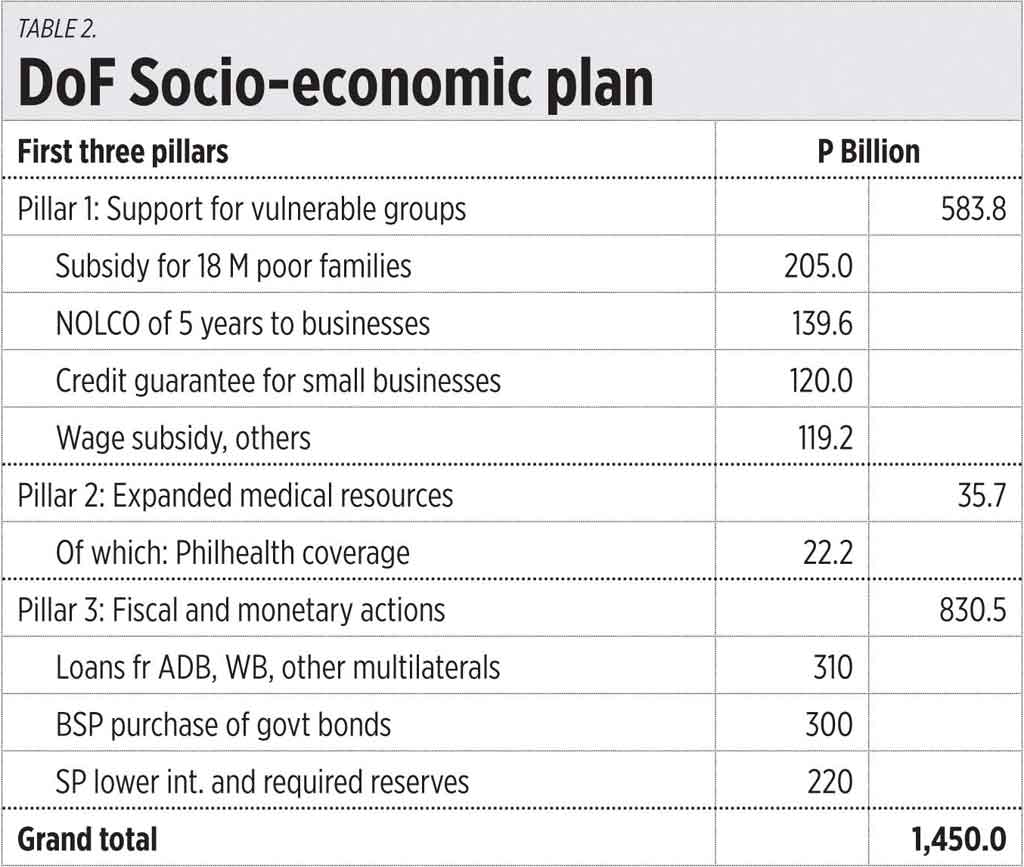
Department of Finance (DoF) Secretary Sonny Dominguez proposed “Four pillars” to economic recovery costing P1.45 trillion, generally on top of the approved 2020 budget of P4.1 trillion (see Table 2).

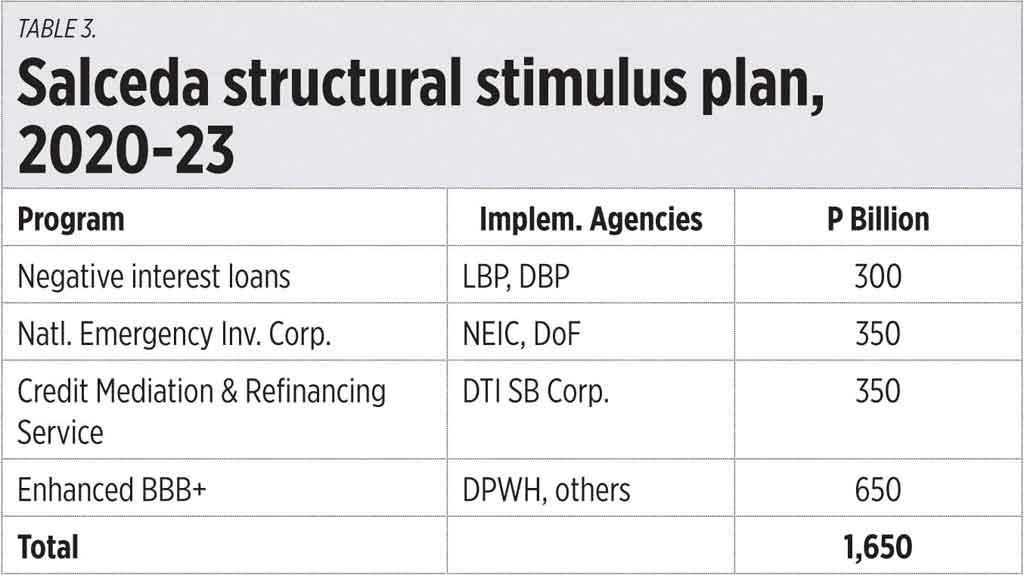
The Chairman of the House Committee on Ways and Means, Congressman Joey Salceda has his own central planning that is much larger than the DoF plan (see Table 3).

Then Congwoman Stella Quimbo, head of the House Sub-Committee on Economic Stimulus Package, made a more modest stimulus plan, assuming a fiscal multiplier of 1.53 and proposed an amount just one-half of the DoF plan (see Table 4).

The longer the lockdown — where even the young and healthy are forced to stay home — lasts, the bigger the economic damage. Which will require even bigger government spending and must be paid later by bigger, higher taxes, regulatory fees, fines and penalties.

The lockdown should end April 30 as scheduled, no more extensions. People have the freedom and right to work and be productive, hysteria and paranoia should not prevail over economic needs and realities.


Bienvenido S. Oplas, Jr. is the president of Minimal Government Thinkers.

minimalgovernment@gmail.com