Home Blog Page 9663

Fabergé eggs anyone?

WHAT do you give a woman who has everything? If you were a Romanov, the answer was apparently a jeweled egg.

Every Easter starting in 1885, Empress Maria Feodorovna of Russia received a jeweled egg from her husband, the penultimate Czar of Russia, Alexander III, each one from the House of Fabergé. The first egg was a white enamel egg with a yolk of pure gold, which opened to reveal a gold pendant shaped like a hen. After the Czar’s death in 1894, his son, Nicholas II, continued the tradition, presenting one egg to his mother, the Dowager Empress, and his wife, Empress Alexandra. The eggs were a surprise, even to the Czar himself: the only requirement for each commission was that each one had to be unique, and must open to contain a surprise. These led to projects such as jeweled Easter eggs that contained portraits in ivory, or moving mechanical trains, or perfect miniature replicas of the Romanov palaces scattered across the Empire.

With the fall of the Romanovs came the fall of the man who bejewelled them. According to legend, Peter Carl Fabergé was driven out of his factory by the Soviets, giving him only enough time to put on his hat and coat. The family escaped Russia, and Peter Carl Fabergé died just two years after his flight in 1918.

While his sons set up a company in Paris using their father’s name, their biggest jobs then were to repair the Fabergé pieces of scores of Russian emigres. In America, businessman Armand Hammer convinced his friend Samuel Rubin to register the name Fabergé Inc. The family sued for the name, but the case was resolved in an out-of-court settlement. The name passed to many other individuals and entities (even Unilever at one point). The vestiges of the House of Fabergé Limited, with a division called Fabergé Heritage Council, has as members two of Peter Carl Fabergé’s great-granddaughters.

As for the Imperial Easter eggs themselves, they’re now scattered across the globe in private collections of billionaires and royals. Some of the eggs are still lost, with one found as recently as 2014. The Third Imperial Egg, given by Alexander III to his empress, was found in an American flea market, selling for $14,000 — while it was supposedly worth $33 million.

For Easter, we’re presenting a collection of Fabergé eggs that non-royals may be able to afford; recent creations by Fabergé. They’re tiny, and go for about a few thousand dollars.

18K ROSE GOLD SPIRAL PENDANT
This Spiral Egg Pendant comes set in 18 karat rose gold decorated with 36 round brilliant cut white diamonds and is presented on a 50 cm chain. Fabergé has also added a 0.01ct ruby at the bottom of the egg — a ‘hidden gem’ to surprise and delight the wearer.

18K YELLOW GOLD AND DIAMOND EGGS CROSSOVER RING
The Yellow Gold Crossover Ring features round white diamonds set in 18 karat yellow gold. In keeping with its fondness for delight, surprise, and discovery, Fabergé has concealed a ruby on the inside of the ring.

SUNBURST 18K ROSE GOLD DIAMOND AND PINK SAPPHIRE EGG CHARM
The Sunburst Pink Sapphire Rose Gold Charm features round white diamonds and a pink sapphire set in 18 karat rose gold. The egg charm is 14mm. (The bracelet is sold separately).

PALAIS 18K ROSE GOLD DIAMOND AND PINK GUILLOCHÉ ENAMEL EGGS CROSSOVER RING
The Palais Tsarskoye Selo Rose Crossover Ring features pink guilloché enamel and white diamonds, set in 18 karat yellow gold. Fabergé has concealed a ruby on the inside of the ring.

I LOVE YOU 18K YELLOW GOLD AND DIAMOND EGG PENDANT
The I Love You Yellow Gold Pendant features round white diamonds set in 18 karat yellow gold, engraved with the words “I Love You.” The egg is 18mm.

All the items are available at Faberge.com.

Peso to appreciate on demand for liquidity

THE PESO is seen to appreciate versus the dollar this week on the back of demand amid the extended Luzon lockdown and continued improvement in market sentiment due to stimulus measures to cushion economies from the impact of the coronavirus disease 2019 (COVID-19).

The local unit closed at P50.585 versus the dollar on Wednesday, stronger by 9.50 centavos from its P50.68 finish on Tuesday, according to data from the Bankers Association of the Philippines.

The peso also gained 29.5 centavos from its P50.88 close on April 1 and 13.5 centavos from its April 3 finish of P50.72 per dollar.

Markets were closed on Thursday and Friday due to the Holy Week holidays.

Rizal Commercial Banking Corp. Chief Economist Michael L. Ricafort attributed the stronger peso last week to market sentiment on the latest trade deficit data.

“Narrower trade deficit data, among the narrowest in about 2.5 years, amid the recent year-on-year declines in imports and modest growth in exports supported the recent gains of the peso,” Mr. Ricafort said in a text message.

Meanwhile, a trader said the peso gained as the central bank announced a reduction in the minimum liquidity ratio (MLR) of smaller banks.

“The strengthening was more of a continuation of the trend of peso’s strength. A little bit of risk on for us because there was a recent announcement for liquidity ratio cut for thrift banks so it’s a bit of easing so it’s a positive for peso,” the trader said in a phone call.

The Bangko Sentral ng Pilipinas (BSP) trimmed the MLR requirement for smaller banks to 16% from 20% until end-2020 in a move to boost the liquidity of thrift, rural and cooperative banks amid the extension of the enhanced community quarantine in Luzon.

For this week, Mr. Ricafort said continued positive market sentiment could drive the peso higher.

“Major catalyst include any continuation of improved global market risk appetite as seen recently in view of the record stimulus measures worldwide and unprecedented monetary easing by central banks in an effort to better deal with the economic fallout largely due to the COVID-19 outbreak and any risk of recession,” he said in a text message.

Meanwhile, the trader said the peso will remain range-bound as demand for cash persists.

“Since the lockdown is extended, liquidity is still the main factor so I think demand for peso will still be there,” the trader said.

The enhanced community quarantine in Luzon which was supposed to end by 12:00 am of April 13 has been extended by two more weeks to April 30 as the government said more time is needed to flatten the curve and to allow for mass testing, with Health officials noting that cases have yet to peak.

COVID-19 cases in the country reached 4,428 as of Saturday, with 247 casualties, according to the Department of Health. Recoveries totaled 157.

For this week, Mr. Ricafort sees the peso playing around the P50.45 to P50.85 band versus the dollar while the trader gave a forecast range of P50.45 to P50.90. — L.W.T. Noble

Colombian farmers switch coca for coffee to protect wildlife

SAN LUCAS MOUNTAINS, COLOMBIA — In a clearing around his modest smallholding, farmer Arcadio Barajas stands before a sea of coffee plants, cloaked in the shadow cast by a wall of verdant forest that covers the San Lucas mountains of northern Colombia.

The San Lucas range is one of the most unexplored places in this South American nation, which is the world’s second most biodiverse country after neighboring Brazil. From its towering Andean peaks to its tropical islands and dense Amazon rainforest, Colombia is home to over 50,000 recorded species of animals and plants.

Deforestation spiked after Colombia signed a peace deal in 2016 with its largest rebel group, the Revolutionary Armed Forces of Colombia (FARC), as swathes of land became more accessible. Government data shows that in 2017, almost 220,000 hectares (543,620 acres) of forest were destroyed, compared with around 124,000 hectares (306,400 acres) in 2015.

The dense forests of San Lucas are a haven for rare predators like ocelots, pumas and spectacled bears — one of the region’s most endangered species — and serve as a crossroads in migratory corridors used by jaguars, whose range stretches from Argentina to Mexico.

Yet this ecosystem is threatened by mining and drug cultivation. Not long ago, crops of coca, the chief ingredient in cocaine, were rooted where Barajas’ coffee plants grow.

Now, Colombian environmental group WebConserva is leading a first-of-its kind project bringing together farmers in San Lucas and roasters across Colombia to produce coffee from plantations that build protective borders around forests to shield the biodiversity within.

So far the project includes 10 families farming some 400 hectares (988 acres) of coffee, which the environmental group covers at a cost of around $77,000 a year. WebConserva hopes eventually to include 200 families, which could protect 20,000 hectares (49,420 acres) or more of virgin forest.

In San Lucas, where Barajas is among the participants, newly planted coffee fields establish a barrier between wild predators and cattle farms, lessening the chance for conflict over cattle.

A religious man, Barajas says tearing down the forest to plant coca and killing wildlife went against his faith but he — like his neighbors — was desperate for money. Now, he feels that growing coffee lets him be a good steward of his land.

“I’m taking care of the environment, the forest and the animals, so that I don’t end up ruined as well,” he said.

Globally more than 31,000 species are threatened with extinction, according to the Red List by the Switzerland-based International Union for Conservation of Nature, whose members include government and civil society. Of these, some 1,050 species are in Colombia, including 187 considered critically endangered.

In San Lucas, the families pledge not to fell trees to expand their crops or to hunt the animals that depend on the forests for survival. Depending on the quality of the product, they receive around $250 to $300 per 125 kilos (275 pounds) of coffee, an enviable return in a country where prices regularly dip below production costs.

While profitability has improved as the peso has fallen against the dollar in recent months, the government doled out $77 million in aid to coffee farmers last year to help them deal with low prices.

As of 2018, the San Lucas area was still carpeted with thousands of hectares of coca crops, according to the most recent government figures.

Gold mining — which drifts between illegality and informality — and farming continue to drive slash-and-burn practices in the region.

Plumes of smoke rise lazily into the sky from multiple points across the mountain range, signaling fires started to clear more space. At the forest edge, patches of scorched earth serve as ugly reminders of human activity.

For the farmers, the switch to coffee from coca or mining is less profitable. Coca could fetch some $760 per kilo, at a time when low coffee prices caused thousands to abandon the industry.

Many families came to rely on illicit activities to support their children, said Arnobis Romero, a former coca grower and miner.

Like many people here, he turned to coffee amid aerial anti-coca spraying campaigns carried out by the government, which were halted in 2015 under then-President Juan Manuel Santos. But the idea of helping to protect the ecosystem and support from WebConserva boosts morale, Romero said.

“We feel really proud to look after this biodiversity and to leave it… for future generations,” he said.

The South American country has designated some 16% of its land territory — some 18.6 million hectares (46 million acres), an area roughly the size of Washington state — as protected areas, but hundreds of thousands of hectares of land are destroyed each year.

Though activists are campaigning for San Lucas to be protected with a national park designation, the process is slow.

In the meantime, WebConserva director Carlos Valderrama hopes the group’s project can build a new system of sustainable production.

“It protects forests, biodiversity and ecosystems at the same time as (improving) coffee growers’ quality of life,” he said.

WebConserva, which acts as a go-between for the farmers and roasters, keeps tabs on the wildlife living in the forests with camera traps that take images when motion sensors are triggered.

Coffee farmer Liseth Alfonso, 28, whose kitchen looks out over the forests below, said seeing photos and videos makes her proud.

“Many are close to extinction,” Alfonso said. “It helps us remember we are taking care of these animals.” — Reuters

PNOC gives P7B for government fight vs virus

STATE-owned Philippine National Oil Corp. (PNOC) forwarded P7 billion of its funds to the government for its fight against the coronavirus disease 2019 (COVID-19) pandemic, the Department of Energy (DoE) said on Sunday.

The fund remittance was authorized by the recently passed Bayanihan to Heal as One law, which granted special powers to President Rodrigo R. Duterte to repurpose funds for the pandemic containment effort. The law empowers him to redirect cash, funds, and investments from any government-owned and controlled corporations and national government agencies to COVID-19 response.

Of the total amount, P5 billion is from accumulated retained earnings of the state-owned company, while P2 billion is from its exploration subsidy.

The DoE noted that the company’s board also pledged to donate a portion of their allowances to procure protective gear and supplies for medical workers in the frontline of the fight to stem the pandemic.

PNOC is a government-owned and controlled-corporation (GOCC) led by the DoE that operates an exploration and a renewables unit.

The PNOC Exploration Corp. has a 10% stake in the Malampaya deep-water gas-to-power project under Service Contract 38 awarded by the DoE, while the PNOC Renewables Corp. runs various solar, hydro, waste-to-energy and other renewable energy projects.

Recently, the DoE authorized the use of the funds under Energy Regulations 1-94 to help local government units in their COVID-19 response. The funds, which come from the centavo per kilowatt-hour take from the total electricity sales of power generation firms, will be redirected for the use of their host communities.

Also, the National Electrification Administration released P1.3 billion of its unused funds to aid in the government’s response against the pandemic.

The National Transmission Corp., also a GOCC under the DoE, has pledged P7.5 million to the Department of Health for the latter’s purchase of testing kits and other equipment needed in its COVID-19 response. — Adam J. Ang

Stuff to do at home (04/13/20)

CCP shows online

The Cultural Center of the Philippines offers HD and archival recordings of theater, dance, visual arts, film, literary, and workshop events from its Cultural Content Digital Archives on YouTube. On April 12 (3 p.m.), CCP Online will be launched with BULAWAN: The CCP 50th Anniversary Gala Concert. To watch the gala and upcoming shows, visit https://www.youtube.com/user/culturalcenterphils?fbclid=IwAR30nifxt1soyxD4bN1DxQeyy_krWWhV2Ruh9OQKJtv-z1q1anDApoPRNzw&app=desktop.

Fundraiser for frontliners

Filipino artists come together for #StrongerTogetherPH, a fundraising show for medical front liners on April 13, 6 p.m. The show will feature Moira dela Torre, Aicelle Santos, Jasmine Curtis-Smith, and Juan Miguel Severo, among others. All proceeds will go to procuring PPE sets and other supplies for hospital workers taking care of COVID-19 patients. To watch the show and for details for donating, visit https://www.facebook.com/BayanihanJDC/.

The National Theater online

London’s National Theater offers free plays online on its YouTube channel (https://www.youtube.com/channel/UCUDq1XzCY0NIOYVJvEMQjqw). Watch an adaptation of Charlotte Brontë’s Jane Eyre until April 16. On April 17 (2 a.m. Philippine time), the theater will premiere an adaptation of Robert Louis Stevenson’s Treasure Island.

The Nanny’s Pandemic Table Read

The cast of the 1990s comedy sitcom The Nanny reunites for The Pandemic Table Read of the show’s pilot episode. It stars Fran Drescher as Fran Fine, a beautician who finds a job as a nanny to the three children of wealthy widower and theater producer Maxwell Sheffield (played by Charles Shaughnessy). To watch, visit Sony Pictures Entertainment’s YouTube channel at https://www.youtube.com/watch?v=C3a6KuP1X14&feature=youtu.be&fbclid=IwAR1eEwvK0A7lrLMnt2GTXBPoDR7y8_Q5TXMexTLIo9es9Gei4W1Yi-asITM.

Hogwarts online

Hogwarts Is Here is an online version of the Harry Potter series’ magical school, created by Harry Potter fans, that allows visitors to take courses like the characters from J.K. Rowling’s book series. Among the various courses are Astronomy, Herbology, History of Magic, and Transfiguration. The website also includes a forum, groups, and library feature. Visit http://www.hogwartsishere.com/.

Free Nikon photography class

Nikon is offering free online photography classes until April 30. Topics include fundamentals of photography, shooting for landscape, portraiture, music videos, and speedlight control. To participate, visit https://www.nikonevents.com/us/live/nikon-school-online/.

Science experiments at home

Try to do 44 science experiments at home with the kids with the James Dyson Foundation Challenge cards. To download the challenge cards, visit https://www.jamesdysonfoundation.co.uk/resources/challenge-cards.html.

PETA’s Charot! The Unwanted Prequel

Philippine Educational Theater Association (PETA) launches episodes of Charot! The Unwanted Prequel once a week at its official Facebook page. The story is a prequel to its play, Charot! The Musical. The prequel is set in a country known as “P.I.,” which is governed by Papsy, as the nation deals with the “Charona veerus.” New episodes will be uploaded on PETA’s official Facebook page weekly. Aside from online content, the theater company is also conducting two donation efforts. One for the distribution of rice to 300 families in Brgy. Kristong Hari, Quezon City; and another for medical equipment such as personal protective equipment for the frontliners of East Avenue Medical Center. To stream the show and for more information on donation efforts, visit https://www.facebook.com/PETATHEATER/.

Color Manolo Blahnik designs

Shoe designer Manolo Blahnik shares a selection of his original sketches in an online coloring book. The shoe designs are downloadable at https://www.manoloblahnik.com/gb/smile.html.

DUP’s plays online

Three Dulaang UP plays — Floy Quintos’ The Kundiman Party, Ang Nawalang Kapatid, and Nick Joaquin’s Father’s and Sons — are now available for streaming on YouTube at https://www.youtube.com/channel/UCm2k83BMK9Fq39P6yJH9lng.

Podcasts on Philippine crime

Stories After Dark features podcasts on Philippine true crime and mystery stories. It currently has 14 episodes including The Maguindanao Massacre (2009), The Ozone Disco Fire (1996), and Pepsi Paloma: Rape or Publicity Stunt? Suicide or Murder? (1982/1985). To listen, visit https://www.facebook.com/storiesafterdarkph/.

Andrew Lloyd Webber musicals online

Andrew Lloyd Webber offers his musicals for free in the online series The Shows Must Go On. The series continues with Jesus Christ Superstar (2012), starring Tim Minchin, Melanie C and Chris Moyles. To watch, visit https://www.youtube.com/theshowsmustgoon.

Palacio de Memoria virtual tour

Art and history enthusiasts can now go on a virtual tour of Palacio de Memoria, the Colonial Revival mansion, and marvel at its luxurious facilities and hundreds of Euro-Filipino paintings, sculptures, art displays, and historical pieces online. It features the showroom of Palacio de Memoria’s auction house, Casa de Memoria, which houses the Lhuillier family’s collection of antiques, the Mosphil Lounge, and a passenger plane that was refitted to be a lounge for special occasions. To view the Palacio de Memoria’s virtual tour, visit https://www.palaciodememoria.com/tours.

Intramuros virtual tour

Visit the sites of Intramuros through its virtual tours at https://artsandculture.google.com/partner/intramuros-administration?fbclid=IwAR0aRtUOboFvmpk73FwjO_OZBBD5OKRfoFBWUOGgPAUUpaA7DquxNG0Jlks. The walled city’s sites may also be visited through the Experience Philippines augmented reality app. The app is free and available on Google Play or the App Store.

Photography workshops with Canon PH

Canon Philippines is offering photography workshops for the month of April via its official Facebook page. The workshops will feature Canon brand ambassadors and professional photographers who will tackle basic to advanced techniques, and specialized topics such as food, architecture, wedding, and music events photography, and vlogging. View the workshop schedule at https://www.facebook.com/canonphils/photos/a.436807569702668/2967524323297634/?type=3&theater.

MSO’s music online

The Manila Symphony Orchestra (MSO) presents Ennio Marricone’s “Nella Fantasia” from The Mission (1986), which was recorded separately by its musicians while in quarantine, in the hope that it brings some comfort to the listener’s soul. To listen, visit https://www.youtube.com/watch?v=ceKQHi-9OKQ&feature=youtu.be. For more information, visit https://www.facebook.com/manilasymphony/.

E-coloring books

The Getty Museum and the Getty Research Institute of Los Angeles offers the “Color Our Collections” edition for 2020. To view, visit http://library.nyam.org/colorourcollections/page/11/.

NFB animated shorts online

Watch animated short films from the National Film Board of Canada at https://www.nfb.ca/animation/.

Silverlens launches Art Boost

To keep in touch with art lovers, Silverlens presents Art Boost, an online drive to maintain engagement with art through social media, exhibition catalogues, and videos. Follow Silverlens’ official social media pages for a series of #athomewith, #weeklyartwork, #trivia, and #sundayread. Visit Silverlens’ official YouTube and Vimeo for artists profiles such as Gary-Ross Pastrana, and Patricia Perez Eustaquio.

National Museum of the Philippines

The National Museum uploaded a coloring sheet of Juan Luna’s Spoliarium by Bryan Ferrer which may be physically or digitally colored. For more information, visit https://www.facebook.com/nationalmuseumofthephilippines/posts/3123148164376147.

Children’s books online

Enjoy digitized children’s book titles from the University of California (UCLA)’s children’s book collection at https://archive.org/details/yrlsc_childrens&tab=collection; and University of Florida’s digital collection of the Baldwin Library of Historical Children’s Literature at https://ufdc.ufl.edu/baldwin/all/thumbs.

Five-hour museum tour

Experience a five-hour tour in Russia’s Hermitage Museum, shot by filmmaker Axinya Gog on an iPhone 11 Pro. To watch, visit https://www.youtube.com/watch?time_continue=4&v=49YeFsx1rIw&feature=emb_title.

Guitar lessons with Fender

Fender is offering three months of free lessons for guitar, bass and ukulele. It includes high-resolution videos with teachers, and a progress tracker. Follow along to videos, and practice at your own pace with the adjustable scrolling tablature and a metronome. To sign up, visit https://try.fender.com/play/playthrough/?utm_source=bouncex&utm_medium=popup&utm_campaign=PlayThrough_BXPopup&utm_term=fender&src=emaill00DTplaypopup/

Toei anime on YouTube

Japanese animation studio Toei’s YouTube channel will stream shows for free. Seventy shows with English subtitles have been released; on April 13, it will release episode 3 and 4 of National Kid (updated on Mondays); and April 14, it will release episode 3 and 4 of Suki Suki Majo Sensei (updated on Tuesdays). To watch, visit https://www.youtube.com/user/ToeiAnimationUS.

Educational TV shows return to ABS-CBN

ABS-CBN brings back 1990s educational TV shows every Saturday. Sineskwela (8:30 a.m.) explains topics on science, Bayani (9 a.m.) is about historical figures and events, and Hiraya Manawari (9:30 a.m.) which focuses on values.

Cirque Du Soleil online

Enjoy free 60-minute specials from shows such as Kurios — Cabinet of Curiosities, O, and Luzia. To watch, visit https://www.cirquedusoleil.com/cirqueconnect.

Ayala Museum online

Continue learning at home with the Ayala Museum’s resources available online. Enjoy previous exhibitions and performances, coloring pages, and playlists. Visit https://www.ayalamuseum.org/online-resources/?fbclid=IwAR2psdA2kvBhhEC-iJs-seLvPXICAZ4zWO-bBIwvxjrhuTm18C_0zyOm3VE.

E-books for kids

Expand your kids’ library at home through the BuriBooks app. Titles include books from publisher Adarna House, reviewers, and Filipino textbooks. Access the app via iOS, Android, or a web browser. Sign up via https://buribooks.com/. Enjoy it free for 30 days.

National Gallery of Victoria’s virtual tours

The National Gallery of Victoria has developed several virtual tours. Audiences can view exhibitions such as Companionship In The Age Of Loneliness of New York-based artist Brian Donnelly, a.k.a. KAWS; and the world premiere of Crossing Lines, featuring the works of Keith Haring and Jean-Michel Basquiat. Visit https://www.ngv.vic.gov.au/channel/.

New free plays on Thursdays

The National Theatre in London brings its shows to YouTube. Every Thursday (7 p.m. GMT/2 p.m. EST), National Theatre at Home will release a new play free to watch for one week. It includes cast and creative interviews and post-stream talks. The remaining shows are Treasure Island on April 16, and Twelfth Night on April 23. For more information, visit https://www.nationaltheatre.org.uk/nt-at-home?queueittoken=e_safetyevent25mar20~q_b79a6e28-67d9-44de-88e6-29cedc812122~ts_1585490458~ce_true~rt_safetynet~h_8c7928d22caa971981f7edf53563d20e2fe8f68a3a3a1458b34b1cb17f11b50b.

Ballets at the Bolshoi Theatre

The Bolshoi Theatre in Russia showcases The Golden Series of classic opera and ballet performances via livestream on the theater’s YouTube channel. Livestreaming began on April 1 with The Tsar’s Bride. To watch, visit https://www.youtube.com/user/bolshoi.

Free Murakami books online

Japanese best-selling author Haruki Murakami’s stories are made available online for free at http://www.openculture.com/2014/08/read-five-stories-by-haruki-murakami-free-online.html. Titles include Kino, A Walk to Kobe, and Samsa in Love.

Free books on modern art

Enjoy PDF and ePubs on modern art from the Guggenheim Museum’s archive. The collection includes books on Francis Bacon, Max Ernst, and Mark Rothko. Visit https://archive.org/details/guggenheimmuseum.

Free vet consultations online

Dr. Cyron Sarmiento opened his Facebook (https://www.facebook.com/mcejsarmiento) and Twitter (@Cyrooon) accounts for free online consultations. For more inquiries, visit https://www.facebook.com/groups/648196199302932/. Consultations will run for the entire duration of the enhanced community quarantine.

Free Japanese courses

The Japan Foundation Manila launched an e-learning program of free Japanese courses. It includes six-month beginner and intermediate lessons on calligraphy, vocabulary, grammar, and conversation. Sign-up for your chosen course at https://minato-jf.jp/?fbclid=IwAR2SrhYV-9nH4Hbc9TbTspxg0t39DH6xtLQ-jz1n1uOkeGMK3bCdL022O8I.

Arts and Culture

Learn something new every day with Google Arts and Culture from virtual tours of sites, and museums to food, fashion, and design. Visit https://artsandculture.google.com/.

Frida Kahlo’s artworks online

View Frida Kahlo’s work online through the Google Arts & Culture platform. The website has 800 paintings, photographs, and objects by the Mexican artist from 33 international museums. To view the exhibition, visit https://artsandculture.google.com/project/frida-kahlo.

Scribd materials for free for 30 days

Enjoy free books, audiobooks, magazines, and documents for 30 days at Scribd. To view titles, visit https://www.scribd.com/readfree?fbclid=IwAR363ywNP9yoBbKJVQFYCtilfGfljPDGeOatqKJgWMV5Pj9-p7j-gkaGOb8.

Classic Pinoy films online

Director Mike de Leon uploaded classic Filipino films from the 1930s to 1960s on his Vimeo account, Citizen Jake. Titles include Manuel Silos’ Pista sa Nayon (1948), Gregorio Fernandez’s Kung Ako’y Mahal Mo (1960), and Lamberto V. Avellana’s Aklat ng Buhay (1952). Watch films at https://vimeo.com/user83013343.

Free Neil Gaiman stories online

Best-selling author Neil Gaiman offers free essays, audiobooks, book excerpts, and videos at his official website under “Cool Stuff and Things.” Visit https://www.neilgaiman.com/Cool_Stuff.

Arts BGC at Home

Every Wednesday, Arts at BGC offers creative prompts at the Arts at BCG (https://www.facebook.com/artsatbgc/ and @artsatbgc) and BGC Art Center ( https://www.facebook.com/BGCArtsCenter/ and @bgcartscenter) Facebook and Instagram pages. Join the Arts at BGC Community to get in touch with other participants. https://www.facebook.com/groups/artsatbgc.

Ballet and opera free online

The Royal Opera House is showing its performances online through its Facebook (https://www.facebook.com/royaloperahouse/) and YouTube (https://www.youtube.com/user/RoyalOperaHouse) pages. Performances include the ballet The Metamorphosis on April 17.

Meg Cabot’s The Princess Diaries — Quarantine Edition online

Best-selling author of The Princess Diaries Meg Cabot offers The Princess Diaries — Quarantine Edition for free on her official website. Entries are updated daily. Visit https://www.megcabot.com/2020/03/corona-princess-diaries-day-1/?utm_content=122945851&utm_medium=social&utm_source=facebook&hss_channel=fbp-67512624694.

NHCP Documentaries on YouTube

The National Historical Commission of the Philippines makes Philippine history education accessible through documentaries on YouTube. For more information, visit https://www.facebook.com/historymuseumsPH/posts/997233837339314. Titles include: Jose Rizal: Sa Landas ng Paglaya, Apolinario Mabini: Talino at Paninindigan, Kababaihan ng Rebolusyon, and, Gregoria de Jesus: Lakambini ng Katipunan.

Drawing lessons for kids with Mo Willems

Best-selling author and illustrator Mo Willems is hosting drawing lessons for kids called Lunch Doodles every weekday on YouTube. Each session will be between 20 to 28 minutes long. Mr. Willems is also welcome to questions (send to: LUNCHDOODLES@kennedy-center.org) which he will try to answer during sessions. For sessions of Lunch Doodles, visit https://www.youtube.com/playlist?list=PL14hRqd0PELGbKihHuTqx_pbvCLqGbOkF.

Paulo Coelho’s books online

Best-selling author Paulo Coelho has made his books available for free. Titles include: The Way of the Bow, The Manuscript Found in Accra, and Brida. Visit his blog at https://paulocoelhoblog.com/books-online/.

Shakespeare plays online

Shakespeare’s plays recorded at the Globe Theater are now available for online streaming. Titles include Hamlet and The Two Noble Kinsmen. To watch, visit https://globeplayer.tv/

Learn at home with Scholastic

Scholastic is offering free online courses for levels pre-kindergarten to Grade 6. Duration of the courses is approximately three hours per day. They include writing, research projects, and virtual field trips. The website is accessible on any device. Visit https://classroommagazines.scholastic.com/support/learnathome.html

Free opera streaming online

OperaWire will host Nightly Met Opera Streams of the Metropolitan Opera for free. The performances begin at 7:30 p.m. EST and will be available to stream for 20 hours. Visit https://operawire.com/metropolitan-opera-to-offer-up-nightly-met-opera-streams/. The Paris Opera is also streaming operas for free. Visit https://www.operadeparis.fr/.

Free films on YouTube

Catch Filipino films for free on the following channels: Regal Entertainment (https://www.youtube.com/user/regalcinema/featured); Cinema One Originals (https://www.youtube.com/channel/UCzggCZVkynvnjNV29L9EccA); and TBA Studios (https://www.youtube.com/channel/UChh0rmwGvToBd3owvN2vRMg).

Free online courses

Enjoy 1,500 free online courses from leading universities such as Stanford, Yale, Harvard, and more. Download the audio and video courses (from iTunes, YouTube, or university websites). Topics include archeology, art, finance, writing, law, health, religion, mathematics, and personality development. Visit http://www.openculture.com/freeonlinecourses.

Online yoga classes

YogaPlus offers daily yoga classes via Facebook live. For schedules, visit https://www.facebook.com/yogaplusph/.

Free Broadway performances online

Enjoy your favorite Broadway performances online for a limited time at https://www.broadwayhd.com/.

Virtual tours

Explore museums around the world through virtual tours: the Solomon R. Guggenheim https://artsandculture.google.com/partner/solomon-r-guggenheim-museum?hl=en; the Smithsonian National Museum of Natural History (https://naturalhistory.si.edu/visit/virtual-tour/current-exhibits); the Louvre Museum (https://www.youvisit.com/tour/louvremuseum). View animals such as otters, penguins, turtles, and corals on live camera at https://www.montereybayaquarium.org/animals/live-cams


Yields on government debt fall on BSP stimulus

By Carmina Angelica V. Olano
Researcher

YIELDS ON government securities (GS) fell across-the-board last week as traders’ sentiment improved further following the Bangko Sentral ng Pilipinas’ (BSP) decision to buy more debt papers from banks this week.

On average, GS yields went down by 24 basis points (bps) week on week, according to the PHP Bloomberg Valuation Service Reference Rates published on the Philippine Dealing System’s website as of April 8.

“Government securities saw steady recovery, coming off the highs supported by BSP’s daily repurchase of front to belly bonds,” the First Metro Asset Management, Inc. (FAMI) said in an e-mail.

“[BSP] bought R3-10, R5-12, and FXTN 7-62 for the previous weeks but [this] week [it] will expand the list of securities,” it added, referring to the bonds’ tenors.

Kevin S. Palma, peso sovereign debt trader at Robinsons Bank Corp., was of the same view: “The GS market…continued to cheer the BSP’s stimulus efforts after it expanded its list of government securities to purchase in the secondary market.”

On March 23, the central bank said it will buy P300 billion worth of short-dated debt from the Bureau of the Treasury under a repurchase agreement to help the government generate additional cash to combat the coronavirus disease 2019 (COVID-19) pandemic. This will be paid within six months at the maximum.

In a statement last Friday, the BSP said it will expand the range of eligible securities that it will buy from the secondary market to cover all peso-denominated papers, “reassuring market participants of demand for GS should they need to liquidate their holdings.”

This one-hour bond-buying window — between 9:30 a.m. to 10:30 a.m. — will remain open until June or “until market conditions return to normal,” the central bank said.

FAMI noted other “supportive” policies implemented by the BSP “helped calm the sell-off” at the start of the Luzon-wide enhanced community quarantine (ECQ) in mid-March.

“The 200-bp RRR (reserve requirement ratio) cut effective April 3, and BSP suspending the term deposit facility have also put downward pressure on local yields,” it said.

Mr. Palma, the peso trader, also noted that reinvestment demand from a P120-billion retail Treasury bond maturing on April 11 pushed local yields lower.

Aside from bond purchases, the central bank also unleashed a series of monetary stimulus under its arsenal last month to inject more cash to the economy currently being battered by the COVID-19 pandemic.

The key rate — the overnight reverse repurchase rate — now stands at 3.25%, reflecting a 50-bp cut on March 19. Overnight deposit and lending rates were likewise slashed to 2.75% and 3.75%, respectively.

It also trimmed the big banks’ RRR by 200 bps to 12% on March 24 to boost lending activities. This move released up to P200 billion into the financial system effective on April 3.

At the secondary market on Wednesday, Treasury bills (T-bills) plunged from week-ago levels, led by the 364-day T-bill which saw a 2.8-bp decline to yield 3.717%. The 91- and 182-day T-bills dipped by 1.3 bps and 1.1 bps to fetch 3.293% and 3.448%, respectively.

Yields at the belly of the curve also decreased. Yields on the two-, three-, four-, five-, and seven-year Treasury bonds (T-bonds) went down by 37.4 bps (3.935%), 39 bps (3.998%), 36.4 bps (4.073%), 33.7 bps (4.163%), and 35 bps (4.372%).

Yields on longer-term debt papers likewise fell, with the 10-, 20- and 25-year T-bonds yielding 4.537%, 4.911%, and 4.864%, down by 41.5 bps, 14.9 bps, and 21.3 bps.

Financial markets were closed from April 9 to 10 in observance of the Holy Week.

For the week, “Yields may continue to move sideways with slight downward bias but that drop may already be tempered by those who want to reduce their risk positions,” Robinsons Bank’s Mr. Palma said.

“Volatility will likely remain for some time as this is a continuous tug-of-war between hopes and fears over the direction that the COVID-19 will be taking,” he added.

For FAMI, even as volatility risks due to the COVID-19 outbreak remain, it expects yields “to move further south given the large US Federal Reserve and BSP cuts in policy rates in March, better liquidity and expanded BSP bond repurchase as well as lower inflation expectations.”

According to the World Health Organization as of April 11, COVID-19 has claimed close to 100,000 lives among more than 1.6 million confirmed cases across 213 countries.

In the Philippines, there were 4,428 confirmed COVID-19 cases as of April 11 tally of the Health department. Fatalities totaled 247, while recoveries reached 157.

V Questions

THIS WEEK, we conclude our multi-issue run to celebrate Velocity’s first year which we wanted to mark by providing a comprehensive snapshot of where we are in greener mobility.

As we go to press, we learned that the enhanced community quarantine in Luzon has been extended to April 30. While it continues to be a difficult period for most of us (more so for the afflicted victims and their families, and frontliners), it also has afforded us a chance at introspection in many aspects of daily life.

One of the points to mull over is how the glut of vehicles contribute to air pollution, particularly since we’ve seen how it is when our thoroughfares are largely clear of them. How many of you have noticed how bright the summer skies are these days? Clouds appear whiter than usual — bereft of the stain of smoke and soot. That’s just one thing to savor now when there sometimes seems nothing to be grateful for. On the contrary, it’s a time to be thankful for family, friends, and so many strangers stepping up amid the pandemic.

Sometime back, we asked five questions from three people of disparate yet relevant backgrounds to help us better understand where we’re at and where we can expect to go from here. If we ask Toyota (and Lexus, the country’s biggest purveyor of hybrids), electrification has been at hand and is viable.

All told, how do we get more of these cleaner days without having to shut down the shop? Keep safe, everyone. — Kap Maceda Aguila


Dr. Clarita R. Carlos
Taught political science, environment, and international relations at the University of the Philippines; European studies at Ateneo de Manila University; and at San Beda Law graduate school
Author of more than a dozen books
Worked with the Department of Transportation-Office for Transport Security

VELOCITY: Please share your assessment of the government’s policies and initiatives to reduce carbon emissions in the country — particularly with regard to public utility vehicles, and in view of the Philippine Clean Air Act.

DR. CARLOS: The Philippine Clean Air Act was sponsored by Senator (Loren) Legarda many years ago. It’s evident that, for most parts, compliance with same has been spotty, fragmented, and “seasonal,” i.e., when the agency in charge of checking emissions scratches their heads and decide that they will station themselves in either EDSA, C5 or Commonwealth and do random checks. When I was still at MMDA with (former chairman) Francis Tolentino, there was only one, repeat, one working emission testing machine. Yikes!

Even in this age when more people are aware of the concept of climate change, there always seems to be the inevitable tug of war between the state and its people when the former wants to enact more earth-friendly regulations. Is there a way out of this constant struggle?

There will always be a continuing tension between the need for economic growth and the difficulty of getting the public to get on board actively and participate in the mitigation and adaptation to climate change. As usual, whenever it is not appearing right before our eyes, we tend either to diminish its value or forget it altogether. Then, when a major catastrophe happens, like Yolanda then, for a few weeks or so, this would be the pivot of many private- and public-sector actions. But after attention diminishes and another issue catches our attention, it’s not sustained!

The challenge is that the Local Government Code gave so many powers to LGUs but they have neither the resources nor motivation to implement climate change mitigation and adaptation. Like, how many of 42,000 barangays are complying with the need for rain catchment areas? They don’t even know they are required to do that so all the runoff water during rainy season goes back to the sea instead of being stored in reservoirs.

What is the ideal role of the private sector — in this case, local auto companies and related industries — to lessen carbon emissions while remaining viable?

The private sector creates wealth, jobs, innovations, etc. The public sector regulates, especially when there is abuse of power by the private sector. Thus, as medical data continue to stress the ill effects of carbon emissions on the populace, the private sector cannot afford not to pay attention to this because it is a health-conscious public that will buy their cars.

I don’t know why car companies in the US still make money and reduce their emissions at same time! Here, there is just too much kitsch and vulgar decorations in the cars which are not needed, which should be scuttled to make them more efficient.

Are you in favor of the United Nations Framework Convention on Climate Change (UNFCCC), and do you think it’s rigorous enough?

We are a signatory to the UNFCCC. Note however that, as usual, the UN has no enforcement capability and like the 2015 Paris Agreement on Climate Change which we also signed, the commitments of nations are based on best efforts and rely on self-reports. I am sure you know already how invalid and unreliable self-reports are.

Compared to states with a similar economy, how is the Philippines doing in the area of sustainability; in what areas can we do more?

Sustainability is a buzz word which all UN and regional agreements have to incorporate in their numerous agreements. To be fair, we may be exerting best efforts to ensure the next generation still has a liveable world (the meaning of sustainability), but like my answer to the first question, even our best efforts are spotty and fragmented.

I have seen so many crisis management protocols, but in every catastrophe we experience, not only do we recreate risks but also commit the same mistakes — never mind those beautiful drawings of crisis management.

Where can we do more? Population management! There are too many people who are usually not educated, lazy, and not productive — and producing many children. This is making generational poverty.


Atty. Angela Consuelo S. Ibay
Climate and Energy Programme Head
Earth Hour Pilipinas National Director

VELOCITY: Do you think that the auto industry in general is doing enough to bring down carbon emissions?

Atty. Ibay: I think that there is more that the auto industry can do in this regard, considering that around a quarter of energy-related greenhouse gas (GHG) emissions globally can be attributed to the transport sector. While there are advancements in the design, manufacture, and production of vehicles that produce less or even no emissions, getting them into circulation in the Philippine market has not been easy or widespread. It would be wonderful to get to the point wherein it would be commonplace to ride a cab which is an electric vehicle or that buses in the city are all electric-powered.

By the reckoning of the World Wide Fund for Nature (WWF), how is the Earth Hour participation here in the Philippines, and are the right messages getting through?

Earth Hour has been running in the Philippines since 2008 and we reckon that for the first decade of Earth Hour, we have been quite successful in raising awareness and shining a light on climate change and climate actions around the world and in the country. We have also seen that stakeholders understand that these actions are not just for the one hour of Earth Hour, but are to be carried out even beyond that. For that, we are very happy and grateful that these messages have come across well and shared by many who support Earth Hour. But starting in 2018, we began pivoting our focus from climate to both climate and nature with our #connect2earth and #naturematters calls. Those calls are still being carried for this year as we call on people to raise their voices for nature and in the Philippines, help #ChangeTheEnding.

Is government doing enough to mitigate air pollution caused by transportation, particularly pollution caused by public transportation?

Similar to my earlier answer, I think the government can still do more. Air pollution is a huge challenge for many of our cities. As urbanization continues, studies have shown that, globally, around 70% of our carbon emissions come from cities with over 90% of city residents breathing polluted air. The same story is true in the Philippines where the transportation sector is a huge contributor to carbon emissions, as well as various air pollutants, particularly in urban areas where traffic jams are prevalent and high-rise buildings proliferate — trapping the polluted air. The government does have a National Environmentally Sustainable Transport (NEST) program that we hope will be rolled out intensively across the country and that sustainable mobility measures such as non-motorized transport and pedestrianization can also be put in place. Last December 2017, WWF Philippines came out with “A Case Study of Philippine Cities’ Initiatives on Sustainable Urban Mobility” building on our One Planet Cities project, which we have shared to government partners. These initiatives have been grouped into four categories, namely: pedestrianization, walkability and green spacing; mass transport; alternative modes of transport; and institutional policies. We think these initiatives show that local governments, along with the DoTr and the DENR, can play significant roles in mitigating air pollution caused by the transportation sector, and promoting sustainable urban mobility.

What is your stand on the public utility vehicle modernization program vis-à-vis concerns that it is supposedly anti-poor?

We try to understand the issues and hope that the government can also address these concerns, particularly when it comes to the economic costs involved and how the impact on the affected sector can be lessened. But we should realize that our planet is at a point wherein transitions, not only in the public utility sector but even in our energy systems, is much needed. This clean energy transition in the transport sector should involve making the sector more efficient, accessible, and sustainable — in harmony with our environment and nature. Considerations for the public (riding or otherwise) in terms of health, good air quality, even improvement of quality of life, should also be seriously taken into account. In the end, these considerations are immeasurable and invaluable and, in fact, benefit everyone.

How is the WWF moving to make a difference in the Philippines, particularly in the area of pollution brought about by our mobility needs?

WWF PH is working with other civil society organizations/nongovernment organizations in advocating for the urgent need to improve our air quality monitoring systems, update our air quality standards, and ensure that these are properly implemented. We are engaging both the Executive and Legislative branches of government in this matter. Meantime, through our One Planet Cities work, we want to highlight the sustainable mobility initiatives that our cities are also implementing to show that it is possible and if we work together, these can be scaled up and provide bigger impact especially regarding the air quality in our cities.


Raymond T. Rodriguez
Lexus Manila President

VELOCITY: Although the Toyota Prius was launched in the Philippines more than a decade ago — the same year Lexus made its way into the country — it has been Lexus carrying the torch of hybrids in the country in that you offer, and have sold, so many units over the course of your decade of operations here. How would you explain this?

Mr. Rodriguez: Lexus started operations in 2009. And as of 2019, over 5,500 cars were sold with more than 350 hybrid models. One the major factors is the reliability of our hybrid technology. We have a long history with this, since 2004 with the RH 400h model. To date 1.5 million hybrid units have been sold worldwide.

Aside from the vehicle’s basic warranty coverage for a period of three years or 100,000 kilometers (whichever comes first), the hybrid battery’s warranty is extended up to five years or 200,000 kilometers. This provides our customers with confidence and peace of mind throughout their ownership experience.

What’s your judgment of the average Lexus customer’s awareness of the nature and benefits of the hybrid powertrain?

Most of our Lexus hybrid models owners are aware of the basic hybrid technology and its benefits before they buy our hybrid units. During our sales process, we also provide them with additional information. We cite the advantages of owning hybrid vehicles. And as I have mentioned, we also stress the extended warranty coverage for the hybrid battery.

Do they actively look for hybrid variants, or are the buyers of these convinced upon learning of the advantages?

In most cases they are aware of hybrid technology, and they do set out to buy those variants. Others who come to our showroom would inquire on the technology, then eventually settle on a variant. Customers normally consider both price and specifications. Our sales ratio for hybrid car purchases ranges between 10% to 15%.

Late last year, Lexus made headlines with the global introduction of the 2020 Lexus UX 300e as the brand’s first-ever electric vehicle. Word of a PHEV model for Lexus is also out. A competing brand announced the arrival of its popular EV this year. Is Lexus looking at moving into the EV and PHEV spaces locally once models become available?

We are looking forward to selling Lexus EVs and PHEVs in the future. However, right now, we are focused on selling our hybrid models, and we would like to increase their share.

How would you briefly explain hybrids, and argue their case?

Hybrid cars have two power sources, the fuel engine and electric motor. The fuel engine performs best when driving at constant speeds during normal cruising, while the electric motor is better for cruising at low speeds. To boost acceleration, both fuel engine and electric motor would operate. It is self-charging so it never needs to be plugged in. It’s reliable, silent, and fuel-efficient.

Local stocks to decline on profit taking, volatility

By Denise A. Valdez
Reporter

PHILIPPINE SHARES are seen to decline this week with profit takers taking center stage and volatility still reigning due to the ongoing coronavirus disease 2019 (COVID-19) pandemic.

The benchmark Philippine Stock Exchange index (PSEi) dropped 139.18 points or 2.46% to 5,510.83 on Wednesday. The market was closed on Thursday and Friday in observance of the holy week.

Last week’s shortened trading resulted in a 3% climb for the PSEi on a weekly basis. This also marked the market’s third straight week of keeping its growth trajectory.

Value turnover rose 7% to an average of P5.72 billion, while foreign outflows grew 19% to an average of P834.89 million.

“Local equities advanced during the three-day trading week, given the slowdown in new coronavirus cases in industrialized economies,” online trader 2TradeAsia.com said in a market note.

It added the slight easing in headline inflation in March to 2.5% from February’s 2.6% also drove the market’s increase.

But for this week, local shares may start seeing declines and the main index may fall to the 5,000 level or lower.

“After three weeks of consecutive gains for the PSEi, we are expecting some profit-taking (this) week which could send it back to 5,000 which is a stronger support level. It may even go lower and fill the trading gap between 4,800 and 5,000 on the daily chart,” AAA Southeast Equities, Inc. Research Head Christopher John Mangun said in a market note over the weekend.

But should the market see strong buying, Mr. Mangun said this would likely be due to investors looking at the situation as a “once in a lifetime opportunity to buy equities at such depressed prices.”

“Some companies have already reduced capital expenditure for this year and are not expecting to turn a profit this year… On the other hand, some investors are optimistic that the temporary lockdown has given the government enough time to prepare… Either way, there is a strong case that the PSEi will stay above the 4,000 support level in the coming weeks…,” he said.

For 2TradeAsia.com, investors will also be keeping watch of virtual stockholders’ meetings and what companies would have to say about the impact of COVID-19 on their businesses.

It noted it is important to identify if the effects of the outbreak are one-off and may be reversed come second half of the year. “These components would help validate valuation angles, more on the extent of growth prospects post-COVID-19,” it said. “Expect volatility to prevail, with emotions still anchored in fending off the coronavirus pandemic.”

2TradeAsia.com is putting immediate support for the PSEi within 5,300-5,400, and resistance within 5,800-6,000. AAA Southeast Equities’ Mr. Mangun is pegging support within 4,700-5,000, and resistance within 5,500-5,800.

How PSEi member stocks performed — April 8, 2020

Here’s a quick glance at how PSEi stocks fared on Wednesday, April 8, 2020.


Which curve to flatten over the next few months?

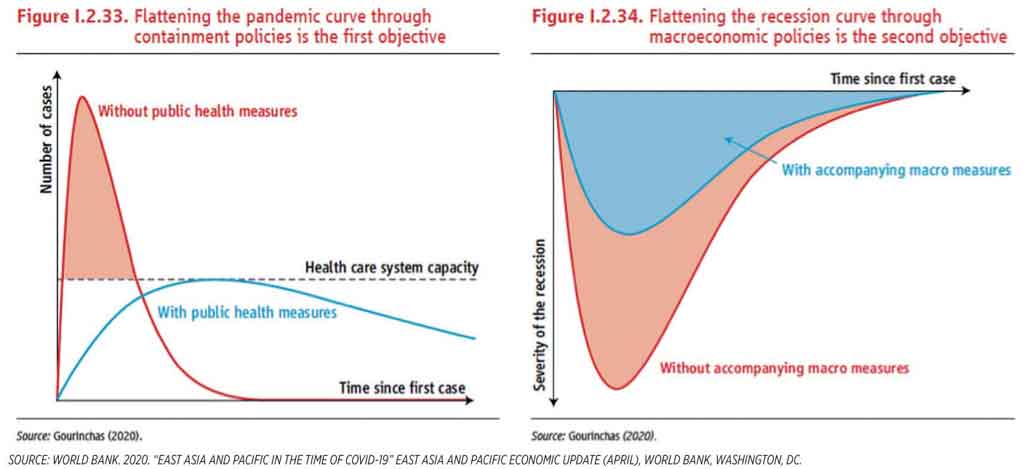
The World Bank in its economic update of the East Asia and the Pacific dated April 2020 has COVID-19 as its theme. The update bears disappointing facts regarding significant slowing down of several growth drivers. While under a normal situation, global and national economic managers can take corrective actions to boost performance, the problem is we live in extraordinary times because of the COVID-19 pandemic. Given the unavoidable economic cost of containing COVID-19 and saving lives, the world may likely expect another type of a pandemic — a global economic recession.

The update talks about the infection and recession curves of COVID-19. Both are interrelated, flattening one steepens the other. The first is what we hear from health experts and national leaders. The UP COVID-19 Pandemic Response Team did mathematical simulations of the curve, and noted that the “epidemic in Metro Manila will happen between April and June 2020”as reported out in the Philippine Star (see https://www.philstar.com/headlines/2020/04/03/2005234/covid-19-strategy-heres-how-philippines-can-combat-pandemic-according-data-scientist).

There are several measures to reduce the number of COVID-19 cases, but the most effective would seem to be what China had done in Wuhan: a city lockdown. Other measures are needed to make the lockdown even more effective, such as social distancing and temporary suspension of the school system at the community level, as well as lifestyle changes at the personal level to reduce the risk of getting ourselves infected. We have a similar response here to contain COVID-19, the enhanced community quarantine or ECQ for the island of Luzon.

Lockdowns are by far the most aggressively effective and most countries are just forced to take it to flatten the infection curve, except Sweden. And that is because healthcare system capacity is fixed in the short run, although the Chinese government demonstrated that they can expand capacity in less than a month. Most countries have healthcare systems built for a normal situation, and a COVID-19 pandemic is extraordinary.

But lockdowns are economically costly, and this is what the recession curve is all about. People out of job in an ECQ disrupts the circular flow of income and spending as earning members of millions of families have to stay out of work, and this slows down, if not reverses, economic growth. Other industries are affected adversely as the circular flow of income and spending is disrupted. What is demonstrably effective in flattening the infection curve has the undesirable effect of deliberately inducing a recession of the economy.

But admittedly doing nothing would steepen both curves. As more and more people get infected and the healthcare capacity is inadequate to cure them, productivity of the economy declines, boosting the recession curve.

If I may just use the two Figures from the update, the two curves may look like this. (See the figures.)

The duration of the lockdown period is uncertain. We just know when it is no longer needed, when the curve is flattened to a level suited for the country’s prevailing healthcare capacity. But not quite. The COVID-19 infection curve simulators of UPLB noted that even a flattened infection curve can rise again with new cases. Our ECQ was targeted to be lifted on April 15, after this Holy Week, two days from now. But last week we were informed Luzon needs two more weeks. But who really knows if that added duration is enough?

It is a quandary on the part of the government. Our leaders and health experts do not know with certainty how much time they need to flatten the infection curve for good. But the longer they force people to stay home, they end up sharpening the recession curve.

In practice, governments have to flatten both infection and recession curves. There has to be some capacity constraint that eventually compels authorities to flatten the recession curve, even as it reduces the number of new cases. The constraint may be the political capital of a country’s leaders. As people lose their incomes for an extended period of time, the political support for the government declines. Before its political capital gets completely depleted, the government would have to do something to relieve the pain induced by lockdowns, i.e. flatten the recession curve.

Congress enacted its anti-COVID emergency law, RA 11469, to help the poor cope with income losses due to the ECQ. According to the Finance Department, P200 billion is needed to sustain emergency assistance to millions of our countrymen, who are on “no-work, no-pay” arrangements over a period of two months.

Beyond May 2020, the government would have to borrow money to sustain the subsidy if the ECQ would still have to be continued by then, and quickly resuscitate the economy back to stronger growth. The World Bank has already provided the government a $100 million loan facility to help fight off COVID-19. Moreover, the government is negotiating with the World Bank and ADB for several hundreds of millions of dollars more in loans to flatten both curves.

The economy is expected to shrink by 0.6 of a percent, says National Economic and Development Authority Director General and Socio-Economic Planning Secretary Ernesto Pernia, if no intervention is done by the government, including the emergency income assistance infusion of P100 billion pesos a month.

Finance Secretary Carlos Dominguez III said that if the lockdown would last for only three months the economy could still lock in a 4.3 % GDP growth for 2020. But that is still recessionary compared to the stronger growth we had until COVID-19 hit us. With the base of the tax reform program reduced, the resources that the government can use to boost the economy are expectedly limited. The “Build, Build, Build” infrastructure program, which has been successful in sustaining high growth at 6% or above can be slowed down.

By the end of April, when the country is still before the peak of the curve, our leaders may consider extending the ECQ in Luzon. Because if they lift that prematurely to get the economy back up and running, the gain from staying at home in terms of fewer new COVID-19 cases in the last month and a half could be neutralized with a new wave of infections, a concern of China now as it lifts the lockdown at Wuhan city. Scientists are even saying now that we may have to continue lockdowns and social distancing, until we have the vaccine for COVID-19. But that is several months away.

But if that second wave in China turns out very weak, and if President Donald Trump has his way and would have restarted the US economy, these developments could persuade our leaders here to end the lockdown, or modify the social distancing rules. That would be great news if indeed the situation would have called for such a move.

Testing, testing, and testing for COVID-19 is really important. With more information about the enemy, we can adjust our policy responses with a lower cost to the economy. So what is it that we need to do to get us all tested at the same rate as we buy Chickenjoy from Jollibee?

Recent data from the Department of Health (DoH) appear to indicate that the infection curve is getting flatter. Obviously, the DoH data is selectively biased. It covers those cases that are only revealed to health authorities because they tested them. The sample is very small relatively to the entire population. The data does not capture infections outside of the system, and we do not know how bad that is for now.

Given these caveats (and this is the only data I have), the following Table shows the daily new cases since the last week of March to April 9. I took a three-day moving average to tone down the irregularities of testing and reporting. The daily new cases are plotted in the Chart.

I broke down the number of observations into weeks and took linear trends of each set of data. In the last week of March, there were 234 cases per day. The number worsened in the first week of April to 285 cases. But in the second week of April, it dropped to 191.8 cases, which, if sustained in the following week, indicates that the ECQ may be working. But that may still change for the worse. Hopefully, the recent trend is going to be sustained.

I am not concluding at all that the curve is flattened or just about to be flattened. It is an observation given the limited data that I have. I agree with our UPLB scientists that this observation of the infection curve may go up again, or may stay flat for good. By April 30, the government would need as much evidence as it can mobilize to guide its policy on lifting or continuing the ECQ, whatever is necessary to flatten both the infection and recession curves.


Ramon L. Clarete is a professor at the University of the Philippines School of Economics.

The tomb on Easter morning

The angel said to the women, “Do not be afraid; for I know that you are looking for Jesus who has been crucified. He is not here, for He has risen, just as He said. Come, see the place where He was lying” (Matthew 28:6).

The empty tomb is testimony to resurrection, or a release from the corruption of the body in the necessary burial for cleansing from sins and the lifting up to the purity of eternal life. Jesus rising from the dead on Easter morning is the clear promise of resurrection for us, lowly mortals in the end of time into Eternity.

Happy Easter to all who believe in Christ, the Redeemer!

According to Christian Today, there were 2.4 billion Christians around the world in 2015, out of about 7.5 billion people, or one-third of the world’s population. The top five Christian countries are: the United States of America with 213 million, or 65% of population; Brazil with 175.7 million, 04.1%; Mexico, 122.5 million, 83.6%; Russia, 117.64 million, 93%; and the Philippines, 110.64 million, 85% of population. Ten countries in the world have Christians composing from 99% (Romania) to 93% (Greece) of their population, with the Vatican, of course, having 100% of its population as Christians (specifically Roman Catholic).

So, perhaps in the whole history of Christianity, never has the anamnesis of Lent and Easter to Christian life been more poignantly enacted than by the present world experience with the coronavirus COVID-19 pandemic. With 1.6 million coronavirus cases reported worldwide, countries have imposed lockdowns, quarantines, stay-at-home or shelter-in-place orders and social distancing, increasingly stricter since mid-February when the fearsome virus was afflicting significant numbers, and extending until after Easter, mostly until the end of April. The prolepsis or anticipation of Ash Wednesday, Feb. 26 that started the 40-days Lenten traditions and ended on Holy Saturday, April 11, too starkly compares the world-wide imposition of isolation from COVID-19 to the death of Christ the Redeemer and the symbolic entombment of Lent.

Then, the world should have been released from the entombment of quarantines from the coronavirus, parallel to the empty tomb of Christ’s resurrection on Easter Sunday. Not just yet, the Lord sayeth. Kyrie elaeison — Lord, have mercy! Will it be in 50 days or hopefully less? Easter is the longest in Christian liturgy, lasting seven weeks until Trinity Sunday, June 7, the first Sunday after Pentecost. Perhaps 50 days more of isolation and cleansing is positive thinking that most of the world can thereafter freely move about more normally — hopefully testing procedures, treatment, and a vaccine against COVID-19 would have been found and set in place by then.

Why is isolation/quarantine necessary in this time of COVID-19? According to Harvard infectious disease epidemiologists studying the US situation in early March, 20% to 60% of adults will be infected with the virus that causes COVID-19. The Centers for Disease Control and Prevention (CDC) came out with a visual graph showing how quickly the estimated 1% fatality rate (as many experts say) will claim tens or hundreds of thousands of deaths in the US alone, until a vaccine is discovered that will prevent the virus from infecting unaffected individuals. “In the worst-case scenario, the daily number of cases jump dramatically, rapidly forming a tall peak that breaks through the critical line marking the capacity of the healthcare system. The reality is stark: Too many cases too soon and they overwhelm the hospitals,” Anthony Fauci, director of the National Institute of Allergy and Infectious Diseases, told a US House committee (USA Today, March 11).

The graph with the tall peak of COVID-19 infections, with the superimposed low-peaked controlled-exposure graph is the #FlattenTheCurve campaign, the only contra to the spread of COVID-19 pandemic so far. “Flattening the curve means that all the social distancing measures now being deployed in most countries around the world aren’t so much about preventing illness but rather slowing down the rate at which people get sick,” the CDC offered.

Ironically, it took a while for the US and major European countries to be really serious about #FlattenTheCurve. The United States is now an epicenter of the coronavirus pandemic. China, where the coronavirus originated, and other countries such as Taiwan, Singapore, and South Korea have been successful in flattening the curve before infection rates soared exponentially, as predicted in the high-peaked “before” chart of the CDC, if isolation/quarantine were not strictly enforced. “But grim projections indicate that the virus has not reached its peak and that the situation will get worse,” said a report in https://foreignpolicy.com/2020/04/02.

In the latest John Hopkins interactive map of COVID-19, there were 1,776,157 confirmed cases worldwide as of Easter Sunday, with 108,804 deaths and 402,903 recoveries. The top five countries affected are: the US, with 529,740 cases, 20,602 deaths, 31,988 recoveries; Spain, with 163,027 cases, 16,606 deaths, 59,109 recoveries; Italy, 152,271 cases, 19,468 deaths, 32,534 recoveries; France 130,730 cases, 13,851 deaths, 26,671 recoveries; and Germany with 125,452 cases, 2,871 deaths and 57,400 recoveries. Note that Germany shows the best recovery rate at 45%, better than the US’ 6.03%, and the others recovering about 20% on the average. But more jarring is the death rate, which goes from 2.8% (Germany) and 3.8% (US) to 10% — 12% of cases in the other three (European) countries. Didn’t the Harvard epidemiologists say COVID-19 has a predicted 1% mortality rate?

The Johns Hopkins report shows the Philippines with 4,428 cases, 247 deaths and 157 recoveries as of yesterday, Easter Sunday. That would be 5.5% deaths and 3.5% recoveries. The increase from the first coronavirus case reported on Feb. 1 peaked on March 31 with 538 cases in just one day. The latest daily increase graph shows 233 new cases on April 11, Holy Saturday. The Philippines has not flattened the curve, and there will be more cases before the infection wanes.

And so must the entombment in the coronavirus contagion in the Philippines continue in extended community quarantine (ECQ) until 11:59 p.m., April 30. Shut yourselves in, and shut your mouths — you cannot use up all your quiet time (albeit imposed by temporal authority), going on Viber and social media blaming government for clumsily addressing the crisis — even if evidently, the vanities of most elected and appointed officials never took into consideration supra-human other dictators (aside from politics) of people’s lives, like the coronavirus. After all, in a government by the people, it is the people who had voted for leaders who turned out to be inept and incompetent, uncouth and brusque, and/or out rightly corrupt and dishonest. And so now we suffer — from the ruthless, indiscriminate coronavirus and its wake of destruction in society and in world and country-economics, and in personal health and wealth.

Pope Francis, in his homilies at his daily Masses at Casa Santa Marta on Holy Week, always pointed out that Christianity is probably the only religion that emphasizes suffering as the fulcrum of Faith in the redemption of Man by the death of Christ on the cross. On Holy Wednesday, in the gospel of the betrayal of Jesus by his disciple Judas Iscariot, Pope Francis warned of “the little Judas” that is in every person’s humanity, that tempts a betrayal of the common good, or the good of another versus personal interest and concerns.

The entombment by the isolations and quarantines of COVID-19 has provided the perfect “closed retreat” to re-think and evaluate Christian values towards resurrection in the true Life. Stay in your tombs, to eventually rise healthy and strong for a cleansed world.


Amelia H. C. Ylagan is a Doctor of Business Administration from the University of the Philippines.

ahcylagan@yahoo.com

Consumer habits permanently changed

Two things are certain. First, the COVID-19 crisis will eventually come to an end. Second, humanity will forever be changed by this pandemic. Nowhere will this be more evident than in the way people consume goods and services.

According to a consumer behavior study conducted by the Nielsen Consulting Group, the new normal, post-COVID-19, will be marked by people having a renewed consciousness about health and well-being and extreme meticulousness about hygiene. As we move forward, the origins of products and their hygienic conditions will become a deciding factor whether certain products are patronized or not. Preferences will shift from mass produced food products to organic foodstuff even if they are sold at a premium. A partiality for locally grown and locally manufactured products will emerge. E-commerce will hit the mainstream and home shopping will become the norm.

China was the first to feel the full impact of the COVID-19 pandemic and the first to get out of it. Life in Chinese communities is gradually going back to normal. McKinsey & Company, a global think tank and consulting firm, conducted a survey in key Chinese cities to quantify the shift in consumer habits after the COVID crisis. The results were insightful and should be useful not only for regular consumers but more so for those involved in fast moving consumer goods, retail, and hospitality.

Bear in mind that the survey was conducted in the 3rd week of March, hence, things are still subject to change. Nevertheless, the results give us an indication of the trends that are emerging for us in the Philippines.

For ease in understanding, let me present the results in bullet point form.

ON RETAIL:
About 55% are likely to permanently purchase their groceries online after the crisis.

About 25% have shifted away from their primary stores (or usual vendors) of which 50% have no intention of going back to their old vendors.

About 10% will visit local farmers markets more frequently, post COVID-19, than they did before the crisis.

ON CONSUMER GOODS:
About 33% have switched brands of consumer goods during the course of the crisis of which 20% have no intention of switching back to their original brands.

Only 85% will consume the same amount of skincare, personal care, and cosmetic products as they did before the COVID-19 crisis. The rest will reduce consumption.

Only 84% will consume the same amount of basic food products as they did before the COVID crisis. The rest will reduce consumption.

Only 79% will consume the same amount of snack food products as they did before the COVID crisis. The rest will reduce consumption.

Only 82% will consume the same amount of alcoholic beverages as they did before the COVID crisis. The rest will reduce consumption.

About 35% will consume the same amount of dairy products, 52% will consume more while 13% will consume less.

About 41% will consume the same amount of deli meat products, 39% will consume more while 20% will consume less.

About 40% will consume the same amount of frozen food, 45% will consume more while 15% will consume less.

ON RESTAURANTS:
About 15% have no intention to eat out as frequently as they did before the crisis.

About 25% of pre-COVID-19 walk-in volume is the rate restaurateurs can expect immediately after the lockdown.

About 99% of take-out and delivery transactions will return to normal immediately after the crisis.

About 15% increase in sales for pre-packed and ready-to-eat food will be realized.

In summary, a decline in demand was noted across all consumer product categories surveyed except for sanitary, medical, and cleaning products.

The strong hold of leading brands have been broken, opening the way for trial usage of alternative brands. New brands that deliver on their promise will grab market share from the market leaders.

For restaurants, dine-in sales is seen to drop by 75% in the first month following the lifting of the lockdown, versus usual volume. Online sales for delivery will be the new source of customer traffic. Moreover, frozen food for home consumption will be an emerging category that is seen to increase over time.

The question on everyone’s mind is — how long before consumer habits revert back to their pre-COVID-19 levels?

Unfortunately, there is no precedent to this. The closest thing I could find was the length of time it took stock markets to recover after a major crash. While not an exact historical comparison, I argue that a correlation exists between consumer habits, corporate earnings and investor’ appetite for investments. So lets see at how long it took markets to recover after these crashes.

The Spanish Flu was a pandemic that occurred in 1918, stock markets across the globe crashed by 20% and recovered after seven months

The Great Depression occurred in 1929 and caused stock markets to spiral down by 89%. It took 26 months for markets to recover from their lowest point.

When Germany invaded France in 1940, stock markets worldwide plunged by 25.5%. It took only one month for stock prices to bounce back.

In 1987’s Black Monday, stock prices slid by 22.6%. Prices recovered after one month.

The Doctcom Bubble burst in 2002 and saw stock prices across the globe contract by 45%. It took 25 months before prices fully recovered

The Subprime Crisis of 2008 saw stock prices tumble by 53.7%. It took 16 months for stocks to regain their post-crisis values.

The COVID-19 crisis caused the average value of stock prices worldwide to plummet by between 25% to 41% so far.

Experts believe that markets, as with consumer habits, will begin their upswing when two events occur: 1. When the number of people that are infected by the virus begins to decline; and, 2. When people are allowed to go back to their daily work routine and the economy begins to hum again. If China is to serve as an example, it took two months for these two events to happen.

However, only when a vaccine is developed will consumer habits and stock market prices reach their pre-crisis levels again. According to the Cooper Academy of Investments, this could take 18 months to two years.

The business world will go through major changes after this crisis. While we are on quarantine, it will be wise to spend the time planning how we can benefit most from the new world order.


Andrew J. Masigan is an economist.

ADVERTISEMENT
ADVERTISEMENT