Home Blog Page 9661

WIM Arianne Caoili (1986–2020)

WIM Arianne Caoili, circa 2000

WIM Arianne Bo Caoili died last March 30 from injuries sustained after her car crashed into a supporting column under a bridge in Yerevan two weeks prior. She was only 33 years old. She played for me when I was Team Captain of the Philippines’ 2000 Istanbul Olympiad team, but to describe her as a chess player would be a grave injustice. She couldn’t sit/stand still and always had to be doing something, and she excelled in everything she did. Just read on.

The daughter of Mr. Arnold Caoili (a former Deputy Minister of Agriculture during the Marcos days) and Ms. Annette Caoili of the Netherlands. I first met her in 1999 when I was still the Executive Director of the National Chess Federation of the Philippines and no less than Hon. Florencio Campomanes recommended her as a great talent to be nurtured.

“Campo” as everyone knows was a chess junkie and played chess anywhere and everywhere. During a local tournament he spotted this tiny cute girl playing blitz against all comers and he had to try her out for himself, losing three games in succession in the process.

To make a long story short the Philippine Chess Society sponsored the “Philippine Chess Center Women’s Championship” where all the top women players in the country participated and Arianne confirmed her skill by winning the event.

She played top board for the Philippines in the 2000 Istanbul Chess Olympiad. I was captain of that team (also the men’s team, but they did not need any captaining from me if you know what I mean!), and fondly remember them all: board 1 WIM Arianne Caoili, board 2 Beverly Mendoza, board 3 Leah Bernardo, board 4 Christine Grace Espallardo, Team Captain: WIM Cristine Mariano.

After breakfast each day the team would go out for a walk in the long pedestrian shopping street near Taksim Square, after which we would go to review our various strategies for the game in the afternoon.

During the morning strolls I felt on top of the world because I was rubbing elbows with famous chess organizers and administrators from all over the world and even famous grandmasters like Ulf Andersson, Michal Krasenkow, Peter Leko would stop and chat a bit. Players who I hardly knew would greet me and strike up a conversation. It was only later on that I realized that this newfound “popularity” was because we had two “lookers” in the team, Arianne and Christine Espallardo.

I would regularly go to the Internet cafes to send reports to the Philippines on the performance of our players and these cafes were usually filled with players from other teams playing online games and chatting with their friends on social media. Now, I am aware that Facebook was created in 2004, Twitter in 2006, and Instagram even later, around 2012. At that time what we had was Internet Relay Chat and the chat rooms. Also, online sites like the Internet Chess Club (ICC) allow players to log in, play, analyze and talk/chat/gossip with each other. It was there that I first got wind of the “babes in the Philippine team” and their clueless team captain!

At the end of 2000 the Philippines hosted the Asian Under-16 Boys’ and Girls’ Championship in Bagac, Bataan, and Arianne won the Girls’ event to get her Woman’s International Master (WIM) title.

In 2004 Arianne transferred chess federations to represent Australia. She played for the women’s team Down Under in the chess olympiads of 2004, 2006, 2008, 2010 and 2012.

2006 was a very eventful year for Arianne. She was one of the celebrity dancers in the fifth Australian season of Dancing with the Stars. Her professional dance partner was Carmelo Pizzino and she finished as the series’ runner-up behind Anthony Koutoufides.

In an episode of the Australian TV show Deal or No Deal she won a car for the home competition entrant.

Later on during the 2006 Turin Olympiad there was some negative publicity. Every Chess Olympiad has a “Bermuda Party” (so named because it is sponsored by the team from Bermuda) held on the eve of a free day, which is usually a big celebration, a wild, noisy affair with multiple imported bands playing well into the wee hours of the morning.

Anyway, Arianne attended that party at the arm of Latvian/German/Azerbaijan GM Arkadij Naiditsch and at some point she started dancing with Levon Aronian then as now considered something of a national hero in Armenia. Suddenly, out of nowhere, England’s GM Daniel Gormally, drunk and in a jealous rage, lunged at Aronian and sent him sprawling on the dance floor. Immediately, GM Varuzhan Akobian of the US team (a native Armenian) rushed Gormally and tried to engage him in fisticuffs. I believe at this stage GM Yasser Seirawan intervened and separated all the parties.

It was not yet over, of course, the next day a group of Armenians waylaid Gormally and roughed him up. The English board 4 was really in physical danger and had to depart from the Olympiad.

Next year when Aronian and Caoili met again in a tournament they connected and started going out. Two years later, in 2008, they were officially in a relationship, became officially engaged in 2015 and were married on Sept. 30, 2017 with no less than Armenian President Serzh Sargsyan and his wife Rita Sargsyan in attendance.

This game, played 20 years ago almost to the day, was quite a sensation at that time. A cute 13-year old girl defeats Vladimir Epishin, one of the top players of the world then, 3rd placer in the 1991 Soviet Chess Championship and a second to former world champion Anatoly Karpov. He is also a theoretician and even has a variation of the Benko Gambit named after him (1.d4 Nf6 2.c4 c5 3.d5 b5 4.cxb5 a6 5.bxa6 g6 6.Nc3 Bxa6 7.Nf3 d6 8.g3 Bg7 9.Bg2 Nbd7 10.Rb1)

Caoili, Arianne (2097) — Epishin, Vladimir (2667) [E15]
III Open de Malaga (4.12), 28.02.2000

1.d4 Nf6 2.Nf3 b6 3.c4 e6 4.g3 Ba6 5.b3 Bb7 6.Bg2 Bb4+ 7.Bd2 a5

This is a popular line with Black hoping that the little girl sitting opposite him would play 8.Bxb4? axb4 rewarding Black with a semi-open a-file. However, Arianne has done a lot of work in her opening repertoire and knows that the crucial square for this line is e4.

8.0–0 0–0 9.a3

The most common moves here are 9.Nc3 and 9.Qc2. On the other hand, the move 9.Bc3 has largely lost its popularity because of Black’s 9…c5! 10.a3 Bxc3 11.Nxc3 d5 12.Ne5 Na6 and it seems that White does not have anything out of the opening.

9…Be7 10.Nc3 d5 11.cxd5 exd5 12.Qc2 Re8 13.Rfc1 Na6 14.Bf4 Qd7 15.Na4

You know what this knight move is for? This is to prevent Black’s knight from re-activating itself via …c6, …Nc7 and …Ne6 because of the attack on b6.

15…Bd6 16.Bxd6 Qxd6 17.e3 h6 18.Nb2 c5 19.Nh4 Rac8 20.Nc4!

Can you believe that a 14–year old girl is handling the white pieces?

20…Qe6 21.Qf5 cxd4 22.exd4 Qc6?!

An inaccuracy. Better is 22…Qe7 defending his hanging bishop on b7. Now, when White moves out his knight 23.Nxb6 there will follow 23…Rxc1+ 24.Rxc1 Qxa3 and Black’s position is looking decidedly better!

23.Rc2 b5 24.Ne3 Qd6 25.Rxc8 Bxc8 26.Qd3 Nc7 27.Nhf5 Qb6 28.Rc1 b4 29.a4 g6?! 30.Nh4

If that wasn’t one of the world’s top grandmasters sitting opposite her maybe Arianne would have gambled with 30.Nxh6+!? Kg7 31.Qd2! because if Black now tries to win the knight by 31…Rh8 then 32.g4! looks strong.

30…Kg7 31.Nf3 Ba6 32.Qc2 Ne6 33.Qd1

Defending her d-pawn and preparing one last thrust at the Black King.

33…Bb7 34.Bh3 Ne4 35.Bxe6 Rxe6 36.Ne5 Nc3 37.Qg4

POSITION AFTER 37.QG4

37…Qxd4??

Pressed for time, Epishin counted only on 38.Qxd4 Ne2+.

Some commentators wrote that Epishin blundered grievously at this point and should have won since 37…h5 would have won Arianne’s rook. That is true if she had intended to play 38.Qf3?? Rf6. But her intention (and Epishin saw this) was to play 38.Nf5+! Now Black’s King cannot go to f6 or f8 because of Nd7+, and neither can it to the h-file because of Qg5 and Qh6. Forced, therefore, is 38…Kg8 39.Qg5! Ne2+ 40.Kg2

• Trying for a win with 40…Rxe5?! backfires: 41.dxe5 d4+ (41…Nxc1? 42.Qh6) 42.f3 White’s threat of Qh6 is deadly.

• Black should agree to the draw with 40…Nxc1 41.Nh6+ Kh7 (41…Kf8?? 42.Nd7+) 42.Nhxf7 Kg8 43.Nh6+ Kh7 (43…Kg7 44.Nf5+) 44.Nhf7 and the draw is a fitting conclusion to this thrilling game.

38.Nf5+! 1–0

Wins the queen and forces Epishin to resign.

Arianne hardly played chess after her 2012 olympiad stint. But that doesn’t mean that she was not active elsewhere. She found time to get her Ph.D. in Economics on “Russian foreign policy, especially its economic and business relations with Armenia on a state and individual level.” She became the Special Economic Advisor for the President of Armenia (2013–2015) and Advisor to Prime Minister Karen Karapetyan.

After working as a consultant at Price Waterhouse Coopers, she founded Akron Consulting in 2015, a global strategy consulting firm based in Yerevan, Armenia, with a presence in Cambridge, Maryland. The firm is active in public policy and economics. In this role she has advised international leaders, including the President of Armenia.

Arianne was also active in several social philanthropic projects. For example in 2018 she made a 2,000-km bike tour from the city of Ayas in Cilicia to Agarak, a town located on the Armenian-Iranian border. Her aim was to raise US $5,500, which she exceeded by collecting US$6,016 in two weeks. These funds were donated to the Children of Armenia Fund which builds schools where chess is now taught.

She was the owner and Editor-in-Chief of Champord, a free mass-distributed newspaper in the Caucasus region (Armenia, Azerbaijan, Georgia) with a print run almost 10 times larger than any other printed press in Armenia. She also served as Chairman of the Champord Fund, an organization invested in the development and training of young Armenian journalists.

She has accomplished much in her 33 years with us.

Rest in Peace, Arianne.


Bobby Ang is a founding member of the National Chess Federation of the Philippines (NCFP) and its first Executive Director. A Certified Public Accountant (CPA), he taught accounting in the University of Santo Tomas (UST) for 25 years and is currently Chief Audit Executive of the Equicom Group of Companies.

bobby@cpamd.net

Game of HORSE

It spoke volumes about the competitiveness — or, to be more precise, lack thereof — of the HORSE matchup between Zach LaVine and Paul Pierce that its most memorable segment involved the former recounting his experience in the shadows of a 40-year-old Kevin Garnett while a rookie with the Timberwolves. Indeed, the 13th overall pick of the 2014 National Basketball Association draft dominated the Challenge, blanking the 2008 Finals Most Valuable Player with an array of shots that highlighted his athleticism and silky smooth touch. Never mind that the rules disallowed any dunking and effectively negated his inherent advantage over the rest of the field.

Not that LaVine was the lone player who impressed in yesterday’s first round. Mike Conley Jr. was likewise a standout, failing to get the better of opponent Tamika Catchings just once. He was a picture of consistency, going to his non-dominant hand — including once from behind the backboard — to get ahead. His Hall-of-Fame-bound opponent was more game, and certainly put up a better fight than the laid-back Pierce did, but he proved to be in his element. And, no doubt, he benefited from having a gym in his home.

The other two set-tos bucked conventional wisdom. Chauncey Billups appeared ready to go down as expected, only to gain confidence midway through and upset pre-event favorite Trae Young. The come-from-behind victory was particularly surprising given the way he crafted it: via three-point shots with a twist that his All-Star foil seemingly had the talent, not to mention the range, to pull off as well. The latter was gracious in defeat, acknowledging the superiority of “a Legend and a mentor of mine” but hinting at a rematch.

Parenthetically, Allie Quigley seemed all too ready to use traditional HORSE fare to upend Chris Paul. For a while there, she looked ready to fold in the face of a spirited comeback. Ultimately, through, the early cushion she built proved more than enough for her to pull through. Forget that she was aided by the point god’s slow start, and, with the outcome on the line, uncharacteristic inability to bank in a shot from the charity stripe. And considering her velvet stroke and willingness to dig deep inside her bag of tricks, she may yet raise more eyebrows.

Moving forward, the Billups-Conley and LaVine-Quigley tiffs are projected to be equally compelling. The format itself lends well to tense moments, but only when participants are eager to push the envelope. In this sense, the four are primed to entertain. And, in a time of COVID-19, the fans win.


Anthony L. Cuaycong has been writing Courtside since BusinessWorld introduced a Sports section in 1994.

alcuaycong@bworldonline.com

Making a difference through fashion, one suit at a time

By Aliyya Sawadjaan
Features Writer, The Philippine STAR

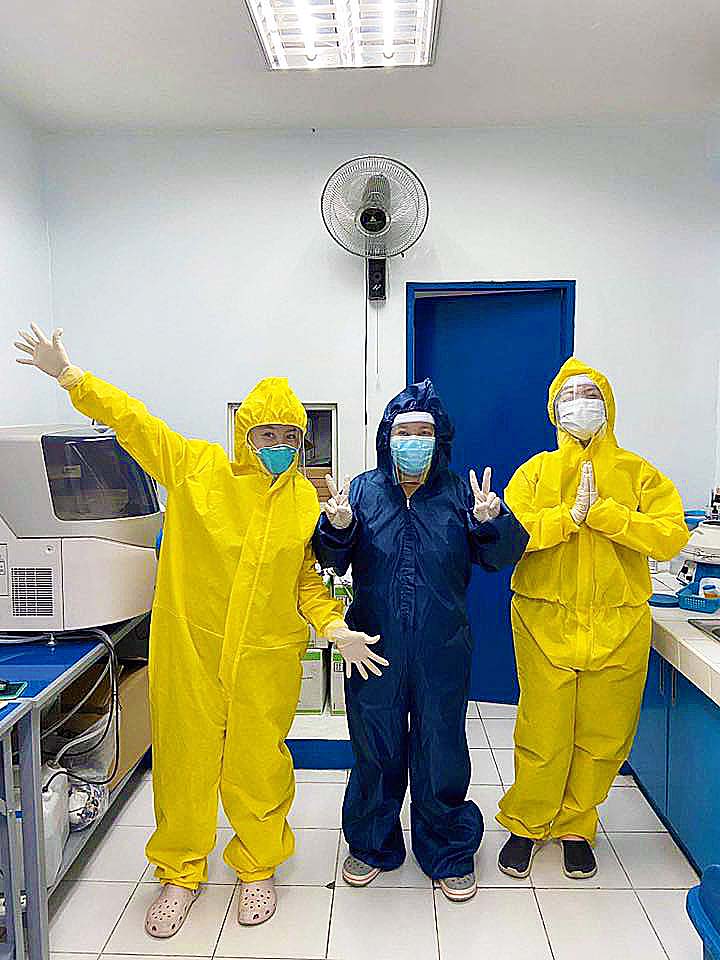
With the rising number of coronavirus disease 2019 (COVID-19) confirmed cases, the number of personal protective equipment (PPE) used by medical professionals has become scarce.

PPE sets include gowns, gloves, masks, goggles, and alcohol-based handrubs. PPEs are important in the fight against the novel coronavirus as these help prevent the spread of germs and viruses in the hospital, protecting people and health-care workers from infections. Medical professionals need these when taking care of COVID-19 patients.

To put things in perspective, the Philippines Health System Review of 2018 reported that as of 2017, the Philippines has a total of 40,775 doctors, 90,308 nurses, and 13,413 medical technologists, which is why more PPEs are needed.

UP Medical Foundation Inc. president Dr. Mediadora Saniel estimates that a hospital with 1,000 healthcare workers need 90,000 masks, 2,500 N95 masks, 5,000 surgical gloves, 2,500 hoods, 2,500 caps, and 300 gallons of alcohol in a month.

Due to the global shortage of PPEs, many frontliners have had to improvise using garbage bag or plastic raincoat as gowns, garden gloves instead of surgical ones, plastic bags for shoe covers and surgical hoods, and DIY reusable face shields from acetate plastic sheets and elastic bands.

Helping frontliners, fashionably 

Hoping to help in the fight against COVID-19, fashion houses, brands and designers have stepped up to the plate by helping frontliners acquire face masks and PPE sets.

Swimsuit designer Domz Ramos, together with his DR Styles Fashion staff, relatives and neighbors, turned small pieces of cloth (retaso) into 2,000 face masks and distributed these to barangays and hospitals.

Designer to the stars Michael Leyva went back to his studio and created hazmat suits and head covers, as well as washable face masks. His team targets to finish at least 3,000 suits. Following the specifications set by the Department of Health (DOH), the suits are made from non-woven, washable and waterproof fabric — the same fabric used to make eco-bags. 

Project Runway Philippines alumnus Santi Obcena and his team have also been sewing masks for donation. He also shared a video tutorial on how to make a reusable face mask using eco bags, umbrella cloth and retaso. The masks they make have an outer water-repellent layer and a pocket for a removable filter. Mr. Obcena also specified in his video that these masks are for communities or households that do not have access to surgical masks.

Fashion designer and milliner Mich Dulce and her team in Manila created the first medically-reviewed open-source PPE suit design. They were able to “reverse engineer” an isolation suit lent to them by Vice President Leni Robredo, creating a pattern and an instructional PDF file for others to follow.

The Office of the Vice President called on Filipino fashion designers to help produce the PPEs for medical frontliners, and Ms. Dulce was one of the first to respond, tapping others to commit to the project. The group is now called the Manila Protective Gear Sewing Club. Aside from calling on fellow designers for help, she also called for donations for fabrics and other materials to make the suits.

Other fashion designers have also chipped in to help address the shortage for PPE suits. Designer Rajo Laurel reopened his factory and his company has donated to different hospitals and healthcare facilities.

Outside of Metro Manila, Cebuano designer Valerie Alvez and her team stepped in by creating PPE sets using eco-friendly material taffeta — a water-repellent fabric. The disposable customized PPE suit has been approved by the DoH. Alvez and her team say they have no plans to stop making the suits as long as it is needed.

Josip Tumapa from Dumaguete City started creating PPE suits for relatives who are frontliners, but then other frontliners requested for these, too. She then created more suits and even personally delivered them to health centers in the city. She has since shared the design for the PPE suit on Facebook.

Adrian Pe, meanwhile, is the designer responsible for the now-viral Teletubbies-inspired PPE suits. He also created suits inspired by Power Rangers and Star Wars.

Pop culture-inspired PPE suits created by Adrian Pe, featuring Teletubbies. Photo from Adrian Pe’s Facebook page

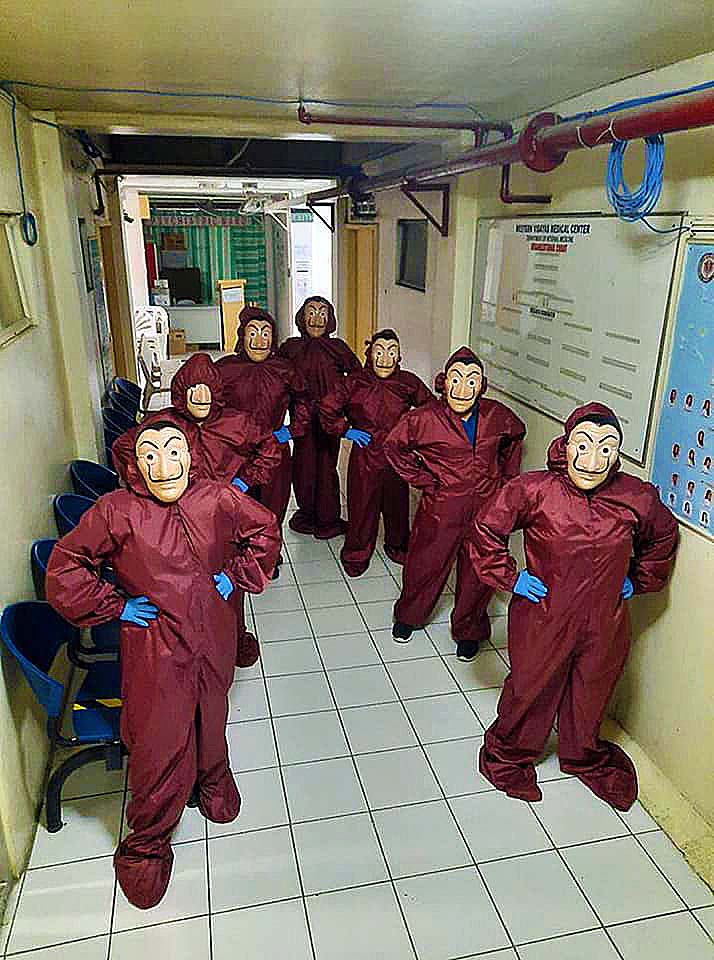
Iloilo-based designer Ram Silva created suits inspired by the popular drama series Money Heist. He gamely posted on Instagram photos of frontliners from Western Visayas Medical Center wearing his creations.

Money Heist-inspired PPE suits created by Iloilo designer Ram Silva. Photo from Ram Silva’s Facebook page

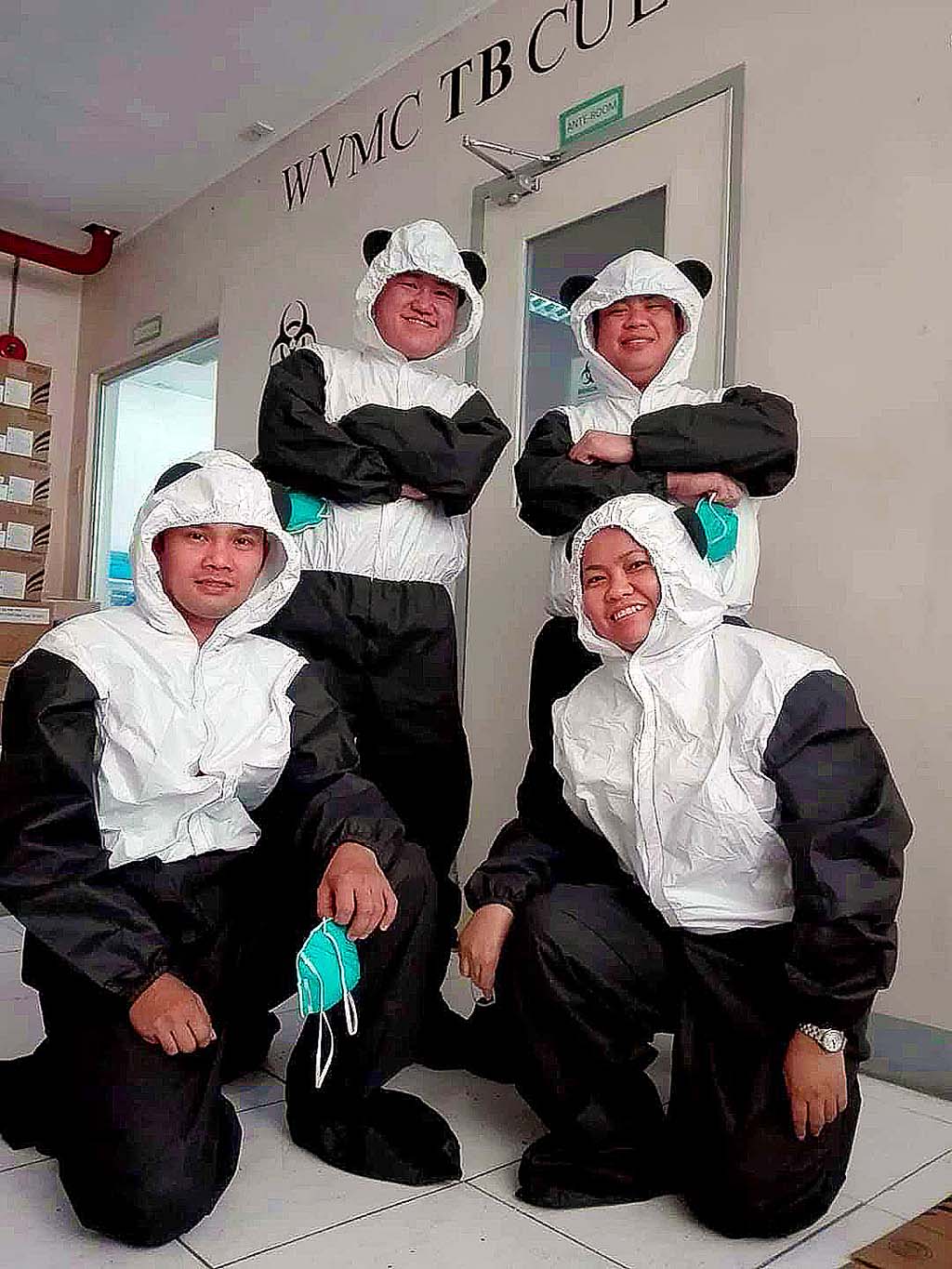
Another Iloilo-based designer, James Roa, created a panda-inspired PPE suit to spread good vibes to patients and medical workers. After reaching out to friends to raise funds for the production of the protective suits, he was able to collect enough to make 100 suits.


Panda-inspired PPE suits created by Iloilo designer James Roa. Photo from James Roa’s Facebook page

The Bunny Project PH, on the other hand, has already distributed more than 7,000 bunny suits or PPEs as of April 7. They were able to produce these suits with the help of the Victoria Tarlac Livelihood Group, the local government of Victoria, Tarlac, and the provincial government of Tarlac who helped mobilize more than 50 tailors and dressmakers.

Just some of the PPE suits prepared and delivered by the team behind The Bunny Project PH. Photo from The Bunny Project PH’s Facebook page

Disenyo Pandi, a group of designers and gown makers based in Bulacan, also created and donated PPE suits for hospitals in Bulacan and Metro Manila.

School of Fashion and Arts (SoFA) Design Institute’s faculty members and alumni have also joined in to address the growing need for the protective suits. Many of the alumni have shared their own designs for the PPE suits and are also available on Facebook for download.

Local clothing brand Penshoppe is also doing its part by working with its vendor partners.

Calls for PPE suits are still on-going with the number of COVID-19-positive cases nearing 5,000.

Linking Systems, Integrating Success: TSI integrates the technologies you need to succeed

Success is too broad to define; it can mean a lot of things to many different people. For entrepreneurs, success might be about growth and profitability, but for political leaders, it could be about gaining power and influence. For some, it could be having the spare time to do what they love, overcome fears, or simply enjoy what life has to offer. Though success may vary from one person to another, it hinged to one big concept — achieving desired vision.

While most successful people associate their victory to years of hard work and perseverance, there are also some who give the credit to a strong network they established over the years. Same thing goes in the business world; companies also need a strong network for them to take off and reach success.

While some companies are still on the verge of finding out what success really is, Technologies Specialist, Inc. (TSI) is rock-steadyin itsdeeply rooted values. The company’s new brand identity, visualized by a flock moving towards success, is not just about linking clients through advanced cabling and network infrastructure solutions. It is a nod towards the invaluable trust that comes from their customers’ complete satisfaction in their services.

With today’s evolving society, the demand for structured cabling is even higher. According to a recent study by market research firm Fact. MR, this is driven by the propagation of fifth-generation technology, or 5G, and the modernization of data centers.

The study said that 5G technology continues to expand at a global scale, and the trails and deployment activities for this next-generation wireless network technology are giving way for new structured cabling installations. The emergence of modular data centers has also stimulated the utilization of modularized data cabling solutions that hold superior networking capabilities.

The never-ending progress of tech brings massive disruption on how businesses are run. It is now a matter of adapting to new innovations, or else be left behind.

While the benefits of structured cabling vary from business to business, the much-prepared-for upgrade will account for cost-effective network infrastructure that will stand the test of time and address the complexities of technology resulting in increased efficiency and improved workflow for a sustainable business continuity.

With a help of the right partner like TSI, the journey to network transformation would be easy. TSI offers holistic solutions covering all processes for structured cabling system; security and surveillance system; fire alarm and detection system; voice evacuation system; card identification system; electrical distribution systems; and rack and wire-ways manufacturing. All these services and solutions are delivered by TSI’s roster of certified engineers and highly skilled project managers, trained to work professionally and competently.

TSI’s provides its clients with cost savings that they can reallocate to other business needs. Its methodology revolves around the commitment to usher business partners to success.

As a subsidiary of Trends Group, Inc. and the affiliate of Trends and Technologies, Inc., TSI shares the same pursuit of excellence and dedication to customer satisfaction.

TSI’s track record in pursuit of excellence can be traced as early as 1996 when it was established. The company was involved in epic endeavors that gave it the opportunity to implement very imposing projects over the years. It was able to work with some of the country’s biggest companies from across different industries, addressing their strict and rigorous requirements. Despite some challenges related to geographical location, and some international and security standards, among others, TSI was able to deliver its promise of excellence.

At present, TSI – aside from its established partnerships with industry leaders – continuously worked on partnering with best-of-breed technology leaders to deliver effective services and solutions.

How would you like to connect towards success? Reach out to TSI today.

DoH modifies classification of COVID-19 cases

On January 28, the Philippines started classifying coronavirus disease 2019 (COVID-19) cases as either Patients under Investigation (PUIs) or Persons under Monitoring (PUMs). However, due to apparent local or community transmission of the virus and the surge in cases, the Department of Health (DoH) has decided to shift from classifying individuals as PUIs or PUMs to using case definitions following guidelines from the World Health Organization (WHO).

PUM — one who may have been exposed to the virus but shows no symptoms — is no longer included in the new classification, as residents are assumed to have been exposed due to local transmission. A PUI (mild, severe or critical) who was not tested or awaiting test results is now classified as Suspect, while a PUI (mild, severe or critical) with inconclusive test results is considered a Probable case. A COVID Positive case is now referred to as Confirmed.

SUSPECT CASE

A. Individuals with influenza-like illness (ILI). Symptoms include fever of at least 38°C and cough or sore throat, AND either of the following: (i) a history of travel to or residence in an area that reported local transmission of COVID-19 during the 14 days prior to symptom onset, OR (ii) with contact to a confirmed or probable case of COVID-19 during the 14 days prior to symptom onset.

B. Individuals with sudden respiratory infection and severe symptoms such as shortness of breath, difficulty of breathing or severe pneumonia with unknown cause, and requires hospitalization

C. Individuals with fever or cough or shortness of breath or other respiratory signs or symptoms and under any of the following conditions: (i) aged 60 years and above, (ii) with a comorbidity, (iii) assessed as having high-risk pregnancy, or (iv) a health worker.

PROBABLE CASE 

A. Suspect case whom testing for COVID-19 is inconclusive

B. Suspect case who tested positive for COVID-19 but whose test was not conducted in a national or subnational reference laboratory, or an officially accredited laboratory

CONFIRMED CASE

A. Any individual who was laboratory-confirmed for COVID-19 through RT-PCR in a national or subnational reference laboratory, or a DoH-certified laboratory testing facility

BSP eyes ‘deeper’ policy rate cuts

THE central bank is looking at a “deeper cut” in interest rates to help cushion the economy from the impact of a “once-in-a-lifetime crisis” caused by the coronavirus disease 2019 (COVID-19) pandemic, Bangko Sentral ng Pilipinas (BSP) Governor Benjamin E. Diokno said ahead of a policy meeting next month.

He also signaled another cut in the amount of cash that banks need to hold as reserves to boost liquidity in the financial system.

“While BSP has cut the policy rate by 150 bps (basis points) since I assumed office last year, the Philippines is now faced with a once-in-a-lifetime crisis. It is now clear that reverting to where we were in 2018 — policy rate at 3.0% — is no longer an appropriate policy goal,” Mr. Diokno said in a text message to reporters on Sunday.

“A deeper cut is warranted in response to the expected sharp economic slowdown,” he said, noting that inflation is likely to settle closer to the lower end of the BSP’s 2-4% target this year.

The policy-setting Monetary Board (MB) has cut rates by a total of 150 bps since 2019, almost completely unwinding the 175 bps in hikes it implemented in 2018 amid multi-year high inflation.

Its latest move was 50-bp reduction on March 19, which brought the overnight reverse repurchase (RRP) rate — or the key policy rate — to 3.25% and overnight lending and deposit rates to 3.75% and 2.75%, respectively, in a bid to shield the economy from the virus fallout.

Headline inflation eased to 2.5% in March coming from the 2.6% in February and the 3.3% in the same month in 2019, mainly on the back of falling oil prices amid low demand due to COVID-19. This brought the year-to-date average to 2.7%, above the 2.2% expected by the BSP for 2020.

The Monetary Board will meet to discuss policy anew on May 21.

While noting that monetary policy works with a lag and that they will remain “data dependent,” Mr. Diokno said governments worldwide need to ensure a “soft landing” for their economies in the aftermath of the pandemic.

“The monetary authorities’ job, in coordination with fiscal authorities, is to manage a ‘soft’ landing and ensure that economic takeoff begins quickly once the pandemic fades,” he said.

“These new realities call for bolder but appropriate moves on the part of the BSP. The challenge is to cushion the impact of the economic slowdown on people, firms and the financial system,” Mr. Diokno noted.

The central bank chief added that they will cut lenders’ reserve requirement ratio (RRR) further following the 200-bp reduction in universal and commercial banks’ RRR earlier this month as they seek to boost liquidity to support economic activity.

The Monetary Board last month authorized Mr. Diokno to cut RRR by a maximum of 400 bps for the year, with potential cuts in the reserve requirements for other banks and nonbank financial institutions also to be explored.

“[T]he additional 200 bps cut is forthcoming based on available data, the needs of the economy, and the utilization of the additional liquidity,” he said.

Mr. Diokno earlier said the 200-bp cut freed up some P180-200 billion in liquidity.

The reserve ratios of thrift and rural banks are at four percent and three percent, respectively. However, the minimum liquidity ratio for stand-alone thrift, rural and cooperative banks was cut by 400 bps last week to 16% until end-2020 to boost their buffers amid the disruptions caused by the pandemic.

Before the COVID-19 outbreak, Mr. Diokno had vowed to reduce big banks’ RRR to the single-digit level by the end of his term in 2023.

ECONOMIC RECOVERY
Analysts said a more aggressive reduction in both benchmark interest rates and banks’ RRR will help ensure the country’s recovery after the crisis.

Rizal Commercial Banking Corp. Chief Economist Michael L. Ricafort said further monetary easing will be in line with aggressive moves by central banks worldwide amid the pandemic.

“There is no better time than now to further cut interest rates and RRR to also complement the record programs versus COVID-19 to better deal with the economic losses especially in providing aid to vulnerable sectors as well as to prepare the economy for a rebound,” Mr. Ricafort said in a text message.

Security Bank Corp. Chief Economist Robert Dan J. Roces said Mr. Diokno’s signal is a “proactive stance” amid easing inflation that also factors in the transmission lags of monetary policy.

“[I]nflationary tendencies from cuts may be absent on the back of low oil prices which may offset any price repercussions,” Mr. Roces said in a text message. “[W]e can hit the ground running in terms of recovery after ensuring that the economy is adequately capitalized.”

UnionBank of the Philippines, Inc. Chief Economist Ruben Carlo O. Asuncion said lower interest rates will help the economy during this crisis even as he warned that this could take a toll on the peso, noting that adjustments can wait until a “soft landing” is reached.

“The peso has been attractive because of its spread between inflation and the existing policy rate. If the RRP is further cut, the peso may not be the same as it is perceived by the market now,” Mr. Asuncion said in a text message.

“[The] BSP has the careful task of continuing to smoothen the volatility of the peso after further rate cuts,” he said. “It’s a difficult balancing act. We may win or lose, but we do not have many policy choices at this point.”

Finance Secretary Carlos G. Dominguez III said last week the country’s gross domestic product (GDP) will likely post flat growth or even shrink by as much as one percent this year, as economic activities in Luzon remain at a standstill due to the Luzon-wide enhanced community quarantine (ECQ) that will last until April 30.

The estimated 1% contraction in GDP is lower than -0.6% to 4.3% growth range seen by the National Economic and Development Authority (NEDA) prior to the extension of the one-month lockdown.

NEDA last month said the low end of its growth estimate for this year, a contraction of 0.6%, is “still too high” if the ECQ is extended beyond one month “or if the spread of COVID-19 is unabated even after the ECQ.”

This compares to the 5.9% GDP expansion in 2019 and the 6.5-7.5% growth target set by the government for this year.

COVID-19 cases in the country reached 4,648 as of Sunday, with 297 casualties, according to the Department of Health. Recoveries totaled 197. — L.W.T. Noble

PCCI lists priorities for gov’t after ECQ lifting

By Jenina P. Ibañez
Reporter

THE country’s biggest business group is urging the government to focus on mass testing for the coronavirus disease 2019 (COVID-19), the resumption of some economic activity and the removal of barriers to movement of people and supplies in order to ensure a path to recovery after the enhanced community quarantine (ECQ) ends on April 30.

At the same time, tycoon and SM Investments Corp. (SMIC) Vice-Chairperson Teresita T. Sy-Coson said a gradual resumption of businesses will help save jobs after the lockdown, which has halted most economic activities in Luzon, is lifted.

“As discussions on possible triggers for a partial lifting of the ECQ begin, the PCCI respectfully submits its recommendations, which encapsulate key elements to recovery. These are (a) success in epidemic control, (b) resumption of economic activity, and (c) eliminating barriers to the supply chain and the movement of people — all towards rebuilding consumer confidence,” the Philippine Chamber of Commerce and Industry (PCCI) said in a statement on Sunday.

The PCCI expressed support for the government’s decision to extend the lockdown to April 30, saying this provides a window for mass testing.

“The results could improve data and monitoring ability that can help flatten the curve,” the group said.

Cabinet Secretary Karlo Alexei B. Nograles, spokesperson of the Inter-Agency Task Force for Emerging Infectious Diseases (IATF-EID), said in a press briefing Sunday that the IATF is discussing government action after April 30, noting that the World Health Organization has said countries should be gradual in lifting lockdowns.

As the revival of economic activity is “critical to recovery,” the PCCI said the ECQ is an opportunity for the government to rehabilitate existing transportation infrastructure but with social distancing measures in place.

The chamber also recommended the prioritization of infrastructure projects that would improve the efficiency of agriculture and manufacturing supply chains.

The government should refocus its strategy on the domestic market, as well as develop agriculture and aquaculture sectors to achieve food security.

“Aside from infrastructure support that include farm-to-market roads, irrigation, post-harvest facilities and other related projects, the agriculture and aquaculture sectors must be provided input subsidies and access to research and development and technologies,” the PCCI said.

The business group also noted micro and small businesses should leverage on digital platforms to address supply chain gaps.

“Farmers, fisherfolks, manufacturers and entrepreneurs need end-to-end logistics platform solutions to ensure that their access to markets is unimpeded,” it said.

The PCCI also urged the Bangko Sentral, banks and other financing institutions, and the Small Business Corp. to make it easier for MSMEs to get loans.

If the government expands the list of “essential” industries, the PCCI recommended the inclusion of the public transport sector.

“Premised on the (future) decision of the Inter-Agency Task Force (IATF) to partially lift the Luzon ECQ, PCCI recommends the partial lifting of the public transport sector in support of the slow but steady journey towards economic normalcy while strictly enforcing social distancing policy,” it said.

The PCCI proposed the implementation of a unified public transport scheme, similar to those in Japan and Singapore where buses follow a regular trip schedule and have designated stops to make it easier to monitor social distancing of passengers.

“As the country prepares for the lifting of the ECQ and gradually resumes economic activity, the government, the private sector and other stakeholders should continue to provide a safe environment for work and for consumption,” the business group said.

SAVE JOBS
For SMIC’s Ms. Sy-Coson, allowing companies to restart operations will ease unemployment, which is expected to rise as overseas Filipino workers (OFW) return home.

“If all the industries can start operating 50% including the transport with all the medical precaution like making test kits more available and disinfecting measures and sanitation safeguards, then we can gradually increase the employment, including the returning OFWs who are adding to our number of unemployment,” Ms. Sy-Coson said in a statement on Sunday.

Aside from loans and government assistance, Ms. Sy-Coson said companies can help boost employment as long as they implement social distancing and frequent disinfection of facilities.

“Employment is also the key to the health of their family by having enough food for their own immunity and the key to the health of our economy,” she said.

The SM group, whose businesses include shopping malls, retail, banking and real estate, employs 157,288 workers as of end-2019. Most of its employees work at SM Markets, BDO Unibank and the SM Store, according to its sustainability report last year.

The Sy-led conglomerate has so far given P170 million in donations for efforts to fight COVID-19. — with Denise A. Valdez

Export firms can ‘enhance’ operations amid ECQ

THE government is allowing export-oriented companies to boost their operations as long as they provide accommodations and shuttle service for workers during the expanded Luzon-wide lockdown.

The Department of Trade and Industry (DTI) in memorandum circular 20-14 dated April 11 said export enterprises are allowed to “enhance” operations by giving workers on-site or near-site accommodations within five kilometers of the factory, or within the same municipality or city as the facility.

Employees of export enterprises that live within five kilometers of their workplace are allowed to work.

These export firms may deploy point-to-point shuttle services for employees in near-site accommodations or residences, provided that social distancing and routine disinfection of vehicles is observed.

The same DTI circular also allows outsourcing companies and their support service providers to deliver, install, and troubleshoot equipment for employees who are under a work-from-home arrangement.

They will now be allowed to provide telecommunications support, logistical support such as food and essential goods, and other support services for outsourcing personnel in temporary housing or working from home at any time during the extended enhanced community quarantine (ECQ).

Outsourcing and export companies were previously given deadlines to move equipment for work-from-home arrangements. A downsized work force was allowed to continue working on-site provided that they were given temporary accommodations.

The Luzon-wide lockdown, which was initially scheduled to end on April 12, was extended up to April 30.

For these arrangements, employees of export and outsourcing companies, along with their support service providers, are allowed to travel to and from work provided that they present a company ID with the address of employer and the employee’s residence and a certificate of employment.

Export personnel must also present the company’s certificate of registration, while support service personnel must show certification from the outsourcing and export enterprise.

The certificate of registration presented by employees of export companies are those issued by the Board of Investments, the Philippine Economic Zone Authority, other investment promotion agencies, or the Securities and Exchange Commission.

The memorandum said that all local government units (LGU) are directed to follow DTI’s advisory, and copies of the memorandum will be presented to the Philippine National Police and LGUs at checkpoints.

There are over 900,000 workers in the outsourcing industry in Metro Manila, according to the Information Technology and Business Process Association of the Philippines (IBPAP).

As of March 20, the Philippine Economic Zone Authority said 703 companies in Luzon economic zones suspended operations due to the lockdown. — Jenina P. Ibañez

Financial secrecy: how jurisdictions compare

Financial secrecy: how jurisdictions compare

Make-or-break moment in virus fight could happen this week

THE world’s ability to check the coronavirus contagion and fully recover from the worst peacetime recession since the Great Depression may depend on what international economic policy makers decide this week.

With emerging markets and developing nations facing health emergencies, collapsing demand and cash crunches, the guardians of the global economy are under the gun to ease the strains at this week’s videoconferenced meetings of the International Monetary Fund and World Bank.

“It’s a make-or-break moment,” said former IMF chief economist Maury Obstfeld. “This may be the greatest global crisis we’ve faced in the postwar period.”

Having all taken steps to support their individual economies, failure by the leading Group of 20 (G20) countries to act now together could consign the world to “reservoirs of disease” and trigger outward migration from poor countries on “a biblical scale,” said Mr. Obstfeld, now a professor at the University of California, Berkeley.

A lack of forceful action could set the stage for damaging debt defaults and throw a roadblock in the way of any sort of robust recovery of the world economy. The dollar’s surge has been particularly painful for countries that ran up borrowing in greenbacks and which will now struggle to cover the loans, especially as their exports tumble.

OUTFLOWS TSUNAMI
If the emerging markets lag behind, “it means more of a U-shaped or an L-shaped kind of recovery for the US and global economies,” said Nathan Sheets, a former US Treasury official who’s now chief economist for PGIM Fixed Income.

While the US, Europe and Japan have opened up the monetary and budgetary spigots to fight COVID-19 and its economic after-effects, many emerging economies lack the scope to do so.

Morgan Stanley economists predict that emerging markets, excluding China, will shrink 4.1% in the current quarter, a deeper dive than the 3.1% of the first quarter of 2009 when the world was last in crisis, though shallower than what’s expected in richer economies. They also estimated in an April 3 report that the peak rate of growth during the recovery for those economies will be 6% in the second quarter of 2021 versus 7.7% in the same period of 2010.

The problem is even more acute in the poorest nations, where many denizens can’t easily practice the social distancing and regular hand washing that has become de-rigueur in rich countries.

Such an environment leaves the IMF reckoning that emerging markets and developing countries will need trillions of dollars in external financing to fight the virus, only part of which they can cover on their own, leaving gaps of hundreds of billions of dollars. Half of the international lending organization’s 189 members are already looking to it for aid.

IMF Managing Director Kristalina Georgieva is trying to rally the world into a unified display of support at the Fund’s semi-annual meeting, which starts Tuesday as a virtual gathering after the typical spring gathering in Washington was re-imagined.

“Today we are confronted with a crisis like no other,” Ms. Georgieva said in an April 9 speech. “The actions we take now will determine the speed and strength of our recovery.”

There are questions, though, about whether the Fund has enough to counter the crisis, especially if it proves protracted.

While the IMF says it has a $1-trillion war chest, Ted Truman of the Peterson Institute for International Economics calculates that the maximum amount available for new lending is $787 billion, after taking into account existing commitments and other factors. “The IMF will need more” from the US and the rest of the G20, he said.

And it’s not just the amount of resources that are at issue. It’s what kind they are.

The crisis has exposed a gaping hole at the center of the global economy. There’s no ultimate lender of last resort who can provide the liquidity that’s demanded in a financial emergency.

FUNDS PULLED
Some $62 billion was yanked out of emerging markets in the first quarter in a global dash for cash by investors, twice the size of outflows at the peak of the world financial crisis, according to the Institute of International Finance (IIF).

While there are signs that pressure is easing — Indonesia, for example, sold $4.3 billion of dollar bonds last week to help finance virus relief measures — there are risks the outflows could resume as the hit to emerging market growth becomes more evident, IIF analysts said.

The Federal Reserve has moved to partly fill the void, including opening up dollar liquidity swap lines with Brazil, South Korea and Mexico. Mr. Sheets said it should do the same with India, Indonesia and Chile.

The IMF also has to step up and be willing to set aside its traditional playbook for dealing with countries in trouble, in which it demands economic reforms in return for financial assistance.

“This is much more of an exogenous shock,” said former US Treasury official Mark Sobel, now at the Official Monetary and Financial Institutions Forum, a think tank focused on economic policy and central banking. “There needs to be some recalibration by the IMF to provide far more liberal and fast liquidity to members.”

The fund seems to be trying to do just that.

It’s looking at the use of precautionary short-term loans to get cash to countries, as well as other funding options like the increased use of reserve assets called special drawing rights, steps that would require the approval of rich nations.

One problem with the IMF stepping up, said ex-IMF official Taimur Baig: Many countries don’t like turning to the organization because they fear being tarred as a nation in trouble.

REPAYMENT PAUSE
“Drawing on to IMF resources has an element of stigma and it is still seen as the last resort of a crisis-hit nation,” said Mr. Baig, who’s now chief economist at DBS Bank in Singapore.

As for the poorest countries, a plan championed by Ms. Georgieva and World Bank President David Malpass calls on wealthy governments to place a temporary pause on debt repayments. The World Bank in March estimated that $14 billion in service payments are due this year.

In the 2008-09 crisis, the G20 banded together to come up with an action plan.

That’s been more difficult this time for a group riven by rivalries — the US and China over trade, Saudi Arabia and Russia over oil, and the UK and the European Union over Brexit.

IIF President Tim Adams said the G-20 must rise to the occasion, nonetheless.

“There will be enormous attention and enormous expectations” focused on this week’s gatherings, he said. “Not meeting them could be detrimental for markets and for confidence.” — Bloomberg

Pangilinan says groups’ jobs safe

By Arjay L. Balinbin
Reporter

BUSINESSMAN Manuel V. Pangilinan on Sunday assured employees of the companies he leads under the so-called MVP Group of Companies that their jobs are safe, noting that their balance sheets are strong and cash flows are more than sufficient even during a prolonged period of pandemic.

In his Easter Sunday message, Mr. Pangilinan said that during the pandemic, the MVP Group has been focusing on protecting and supporting its employees, continuing to serve its customers, and working with all levels of government in lifting the welfare of the broader community.

“It is important that we keep our businesses going as best as we can. We must keep the lights on, people connected, water flowing, and care for those infected by the virus,” he added.

Mr. Pangilinan is at the driver’s seat of Metro Pacific Investments Corp. (MPIC); PLDT, Inc.; MediaQuest Holdings, Inc.; Philex Mining Corp.; Manila Electric Co. (Meralco); and Maynilad Water Services, Inc., among others.

“A number of you have asked me if this scourge has put your jobs at risk. The answer is — No,” he said.

He added: “I am pleased to tell you that our Balance Sheets are strong and Cash Flows even under a prolonged period of the pandemic are more than sufficient to carry us through.”

Mr. Pangilinan likewise noted that the group’s profit “has temporarily taken a back seat to cash.”

“Not that it is no longer important — our marching orders are in fact to preserve as much as we have originally budgeted,” he said.

“You have steady hands on the tiller, and the ship itself is sturdy. So I assure all of you: our companies are safe, your jobs are safe, and you and your families are safe,” the businessman said further.

MPIC’s tollways unit Metro Pacific Tollways Corp. alone had about 4,000 employees as of 2019 while PLDT had 17,222 employees as of 2018.

Maynilad’s total number of employees in 2018 was 2,204 while Meralco had 5,602.

Mr. Pangilinan said it will take time for businesses to return to normal.

“It will take time for us to overcome our fear of joining social gatherings or business meetings. It will take time for malls, hotels, and restaurants to recover their trade. It will take time for our Tollways and Light Rail to regain their previous traffic. It will take time for all of us — individuals and businesses — to rebuild and heal,” he said.

The government announced on Tuesday last week the extension of the lockdown on Luzon island until the end of April, as the country has yet to contain the spread of the coronavirus disease 2019 (COVID-19).

“And when we do reach that summit, hopefully by end April or early May, I am sure we will all be relieved because it is the beginning of the end. I am sorry to say this but realistically, we should not expect to see the pandemic to end as quickly as it started… This could take a few more weeks, or a few more months,” Mr. Pangilinan said.

Also on Sunday, PLDT announced that it is providing its Smart, TNT and Sun subscribers with free access to StaySafe.ph, a COVID-19 emergency-response website developed by Multisys Technologies Corp.

StaySafe.ph is a website that allows its users to protect their loved ones and community by voluntarily answering a series of questions about their health status without disclosing their personal identity. Based on the users’ responses, the online platform classifies individuals as being in good health, or experiencing mild symptoms or severe conditions,” PLDT said.

PLDT added that data from this website will help local governments and private sector organizations to assist individuals with COVID-related concerns and guide authorities in making their decisions.

Hastings Holdings, Inc., a unit of PLDT Beneficial Trust Fund subsidiary MediaQuest Holdings, has a majority stake in BusinessWorld through the Philippine Star Group, which it controls.

JLL says lockdown prompting real estate companies to go digital

By Denise A. Valdez
Reporter

THE current enhanced community quarantine in Luzon and other select areas across the country is pushing the real estate sector to accelerate the digitalization of operations.

In a recent report by property services firm JLL Philippines, it said real estate players will have to adapt faster to the market’s changing demand as the quarantine poses new needs from emerging work environments.

“There could be greater impetus and increased urgency for real estate players to accelerate their digitization efforts and incorporate technology in their existing and future workflows,” it said.

“Many real estate firms have leveraged on technology and online platforms to keep their business afloat and remain connected to employees and clients during this period. These companies may be inclined to incorporate applications that prove helpful during the outbreak in their operations and may be more open to embrace new ones moving forward,” it added.

JLL noted the real estate sector — across industries — has recorded declines in the past weeks due to the coronavirus disease 2019 (COVID-19) pandemic.

Since the implementation of an enhanced community quarantine in Luzon mid-March, demand for office space in Metro Manila has slumped, particularly from the online gaming and information technology-business process management (IT-BPM) sectors.

The residential segment likewise saw clients pulling out of their spaces, proven by the reopening of condominium units in different residential projects. JLL said this resulted in an increased use of online platforms to seal new transactions, and in worse cases, developers planning to postpone project launches.

The retail segment is also challenged by the situation, not just by the lack of foot traffic in malls, but also by rent condonation for tenants. Shopping activity has now shifted to online stores that are using social media to support their businesses.

The pandemic also forced some players in the hospitality segment to temporarily close because of massive drops in bookings from the tourism market. JLL said occupancy levels for hotels in Metro Manila are now declining to around 20-30% so far.

The industrial segment is not immune from the pandemic either, as the disruption in the supply chain due to travel restrictions has resulted in reduced capacity of 50% or lower for some contract logistics providers.

As the landscape changes, JLL said it is important for the real estate sector to adapt to the shift in customer activity to online and study how to grow in the new environment.

“Developers and property managers may bolster their existing applications and virtual functionality by introducing new and/or expanding the roster of processes and systems migrated online… Similarly, retail players may continue to strengthen their omni-channels and increase their in-house capability and/or expand their logistics network,” it said.

The work-from-home scheme currently implemented by most companies, as forced by the lockdown, also pushes the real estate sector to evaluate how to remain relevant when the setup becomes more widely accepted.

“There may be increased reception towards adopting flexible work arrangements and explore alternative workplace strategies that may influence future space requirements and design… [T]hose that found effective setups may be more open to employ similar schemes that may affect their physical space moving forward,” JLL said.

The firm also expects there would be increased attention to health and wellness as part of real estate design, as buyers would be more conscious of these concerns due to the virus outbreak. “Building owners and property managers may also revisit their building ventilation designs and air filtration systems, as well as consider the application of new cleaning technologies to enhance health and safety measures within their buildings,” it said.

The crisis may also give birth to new opportunities for real estate in Visayas and Mindanao, as JLL said companies may consider setting up sites outside Luzon as part of their business continuity plans. It noted recent calamities and the current quarantine are all in the Luzon region, which might make Visayas and Mindanao more attractive from here forward.

“This may translate to increased demand for both traditional office and flexible workspaces in established and growing markets such as Cebu, Davao, Iloilo, Bacolod, and Cagayan de Oro City, among others” it said.

ADVERTISEMENT
ADVERTISEMENT