Home Blog Page 9660

DoLE reps share insights on working during ECQ

By Hannah Mallorca
Features Writer, The Philippine STAR

AS a result of the Enhanced Community Quarantine (ECQ), which will run until April 30, companies from various sectors have implemented a “work from home” arrangement. The STAR’s CareerGuide section recently invited representatives from the Department of Labor and Employment (DoLE) to clarify employee guidelines and provide insights on working from home amid the pandemic.

Ma. Teresita S. Cucueco

The Facebook live discussion featured Labor and Employment Undersecretary Atty. Ana Dione, OIC-Assistant Secretary Dominique Rubia-Tutay, OIC-Assistant Secretary Ma. Teresita Cucueco, and Tech Mahindra HR manager Mayeth Reyes.

Use of leave credits

One of the employees’ concerns is the use of leave credits during the quarantine, as many netizens stated that not all sectors can bring their work at home.

Ms. Dione informed that the DoLE released Labor Advisory Nos. 4, 9 and 11 to guide employees on when to use these leaves.

LABOR ADVISORY NO. 4
An employee’s leave of absence may be charged to his sick or vacation leave credits under the company policy. Employers are considered to implement leave of absence without pay if credits are used up. Despite this, employers are encouraged to grant additional leave with pay.

LABOR ADVISORY NO. 9
Flexible work arrangements are considered, citing reduction of work hours or work days, rotation of workers and forced leaves.

LABOR ADVISORY NO. 11
Flexible work arrangements for employers. Employees in healthcare, manufacturing, retail, and delivery sectors are advised to operate, provided that proper safety and health measures are observed.

Atty. Ana C. Dione

Pero dito sa hindi makapag-implement ng work from home, necessarily, there is reduced income since hindi makapasok. If mayroon kang available leave credits, you may use your leave credits so that yung period na covered ang leave credits mo, you will receive salary,” added Ms. Dione.

On the other hand, Ms. Cucueco emphasized that companies should provide accommodation and transportation for their employees if they need to report to work, citing it as a requirement mandated by the International Automotive Task Force.

“They should be providing nearby accommodations so they can practice social distancing and other health measures. They should try to find someplace nearby or if not, a shuttle within the area,” added Ms. Cucueco.

Compensation for employees

COVID-19 ADJUSTMENT MEASURES PROGRAM (CAMP)
Provides assistance to affected workers in the formal sector, regardless of status (i.e. permanent, probationary, or contractual), who are affected by Flexible Work Arrangements or temporary closure

TUPAD #BARANGAY KO, BAHAY KO PROGRAM
For displaced or disadvantaged (“no work, no pay” or reduced salary), minimum wage earners, underemployed and self-employed workers in the informal sector

According to Ms. Dione, companies are encouraged to provide relief assistance to their employees — so they can provide their families with basic necessities during the COVID-19 pandemic.

You can access DOLE’s Labor Advisory No. 04, Labor Advisory No. 09, Labor Advisory No. 11, CAMP’s guidelines and forms and information about TUPAD #Barangay Ko, Bahay Ko program on DOLE’s official website.

For more information about job openings and advertising options, visit CareerGuide PH on Facebook.

Alcohol, tobacco and vapes, virus infection and WHO disinformation

In the ongoing Enhanced Community Quarantine (ECQ) in the Philippines, there are many prohibitions and closures — office or shop work, many businesses, and public transportation have been shut, strolling around and long travel are prohibited, etc. Also among the weird bans is a liquor ban in many cities in Metro Manila and provinces, and cigarette and e-cigarette bans in some small municipalities like General Luna in Quezon province.

The main reason given is that these three products are seen to weaken our body’s immune system against the China virus infection, so these should be restricted or prohibited for the ECQ duration.

And the World Health Organization (WHO) issued a paper, “WHO, Q&A on smoking and COVID-19” (posted March 24) saying that “smokers are likely to be more vulnerable to COVID-19 as the act of smoking means that fingers (and possibly contaminated cigarettes) are in contact with lips which increases the possibility of transmission of virus from hand to mouth.” (https://www.who.int/news-room/q-a-detail/q-a-on-smoking-and-covid-19)

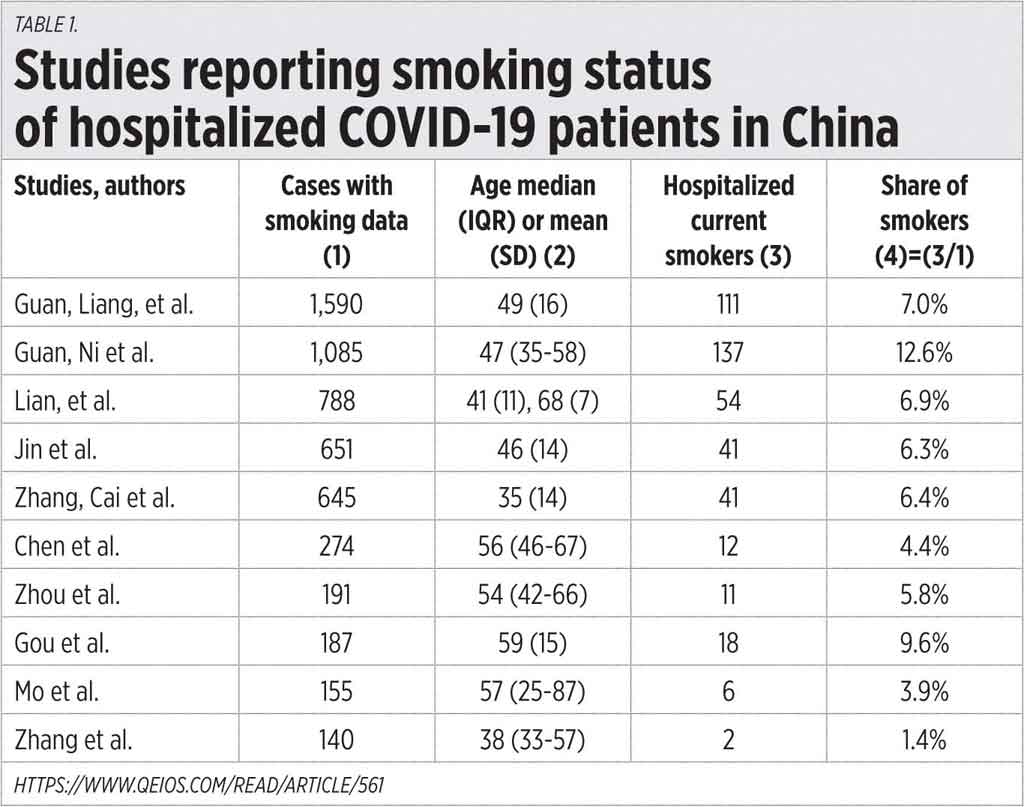
Is the WHO correct here? I want to see numbers to verify if the WHO is correct or spreading disinformation. I searched many materials online and I found two case studies, in China and the US. The China case study, “Smoking, vaping and hospitalization for COVID-19,” (10 pages) was published (April 4) by three academics, Konstantinos Farsalinos, Anastasia Barbouni, and Raymond Niaura. The first two are from the University of West Attica, Athens, Greece and Dr. Niaura is from New York University, USA. The authors made a review of publications on PubMed using the terms “[SARS-CoV-2 OR COVID-19 OR 2019-nCoV] AND [Clinical OR Mortality OR Outcome].” Out of 432 studies in total, the authors identified 13 studies that included data about smoking status of hospitalized COVID-19 patients.

I repost their table below but I did not include three studies which have small sample sizes of below 140 patients. The median interquartile (IQR) or mean standard deviation (SD) age of patients are given. There is an interesting revelation – in China, with high smoking prevalence of 26.6%, only about 7% of the hospitalized COVID-19 patients are current smokers (see Table 1).

The authors concluded, “The generalized advice to quit smoking as a measure to improve health risk remains valid, but no recommendation can currently be made concerning the effects of smoking on the risk of hospitalization for COVID-19. No studies recording e-cigarette use status among hospitalized COVID-19 patients were identified. Thus, no recommendation can be made for e-cigarette users.”

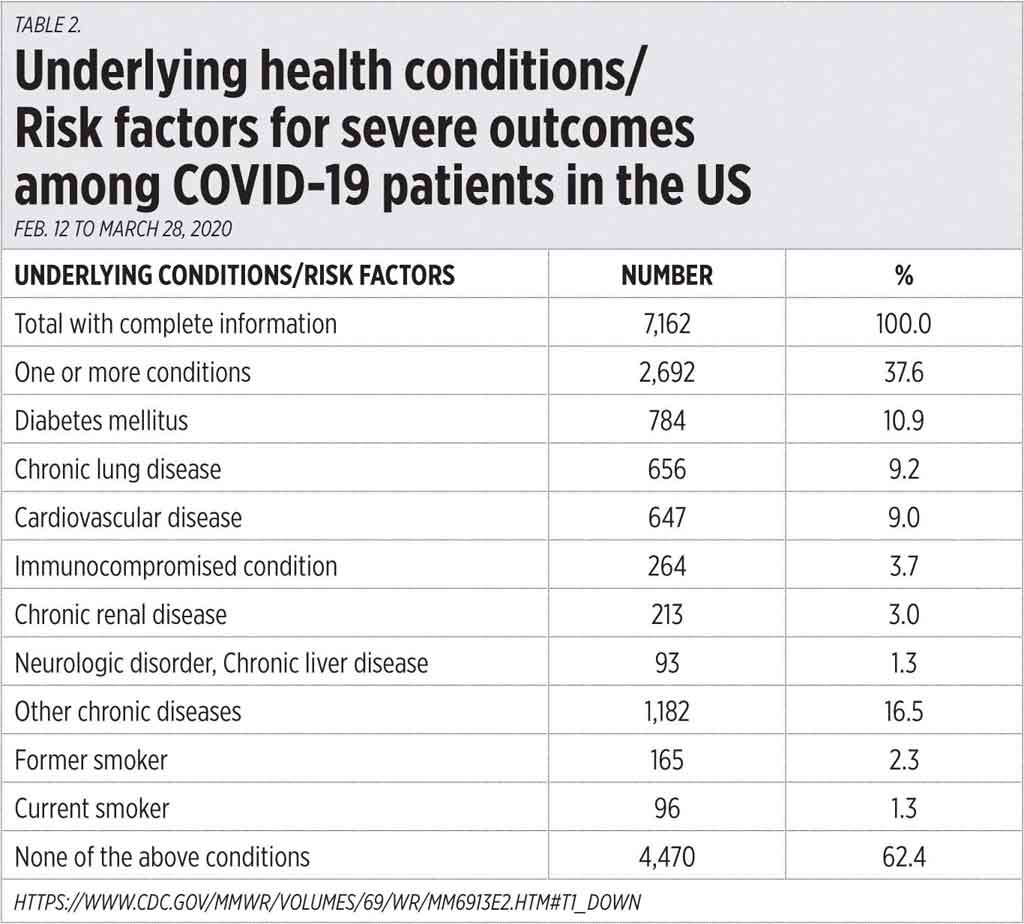
Next the US case. I found a report from the US Centers for Disease Control and Prevention, “Preliminary Estimates of the Prevalence of Selected Underlying Health Conditions Among Patients with coronavirus disease 2019 — United States, February 12–March 28, 2020” (posted April 30). An attached table shows the total cases with case report forms, 74,439, of which (a.) with missing or unknown status for all conditions, 67,277, and (b.) with completed information, 7,162.

And the table shows another interesting revelation — only 3.6% of the US’ COVID-19 cases as of March 28 are former or current smokers. Meaning 96.4% are non-smokers, past or present, and they still got the infection (see Table 2).

In the two cases, the big lesson is that the WHO is spreading disinformation when it announced that “Smokers are likely to be more vulnerable to COVID-19…”

And If we follow the WHO’s logic that hand to mouth actions like smoking or vaping increase the risk of transmission, then finger-lickin-good foods like potato chips, KFC chicken should also be avoided or banned?

The WHO and many national governments’ Health Departments or Ministries seem to have PhD and post-doctorate degrees in regulating, banning certain products to deal with non-infectious diseases, but they seem to have only an AB or high school degrees in dealing with really killer infectious diseases like dengue and many strains of corona viruses. They should learn to reverse their priorities.


Bienvenido S. Oplas Jr. is the President of Minimal Government Thinkers.

minimalgovernment@gmail.com

New way of life leads to new way of doing business

The best way to beat the coronavirus is to practice social distancing and to avoid gatherings, say our national health officials. In simple terms, people should stay home in order not to be infected by the virus. And at home, one should keep distance from other members of the household.

In our part of town, the “stay home” order is strictly enforced. Jogging out in the streets is prohibited at any time of the day. So is walking the dog. The subdivision’s sports facilities like the basketball and tennis courts and the swimming pool are cordoned off. The convenience store and the clinic are closed. The village administrative office is open only three days of the week and from 10 a.m. to 3 p.m. only. Curfew is from 8 p.m. to 5 a.m. Security guards and maintenance crew remain in the village for the duration of the community quarantine. Quarters have been provided for them.

Only the main gate of the subdivision is open. A resident is allowed to drive out of the subdivision to go to the supermarket, drugstore, or the bank. Only one member of each household is allowed to leave the village and only once during the day. Each household designates one member as the errand person of the household. That person’s name is registered with the subdivision’s Security Office and is given a pass which has to be shown to the security guards at the open gate. No other member of the household can leave the village to do errands.

Non-residents are denied entry into the community. Household help and family drivers who had gone home to join their family the weekend before the enhanced community quarantine (ECQ) order came into effect were not allowed to report back for work. While delivery of ready-to-eat food is allowed, fast-food chains would not deliver. When we call their 8888 number to place an order, we are told that they don’t deliver to our place as our barangay is listed as totally locked down.

By the third week of the lockdown, residents of our community began to miss many of the things they used to enjoy on weekends, things like their favorite burger, pizza, dim sum, or fried chicken meal, all of which used to be delivered directly to their homes. Then someone thought of forming a Viber group to serve as a community billboard on which residents can post the things they need or the products they can supply.

Within an hour of the formation of the group, soft drinks, beer, sourdough, pan de sal, eggs, fresh fruits, fresh vegetables, antiseptic alcohol, face masks, even charcoal and dog food were posted as “wanted.” To the pleasant surprise of many, some fellow residents posted they have the wanted products and can be picked up anytime. The following day, other residents posted they can make to order cinnamon rolls, banana cakes, lumpiang togue (spring rolls), turon (sweet banana spring rolls), suman (a rice cake), ginataan (a coconut milk treat), brownies, pancit (a noodle dish), and pizza.

It turned out some residents own restaurants, bake shops, or gasoline stations with a convenience store. They had pulled their supplies out of their establishments and brought them home for safekeeping before the lockdown was imposed. So, when fellow residents made known what they needed or wanted, those with the products offered their supplies for sale. Cases of soft drinks are available from a pickup parked in front of the vendor’s residence. Others posted the products they can make. There happened to be buyers for all of them.

Then the big players came into the scene. Somehow they managed to work their way into the Viber group. Chooks, the roasted chicken chain, posted it can deliver. It was immediately swarmed with multiple orders. The Max’s group followed suit. It can deliver any product of the member companies except Max’s fried chicken. Select of Shell offered frozen Jollibee Chicken Joy. Days before Easter Sunday, there appeared postings that paella, baked salmon, beef caldereta (a stew), bicol express (pork cooked in coconut milk and chili peppers), embotido (a meat loaf), kare-kare (a stew with a peanut-based sauce), truffles pasta, paksiw na pata (vinegar and soy sauce-stewed pork hock), and many other dishes could be made to order and delivered on Easter Sunday.

Payment for orders is mostly through online bank deposit to the vendor’s bank account. Other payment options are GCash, PayPal, and Pay Maya. A screenshot of the transaction is taken as proof of payment and the image is sent to the vendor via Viber. Cashless payment is preferred by most vendors as it eliminates handling of money which can be a carrier of the virus. If payment is made in cash, vendors require an exact amount to avoid giving change. The money is dropped into paper bags or cardboard boxes. It is presumed the vendor will disinfect it.

As nobody, not even epidemiologists nor molecular biologists, can tell when the COVID-19 virus will be eradicated from the face of the earth, people will continue to practice physical distancing and avoid gatherings. A face mask will be part of daily wear. The way of life that has evolved out of the lockdown may prevail indefinitely. It will in turn give rise to a new way of doing business.

Many restaurateurs will opt to close down and instead set up a commissary where the food can be prepared and delivered from. Exorbitant rent for strategically located space would be eliminated as the commissary need not be located in a business district. Likewise, many grocery store owners would choose to give up their space in expensive commercial areas in favor of putting up a warehouse in the periphery of residential districts from where goods can be delivered to online customers. Advertising for these enterprises will shift from mainstream media to social media.

We have seen how Cabinet meetings and Congressional sessions have been held lately. Attendees are seated far apart from each other yet some of them had been infected by the COVID-19 virus. Offices of companies and government institutions will have to be reconfigured to avoid the spread of COVID-19 among officemates. Cubicles of business processing workers will have to be redesigned to enclose each worker to protect him from being infected by co-workers. Cubicles, earphones, and gadgets will have to be dedicated to each worker. Restrooms in office buildings will have to be sanitized several times a day and soap and tissue or hand dryers have to be provided. Same for coffee lounges.

Companies into the manufacture of alcoholic beverages might step up their production of disinfectant alcohol. Ladies undergarment manufacturers might switch some of their production line to the making of disposable and washable face masks and gloves.

Movie houses, live show theaters, and concert halls will suffer a sharp fall in ticket sales as physical distancing is not feasible in those places. People will not risk getting infected with just to see their favorite star or hear their favorite singer.

I also foresee the decline in popularity of the Philippine Basketball Association (PBA) games. As in movie houses, theaters, and concert halls, physical distancing in sports arenas during PBA games is highly improbable. And with all the cheering, shouting, and razzing during the games, the virus would fly all over the place, The transmission of the virus from an infected person to the people around him would almost be guaranteed.

I expect even the quality of the games to decline. Players will avoid close physical contact with opposing players for fear of getting the virus. Then even the TV audience will shrink considerably.

There is a saying which goes, “There are no atheists in foxholes.” It is used to argue that in times of extreme crisis or fear, such as during an intense fighting on the battlefield, every soldier in foxholes will believe in a higher power that will protect him and keep him alive. What COVID-19 has done is make people renew their faith in a super power who will be their salvation. That renewal of faith in a Supreme Being will have a great impact on the life of every Filipino.

Alleluia!


Oscar P. Lagman, Jr. is a retired corporate executive, business consultant, and management professor. He has been a politicized citizen since his college days in the late 1950s.

A new meaning for staycation

By Tony Samson

STAYCATION was a clever marketing strategy for hotels to fill up rooms over lean days like weekends which business travelers seldom book. It meant staying a weekend in a nearby luxe hotel, requiring a short car trip (free basement parking) at the same time enjoying fresh bed sheets, fluffy towels, a swimming pool, and free breakfast buffet. And this is offered as a package with hefty discounts for a family staying in the city and having a vacation. This is not to be confused with the shorter stay for a couple where the fluffy towels also come in handy along with a preference for in-room dining — no breakfast required.

Can staying at home even on a work day and going to the office downstairs in pajamas be the new meaning of staycation?

Even those retired from work, including those “between jobs,” had a schedule involving getting out of the house. This may even have been a daily routine with a digital calendar slicing up the day’s to-do list into hours, lest they be forgotten — check out the new jazz pub in Timog. These activities filled up the hours which included commute time. Often did we airily dismiss this boring routine and envied start-up entrepreneurs in the fin tech space looking for angels and whose run of the day was more freewheeling but longer.

Of course, staying home and making a tour of corners and checking the aquarium for bubbles and what’s still there in the attic can be something of a routine too, especially in a household where division of labor is enshrined. (You can’t just lie around the house and read about stoicism.) Home work (two words) is a routine for the homemaker.

Breaks from routine are also scheduled. Isn’t this what vacations are for? There was a time when such breaks were an option. Not these days. But vacations were welcome disruptions of routine. They were stress-relievers when the office rut (from the same root word) got too repetitive or pressured. The very novelty of a new place to visit like Milan or Davao offered a break from routine, especially with the option of customized tours, and lots of unscheduled activities like shopping and trying out restaurants.

Still, the person used to routine and having something definite to do with a schedule to follow during the day seems at a loss when the calendar is blank. Isn’t this the biggest fear of someone retired from work? Second only to the loss of revenues, or their lack of regularity. Dipping into savings can be stressful.

We are supposed to be creatures of habit. Routine provides a certain structure to life, like three meals a day. Even the scheduled change of scenery going from home to office and the commute time this involves can be comforting. A full calendar seems to define the value of a person. And staying home, even when this entails working on a computer or phone and attending virtual meetings is a new routine that takes getting used to.

Routine is not really something we embrace. It can be stultifying too. So, maybe staying at home at this time has become, even if only temporarily, the new normal in terms of work habits. What is missing are the little breaks from routine. The coffee chats, the meetings outside the office, the training sessions, and dropping in on colleagues, these are not possible when forced to stay home.

Maybe the next wave of medical attention will involve psychiatric therapy. The findings posted on social media may not be as compelling as the present updates on the contagion spread. Still, the sense of alienation and the interruption of the circadian sleep patterns will be pronounced. When asked what exercise was preferred, do “climbing the walls” and “tearing out my hair” qualify?

Who would have thought that anyone would miss traffic jams with motorcycles weaving in and out between the stuck cars, of people lining up for their rides? People were going somewhere. Economists arguing lost productivity and man hours from commute time are also quick to point out the increase in car sales and the boom in SMEs. They point out that heavy traffic is an indicator of economic growth. Hmmmm.

The empty streets with checkpoints along the way are eerie. True, the skies are bluer… and so are those under them.


Tony Samson is Chairman and CEO, TOUCH xda.

ar.samson@yahoo.com

Politics and Crisis: A Discussion Series POWER FROM BELOW: Social Policy for the People, by the People

By the Ateneo de Manila Department of Political Science

(Third of an eight-part series)

THE COVID-19 pandemic has re-worked the economic, social, and even political fabric of countries around the world. In the Philippines, problems of slower — or even contracted — economic growth, large-scale displacement of workers, and food insufficiency are expected effects of the adoption and extension of the Luzon-wide enhanced community quarantine (ECQ) policy. The pandemic as such has brought to the fore the importance of social policy — both in the form of social services provision, and social protection mechanisms.

A crucial aspect of the National Action Plan (NAP) for COVID-19 is the Social Amelioration Program (SAP). Dubbed by the president himself as the most ambitious social protection policy by far, the SAP intends to aid the sectors made most vulnerable by the pandemic. It includes social assistance in the form of cash or in-kind transfers specifically targeted for the poor, as well as for the workers displaced by the pandemic, including those in the agricultural sector. The program also has an aid package for micro- and small-scale entrepreneurs. Furthermore, the SAP sets up income-generating activities in the form of short-term public employment programs.

Several difficulties in effectively implementing the SAP at once present themselves. The duration and substance of the aid, and the tensions between the implementing agencies, as well as tensions between the national and local levels of government are some of the relevant issues that need to be addressed.

We argue as such that an effective social policy is founded on two interdependent factors. First, it must be designed well. And second, it must be supported by a strong administrative system.

DESIGNING SOCIAL POLICY THAT WORKS
First, the design of social policies and programs should reflect long-term solutions, not just short-term fixes or one-off legislative acts, because social issues transcend beyond a generation. The goal is to achieve intergenerational and sustainable security and productivity, able to absorb shocks brought about by disasters and disruptions.

The pandemic has caught many off-guard, but a country like ours that has experienced multiple disasters in the last decade should have been at least half-prepared to respond. The devastation caused by the typhoons and tropical storms such as Ondoy, Sendong, and Yolanda, the earthquakes in the Visayas and Mindanao, the eruptions of Taal and Mayon volcanoes, and the Marawi siege should have enabled us to create innovative and long-lasting social policies that would cushion many of the impacts most of us are facing today. Hence, social policies must be able to respond to social issues not only of the present, but also of the future by building on the lessons of the past.

Second, there should be broader participation in designing social policies and programs. As Amartya Sen mentioned most recently, add ressing social calamities like this pandemic is less a matter of approaching it like being engaged in a war, but more of engaging in public discussion and participatory governance. It does not also help that most of our policymakers are detached from the realities of ordinary people. Citizens, especially the poor, should be able to voice their concerns and suggestions, for no one understands their situation better than themselves.

However, meaningful participation in policy making is difficult if certain political, economic and social conditions have not yet been achieved. Hence, we need to encourage intermediaries that promote the organization of voice, important of which are social movements, community-based groups, labor unions, and cooperatives to name a few. We also need to encourage new tools and channels of participation as well as the opportunities given by information communication technologies (ICTs).

Third, LGUs must be enabled to contextualize national social policy. Although the pandemic undoubtedly does not choose its victims, its aftermath, and the policies intended to control it will be experienced differently across geographical lines. Public policies do not operate in a vacuum. It is a product of its place. Part of its success or failure will depend on how well it is able to address the specificities of its context.

For instance, the epicenter of the pandemic in the country, Metro Manila, is one of the densest urban areas in the world. It is not only the country’s center of economic, social, and political activities, but also a hotbed of poverty, poor living conditions, unsatisfactory water and sanitation facilities, job insecurity, and overcrowding of public schools and health facilities. Such conditions might not necessarily be true in other places in the country, hence blanket social policies and programs might bring more problems than solutions.

Fourth, social policy should be universal, in the sense that programs should not be targeted only towards the poorest of the poor. There is preference for developing countries whose financial resources are limited, to implement social protection that is residual — one that specifically targets only those who are in most need. While this is the most intuitive way of proceeding, it must be emphasized, however, that finding those who are “in need” is like trying to hit a constantly moving target. For example, many families of Overseas Filipino Workers (OFWs) who were considered “not poor” became vulnerable when cruise ships, construction work, and hotel industries in other countries shut down and sent their workers home.

While targeted social policies might be more economical in the short term, they are more politically problematic as they create tensions between those who are part of the list of beneficiaries, and those who were excluded. More importantly, targeting makes the programs a source of patronage, given the clientelist nature of Philippine politics. In the long term, therefore, a universal social policy is the more effective and enabling way of moving forward.

THE NEED FOR A STRONG ADMINISTRATIVE SYSTEM
A strongly-designed social policy will be brought to naught if it is not coupled with an equally strong administrative system. This need for a strong administrative system, however, does not mean a recourse to authoritarianism.

Characteristic of a strong administrative system is recruitment based on ability, technical knowledge, and merit. The COVID-19 pandemic reveals the importance of technical competence. Now more than ever, there is a demand for decision-making based on evidence and data analyzed with the appropriate tools of public health and its allied sciences. A militaristic response to the pandemic is not apt given the different competency of the military; in fact, such a response is indicative of our weak administrative system.

Another cornerstone of a strong administrative system is the presence of mechanisms that promote transparency and accountability. By allowing citizens to access information, check and question decisions, it prevents abuse of power and corruption. This highlights that power comes from the people and the institution should, therefore serve the people, not the politicians. In becoming so, it is able to defend itself from — if not withstand — bad leaders, and adapt as well as maximize its potential in the presence of a good leader.

The administrative system should also allow for, and give value to innovative solutions at the local level. We have seen how local business communities, homeowners’ associations, students, researchers, professional groups, and grassroots organizations have creatively supplied solutions to their respective local government units (LGUs). An administrative system responsive to the needs of its people, and a people critically engaged with the affairs of the administrative system are important ingredients for democratic governance.

Building a strong Philippine administrative system therefore requires having: 1.) public servants who are able to generate evidence-based policies, 2.) mechanisms that promote transparency and accountability, and 3.) trust in the LGU, private sector, and civil society’s capability to share in the governance of social policy.

TOWARDS POLICYMAKING ‘FROM BELOW’
Post-pandemic, we are given a unique opportunity to construct social policy from below. We have seen how, despite the lack of organized voice, we are able to collectively revise misleading narratives, push for better policy designs, demand for clarity when confronted by incoherent utterances, and find creative solutions to localized problems brought about by COVID-19.

The many disruptions brought about the pandemic have affected both our individual and collective lives. The boundaries we drew to separate ourselves from the others collapsed, because regardless of inequality — the rich, the poor, well-educated or not, factory workers, farmers, business people, jeepney drivers, medical practitioners, teachers, lawyers, OFWs, business process outsourcing (BPO) staff — we are all in the same boat; that we do not have a choice but to rely on each other because our institutions simply cannot protect us all. This sense of fraternity has always been alive in moments of calm and calamity, proof that the “imagined community” theory of political scientist and historian Benedict Anderson is real.

We must seize this moment to reclaim the power to participate in crafting and implementing policies that are and will be affecting our lives and the next generation. This is the only way for our institutions to remain resilient and rational during the most irrational and dysfunctional times.

(To be continued.)

Philippines boosts test capacity as COVID-19 cases reach 4,932

By Vann Marlo M. Villegas, Reporter

THE Philippines now has 15 testing centers for the coronavirus disease 2019 (COVID-19), allowing it to test 3,000 samples daily, according to a government task force against the pandemic.

“We’re now in a better position to reach our target of 3,000 tests per day, then eventually 8,000 to 10,000 tests per day,” Cabinet Secretary and task force Spokesman Karlo Alexei B. Nograles said at a news briefing on Monday.

The Department of Health yesterday reported new 284 COVID-19 infections, bringing the total to 4,932. Eighteen more patients died, raising the death toll to 315. It said in a bulletin. Forty-five more patients have gotten well, bringing the total of those who have recovered to 242, it added.

The Health department would start expanded COVID-19 tests on April 14, Health Undersecretary Maria Rosario S. Vergeire told a separate news briefing.

The agency would coordinate with the University of the Philippines National Institute of Molecular Biology and Biotechnology in Diliman, Quezon City for the deployment of 300 volunteer medical technologists, molecular biologists, laboratory technicians and researchers to various laboratories.

“We want to ensure that there are enough health workers at each facility,” Ms. Vergeire said, adding that 1,429 volunteers had finished an online biosafety course organized by UP Manila.

They are also coordinating with the Department of Science and Technology for borrowed supplies and equipment.

Ms. Vergeire noted that aside from the 15 testing laboratories, 28 institutions were undergoing certification and 37 have expressed a desire to become testing laboratories.

She said the agency would prioritize the first and second stages of the certification process for laboratories in the Visayas and Mindanao.

DoH was also looking at alternative approaches that will deliver fast and accurate results to detect the disease, she said.

The agency was awaiting delivery of 3,000 GeneXpert cartridges developed by Cepheid and approved by the US Food and Drug Administration for COVID-19 tests.

GeneXpert, which is used in diagnosing tuberculosis, yields faster results than the reverse transcriptase polymerase chain reaction technique used for COVID-19, Ms. Vergeire said.

Mr. Nograles said the testing centers now include St. Luke’s Quezon City and Bonifacio Global City, V. Luna Hospital in Quezon City, Medical City in Pasig, the Makati Medical Center and the Molecular Diagnostic Laboratory.

He said 33,814 individuals have been tested for the virus.

Meanwhile, the city of Manila has started localized mass testing and could now test more than 1,000 virus samples a week, it said in a statement.

Manila Mayor Francisco Domagoso allowed localized target mass testing to be led by the city’s Health department and six district hospitals.

Seven health facilities in the nation’s capital can conduct 232 swab tests daily, or 1,624 a week, it said.

The swab tests will be processed by the Department of Health’s Research Institute for Tropical medicine or the University of the Philippines Philippine General Hospital.

UP-PGH Director Gerardo D. Legaspi has committed to release results in two to three days, according to the statement.

DSWD releases P48B in cash assistance to local governments

THE Department of Social Welfare and Development (DSWD) said it has released P48 billion in emergency cash subsidies to local governments and welfare offices to help Filipino families affected by the Luzon-wide lockdown meant to contain the coronavirus disease pandemic.

More than 77,000 low-income families not covered by the government’s conditional cash grants have received P424 million in cash aid as of April 13, Social Welfare Secretary Rolando Joselito D. Bautista said at a news briefing on Monday.

About 3.7 million poorest of the poor families under the state’s cash grant program have received P16.3 billion in financial assistance, he added.

Public utility drivers in the National Capital Region were among the first to receive the cash aid, Mr. Bautista said.

He added that more than 368,000 family food packs have been distributed to 12 regions in the country.

The social amelioration program is on top of the agency’s regular financial assistance programs, he said.

“The agency has served 12,204 clients with COVID-19-related concerns, including medical and burial assistance worth P57 million,” Mr. Bautista said.

The government allotted P200 billion in cash aid for about 18 million low-income families under a law that gave President Rodrigo R. Duterte special powers to deal with the coronavirus disease 2019 pandemic.

Eligible families will get P5,000 to P8,000 depending on the prevailing wage rate.

Mr. Bautista said eligible families “should make a noise” if they haven’t received their share to ensure local government officials are made accountable. — Genshen L. Espedido

1,000 more Filipino seamen come home amid virus pandemic

MORE than a thousand more Filipinos from the US, Dubai, Indonesia and Barbados have come home amid a COVID-19 pandemic that has sickened 1.8 million and killed more than 114,000 people worldwide, the Department of Foreign Affairs (DFA) said.

About 440 seafarers from Miami arrived on its 14th day of repatriation, the agency said. The batch included the 365 crewmen of the MS Norwegian Epic and 75 from the MS Marina.

DFA said 382 seafarers from the MS Norwegian Spirit from Barbados also arrived on Monday.

“The seafarers of MS Norwegian Epic and MS Marina will undergo a 14-day facility-based quarantine while those of MS Norwegian Spirit will undergo home quarantine,” it said in a statement.

This is based on the assessment of the Department of Health-Bureau of Quarantine.

Their return was facilitated by the Philippine Embassy in Washington DC, in coordination with local manning agency CF Sharp as well as the Norwegian Cruise Lines and Oceania Cruises, it said.

DFA said the Norwegian Cruise Lines shouldered the repatriation of more than 3,670 of its Filipino crewmen.

The latest arrivals followed the repatriation of 208 crewmen of Nautica, Norwegian Jade and Seven Seas Voyager from Dubai and 33 Filipino workers from Indonesia on Sunday evening.

This brings the total number of repatriates to 12,966 out of 20,000 target beneficiaries, DFA said.

It said 654 Filipinos overseas have tested positive for the COVID-19 virus, 382 of whom were still being treated. It said that 188 Filipino patients overseas have recovered, while 84 died. — Charmaine A. Tadalan

#COVID-19 Regional Updates (04/13/20)

Makati warns quarantine violators of stiff penalties

THE MAKATI City government has warned that violators of quarantine rules and the mandatory wearing of face masks outside homes will be fined with up to P5,000 and jail time. In a statement Monday, the local government stressed that City Ordinance No. 2020-088 imposes a P5,000 fine for first- and second-time offenders of the mandatory quarantine, while those caught a third or more times face one-year imprisonment in addition to the financial penalty. Meanwhile, City Ordinance No. 2020-089 sets a maximum of P5,000 fine or six months imprisonment for residents caught not wearing face masks outside their homes. A fine of P1,000 will be imposed on first-time offenders and P3,000 for the second time. — Genshen L. Espedido

WVMC resumes services to non-COVID-19 patients

THE WESTERN Visayas Medical Center (WVMC) in Iloilo City, the only tertiary-level public hospital in Region 7, on Monday resumed services for severe cases not related to the coronavirus disease 2019 (COVID-19) to cater to indigent patients needing urgent care. Department of Health Regional Director Marlyn W. Convocar said while the COVID-19 situation is a health crisis, there are still patients with other conditions that also require tertiary medical care. “With this protocol, we can prevent the displacement of indigent patients with severe medical cases,” she said in a press conference. The 450-bed WVMC, which was earlier designated as a dedicated COVID-19 hospital, will now just allocate 100 beds for COVID-19 patients. WVMC Chief of Hospital Joseph Dean Nicolo said starting Monday, they will accept patients requiring tertiary health care under the Internal Medicine and Obstetrics-Gynecology Departments. “Other departments are now ready to accept extreme emergency cases or life-threatening cases only. We ask everybody to remain patient as we gradually make our services available to the general public based on our capacity as a dedicated COVID-19 and non-COVID hospital,” he said. As of April 11, the region had 40 confirmed COVID-19 cases, of which 13 were admitted in hospital, 14 under home quarantine, six have recovered, and sever died. — Emme Rose S. Santiagudo

Food delivery thrives in Davao City amid quarantine

FOOD delivery service in Davao City — including for fresh produce, groceries, and cooked meals — has been on high demand amid quarantine measures to stop the spread of the coronavirus disease 2019 (COVID-19) and suppliers are stepping up to meet orders. The foodpanda Group, for one, is launching bicycle riders and expanding its service area in the city. Reynaldo Rubio, foodpanda PR manager, said they have started to deliver food orders to the Toril area in the southwestern part of the city in addition to Puan in the south and Panacan in the north. The food delivery firm currently has over 30 restaurant partners in the city. Dine-in operations at restaurants is prohibited under existing restrictions. “Foodpanda has hundreds of riders serving daily and we will be launching the bicycle riders soon as well,” Mr. Rubio said in an e-mail interview. He noted that the company has more than a thousand riders nationwide, with bicycle riders comprising about 10%. He added that “walkers as part of the delivery fleet might also happen soon.”

NCCC
The New City Commercial Center (NCCC), a homegrown supermarket operator, has also enhanced its delivery service that was seldom used before the COVID-19 outbreak. Thea Septann S. Padua, NCCC public relations manager, said it has started hiring more drivers to speed up delivery. “Our target is to make 50 deliveries in a day,” she said in an online message. The company has also opened a “call and pick-up” service wherein a customer gets a “personal shopper” to put together the items on the list. The customer then picks up the bags at a designated parking slot. Ms. Padua said the company believes these services will become an “essential component of retail operations” after the COVID-19 health crisis. The Department of Agriculture-Davao Region office and several groups on social media, particularly Facebook, have also been actively posting delivery services for agricultural goods. Davao City Chamber of Commerce and Industry President John Carlo B. Tria, in a statement, said the community quarantine has opened work opportunities in the delivery business. “A number of delivery and courier service providers like Errands Davao have told us that they are facing shortage of riders due to the overwhelming demand from customers, or are limiting their services since they cannot cater to the large demand,” Mr. Tria said. “It is important for business to keep running especially the ones that would supply daily commodities as demand remains high. One way to do this is to utilize social media for delivery services,” he said. —Maya M. Padillo and Carmelito Q. Francisco

Nationwide round-up

Solon says ban on health care worker deployment constitutional but…

PHILSTAR/MICHAEL VARCAS

THE TEMPORARY ban on the deployment of health care workers abroad is constitutional, Albay. Rep Edcel C. Lagman said.

“The temporary ban on overseas employment of doctors, nurses and other health care workers imposed…on April 2, 2020 because of the COVID-19 (coronavirus disease 2019) pandemic is constitutional. However, the ban must be coupled with adequate compensation and other benefits to medical professionals and workers who volunteer to be in the frontlines against the viral menace,” he said in a statement on Monday.

The Philippine Overseas Employment Administration (POEA) approved the temporary suspension of health workers to ensure that the country has enough medical workers amid the public health emergency.

According to Mr. Lagman, the rights to travel and non-impairment of contracts are “not absolute and are subject to restrictions or limitations which the State may enforce in exercise of its police power.”

He added, however, that the government must negotiate with the host countries to preserve the employment contracts of the affected medical professionals and workers during the imposition of the deployment ban.

“The enforcement of the ban on foreign deployment of migrant workers has been duly delegated by the legislature under the established standards of national interest or public welfare to the POEA Governing Board. With respect to the imposition of the ban, the Department of Foreign Affairs has to be merely consulted but it has no veto power over the decision to terminate or ban foreign employment,” Mr. Lagman said.

Foreign Affairs Secretary Teodoro L. Locsin, Jr. has expressed opposition to the policy and vowed to lobby for its withdrawal before the government’s COVID-19 task force. — Genshen L. Espedido

Gov’t to issue data sharing guidelines for COVID-19 patients

THE GOVERNMENT is still preparing guidelines on data sharing to ensure privacy protection for coronavirus disease 2019 (COVID-19) patients following its announcement of the mandatory reporting of personal and health information.

In a briefing Monday, Inter-Agency Task Force on Emerging Infectious Diseases (IATF-EID) Spokesperson Karlo Alexei B. Nograles said the use of patient information and privacy security in consideration of public welfare is a “delicate balancing act” that is still being discussed by the task force.

He assured that the Department of Health’s (DoH) guidelines will respect both Republic Act 10173 or the Data Privacy Act and Republic Act 11332 or the Mandatory Reporting of Notifiable Diseases and Health Events of Public Health Concern Act.

He explained that patient information will mainly be shared with government enforcement agencies and other authorities for the purpose of contact tracing and policy making.

“We’re not asking the patient to disclose to the public. We’re asking them to disclose to the DoH,” Mr. Nograles said.

“The DOH will be coming up with guidelines… So in the IATF meeting today and the next IATF (meeting), hopefully, the DoH will finalize the guidelines regarding data sharing and contact tracing and using of the mandatory disclosure of patients regarding personal information,” he said. — Gillian M. Cortez

Senate, DSWD rebuff proposal to reduce cash aid for more beneficiaries

THE SENATE and the Department of Social Welfare and Development (DSWD) opposed moves by local governments to halve the P5,000-8,000 monthly emergency subsidy to cover more beneficiaries amid the coronavirus disease 2019 (COVID-19) crisis.

Senate President Vicente C. Sotto III said the set monthly subsidy per low income household is already a small amount.

Bakit ibaba, kung kaya ‘yung (Why lower it if we can afford) P6,000 and P8,000? Ang liit na nga noon (That is already a small amount),” he told reporters over phone message on Monday.

He insisted that the government has enough funds for the subsidy program and noted that the problem lies in identifying the target beneficiaries.

“Their (local governments’) problem is identification and info dissemination.”

Some local government units (LGUs) have reportedly distributed subsidies lower than the range provided in Republic Act No. 11469, the Bayanihan to Heal as One Act.

The law mandates a P5,000-8,000 monthly subsidy for two months for low-income households, which will vary based on the regional minimum wage rate.

DSWD Spokesperson Irene B. Dumlao likewise said they are not supporting the lowering of the subsidy, citing that the amount has been determined to fund the basic needs of each household.

“We discourage ‘yung paghahati ng (the division of the) emergency subsidy fund,” she said during the Laging Handa virtual briefing Monday. “Itong amount na ito ay pinag-aralan at ito ang nakita na close approximation na kakailanganin ng isang pamilya para ma-meet ang pangangailangan sa isang buwan (This amount was studied and determined to be in close approximation of what each family will need to meet the basic monthly needs),” Ms Dumlao said. — Charmaine A. Tadalan

Roque returns as Presidential spokesperson

LAWYER Herminio “Harry” L. Roque is returning as the President’s spokesperson effective April 14, the Palace reported Monday.

“The Palace confirms that President Rodrigo Roa Duterte has offered the position of Presidential Spokesperson to Atty. Harry Roque who, in turn, has accepted the same,” outgoing Spokesperson Salvador S. Panelo said in a statement.

Mr. Panelo, meanwhile, will continue as the President’s legal counsel, which he juggled along with his spokesperson duties from October 15, 2018 to April 13, 2020.

Mr. Roque was first appointed by Mr. Duterte in November 2017, staying in position for almost a year.

Mr. Panelo said the changes were decided upon with the country under a national state of calamity due to the coronavirus disease 2019 (COVID-19) crisis. “The present crisis requires a new tack in messaging,” Mr. Panelo said. — Gillian M. Cortez

NBA has ‘25-day plan’ to return to game action

THE NATIONAL Basketball Association may not know when — or if — play will resume this season, but the league reportedly has a plan to get players into game shape and onto the court should that day come.

According to ESPN’s Brian Windhorst on Sunday, the league has a “25-day plan” that would kick in after the league sets a return date from the coronavirus-induced layoff and would conclude with players ready to play regular-season games again.

“They’re spending a lot of time getting a back-to-basketball plan ready,” Windhorst said during a TV interview of what league officials have been working on in recent days.

“What they’re looking at is a 25-day return-to-basketball window,” he continued. “… An 11-day series of individual workouts, where there’d be social distancing for a period of time, and then hopefully … a 14-day training camp.”

The NBA halted its regular season on March 11. Commissioner Adam Silver has previously said the league doesn’t plan to make any decisions regarding the calendar until at least May 1.

The regular season had about a month remaining when it was suspended, and the playoffs typically take about two months to complete. The 2020–21 regular season typically would begin in October, although Silver acknowledged that could be affected as well. — Reuters

British Formula One great Stirling Moss dead at 90

LONDON — Stirling Moss, the British racing driver who ranked as an all-time Formula One great despite never winning the world championship, died on Sunday aged 90 after a long illness.

“He died as he lived, looking wonderful,” his wife Susie told the Daily Mail newspaper.

“He simply tired in the end and he just closed his beautiful eyes and that was that.”

A teammate at Mercedes to Argentine five-time world champion Juan Manuel Fangio, the Briton survived one of the deadliest eras of motorsport with 16 grand prix wins in the 1950s and early 1960s.

Four times a championship runner-up, and also third overall on three occasions, no other driver has won as many races without taking the title.

Moss was the first Briton to win his home grand prix, beating Fangio at Liverpool’s Aintree circuit for Mercedes in 1955, with his name becoming a byword for speed for a generation of fans.

He also won grands prix in Maserati, Vanwall, and Rob Walker-entered Cooper and Lotus cars and was admired by generations as “Mr. Motor Racing.”

News of his passing was mourned across the world of motorsport, with Formula One and Jean Todt, president of the governing FIA, hailing a “legend” of the sport and “one of the true greats.”

“Sir Stirling was a larger-than-life figure in our sport and one of the survivors of an age when motor racing was about danger, bravery and camaraderie,” said Mercedes F1 team boss Toto Wolff.

“But most of all, Stirling’s career was characterized by an impeccable sportsmanship and in this he truly set himself apart… it is no exaggeration to say that we will never see his like again.”

Ferrari hailed “a true legend and a wonderful person” and added: “To Scuderia Ferrari, he was a formidable opponent.”

But for his sense of sportsmanship, Moss could have been Britain’s first world champion in 1958 instead of Mike Hawthorn.

He lost the title by a single point that year after asking stewards to reinstate his disqualified compatriot at the Portuguese Grand Prix.

“I felt that it was quite wrong and I went and gave evidence on Mike’s behalf and said no way should he be disqualified,” Moss, who won four races that year to Hawthorn’s one, told Reuters in an interview at his home in 2009. — Reuters

ADVERTISEMENT
ADVERTISEMENT