

Home Blog Page 9605

Fed’s slowing Treasury purchases may boost yields

NEW YORK — The Federal Reserve’s gradual withdrawal from the US Treasury market as the coronavirus pandemic eases and liquidity improves could dry up appetite for longer-dated government debt and push up long-term interest rates months from now.

The Fed has purchased about $1.3 trillion in Treasuries since an emergency plan kicked off last month to address liquidity issues in the $17-trillion market.

For now, there is no indication that Treasuries have become less popular, with most auctions of US debt being oversubscribed. In an era of negative yields, benchmark 10-year yields between 0.5% and 0.8% still stand out, analysts said.

But the Fed is slowly reducing its purchases, to an average of $15 billion per day last week from a peak of $75 billion per day from March 19 to April 1. Analysts are growing worried there may not be enough demand for Treasuries if the Fed is pulling back.

“If they do withdraw support, it will be the long end that will be under pressure,” said Priya Misra, head of US rates strategy at TD Securities. “People are not getting paid to take on duration risk.”

US Treasury yields raced higher in 2013, an episode in financial markets referred to as a “Taper Tantrum” as the Fed signaled it wanted to slow the pace of asset purchases. The Fed was only able to start shrinking its balance sheet in 2017, nine years after it began expanding it during the global financial crisis.

Treasury has so far issued more than $1 trillion in bills and other types of short-term debt to finance the government’s roughly $3-trillion stimulus package in response to the pandemic’s economic devastation. It has focused on the front end of the curve where there is ample demand from investors fleeing risky assets or trying to raise cash as a liquidity buffer.

But with interest rates at record lows, analysts said it would make sense for the US government, at some point, to issue debt with longer maturities.

Investors are operating on the assumption that the Fed will step in any time and increase their purchases again, analysts said.

“It would be difficult for the Fed to withdraw from the Treasury market,” said Vincent Deluard, global market strategist at INTL FCStone in San Francisco. “In Europe, there are emergency measures that last for 10 years. The funding aspect would be very problematic.”

When the health crisis improves, even if that is before the arrival of treatments or a vaccine, the Fed may be constrained to intervene in the market again, especially with a balance sheet that has ballooned to $6.6 trillion, or about 31% of expected US gross domestic product for 2020.

“I would be careful with longer-dated bonds until I see there are others, other than the Fed willing to buy the increased issuance that the Treasury is putting out there,” said Patrick Leary, chief market strategist and senior trader at Incapital in Chicago. — Reuters
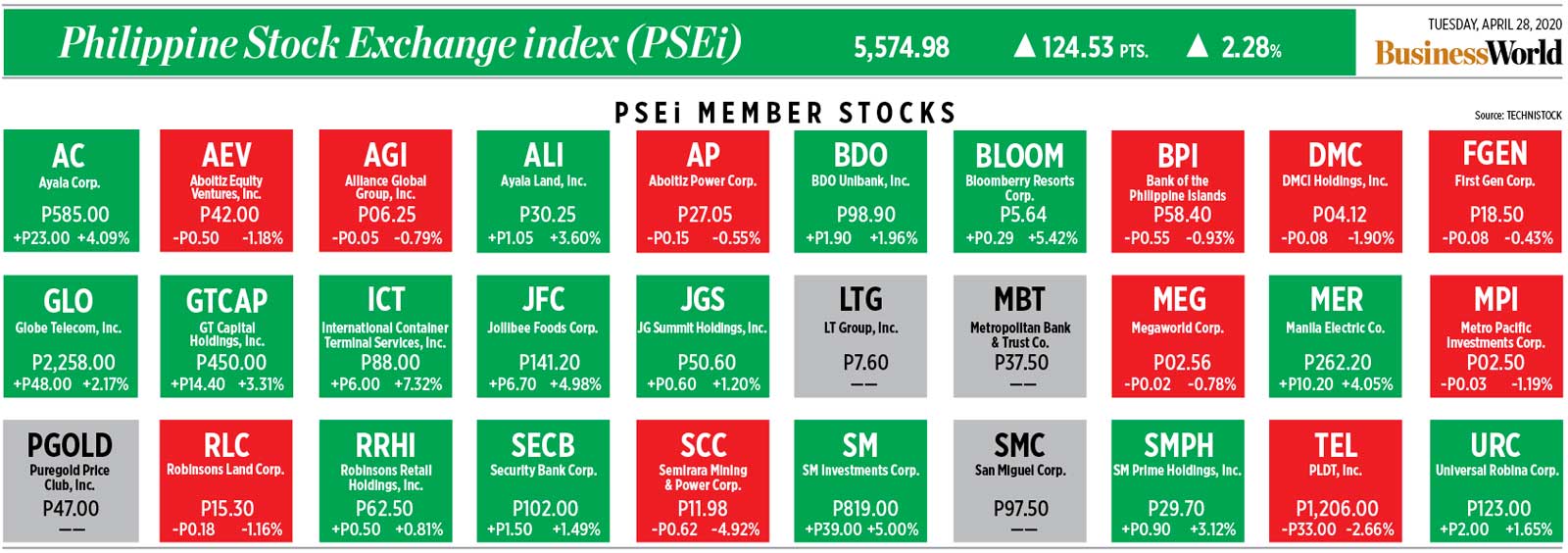

How PSEi member stocks performed — April 28, 2020

Here’s a quick glance at how PSEi stocks fared on Tuesday, April 28, 2020.


Filipinos approve of local institutions’ handling of pandemic, see outbreak to be solved sooner

Filipinos approve of local institutions’ handling of pandemic, see outbreak to be solved sooner

National ID registration to start in Oct. with 10-M sign-up target

FULL-SCALE registration for the National ID is now expected to begin in October with a target to register 10 million people, after pilot registration efforts set for earlier in the year were hampered by the coronavirus disease 2019 (COVID-19) outbreak.

The Philippine Statistics Authority’s (PSA) Deputy National Statistician and Assistant Secretary Lourdines C. dela Cruz told BusinessWorld that the October sign up period represents a few months’ delay from the original plan of a June-July rollout.

“Our team decided to move the mass registration to October,” Mr. Dela Cruz said by mobile phone Tuesday, to provide for the safety of the personnel manning registration centers as well as of the applicants.

“Even if we move mass registration to October, (we have increased the target this year) from originally five million individuals (to) 10 million.”

He said the full-scale registration will prioritize heads of household and single parents, in order to capture more information about potential beneficiaries for the government’s cash subsidy programs.

Mr. Dela Cruz said the first pilot registrations took place last year while the second phase, due to start in March, faced delays due to the lockdown. The pilot programs were designed to reduce the time spent in registration booths to 10-12 minutes from the initial 15 minutes.

He said the PSA hopes to register “most” Filipinos before President Rodrigo R. Duterte steps down in 2022.

Mr. Dela Cruz said the PSA will observe social distancing rules during registration and launch an online pre-registration and appointment system to speed up data collection before applicants proceed to registration centers to provide biometric information.

He said the internal target is to launch the online pre-registration initiative by August or September.

National Economic and Development Authority Acting Secretary Karl Kendrick T. Chua announced earlier that among his priorities is to fast-track the registration for the national ID system, with mass registration to start in June or July.

Mr. Chua had not responded to requests for comment about the new timetable at deadline time. — Beatrice M. Laforga

Essential industries could be offered incentives under CITIRA

THE Senate Ways and Means Committee is considering amending incentives under the proposed Corporate Income Tax and Incentives Rationalization Act (CITIRA) to benefit industries deemed essential during the coronavirus disease 2019 (COVID-19) public health emergency.

“Definitely, I see the opportunity for the CITIRA to be used to incentivize industries that we need right now,” Senator Pilar Juliana S. Cayetano, who chairs the panel, said in a virtual briefing, Tuesday.

Ms. Cayetano said she is looking to provide incentives for industries that are sustainable and job-generating as well as those that engage in providing medical supplies, equipment and other critical goods.

She also said the CITIRA bill will complement the “Balik Probinsya” program, proposed by Senator Christopher Lawrence T. Go. “For me, magagamit ko ‘yung structure envisioned by CITIRA to incentivize these (The CITIRA structure will facilitate the provision of incentives for provincial relocators).”

“If you ask me it could be one of the main incentivized programs of the government because I totally agree that areas of NCR (National Capital Region) and other metropolitan areas (are overpopulated).”

Ms. Cayetano said the amendments will require consultation with the Department of Finance and the National Economic and Development Authority.

“The programs should really be reviewed at this point, so that we can really incentivize those that would generate employment and income… we might have to go back to the drawing board.”

She said the reaction from the administration and her colleagues will determine whether the bill is declared a priority measure when session resumes on May 4.

The proposed measure will gradually lower the corporate income tax to 20% from the current 30% by 2029 and rationalize fiscal incentives. It was approved on third reading by the House of Representatives, but is awaiting second reading in the Senate.

President Rodrigo R. Duterte has certified the bill as an urgent measure, which will allow the chamber to approve it on second- and third-reading on the same day.

CITIRA is among the tax reform measures still pending in Congress, along with the proposal to simplify the tax structure for financial instruments, and provide a uniform framework for real property valuation.

The government has so far enacted a measure cutting personal income taxes and increasing or adding levies on several goods and services and another one granting estate tax amnesty and amnesty on delinquent accounts.

It has also passed laws separately increasing the excise tax on alcohol products and conventional and electronic cigarettes. — Charmaine A. Tadalan

Tourism revenue, arrivals both decline over 40%

THE Department of Tourism (DoT) said tourism revenue fell 40.62% year on year in the first quarter, after the industry experienced travel disruptions and lockdowns due to the coronavirus disease 2019 (COVID-19) outbreak.

At a virtual hearing of the House tourism committee on Tuesday, Tourism Secretary Bernadette T. Romulo-Puyat said revenue for the three months to March totaled P79.8 billion, after a 40.2% decline in visitor arrivals during the quarter to 1.31 million.

Ms. Romulo-Puyat said the DoT will launch the Tourism Response and Recovery Program to aid the industry. The program will observe a moratorium on the collection of accreditation fees from new and renewing applicants; provide incentives for domestic tourism; extend interest-free loans for businesses; and provide amelioration assistance for displaced workers, among others.

The DoT also implemented an online training program for workers and developed an application known as Maze, which is designed “to address the congestion of people in essential places by crowdsourc(ed) information on the crowd status of a specific area.”

The DoT said it will also require the regular sanitation of accommodations and tourism transport vehicles; provide sanitation and disinfecting devices for tourism workers; and develop online systems to facilitate tourism-related transactions.

Tourism Congress of the Philippines (TCP) President Jose C. Clemente III said that TCP’s main concern now is “weathering the storm” for the next several months as tourism is not expected to bounce back immediately.

“What we have now is a question of survival for the industry. I fully support the proposal of the Tourism Congress of the Philippines that we need wage subsidies. And at the same time, there should be a window for private facilities that will enable these businesses to have start-up capital… because by this time working capital might have been used up already,” former Tourism Undersecretary Oscar P. Palabyab said.

Meanwhile, Philippine Hotel Owners Association Director Jeffrey Ng said the organization “welcomes” the P42 billion funding earmarked under the economic stimulus package pending in the House of Representatives.

“We very much welcome the funding in the stimulus package of something like P42 billion which these hotel owners will need as zero or negative interest loans for the next five years just to be able to survive,” he said.

Previously known as the Philippine Economic Recovery Act, the latest draft of the Philippine Economic Stimulus Act intends to inject about P1.3 trillion to P1.4 trillion in the first year of the intervention period of 2020-2022 to help workers and businesses deal with the effects of COVID-19. — Genshen L. Espedido

ADB approves $200-M loan to support 4Ps

THE Asian Development Bank (ADB) approved on Monday a $200-million loan to support the government’s cash-transfer program targeted at poor families.

In a statement, the bank said the $200-million loan marked the second additional facility in the Social Protection Support Project, which supports the Pantawid Pamilyang Pilipino Program (4Ps).

The loan will help finance the $726 million needed to extend emergency cash handouts to some 4.3 million 4Ps families included in the government’s Social Amelioration Program.

ADB Vice-President Ahmed M. Saeed said the loan will help protect the gains made in reducing poverty in the country.

“This global pandemic, of a kind not seen in the last century, has disrupted the livelihoods of millions of Filipinos and could set back the very substantial gains the country has made in reducing poverty in recent years,” Mr. Saeed was quoted as saying.

“The new loan supports the government’s emergency subsidy program, which was designed to help vulnerable households get through this very difficult period and avoid falling into poverty,” he added.

The Philippine poverty rate declined to 16.6% in 2018 from 23.3% in 2015, the equivalent to 5.9 million Filipinos exiting the poverty category. The government targets to bring this down further to 14% by 2022.

ADB said it is also preparing an Expanded Social Assistance Project to further support the 4Ps over the medium term.

Since 2010, the bank has been providing support for the 4Ps, a conditional cash transfer program whose beneficiaries are required to keep children in school and submit to periodic health checks, conditions which are deemed necessary to help lift them out of poverty.

The ADB approved a $1.5-billion loan for the Philippines on April 23 to support programs to contain the coronavirus disease 2019 (COVID-19) outbreak.

The ADB has also extended a total of $8 million worth of grants to the Philippines to provide food packages to poor families and help set up a new laboratory that will expand COVID-19 testing capacity by 3,000 tests a day.

Earlier, the World Bank approved a $100-million loan to also support the government’s emergency measures and the $500-million Third Risk Management Development Policy Loan to boost the country’s capacity to respond to natural disasters.

The government is asking the World Bank for another $500-million Philippines Emergency COVID-19 Response Development Policy Loan. The bank’s Board is scheduled to act on the proposal on May 20.

The Department of Finance has said it hopes to tap a total of $5.7 billion in financial assistance from multilateral agencies such as the World Bank and ADB. — Beatrice M. Laforga

House bill to make mask-wearing, distancing mandatory after ECQ

HOUSE leaders filed a bill Monday seeking to lay down the post-quarantine rules for people venturing outside the home, including mandatory mask-wearing and social distancing.

House Bill 6623 or the New Normal for the Workplace and Public Spaces Act of 2020 makes the wearing of masks in public spaces and workplaces mandatory, and will require the availability of hand washing or sanitizing stations in “high-touch” areas, physical and social distancing of at least one meter, and temperature checks.

The bill sets the penalty for failing to wear a mask in public at P1,000.

Gatherings as well as the flow of people in government-managed spaces such as public markets, parks and plazas, among others, will be “highly regulated” and subject to guidelines set out in so-called “new normal” permits by the local government unit (LGU).

Privately-organized gatherings in “privately-managed spaces” will also be “highly regulated” and dispersed by the LGU “after determination by authorities that the said gathering is not observing the Universal and Mandatory Safety Measures.”

The operation of motorcycle taxis will remain suspended to prevent the spread of the virus through shared helmets and close physical contact between the rider and the passengers.

Passengers in all types of public transportation will be required to wash or sanitize their hands before boarding the vehicle, be seated one seat apart, wear a face mask at all times, and be made to pay through “contactless” methods.

The bill provides for “green lanes” on the road network for health care, emergency, law enforcement, and supply-chain vehicles.

The bill also proposes the suspension of classes and other school activities until further notice “without prejudice to the academic freedom and levels of autonomy of institutions of higher learning,” provided that no student is unreasonably penalized for their inability to participate in online learning.

Educational institutions are required to establish online learning platforms. Funding for research and the development of systems for learning continuity during times of crisis will be made available by the national government.

The bill also requires all private commercial, industrial, and other forms of businesses to submit a “New Normal Workforce and Workplace Management Plan” to the LGU, which will verify the businesses’ compliance with safeguards prior to the resumption of their operations.

Food service workplaces are allowed to resume operations with take-out and delivery service only, while gradually re-introducing in-store dining. The bill recommended that buffets and salad bars be discontinued temporarily and to create more space in the dining area.

Malls and other commercial establishments are required to limit the number of people inside their premises and implement contact-less sales and customer service.

The Philippine Statistics Authority (PSA) will be required to fast-track the implementation of the Philippine Identification System Act to facilitate contact-tracing. The bill also calls for the Department of Information and Communications Technology (DICT) to expedite and fully implement a national broadband program.

Other government agencies will be required to develop and implement a system for facilitating government transactions through online platforms.

HB 6623 violations are punishable by imprisonment of two months or a maximum fine of P50,000.

If passed, the measure will be effective for three years from the date of its enactment or sooner upon official declaration of the end of the crisis by the President, on the recommendation of the Inter-Agency Task Force on Emerging and Infectious Diseases.

HB 6623 was filed by Speaker Alan Peter S. Cayetano; Majority Leader Ferdinand Martin G. Romualdez; ACT-CIS Party-list Representative and appropriations chair Eric G. Yap; Anakalusugan Party-list Rep. and public accounts chair Michael T. Defensor; Bulacan Rep. and good government and public accountability chair Jose Antonio R. Sy-Alvarado; and Deputy Speakers Luis Raymund F. Villafuerte, Paolo Z. Duterte and Loren B. Legarda. — Genshen L. Espedido

Energy efficiency industry bats for inclusion in stimulus program

THE energy efficiency industry is seeking a share of stimulus incentives to encourage investment in power conservation, which it touted as an opportunity to emerge from the public health emergency with greener power infrastructure.

The Philippine Energy Efficiency (PE2) Alliance said energy efficiency adoption by both the public sector and small businesses will also create jobs and support investment needed to emerge from the economic stagnation caused by the coronavirus disease 2019 (COVID-19) outbreak and lockdowns.

“The urgent PERA bill can potentially include another (“Build, Build, Build”) component intended to accelerate public spending in the next [three] years to bridge a P30-billion portion of a P66-billion capital gap for energy efficiency improvements in public facilities, especially government buildings used by national government agencies, government-owned and controlled corporations, state universities and colleges and the multitude of local government units across the countryside,” PE2 President Alexander de Ramos Ablaza told BusinessWorld.

He was referring to the House stimulus legislation originally known as the PERA bill (the proposed Philippine Economic Recovery Act), which has since been renamed the Philippine Economic Stimulus Act (PESA). If signed into law, it will inject between P1.3-P1.4 trillion in the first year of the intervention period of 2020-2022 to help workers and businesses deal with the effects of COVID-19.

“Build, Build, Build” is the government’s flagship infrastructure program.

Mr. Ablaza added that the stimulus bill can include a provision allocating at least P30 billion for concessional loans from government financial institutions to micro, small and medium enterprises to encourage them to adopt energy-efficient equipment.

He claims such investment has the potential to cut the operating expenditures in the public sector and small businesses by about P138 billion between 2021 and 2030.

The investments will also “reduce dependence on imported fossil fuels and help the country meet its Paris climate obligations with an estimated 9.4 million tons of CO2e (carbon dioxide equivalent) share

of greenhouse gas emission reductions due to energy efficiency during the same 10-year period,” he added.

The alliance has proposed in a position paper the inclusion of energy efficiency in the government’s post-pandemic economic recovery program.

In the paper, the group claimed that energy efficiency projects “can be planned, designed and completed to deliver energy savings and job creation impacts in much shorter periods, typically 6-12 months for each commissioned project.”

“Compared to other stimulus activities, a vast majority of energy efficiency projects pose little or no

negative impact on the local environment. On the contrary, energy efficiency projects harvest waste energy from every energy end-use sector and convert such waste into useful energy,” it added.

Malacañang signed into law Republic Act No. 11285 or the Energy Efficiency and Conservation Act in April 2019. — Adam J. Ang

SRA says sugar stocks adequate amid checkpoint issues

THE Sugar Regulatory Administration (SRA) said the supply of sugar is sufficient to meet domestic demand even with the extension of the enhanced community quarantine in several regions until May 15.

“Sugar milling is on-going and stocks are building up,” the SRA said.

The SRA has received reports of difficulties in the delivery and movement of sugar as local government units are enforcing conflicting standards at checkpoints.

At the national level, basic food commodities have been allowed free passage through quarantine checkpoints, but LGU interpretations of the rules have varied.

The Inter-Agency Task Force on the Management of Emerging Infectious Diseases has also established the principle of the free movement of basic food commodities in its various resolutions.

“Sugar is a basic food commodity hence, activities related to its production and delivery of supply should be unhampered. With these policies in place, the transfer and transport of sugar from source to market should be unimpeded,” the SRA said.

Meanwhile, the SRA also reported that the two sugar mills in the Bukidnon province have reopened after a lockdown imposed by the provincial government on March 28.

On April 20, Bukidnon Governor Jose Maria R. Zubiri, Jr. allowed sugar companies Busco Sugar Milling Co., Inc. and Crystal Sugar Co., Inc. to resume operations.

According to the Department of Agriculture, these two sugar mills produce 82% of Mindanao’s total output, and 16% of the national total. — Revin Mikhael D. Ochave

NGO pressing gov’t to complete sardine management plan

OCEANA, a non-government association, said the government must manage the sardine fishery more systematically to ensure food security during national emergencies and generate jobs.

It said the Department of Agriculture and the Bureau of Fisheries and Aquatic Resources must roll out the National Sardines Management Plan for the resource, which is not only a widely-used food source but also a driver of economic activity for small businesses.

“The sardine industry is an important economic driver providing jobs and livelihood, for small-scale entrepreneurs in the dried and smoked sector, and for factory workers in the canning and bottling sectors,” Oceana said.

In a statement, lawyer Gloria Estenzo-Ramos, an Oceana vice-president, said the management plan will allow the industry to set realistic business goals by better organizing biological, economic, and social information regarding the fishery.

“The approval of the National Sardines Management Plan is not only imperative for the sectors dependent on this industry for their economic interests. With the coronavirus disease 2019 (COVID-19) pandemic, we saw again how important this is for our food security and health,” Ms. Ramos said.

According to a survey conducted in 2017 by the Social Weather Stations (SWS) polling organization and Oceana, 70% of Filipinos eat fish or seafood five days in each month while three out 10 adults eat sardines at least once a month.

According to the Philippine Statistics Authority, sardines accounted for 15% of the marine fishery over the last 15 years, with the industry averaging 333,743 metric tons a year.

“Aside from being a preferred food for our urban households, poor fishermen have been dependent on sardines for their food and livelihood. It is an important fish for the Philippines as we take pride in nine species found in different parts of the country,” Ms. Ramos said.

Ms. Ramos said the sardine fishery has been beset by overfishing, which can be prevented with a science-based, cohesive, and sustainable management plan.

The National Sardines Management Plan has undergone several public hearings and consultations over the past three years and has been recommended for approval by the National Fisheries and Aquatic Resources Management Council. — Revin Mikhael D. Ochave

Stocks rise as gov’t hints on modified lockdown

THE LOCAL MARKET ended in the green as investors digested hints from the government of an end to the enhanced community quarantine (ECQ) and a shift to a general community quarantine (GCQ) after.

The 30-member Philippine Stock Exchange index (PSEi) went up by 2.28% or 124.53 points to 5,574.98 while the broader all shares index rose by 1.55% or 52.03 points to 3,394.75.

Philstocks Financial, Inc. Research Associate Claire T. Alviar said in a text message that bargain hunting in the market was supported by the possibility that areas affected by the coronavirus disease 2019 (COVID-19) now under enhanced community quarantine will be placed under general community quarantine instead after May 15.

“Given this, most companies could start operating again — consumer demand and companies’ income are expected to recover, along with the economy. The adverse impact of the coronavirus disease 2019 pandemic is still there, but the GCQ gives hopes to the investors, and spur optimism in the market,” Ms. Alviar said.

Timson Securities, Inc. Head of Online Trading and Trader Darren Blaine T. Pangan said in a text message that the market rose by 100 points or around 2% after the positive sentiment from investors.

“Technically, the market bounced off of the 5,400 level as it currently trades near its 20-day moving average line,” Mr. Pangan said.

Philstocks Financial’s Ms. Alviar added that the local bourse took cues from the performance of US markets, with the Dow Jones Industrial Average increasing more than 350 points overnight as most investors expect a restart in the US economy.

Wall Street gained more than 1% on Monday at the onset of a hectic earnings week, as investors turned a hopeful eye toward several US states that are relaxing shutdown restrictions put in place to curb the spread of the COVID-19 pandemic.

Back home, all sectoral indices registered an increase except for the mining and oil index which fell by 4.12% or 199.92 points to 4,635.64.

Holding firms went up by 2.86% or 152.13 points to 5,464.71; property picked up by 2.66% or 72.79 points to 2,805.23; industrials improved by 2.28% or 165.52 points to 7,415.19; services climbed 1.48% or 19.54 points to 1,337.77; and financials increased by 0.58% or 6.74 points to 1,169.35.

“Despite the move upward, foreigners remained net sellers for the 30th straight day as global market participants still remained cautious of the COVID-19 pandemic. We may have to see if the 5,500 level holds throughout the week,” Timson Securities’ Mr. Pangan said.

Value turnover rose to P4.61 billion yesterday from P4.07 billion the day earlier.

Advancers bested decliners, 109 to 78, while 35 names remained unchanged.

Net foreign selling ended at P471.71 million, down from the P823.64 million seen the day prior. — R.M.D. Ochave

ADVERTISEMENT
ADVERTISEMENT