

Home Blog Page 9602

Rushing new treatments and vaccines

On April 24, President Rodrigo Duterte announced in his address to the nation, “…the bright Filipinos who are there working day and night trying to find out how to combat COVID, I’m raising the bounty to 50 million… Baka ‘pag sa ligaya ko, another 50 million… So kung kailangan nila ng additional funding… kung hindi masyado malaki, I will readily give it to them.”

The good news about this statement is that the President recognizes the importance of medicines and vaccines innovation and by extension, government should reward, not harass innovators.

The bad news is that developing just one new successful and effective vaccine will cost not just $1 million (P50 million) but around $1 billion or more. And upon the prodding of the Department of Health (DoH), he signed Executive Order (EO) 104 on Feb. 17 that precisely harasses innovators via drug price control.

There are two types of vaccines to deal with diseases: 1.) Preventive vaccines, help the body develop immunity to a disease by imitating an infection and teach the immune system how to identify and target viruses and bacteria without actually causing an infection; and, 2.) Therapeutic vaccines which treat pathogens by provoking a targeted immune response against an existing disease.

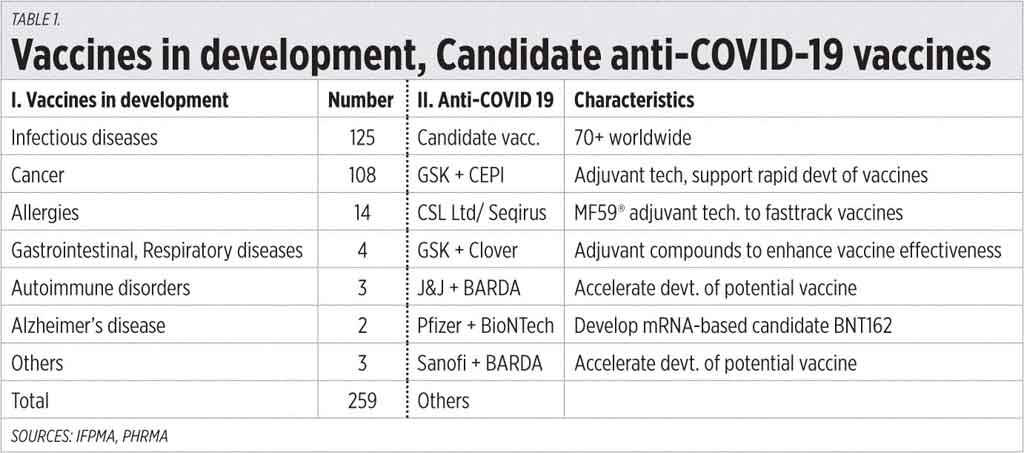
Vaccine development by innovator pharma and biotech companies against COVID-19 was progressing fast. As of mid-March, more than 20 vaccines and antiviral medicines were being developed and undergoing nearly 80 clinical trials in various phases in various countries, data from the International Federation of Pharmaceutical Manufacturers Association (IFPMA) showed.

By mid-April, there were already 70+ candidate vaccines from many innovator companies worldwide. Other diseases were also getting new candidate vaccines on top of existing ones, according to data from the Pharmaceutical Research and Manufacturers of America (PhRMA) showed (see Table 1).
Humanity is being assured of better healthcare in the future via new and evolving treatment and vaccines. But politics of envy interfere in the distribution and sale of these new treatments. Recall how the DoH was focused on drug price control (DPC) lobbying and defending mainland Chinese travellers even when COVID-19 was already wreaking havoc in China and other countries since January (see Table 2).

So when those successful vaccines and treatments vs COVID-19 become available worldwide a few months from now, there is the danger that the Philippines may not get them because of existing political dangers.

One, the old DPC under EO 821 (July 2009) issued by former President Gloria Macapagal Arroyo remains in place until now and was never pulled out.

Two, IPR- and patent-confiscation provision via compulsory licensing against newly invented, patented successful medicines and vaccines may be issued under RA 9502 (Cheaper Medicines Act of 2008).

Three, with EO 104 is already waiting for them, price controls at the manufacturers and wholesale level can be imposed at any time. Criteria No. 4 of EO 104 says that if medicines are most prescribed by physicians and it is not priced “fairly” based on DoH’s subjective judgment, then it can be placed under price control.

It will be unfair for Philippine patients and the public if effective treatments and vaccines against the virus are available in Hong Kong, Malaysia, Singapore, etc. but not in the Philippines because of these dangers.

While the DoH and the President may not have the time to amend dangers 1 and 2, they have the time and power to rethink EO 104 as its timing is very bad at the moment. They should pull out this order without fanfare.


Bienvenido S. Oplas, Jr. is the president of Minimal Government Thinkers.

minimalgovernment@gmail.com

Cancellations and postponements

By Tony Samson

IT HAS BEEN almost routine since early March for announcements to be made that yet another much awaited event or season, even the Tokyo Olympics, has been canceled or postponed. The news is greeted with the same mild concern as weather reports, even of an impending typhoon about to enter the country’s area of responsibility. More alarming perhaps, given the panic mode we’re in, is to hear of an event that is pushing through as scheduled, even if this is still in August.

Rites of passage like weddings, milestone birthdays, and, yes, graduations (and moving ups) have fallen under the cancellation wave. Most of these have been planned months ago with the venue reserved or trips booked, and so entail some non-refundable costs. This is in addition to crushed emotions arising from missing a milestone event. Does an invitee to a canceled wedding still have to give gifts to the couple who went ahead with a virtual wedding, at least for the guests?

Opportunity costs are relevant here, especially for big events like the Olympics, the Cannes Lion, or the UAAP. Expected venue rentals, hotel bookings, and waived tickets and corporate sponsorships form part of these costs. There are too the unquantifiable costs of wasted preparation and training for an event that has been canceled. Will the athletes that got through eliminations and kept in shape for the 2020 Tokyo Olympics still be fit to compete in 2021?

The feeling of getting left behind and losing one’s place because of the lockdown is similar to the panic of one marooned on an island. (No house is an island.)

In the 2000 movie, Castaway, our hero is played by Tom Hanks as a FedEx executive. The cargo plane for deliveries that he’s flying in crashes to the sea. He survives and is marooned in a desert island for four years. When he is finally rescued, after building a raft to sail out in, he returns home to find his fiancé already married with a family of her own. The poignant scene of a short reunion and another separation canceled the prospect of a happy ending, except for the possible offshoot of a delivered package. (Will there be a sequel?) The despair of life going on in unforeseen ways without us can be real.

True, in this case we are all stranded at home and seem to be all in the same boat.? Or are we? Cancellations do not affect everyone the same way. The opportunity costs are heavier on those who made the plans and bear the “break up” costs unless these have been insured. And then, it’s the insurers who pay up. Postponement costs even more. It means planning for the event one more time, with perhaps less enthusiasm on the part of the stakeholders.

What the pandemic has taught us is that there is a hierarchy of needs (and justifications). It seems that those who can give numbers for what the lockdown is costing us are easily trumped by others who only need the daily contagion count and mortality rate. To stop any further discussion, the latter group only has to say the dreaded phrase “second wave.” Defenders of the lockdown (and sometimes its indefinite extension) claim to defer to the specialists in science and statistical projections “if the trends continues.” In the end, they throw in the kicker — a life cannot be sacrificed for money. Giving two mutually exclusive options like life or livelihood is what economists call a false choice. Can’t you have both? The Czech Republic has opened up and requires only face masks to go through normal living.

Just to give some perspective for the numerically inclined, WHO (the same agency we hear from daily) declared that in 2015, there were 1.25 million deaths from car accidents. Of these, 13,000 was contributed by the Philippines. Did these even scarier numbers lead to banning cars from the road, even for two months, until the numbers went down?

We expect more cancellations and postponements to come.

Ironically, the two main events of life are difficult to plan anyway. Birth perhaps can be estimated, sometimes to the day if a caesarean delivery. Death on the other hand is unplanned. Neither event can be canceled or postponed when the time comes.

Tributes in social media accompanied extol front-liners in the medical and care-giving profession and occasionally the military personnel manning the checkpoints. Forgotten are those attending to the dead and their small circle of mourners… in this uncanceled event.


Tony Samson is Chairman and CEO, TOUCH xda.

ar.samson@yahoo.com

Dreaming of a better future, not a return to the past

By Dr. Amal Makhloufi

IN SOME COUNTRIES, through combinations of intensive testing programs and strict community quarantine rules, first steps are being taken in reopening their economies and loosening of strict lockdown rules. What is becoming clear from these countries is that life on the other side of COVID-19 will not initially resemble life before the virus arrived.

While these countries now have the possibility to restart some aspects of their economies, a return to “normal,” if normal is defined as pre-COVID-19 life, will be some years away. Even when managed, some amount of virus will still be present and large gatherings and international travel will continue to be impacted until a vaccine has been developed and widely distributed on a worldwide basis.

So, governments will need to plan. They will need to consider how quarantines can be partially and then more fully lifted. They will need to make a decision on what type of social distancing will remain in place for the near future. These decisions will be informed by expert opinion, data as well as individual national circumstances.

What we can do as a society with the time provided by the community quarantine measures is to give thought to what we want our future new normal to be. Rather than dwell on regression to a past, we can dream about a new future, different from the world before coronavirus.

Our future new normal can be better, we can emerge from this crisis stronger, better prepared and agile in anticipating future risks and managing them with less disruption. While history does not repeat itself, it sometimes rhymes, and lessons must be learned from our current situation to ensure that our future is more resilient.

Global pandemics are not new. We have developed ways of managing and preventing these once-grave threats to human health, but not before these diseases wrought a terrible toll in terms of death. COVID-19 is the latest of these. It will not be the last. We can and should anticipate that a future virus will mutate and pose the risk of another global pandemic.

So, what should our principles be as we look to build our new normal? How do we learn from the past, use the present as a teachable moment in order to shape a better, more resilient, future?

Two key lessons from the current coronavirus outbreak must focus on our healthcare systems, especially their capacity to serve the population effectively as well as the health of our society.

How to translate these lessons into a set of principles to shape our future new normal must start with a wide-ranging public dialogue embracing multiple stakeholders in our society. There is much for us to consider as we dream of a better tomorrow: Firstly, we should recognize healthcare as an investment, not a cost. If we have learned one thing from our current situation, it is that any supposed trade-off between public health and economic gain is a false narrative. And if a sickly society cannot translate into a successful economy, we should look at investments in our health as investments in our future, particularly in a country like the Philippines where people are the nation’s greatest natural resource.

Secondly, we need to appreciate that disease cannot read postal codes. They do not much care what you do for a living or how large your bank balance might be. In a pandemic where we all have the ability to potentially infect one another or protect one another, it is in all our interests that healthcare is seen as a universal right and not a privilege for the few. Your neighbor’s good health is to your benefit as well as his.

Thirdly, our self-responsibility for health, hygiene, and wellness is good for our community, and society as a whole. We all have a role to play in managing our health and looking to be healthier.

Returning to the world we had before COVID-19 is likely to be as big a challenge as creating a new, better future. So why not dream big and work together to create new values and priorities for a healthier and more resilient future? Our dreams can be for a healthier Philippines, a stronger Philippines, and a more prosperous Philippines.


Dr. Amal Makhloufi is the Chairperson of the Committee of Health of the European Chamber for Commerce and Industries (ECCP). She is also the Country Manager of Sanofi Philippines and the General Manager for Pharmaceuticals.

Players should not be rushed back to action, says WPA

ATHENS — Professional athletes across the world should not be rushed back to action once the COVID-19 pandemic subsides, and they must have a strong say in determining the conditions for their return, the World Players Association (WPA) said on Tuesday.

Sports competitions around the world have come to a screeching halt this year as the virus spreads across the globe, starving clubs, leagues and federations of revenues and putting tens of thousands of professional athletes on hold.

“At the moment there is a lot of pressure from the leagues on all continents to resume,” WPA Executive Director Brendan Schwab told Reuters in an interview.

“The players can only agree to that (return) if they know that their interests will be protected. The best approach we are seeing is when the leagues… set up joint groups where players have an equal say,… where they are not being rushed.”

Several football leagues in Europe, including Germany’s Bundesliga, have drawn up their plans to be ready to resume play without spectators if it means finishing the season and remaining contractually in order with broadcasters and sponsors.

The WPA, an association representing some 85,000 athletes around the world through more than 100 player associations in over 60 countries, held a conference call earlier on Tuesday with its affiliated associations to update on the situation.

It is unclear what kind of influence the players or the WPA as a whole can yield with cash-strapped clubs and federations desperate for a return to action both on a national and international level.

GROWING INFLUENCE
However, the athletes’ growing influence in global decision making in sport was felt last month when their vocal opposition to competing in the Olympic Games in Tokyo this year contributed to a postponement of the Games to 2021.

The pandemic has infected almost three million people worldwide and killed more than 200,000, raising expectations of a prolonged battle to contain it.

Every major sports event has been postponed and seasons across all sports have been suspended creating a competition backlog, with the Tokyo Games’ move to 2021 further reshuffling the sports calendar next year.

Schwab said any return to action would also need to clarify issues including testing, any potential future interruption if the virus flares up again and that the infection of a player will be treated as a workplace injury by the clubs.

Career-ending or fatal illness due to the virus should have the full protection “of this being a workplace injury,” Schwab said. “This is not clear yet in a lot of the leagues.”

Testing would also need to be adapted to the various sports with some, such as tennis or cricket, requiring fewer tests than contact sports such as basketball or football that would require extensive pre- and post-game testing, he said.

Several nations’ laboratories are working to find protective vaccines and drugs for the disease, but it could be many months before they become widely available due to the need for exhaustive clinical trials of their effectiveness and safety.

“Any return to play scenario would also need to have a strong plan B,” said Schwab as there were no guarantees the seasons would finish once they restarted.

“The situation is still fluid and interruptions need to be considered,” Schwab said.

“What is critical is that all player associations have the strongest possible position at the bargaining table so they can get the balance right between economic viability and public and player health.” — Reuters

Groups move to protect kids in time of COVID-19

AS THE coronavirus disease 2019 (COVID-19) pandemic continues to take its toll across all fronts in the country, a lot of people are being affected or left vulnerable to exploitation, including children online. This is what an upcoming effort – Sweat to Protect — wants to address.

Set to happen on Saturday, May 2, Sweat to Protect is a fundraiser organized by Fight to Protect, an organization focused on tackling child sexual violence through sports, and Poveda Batch 2008, and the proceeds of which will go directly to Project S.A.F.E. (Support and Awareness to Fight Exploitation).

Project S.A.F.E. is a community-based effort by Nazarene Compassionate Ministries that targets the rising cases of child trafficking due to the COVID-19 community quarantine, by providing relief goods and child-safety orientations in vulnerable communities.

Organizers said children being preyed on, particularly online, and taken advantage of are a serious concern and merit needed action against. And Sweat to Protect is one platform to bring such to the fore.

“Project S.A.F.E.’s goal is to raise funds to supply OSEC-vulnerable communities with ‘safe packages’ — gift packs that include basic needs such as food and home items, so that families will not have to resort to crime to make ends meet during the COVID-19 lockdown,” said Meggie Ochoa, Fight to Protect founder and jiu-jitsu national athlete, and one of the proponents of the fight against the online sexual exploitation of children (OSEC).

“By providing them with basic needs, families can focus on nurturing a safe environment and building happy relationships which allow children to thrive,” she added.

Sweat to Protect happens from 9 a.m. to 6 p.m. and will feature a series of workout sessions such as yoga, high intensity interval training, dance fitness, and jiu-jitsu fitness by instructors from Poveda Batch ‘08 Mariana Bantug, Paui Peña, Chrissie Torres-Jamlang, Ms. Ochoa and guest instructor MYX VJ Anton Fausto.

The event will be hosted by veteran radio DJ Katz Salao and will be streamed online via Faceook Live at fb.com/fight2protect.

To join in and get into the action, one can register by donating to Project S.A.F.E. via the link bit.ly/projectsafe2020.

Apart from doing their part in fortifying the fight against OSEC and getting the needed workout, donors/participants also get the chance to win exciting raffle prizes from partner brands at Sweat to Protect. — Michael Angelo S. Murillo

A true national match

Loyola Grandmasters
Match 1977 Philippines,
January 22–April 25, 1977

Final Result

GM Eugene Torre 2550 6.0-4.0

GM Rosendo C. Balinas, Jr. 2420 4.0-6.0

Format: Unlimited match with the 1st to win 6 games taking the series. Draws do not count towards the final score.

Time Control: 40 moves in 2½ hours. Then an hour for every 16 moves after that.

When Loyola Life Plans agreed to sponsor the match between Asia’s first two grandmasters they pulled out all the stops to make it a true spectacle. Total prize package is P50,000 with P30,000 to the winner. More than the prize fund though they promoted the heck out of the event.

First of all the match was spread over several venues.

Makati Hotel — games 1–5

Davao — games 6–7

Cebu — games 8–9

Bacolod — games 10–12

Makati Hotel — games 13–17

Philam Life — game 18

Giant demo boards were set up all around in Metro Manila to show the progress of the match, manned by National Masters.

Both players entered the match with an equal record. They met for the first time in the 1968 National Open. Each had won two, lost twice and drawn four times in a span of nine years.

After game 1 which Torre won, Balinas surprised everyone by winning games 3, 4 and 5 to take a 3-1 lead. Torre’s aura of invincibility had been broken!

Game 3. Torre got confused with Balinas’ irregular opening and loses a pawn and gets a horrid position. He fights back hard and almost equalizes but time trouble reared its ugly head and a bad mistake towards the end dooms him.

Balinas, Rosendo C (2420) — Torre, Eugenio (2550) [B23]
Loyola Grandmasters
Match ‘77 Manila (3), 26.01.1977

1.e4 c5 2.Ne2 e6 3.Nbc3 a6 4.g3 b5 5.Bg2 Bb7 6.0–0 b4 7.Na4 Nf6 8.d3 d5

Perhaps a bit premature as he has not yet completed development. 8…d6 looks equal.

9.exd5

Twenty-three years later I was to see this position again in Nelson Mariano versus Dao Thien Hai from the Equitable Card Invitational, of which I was the tournament director. 9.Bg5 Nbd7 10.exd5 Bxd5 11.Bxd5 exd5 12.Nf4 Be7 13.Re1 0–0 14.Bxf6 Nxf6 15.Qf3 Ra7 16.Re2 Qd6 17.Rae1 Rd8 18.b3 Bf8 19.h4 Rc7 20.g4 h6 21.Re5 Re7 22.Rxe7 Bxe7 23.Kg2 (I don’t know what got over Nelson. Of course he should have continued with his original intention 23.g5 hxg5 24.hxg5 Nh7 25.g6 and he has a superior game) 23…Nh7 24.Nxd5 Bxh4 25.Nab6 Ng5 26.Qf4 Ne6 27.Qe5 (27.Qxd6? Rxd6 White’s knights are awkward and one of them must fall) 27…Qc6 28.Kh3 Bg5 29.Re4? (29.Kg3) 29…Rd6! now White loses at least a piece 30.c4 bxc3 31.Rc4 c2 32.Rxc2 Kf8 33.b4 Nf4+ 34.Nxf4 Qf3+ 0–1 (34) Mariano, N. (2403)-Dao, T. (2550) Quezon City 2000.

9…Bxd5 10.c4 bxc3 11.Nexc3 Bxg2! 12.Kxg2 Nc6 13.Be3 Nd4 14.Ne4 Nd5?

The problem is that defending the c5–pawn is tricky. If 14…Rc8 15.Rc1 Qa5?? 16.Nxf6+ gxf6 17.Bxd4 wins a piece. Black should play 14…Be7 15.Naxc5 0–0 (with the idea of Bxc5, Nxc5, Qd5+) 16.Rc1 Nf5 and at least he has some counterplay.

15.Naxc5 Bxc5 16.Qa4+ Kf8 17.Nxc5 Nxe3+ 18.fxe3

Not only is Black a pawn down but his king cannot castle and it is on the semi-open f-file.

18…Qd5+ 19.Ne4 Nf5 20.Qa3+ Kg8 21.Rf3 h5

White will be coming down the c-file. Black would like to contest it with 21…Rc8 but unfortunately after 22.Qxa6 Rc2+ 23.Rf2 Nxe3+ 24.Kg1 he lacks a good follow-up and will be losing material due to the threats on the back rank. For example: 24…Rc7 (24…Rxf2 25.Qc8+) 25.Qb6 wins the knight on e3.

22.Rc1

To be followed-up with Rc5 and Qc3.

22…h4?

Desperately trying to complicate.

23.Rc5

[23.g4! Nh6 24.Rc5 Qb7 25.Qc3 White dominates the board]

23…Qd8 24.Qc3

[24.g4! Nh6 25.Rg5 with the deadly threat of Nf6+ wins]

24…hxg3 25.hxg3 Rh6 26.d4 Rg6

White is still better but Black is already showing some signs of life.

27.Rf4 Ne7 28.Qc2 Qb8 29.Rh5?! Nf5 30.Kf2 Ra7 31.Qd2

With the idea of 32.g4 Nh6 33.g5 Nf5 34.Kf3, etc, and occupy the h-file.

31…Nh6?

Black is too concerned with the planned offensive down the h-file and lets the enemy rook back on the c-file. In reality, g2–g4 is answered quite convincingly with …Rh6!.

32.Rc5 f5 33.Qc3! Ra8 34.Nd2 Ng4+ 35.Ke1 Nf6 36.Qc4 Nh5?

Short on time Torre overlooks 36…Ng4! now 37.Ke2 (37.Rfxf5 is refuted by 37…Nxe3) 37…Kh8 the Black king is safe.

37.Rfxf5! Qxg3+ 38.Kd1 Qg4+ 39.Kc2 Ng3 40.Rf4 Qh3?

Loses immediately. Anyway, even after the relatively better 40…Qe2 White is still winning: 41.Rc8+ Rxc8 42.Qxc8+ Kh7 43.Rf8 Kh6 (43…Rf6 44.Rxf6 gxf6 45.Qc7+ etc) 44.Qb8 Nf5 (44…Ne4 45.Rh8+ Kg5 46.Qf4#) 45.Rh8+ Kg5 46.Qf4+ Kf6 47.Qe5+ Kg5 (47…Kf7 48.Qc7+ Ne7 49.Qd8) 48.Rh2 Qxe3 49.Rg2+ Kh6 50.Qh2+ the end.

41.Rc8+ This was the adjourned position. Torre resigned without resumption. 41.Rc8+ Rxc8 42.Qxc8+ Kh7 43.Rf8 is curtains. 1–0

Game 4. Torre attacked Bali’s Petroff Defense but once again made some crucial mistakes in time trouble and allowed his opponent to get a dangerous passed pawn on the queenside. Balinas showed excellent technique and turned the tables in the endgame.

Torre, Eugenio (2550) — Balinas, Rosendo C. (2420) [C42]
Loyola Grandmasters
Match ‘77 Manila (4), 28.01.1977

1.e4 e5 2.Nf3 Nf6 3.Nxe5 d6 4.Nf3 Nxe4 5.d4 Be7 6.Bd3 d5 7.0–0 Nc6 8.c4 Nf6 9.Nc3 0–0 10.cxd5 Nb4 11.Re1 Nbxd5 12.Ne5 Be6 13.Bg5 Re8 14.Qf3 c6 15.Rad1 Nd7 16.Bxe7 Rxe7 17.Ne4 N7f6 18.Nc5 Qa5

With the idea of 19…Bg4 20.Nxg4 Rxe1+

19.Nxe6 Rxe6 20.g4

Now 21.g4–g5 would win Black’s f7–pawn, which explains Bali’s next move.

20…Re7 21.Re2 Qd8 22.Rde1 Nd7 23.Nxf7 Rxf7 <D>

Position after 23…Rxf7

24.Bxh7+! Kxh7

Forced. 24…Kf8 allows 25.Qa3+ Re7 (25…Ne7 26.Bg6) 26.g5! followed by Bg6 and Qf3+

25.Qxf7 N7f6 26.Re3

The problem with 26.g5 is that 26…Qd7! forces transition to the endgame with 27.Qxd7 Nxd7 28.Re8 White has a rook and 2Ps vs Black’s 2Ns. It is not clear who is ahead.

26…Nxe3 27.Rxe3 Kh8 28.Rh3+ Nh7 29.Qg6 Qg8 30.g5 Rd8 31.Rh4 a6 32.b3 Rf8 33.h3 Rd8 34.Kf1 a5 35.Kg1 Rf8 36.f4 Rd8 37.f5

Now Torre intends Qh5 and g5–g6.

37…Rf8 38.a4 b5 39.axb5?

The crucial move before time control. White unwittingly gives his opponent the advantage in the queenside. 39.Qxc6? Qxb3 is winning for Black but White could have continued 39.Rh5 bxa4 40.bxa4 Rc8 41.f6 Rc7 (41…gxf6 42.Qf5 White wins back his sacrificed material 42…fxg5 43.Rxh7+ Qxh7 44.Qxc8+ Kg7 this is probably drawn with best play) 42.Qe4 g6 (42…gxf6 43.g6 Rg7 44.Rh6 Qa2 45.Qe8+ Qg8 46.Rxh7+ Rxh7 47.Qxg8+ Kxg8 48.gxh7+ Kxh7 49.Kf2 once again we reach a drawn endgame)

39…cxb5 40.d5 a4! 41.bxa4

The sealed move. Balinas has a big advantage.

41…bxa4 42.Rxa4 Qxd5 43.Rh4 Qg8! 44.Re4 Qb3 45.Re8

[45.Rh4?? Qg3+]

45…Qg3+ 46.Kf1 Qxh3+ 47.Ke2 Qg2+ 48.Ke1 Qg3+ 49.Ke2 Qg4+ 50.Kf1 Qd1+ 51.Kg2 Qd5+ 52.Kg3 Qb3+ 53.Kh2 Qa2+ 54.Kg1 Qa7+ 55.Kg2 Qd7! 56.Rxf8+ Nxf8

Now Black should be able to win this. It takes him another 22 moves, but with proper care the result is not in doubt.

57.Qh5+ Kg8 58.Qg4 Qd5+ 59.Kh2 Nd7 60.Qf4 Ne5 61.Kg3 Qd3+ 62.Kf2 Qc2+ 63.Ke3 Qb3+ 64.Kd4 Nf7 65.Kc5 Qa3+ 66.Kd5 Qa8+ 67.Kc5 Qc8+ 68.Kb4 Qd8 69.f6 Qb6+?

[69…g6 70.Qe4 Qd6+ 71.Kb3 Ne5]

70.Ka4 Qa6+

Not 70…Nd6? 71.Qe5 and there is no longer any win.

71.Kb4 Qb7+ 72.Ka3 g6 73.Qe3 Qa6+ 74.Kb4 Qd6+ 75.Kb3 Qe5 76.Qa7 Qxg5 77.Qb8+ Kh7 78.Qh2+ Qh5 0–1


Bobby Ang is a founding member of the National Chess Federation of the Philippines (NCFP) and its first Executive Director. A Certified Public Accountant (CPA), he taught accounting in the University of Santo Tomas (UST) for 25 years and is currently Chief Audit Executive of the Equicom Group of Companies.

bobby@cpamd.net

Two more inmates die of virus; national infections top 8,000

By Vann Marlo M. Villegas, Reporter

TWO MORE inmates from the Correctional Institution for Women in Mandaluyong City died of the coronavirus disease 2019, the Bureau of Corrections (BuCor) said on Wednesday, as the national infection tally topped 8,000.

In a statement, the prison bureau said a 72-year-old woman — the first confirmed case at the prison — died on April 27. She had been hospitalized since April 13 after experiencing severe pneumonia symptoms, it said.

The other COVID-19-positive inmate died of septic lupus on April 21. She was tested on April 14 but the result came out only on April 27, BuCor said.

The prisoner was confined at the East Avenue Medical Center in Quezon City since April 13 but had been in and out of the hospital since February due to systemic lupus, kidney disease and other ailments, the bureau said.

This brings the death toll of inmates from COVID-19 to three, after the death of the first and only confirmed case at the national penitentiary in Muntinlupa City. BuCor said confirmed cases in its facilities were at 50.

“All are found at the New Bilibid Prison and Correctional Institute for Women, while the rest of the prison and penal farms across the country are still considered COVID-19-free,” it said.

The Department of Health (DoH) reported 254 new infections yesterday, bringing the total to 8,212.

Twenty-eight more patients died, raising the death toll to 558, it said in a bulletin. Forty-eight more patients have gotten well, bringing the total recoveries to 1,023.

DoH on Tuesday said it was planning to conduct mass testing for COVID-19 infections in the country’s overcrowded jails to avert a contagion.

With 215,000 prisoners nationwide, Philippine jails and prisons are overfilled more than five times their official capacity, making it the most overcrowded prison system in the world, according to the World Prison Brief, a database kept by the Institute for Crime & Justice Policy Research at the University of London.

Nine inmates and nine staff at the Quezon City Jail near the capital, and more than 210 at the Cebu City Jail have been infected, adding to worries about contagion risks in the country’s jails.

Twenty-two political prisoners who claim to be at risk of dying if they get infected have asked the Supreme Court to allow their release through bail on humanitarian grounds.

The Justice department earlier approved a Board of Pardons and Parole order easing the requirements for pardon and executive clemency.

The Office of the Court Administrator has also ordered trial judges to enforce a six-year-old rule allowing the release of prisoners who have served the minimum penalty for their sentences.

UST-Legazpi student tops 2019 Bar exams

A LAW student from the University of Santo Tomas (UST) in Legazpi City topped last year’s bar exams, the Supreme Court said on Wednesday.

Mae Diane M. Azores (91.05%) was one of the 2,103 who passed out of 7,685 examinees, or a passing rate of 27.36%, the high court said in statement.

Last year’s passing rate is higher than 22.07% in the 2018.

Landing at No. 2 was Princess Fatima T. Parahiman (89.5230%) from University of the East, followed by Myra M. Baranda (88.8250%) also from UST-Legazpi.

Also making it to the top 10 were Dawna Fya O. Bandiola from San Beda College-Alabang (88.34%), Jocelyn B. Fabello from Palawan State University (88.26%), Kenneth Glenn L. Manuel from UST (88.17%), Rhowee D. Buergo from Jose Rizal University (87.87%), Anton Luis A. Avila from Saint Louis University (87.58%), Jun Dexter H. Rojas from the Polytechnic University of the Philippines (87.58%) and Bebelan A. Madera from University of St. La Salle (87.38%).

Bar chairwoman Justice Estela M. Perlas-Bernabe said at a virtual briefing the Supreme Court justices had lowered the passing grade to 74% from 75%.

She cited the need for younger and technologically adept lawyers “to help different fronts of society as we meet the peculiar challenges brought about by the COVID-19 pandemic and transition to the new normal.”

The Bar exams cover political and public international law, labor and social legislation, civil, taxation, mercantile, criminal and remedial law, and legal and judicial ethics.

Chief Justice Diosdado M. Peralta said the passers should look back on this day “with a renewed sense of commitment towards upholding truth, fairness and justice within the legal profession.”

The Supreme Court postponed the 2020 Bar examinations due to the coronavirus pandemic that has sickened more than 8,000 people in the Philippines.

“This is to give the court ample time to determine the necessary adjustments and to make adequate preparations for the safe and orderly conduct of the examinations,” according to a bulletin signed by Justice Marvic M.V.F. Leonen, who heads the 2020 Bar exams.

The new schedule will be announced in June and will likely be held sometime in 2021. — Vann Marlo M. Villegas

800 more overseas workers come home

A TOTAL of 836 more Filipino workers from Ethiopia and Malaysia have come amid a coronavirus disease pandemic that has sickened 3.1 million and killed more than 217,900 people worldwide.

Of the total, 312 were skilled workers for Turkish company Yapi Merkezi, Inc. in Ethiopia who arrived on Wednesday, the Department of Foreign Affairs (DFA) said in a statement yesterday.

They served as machine operators and engineers at a railway Project there, it said.

Yapi Merkezi, which builds buildings has committed to rehire the workers when restrictions on its operations are lifted, DFA said.

The agency said 341 Filipino workers arrived from Saudi Arabia on Wednesday, while 183 Filipinos from Malaysia arrived on Tuesday evening, bringing the total repatriates to more than 22,000.

DFA is also working on the return of Filipino sailors aboard the MV Costa Atlantica, docked in Nagasaki City.

The agency said 1,604 Filipino workers overseas have been infected with the virus, 996 of whom were being treated, 419 have recovered and 189 have died.

Meanwhile, Senator Sherwin T. Gatchalian has asked the Overseas Workers Welfare Administration to provide decent quarantine facilities for the mandatory 14-day quarantine of repatriated Filipino workers.

He also said the agency may tap its P19.4-billion trust fund to improve conditions in government-sponsored quarantine facilities.

This followed reports of poor sanitation and concerns about health protocols inside quarantine facilities for Filipino workers who have come home. — Charmaine A. Tadalan

#COVID-19 Regional Updates (04/29/20)

Bacolod mayor says ‘better safe than sorry’ as LGU seeks extended strict quarantine

BACOLOD officials have asked the national government to include the city in the list of areas under continued strict quarantine measures until May 15 due to the continued threat of coronavirus disease 2019 (COVID-19) transmissions. The request, contained in a Sangguniang Panlungsod (SP) or city council resolution passed on April 28, was submitted to the Inter-Agency Task Force on Emerging Infectious Diseases (IATF-EID). “This SP resolution, together with my own appeal as city mayor and that of Congressman Greg Gasataya, presented the unanimous position of the city to our national government that it would be premature to lift the ECQ (enhanced community quarantine) in Bacolod by April 30 as cases of positive local transmissions are just beginning to emerge and coming to the notice of our health authorities,” Mayor Evelio R. Leonardia said in a statement. “Thus, it is better to be safe than sorry, and to take all steps necessary, like extending the ECQ until May 15, to protect our people from further COVID infections, which can spread more easily when people begin to move around in greater numbers under more relaxed quarantine conditions.” The IATF-EID on Wednesday identified the areas that will have to remain under ECQ. All other parts of the country are considered under low or moderate COVID-19 risk, including Bacolod, and can transition to a general community quarantine wherein more businesses will be allowed to reopen and public transport can resume operations. “While we are happy that the IATF classified us as a low-risk area, that is not an absolute guarantee that our people is now truly safe and secure. Better to err on the side of caution than to live under a false sense of security and suffer for it eventually,” the mayor said. Bacolod, the capital and commercial center of Negros Occidental, has recorded nine COVID-19 cases as of April 28, with four recoveries and two deaths. One is still in hospital while two others are under home quarantine. — MSJ

DepEd-Davao to prepare for take-home modules, online classes in new school year

THE DEPARTMENT of Education-Davao Region office (DepEd-11) will develop take-home modules as well online class schemes for the school year 2020–2021. DepEd-11 Spokesperson Jenielito S. Atillo, in an online interview, said this “learning continuity program” would be needed under the new normal wherein physical distancing, among other health safety measures, will have to be observed. He said schools in areas with internet connection can use online classes while those in unserved or underserved remote areas can use hard-copy modules. Mr. Atillo also said they support the postponement of school opening to August to give them more time to prepare for the adjustments. “The two months hiatus (June and July) will give us enough elbow room to further ready our teachers and our programs in August opening,” he said. DepEd is expected to present its recommendation on the school opening schedule to the Inter-Agency Task Force on Emerging Infectious Diseases within the first week of May. — Maya M. Padillo

Nationwide round-up

Less restriction, more benefit sought for senior citizens

LAWMAKERS at the House of Representatives have appealed to the administration to reconsider the rule prohibiting senior citizens, or those 60 years old and above, from going outside their home even under the more relaxed quarantine policy that will take effect May 1 in parts of the country. “Many of our senior citizens are still strong and gainfully employed or are active in business. We don’t need to completely disallow them from leaving their homes just because of their age,” Representatives Enrico A. Pineda and Francisco G. Datol, Jr. said in a joint statement on Wednesday. Mr. Datol, who represents the Senior Citizens Party-list and chairs the related House committee, said the seniors “also need to go outside to move around,” and that locking them up indoors could be bad for their health. Mr. Pineda, representing 1-Pacman Party-list chair of the committee on labor and employment, cited that many key leaders in both government and the private sector are over 60. Presidential Spokesperson Harry L. Roque said the Inter-Agency Task Force on Emerging Infectious Diseases (IATF-EID) is already considering to exempt some senior citizens from the stay-at-home policy. He acknowledged that many decision-makers in companies and the government are senior citizens. “I think 80% of the Cabinet are senior citizens as well. So I hope they come up with exceptions to the rule that says that senior citizens, together with the youth will have to stay indoors,” he said in an interview over ABS-CBN News Channel (ANC).

SUBSIDY
Meanwhile, Senator Risa N. Hontiveros-Baraquel has filed a resolution seeking to expand the coverage of the emergency fund to include all families with a senior citizen member. Under Senate Resolution No. 370, the Social Amelioration Program should cover even senior citizens who receive a monthly pension from their previous formal employment — provided by the Social Security System (SSS) for the private sector, and the Government Service Insurance System (GSIS) for public workers. “A massive number of senior citizens who were left out of the initial DSWD (Department of Social Welfare and Development) memorandum only receives P5,000 or less a month under SSS and GSIS pension programs and only as mere supplement to their informal income,” the senator said in a statement. She added that many of the country’s senior citizens are still part of the informal sector, whose livelihoods have been badly hit by restrictions under the enhanced community quarantine policy. She also noted that senior citizens are among the most vulnerable to contracting the coronavirus disease 2019 (COVID-19), which has so far infected more than 7,900 and killed 530 people in the country. She said, “An overwhelming majority of our senior citizens are poor, and the COVID-19 crisis managed to magnify their physical and financial vulnerabilities.” — Genshen L. Espedido and Charmaine A. Tadalan

GSIS reports death benefit tally for gov’t health workers in COVID-19 frontline

THE GOVERNMENT Service Insurance System (GSIS), which covers the public sector, reported a total of P13.5 million will be released for the beneficiaries of eight health workers who have died in the frontline against the coronavirus disease 2019 (COVID-19). GSIS President Rolando L. Macasaet, in a briefing on Wednesday, said the death benefit has been increased from the regular P300,000 to P500,000 life insurance with an additional P500,000 from the agency. The Bayanihan to Heal as One Act, the law covering COVID-19 measures, also provides that “a compensation of one million pesos (P1,000,000.00) shall be given to public and private health workers, who may die while fighting the COVID-19.” As of April 28, Department of Health data shows 27 health care workers have succumbed to COVID-19 out of the 1,245 who have so far contracted the virus. — Gillian M. Cortez

DoLE realigns P1.5B fund to cover more displaced workers

DoLE
PHILSTAR

THE Department of Labor and Employment (DoLE) announced on Wednesday that it has realigned P1.5 billion from its 2020 budget to cover more workers displaced by the coronavirus disease 2019 (COVID-19) crisis. In a statement, DoLE said the redirected fund will “provide a one-time assistance of P5,000 to an additional 300,000 workers already processed under the COVID-19 Adjustment Measures Program (CAMP).” The CAMP fund will now be P3.24 billion. DoLE closed its applications for CAMP last April 15 as the original P1.6 billion allocation could no longer cover all the requests filed nationwide. As of April 29, the department said it has already released the cash subsidy to 407,300 workers. Despite the additional fund, about a million applications will still not be covered. The Department of Finance is implementing the Small Business Wage Subsidy (SBWS) Program, which will provide a P5,000 to P8,000 per month aid for two months to affected workers. Those who were not able to avail of assistance under CAMP can apply for the SBWS. Those who have received CAMP assistance can also apply but will only be qualified for a one month subsidy. — Gillian M. Cortez

Digital bayanihan on Facebook in the time of Covid-19

Bayanihan is a local concept that refers to the act of helping out one’s neighbor as a community. This concept is manifest nowadays in digital form on Facebook, the most popular social media platform among Filipinos. With the stay-at-home government directive still in place, Filipinos are flocking online to find ways to lend a virtual helping hand. From online concerts to game streaming for a cause, check out how we are supporting each other during this difficult time: 

Fundraising concert series

Organized and led by National Artist for Music Ryan Cayabyab, Bayanihan Musikahan brings together homegrown musicians to perform nightly online concerts on Facebook Live. With the participation of big names in the local music industry, they have raised P42 million and counting—the proceeds of which go to providing food and health support for urban poor communities across Metro Manila.

“Through Bayanihan Musikahan we want to uplift the spirits of Filipinos everywhere with music and critical support. Seeing artists and people pitching in has been overwhelming and inspiring, so we will continue to raise funds for a community-based COVID-19 care center,” says Mr. Cayabyab.

Gamers’ charity stream

Creators on Facebook Gaming from across the world have been hosting charity streams for the United Nations Foundation’s COVID-19 Fundraiser for WHO. The fundraiser’s goal is to reach $10 million in donations, which Facebook will match to support the work to prevent, detect, and respond to the outbreak around the world.

Locally, 23 Pinoy creators participated in the #GamersVsCOVID and United as One campaigns for a cause with top game streamers Alodia Gosienfiao and ChooxTv’s livestreams reaching 1.5 million and 1.1 million views, respectively. Continued efforts under the Work From Home Charity Cup are giving gamers a chance to show how they can do their share in the fight against COVID-19 both online and offline.

Meal drops for healthcare workers

Members of the LEP Association of Food Vendors & Restaurant Owners (LEPA) 🇵🇭 are stepping up to aid our frontliners. Operating under their motto, #TulunganPare🤙🏼, they have been able to provide full-day meals for 9 hospitals including The Medical City, Makati Medical Center, UERM Memorial Medical Center, and VRP Medical Center.

“We’ve discovered that some hospitals already have enough meal sponsors but are seriously lacking in medical supplies,” shared Mark del Rosario, founder of Let’s Eat Pare. “This is a gap that we are trying to bridge.”

If you are in the food industry or if you have any leads in line with Let’s Eat Pare’s efforts, coordinate with them via lepassoc@gmail.com.

Web workshops for mompreneurs

Facebook group Filipina Homebased Moms (FHMOMS) continues to take strides to help its community of moms keep up with parenting, freelancing, and entrepreneurship in the time of COVID by providing home-based work resources and learning materials.

They’ve so far set up webinars featuring guest speakers and volunteer hosts who discuss topics ranging from mental health to virtual learning, homeschooling, e-commerce, and a design thinking workshop to solve lockdown problems.

They are also starting a paid workshop on Facebook Group Growth Hacking with a pay-what-you-can scheme—all proceeds of which will go to supporting frontliners and people who need it the most.

ADVERTISEMENT
ADVERTISEMENT