

Home Blog Page 9550

NBPA poll

The National Basketball Players Association denied the other day that it asked members if they want “to try and play again this season.” Its statement, coming within hours of ESPN scribe Adrian Wojnarowski’s tweet disclosing the “yes or no” query its regional representatives supposedly sent its ranks via text messages, was, however, notable for construction. “The NBPA is not engaging in and has not authorized any formal poll of its players,” it said. Which is to say it could have engaged its constituency exactly as reported: in an informal, non-scientific manner.

To be sure, the NBPA has its reasons for splitting hairs. It supports the move of Commissioner Adam Silver to try and salvage the league’s 2019–20 campaign, but under terms that protect the players’ safety and health. And, in this regard, it needs consensus — of which its pursuit cannot be seen as haphazard. That said, it stood to benefit from a straw vote, which, at the very least, would have given it the temperature of its membership base. Never mind that conventional wisdom seems to point to the right answer; save for those already eliminated from playoff contention, the continuation of competition stands as the most viable option.

The obvious benefit cannot be denied. Asterisk or no, the championship is still up in the air, and those with legitimate chances to claim it will want to exhaust all options for the resumption of the season. Even an amended schedule is better than none at all. And it isn’t simply because contenders don’t want to see the work they already put in laid to waste; even without dwelling on the past, they understand the importance of building for the future. Very rarely in a career is an opportunity to make history for the taking. Are there dangers? Yes. Can the dangers be minimized, if not altogether eradicated? That’s what players want to know — precisely because they’re keen to burn rubber anew.

Understandably, the degree of investment is directly tied to the relative returns. Those whose teams have already been eliminated from the postseason won’t be keen to exert extraordinary effort for an endeavor that all but reduces them to practice scrubs. That said, they’ll be good soldiers if for no other reason than because the medium term is likewise at stake. As Laker Jared Dudley noted in response to Wojnarowski’s post, “No playoffs, no tv money, NEW CBA next year!”

Clearly, a lot still needs to happen between now and then. That’s what the NBPA wants to ascertain beyond dipstick surveys and verbal approvals. And because of the evident tradeoffs, the “formal poll” it spoke of will come — hopefully sooner than later, and bearing results fans can accept.


Anthony L. Cuaycong has been writing Courtside since BusinessWorld introduced a Sports section in 1994.
alcuaycong@bworldonline.com

How Bunch is bringing gamers together during COVID-19

Imagine: The year is 2002. You’re walking from a stop after school, absolutely exhausted, until you arrive at a small shop tucked in the corner of a street. Smiling, you wave at the receptionist at his desk and plunk down in front of the PC he points at. As you launch your favorite game, your friends occupy the seats beside you one by one, laughing about that incident in Math class or stressing over the amount of homework. In a matter of minutes, you’re all in a virtual sandy desert ruin, tense, locked, and loaded. Yells start to reverberate in the shop as some epic kills are made. Chaos ensues.

For millions all over the world, these “LAN Parties” were an essential part of growing up—among them, Turkey native Selcuk Atli. The video game enthusiast loved the closeness and banter of these gatherings, a sentiment that he carried even as developments in the gaming industry allowed for playing at a distance. As the mobile phone became increasingly sophisticated and accessible, he saw an opportunity to bring them back.

“[In] late 2017, what I was thinking is, ‘Why can’t you do this on your smartphone? Because your smartphone is just as powerful as your computer like 3 years ago,” he said. “The only thing that was really missing is high-quality, real-time multiplayer games that you can play at the same time with your friends, and we thought that was on the verge of happening.”

Getting the gang together

This eventually inspired Atli, along with Jason Liang and Jordan Howlett, to build Bunch, a video chat app that allows a group to talk to each other while playing games.

Bunch’s Overlay feature allows users to see their friends on a video hovering over the interface. The feature is only available on Android so far, but upcoming updates include iOS compatibility and deeper integration with games being played—like switching the camera over to whomever you’ve trained your crosshairs on while playing your favorite shooter, all the better to see their reaction when you pull off that headshot.

Funded by the likes of Tencent, Supercell, and Riot Games, users have over 20 games on the platform to choose from: including original, plug-and-play titles such as Mars Dash and Draw Party, to third-party favorites that require an external download such as Mario Kart, Fortnite, Minecraft, and even Monopoly.

“When you look at the content experience on Bunch, it’s a lot like a Sega or Nintendo,” said Atli. “If you love Sonic, you buy a Sega. If you love Mario, you buy a Nintendo. And while you get this immediately lovable onboarding experience where you can play these games right away, in the long term, you stay on the console because of the third-party games.”

Social upgrades

As people continue to distance themselves from each other due to the ongoing pandemic, platforms like Bunch have become even more important in creating and maintaining connections—a virtual couch or computer shop where you have fun and stay close to the people that you love.

As of March 22, its total number of game sessions and hangouts grew 50 times over the last two weeks, with the total time spent in hangouts growing by 25% day over day. And it’s a diverse demographic that’s enjoying the platform, composed of 62% female players and 75% of the user base outside the USA and Canada.

Bunch has also enabled its users to connect in more unique ways, with Atli recounting a group that threw a video game birthday bash for their friend through the platform. And with the so-called new normal inculcating itself into our daily lives, he feels that such interactions will only persist over time.

“Because of COVID-19, people started looking for this kind of experience on their phone… they’re looking for more meaningful ways to connect with each other, better than video chat,” he said. “And when you think about it, what’s better than video chat? It’s playing games while you video chat.”

Facebook invests $2M in support of Asia-Pacific newsrooms

Despite the rising need of verified, trusted information through this pandemic, newsrooms are no exception to the COVID-19 crunch. Just last month in Malaysia, Blu Inc Media shut down after a 46-year run. Earlier in Thailand, Kom Chad Luek announced cessation of its operations. Over in Australia, Bauer Media announced that it was suspending the printing of “certain titles” as the virus continues to impact their local advertising industry. 

In the face of flagging profits, and in the spirit of helping publishers address immediate and critical business needs, the Facebook Journalism Project is announcing a $2 million investment in grant funding, coaching, and training to support Asia-Pacific news organizations’ COVID-19 stories. The following initiatives enables media outfits to receive funding and business support:

  • Redirection of a portion of the Splice Beta Fund to aid more than 50 news organizations’ business operations. 
  • Administration of a financial support program for news publishers in Australia and New Zealand through The Walkley Foundation.
  • Partnership with the International Center for Journalists (ICFJ) to offer a combination of grants, webinars, and professional mentorship.
  • Launch of a virtual edition of its Reader Revenue Accelerator grant and training program to strengthen reader revenue strategies.

Journalists are also joining remote training sessions across the region. The Project has restructured WAN-IFRA’s Newsroom Transformation 2020 into a five-month Newsroom and Business Transformation 2020 online curriculum. More than a thousand media professionals across the region have also joined a Digital Media Bootcamp: COVID-19 Edition to learn Covid-19 coverage best practices for products.

Co-founder & CEO of Splice Media Alan Soon said, “It’s important that news orgs not only survive, but are in a stronger position when COVID-19 passes. The funds that the industry is gathering and distributing are key if we’re to build more sustainable and more relevant media next year.”

“Asian newsrooms were the first in the journalism field to feel the full impact of the COVID-19 pandemic,” added Johanna Carrillo, ICFJ’s vice president of programs. “With this new grant from the Facebook Journalism Project, we can build on our work together helping newsrooms and publishers in the region at this difficult time.”

Modified ECQ until May 31 for NCR, Laguna, Cebu City – Palace

By Argie C. Aguja
Senior Features Writer, The Philippine STAR

A “modified” enhanced community quarantine (MECQ) will be enforced over the entire National Capital Region (NCR), Laguna and Cebu City from May 16 to 31, Malacañang announced Tuesday, May 12.

President Rodrigo Duterte issued the order based on recommendations from the Inter-Agency Task Force for the Management of Emerging Infectious Diseases (IATF-EID) Resolution No. 35.

Modified ECQ for high-risk areas

In a televised press briefing, presidential spokesperson Harry Roque said that movement of people in NCR, Laguna and Cebu City, all considered as high-risk areas, will continue to be severely restricted under the “modified” ECQ.

People will be allowed to leave their homes only to buy food and other basic necessities and during emergencies. There will be limited transportation for essential goods and services. Existing rules on the closure of most establishments, suspension of school, work, and public transportation still apply.

Only employees of “indispensable” businesses will be allowed to report back to work. They will be mandated to show their IDs and proof of employment to be able to travel to and from their jobs. “The difference: we will resume the economy little by little, we will have operations in select manufacturing and processing plants up to a maximum of 50%,” Roque explains.

The NCR is the political and socioeconomic heart of the nation and is considered a hotspot of coronavirus infections. Of the 11,618 confirmed COVID-19 cases in the country as of May 13, more than 60% are in Metro Manila.

GCQ for moderate-risk areas

Meanwhile, a state of general community quarantine (GCQ) will remain in moderate-risk areas from May 16 to 31. Under the GCQ, people may enjoy limited movement to procure essential goods and go to work, as government offices and most businesses may resume partial operations with a maximum of 75% of their workforce. However, concerning leisure and entertainment establishments will still be closed.

Transportation services will be limited to government and those supporting private operations. Schools may open in limited capacity and engage flexible learning arrangements. The Department of Health (DoH) also urged the public to observe minimum public health standards in GCQ areas. Cities and provinces under the GCQ include:

–  Region II – Batanes, Cagayan, Isabela, Nueva Vizcaya, Quirino, Santiago City

–  Region III – Aurora, Bataan, Bulacan, Nueva Ecija, Pampanga, Tarlac, Zambales,Angeles City, Olongapo City

–  Region IV-A – Cavite, Quezon, Rizal, Batangas

–  Cordillera Administrative Region – Abra, Apayao, Benguet, Ifugao, Kalinga, MountainProvince, Baguio City

–  Region VII – Bohol, Cebu, Negros Oriental, Siquijor, Mandaue City, Lapu-Lapu City

–  Region IX – Zamboanga del Norte, Zamboanga del Sur, Zamboanga Sibugay,Zamboanga City, Isabela City

–  Region XI – Davao City, Davao de Oro, Davao del Norte, Davao del Sur, DavaoOccidental, Davao Oriental

–  Region XIII – Agusan del Norte, Agusan del Sur, Dinagat Islands, Surigao del Norte,Surigao del Sur, Butuan City

Modified GCQ for low-risk areas

For eight regions that are considered as low-risk, a “modified” GCQ will be put in place from May 16 to 31, according to a revised IATF decision announced by Interior and Local Government Secretary Eduardo Año on May 13.

Kapag wala nang quarantine ay ine-expect na magkakaroon ng second or third wave. Kaya wala na tayongarea sa buong Pilipinas na hindi under ng community quarantine, iba-iba lang po ng level,” he explains.

Movement in areas under “modified” GCQ is more relaxed. Workers are allowed to report back to their jobs, even in non-essential industries provided they observe the minimum public health standards. Cities and provinces under the “modified” GCQ include:

– Region I – Ilocos Norte, Ilocos Sur, La Union, Pangasinan, Dagupan City

– Region IV-B – Marinduque, Occidental Mindoro, Oriental Mindoro, Romblon, Palawan, Puerto Princesa City

– Region V – Albay, Camarines Norte, Camarines Sur, Catanduanes, Masbate, Sorsogon, Legazpi City, Naga City

– Region VI – Aklan, Antique, Capiz, Guimaras, lloilo, Negros Occidental, Iloilo City,Bacolod City

– Region VIII – Biliran, Eastern Samar, Leyte, Northern Samar, Southern Leyte, Ormoc City, Tacloban City

– Region X – Bukidnon, Camiguin, Lanao del Norte, Misamis Occidental, MisamisOriental, Cagayan de Oro City

–  Region XII – North Cotabato, South Cotabato, Sarangani, Sultan Kudarat, GeneralSantos City

–  Bangasamoro Autonomous Region in Muslim Mindanao – Basilan, Lanao del Sur,Maguindanao, Sulu, Tawi-Tawi, Cotabato City

In all categories, the public is directed to wear face masks, observe proper social/physicaldistancing, constant handwashing and disinfecting to prevent the spread of coronavirus. As of May 13, the country recorded 11,618 confirmed COVID-19 cases, 772 deaths and 2,251 recoveries.

COVID-19 pandemic may give Asia-Pacific’s oceans a chance to recover, highlights new UN report

Bangkok (ESCAP news) – The well-being of oceans in the Asia-Pacific region are edging closer to a tipping point due to the unprecedented pace of marine pollution, overfishing and climate change in recent years. However, a new report released today by the United Nations Economic and Social Commission for Asia and the Pacific (ESCAP) suggests that the temporary shutdown of activities as well as reduced human mobility and resource demands due to the COVID-19 pandemic may provide marine environments the much-needed breathing space for them to recover.

The report entitled Changing Sails: Accelerating Regional Actions for Sustainable Oceans in Asia and the Pacific also suggests that large-scale recovery investments being put in place by governments have the potential to turn the tide towards improving marine sustainability and resilience in the post-COVID 19 world if they catalyse a shift towards sustainable practices such as green shipping and decarbonization, and low-impact fisheries, aquaculture and tourism.

“Promoting the health and sustainability of oceans is inextricably linked with the implementation of the 2030 Agenda for Sustainable Development in Asia and the Pacific. During these challenging times of the COVID-19 pandemic, it is crucial to take advantage of the window of opportunity offered by reduced emissions and energy demand to protect the marine environment,” shared United Nations Under-Secretary-General and Executive Secretary of ESCAP Ms. Armida Salsiah Alisjahbana at the report launch today.

“Many of the challenges in the conservation and sustainable use of the oceans and marine resources lie in the transboundary and highly complex nature of ocean management, coupled with the fragmented understanding of the interaction between oceans and human activities,” added Ms. Alisjahbana.

Oceans are extremely valuable for Asia and the Pacific, a region that uses them intensely. For example, fisheries provide food and income to more than 200 million people in the region, with 34 million engaged in commercial fishing. More than 80 per cent of international trade is transported by shipping with two thirds of these operations concentrated in Asia. However, countries in the Asia-Pacific are among the world’s top plastic polluters. Eight of the ten rivers responsible for up to 95 per cent of plastic waste leaked globally into oceans are in Asia.

The study dives into three key areas – maritime connectivity, sustainable fisheries and marine plastic pollution – around which the region can rally to take urgent action to halt and reverse the declining health of oceans and marine ecosystems.

A startling lack of data and statistics on oceans in the region is revealed in the report, with data only available for two of the ten targets for Sustainable Development Goal (SDG) 14: Life Below Water. At the same time, the data gaps are uneven, often being the largest in countries where they are needed the most. To transform actions for the oceans, the report urges for more transparent sharing of ocean data and stronger investments in national statistical systems to resolve existing blind spots.

ESCAP also underscores the need for countries in the region to take advantage of scientific and technological advances, and to consistently enforce international conventions, norms and standards on the protection and sustainable use of the oceans such as those by the International Maritime Organization (IMO), Food and Agriculture Organization (FAO), and UN Environment Programme (UNEP).

The UN body further highlights the importance of strengthening regional cooperation between countries at different stages of development to live up to this shared responsibility. It points to existing platforms such as the Asia-Pacific Day for the Ocean to rally multi-stakeholder partnerships.  Regional dialogue is also essential to support the connectivity and data needs of Pacific small island developing states, which currently remain isolated from beneficial global and regional maritime trade.

The report is released in line with the theme of the 76th Economic and Social Commission for Asia and the Pacific, which will be held on May 21. For the first time in ESCAP’s history, the Commission session will take place fully online with the participation of Ministers, senior government officials and various stakeholders from 53 member States and nine associate members.

The full report can be accessed at: www.unescap.org/publications/changing-sails-accelerating-regional-action-sustainable-oceans-asia-and-pacific


Is natural gas a good investment?

As worldwide demand for energy continues to rise on pace with the expanding global economy, several measures aimed to reduce greenhouse gas emissions have been introduced. In this context, natural gas has emerged as the fuel of choice both from an environmental and economic point of views, helping the transition away from coal-fired power plants to cleaner, cheaper, and more reliable alternatives.

Natural gas is known as the cleanest of all the fossil fuels. International Gas Union (IGU) said that burning natural gas emits about 50% less carbon dioxide (CO2) than coal and up to 30% less than oil.

CO2 is a naturally occurring greenhouse gas that helps keep the Earth warm by absorbing the sun’s heat and redirecting it back to the Earth’s surface. An increase in the amount of CO2, however, creates an overabundance of greenhouse gases that trap additional heat which leads to melting ice caps and rising ocean levels, among others.

In terms of cost, natural gas is as competitive as coal. According to Lazard, a financial advisory firm that publishes annual estimates of the total cost of producing electricity, levelized prices per megawatt hour (MWh) from electricity for coal-fired power plants range from $60 to $143, compared to natural gas that only ranges from $41 to $74.

“Natural gas is an energy source that offers a diverse set of benefits to a global economy that is in the process of an unprecedented energy transition. It is a unique and abundant fuel that is able to reliably supply the world’s rapidly changing energy systems with more energy, while helping to immediately cut emissions and improve air quality,” IGU said in the Global Gas Report 2019.

Considering the various benefits of natural gas to the environment and economy, is investing in natural gas really worth it, especially in the long run?

A POSITIVE OUTLOOK

Over the past years, natural gas gained a firmer foothold despite some market volatility. A report from the International Energy Agency (IEA) showed that global demand for natural gas surged by 4.6% in 2018, its highest growth rate since the beginning of the decade in 2010. The demand, according to IEA, is driven by strong economic growth, the transition away from coal-fired electric power, and weather-related demand, with most of the consumption coming from the United States and China.

After this remarkable clip, IEA still expects positive growth in the coming years, to be driven by strong consumption in fast-growing Asian economies and continued development of the international gas trade.

“Gas demand in the coming five years is set to be driven by Asia Pacific, forecast to account for almost 60% of the total consumption increase to 2024. China will be the main driver for gas demand growth, though slower than in the recent past as economic growth slows, but still accounting for about 40% of total gas demand increase to 2024,” IEA said in its annual gas report in 2019.

In the Philippines, sourcing energy from natural gas is not a new concept. As early as 1990s, natural gas was discovered in the West Philippine Sea, at the Malampaya offshore gas field in Palawan. First Gen Corporation, a subsidiary of First Philippine Holdings Corporation (FPH), led the way in utilizing this power source through the construction of the Sta. Rita and San Lorenzo plants that use gas from the Malampaya field. Since then, natural gas-fired plants have been providing up to 45% of Luzon’s energy needs.

Currently, First Gen owns and operates four natural gas-fired power plants with a combined installed capacity of 2,017 MW, supporting communities and powering millions of households and businesses in the country. As the world transitions into a clean energy future, the firm is continuously developing and strengthening its natural gas portfolio.

A WORTHY INVESTMENT

With the growing energy market share for natural gas, making investments in the industry is becoming a sound choice. According to McKinsey & Company, natural gas remains as the fastest-growing fossil fuel and the only fossil fuel expected to grow beyond 2035. To gain access to this growing global trade, countries across the globe can turn to liquefied natural gas (LNG), and push for the development of LNG terminals.

In its gaseous state, natural gas requires pipelines to deliver the gas to power plants and end-users. But once natural gas is in its liquid form, it can be easily shipped across various points. Upon reaching its destination, the LNG goes through a “regasification” process at LNG terminals where it is turned back into its original form.

In the Philippines, the development of LNG terminals is seen to put the country in the regional supply chain for LNG. First Gen, through its subsidiary FGEN LNG Corp., is helping achieve this by spearheading the development of an LNG terminal in Batangas City.

First Gen said that this LNG terminal is crucial to ensure the continued operations of the country’s 3.2-gigawatt existing natural gas-fired plants, given the expected and continuing reduction in gas supply from the Malampaya field up to the expiration of its service contract by 2024.

Efforts from the public sector to put the Philippines in the regional supply chain for LNG are also underway. Last April, the Department of Energy (DoE) issued rules to regulate the importation, trading, supply and distribution of natural gas in the country.

Under the rules, the DoE requires all businesses engaged in natural gas to submit the appropriate reportorial requirements in compliance with the Philippine Downstream Natural Gas Regulation (PDNGR). This is to ensure a unified and coordinated effort towards establishing a successful and robust natural gas industry in the country.

Considering all the related factors coming into place — from a positive growth forecast to continued development in global gas trade and essential policies — investing in the natural gas sector is indeed a smart choice.

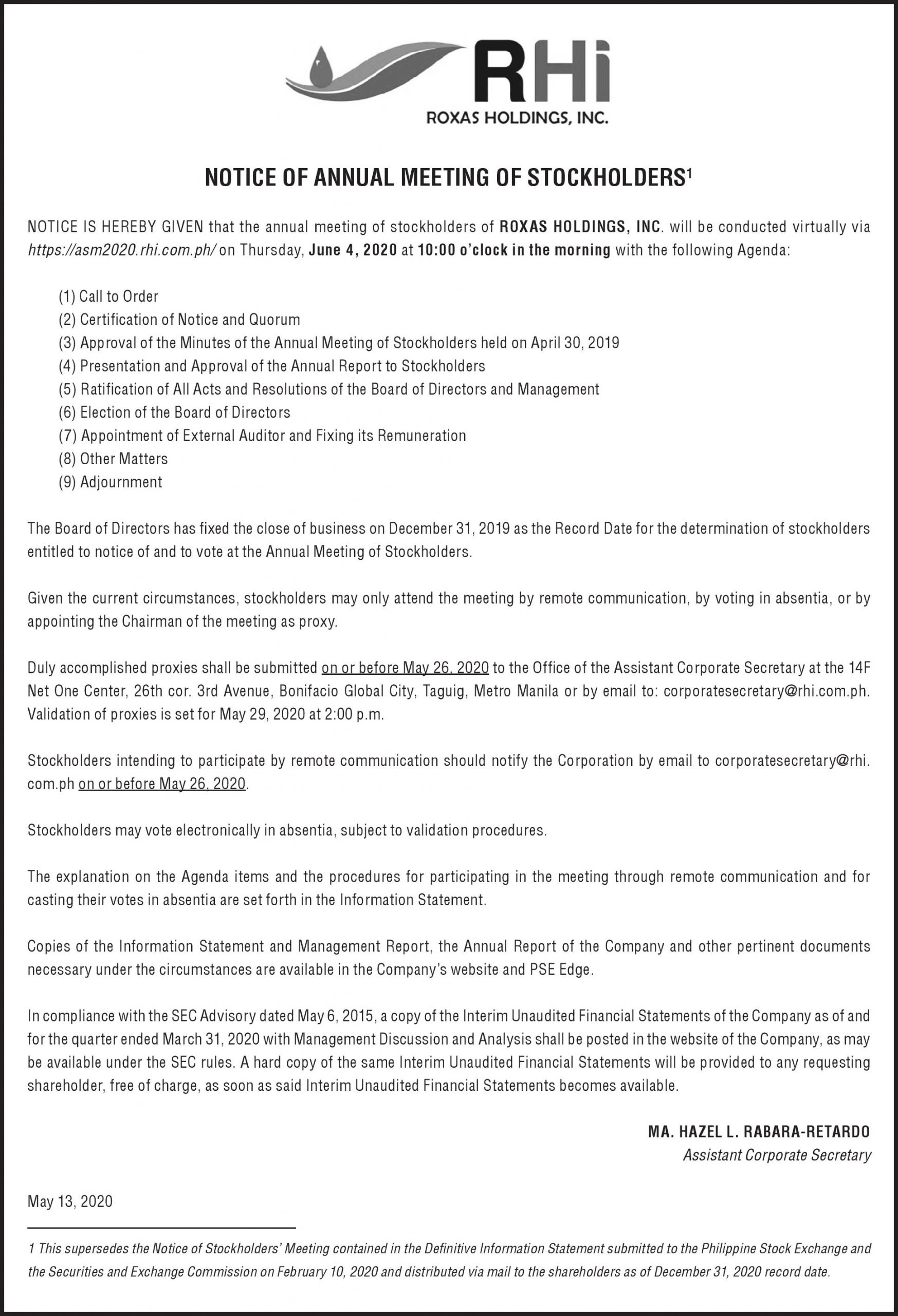
Roxas Holdings, Inc. sets stockholders’ meeting via remote communication

Please be advised that the Annual Meeting of the stockholders of Roxas Holdings, Inc. for the year 2020 will be conducted by remote communication on Thursday, 4th day of June 2020 at 10:00 a.m. (URL: https://asm2020.rhi.com.ph/).

Stockholders who are interested to participate in the proceedings may visit the above website, RHI’s website at https://www.roxasholdings.com.ph or check the Company’s disclosures via PSE Edge, for the requirements to register.

Should you have queries, kindly send an email to: corporatesecretary@rhi.com.ph.

GDP contraction seen to deepen

By Beatrice M. Laforga
Reporter

THE Philippine economy may now contract by as much as 3.2% this year, the government said on Wednesday, as the coronavirus disease 2019 (COVID-19) outbreak pummels investments and domestic demand.

The Development Budget Coordination Committee (DBCC) said in a statement that gross domestic product (GDP) is expected to shrink by 2 to 3.4% this year, lower than the -1% to zero growth forecast made in late March.

If realized, the worst-case 3.4% contraction would be a steep decline from the six percent growth recorded in 2019 and would be the first full-year contraction since 1998 and the lowest since the -6.9% recorded in 1985.

The National Economic and Development Authority (NEDA) estimated the pandemic’s potential economic impact may hit P2 trillion or 9.4% of GDP this year.

NEDA Acting Secretary Karl Kendrick T. Chua is optimistic the economy can post growth in the last two quarters, marking a “gradual recovery” from the 0.2% decline in January-March and the widely expected deeper contraction in the second quarter.

“Hopefully, [GDP growth will be] positive in the second half,” Mr. Chua told BusinessWorld in a Viber message yesterday.

The DBCC expects the economy to make a strong recovery next year with a 7.1-8.1% growth.

“Timely implementation of a well-targeted recovery program, alongside efforts of the private sector, will mitigate the impact of the COVID-19 pandemic. Such a program will help the country regain confidence, attain higher economic growth, and restore employment rates to pre-crisis levels,” the DBCC said.

Nicholas Antonio T. Mapa, senior economist at ING Bank Philippines, said in a note yesterday that the expected sharp bounce back to 7% level next year is “due presumably via base effects.”

“In times of economic hardship, the economy generally turns to the government to provide a stimulus to get the sluggish economy up and running… Whether it be via supplemental budget or via presidential decree by way of the President’s newfound special emergency powers, the fiscal rescue package must look to arrest the development of falling GDP and plug the numerous holes left in the Philippine growth engine,” Mr. Mapa said.

REVISED TARGETS
The interagency DBCC met late Tuesday to revise its macroeconomic assumptions and fiscal program for this year and next year, which will “allow the government to operate with a more realistic and prudent fiscal stance as it flags the downside risks to the economy and the fiscal program for the rest of the year.”

The budget deficit is seen to balloon to P1.56 trillion or 8.1% of GDP this year, amid massive spending and a slump in tax collections.

The revised deficit ceiling is 2.8 percentage points wider than the deficit-to-GDP ratio of 5.3% adopted in March, and the original 3.2% deficit cap.

The debt level “remains manageable,” the DBCC said, adding that the Philippines posted its lowest-recorded debt-to-GDP ratio of 39.6% last year.

“Despite increased deficit spending, the national government’s deficit-to-GDP ratio will remain in the median of comparable countries in ASEAN and in East Asia… as long as the ratio does not exceed 9.0%. Below this threshold, the debt-to-GDP ratio will be around 50%, which is far lower than the most recent peak of 71.6% in 2004,” the DBCC said.

Budget Undersecretary Laura B. Pascua told BusinessWorld the deficit-to-GDP ratio over the medium term is expected to decline to 6% in 2021 and further down to 5% in 2022.

The DBCC slashed the full-year revenue collection target by 17.7% to P2.61 trillion from the P3.17-trillion program approved in March. Disbursements will also be slightly higher at P4.18 trillion or 21.7% of GDP this year.

“The emerging disbursement program takes into account the releases for COVID-19 initiatives charged to savings coming from austerity measures, among others,” it said.

For next year, the DBCC adopted a revised cash budget for 2021 at P4.18 trillion, or 19.6% of GDP, lower by 9.9% than the P4.64 trillion estimated in December.

“The DBCC noted that the Philippines has strong economic fundamentals and sound fiscal health. At the same time, the DBCC reiterated its commitment to work with the whole of government in responding to challenges brought about by COVID-19 while helping drive a rapid economic recovery for the country,” it said.

The Bangko Sentral ng Pilipinas (BSP) also recommended a lower price assumption for Dubai crude between $23 to $38 per barrel, as global oil prices plunged. The previous estimate was $35-50 per barrel.

BSP also lowered the output projection for goods exports and imports to -4% and -5.5%, respectively, in anticipation of the sharp contraction of the global economy this year. In 2021-2022, exports and imports are expected to grow by 5% and 8%, respectively.

This compares to the earlier export projection of 4% growth in 2020 and 6% in 2021-2022; and 8% growth for imports until 2022, adopted during the DBCC meeting last December.

The central bank also expects the foreign exchange rate to settle within P50-54 against the greenback this year until 2022, a slightly wider range compared to P51-54 per dollar range adopted in December.

Full-year inflation rate target was also maintained at a 2-4% range for this year until 2022. But due to “subdued demand,” the inflation rate projection for this year has been pegged at 1.75-3.75%.

DOUBLE-DIGIT Q2 CONTRACTION
Meanwhile, the Philippines is expected to be the hardest-hit economy in the emerging Asia region, as the government extended its lockdown for Metro Manila and two other cities while neighboring countries began relaxing lockdown measures.

“For the year as a whole, we think the economy will contract by 6%, which would be the biggest drop since 1985. It would also make the Philippines the worst-hit country in the region relative to its 2019 performance,” Capital Economics said in a note published late Tuesday.

After the slump in the first quarter, Capital Economics Senior Asia Economist Gareth Leather said the Philippines is bracing for a more severe impact this quarter as the lockdown will now last until end-May.

“We have pencilled in a 17% y/y decline in activity for the second quarter,” he said.

Capital Economics said the Philippine recovery should “begin to take shape” once lockdown restrictions are relaxed and external demand gradually picks up.

Think tank Oxford Economics also expects the Philippines to lag behind its peers in the Asia-Pacific countries.

“Malaysia and the Philippines have also made progress with containment, but not yet decisively. With less room to ease restrictions, we expect their economic recovery to lag that of the other three (Australia, Thailand and Vietnam),” it said in a note published Tuesday.

Oxford Economics noted the Philippines, even as its lockdown was considered the most stringent, is among the countries where containment measures “appears not to be decisive [and] workplace mobility remains much lower.

“This portends a deeper and longer-lasting impact on their domestic economies,” it said.

Electronics exporters appeal lockdown extension

By Jenina P. Ibañez
Reporter

ELECTRONICS exporters are appealing the government’s decision to extend the strict lockdown in Laguna, citing up to $20 million in business losses for the sector each month.

Semiconductor & Electronics Industries in the Philippines Foundation, Inc. (SEIPI) President Danilo C. Lachica sent a letter to the Inter-Agency Task Force for the Management of Emerging Infectious Diseases (IATF) on Wednesday to request for a shift to a general community quarantine (GCQ) in Laguna.

Laguna, along with Metro Manila and Cebu City, will be on a modified enhanced community quarantine (MECQ) until the end of the month.

The modified ECQ allows selected manufacturing and processing plants, including electrical equipment and machinery manufacturing, to operate with up to 50% of their workforce.

Under a GCQ, a longer list of businesses may operate with up to 75% of their workforce on-site, with some transportation services allowed to support the industries.

Export-oriented companies have already been allowed to operate under ECQ, under conditions that companies provide accommodations and transportation.

Mr. Lachica in a mobile message explained that they intend to ramp up capacity, with the hope that the movement of supplies and workers are not impeded.

“We still have not normalized air/sea shipments. As for workers, the concern would be the COVID-19 case status of barangays they come from,” he said.

In its letter, SEIPI said that the electronics industry in Laguna generated export revenues of $17.5 billion in 2019, with 160,000 direct jobs. SEIPI members include around 40 manufacturing companies and 100 suppliers in Laguna.

Philippine electronics exports in 2019 grew by 4% to $43.32 billion, or 61.6% of the country’s total commodity exports, according to the Philippine Statistics Authority.

Electronics exports in the first quarter of 2020 dropped 4% to $9.3 billion, accounting for 59% of total commodity exports.

“After 8 weeks of ECQ, massive amounts of business ($10 million to $20 million per month) have been shifted to China, Vietnam, Japan and other countries, which if sustained, will deprive thousands of Filipino’s their jobs,” SEIPI said.

“An extended ECQ makes it more likely that business will stay overseas. Our government needs to act now to preserve what it can of the remaining business and jobs.”

SEIPI also said that a Laguna-based electronics company planning to invest $400 million and hire 3,000 new employees over the next four years may move its investment to Thailand if the lockdown puts its expansion at risk.

SEIPI said that half of its employees are unable to come to work during the lockdown. The group added that its health and social distancing measures are guided by corporate headquarters, noting that it provides transportation, hygiene protocols, and personal protective equipment.

According to SEIPI, its multinational companies in Laguna are part of a global supply chain producing components for pandemic response technology for hospitals and cloud-based data storage providers.

The ECQ was declared in mid-March in an effort to contain the spread of the coronavirus disease 2019 (COVID-19).

The 7,286 COVID-19 cases in Metro Manila account for most of more than 11,000 cases in the country as of Tuesday. Cebu City recorded 1,484 cases.

Laguna recorded 390 infections of COVID-19 as of Tuesday, with 335 active cases and 10 deaths, according to the Health department’s online tracker.

Starting May 10, the Health department tests more than 8,000 people per day, ten days past its target date for this testing capacity.

Stock market may retest lows amid virus crisis

By Denise A. Valdez
Reporter

THE stock market may retest lows in the coming months as the full extent of the economic fallout from the coronavirus disease 2019 (COVID-19) pandemic has yet to be seen.

At the same time, bourse operator Philippine Stock Exchange, Inc. (PSE) expects only two to three initial public offerings (IPOs) this year from its previous target of about six.

COL Financial Group, Inc. Research Head April Lynn Tan said the PSE index (PSEi) may hit deeper lows in the coming months.

“I’m not really very optimistic at this stage. I don’t expect the strong performance so far to be sustained,” she said during Wednesday’s BusinessWorld Insights online forum.

On Wednesday, the PSEi closed at 5,626.25, up 22% from its low of 4,623.42 in March. Ms. Tan said the stock market’s rise was largely due to external developments such as the reopening of other economies as they seemingly “flattened the curve,” efforts by global central banks to boost liquidity, and other countries’ aggressive fiscal stimulus programs.

However, she said the stock market’s ascent may not be sustainable as the magnitude of the economic impact of COVID-19 has not been seen.

The Philippine economy contracted 0.2% in the first quarter, which only accounted for the first two weeks of the Luzon-wide enhanced community quarantine (ECQ). The second quarter is expected to be worse, as lockdown measures continued through April and May. There are also doubts the economy will be able to immediately bounce back to pre-lockdown levels.

Ms. Tan said stock valuations are currently cheap, but still far from previous bear market bottoms and therefore may still see some downside risks in the short term.

She also noted foreign investors continue to pull out funds from the local bourse, which is not a good indication as it is difficult for the PSEi to sustain a strong recovery without them.

“We’re still not yet there. There is room to go down,” Ms. Tan said.

While the 1997 Asian Financial Crisis and the 2008 Global Financial Crisis are commonly used benchmarks for the market’s current challenges, Ms. Tan noted those two are “regular garden variety type of financial crises,” while the current pandemic is nothing like what is taught and studied in school.

Philstocks Financial, Inc. Senior Research Analyst Japhet Louis O. Tantiangco said the current crisis involves economic and health problems that cannot be addressed at the same time.

“This is where the dilemma comes in. If you want to solve our health crisis, it would be at the expense of our economy. If you want to jumpstart the economy, bring us back to our full productive capacity, this will be at the expense of the health of the country,” Mr. Tantiangco said at the same online forum.

Given the gloomy outlook, PSE President and Chief Executive Officer Ramon S. Monzon said he is not very hopeful there will be many PSE listings this year.

“I think we would be lucky if we could get two or three additional companies to list at this time,” he said.

The PSE welcomed four IPOs last year and was initially hopeful for about six IPOs this year, along with two to three listings of real estate investment trusts (REIT) after it approved new REIT rules in January.

But more than four months into the year, the PSE only has a P1.6-billion IPO application from grocery operator MerryMart Consumer Corp. and a P15-billion REIT application from Ayala Land, Inc. (ALI).

“I think they will be more careful as far as going to the equity market is concerned,” Mr. Monzon said. He also said MerryMart is now in the process of book building and is targeting to list on June 15.

Despite the market’s volatility, Ms. Tan said both MerryMart and ALI may perform well in their offerings, as grocery businesses remain robust despite the pandemic while office leasing is resilient.

While the outlook remains dim, she said now is a great time for stock market investors to be “greedy” and plan for the long term. “I’m quite confident if you hold on to what you own right now, give it a year or two, we’ll probably be in a better position,” Ms. Tan said.

For Mr. Tantiangco, it is likely that the current crisis will have a lasting impact on market psychology, noting that investors may shy away from the market for now.

But he noted it may also usher in new economic trends where there would be bias for businesses catering to healthier lifestyles, those focusing on food sufficiency and sustainability, and those fostering growth in the digital space.

“Those companies which will be able to find opportunities out of these will likely be the new favorites of the market,” he said.

Mining firms can start full operations under GCQ

mining

MINING COMPANIES will be allowed to resume operations at full capacity as long as they follow strict safety guidelines, after the national government began relaxing quarantine restrictions around the country.

The Mines and Geosciences Bureau (MGB) on Wednesday released the guidelines for the resumption of mining and mineral processing operations under a general community quarantine (GCQ).

“A workforce anywhere between 50% up to full operational capacity at the mine shall be allowed, without prejudice to work from home and other alternative work arrangements. Entry and exit of employees and personnel to and from the enhanced community quarantine zone (ECQ) shall be prohibited,” Acting MGB Director Wilfredo G. Moncano said in the circular.

The Inter-Agency Task Force for the Management of Emerging Infectious Diseases has allowed mining operations to resume in areas under the GCQ.

Caraga, which is considered the main ore-producing region, will be downgraded to a GCQ starting May 16.

The MGB said mining firms should enforce a “no face mask, no entry” policy and physical distancing in all work areas.

Mining firms are also required to provide medical equipment, thermal scanners, personal protective equipment (PPE), sanitizers and disinfectants at its mine sites and plants.

Employees and personnel reporting for work will be subjected to health procedures such as thermal scanning and monitoring. Those who register a temperature reading above 37.5 degrees Celsius, even after a five-minute rest will not be allowed to enter the site.

The MGB also said all cargo vessels carrying minerals will be quarantined for 14 days, starting from its departure from the last port of call.

“No disembarkation of any vessel crew policy shall be strictly implemented,” the circular said.

One of the biggest mining companies in the country, Nickel Asia Corp. has already resumed operations.

In a disclosure to the stock exchange last week, Nickel Asia said that its Taganito and Taganaan mines have resumed partial operations after almost a month of voluntary suspension. — Revin Mikhael D. Ochave

House approves ABS-CBN provisional franchise on second reading

By Genshen L. Espedido

A BILL seeking to provide a provisional franchise to ABS-CBN Corp. until Oct. 31, 2020 was approved on second reading on Wednesday, the same day it was filed.

The House of Representatives, constituted as a Committee of the Whole, tackled and approved House Bill (HB) 6732 during its plenary session.

The bill is authored by House Speaker Alan Peter S. Cayetano; deputy speakers Neptali M. Gonzales, Raneo E. Abu, Roberto V. Puno, Dan S. Fernandez and Luis Raymund F. Villafuerte, Jr.; House Majority Leader Ferdinand Martin G. Romualdez; and Bulacan Rep. Jose Antonio R. Sy-Alvarado.

“Through this measure, we hope to strike a balance between the immediate needs of the people amid this crisis and the duty of Congress to ensure accountability to our present laws. Providing ABS-CBN with a provisional franchise valid until 31 October 2020 will give both the House of Representatives and the Senate to hear the issues being raised for and against the renewal and assess…whether or not the network shall be granted a franchise for another twenty-five years,” part of the explanatory note read.

Under the bill, the National Telecommunications Commission (NTC) is mandated to grant appropriate permits and licenses for the operation of ABS-CBN.

The bill also requires that ABS-CBN provide “adequate public service time” free of charge to enable the government to relay important public announcements.

“Public service time referred herein shall be equivalent to ten percent (10%) of the paid commercials or advertisements which shall be allocated based on the need to the executive, legislative, judiciary, constitutional commissions and international humanitarian organizations,” it said.

The measure also empowers the President to temporarily take over and operate the stations “in times of war, rebellion, public peril, calamity, emergency, disaster or disturbance of peace and order.”

During his sponsorship speech, Mr. Cayetano said that “whatever the outcome of these hearings will be, there will be reforms” not only for ABS-CBN, but for the entire media industry.

“There must be, not just a new, but a better ‘normal’ not only for ABS-CBN, but for the entire media industry,” he said.

The bill will have to go through third reading before it hurdles the lower chamber and relayed to the Senate.

Mr. Cayetano is supposed to step down from House speakership and will be replaced by Marinduque Rep. Lord Allan Jay Q. Velasco at the end of October.

In a statement on Wednesday night, ABS-CBN thanked the House for approving HB 6732.

“We thank the leaders of the House of Representatives and the sponsors of the bill led by Speaker Alan Cayetano and Majority Leader Martin Romualdez for recognizing the role we play in providing for the needs of the people in terms of access to news, information, entertainment, and public service at this crucial time,” it said.

“We look forward to participating in the process of our franchise renewal and stand ready to respond to the issues that have been raised against the network, its owners, management and employees,” it added.

Senate Majority Leader Juan Miguel F. Zubiri said that the Senate would schedule a committee hearing on the ABS-CBN franchise early next week.

“With the House of Representatives passing the measure on 2nd reading with a 3rd reading schedule next week. We in the Senate will proceed to schedule the Committee hearing early next week to pass the committee report and hopefully sponsor the measure by Wednesday afternoon before the Committee of the Whole hearings on COVID-19 (coronavirus disease 2019). Hopefully we can pass the measure the week after. We will work expeditiously to pass the measure up-to ratification before the June 3 break,” he told reporters in a Viber message.

A counterpart bill, Senate Bill 1521, seeks to grant ABS-CBN a provisional franchise until June 2022. It was filed in the Senate on Monday.

ADVERTISEMENT
ADVERTISEMENT