

Home Blog Page 9516

Can CITIRA help revive the economy in the middle of this COVID-19 crisis?

It is disquieting to read a news report about Senate President Tito Sotto promising to fast track the passage of CITIRA (Corporate Income Tax and Incentive Reform Act) by the Senate, justifying it as an urgent measure needed to stimulate the economy. All agree that the economy needs to recover as fast as it can. It was already reported in the first quarter of this year that on a year-to-year basis, the GDP contracted by 0.2%.

In the middle of this crisis, it is likely that CITIRA can drive away existing investors and reduce the country’s exports, without the offsetting gain of higher tax revenues and new investments.

CITIRA has two parts. One is lowering the corporate income tax from 30% to 20% in 10 years, the other to rationalize the country’s investment incentives to make them “

Since the 1990s, we have had two reductions of the corporate tax, in 1997 and 2009. Both reforms were taken to stimulate the economy. In 1997, the region was hit by the Asian financial crisis and its economies contracted or their growth slowed. The corporate tax was reduced from 35% to 32% over a three-year period, part of the comprehensive tax reform program (CTRP) of 1997. The second cut happened in 2009, and followed the global financial and economic crisis in 2008. Our Congress cut the rate from 32% to 30% then.

The CTRP was like the current tax reform program of the current government. The reforms covered income taxes including personal income tax, and the excise tax on alcohol and cigarettes. It failed in preventing the rise of the marginal tax rates on personal income tax brackets by not including inflation adjustments to personal income tax brackets. While it was touted to minimize revenue leakages, it did not succeed so in excise taxes on cigarettes, with specific tax rates and multi-tier rates that allowed producers to legally avoid their tax dues, resulting in the decline of excise tax revenues.

CITIRA forms an important phase of this government’s tax reform program. It is designed to increase investments and promote economic growth, which Senate President Sotto stressed as urgently needed to reverse the decline of the economy due to the national government’s COVID-related quarantine regulations.

That CITIRA can help in the middle of the pandemic is doubtful. Figure 1 charts the increase in levels and growth rates of corporate tax revenues. The Figure is only up to 2016, but it suffices for this discussion. First, in both episodes of rate cuts, tax revenues fell. The rate cuts gave instantaneous relief to taxpayers, and that is all there is it to it in so far as revenues are concerned. To a government in need of higher tax income as it has to spend for social protection of the poor and to revive the economy, the corporate tax rate cut of CITIRA would appear not to be a help.
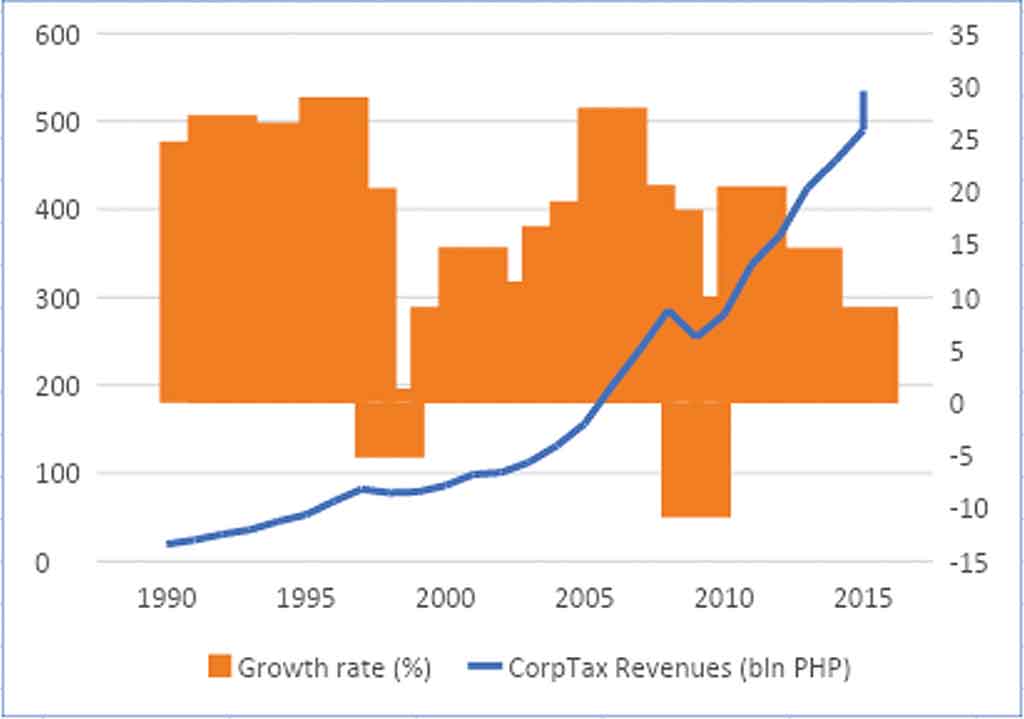
Revenues bounced back following the rate cuts, but they did so because the economy recovered. The regional and global economic crises in 1997 and 2008 were short in duration of one or two years, with sharp plunges and recovery.

Lower tax reduces the user cost of capital and increases investment demand. The tax reform in 1997 and 2009 might have contributed to the economic recovery. But will it deliver the same in 2020?

Unlikely. There are other factors which need to be considered. The effect on investments of a lower corporate tax will be outweighed by the uncertainty spawned by COVID-19. The health emergency has to end for good with the availability of vaccine and medicine which competent authorities have shown to be efficacious and safe. Absent that, we will still live as if we hide from our unseen enemy, the virus. That is not good for business. The last thing a new investor would want to be told is to close his new business to flatten some future wave of COVID-19 infections.

Access to effective and easy to use tests for COVID-19 can mitigate the uncertainty. But businessmen all over the world have to be persuaded that this pandemic is behind us.

Until the world has those medical antidotes, the prevailing risk to business can dampen, if not wipe out, the expected new investments that a lower corporate tax is expected to offer the economy. Without the expected rise in revenues due to lingering economic recession with COVID-19 still unchecked, reduced corporate tax will not help mitigate the fiscal deficit.

There is another factor to consider. Unlike its Asian or global counterpart, this global economic crisis is pandemic as well. There is not a single country ready to become the engine of the world economy. All major countries and regions — China, US, and the EU — are reeling from COVID-19 and the economic fallout that it induces. Although increasingly they are starting to open up their economies, all are trying to restart growth behind a backdrop that at any time authorities can order their constituents to go back into isolation to stop a possible future wave of infections.

EXPORTS AND INCENTIVES REFORM
CITIRA is designed to remove the privilege of the special 5% income tax privilege in lieu of national and local taxes in at least PEZA-administered economic zones. The exporters locating in these zones will be told to pay their national and local taxes the way all other taxpayers do. New projects of locators may still get a package of incentives, which proponents say are flexible and inclusive of non-tax measures to suit the requirements of companies which plan to invest in the country.

New projects of PEZA locators are eligible under the Strategic Investment Priority Plan (SIPP) with the Fiscal Incentives Review Board (FIRB) for incentives. Project owners would still have to show the FIRB that their projects bring in positive net benefits to the country. Some of these incentives include an income tax holiday (ITH) for two to six years; reduced corporate income tax rates after its ITH, or availment of special incentives such as tax deductions for expenses on training, research and development, and infrastructure facilities.

This planned reform of our investment incentives carries a great risk of us losing export competitiveness. The businesses in PEZA zones are all exporters, or most of them as some are indirect exporters. The businesses in PEZA zones make up our country’s capacity to export.

Exports from PEZA zones account for at least half of the country’s merchandise exports. In 2015, these businesses brought in about 59% of total merchandise exports, 65% in 2016, and 64% in 2017. Exports make up 29.2 % at 2018 prices of the country’s gross domestic product in 2019. This share has grown consistently since 2015, when it was only 25.3%.

Export growth is an important determinant of overall economic growth, as shown in Figure 2. In the global economic crisis in 2008 and 2009, GDP growth plunged from 4.3% in 2008 to 1.4%. The export contraction in those two years appeared to pull economic growth down. In the first half of the Arroyo government in 2000 to 2005, annual export growth averaged 6.8%, and that pulled up GDP growth, except that we had political crises in those years which dampened economic growth. Absent that, high export growth pulled up GDP growth in the Aquino 2 and the current government. When export growth jumped from 2% in 2013 to 12.1% in 2014 and stayed in the two-digit rate range, economic growth was at least 6%.
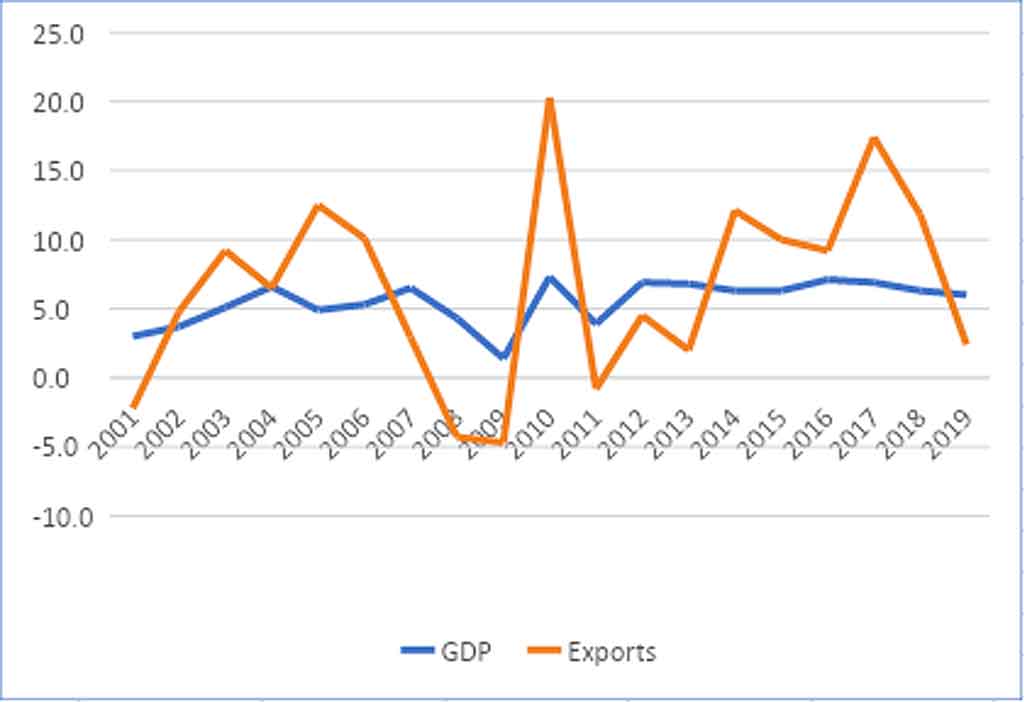
Export growth slowed down in 2018 and 2019, and with COVID-19 and the ECQ in 2020, export growth is likely to be in the red once again. The trend is likely going to pull down GDP growth. It was still up in 2018 and 2019 because of the government’s infrastructure program. But the economy is likely to contract this year, as the first quarter GDP growth of -0.2% indicated.

PEZA businesses, the country’s export engine, are already adversely affected by the COVID-related ECQ. Some reports indicate that only half of the workforce were actually employed in the first half of 2020 because of ECQ and lack of imported materials. Profitability had declined as the ECQ-related spending required additional expense to export products or import materials. In 2019, a total of P22.9 billion were invested by PEZA locators, and if not for CITIRA and COVID-19, more investments would have been realized in 2020. In February this year, investments declined by 28% on a year-on- year basis.

CITIRA, if passed by the Senate in the middle of the crisis, may just compel locators to re-assess their location decisions. Some important businesses, like electronics which take up about half of the country’s merchandise exports, are portable. If the tax perks under this new reform are not those that would give the best return, they may just move somewhere else. Rather than help stimulate economic recovery, which is unlikely while COVID-19 is still around, the proposed law could cut down our export capacity in years to come, and dampens economic growth.

But there is still the opportunity to improve our proposed incentives reform law such that the country can sustain our export capacities and save jobs.


Ramon L. Clarete is a professor at the University of the Philippines School of Economics.

Trust and credibility to win the war against COVID-19

Imposing and extending the lockdown or the enhanced community quarantine (ECQ) is a difficult choice to make. The biggest casualty is the economy. That the Philippine economy (and for the rest of the world) shrunk in the first quarter of 2020 was expected. Only upon the containment of the pandemic — and we do not know when this will happen — can the economic slump be turned around.

The plunge in economic growth is the price to pay to protect the health of our people and save lives. We thus have to make the ECQ work.

The ECQ likewise makes economic sense. The country’s social and economic fiber is strengthened by saving scores of thousands of lives and preventing more people from getting severely sick. This enables a smoother and quicker recovery.

The choice of trading the economy for the people’s health by adopting the ECQ is deliberate. This is unlike previous recessions or downturns that were a result of bad or misguided choices.

Arguably, rejecting a lockdown would have still yielded the same negative economic outcome. This is because the pandemic, with or without lockdown, deadens the spirits of consumers and investors. The fear of the deadly virus whose spread is exponential makes people panic. Markets, both domestic and foreign, are disrupted and become incomplete.

To illustrate, even Sweden, which models itself as a country that has not resorted to a full lockdown, is suffering economically. The title of a CNBC news report (April 20) needs no further explanation “Sweden had no lockdown but its economy is expected to suffer just as badly as its European neighbors.” Sweden’s central bank paints two scenarios, both grim: the better scenario of Gross Domestic Product (GDP) contracting by 6.9% in 2020 and the worse scenario of output falling by 9.7%.

The health outcome of Sweden’s controversial strategy is dreadful. To quote a note (May 2020) from the Peruvian economist Oscar Urgateche: “Sweden, which also chose not to implement containment measures, has more deaths per million inhabitants than the US, with the former having 319 and the latter 238.”

In the Philippines, the ECQ has prevented a much higher number of people from dying and from getting infected by COVID-19. At the national level, the reproduction number is less than one, which means we have been able to slow down the spread of the virus. Still, densely populated, highly urbanized areas remain at high risk. In this context, the ECQ is gradually being relaxed.

Admittedly, we could have done better. Lack of initial resources is understandable but surmountable. Success stories in Vietnam or in the Indian state of Kerala demonstrate that a “low-cost” strategy is feasible in fighting the pandemic.

But inexcusable factors undermine the Philippine strategy. These include the following: policy inconsistency (e.g., conflicting pronouncements on the use of antibody tests, despite the caution of the medical community that antibody tests are highly unreliable for diagnostics); non-compliance with social distancing (e.g., high-level officials who violate rules being condoned); political distractions (e.g., the closure of the ABS-CBN media conglomerate and a campaign to postpone the 2022 elections); corruption (e.g., the hold up of medical supplies at the Bureau of Customs and essential goods at barangay checkpoints; bureaucratic inefficiencies (e.g., slow distribution of social amelioration benefits).

These factors have led to public dissatisfaction with the Philippine leadership. Public dissatisfaction, nonetheless, exists in other countries as well.

A recent global survey done by the Singapore-based Blackbox (blackbox.com.sg) on the performance of the political leadership in addressing the pandemic shows an average score of 40% approval. The survey covers 23 advanced economies and emerging economies. The score for the Philippine political leadership is 45%, slightly above the average but still low. Surprisingly, for political leadership, the Philippines is ranked number 8, even ahead of countries with good institutions like Singapore (41%), Australia (41%), Germany (35%), South Korea (21%) and Japan (5%). It goes without saying though that we should not compare ourselves with other countries because many other variables are not controlled.

Also revealing is that across the board, the scores for business leadership (28%) and community leadership (37%) are worse than that for political leadership. Only media leadership has performed creditably (76%). For the Philippines, business leadership, community leadership, and media leadership have scores of 37%, 36%, and 78%, respectively.

COVID-19 will not go away soon. The Philippines is on its way to flattening to the curve, even as more compelling actions have to be taken. But we cannot discount the possibility of resurgence. Hence, quarantine, social distancing, and related stern measures will still be used in varying forms.

Compliance through collective action is absolutely necessary to winning the war against COVID-19. But what will thoroughly enable compliance and collective action is having a leadership that is trusted and credible.


Filomeno S. Sta. Ana III coordinates the Action for Economic Reforms.

www.aer.ph

Parallel contagion

“Up to 10 million Filipinos could lose jobs in the Philippines due to COVID-19,” Department of Labor and Employment (DoLE) Secretary Silvestre Bello III said during a Senate hearing on coronavirus pandemic updates on May 20. He said 2.6 million workers have already been laid off due to temporary closure of business establishments (GMA News, May 20).

These are chilling statistics, correlated to those of the despairing statistics on the status of COVID-19 infections in the country. As of May 20, the confirmed cases of the novel coronavirus infection were 13,221, of whom 842 persons died — a 6.36% mortality rate. Will Bello’s estimate of the parallel contagion in the labor force (the lay-offs, cut-jobs) increase the latest reported 5.3% unemployment rate (3.868 million unemployed as of January) to 19% (13.868 million) unemployed because of COVID-19’s economic impact?

“I hate to say it, but it’s possible,” Bello said at the Senate hearing.

Call it sinister and macabre, but COVID-19 has killed more families than the acknowledged 6.36% of confirmed cases — and will kill more in terms of jobs and businesses lost in the quarantine restrictions and in the shifted paradigms in micro- and macro-economics. More than four million Philippine families (one in every five) went hungry over the past three months, doubling from December amid lockdowns to stem the coronavirus outbreak, according to a Social Weather Stations survey in early May, in a report carried by Bloomberg on May 23.

A focus analysis in the BusinessWorld (May 14) cited that “more than 99% of the roughly one million business establishments in the country in 2018 were micro, small and medium enterprises (MSMEs), according to the Department of Trade (DoT). The smallest of them accounted for 88% of the total, or a little more than 887,000 establishments. These have raised the quality of life of their families and workers, having created 5.7 million jobs or 63.19% of the country’s new jobs in 2018, data showed. About 436,000 of the country’s 1.6 million small businesses were forced to halt operations amid the lockdown, with one million of them operating with a skeleton workforce, according to the Department of Finance (DoF).

The vulnerability of jobs in time of the coronavirus (which weaknesses will most probably prevail long after quarantines are lifted) is reflected in a tabulation of “Businesses allowed to open under quarantine” in the BusinessWorld of May 13. Businesses were grouped by the government Inter-Agency Task Force (IATF) in four categories, evidently based on customer-contact needs that company personnel will have to serve within the constraints of social distancing to avoid contamination of and by others. The option of “work-from-home” elevated the lower categories upwards in the Expanded Community Quarantine (ECQ), Modified ECQ, and General Community Quarantine (GCQ, or the most-relaxed ECQ) listings.

It is indicated that Category IV businesses, which have the most customer-contact (like travel, tourism, group recreation, personal services and the like, will give less opportunities for jobs in this time of the coronavirus. Malls (for non-leisure stores and retail services for essential needs) are in Category III, which can have controlled customer contact and reduced staff (because of physical space allocation for again, social distancing). Note that the initial testing of malls re-opening has reportedly been graded “unsuccessful” because of the hordes of over-eager shoppers that were said to have violated social-distancing when malls were allowed to partially open (50% staff, on rotation) on the weekend of May 15.

Category II concerns financial, commercial, and manufacturing businesses that can do administrative functions by work-from-home (tech-based), previously barred under ECQ, but to be allowed full operations in GCQ. Category I can do all things they do under ECQ, Modified ECQ and GCQ: hospitals and health care manufacture, manufacture of essential goods, all agriculture and food production, delivery services, telecoms and media among other essential goods and services.

The Categories can be used as a template for gauging which businesses and economic activities will survive, which will have to downsize or adjust, and how much employment these surviving, new or re-engineered businesses will generate as their contribution to the livelihood and well-being of the Filipino labor force, and of course, towards the businesses’ own profitability — else why be in business?

Bello, in his own words said the jobs to be lost will mostly be from the service sector: “Karamihan po ’yan sa service sector. Malaki po ang tourism, ’yung allied businesses like restaurants, then transportation.” Services comprise 58.6% of the total employed in January 2020, according to DoLE statistics. And we must talk of the fate of our Overseas Filipino Workers (OFW), and our Business Process Outsourcing (BPO) workers, both from the service sector, which are vulnerable in this global pandemic, basically because of the downturn in the economies to which we export these services.

A BusinessWorld infographic on May 15-16 showed “Which economies stand to lose the most if remittances run dry?” Estimates of the Global Knowledge Partnership on Migration and Development (KNOMAD) showed that the Philippines received remittances of $35.17 billion in 2019, from some 2.8 million OFWs, contributing about 10% to GDP. The Philippines has the largest share of OFW remittance in the world, where Egypt comes a far second with $26.791 billion (8.9% of GDP), and Ukraine, third, with $15.814 billion (10.5% of GDP).

In April, Carlito Galvez, chief implementer of the national policy against COVID-19 said that around 100,000 OFWs were to be expatriated by their host countries, as international airports were partially reopening to allow foreigners to go home to their countries. (GMA News, April 14). It is not far fetched that more OFWs will be coming home to the Philippines, because of the changes in the economic status of their employers, who may have assessed their needs versus fear of close personal contact in this time of the pandemic, and in anticipation of future similar situations. It is reported that importing countries for personal services are now organizing indigenous services and facilities like retirement and nursing homes, day-care facilities, and housemaid services to avoid OFWs.

The volatility and sharp decline in fuel prices in this pandemic (and after) also affect the incomes and tenure of millions of OFWs in the Middle East. What to do with, say a million or so displaced returning OFWs globally who (except for the technical service workers) do not have other expertise? Someone said, train them to be BPOs. (Hmmm, perhaps a few.)

Way before the pandemic, BPO was bruited about as the perfect replacement for the declining OFW remittances (BusinessWorld May 01, 2015). The Philippines was already second overall among the world’s offshoring destinations, next only to India’s pioneering BPO industry, but first in the call center sub-sector, because young Filipino agents spoke better English. The real estate sector responded wildly with commercial buildings to house call center hubs in ready-made communities to serve the 1.2 million or so BPO agents. The BPO industry generated $23 billion in revenues in 2017.

The BPOs have been exempted from the quarantine. But the BPO Industry Employees Network (BIEN) revealed that because of the low volume of work and calls, BPO companies have been forced to dismiss workers, especially those on a project basis. Workers are placed in floating status because of account closures. There are also companies that have already issued notices of retrenchment because of the impact of COVID-19 on the businesses and economies that BPOs in the Philippines service abroad, BIEN said.

So there is the rough tally of the “about 10 million jobs” that DoLE Secretary Bello declared to be endangered and possibly lost because of COVID-19, and its merciless upheaval of human life and livelihood. He is appreciated for his honesty and candor in seeing the big picture beyond the palliatives of wage and income subsidies. But he should really get to work with the DoT, the government managers and socio-economic planners, and all other agencies relevant to the COVID-19 disruptions to plan and execute a strategy for the most basic need of the people: physical and economic survival.

Let’s see the plan for those 10 million threatened jobs.


Amelia H. C. Ylagan is a Doctor of Business Administration from the University of the Philippines.

ahcylagan@yahoo.com

A republic made stronger by crisis

The prognosis for the economy is becoming progressively worse. Last month, our economic managers were hopeful that 2020’s gross domestic product (GDP) would expand by 2.5% on the premise that we are able to catch up on the second semester. Two weeks ago, the National Economic and Development Authority (NEDA) adjusted its forecast, saying that the economy could no longer post positive growth and that we are now looking at a contraction of 2% to 3.4%.

Last week, New York based think tank Global Partners Inc. published a study saying that the Philippines was on its way to a contraction of 5% to 7%. This contraction is nearly as deep as what we experienced in 1985, our worst economic reversal since World War 2. It took us 25 years to recover from the economic devastation of 1984 and 1985.

A recession is now inevitable. The challenge is to recover as quickly as possible.

Acting NEDA Secretary Kendrick Chua recently submitted a plan to realize a V-shaped recovery. With a package of reforms, he hopes to induce the economy to rebound by 7.1% to 8.1% next year. The plan comes in two phases, the “Recovery Stage,” which will take effect from June to December, followed by the “Resiliency Stage,” which shall take place from 2021 onwards. Government has prepared a P1.49-trillion stimulus package to support the plan.

The Recovery Stage aims to minimize the impact of the pandemic on the economy. It calls for the enactment of three laws. The first is the Bayanihan Act 2 which is meant to prevent more job layoffs, save companies from insolvency, and stimulate consumer demand. The law calls for the appropriation of funds to strengthen healthcare, support agriculture and food manufacturing. It also provides loans and credit guarantees for local enterprises to save them from bankruptcies. The second is the enactment of a new law called CREATE (Corporate Recovery and Tax Incentives for Enterprises Act) which seeks to generate jobs, help local enterprises become profitable again and attract foreign investments. It proposes to reduce corporate income tax from 30% to 25%, a one-time 5% reduction; permit companies to carry-over losses for five years; offer tailor-made incentives to strategic foreign investors; maintain the same incentives for existing investors (to prevent them from leaving); and, provide tax incentives for government’s “Balik Probinsiya Program.” The third is the General Appropriations Act (GAA) of 2021. This law will be formulated in a way that it pump-primes the economy through massive spending on infrastructure, agriculture, healthcare and the food supply chain.

The Resiliency Stage, on the other hand, aims to strengthen the basic institutions of the country whilst setting the economy on a path of high growth. It involves a package of reforms that affect 11 aspects of economic and social development. On the economic side, it involves reforms to improve the country’s investment climate; business conditions; labor-related programs; agricultural productivity and logistics. On the social side, it involves reforms to bolster healthcare, education, digitization of government services, disaster response, social protection (SSS and Pag IBIG), and public transport

NEDA has brought forward a sensible plan which, no doubt, will put us in a better position to bounce back faster. However, we should not let this crisis go to waste. Now is the best time to enact controversial but necessary reforms we could not do in normal circumstances. I offer six reforms for the consideration of our economic managers:

Economic policy towards industrialization. I wrote about this two weeks ago. Fact is, the economy has already been growing above its potential growth (or capacity to grow) from 2013 to 2016 such that growth has been on a path of steady deceleration since 2016. The only way to reverse the trend is to restructure the economy. This can be done through rapid industrialization. To keep the economy in its current structure will only result in lower growth and a further widening of our current account deficit.

Industrialization involves migrating the millions of low income workers in subsistence agriculture, hospitality and retail sectors to more sophisticated jobs in manufacturing and technical services; the second is a natural off-shoot of the first, which is to shift from being an economy driven by consumption and government spending to one that is lead by production. Third, to transform the economy from one that is a specialist in only two industries (electronics and BPOs) to one that specializes in a range of high value-added products including pharmaceutical manufacturing, industrial machineries, and the like. We must establish our industrial backbone in chemicals, iron and steel, artificial resins and plastic materials. The fourth is to climb the value chain where Philippine-made products become more technologically complex, unique, and renowned for quality.

Economic charter change. The restrictive provisions of the constitution have held back the country’s development for more than 30 years.

Embedded in the 1987 constitutions is a list of industries in which foreign investors are precluded from participation. These industries include agriculture, public utilities, education and media, among others. The absence of foreign investors in these sectors have starved us of capital, technology and competition to push local companies to be more efficient.

The protectionist flavor of the 1987 constitution clearly favored the interest of select Filipino families who are/were involved in media and broadcasting, power generation, and telecommunications. The constitution further limits foreigners from owning more than 40% equity share in corporations. This has led investors to either invest their money elsewhere or use several levels of dummy companies to evade the law. The latter breeds a domino effect of illegal acts.

We have lost billions worth of investments to our neighbors because of our constitution. It is high time to amend it. In the meantime, Congress should expedite the passage of the Foreign Investment Act, Public Service Act, and Retail Trade Act.

Grab our fair share of investments leaving China. FDIs bring capital formation, technology transfer, recurring income through taxes, exports revenues, and jobs. With half a million returning OFWs and nearly 3 million displaced workers, we need FDIs more than ever.

Fortunately, manufacturing companies from Japan, the US, and the European Union are leaving China. NEDA and the Board of Investment have adopted a strategy whereby they individually approach potential investors who serve a strategic purpose to us and offer them fiscal incentives tailor-made for them.

Nothing wrong with this strategy, but the problem is that the government has been so preoccupied with the COVID-19 crisis that it is not given this matter the attention it deserves. Our campaign to attract manufacturing firms leaving China must be quick and massive. We are in stiff competition with Vietnam, Indonesia, and Thailand and unless we act now, we will lose out on this investment bonanza like we did in 2008 and 2015.

Go back to Public Private Partnerships (PPP). With the urgent two-pronged need to pump-prime the economy and modernize infrastructure, the government must re-visit and aggressively pursue PPP financing, including unsolicited proposals. It should no longer delay (and finally green light) projects that have been under protracted negotiations for years. I am referring to the Bulacan Airport and NAIA Rehabilitation. The scale of these projects will be a boon to job generation.

Investments in Food Security. The disruption of the logistics chain after the enactment of the Enhanced Community Quarantine (ECQ) would have resulted in a food shortage had the government not played its diplomatic card to persuade Vietnam to continue exporting rice to us. Sadly, local production of rice, vegetables, and meats is insufficient to feed our ever-growing population. We are dependent on imports for the lion’s share of our food requirements.

What we need is a green revolution to achieve self sufficiency in food production. It is imperative that we make the shift from traditional farming to technology-assisted farming. Unfortunately, agricultural development is stymied by the Comprehensive Agrarian Reform Law (CARL). The five hectare limitation on land ownership relegates farmers to subsistence farming and low productivity. Economies of scale cannot be achieved with such a small amount of land. The need to amend CARL cannot be overstated. We also need to amend the Agri-Agra Credit Law and Warehouse Receipts Law to make agricultural industries flourish.

Prepare for a Digital Economy. The post-COVID-19 world will be one where we live and work in the digital sphere. Work from home will become the new norm, gig employment (freelancers and outsourced services) will become increasingly common, and goods and services will be bought and sold through the internet. Bills will be paid online, interactions with government agencies will be done through the net, the same with banking.

All these necessitate fast and reliable internet service. Although broadband service has improved in the last year, it is still slow against world standards. Reforms must be put in place to induce healthy competition in the industry. Government must lower the barrier to entry of new players to encourage more investments in digital infrastructure. It must also call Dito Telecoms (formerly Mislatel) to task to expedite its much-delayed 5G roll-out. In addition, internet service providers (ISPs) and value-added service providers must be able to connect directly to satellites for broadband connectivity and be allowed to share in cellular tower infrastructure.

The Open Access in Data Transmission Act must be passed and the Public Service Policy Act must be amended.

We have a window of opportunity to fix the laws that impede national development. Let’s hope the government uses this opportunity to fix all that is wrong with our system and create a stronger republic.


Andrew J. Masigan is an economist.

Pag-IBIG expands home construction funding

PAG-IBIG Fund, the government’s low-cost mortgage agency, said it expanded its home construction fund to P10 billion from P2 billion to support the housing market and help revive the economy.

In a statement Saturday, Human Settlements and Urban Development Secretary and head of the Pag-IBIG Fund board Eduardo D. del Rosario said its House Construction Financing Line (HCFL) has been given a P10-billion budget, well above the P2 billion originally allocated for the scheme.

The additional P8 billion was approved by the Pag-IBIG board on May 20.

“This is a win-win situation for everyone involved because home construction has a high multiplier effect. Not only will this be able to construct more houses to address our members’ housing needs, this would also benefit our fellow Filipinos with the jobs that the construction would generate,” Mr. Del Rosario said.

Meanwhile, Pag-IBIG Fund Chief Executive Officer Acmad Rizaldy P. Moti said home loan releases in the first four months of 2020 declined after the lockdown hampered construction projects and the completion of housing units financed by the agency’s home loans.

Mr. Moti said home loan releases in April fell to P882 million, down from P3.8 billion in March, P6.5 billion in February, and P5.5 billion in January.

“The drop in home loan releases during this period is only temporary and we expect to recover as we gradually transition to the new normal,” Mr. Moti said.

Mr. Moti said that Pag-IBIG has disbursed financing for 16,585 homes of which 16,170 or 97.5% are considered socialized housing and low-cost units.

In 2019, the agency’s home loan releases in the first quarter hit P17.2 billion.

In 2019, housing loan takeouts — eligible mortgages originated by other institutions and taken over by the fund — hit P86.74 billion, up 15%. — Luz Wendy T. Noble

DoTr planning more online registration, cashless fares

THE Department of Transportation (DoTr) said its post-pandemic transport modernization plan will seek to take greater advantage of automation, including online vehicle registration and digital fare collection systems.

“The road sector of the DoTr is preparing itself… to modernize the transportation systems as part of the new normal to ensure the survival of our people,” Transportation Assistant Secretary Goddes Hope O. Libiran said in an unpublished article shared with BusinessWorld last week.

She added: “These will involve technology-driven, integrated, and sustainable initiatives that will not only address disease transmission but will also revolutionize road transport to become efficient, reliable, environment-friendly and safe.”

The post-pandemic plans call for more online payments ad online renewals of driver’s licenses, to minimize human contact, Ms. Libiran said.

“Part of the process for motor vehicle registration will also be done online. OTC’s (Office of Transportation Cooperatives) required seminars for coops can also be done as teleconferences or webinars,” she added.

The department has also started using fleet monitoring systems in the free buses for medical frontliners, which are equipped with GPS devices to allow passengers to track them and monitor expected arrivals at their locations.

“This will make commute more hassle-free. To the operator and government regulator, it will enable us to track driver behavior and trips made and kilometer run of the buses, monitor how many are running, and minimize waste of resources such as engine idling,” Ms. Libiran said.

The department has been pushing for the use of automatic fare collection systems (AFCS) in public transport to limit the transmission of the coronavirus and speed up revenue accounting.

Ms. Libiran said data collected through the AFCS can also help operators and policy makers improve the efficiency of public transport services.

The department is also looking at online seat booking to reduce passenger congestion at terminals.

“This will not only cut down on exposure risk, but can also help trace possible contacts and quickly disseminate information if a passenger is diagnosed with any infectious disease,” the official said.

She noted that many motorists are now embracing the electronic toll collection system. “People have seen its vast benefits of faster queuing time at toll booths, rather than cash transactions.”

The department is likewise looking at the consolidation of operators and the rationalization of routes.

“Operators need to consolidate for economies of scale. Drivers need to be employed into the formal society so that employment benefits will be provided. Routes should be optimized for operators to gain more load factor per trip,” Ms. Libiran said.

Other measures are dedicated lanes for buses, shuttle services for employees, school buses for students, and greater use of non-motorized transport such as bicycles.

“Integration of the non-motorized transport to the road space and development of necessary infrastructures will be prioritized,” Ms. Libiran said. — Arjay L. Balinbin

‘Junk-food’ excise tax touted as potential P73-billion revenue generator for government

EXCISE taxes on salty snacks and fast food products could raise up to P72.97 billion on average in fresh revenue for the government each year, according to the National Tax Research Center (NTRC).

Assuming a 20% excise tax on the “junk food” category, the NTRC estimated that the government could raise P61.57 billion in 2020, P66.8 billion in 2021, P72.49 billion in 2022, P78.65 billion in 2023 and P85.34 billion in 2024, or an average of P72.97 billion a year.

The search for revenue to pay for the coronavirus containment effort could revive stalled initiatives to tax the category, after Congressional opposition derailed the effort last year.

The findings were detailed in an NTRC study, “Feasibility of Imposing a Junk Food Tax in the Philippines.”

At 15% excise, it said collections could average P54.73 billion annually, or P46.18 billion to be generated in 2020, P50.1 billion in 2021, P54.36 billion in 2022, P58.99 billion in 2023 and P64.01 billion in 2024.

At 10%, the take will average P36.48 billion a year, or P30.78 billion in 2020, P33.4 billion in 2021, P36.24 billion in 2022, P39.33 billion in 2023 and P42.67 billion in 2024.

The NTRC based its estimates on the projected gross income of manufacturers of snack products and fast food chains and a growth assumption of 8.5% annually.

The higher prices due to the new tax would “encourage consumers to make appropriate changes in their diet because they can no longer afford the expenses associated with junk food reliance.”

“To discourage the bad habit of eating or consuming foods detrimental to the body, especially for the young and the poor, an excise tax at the rate of 10-20% may be considered,” according to the study, published in late 2019.

NTRC backed a tax by category of food rather than one based on content like saturated fat and sodium, since manufacturers can update or modify the production processes to avoid tax.

It noted some support for taxes of at least 20% “to have a significant impact on obesity and cardiovascular disease.”

However, NTRC also said classifying products as “junk food” may pose difficulties as some cheap and accessible products are considered staples by many families.

The Health department first floated the idea of imposing taxes on salty foods and in the second half of 2019 when the country’s salt consumption of 11 grams of salt per day was found to be more than double the five grams of salt per day recommended by the World Health Organization (WHO).

“However, several legislators (said) the proposal of taxing salty foods such as dried fish and instant noodles, should be studied carefully since the former is the main livelihood of certain provinces while the latter is the typical go-to meal of many blue-collar workers,” the NTRC said.

The NTRC said the government can also consider subsidizing healthy foods, restricting food advertising for junk food, candy, soft drinks and fast food. — Beatrice M. Laforga

USAID offers MSMEs COVID-19 recovery grants

THE United States will be granting financial assistance for the recovery of hard-hit micro, small, and medium enterprises (MSMEs) after the pandemic, the US Agency for International Development (USAID) said.

The agency on May 22 issued a Request for Applications (RFA) for MSME Recovery Grants, which is a part of the USAID-Philippines Delivering Effective Government for Competitiveness and Inclusive Growth or the DELIVER project.

“As one of its components, DELIVER is working towards improving MSME competitiveness in the country,” according to the RFA call.

“COVID-19 is a big threat to the continued operations of all enterprises in the country, particularly the MSMEs that are most vulnerable to the impact of the pandemic.”

MSME operations were disrupted after President Rodrigo R. Duterte placed Luzon on lockdown starting mid-March, suspending work, classes, and public transportation.

The DELIVER is a $17.7-million five-year project that extends support to allied countries within the Indo-Pacific region.

In aid of MSME recovery, the USAID said it may award grants, ranging from P1 million to 7 million. The grants are expected to be awarded by August.

“USAID/DELIVER anticipates multiple awards… valued at P15 million. It is anticipated that each grant award may range from between P1 million-7 million.”

The US government has provided a total of $15.5 million, or P780 million, worth of financial assistance to support the Philippines’ response against the pandemic. — Charmaine A. Tadalan

BCCP calls for reduced entry barriers for retail

THE British Chamber of Commerce of the Philippines (BCCP) called for the reduction of barriers to entry in the retail industry to attract foreign direct investment (FDI).

BCCP Executive Director Chris Nelson in phone interviews last week said the chamber is looking for restrictions on FDI to ease, and supports the reduction of the minimum paid-up capital requirement for foreign entrants to the retail sector.

The chamber also backs the immediate reduction of corporate income tax to 25% from 30%, as well as the Philippine Economic Stimulus Act (PESA).

More than 80% of the House of Representatives support the P1.3 trillion PESA, which includes wage subsidies and loan programs.

“What we need is combining a stimulus with reduction in corporate income tax and a reduction in foreign investment restrictions, and finally continued reduction in red tape and bureaucracy,” Mr. Nelson said.

He said these measures would help small and medium-sized businesses that have been disproportionately affected by the pandemic.

“One of my biggest concerns in managing the chamber is the middle-sized and medium-sized companies (they) are going to be especially challenged.”

The Board of Investments recorded a 71% drop in investment pledges in the first four months in 2020, including an 80% drop in FDI. The Philippine Economic Zone Authority reported a 30% decline in approved investments in the first quarter.

Mr. Nelson said the chamber recently had an online meeting with Trade Secretary Ramon M. Lopez to discuss investment measures, including the lifting of local government liquor bans.

Some local governments in Metro Manila recently lifted their bans as the region shifted to a more relaxed modified enhanced community quarantine (MECQ). The British chamber includes several companies in the alcohol industry, including Diageo Plc.

Meanwhile, the European Chamber of Commerce of the Philippines (ECCP) said that it also sees trade and investments declining due to the pandemic.

ECCP President Nabil Francis said in a mobile message Thursday that he is calling on the Philippine government to implement policy reforms that will speed up economic recovery.

“Further liberalizing key economic activities will help generate jobs and make the country more competitive. Among the major economic reforms that the Chamber advocates for include the amendments to the Foreign Investments Act, Public Services Act, among others. The Chamber also underscores the need for an attractive incentives package — we need to go big, and we need to do this fast,” he said. — Jenina P. Ibañez

GOCC subsidies rise 347% in March

SUBSIDIES to state-owned firms rose 347% year on year in March, with the National Electrification Administration (NEA) and Light Rail Transit Administration (LRTA) receiving the largest amounts.

According to the Bureau of the Treasury (BTr), the national government extended P25.667 billion worth of budgetary support to government-owned and -controlled corporations (GOCCs) that month, against P10.487 billion in February and P5.74 billion recorded in March 2019.

Some 83% went to NEA and LRTA. NEA received P11.015 billion while LRTA took in P10.416 billion, against P5 million a year earlier. NEA did not receive a subsidy in March 2019.

The National Irrigation Administration received P2.945 billion, down 18% year on year.

Also receiving subsidies were the Philippine Fisheries Development Authority (P342 million), the National Housing Authority (P288 million), the Small Business Corp. (P145 million) and the Philippine Heart Center (P118 million).

In the March quarter, the national government extended a total of P36.154 billion worth of subsidies to GOCCs.

The government subsidizes GOCCs to cover operational expenses not supported by their revenue. — Beatrice M. Laforga

Stay safe! Cybersecurity during COVID-19

The COVID-19 pandemic has forced a majority of companies to promote work from home (WFH) arrangements. What used to be considered a benefit to improve employee work-life balance is now the new normal for most companies as a safety measure against coronavirus infection. While some companies have proven to be technologically well-equipped for WFH arrangements, unfortunately, many are also not ready. The ill-equipped are once again the targets of cyber threat actors. These insidious groups know very well the meaning of Winston Churchill’s words, “Never let a good crisis go to waste” and they will take advantage of the seemingly chaotic situation. They are even more active now due to three reasons: weakened corporate cybersecurity controls, taking advantage of FUD (Fear, Uncertainty and Doubt), and heightened use of technology.

WEAKENED CORPORATE CYBERSECURITY
Some companies are loosening, bypassing, or simply turning off cybersecurity controls in order to allow employees to access company systems while at home. They are turning off their secure remote network access controls (i.e., Virtual Private Networks and token authentication) because they only have a fraction of the licenses to accommodate the employees working from home or remote locations. In this scenario, the only protection the company has is a text password which could be eventually guessed by cyber threat actors.

Critical security patches and updates may not be installed on employees’ computers in time, if at all. The deployment of these security patches is typically done from a central server in the company’s network. It’s easier to deploy the security patch in the office since the network speed is usually fast. However, in most cases, the security patch will be hard to deploy through the narrow bandwidth of the employee’s home Internet connection. This means that many of these unpatched company computers are left vulnerable to cyber threat actors while connected to the Internet.

There will also be employees who will try to disable or bypass the company security controls in their laptops in order to install unauthorized software or access restricted websites. This action leads to inviting a wide range of malware to infect the computer (e.g., keyboard stroke loggers, audio/video recorder, or ransomware).

TAKING ADVANTAGE OF FUD
Cyber threat actors are also using the current atmosphere of Fear, Uncertainty, and Doubt for unjust monetary gain. They are using COVID-19 to target both people and companies with carefully crafted phishing messages. Many of the phishing campaigns currently in progress have frequently been related to groups specializing in ransomware attacks. The current crisis has led people to be more curious about the virus and what’s happening, especially in their communities. Sophisticated phishing emails and malicious websites now abound to exploit this knowing that somebody who wants to stay updated on the pandemic will eventually make that “click” and compromise his or her computer.

HEIGHTENED USE OF TECHNOLOGY
The use of technology and the Internet is unprecedented at this time. One can really just stay at home to purchase goods, pay bills, or watch a movie with just a few clicks. There is a rise in the usage of video conferencing and online banking systems. Almost immediately, new fake domains have been set up to mimic these systems. Moreover, malicious executable files were also quickly developed around these popular systems with the goal of making people install malware onto their devices to harvest usernames and passwords, among others.

STAY SAFE!
“Stay Safe” is now a common expression when ending a conversation. Similar to all the precautions that we take to keep the COVID-19 from infecting us, we must do the same for our technology.

To help mitigate the risks, consider some recommendations from the article of EY’s Global Advisory Cybersecurity Leader, Kris Lovejoy, “Seven ways to keep ahead of cyber attackers during COVID-19.”

1. Understand your company’s remote connectivity and authentication capabilities. Be mindful of potential workarounds which employees might be using to do their work and keep in mind insecure use of these technologies is the easiest path for an attacker.

2. Assess and implement new security analytics models to account for privileged activity and use of new administrative tools and services (i.e., system administrator’s activities).

3. Review your current e-mail security controls and take into consideration current remote workforce conditions. Utilize current controls provided by your e-mail provider to the fullest before looking to purchase additional services or technologies.

4. Assess the current visibility of assets (i.e., computers) and network traffic to identify what has changed due to workforce relocation.

5. Update and test your incident response and disaster recovery plans to ensure they are applicable to the current state of your workforce. Update your external incident response provider and consider an additional external provider if a more appropriate response time is needed.

6. Test the ability to recover from your backups in a timely manner with a keen eye to ensuring that your organization is backing up all the data it needs in a format that is accessible yet secure to prevent both explicit or inadvertent tampering or corruption.

7. Review, update and recommunicate cybersecurity training to all employees. Ensure that the latest threats to your organization and employees are highlighted.

The unprecedented scale of global disruption caused by the COVID-19 pandemic has wrought significant paradigm shifts in nearly every sector and aspect of society. However, companies that take decisive action to deal with the situation now, create contingencies for what happens next, and proactively plan for the world beyond the pandemic will have better chances to survive and thrive in the new normal.

This article is for general information only and is not a substitute for professional advice where the facts and circumstances warrant. The views and opinions expressed above are those of the author and do not necessarily represent the views of SGV & Co.


Philip B. Casanova is an Advisory Partner and Nathaniel F. Dizon is a Manager of SGV & Co.

Philippines says most advanced ship to shield seas from threats

By Gillian M. Cortez
Reporter

THE Philippines took delivery of its first ever guided missile frigate at the weekend to protect its seas against threats, the presidential palace said, as China’s neighbors race to empower their Coast Guard fleets amid increasing tensions in the South China Sea.

“The arrival of the country’s most advanced warship, delivered during this administration, is a testament to President Rodrigo R. Duterte’s commitment to modernize our armed forces,” his spokesman Harry L. Roque said in a statement on Sunday.

“This forms part of the national leadership’s initiative to enhance the country’s defense capabilities to secure our seas against current threats,” he added.

China claims sovereignty over more than 80% of the South China Sea based on its so-called nine-dash line drawn on a 1940s map.

It has been building artificial islands in the disputed Spratly Islands and setting up installations including several runways.

Called the BRP Jose Rizal, the warship arrived in Subic Bay north of Manila, the capital on Saturday and is the first of two frigates acquired by the Philippine Navy from South Korea’s Hyundai Heavy Industries.

The second frigate, the BRP Antonio Luna, will be delivered by the end of the year. The purchase of both ships are under the Armed Forces of the Philippines’ P300-billion modernization program.

“We consider this a breakthrough in the Philippine Navy’s transformation journey in our goal of building a strong and credible maritime force,” Mr. Roque said.

The Philippines this month protested China’s creation of two new districts — Nansha and Xisha — in the South China Sea because these are supposedly part of Philippine territory and sea zones.

Rival Southeast Asian claimant nations and the United States have criticized China’s recent assertive moves in the disputed waterway as the world battles the coronavirus pandemic.

Mr. Duterte has sought closer investment and trade ties with Beijing, including over resources in the disputed sea, since he assumed office in 2016.

In February, he officially notified the US of his decision to end the visiting forces agreement — a two-decade-old military agreement with the US on the deployment of troops for war games — after the US visa of Senator Ronald M. de la Rosa, his former police chief, was revoked.

His predecessor, Benigno S. Aquino III, sued China before an international arbitration tribunal over its territorial claims, and won. He also strengthened Philippine alliance with the US to try to check China’s expansion in the main waterway.

Aside from China and the Philippines, other claimants to the main waterway are Brunei, Indonesia, Malaysia, Taiwan and Vietnam.

ADVERTISEMENT
ADVERTISEMENT