Home Blog Page 9480

Silver, NBA shift focus to fighting racism

NATIONAL Basketball Association commissioner Adam Silver asked all 30 teams to encourage and embrace the push for social change.

Silver issued a memo to every NBA team late Sunday as nationwide protests surrounding the deaths of George Floyd, Ahmaud Arbery and Breonna Taylor, all of whom were black and unarmed, raged for another night.

“As a league, we share the outrage and offer our sincere condolences to their families and friends,” Silver wrote in the memo. “Just as we are fighting a pandemic, which is impacting communities and people of color more than anyone else, we are being reminded that there are wounds in our country that have never healed. Racism, police brutality and racial injustice remain part of everyday life in America and cannot be ignored. At the same time, those who serve and protect our communities honorably and heroically are again left to answer for those who don’t.”

Michael Jordan, Kareem Abdul-Jabbar, LeBron James and Jayson Tatum are among the chorus of NBA legends and current stars calling for public support to meet the need for social change.

“This moment also requires greater introspection from those of us, including me, who may never know the full pain and fear many of our colleagues and players experience every day,” Silver said in his memo. “We have to reach out, listen to each other and work together to be part of the solution. And as an organization, we need to do everything in our power to make a meaningful difference.”

SHAW TO COACH G LEAGUE ELITE TEAM
Meanwhile, in a another story, former NBA player and coach Brian Shaw has agreed to become head coach of the G League’s elite pro team, The Athletic’s Shams Charania reported Monday.

The new team is set to launch next season in Los Angeles. It is part of the NBA’s professional pathway program that will pay elite prospects and provide a one-year development program.

Five-star recruits Jalen Green, Isaiah Todd and Daishen Nix are among the players committed to the team for the 2020–21 season.

Also part of the team is Filipino prospect Kai Sotto.

Shaw, 54, played parts of 14 seasons with seven NBA teams. He won three straight NBA titles with the Los Angeles Lakers from 1999–2000 through 2001–02.

After serving as an assistant coach with the Lakers from 2005–11 and as associate head coach with the Indiana Pacers from 2011–13, Shaw was the head coach of the Denver Nuggets during the 2013–14 and 2014–15 seasons. He compiled a 56-85 record in Denver before being fired in March 2015.

Shaw rejoined the Lakers as an associate head coach from 2016–19. — Reuters

‘Weird’ playing without fans, but good to be playing again — Kvitova

MUMBAI — Petra Kvitova has 27 career titles but winning an all-Czech exhibition tournament last week was a different experience for her and it felt “weird” to play in the absence of fans, the two-time Wimbledon champion told Reuters.

The Prague tournament was one of the few global exhibition events held after professional tennis was suspended in early March as countries went into lockdown to contain the spread of COVID-19.

While it was still a special occasion for the former world number two to lift the trophy at her home tennis club where she had won a WTA event two years back, the feeling was not the same.

“I’m happy with the win for sure but it was a different kind of tournament,” said the 30-year-old, who wore the dress she had chosen for the postponed French Open. “Playing without fans was very weird as well.

“We hit some unbelievable winners and nobody was clapping, so it’s been really tough. But on the other hand it’s nice to have the game-feeling again.”

With motivation lacking to practice and train, Ms. Kvitova found it tough to mentally prepare for the event. The first match was most difficult as her focus was drawn to the empty stands. It was after reaching the semifinals that she was able to concentrate more on her game.

But left with no other choice, Ms. Kvitova said players would learn to adapt.

“For me it was really different that I couldn’t have the towel between the points. It took a while to go for the towels, so I just left it on the bench,” she said in an interview.

“For me it was pretty annoying and, of course, the ball boys couldn’t hold it for me. And I didn’t know we couldn’t shake hands after the match. It felt such an ungentlemanlike thing.”

GRAND SLAM FUTURE
Currently the professional circuit has been suspended at least until the end of July. Wimbledon was cancelled for the first time since World War II while the French Open has been postponed to September. The fate of the US Open in New York will be decided this month.

While playing in presence of fans remains Kvitova’s preference, she said players also need the sport to resume.

“It’s tough to think about Grand Slams without fans,” she said. “It’s really tough because fans are very important for players … if we are playing Grand Slams without fans, it will be very sad.

“But still better to have a Grand Slam than no Grand Slams.”

Ms. Kvitova, currently ranked 12th, said she will not enjoy being in quarantine ahead of a tournament.

“It will be very difficult to be in quarantine in a foreign country and the hotel room for two weeks. It wouldn’t be very nice for sure” she said, adding that it would be “great” if tournaments restart in August. “So it will be a tough decision.”

Kvitova required surgery on a stab wound to her racket hand she suffered during an attack by a knife-wielding home intruder in 2016. Besides the mental trauma, the incident also taught her to cope with waiting on the sidelines.

“I missed tennis for five months when I had to really work (hard) to be back playing. I really missed it when I saw the other girls playing a tournament and fighting,” she said.

“We are all waiting to see what the future brings for us and we know that one day we’re going to be back.” — Reuters

LaLiga preparing for return to action

MADRID — The return of LaLiga is imminent. Javier Tebas confirmed as much in an interview with the El Partidazo #VolverEsGanar show on Movistar, LaLiga’s broadcaster in Spain. The LaLiga President announced that there will be games on every day of the week, and also confirmed the kickoff times for the first and second match day back.

No end of excitement awaits fans in the coming days, with clashes such as Athletic Club vs. Atletico de Madrid and the Valencia derby, pitting Valencia CF against Levante UD, set to be played on the first match day back following the competition’s restart.

The LaLiga president also revealed a project to involve LaLiga fans in matches, which will be played behind closed doors for the time being. The Applause to Infinity initiative will see applause from fans from across the world played out in stadiums in the 20th minute of matches.

Among the news revealed by Tebas was the announcement of official kickoff times for the first and second match day back, and also confirmation that there will be three time slots for matches which can be adjusted based on weather conditions, in particular high temperatures.

From now until the end of the season, weekdays will feature regular match slots at 19:30 and 22:00 CET, while regular match times for weekend fixtures will be 17:00, 19:30 and 22:00 CET. The first of these slots will be reserved for games played in the north of Spain, where June and July temperatures are milder than the rest of the country. In addition, if the weather conditions are favorable, one more weekend match slot will be included at 13:00 CET. Over 40 LaLiga Santander and LaLiga SmartBank games are planned to be played each week.

Sevilla FC vs. Real Betis will be played on Thursday, June 11, at 22:00 CET to kick off Matchday 28 of LaLiga Santander, Elche CF versus Extremadura UD, CF Fuenlabrada against CD Tenerife and Málaga CF playing against SD Huesca will kick off Matchday 32 in LaLiga SmartBank on Friday, June 12, at 19:30 CET.

LaLiga Santander and LaLiga SmartBank will be back starting on June 11 on BeIN Sports in the Philippines.

APPLAUSE TO INFINITY
In addition to kickoff times, the LaLiga president also unveiled the Applause to Infinity project, an initiative which will involve LaLiga fans from all over the world and pay tribute to the heroes who are fighting to overcome the current global health pandemic.

The restart of the league season will see all LaLiga teams forced to play behind closed doors due to the exceptional measures taken to deal with the pandemic. Applause to Infinity will, however, ensure that fans’ presence is felt during every LaLiga Santander and LaLiga SmartBank match, with their applause ringing out in stadiums in the 20th minute.

To this end, LaLiga has created www.applausetoinfinity.com where fans from all over the world can upload applause in support of their club as well as the heroes of the COVID-19 pandemic. A single track will then be created using sounds from across the globe and played in stadiums in the 20th minute of matches. The applause will help build a wall of sound in commemoration of the heroic efforts that have been made to overcome the crisis.

Blackballed

The Last Dance has come and gone, and, in the aftermath of the initial broadcasts of its 10 episodes, engendered criticisms on the veracity of parts of its overarching narrative. Considering the last-say position of principal protagonist Michael Jordan both on and off camera, certain quarters have seen fit to look beyond the series’ entertainment value and cast a critical eye towards its worth as a factual chronicle of events. Even some of those who were part of the Bulls’ historic run for a second three-peat through the 1997–98 season found cause to buck its evident bias.

There is, to be sure, no perfect documentary. The very definition of the word — “consisting of official pieces of written, printed, or other matter” — presupposes the application of perspective and, inevitably, partiality on the proceedings. That said, some are better than others, and, in terms of hewing closer to conventional wisdom, Blackballed, for instance, does a superior job. Available on Quibi, the 12-part series deals with how the National Basketball Association in general, and the Clippers in particular, dealt with the exposition of the racist leanings of franchise owner Donald Sterling while in the middle of the 2014 Playoffs.

Perhaps it’s unfair to compare The Last Dance with Blackballed given the differences in approach. The former was released on ESPN+ and Netflix, media services providers capable of giving producers leeway in terms of broadcast length. The latter, meanwhile, is being offered through Quibi, a platform specifically designed to churn out short-form videos for on-the-go consumption. And, indeed, they’re best appreciated in different ways, with the information they carry and send fit for their respective objectives.

Each of Blackballed’s episodes may last all of seven minutes, but there can be no underestimating the power behind the overall message. The Clippers’ remarkable resiliency and Sterling’s eventual ouster from the league turned crisis into opportunity. They could have closed ranks: instead, they led by example. Amid the tumult, they even managed to harness their emotions positively and advance to the second round of the postseason. Unlike in The Last Dance, the Larry O’Brien Trophy did not adorn the denouement. All the same, the outcome is at least as worthy of praise — especially in the context of recent events.

At this point, Blackballed looks to age better. As it shows, the Clippers were at their most vulnerable. And, as it shows, the Clippers were also at their most venerable. They didn’t just shut up and dribble. They weren’t merely players. They were men. Which, in the final analysis, is all that truly matters.


Anthony L. Cuaycong has been writing Courtside since BusinessWorld introduced a Sports section in 1994. He is a consultant on strategic planning, operations and Human Resources management, corporate communications, and business development.

PPP and economic recovery in the ‘new normal’

As the COVID-19 pandemic continues to capsize economies around the world, the Philippine government is banking on its infrastructure development plan to boost economic recovery in the second half. The Department of Finance has recommended the acceleration of the Duterte administration’s Build, Build, Build (BBB) program as part of the five priority measures that the country needs to get the economy back on track. However, infrastructure development in the country over the last few years has fallen short of its potential.

Poor infrastructure has hindered the country’s economic growth for years. Its development stagnated when the Duterte administration sidelined the Public-Private Partnership (PPP) modality in favor of heavy reliance on Official Development Assistance (ODA) and concessional loans, particularly from China, as the country’s main source of infrastructure funding.

Remarkably, projects under the BBB program have continuously faced largely the same implementation bottlenecks: right of way issues, delays in the approval process, budgetary constraints, and the low absorptive capacity of the implementing agencies.

With the slow progression of the BBB program in the last two remaining years of President Duterte, the country’s economic managers have started to realize that there is a need to reassess their approach by considering the greater participation of the private sector through the PPP. One of the results of this initiative can be seen in the recent increase of PPP-funded projects under the BBB program.

In the latest virtual round table discussion organized by Stratbase ADR Institute and CitizenWatch Philippines, Senator Grace Poe, Chairperson of the Senate Committee on Public Services, supported the encouragement of PPP, Foreign Direct Investments (FDI), and the passage of the Public Services Act as strategic policies for the country’s economic recovery amid the COVID-19 pandemic.

Speaking before 300 participants including government officials, industry leaders, and other stakeholders, Senator Poe pushed for the revival of the PPP scheme as a way to safeguard the country’s fiscal position and prevent the economy from collapsing as the government reprioritizes resources to fight the pandemic.

“By contracting out the undertaking of large projects that are commercially viable, the government can free up funds to spend on health care and poverty alleviation projects,” she said.

In addition, she also emphasized the importance of opening the economy to more FDIs to encourage the entry of more players and provide the capital infusion needed by several industries including manufacturing, transportation, and logistics. She believes that PPP will encourage the entry of more players and capital investments and lead to better consumer service.

She also encouraged the private sector to take on the responsibility of behaving in a socially responsible manner in order to convince the Duterte administration about the merits of PPP.

Congressman Edgar Mary Sarmiento, Chairperson of the House Committee on Transportation, likewise supported Senator Poe’s call. He highlighted the capacity of the private sector to generate jobs, encourage economic growth, and assist the government in its initiatives to address the COVID-19 pandemic through the PPP.

He lauded the latest PPP projects such as the Cavite Barge Terminal of ICTSI, the LRT line 1 extension of Ayala and Metro Pacific, and CALAX of MPIC Tollways as proof that the government working hand-in-hand with the private sector will give better infrastructure to the people.

Given the current economic situation, it is doubtless that infrastructure development comprises one of the key components in the country’s path to economic recovery.

However, the Philippine government must first realize that in order to accelerate its infrastructure program, it cannot rely on loans or grants alone. Now is the time for the Duterte administration to revisit and strengthen its partnership with the private sector so that significant investments in the infrastructure sector could be done. Through PPP, the Philippine government could properly readjust and sustain the BBB program with due consideration to the health and welfare of its people.

The COVID-19 pandemic requires special coordination between the government and the private sector to strike a balance between economic development and health priorities. Hence, the Philippine government must ensure that the policy environment in the country be conducive for more investments to thrive.

Furthermore, it should establish a culture of transparency and accountability among its agencies so that local and foreign investors would be interested to participate in future PPP projects. Trust and confidence in the government’s regard for the rule of law, and especially respect for the inviolability of contracts, will make or break the big investment deals that the country will need for economic recovery.

Good governance is vital in attracting investments that would generate jobs, provide income security and strengthen the country’s economy beyond the COVID-19 pandemic. Collaboration and commitment established on shared values and goals will be the key driver for a new era of sustainable economic growth and resilience in the “new normal.”


Victor Andres C. Manhit is the president of Stratbase ADR Institute.

How we broke the world

Greed and globalization set us up for disaster

By Thomas L. Friedman

IF RECENT WEEKS have shown us anything, it’s that the world is not just flat. It’s fragile.

And we’re the ones who made it that way with our own hands. Just look around. Over the past 20 years, we’ve been steadily removing man-made and natural buffers, redundancies, regulations and norms that provide resilience and protection when big systems — be they ecological, geopolitical, or financial — get stressed. We’ve been recklessly removing these buffers out of an obsession with short-term efficiency and growth, or without thinking at all.

At the same time, we’ve been behaving in extreme ways — pushing against, and breaching, common-sense political, financial, and planetary boundaries.

And, all the while, we’ve taken the world technologically from connected to interconnected to interdependent — by removing more friction and installing more grease in global markets, telecommunications systems, the internet, and travel. In doing so, we’ve made globalization faster, deeper, cheaper, and tighter than ever before. Who knew that there were regular direct flights from Wuhan, China, to America?

Put all three of these trends together and what you have is a world more easily prone to shocks and extreme behaviors — but with fewer buffers to cushion those shocks — and many more networked companies and people to convey them globally.

This, of course, was revealed clearly in the latest world-spanning crisis — the coronavirus pandemic. But this trend of more frequent destabilizing crises has been building over the past 20 years: 9/11, the Great Recession of 2008, COVID-19, and climate change. Pandemics are no longer just biological — they are now geopolitical, financial, and atmospheric, too. And we will suffer increasing consequences unless we start behaving differently and treating Mother Earth differently.

Note the pattern: Before each crisis I mentioned, we first experienced what could be called a “mild” heart attack, alerting us that we had gone to extremes and stripped away buffers that had protected us from catastrophic failure. In each case, though, we did not take that warning seriously enough — and in each case the result was a full global coronary.

“We created globalized networks because they could make us more efficient and productive and our lives more convenient,” explained Gautam Mukunda, the author of Indispensable: When Leaders Really Matter. “But when you steadily remove their buffers, backup capacities and surge protectors in pursuit of short-term efficiency or just greed, you ensure that these systems are not only less resistant to shocks, but that we spread those shocks everywhere.”

SEPT. 11, 2001
Let’s start with 9/11. You could view Al Qaeda and its leader, Osama bin Laden, as political pathogens that emerged out of the Middle East after 1979. “Islam lost its brakes in 1979” — its resistance to extremism was badly compromised — said Mamoun Fandy, an expert on Arab politics.

That was the year that Saudi Arabia lurched backward, after Islamist extremists took over the Grand Mosque in Mecca and an Islamic revolution in Iran brought Ayatollah Ruhollah Khomeini to power. Those events set up a competition between Shiite Iran and Sunni Saudi Arabia over who was the real leader of the Muslim world. That battle coincided with a surge in oil prices that gave both fundamentalist regimes the resources to propagate their brands of puritanical Islam, through mosques and schools, across the globe.

In doing so, they together weakened any emerging trends toward religious and political pluralism — and strengthened austere fundamentalism and its violent fringes.

Remember: The Muslim world was probably at its most influential, culturally, scientifically, and economically, in the Middle Ages, when it was a rich and diverse polyculture in Moorish Spain.

Diverse ecosystems, in nature and in politics, are always more resilient than monocultures. Monocultures in agriculture are enormously susceptible to disease — one virus or germ can wipe out an entire crop. Monocultures in politics are enormously susceptible to diseased ideas.

Thanks to Iran and Saudi Arabia, the Arab-Muslim world became much more of a monoculture after 1979. And the idea that violent Islamist jihadism would be the engine of Islam’s revival — and that purging the region of foreign influences, particularly American, was its necessary first step — gained much wider currency.

This ideological pathogen spread — through mosques, cassette tapes, and then the internet — to Pakistan, North Africa, Europe, India and Indonesia.

The warning bell that this idea could destabilize even America rang on Feb. 26, 1993, at 12:18 p.m., when a rental van packed with explosives blew up in the parking garage below the 1 World Trade Center building in Manhattan. The bomb failed to bring down the building as intended, but it badly damaged the main structure, killing six people and injuring more than 1,000.

The mastermind of the attack, Ramzi Ahmed Yousef, a Pakistani, later told FBI agents that his only regret was that the 110-story tower did not collapse into its twin and kill thousands.

What happened next we all know: The direct hits on both twin towers on Sept. 11, 2001, which set off a global economic and geopolitical crisis that ended with the United States spending several trillion dollars trying to immunize America against violent Islamic extremism — via a massive government-directed surveillance system, renditions, and airport metal detectors — and by invading the Middle East.

The United States and its allies toppled the dictators in Iraq and Afghanistan, hoping to stimulate more political pluralism, gender pluralism, and religious and educational pluralism — antibodies to fanaticism and authoritarianism. Unfortunately, we didn’t really know how to do this in such distant lands, and we botched it; the natural pluralistic antibodies in the region also proved to be weak.

Either way — as in biology, so, too, in geopolitics — the virus of Al Qaeda mutated, picking up new elements from its hosts in Iraq and Afghanistan. As a result, violent Islamic extremism became even more virulent, thanks to subtle changes in its genome that transformed it into ISIS, or the Islamic State.

This emergence of ISIS, and parallel mutations in the Taliban, forced the United States to remain in the area to just manage the outbreaks, but nothing more.

THE GREAT RECESSION
The 2008 global banking crisis played out in similar ways. The warning was delivered by a virus known by the initials LTCM — Long-Term Capital Management.

LTCM was a hedge fund set up in 1994 by the investment banker John Meriweather, who assembled a team of mathematicians, industry veterans, and two Nobel Prize winners. The fund used mathematical models to predict prices and tons of leverage to amplify its founding capital of $1.25 billion to make massive, and massively profitable, arbitrage bets.

It all worked — until it didn’t.

“In August 1998,” recalled Business Insider, “Russia defaulted on its debt. Three days later, markets all over the world started sinking. Investors began pulling out left and right. Swap spreads were at unbelievable levels. Everything was plummeting. In one day, Long-Term lost $553 million, 15% of its capital. In one month it lost almost $2 billion.”

Hedge funds lose money all the time, default, and go extinct. But LTCM was different.

The firm had leveraged its bets with so much capital from so many different big global banks — with no trading transparency, so none of its counterparties had a picture of LTCM’s total exposure — that if it were allowed to go bankrupt and default, it would have exacted huge losses on dozens of investments houses and banks on Wall Street and abroad.

More than $1 trillion was at risk. It took a $3.65 billion bailout package from the Federal Reserve to create herd immunity from LTCM for the Wall Street bulls.

The crisis was contained and the lesson was clear: Don’t let anyone make such big, and in some ways extreme, bets with such tremendous leverage in a global banking system where there is no transparency as to how much a single player has borrowed from many different sources.

A decade later, the lesson was forgotten, and we got the full financial disaster of 2008.

This time we were all in the casino. There were four main financial vehicles (that became financial pathogens) that interacted to create the global crisis of 2008. They were called subprime mortgages, adjustable rate mortgages (ARMs), commercial mortgage-backed securities (CMBS), and collateralized debt obligations (CDOs).

Banks and less-regulated financial institutions engaged in extremely reckless subprime and adjustable rate mortgage lending, and then they and others bundled these mortgages into mortgage-backed securities. Meanwhile, rating agencies classified these bonds as much less risky than they really were.

The whole system depended on housing prices endlessly rising. When the housing bubble burst — and many homeowners could not pay their mortgages — the financial contagion infected huge numbers of global banks and insurance companies, not to mention millions of mom-and-pops.

We had breached the boundaries of financial common sense. With the world’s financial system more hyper-connected and leveraged than ever, only huge bailouts by central banks prevented a full-on economic pandemic and depression caused by failing commercial banks and stock markets.

In 2010, we tried to immunize the banking system against a repeat with the Dodd-Frank Wall Street Reform and Consumer Protection Act in America and with the Basel III new capital and liquidity standards adopted by banking systems around the world. But ever since then, and particularly under the Trump administration, financial services companies have been lobbying, often successfully, to weaken these buffers, threatening a new financial contagion down the road.

This one could be even more dangerous because computerized trading now makes up more than half of stock trading volume globally. These traders use algorithms and computer networks that process data at a thousandth or millionth of a second to buy and sell stocks, bonds or commodities.

Alas, there is no herd immunity to greed.

COVID-19
I don’t think that I need to spend much time on the COVID-19 pandemic, except to say that the warning sign was also there. It appeared in late 2002 in the Guangdong province of southern China. It was a viral respiratory illness caused by a coronavirus — SARS-CoV — known for short as SARS.

As the Centers for Disease Control and Prevention website notes, “Over the next few months, the illness spread to more than two dozen countries in North America, South America, Europe, and Asia” before it was contained. More than 8,000 people worldwide became sick, including close to 800 who died. The United States had eight confirmed cases of infection and no deaths.

The coronavirus that caused SARS was hosted by bats and palm civets. It jumped to humans because we had been pushing and pushing high-density urban population centers more deeply into wilderness areas, destroying that natural buffer and replacing it with monoculture crops and concrete.

When you simultaneously accelerate development in ways that destroy more and more natural habitats and then hunt for more wildlife there, “the natural balance of species collapses due to loss of top predators and other iconic species, leading to an abundance of more generalized species adapted to live in human-dominated habitats,” Johan Rockstrom, the chief scientist at Conservation International, explained to me.

These include rats, bats, palm civets, and some primates, which together host a majority of all known viruses that can be passed on to humans. And when these animals are then hunted, trapped, and taken to markets — in particular in China, Central Africa, and Vietnam, where they are sold for food, traditional medicine, potions, and pets — they endanger humans, who did not evolve with these viruses.

SARS jumped from mainland China to Hong Kong in February 2003, when a visiting professor, Dr. Liu Jianlun, who unknowingly had SARS, checked into Room 911 at Hong Kong’s Metropole Hotel.

Yup, Room 9-1-1. I am not making that up.

“By the time he checked out,” The Washington Post reported, “Liu had spread a deadly virus directly to at least eight guests. They would unknowingly take it with them to Singapore, Toronto, Hong Kong, and Hanoi, where the virus would continue to spread. Of more than 7,700 cases of severe acute respiratory syndrome tallied so far worldwide, the World Health Organization estimates that more than 4,000 can be traced to Liu’s stay on the ninth floor of the Metropole Hotel.”

It is important to note, though, that SARS was contained by July 2003 before becoming a full-fledged pandemic — thanks in large part to rapid quarantines and tight global cooperation among public health authorities in many countries. Collaborative multinational governance proved to be a good buffer.

Alas, that was then. The latest coronavirus is aptly named SARS-CoV-2 — with emphasis on the number 2. We don’t yet know for sure where this coronavirus that causes the disease COVID-19 came from, but it is widely suspected to have jumped to a human from a wild animal, maybe a bat, in Wuhan, China. Similar jumps are bound to happen more and more as we keep stripping away nature’s natural biodiversity and buffers.

“The more simplified and less diverse ecological systems become, especially in huge and ever-expanding urban areas, the more we will become the targets of these emerging pests, unbuffered by the vast array of other species in a healthy ecosystem,” explained Russ Mittermeier, the head of Global Wildlife Conservation and one of the world’s top experts on primates.

What we know for sure, though, is that some five months after this coronavirus jumped into a human in Wuhan, more than 100,000 Americans were dead and more than 40 million unemployed.

While the coronavirus arrived in the US via both Europe and Asia, most Americans probably don’t realize just how easy it was for this pathogen to get here. From December through March, when the pandemic was launching, there were some 3,200 flights from China to major US cities, according to a study by ABC News. Among those were 50 direct flights from Wuhan. From Wuhan! How many Americans had even heard of Wuhan?

The vastly expanded global network of planes, trains, and ships, combined with far too few buffers of global cooperation and governance, combined with the fact that there are almost eight billion people on the planet today (compared with 1.8 billion when the 1918 flu pandemic hit), enabled this coronavirus to spread globally in the blink of an eye.

CLIMATE CATASTROPHE
You have to be in total denial not to see all of this as one giant flashing warning signal for our looming — and potentially worst — global disaster, climate change.

I don’t like the term climate change to describe what’s coming. I much prefer “global weirding,” because the weather getting weird is what is actually happening. The frequency, intensity and cost of extreme weather events all increase. The wets get wetter, the hots get hotter, the dry periods get drier, the snows get heavier, the hurricanes get stronger.

Weather is too complex to attribute any single event to climate change, but the fact that extreme weather events are becoming more frequent and more expensive — especially in a world of crowded cities like Houston and New Orleans — is indisputable.

The wise thing would be for us to get busy preserving all of the ecological buffers that nature endowed us with, so we could manage what are now the unavoidable effects of climate change and focus on avoiding what would be unmanageable consequences.

Because, unlike biological pandemics like COVID-19, climate change does not “peak.” Once we deforest the Amazon or melt the Greenland ice sheet, it’s gone — and we will have to live with whatever extreme weather that unleashes.

One tiny example: The Washington Post noted that the Edenville Dam that burst in Midland, Mich., this month, forcing 11,000 people out of their homes after unusually heavy spring rains, “took some residents by surprise, but it didn’t come as such a shock to hydrologists and civil engineers, who have warned that climate change and increased runoff from development is putting more pressure on poorly maintained dams, many of them built — like those in Midland — to generate power early in the 20th century.”

But unlike the COVID-19 pandemic, we have all the antibodies we need to both live with and limit climate change. We can have herd immunity if we just preserve and enhance the buffers that we know give us resilience. That means reducing CO₂ emissions, protecting forests that store carbon and filter water and the ecosystems and species diversity that keep them healthy, protecting mangroves that buffer storm surges and, more generally, coordinating global governmental responses that set goals and limits and monitor performance.

As I look back over the last 20 years, what all four of these global calamities have in common is that they are all “black elephants,” a term coined by the environmentalist Adam Sweidan. A black elephant is a cross between “a black swan” — an unlikely, unexpected event with enormous ramifications — and the “elephant in the room” — a looming disaster that is visible to everyone, yet no one wants to address.

In other words, this journey I have taken you on may sound rather mechanistic and inevitable. It was not. It was all about different choices, and different values, that humans and their leaders brought to bear at different times in our globalizing age — or didn’t.

Technically speaking, globalization is inevitable. How we shape it is not.

Or, as Nick Hanauer, the venture capitalist and political economist, remarked to me the other day: “Pathogens are inevitable, but that they turn into pandemics is not.’’

We decided to remove buffers in the name of efficiency; we decided to let capitalism run wild and shrink our government’s capacities when we needed them most; we decided not to cooperate with one another in a pandemic; we decided to deforest the Amazon; we decided to invade pristine ecosystems and hunt their wildlife. Facebook decided not to restrict any of President Trump’s incendiary posts; Twitter did. And too many Muslim clerics decided to let the past bury the future, not the future bury the past.

That’s the uber lesson here: As the world gets more deeply intertwined, everyone’s behavior — the values that each of us bring to this interdependent world — matters more than ever. And, therefore, so does the “Golden Rule.” It’s never been more important.

Do unto others as you wish them to do unto you, because more people in more places in more ways on more days can now do unto you and you unto them like never before.

NEW YORK TIMES

Copyright or copywrong?

Within just two months, the way we lived our lives has immensely changed. Essentially everything is now done within the confines of one’s home, be it work, exercise, or hobbies. For the privileged, the daily routine includes time for binge-watching different series, movies, or vlogs. As of late, foreign series and movies have been circulating and made available on different on-line streaming platforms. Understandably, not all viewers will be able to fully comprehend what foreign actors and actresses are saying. Unless one is a polyglot, a viewer would necessarily have to rely on subtitles or “subs” for them to fully appreciate a particular show.

Subtitles are the text version of characters’ dialogs, written in a specific language (e.g., English, Filipino, etc.), and are usually displayed at the bottom part of a video screen. Interestingly, these subs may or may not have been prepared by the producers or owners of the videos on which they are used. Subs prepared by other parties, such as “fansubs,” are not commissioned by the video producers or owners, making them the subject of several legal disputes in various jurisdictions.

In 2017, a Swedish court ruled against Undertexter.se citing that its distribution of subtitles constituted copyright infringement. The defense claimed that subtitles were creative works which are separate from the movies themselves. They argued that movies were composed of both video and audio; and that the subtitles were merely supplementary. Founder Eugene Archy claimed that the subtitles were “creative works in their own right.” Unfortunately, the court found otherwise and ruled that the subtitles were part of the movies themselves and thus, the unauthorized distribution of subtitles resulted in infringement.

Meanwhile in the Netherlands, “fansubbing” has been declared illegal. The Dutch court ruled that subtitles may be distributed only with the consent of the copyright holder. Otherwise, the distribution will constitute copyright infringement. In Australia, certain groups from the entertainment industry sought a court injunction ordering certain internet service providers to block websites offering copyrighted material, including those which distribute “fansubs.”

Consistently in all these disputes, subtitles were subject to copyright infringement cases. Would this be the case under Philippine law? To date, there has been no case involving the issue of whether or not the creation and distribution of subtitles and fansubs constitutes infringement.

Under Philippine law, copyright infringement refers to the violation of any of the economic or moral rights to which a copyright holder is entitled. Under Republic Act No. 8293, otherwise known as the Intellectual Property Code of the Philippines (IP Code), a copyright holder has the exclusive right to carry-out, authorize, or prevent, among others, the reproduction of the work; the dramatization, translation, or other transformation of the work; and other communications of the work to the public.

Will the creation and subsequent distribution of subtitles result in the reproduction, dramatization, translation or other communication of a “work” to the public and thus give rise to copyright infringement? It seems that the matter is arguable either way.

On the one hand, subtitles may very well be considered as a translation and communication of a “work”, i.e., the movie, to the public. The subtitles translate the dialogue into a particular language and its inclusion in the movie, even as a mere text, results in a form of communication to the public.

The defense’s argument in the Undertexter.se case that subtitles are separate works seems to be the basis for a viable contrary argument. It may be said that subtitles are treated as separate works from the movies and may even be considered as copyrightable material in themselves. Hence, the creation and distribution of these subtitles do not refer to the reproduction, dramatization, translation or other communication of a “work.”

Under the IP Code, copyright protection pertains to either original literary and artistic works and to some derivative works. While literary and artistic works refer to intellectual creations in the literary and artistic domain protected from the moment of creation, derivative works are those which are either: dramatizations, translations, adaptations, abridgments, arrangements, and other alterations of literary or artistic works; and collections of literary, scholarly or artistic works, and compilations of data and other materials which are original by reason of the selection or coordination or arrangement of their contents.

The subtitles may be considered as the translator’s (sometimes termed as a “subber”) own creative work and would necessarily require a separate creative process for their conception — while the dialogue’s direct English translation is “it’s better to be safe than sorry,” the subber may instead use the idiom “look before you leap.” The subtitles may also be considered as an original compilation by reason of the selection or coordination or arrangement of the words chosen by the subber. As a form of derivative work, a subtitle may be considered as an entirely separate work placing its creation and distribution beyond the ambit of copyright infringement.

Until such time that these issues and arguments are raised in an actual case in court, we can only surmise on the legality or illegality of the creation and distribution of these non-commissioned subtitles or fansubs. In the meantime, enjoy binge-watching responsibly and always keep safe and healthy!

This article is for general informational and educational purposes only and not offered as, and does not constitute, legal advice or legal opinion.


Josemaria Carlo F. Magsino is an Associate of the Intellectual Property Department of the Angara Abello Concepcion Regala & Cruz Law Offices (ACCRALAW).

8830-8000

jfmagsino@accralaw.com

Thousands in Masbate get food relief packs from mining firm

Thousands of homes, specifically 21,329 families, in Masbate province and in Aroroy town, have received relief packs from the  Phil. Gold Refining & Processing Corp. (PGPRC), which had earlier earmarked P16.8 million to support the anti-COVID19 efforts of the province and the municipality which hosts PGPRC’s mining site.

The firm also turned over an ambulance unit to the Masbate Provincial Health Office through the Office of the Governor, and another unit is set to be delivered in the next few weeks.

PGPRC owns and operates the processing plant of the Masbate Gold Project located in the municipality of Aroroy, which has stimulated the local economies and has created jobs for people in Masbate, particularly in Aroroy.

PGPRC had already disbursed P12 million (from the P16.8 million), specifically for funding support directed at Aroroy’s rural health units and including medical frontliners, which received weekly food packs, plus food relief pack 6,398 families in eight impact barangays, and 14,931 families from 33 neighboring barangays.

PGPRC president  Dan Moore said that in the context of the “worldwide health and economic crisis that we are experiencing, we all have to do our part in working together to protect and provide not only for ourselves and our families but also for the community as a whole.”

Since March 15, the gold firm has been working with Masbate Governor Antonio Kho, Aroroy Mayor Art Virtucio, and local line agencies to provide Aroroy’s rural health unit quarantine tents with health amenities, gallons of rubbing alcohol, N95 masks, and food packs. Some 500 sacks of rice were donated to the provincial government for distribution to marginalized constituents in other municipalities.

  In April, PGPRC and the municipal government of Aroroy distributed food packs for the eight impact barangays and 33 neighboring barangays. This effort covered rice subsidies of all of Aroroy’s 41 barangays. PGPRC has sustained its continuing support programs, such as providing meals to the enforcement frontliners of Aroroy who man the check points and quarantine areas.

The donations came from PGPRC’s realigned Social Development Program (SDMP) fund. Aside from the funds sourced from PGPRC’s SDMP funds, the firm also donated five million pesos to the Provincial Disaster Risk Reduction Management Office (PDRRMO).
He cited the provincial and municipal governments for providing these services, saying: “It is good that the government is providing all these services and relief to the community; so we in the private sector, as well as private individuals, should take on the challenge and do our share to make sure the communities and their people around us stay afloat.”

PGPRC is a wholly-owned firm by Vancouver-based B2 Gold Corporation, a 13-year old  low cost, international senior gold producer, which has operations in Mali and Namibia and numerous exploration and development projects in various countries like Colombia, Burkina Faso, and the Philppines.

Recently, PGPRC was cited by the Department of Finance as one of the top 20 of the corporations who paid their income tax ahead of the deferred payment deadline. “This was meant to help the government sustain in its current efforts against coronavirus, and to bolster its economic recovery programs,” Company officials said.

SafePass and SafeForm envision a safe next normal

Earlier in May, Regtech startup UNAWA launched two digital solutions to aid businesses reopen and operate safely post-lockdown. SafePass and SafeForm are envisioned to help SMEs and large enterprises ensure the safety of their physical locations as well as their businesses’ digital data.

SafePass

SafePass is an all-digital, contact-free authorizing, scheduling, and contact tracing platform. The system aims to help companies better manage their physical locations by allowing them to control the number of people in their premises, and by providing contact tracing capacities, notifying their customers should an incident arise from their location.

Among the platforms features are:

 – Scheduling and capacity management – for better implementation of physical distancing rules;
 – Guest reservation – for a more predictable visit for everyone;
 – Visitor health questionnaire – for the collection of health information from every visitor in an all-digital and contact-free way; and
 – Contact tracing analytics – for an improved incident management experience.

SafePass asserts they claim no ownership over the data they process. This information volunteered by users is to be used by the businesses only for contact tracing purposes.

Given the example of a grocery store using this system, UNAWA explains the user experience as follows:

End-users, whether customers (shoppers) or employees, will need to sign up for a SafePass QR from the establishment first. SafePass has a feature called Guest Reservation that will enable end-users (based on the Business’ subscription plan) to “reserve” his / her access to a specific establishment.

The grocery will need not email a health questionnaire, as this feature is built into the SafePass app. The questions include three specific questions related to: having fever over 37.5, experiencing symptoms (e.g. cough, vomiting), and contact with someone that has confirmed diagnosis of COVID-19 or travel to another country.

You will not need to send a SMS to inform them of your preferred shopping time slot, nor will the grocery revert with a confirmation SMS.

Under the Guest Reservation feature, the user will be able to select the time slot to gain access / entry to the grocery, based on the time slots provided by the business. SafePass also allows admin operators (or those who will manage SafePass) to set the capacity per slot that it will define in its settings.

This Capacity Planning feature will help to minimize foot traffic and ease crowds. Scheduling and Capacity Management also help to make business more predictable.

If someone in the facility turns out to be COVID-19 positive or has confirmed diagnosis of COVID19, the system allows businesses to contact those who were in contact with said person provided that the information given is sufficient to trace the contact.

SafePass will be web-based, so will not need to be downloaded. Access via web browser is all that is needed. Once he/she receives a SafePass QR from a specific establishment, they may already be granted access to enter said establishment, given they meet the minimum health criteria.

SafeForm

The firm’s second offering, SafeForm, helps companies “take that next step in digital transformation” by enabling business owners to create digital forms or convert their analog forms to digital platforms. It allows for securing company data and contact-free transactions and processes through:

 – Digitization – transformation of analog forms and information into digital data;
 – Protection – protection of data and compliance with Philippine Data Privacy laws; and
 – Transaction – creation of e-signatures, etc. to make forms legally binding.

As with SafePass, SafeForm will likewise not own any consumer data.

The realities of the next normal

These two systems were born out of the health concerns, mobility restrictions, and the necessary shift to the digital economy. With both platforms, UNAWA aims to enable entrepreneurs to operate effectively in the next normal.

Winston Damarillo, Chief Strategy Officer of UNAWA and Executive Chairman of Amihan Global Strategies, said, “Gusto nating bigyan ng lakas ng loob ang ating mga negosyo para magbukas, at gusto nating bigyan ng tiwala ang ating mga consumers at pumunta at [tangkilikin ang] ating mga businesses.”

[“We want to give our entrepreneurs the courage to reopen, and we want to give our consumers the confidence to go and patronize these businesses.”]

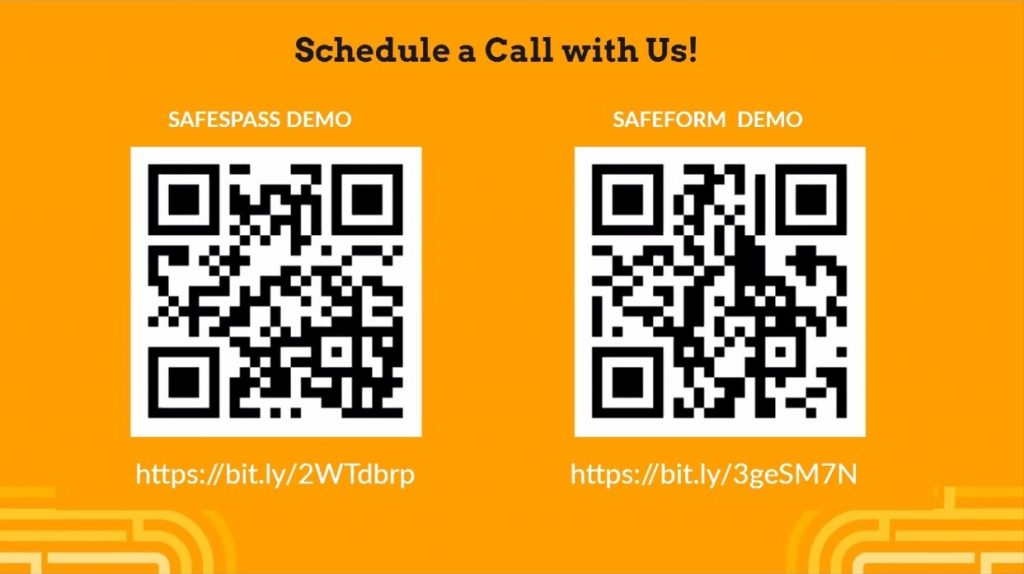
The entry level plan for SafePass is free for one establishment. Scan the QR codes below to book a free demo for either system or email una@unawa.asia.

FHMoms, serving and empowering the nation’s working mothers

MK Bertulfo had had enough of her daily grind as a working mother. Caught between rush hours for a call center job that barely paid the bills and tending to a baby that would cry whenever she left the door, she knew she needed to find a new way to support her family.

One inspired night, she decided to respond to an online job listing from a Canadian tattoo shop looking for email support. To her surprise, she got called for an interview a few hours later. It was the first of many similar, well-paying jobs she would end up taking—jobs she could do from home, earning her the time for her family and financial freedom that she, and so many women in her position, yearned for.

In 2017, one of her friends, who had also worked at a call center, had a baby. Bertulfo knew she had an entire playbook of tips she could share to help her friend out. But, realizing that this struggle they shared was a universal one, she decided to create a Facebook group to share those strategies with all her mommy friends. The small group quickly ballooned to encompass more than 195,000 members from all over the country, all looking to Bertulfo for career advice.

Before long, she was flying out from Metro Manila to as far as Zamboanga every week, holding seminars, with her baby in tow. She even started conducting online training sessions for mothers who lived in far-flung areas.

In the span of two years, Bertulfo ‘s online support group grew into a full-fledged business: Filipina Homebased Moms (FHMoms).

Tailor-fitted learning

Today, FHMoms has expanded beyond a simple support group, now offering market research services for brands looking for insights from working mothers. They also offer recruitment services, partnering with a BPO looking for call center agents among the group’s members.

But staying true to its original purpose, FHMoms is still primarily an e-learning platform for mothers, offering courses including:

– social media marketing,
– local and international e-commerce,
– photo and video editing,
– writing
– and basic SEO.

“We wanted them to choose the online course that they like,” Bertulfo said. “The idea is like it’s school where you only focus on one field, unlike other e-learning platforms that offer courses in bundles.”

“Our trainers are also mommies, so it’s more personal and they can relate [to their students],” said Bertulfo. “And our courses and platform are designed for busy moms… That’s why they like [the courses], because once they’re done with their chores at home, for example, they’re more encouraged to study.”

For those unable to take advantage of their online courses, FHMoms also does on-site training sessions.

Keeping mommies at heart

But beyond new revenue streams and the better lifestyles that come with it, Bertulfo shared that it’s the sense of pride and dignity that the members of her community—many of whom were never able to finish school—have really come to appreciate. For one member, a single mother and PWD, her life changed when she was able to secure a post as a virtual assistant. For another, her nine-year stretch of unemployment finally came to an end with a writing gig she secured through the community.

“When I started this, all I had in mind then was my officemates, my friends,” said Bertulfo, believing her personal connection with her community has been instrumental to her success. “Because of that, I was able to create a culture and environment for the community that was more genuine, that wasn’t too focused on business and money.”

“It was such a big help that my market represents who I really am. So it wasn’t hard to solve the problems because I understood them, I had experienced them, and I was able to come up with these solutions myself.”

Factory activity slide eases in May

The Philippines manufacturing purchasing managers’ index (PMI) saw a softer decline in operating conditions in May, according to IHS Markit. — REUTERS

FACTORY activity remained in contraction for a third straight month in May, but at slower pace than April’s crash, as the lockdown continued to disrupt manufacturing firms’ operations.

IHS Markit on Monday said the Philippines manufacturing Purchasing Managers’ Index (PMI) improved to 40.1 last month from April’s record low of 31.6, as “easing of measures in some regions helped the rate of contraction in production soften from April.”

“Despite the improvement, the reading still pointed to a sharp deterioration in operating conditions across the manufacturing sector, the third in as many months,” IHS Markit said in a statement.

A PMI reading below 50 signals deterioration in operating conditions compared to the preceding month, while a reading above 50 denotes improvement.

The headline PMI measures manufacturing conditions through the weighted average of five indices: new orders (30%), output (25%), employment (20%), suppliers’ delivery times (15%) and stocks of purchases (10%).

Manufacturing purchasing managers’ index of select ASEAN economies, May (2020)

Manufacturing conditions in countries across the region all rebounded in May from the record lows recorded in April, but still remained below 50. Malaysia reported a marked improvement to 45.6 last month from 29 in April, followed by Vietnam’s 42.7, Thailand’s 41.6 and Myanmar’s 38.9.

As of press time, data for Indonesia and Singapore are not yet available.

IHS Markit attributed the muted production levels in the Philippines to lockdown measures that continued through May in some parts of the country, including Metro Manila and Calabarzon (Cavite, Laguna, Batangas, Rizal, and Quezon). Other provinces shifted to a more relaxed quarantine, which allowed more businesses to reopen.

“Yet conditions have still not recovered, with restrictions in the capital and other cities broadly the same since April, in part leading to another sharp fall in new order volumes,” David Owen, an economist at IHS Markit, was quoted as saying.

“Only the lifting of measures in rural areas helped to slow the decline. Employment continued to drop amid excess capacity, further hampering demand conditions,” he added.

IHS Markit said capacity of factories was still “lower than normal” in May as companies implemented physical distancing measures. Companies were also reluctant to increase output as new orders remained weak.

“Demand for manufactured goods continued to fall during the month, with the latest decrease softer than that seen in April but still the second-sharpest since the series began in January 2016,” it said.

Firms reported weaker sales here and abroad due to the lockdown, forcing companies to cut back buying activities and reduce inventories.

“That said, the drop in inventories of raw materials and semi-finished items eased as some manufacturers raised holdings in anticipation of a nationwide lifting of lockdown measures,” IHS Markit said.

With travel bans and checkpoints around the country, deliveries of materials continue to be delayed with lead times rising “substantially and for the tenth month running.”

Employment fell for the fourth time in five months in May, as companies operated with only skeletal workforce.

“The fall in new orders meant that capacity to complete backlogs remained sufficient, although outstanding work dropped only marginally and at the softest pace in over four years,” it added.

IHS Markit noted the manufacturers reported a rise in input costs in May due to more expensive raw materials, although lower fuel prices cushioned the impact.

“Price pressures began to inflate in May after marked decreases during March and April. Raw material prices rose slightly as reductions in global supply started to outweigh weaker demand and lead to difficulties in acquiring inputs,” Mr. Owen said. “Output prices also increased, but firms tried to keep charge inflation low, hoping this would encourage an improvement in sales once demand conditions have returned to normal.”

IHS Markit said it saw improvement on the “degree of sentiment regarding output in a year’s time” as firms were encouraged on partial lifting of lockdown and cases of coronavirus disease 2019 (COVID-19) “being kept under control.”

“Firms hoped that the introduction of new products would also drive activity higher,” it said.

According to think tank Capital Economics, the PMI readings across Emerging Asia, which includes the Philippines, may “not accurately reflect the change in industry conditions last month, but they are still indicative of the fact that output remains very depressed.”

Meanwhile, Capital Economics said in a note that conditions in the manufacturing sector “worsened from April to May” as readings were below 50.

“While PMI readings are unusually hard to interpret this month, the bigger picture remains the same — the region’s manufacturing sector is in a deep recession. Industry is likely to have seen an initial jump from the easing of lockdown restrictions. And things are likely to continue improving very gradually over the coming months as external demand recovers,” the think tank’s economist Alex Holmes said.

ING Bank N.V. Manila Senior Economist Nicholas Antonio T. Mapa said the improvement in factory activity in May is still a “welcome sign” that output and new orders rebounded from the low April levels, which could signal a “start of the recovery and one step towards expansion.”

“With some parts of the country allowed to restart limited manufacturing in mid-May, output improved from April’s lows where almost 70% of the economy was shuttered as we sheltered in place. New orders also picked up, offering us clear indications that June activity will post a second month of improvement as lockdown measures were eased in NCR, hopefully in expansion territory as we look to salvage the year,” Mr. Mapa said via e-mail.

Capital Economics said output will likely still settle below normal levels “for many months to come” as demand both locally and globally will remain “very depressed.” — Beatrice M. Laforga

Manufacturing purchasing managers’ index of select ASEAN economies, May (2020)

FACTORY activity remained in contraction for a third straight month in May, but at slower pace than April’s crash, as the lockdown continued to disrupt manufacturing firms’ operations. Read the full story.

Manufacturing purchasing managers’ index of select ASEAN economies, May (2020)