Home Blog Page 947

New law creates framework, body for safe nuclear use in PHL

STOCK PHOTO | Image by Lukáš Lehotský from Unsplash

PRESIDENT Ferdinand R. Marcos, Jr. signed a measure establishing a national framework for the peaceful and secure use of nuclear energy, expected to accelerate its integration in the country’s power mix.

Signed on Sept. 18, Republic Act No. 12305, the Philippine National Nuclear Energy Safety Act, creates the Philippine Atomic Energy Regulatory Authority (PhilATOM), an independent quasi-judicial body tasked with overseeing all nuclear and radiation activities in the country.

Under the law, PhilATOM will hold sole and exclusive jurisdiction over the regulation of nuclear energy and radiation sources in the Philippines, ensuring their peaceful, safe and secure use.

The new body will consolidate regulatory functions from other agencies and serve as the country’s official counterpart to the International Atomic Energy Agency (IAEA).

Its leadership will consist of a Director General, appointed by the President for a five-year term, supported by four deputy directors general who are likewise presidential appointees.

The PhilATOM will have the power to craft implementing rules, safety standards, and guidelines, and to enforce them through inspections, violation notices, and penalties.

It may also suspend, modify, or revoke authorizations following due process in cases of noncompliance with the law or its regulations.

The new measure affirms the government’s commitment to promoting the peaceful, safe, and secure use of atomic energy to advance national interests in areas such as power generation, healthcare, scientific research, agriculture, industry and education.

At the same time, it imposes a strict prohibition on military or non-civilian applications, making clear that nuclear energy may only be used for peaceful purposes and that any facilities or activities related to nuclear weapons, radiological dispersal devices, or other non-peaceful uses are expressly forbidden.

Republic Act No. 12305 mandates authorization for all nuclear-related projects, including the construction, operation, commissioning, and decommissioning of nuclear or radiation facilities and their associated activities. 

To strengthen preparedness for nuclear or radiological emergencies, the law calls for a national response plan — integrated into the National Disaster Risk Reduction and Management Council framework — to mitigate the impact of incidents both within and beyond Philippine territory.

In line with the country’s commitments under the IAEA Safeguards Agreements and Additional Protocol, the law requires oversight of all nuclear activities.

The PhilATOM is tasked with creating a national registry of radioactive waste and spent fuel, covering regulation, documentation, and long-term oversight of disposal sites.

POWER MIX
The Department of Energy (DoE) expects the measure to help boost the integration of nuclear energy into the national power mix.

“The passage of RA 12305 strengthens the regulatory framework that will enable the safe and secure peaceful use of nuclear energy in the country. The law modernizes nuclear regulation consistent with the latest International Atomic Energy Agency (IAEA) standards and global best practices,” Energy Secretary Sharon S. Garin said in a statement on Thursday.

The DoE said that the creation of PhilATOM is crucial to “ensuring that all aspects of nuclear energy infrastructure, such as site selection, construction, licensing, safety, and eventual operation are thoroughly and effectively regulated by a competent authority.”

The generation of electricity from nuclear energy will remain subject to the Electric Power Industry Reform Act and under the regulatory oversight of the DoE and the Energy Regulatory Commission.

The Philippines has been elected to the board of the IAEA, an international organization that works to promote the peaceful use of nuclear energy.

As one of only 35 member-states represented on the board, the Philippines will help steer key decisions on safeguards and technical cooperation.

“The Philippines’ participation in the IAEA Board and the passage of the PhilATOM law demonstrate the country’s commitment to science, innovation, and sustainable development,” Ms. Garin said.

Under the Philippine Energy Plan, the country’s first nuclear power plant is set to be built by 2032. — Chloe Mari A. Hufana and Sheldeen Joy Talavera


Marcos underscores little progress in SCS as he bids Chinese envoy farewell

PRESIDENT Ferdinand R. Marcos, Jr. Received His Excellency Huang Xilian, outgoing Ambassador of the People’s Republic of China, for a farewell call at the Study Room in Malacañan Palace, Sept. 25, 2025. — YUMMIE DINGDING / PPA POOL

By Chloe Mari A. Hufana, Reporter

PHILIPPINE President Ferdinand R. Marcos, Jr. on Thursday expressed appreciation to outgoing Chinese Ambassador Huang Xilian, acknowledging his service in Manila while noting the little progress in resolving tensions in the South China Sea (SCS).

“It’s unfortunate we didn’t make much progress of the difficulties that we have in the South China Sea, West Philippine Sea,” he said during the ambassador’s farewell call in Malacañang.

“Considering how difficult the situation was, that we have managed to keep things at least away from too much problem,” he added.

Both countries have been engaged in a diplomatic standstill as China continues to harass Philippine vessels in the disputed waterway despite a 2016 arbitral ruling in favor of Manila.

Diplomacy lecturer at De La Salle-College of St. Benilde Josue Raphael J. Cortez said the Philippines and China have made progress since the Ramos administration’s adoption of the Declaration of Parties on the South China Sea, with the 2017 Bilateral Consultation Mechanism serving as a testament to their efforts to manage relations.

However, Beijing continues to disregard the 2016 Arbitral Award and Filipino fishing rights in the South China Sea, leaving much to be addressed, including the need for a binding Code of Conduct and respect for Manila’s territorial integrity, he noted.

Mr. Marcos aims to push for a legally binding Code of Conduct in the waterway when Manila assumes chairmanship of the Association of Southeast Asian Nations (ASEAN) in 2026.

While economic relations may deepen given the role of the Chinese Communist Party (CCP) and Chinese state-owned enterprises, Beijing is unlikely to concede sovereignty, as this would be seen as weakness and undermine the Party’s credibility amid internal challenges and an unclear succession plan, Mr. Cortez added.

“However, concerning the dispute over the West Philippine Sea, the CCP would not easily give away and honor the sovereignty of the Philippines as it would also show ‘weakness’ for their part,” he said via Facebook Messenger.

“With no clear succession plan for the next Chinese regime, this is something that CCP would not want to happen: that they show respect for the country’s territorial integrity over the disputed waters, which in turn could further challenge the Party’s credibility given the internal challenges China currently faces.”

Mr. Huang has been China’s envoy to the Philippines since 2019. During his tenure, he was repeatedly summoned by the Department of Foreign Affairs to explain Beijing’s actions in the disputed territory.

Fighter jets plan still in limbo

KOREA Aerospace Industries FA-50 fighter jets — M.KOREAAERO.COM

THE Philippine Defense department’s plan to procure multi-role fighter jets remains in limbo due to persistent funding shortfalls, a congressman said on Thursday, delaying the selection of jets needed for the military modernization program amid lingering tensions in the South China Sea.

Defense officials have yet to make progress in selecting the advanced jets, despite receiving offers from several defense suppliers, Negros Occidental Mercedes K. Alvarez said.

“The greatest challenge we face is that there is limitation on the funding,” she told the House of Representatives plenary.

The Philippines has been scouting for coveted multi-role combat jets as part of efforts to boost its inventory of air force planes, which mainly consist of turboprops.

Defense Secretary Gilberto C. Teodoro, Jr. said in July the government is ready to make a decision on the advanced fighter jets, but funding gaps remain to be the biggest stumbling block to its purchase.

Manila has launched a $35-billion (P2 trillion) military modernization program aimed at bolstering its defense capabilities in the next decade, including the acquisition of advanced naval ships, planes and missile systems, as it pushes back against Beijing’s military might in the region. — Kenneth Christiane L. Basilio

NCR dev’t plan finalized next year

Condominium and office buildings are seen in the Ortigas Business District, April 4, 2025. — PHILIPPINE STAR/MIGUEL DE GUZMAN

A METRO MANILA development plan is expected to be finalized by next year, providing planning authorities with a blueprint to manage the region’s growth, a congressman said on Thursday.

The Metropolitam Manila Development Authority (MMDA) has hired consultants to draft a comprehensive planning blueprint for the 14-million-strong metropolis, expected to be finished by March 2026, Makati City Rep. Monique Yazmin Maria Q. Lagdameo said.

The metropolitan authority will cascade the regional development framework to individual local governments to guide “physical planning” across the capital, she added, helping ensure alignment in infrastructure development strategies throughout the capital region.

“It will be a comprehensive and integrated regional physical framework plan which will serve as a blueprint in planning, implementing and managing programs, projects, and activities for Metropolitan Manila,” Ms. Lagdameo told the House of Representatives floor. — Kenneth Christiane L. Basilio

FNI chairman still detained

JOSEPH C. SY — GFNI.COM.PH

THE Bureau of Immigration (BI) has not yet released Global Ferronickel Holdings, Inc. (FNI) Chairman Joseph Sy, despite orders by the Court of Appeals (CA), the company said.

The CA on Wednesday ordered the immediate release of Mr. Sy, giving the bureau 5 days from the receipt of the resolution to comply.

“While, the BI has yet to comply with this directive, the Company views this development as a strong affirmation of the rule of law and the constitutional protection guaranteed by the writ of habeas corpus,” FNI said in a disclosure on Thursday.

“It underscores that the rights of citizens are safeguarded against overreach and that judicial institutions remain firm in upholding established legal principles.”

FNI issued the disclosure to clarify it has not received any official notification from the BI that it elevated the case to the Supreme Court as opposed to a Sept. 24 news article.

Mr. Sy was taken into custody on Aug. 21 for allegedly holding fraudulent Philippine documents and having biometrics that matched those of a Chinese citizen. — Andre Christopher H. Alampay

Classroom backlogs to widen

PRESIDENT Ferdinand R. Marcos, Jr. led the Brigada Eskwela 2025 on Monday at the Barihan Elementary School in Malolos City, Bulacan on June 9, 2025. — YUMMIE DINGDING / PPA POOL

A TEACHERS’ group on Thursday said the classroom backlogs will continue to widen due to insufficient target construction for 2026, the rapid increase in enrollment rate, and substandard facilities.

“We need 50,000 annually to address the 165,000 classroom backlogs,” Alliance of Concerned Teachers (ACT) National Capital Region President Ruby Ana Bernardo told BusinessWorld in a Facebook message on Thursday.

“During the budget hearing, the target classrooms for 2026 increased from 4,000 to over 13,000,” she said. “Far too slow to keep up with growing enrollment.”

Ms. Bernardo added that the situation has been aggravated by unfinished and substandard classrooms built by the Department of Public Works and Highways (DPWH).

“While billions are being wasted on corruption-riddled projects like flood control infrastructure, our schools continue to deteriorate and remain neglected,” she said. “How can we improve the quality of education if classrooms themselves cannot be built, and those that are built are substandard?”

Education Secretary Juan Edgardo “Sonny” M. Angara revealed that over 1,000 classrooms turned over by the DPWH to the Department of Education (DepEd) are incomplete.

In line with Mr. Angara’s statement, former DPWH assistant engineer Brice Ericson P. Hernandez said last Tuesday that all projects, including classrooms, in the first district of Bulacan from 2019 to 2025 are substandard or “under-designed.”

“This confession confirms what we have long suspected — that our students and teachers are being shortchanged by substandard school buildings built with taxpayers’ money,” Ms. Bernardo said.

“This is why many school buildings, aside from being unusable, are also hazardous and unsafe for students and teachers,” she added.

In the House version of DepEd’s 2026 budget, a special provision allows the department to implement school building projects through its own engineers, or in partnership with the DPWH, local government units, or public-private partnerships.

The approved House budget for classroom construction is P22.5 billion, nearly seven times higher than the proposed P3.28 billion during the budget deliberations. — Almira Louise S. Martinez

Release of minors nabbed in Sept. 21 protest sought

A MAN waves a Philippine flag after young demonstrators staged a violent act along Ayala Bridge near Malacañang compound on Sunday, Sept. 21, 2025. — PHILIPPINE STAR/NOEL PABALATE

HUMAN RIGHTS lawyers on Thursday filed an urgent motion before the Manila City Prosecutor’s Office seeking the dismissal of complaints and immediate release of individuals, including minors, arrested during the Sept. 21 protest actions.

In a joint filing, the National Union of Peoples’ Lawyers (NUPL), Public Interest Law Center (PILC), and Sentro para sa Tunay na Repormang Agraryo (SENTRA) argued that the respondents were apprehended without warrants and detained beyond the period allowed under Article 125 of the Revised Penal Code.

“As of the filing of the motion, those arrested have been in continuous police custody,” Atty. Julianne Agpalo of NUPL told BusinessWorld via Viber chat. “The majority only underwent inquest proceedings on Sept. 23, others just yesterday, and a few today. ALL must be released because that is beyond 36 hours.”

The lawyers added that the complaints — citing illegal assemblies, direct assault, resistance and disobedience, tumultuous disturbance, and the Public Assembly Act — fail to establish a prima facie case, meaning there is not enough evidence to proceed.

“Many of those arrested were peaceful participants or mere bystanders,” the lawyers said in a statement. They added that some were residents or passersby caught in the crackdown. They also alleged violations of the Juvenile Justice and Welfare Act (RA 9344), stressing that minors should not have been subjected to criminal complaints.

Manila City Mayor Francisco “Isko” M. Domagoso earlier vowed to pursue criminal and civil cases against those arrested, citing damage to public and private property during the protests. The Manila Police District reported that masked demonstrators hurled projectiles, burned debris, and clashed with law enforcers in Rizal Park, Ayala Bridge, and Mendiola.

Rights advocates, however, described the crackdown as marked by arbitrary arrests, violence, and continuing rights violations.

The Sept. 21 mobilizations drew thousands in Manila in what was described as the biggest protest so far against the alleged multi-billion-peso flood control scandal, coinciding with the 53rd anniversary of the Martial Law declaration. — Erika Mae P. Sinaking

Rape, lasciviousness complaints filed vs Marikina lawmaker

BW FILE PHOTO

THE Department of Justice (DoJ) on Thursday said it received two complaints of alleged sexual misconduct against a sitting lawmaker.

DoJ spokesperson Jose Dominic F. Clavano said in a statement that the complaints were filed against Marikina Rep. Marcelino Reyes Teodoro by two female police officers who worked as his personal security at different times. One alleged acts of lasciviousness, while the other accused him of rape and lascivious acts.

Mr. Clavano said the complaints will undergo case build-up and legal evaluation under DoJ Circular No. 20 (2023) to determine if there is enough evidence before a preliminary investigation. He added that the process ensures any action will be based on a complete and substantiated record.

The DoJ also said the lawmaker will be afforded due process, while the identities of the complainants are being withheld to protect their privacy and security.

In a response, Mr. Teodoro denied the accusations, calling them “malicious and untrue.” He said the allegations have no basis, were fabricated to damage his reputation, and appear to be a “politically motivated attack.”

The lawmaker added that he has not yet received a formal copy of the complaint and stressed that allegations are not evidence.

“I call and hope for an impartial, transparent, and open investigation to protect my reputation,” he said, noting that he has been facing “continuous attacks.” — Erika Mae P. Sinaking

Public school teachers among recipients of bonuses — DBM

BW FILE PHOTO

THE Department of Budget and Management (DBM) said the Department of Education (DepEd) personnel and public-school teachers are among government workers set to receive performance-based bonuses along uniformed personnel.

In a statement on Thursday, the DBM confirmed that teachers will also be included to government officials set to receive Performance-Based Bonus (PBB) for 2023, initially announced for army personnel.

“I’m happy to announce to our colleagues at the DepEd, especially our teachers, that after thorough deliberation, they have been confirmed eligible to receive their Performance-Based Bonus for the year 2023,” Budget Secretary Amenah F. Pangandaman said.

The DBM earlier approved the release of P1.64 billion for the PBB of 110,688 eligible Armed Forces of the Philippines — Philippine Army (AFP-PA) employees.

In the recent plenary deliberations on the General Appropriations Bill (GAB), the DBM, through House Committee on Appropriations Chair Mikaela Angela B. Suansing, confirmed that the Technical Working Group on Executive Order No. 61 is scheduled to meet on Sept. 30 to formally issue a resolution declaring DepEd eligible for the grant of the 2023 PBB.

“They will have a Technical Working Group meeting on September 30, during which, they will finalize this and they will come up with a resolution formalizing that fact — that the teachers are indeed eligible for the Performance-Based Bonus,” Ms. Suansing said. — Aubrey Rose A. Inosante

Baguio Council to quiz Discayas over P110-M tennis court, parking building

BAGUIO CITY — The Baguio City Council will summon the Discaya couple to explain the involvement of the St. Gerrard Construction company in the P110-million Burnham Park tennis court and parking building project, which has drawn criticism for poor quality and lack of transparency.

Vice Mayor Faustino A. Olowan said the invitation aims to clarify the group’s role in the controversial project, which was already inaugurated last May despite ongoing complaints.

The firm was reportedly blacklisted in 2020, raising questions about how it secured the contract — particularly under Mayor Benjamin B. Magalong.

Mr. Olowan said, “We need to set the facts straight,” with several councilors backing a resolution to formally summon the Discayas in the next session.

Facing public pressure, Mayor Magalong has since called for an independent third-party probe. “This is about protecting public interest,” he said, though he earlier defended the project’s legality.

Lawyer Francis Camtugan, who first flagged the issue, believes local officials — including the Bids and Awards Committee — must also be held accountable. He stressed the need for full transparency of all project documents.

Mr. Camtugan also warned that summoning the Discayas could create a “security nightmare” and asked, “Are we ready to pay the price?” — Artemio A. Dumlao

Potential entrants sending telecom investment feelers

BW FILE PHOTO

By Ashley Erika O. Jose, Reporter

AT LEAST FOUR foreign companies have signified their interest in entering the telecommunications industry following the passage of the Konektadong Pinoy Act, the Department of Information and Communications Technology (DICT) said.

It added that the implementing rules and regulations (IRR) for the law are due for release by  the end of October.

“We are on track… final comments (on the draft IRR) will be submitted by the first of October. From there it’s due for publication. Before the end of October, (the IRR) should be out,” Information and Communications Technology Secretary Henry Rhoel R. Aguda told reporters on the sidelines of Arangkada Philippines Investment Forum 2025 Thursday.

The Konektadong Pinoy Act, or the Open Access in Data Transmission Act, lapsed into law in August. It streamlines the licensing process for new entrants, boosting competition in data transmission.

He did not identify the four potential entrants, saying only that they are from the US, Japan, India, and the Middle East.

Mr. Aguda said the IRR will address the concerns  raised by incumbents, who participated actively in drafting the IRR.

The Philippine Chamber of Telecommunications Operators has said that some provisions of the law undermine regulatory oversight and fair competition, noting that the law only requires entrants to obtain cybersecurity certification after two years of operations.

The IRR will set security standards applicable to all, incumbents and new entrants alike, he said.

New entrants will also be directed to underserved markets or the geographically isolated and disadvantaged areas (GIDA).

“Part of the IRR is to encourage them to operate in areas without connectivity,” Mr. Aguda said.

Mr. Aguda has said that some foreign companies like Elon Musk’s Starlink have signified their interest in helping prepare the IRR.

Public works slowdown starting to affect sales of European suppliers

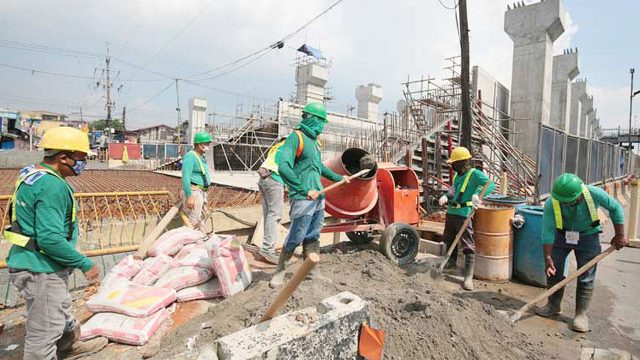
Workers are seen mixing cement at a construction site in Quezon City, May 19, 2020. — PHILIPPINE STAR/ MICHAEL VARCAS

EUROPEAN COMPANIES, particularly those involved in construction, are reporting a slowdown in orders as an offshoot of the corruption scandal in public works, the European Chamber of Commerce of the Philippines (ECCP) said.

Florian Gottein, ECCP executive director, said some members of the chamber produce materials  used for infrastructure projects.

“Because some of those projects are now being put on hold, they have experienced a reduction in sales, and it might go on for the next couple of weeks and months,” he told reporters on the sidelines of the Arangkada Forum on Thursday.

Such concerns are being raised by European firms doing business in the Philippines rather than those that are yet to invest in the country, he said.

“But the matter has also made it to the news in our respective home countries. And definitely it is not the best picture we are sending out there,” he added.

He said that the business community is still gauging how far the allegations will go, whether they affect only involve flood control projects or other categories of infrastructure as well.

“For now, we are still in a wait-and-see position…The chambers have made statements that it is definitely not a conducive environment for business here, but we trust in the government and the responsible organizations to investigate and immediately act on their findings as well,” he added.

Asked how corruption will affect free trade agreement negotiations, he said the government must act quickly to investigate and determine the next steps.

“We also hope that we will see safeguards in place that will prevent similar situations from happening again in the future,” he added

He said that ease of doing business (EoDB) remains a top concern for European investors in the Philippines, even more than corruption.

“Corruption is one topic, but I think what is really of more concern to our members is the EoDB,” he said.

“We have a beautiful EoDB law, but I think many of our members are struggling with its proper enforcement, proper implementation, or the lack thereof,” he added.

He also said that the cost of doing business in the Philippines is also a concern for investors.

“If you compare the cost of doing business here in the country to other countries in the region, it is higher here, and I think corruption plays into that,” he said.

“When you want to participate in government-funded projects, there are kickbacks, and what we see now is 25-30% of the project cost is being siphoned off. It also plays into the topic of why the cost of doing business is so high in the Philippines,” he added.

In its Reform in Motion: 15 Years of Arangkada and the Road Ahead policy book, the Joint Foreign Chambers of Commerce of the Philippines (JFC) presented its priority executive actions.

These include the improved implementation of the EoDB Act, the Corporate Recovery and Tax Incentives for Enterprises to Maximize Opportunities for Reinvigorating the Economy (CREATE MORE) Act, and the Ease of Paying Taxes Act.

It also asked for a reconsideration of the use of digital and integrated systems for the pre-border technical verification and cross-border electronic invoicing of all imported commodities and Food and Drug Administration revised registration fees, as well as streamlined travel requirements and visa applications.

It also sought a review of taxes on non-resident foreign corporations and the Extended Producers’ Responsibility Act. — Justine Irish D. Tabile

ADVERTISEMENT
ADVERTISEMENT