

Home Blog Page 9455

Quarantine is terrible, but it works

By Mark Buchanan

IN MARCH, many governments around the world imposed strict controls on human meetings and movement — “lockdowns” — to slow the spread of coronavirus. The pandemic’s curves were soon “flattened,” sparing health services from being overrun. Now, in China, Europe, the US, and elsewhere, authorities are cautiously relaxing the rules. Lockdowns have been costly, but they helped us avoid a far worse catastrophe.

Yet our very success — tenuous as it is — has suddenly stirred contrarian voices, with some pondering the possibility that the lockdowns may not have had much effect. Statistician William Briggs insists that “there’s no evidence the lockdown made a difference,” noting that the virus waned even in some nations — Taiwan, for example — that did not go into lockdown. An article in a right-wing British newspaper insists that there’s not even a “shred of real proof” the lockdown did any good.

None of this should be taken seriously. The position flies in the face of overwhelming evidence, and accepting it requires the commission of a litany of basic errors in reasoning.

To begin with, Briggs relies on a terrible statistical argument, citing the lack of a strong correlation between the number of coronavirus deaths in a nation and its imposition of a lockdown policy. The UK imposed a lockdown yet has still had the second-highest death rate per capita of any nation. No-lockdown Taiwan, in contrast, had very few deaths. On a graph of lockdown or no lockdown versus epidemic outcome, there’s no clear pattern, so Briggs thinks: “What can we conclude? Only one thing: We cannot conclude that lockdowns worked.”

Yes — if we only consider this kind of misguided statistical comparison. We shouldn’t expect any clear correlation, because we know that lots of other factors matter besides lockdown or no lockdown, including the timing of the lockdown and the presence (or absence) of an effective public-health service to carry out testing, contact tracing, and quarantining of the infected.

Take timing. Of countries taking similar measures, those that acted earlier were more successful in containing the epidemic. New Zealand, instituting lockdown when it had only 102 cases, has had 22 deaths. On March 16, the UK had 3,000 confirmed cases yet delayed lockdown for another week. This one-week delay, a recent study in pre-print estimates, caused roughly 28,000 further, avoidable deaths. Not really surprising, as the number of infected was doubling every three to four days at the time.

If lockdowns were effective, why did some nations without lockdowns have very few deaths? Obviously lockdown isn’t the only way to fight the spread of an epidemic. Some nations didn’t lock down because they didn’t need to. South Korea, Hong Kong, and Canada each had very-well-developed infrastructure for aggressive testing, tracing, and quarantining. They applied more precise anti-epidemic tools than others did.

If lockdown didn’t make any difference, then why, in all the nations imposing lockdowns, did the growth rate of the epidemic soon show marked reductions? Take China, the US, the UK, Spain, France, Italy — each shows the same pattern of sharp change in growth rate soon after lockdown. Is this just a weird coincidence?

There is one conceivable alternative explanation: that the epidemic slowed everywhere as enough people became infected and populations reached herd immunity. Exponential growth of a new epidemic does normally slow when so many get infected that the virus has a harder time finding new uninfected targets. But the evidence weighs heavily against this idea. Estimates in Spain and France find about 5% of their populations may have been infected by early May. The number is similar for the UKoverall, rising to perhaps 15% in London. This isn’t close to herd immunity, with almost everyone in the population remaining susceptible.

Aside from all this evidence, it’s also just very hard to imagine how a lockdown, which greatly reduces the frequency of human contact, could possibly fail to have an impact on the spread of an infectious agent. This is epidemiology in another universe. Indeed, scientists have clearly seen the effects of lockdown on this year’s flu in Northern Hemisphere countries. In January, we had expected this year to be among the worst flu seasons in several decades. But the number of flu infections dropped sharply in April, not long after COVID-19 lockdowns were imposed. Another weird coincidence?

It is hard to understand the motivation for “lockdowns had no effect” thinking. Of course lockdown is unpleasant. It has been socially and economically costly. But it never had any effect? That’s about as plausible as COVID-19 being caused by 5G microwave signals.

BLOOMBERG OPINION

Socially responsible partnership

Last week I saw a video circulating on Facebook of a bicycle shop owner giving a teary-eyed street vendor his dream bicycle after noticing that the man had been coming into the shop week after week just to ask about it. Last month, I read about a public-private sector initiative called Taskforce T3 that’s working with hospital groups to increase the country’s much needed COVID-19 testing capacity. A few months ago, there was also Project Ugnayan, a partnership of the country’s biggest businesses that raised over P1.7 billion to give grocery vouchers to millions of poor Filipino families affected by the lockdown. At the beginning of the lockdown, several public utility companies, like Meralco, also announced that they would continue to provide their services while also extending payment deadlines to help affected users.

These stories remind us that there are a lot of businesses out there, both big and small, that aren’t just about making a profit, but that are also committed to being truly socially responsible. It is companies like these that have the spirit of social responsibility that can serve as reliable partners of the government in responding to the pandemic and beyond. This is something important for the government to keep in mind now that it looks to jumpstart the nation’s economy with a renewed focus on Public-Private Partnerships (PPP), an arrangement that involves government and businesses working together and sharing the risks of completing a project or providing a service.

If you recall, President Rodrigo Duterte had originally moved away from the PPP program at the beginning of his term, deciding instead to fund infrastructure development through the national budget and loans from countries like China and Japan. However, due to the economic impact of the pandemic, the administration seems to have reconsidered its position and has increased the number of PPP-funded projects to beef-up its PH PROGRESO recovery program.

Unsurprisingly, the newfound openness of the government towards PPPs was welcomed by the participants of a recent roundtable discussion organized by Stratbase-ADR Institute. Speaking at the event, Prof. Dindo Manhit, President of Stratbase ADR Institute said, “By harnessing the private sector’s support to invest in public infrastructure across the country, our government can appropriately revise and sustain the BBB (Build, Build, Build) program with due consideration to public health, education and social services.”

Rep. Edgard Mary Sarmiento, who was there to share his insight as Chairperson of the House Committee on Transportation, said he believed in the power of the private sector to boost the Philippine economy and cited recent PPP projects such as the Cavite Barge Terminal of ICTSI, the LRT line 1 extension of Ayala and Metro Pacific, and CALAX of MPIC Tollways as examples of private companies working “hand in hand” with the Transportation and Public Works departments to deliver better infrastructure to the people.

Senator Grace Poe, who also participated in the roundtable discussion, spoke about the financial advantages of PPP projects and how these projects can free up government funds to spend on health care and poverty alleviation projects. However, Senator Poe also pointed out the need for good governance and a competitive and stable regulatory environment that respects the sanctity of contracts and rule of law to foster public-private collaboration.

She also had comments directed squarely at the private sector, appealing to them to take on the responsibility of behaving in a socially responsible manner when entering into PPPs with the government as the reluctance or openness of government towards PPP may depend on it.

This is why, now that the government is creating new policies to usher in economic growth in our new normal, it must ensure that a stable and competitive policy environment is created. This policy environment will be key in attracting the right kind of investors.

After all, it is not always easy to do the right thing. For example, the move of public utilities to continue providing services during the three-month lockdown without collecting any fees was indeed a socially responsible thing for them to do. In the case of Meralco, they’ve even decided to stagger the payment of unpaid dues during the lockdown into four equal monthly instalments to ease the burden on consumers. Despite its efforts, however, companies like Meralco, will likely still be criticized moving forward, simply because people just aren’t used to getting two bills from the same utility in a single month.

Doing the right thing is not always easy. This is why it is important to attract the right kind of investors and for the government to only partner with socially responsible organizations, ones that are out to serve not only their shareholders but the Filipino people as well.


Paco A. Pangalangan is the Executive Director of Stratbase ADR Institute.

Hydroxychloroquine farce has tragic consequences

By Lionel Laurent

“FOLLOW THE SCIENCE” — these are reassuring words in a pandemic like COVID-19, when widespread fear of a deadly virus can be exploited by unscrupulous politicians, snake-oil salesmen and cranks. Public trust in scientists has risen recently.

But we may be hitting the limits of this trust, just as many countries enter the crucial phase of reopening their economies with a raft of new social-distancing measures meant to ward off a second wave of infections. We’ve seen several confusing U-turns and unresolved debates on issues such as the effectiveness of cloth masks or the risks of reopening schools. Faith in authority is ebbing globally, even in high-trust countries like Sweden, where a famously hands-off approach to lockdown is spreading ripples of doubt. And now the messy rush to find a treatment that works — even if it means throwing long-standing scientific standards out of the window — is veering from farce to tragedy.

Last week, highly respected and peer-reviewed journal The Lancet retracted a bombshell study that suggested hydroxychloroquine, a contested potential treatment for COVID-19, was linked to an increased risk of death and heart ailments. The sheer scale of the retrospective analysis, drawn from more than 96,000 patients in 671 hospitals, had been enough to convince institutions running several global trials of the drug (including the World Health Organization) to slam on the brakes. Only afterward did odd inconsistencies in the data, such as an inflated number of victims in Australia, lead to questions about how exactly its provider, Surgisphere Corp., had compiled it. A lack of convincing answers — flagged by the paper’s own co-authors — led to the retraction. Other studies in other journals have subsequently been retracted.

This kind of embarrassment is nothing new, even for The Lancet, which in 2010 retracted a paper linking autism to vaccines — 12 years after it was first published. We should be thankful this case was dealt with quickly.

But the damage can’t be undone. Yet more precious time studying potential treatments for COVID-19 has been lost, and the retraction played into the hands of conspiracy theorists who promote the unsubstantiated idea that special interests want hydroxychloroquine, a generic drug, out of the running. (The drug’s top supporter, French scientist Didier Raoult, used the hashtag “#LancetGate” on social media.) Surgisphere has defended its approach to consolidating medical records using artificial intelligence and machine learning, according to Bloomberg News, and says it’s not responsible for the source data.

This is a wake-up call for how the public, the media, and the scientific community evaluate research, even the gold standard of peer-reviewed papers. In theory, it should be hard to game the system that underpins journals, which ask relevant experts to confidentially review papers ahead of publication. But, in practice, there are problems. Over the years, researchers have pointed to a lack of consistency and objectivity in responses by peers; a 2012 study found that when papers have been retracted there was often some kind of misconduct involved, including suspected or confirmed fraud. The lack of credit and scientific glory involved in reviewing a paper, along with the knowledge that other people will analyze the study too, might be hurting the quality of gate-keeping.

Whatever flaws already existed in scientific research have been supercharged by the pandemic. Hurried trials have sacrificed rigor for speed, and there has been a “rush to publish” the results in scientific journals, according to Jeffrey Aronson, clinical pharmacologist at the Center for Evidence-Based Medicine at Oxford University. In the case of hydroxychloroquine, the bias toward getting any kind of information out has led to hastily drawn conclusions on both its effectiveness and its dangers in treating COVID-19. That’s meant that the political and social-media fights over the drug have preceded clear results.

This has done sufferers of COVID-19 no favors: While the peak of the novel coronavirus outbreak has come and gone across most of Asia and Europe, major trials have been repeatedly delayed as exaggerated hype and conflicting studies make enrolling patients harder. We still don’t know how decisive a new UK study from Oxford published on Friday, finding that hydroxychloroquine offered no benefit, will be.

More caution, more rigor and more tightening of the peer-review system would be positive consequences of this debacle. But so much time has been lost already. The danger now is that if a severe flare-up in infections were to strike, we would still lack clear evidence of any existing, cheap treatment — and we would also have frittered away the public trust needed to successfully impose measures such as lockdowns or quarantines. “Follow the science” won’t be an effective rallying cry much longer.

BLOOMBERG OPINION

The new normal workplace

The COVID-19 global pandemic has not only struck people’s health, but also the economy, particularly the labor and employment sector. Based on reports by the International Labor Organization (ILO), COVID-19 is currently having a catastrophic effect globally on working hours and earnings. In the Asia Pacific region alone, the crisis is expected to wipe-out almost 125 million full-time employment or 7.2% of the workforce in the region.*

Locally, to avert economic collapse, the Philippine Government is trying its best to cope with the rigors of the pandemic. After having been placed under Enhanced Community Quarantine (ECQ) for more than two months, Metro Manila, the economic and political capital of the country, has now been placed under a less strict scheme of General Community Quarantine (GCQ) effective June 1 until June 15, unless otherwise extended.**

With the GCQ in place in Metro Manila and other regions, more industries and business enterprises are allowed to operate subject to compliance with strict health protocols. The Interim Guidelines on Workplace Prevention and Control of COVID-19 by the Department of Trade and Industry (DTI) and the Department of Labor and Employment (DoLE), require both workers and employers to abide by mandatory precautionary measures.

The DTI and DoLE Interim Guidelines have set minimum requirements for entry in all work premises: 1.) mandatory wearing of masks; 2.) accomplishment of daily health questionnaires; and, 3.) mandatory submission to temperature checks — where entry shall be allowed only for those with temperature of less than 37.5 degrees centigrade.*** Employers are likewise obliged to provide necessary company policies and resources for the prevention and control of COVID-19, which costs shall be borne by the employer.**** Monthly reporting of illness, diseases, and injuries by utilizing the DoLE Work Accident/Illness Report Form (WAIR) was also emphasized to be mandatory.****

On the other hand, the Department of Health (DoH), through its Interim Guidelines on Return-to-Work, has also reminded employers that all returning employees must be screened for symptoms of COVID-19. The DoH has provided for an action guide to aid in the screening of employees. In line with this, employers are further given the option to conduct testing in a representative sample.*****

As a consequence of returning to work, the question of whether an employer may initiate COVID-19 testing of its employees becomes relevant. The DoH Interim Guidelines state that employers may test workers for COVID-19, provided that testing kits used and procured shall be the responsibility of the employer.***** However, in no case shall testing be a condition for returning to work.******

Apart from precautionary protocols, the DoLE has introduced measures on how to deal with decreasing total working hours and earnings. Alternative Work Schemes or Flexible Work Arrangements (FWA) are emphasized and encouraged. The more recent DoLE Labor Advisory No. 17 provided for better FWA options. On top of it, employers are now given the opportunity to enter into a Wage and Wage-related Benefits Adjustment Agreement with their employees that is temporary in nature.*******

Government agencies continue to formulate rules and policies relative to COVID-19 prevention and control. Labor policies continue to adapt to changing environmental circumstances, with the end view of helping everyone in the industry. From the words of Guy Ryder, Director General of ILO, it is believed that “this is the greatest test for international cooperation in more than 75 years.” Hence, all must collaborate and do their respective roles to help the nation overcome the pandemic. May all work together and abide by state protocols and rules as the Philippines shifts to and deals, probably for years, with the so called “New Normal.”

* International Labor Organization (Geneva): COVID-19 and the world of work. 2nd Edition

** Inter-Agency Task Force on the Management of Emerging Infectious Diseases (IATF) Resolution No. 41

*** Department of Trade and Industry and Department of Labor and Employment Guidelines on Workplace Prevention and Control of COVID-19

**** Department of Labor and Employment Labor Advisory No. 18 Series of 2020

***** Department of Health Memorandum Circular 2020-0220: Interim Guidelines on Return-to-Work

****** Inter-Agency Task Force on the Management of Emerging Infectious Diseases (IATF) Resolution No. 37: Omnibus Guidelines on the Implementation of Community Quarantine in the Philippines

******* Department of Labor and Employment Labor Advisory No. 17 Series of 2020

The views and opinions expressed in this article are those of the author. This article is for general informational and educational purposes, and not offered as, and does not constitute, legal advice or legal opinion.


Agatha Josephine V. Matabuena is an Associate of the Labor and Employment Department of the Angara Abello Concepcion Regala & Cruz Law Offices (ACCRALAW).

avmatabuena@accralaw.com

(632) 8830-8000

PBA hopeful of favorable IATF response to request for return

THE PHILIPPINE Basketball Association said on Tuesday that it is hopeful of getting a favorable response from the Inter-Agency Task Force for the Management of Emerging Infectious Diseases (IATF) to the league’s request to resume some activities amid the coronavirus disease 2019 (COVID-19) pandemic.

Speaking to members of the Philippine Sportswriters Association in yesterday’s PSA online forum, PBA Commissioner Willie Marcial and his deputy and operations head Eric Castro said the league office had already sent its request to the IATF, the lead agency tasked to handle measures against COVID-19 and its effects, for the league to be allowed to squeeze in some activities, particularly for teams to be given the nod to have practices for conditioning.

Along with the request is the set of protocols the PBA has crafted to ensure proper health and safety measures are observed. The league said in coming up with the return rules it was guided by protocols set by concerned governing agencies, including those from health and sports.

Mr. Marcial reiterated that the league’s return to action all begins with IATF giving the thumbs-up for the PBA’s proposal for a phased-in resumption of activities.

“It all depends on the IATF. We have sent our letter of request to IATF and we’re just waiting for the response,” said the PBA chief, who held a meeting with the league board last week to discuss further moves they plan to take amid the pandemic.

“We’ll just wait for the response and see after. If even practices are not allowed, basketball may not push through at all. So, we’ll see,” he added, just as he said that they are willing to revise their proposal if the IATF sees the need for them to do so.

Mr. Marcial also shared the pandemic has surely affected the league in more ways than one, including financially as it has deprived them of income from gate receipts, TV broadcast and sponsorship, among others.

Nonetheless, they are hopeful of getting back to the stream and flowing anew. “Besides earning once again we want to come back to give fans hope. Maybe when they see the PBA back they can feel things are on the way of being okay. I’m sure they miss basketball a lot,” he said.

The PSA online forum was presented by San Miguel Corp., the Philippine Amusement and Gaming Corporation (PAGCOR), Amelie Hotel Manila, Braska Restaurant, Go For Gold, and powered by Smart. — Michael Angelo S. Murillo

Warriors unsure if Klay Thompson is fully healthy

ONE WEEK shy of a year after Klay Thompson tore his left anterior cruciate ligament, the Golden State Warriors remain uncertain about whether he is fully healthy.

Golden State general manager Bob Myers addressed Thompson’s status Monday in a conference call with reporters.

“I think we’ve got to take a look at him when we see him. There’s different versions of 100 percent,” Myers said. “One-hundred percent for you or me with being able to walk around the street, that’s not 100 percent for a basketball player playing basketball.

“Until we kind of test him and see him, and start him in one-on-one and two-on-two work — the pandemic hasn’t allowed him that opportunity to do those type of things — there’s no rush, clearly.”

The latter comment is a reference to the fact that the Warriors’ season is over. Golden State is one of eight NBA teams that will not return to action when play resumes this summer at Walt Disney World Resort near Orlando, Florida.

When the league suspended the season on March 11 due to the coronavirus pandemic, the Warriors owned the NBA’s worst record at 15-50. Their season was ruined by the absence of their backcourt stars, Thompson, who was hurt in the last game of the 2019 NBA Finals, and Stephen Curry, who played in just five of the teams’ 65 games due to a broken left hand.

Thompson exited Game 6 of the Finals against the Toronto Raptors in the third quarter due to the knee injury. He still wound up as the game’s high scorer with 30 points.

According to multiple media reports, Thompson did much of his recent rehab work at his Southern California home. He was back in Northern California on Wednesday, when he and Warriors teammates Curry, Damion Lee and Kevon Looney took part in a protest walk in Oakland, California, organized by another Golden State player, Juan Toscano-Anderson.

The rally was one of many held worldwide in the wake of the death of George Floyd, a black man who died while a white police officer kneeled on his neck for more than eight minutes.

Thompson walked the full three-plus-mile path around Lake Merritt and didn’t appear to be in pain or discomfort, the San Francisco Chronicle reported.

“As far as I’ve heard, he’s been recovering fine,” Myers said. “There hasn’t been a setback. But one thing that has been a little difficult the last couple of months has been our ability to see those things as much as you might normally would.”

Thompson, 30, is a three-time NBA champion and five-time All-Star. He owns career averages of 19.5 points, 3.5 rebounds and 2.3 assists.

REPLACEMENT PLAYERS
Meanwhile, NBA teams will be permitted to carry replacement players who can be added to the active roster in the event of a positive COVID-19 test, ESPN reported.

If a player on the roster tests positive for the coronavirus, they will be quarantined and teammates will be tested.

To fill the vacant roster spot of the player testing positive, a “replacement player” can be called up.

Players on two-way contracts would also be eligible to join the active roster if a team loses a player to injury.

Those rules are yet to be fully approved as the NBA modifies protocol and roster management regulation when the season resumes July 31. — Reuters

URCC ready to go anew when given the thumbs-up

By Michael Angelo S. Murillo, Senior Reporter

ITS EVENTS temporarily halted by the coronavirus disease 2019 (COVID-19) pandemic, the Universal Reality Combat Championship (URCC) said it remains committed to what it does and expressed readiness to get back into action once conditions permit it to do so.

Founded in 2002 by martial artist Alvin Aguilar, the URCC has been credited largely by many for furthering the growth of mixed martial arts in the country and in Southeast Asia as well as paving the way for many Filipino fighters to establish solid careers not only in the promotion but also in other groups abroad.

Like many sports organizations in the country, the URCC said it laments COVID-19 putting everything to a halt, but it recognizes the seriousness of the situation with the pandemic and is willing to wait it out to ensure the safety and health of every stakeholder.

“As soon as everything, all the guidelines are in and we’re allowed to have major events, we’re all go. As long as everyone’s safe, I don’t want to be responsible for getting people [sick] or [having people] spreading this disease … I don’t want to be known as that promotion,” said Mr. Aguilar, who was the first guest in the inaugural episode of Tiebreaker Vods’ The Hit List on Sunday.

The URCC was scheduled to hold an event in April but was forced to put it on hold as COVID-19 became a going concern and the government came out with mitigating measures to help stop the spread of the virus, including prohibiting mass gatherings like sporting events.

It is looking at resuming activities sometime in September where it hopes the situation would be far better as far as the COVID-19 situation is concerned.

Also in the podcast, Mr. Aguilar talked about how far the MMA in the country, and the URCC as an organization, has gone, something they intend to take further moving forward.

“I knew eventually it would pick up and everybody would start accepting it, but when I first did the event I was expecting you know… five hundred people to show up and five thousand people showed up and that was the start of MMA history here in Southeast Asia,” said Mr. Aguilar, referring to the “URCC 1: Mayhem in Manila” in November 2002.

The URCC founder went on to share that early on they had to debunk a lot of misconceptions about the sport, including it being “brutal” and “gruesome,” and had to convince people of MMA’s value both as a sport and entertainment fare.

Mr. Aguilar said nearly two decades into URCC’s existence they are not done seeing their mission and vision through.

“To tell you honestly, I’m not where I want to be in terms of goals yet. So when we say [we] made it, I have a different made it because I have a long, long game plan. So I have a game plan that no other country would be doing,” Mr. Aguilar said.

Among the things they still want to achieve are shoring up the amateur side of MMA here and taking the sport nationwide once again. These involve helping athletes develop their game with the end view of making them “world-class.”

“So in terms of [having] made it, not yet. We haven’t made it yet but we’ll get there and I’ll tell you right away you’ll see,” Mr. Aguilar said.

Moving forward, the URCC official said fans should expect continuing to see quality action from the promotion.

“I can’t wait to see you [fans] guys again watching all the fights. Don’t worry, we are not going anywhere, we are always going to be here. We’re always going to be a staple in our country and elsewhere. We’re always going to be a staple here, show you the best fights, the most exciting MMA promotion in Asia; real fights,” Mr. Aguilar said.

GAB reaches out to IATF on behalf of sports stakeholders

AFTER thorough studies and direct consultations with the different professional sports organizations in the country, the Games and Amusements Board (GAB) on Saturday officially submitted the “Proposed Framework for the Resumption of Professional Sports in the Philippines in Anticipation to the New Normal” to the Inter-Agency Task Force for the Management of Emerging Infectious Diseases (IATF).

The 59-page document was drafted by GAB officials, led by Chairman Abraham ‘Baham’ Mitra and Commissioners Eduard Trinidad and Mar Masanguid, along with Dr. Jesucito Garcia, boxing chief; Dr. Redentor Viernes, medical section chief; and Ms. Marissa So of the horse betting division.

The document was also drafted with consent with Dioscoro Bautista, pro basketball and other pro games chief, and other professional sports bodies such as the Philippine Basketball Association and the Philippine Football Federation.

The proposal was created in order to ensure the safe return of sporting and amusement events following their temporary halt due to the coronavirus disease 2019 (COVID-19) threat.

It shall likewise serve as a guide to help the IATF in assessing all the risk factors and the earliest but most reasonable time for the resumption of professional sports events such as boxing, muay thai, mixed martial arts, motocross, triathlon and amusement games like horse racing in the country, while putting into consideration the socioeconomic impact of COVID-19 pandemic on the lives of Filipino professional athletes and other GAB licensees.

“We are in close coordination with the different professional sports bodies. This initiative is also being done by other industries. We are hoping that DoH (Department of Health) and IATF will consider our proposal and the health and safety protocols included therein, in order to help our professional athletes and their families survive this trying time in our nation’s history,” said Mr. Mitra.

Extraordinary efforts

The National Basketball Players Association’s imprimatur on the resumption of the 2019–20 season was to be expected. With heads of the union kept in the loop through every step of, and actually included in, the decision-making process, getting the ranks to agree on the general proposition didn’t require any arm twisting. Certainly, the collegial approach adopted by commissioner Adam Silver helped in no small measure; for as long as all and sundry can remember, he views those with a stake in the principal product as partners and not adversaries. Accordingly, the trust he has built over time is precisely what they remember when he puts forth radical ideas; they understand from the get-go that collective interests are being forwarded.

Nonetheless, there remains much to be discussed. The date and venue may be set; fans are already looking forward to seeing marquee names in active competition late next month at Walt Disney World’s ESPN Wide World of Sports complex. Most other things are not, however. How big of a staff will teams be allowed to bring in? When will players have to be at the site? Will family members be allowed? What is the magnitude of the testing required? And what happens if one individual in the bubble is found to be positive of the novel coronavirus?

All these and plenty more items will be subjects of discussion — and even contentious back and forth — between the league and union representatives. Baselines have to be set, after which not inconsiderable give and take will be negotiated. And amid all the tumult caused by both the pandemic and the civil unrest it has placed front and center, questioning the validity of pushing through with a sporting spectacle is far from unreasonable. The flipside, of course, is that livelihoods and lives are likewise at stake. The NBA is a billion-dollar enterprise on which countless quarters rely, hence the profound interest in restarting the season.

A less considered reason that is likewise crucial to the well-being of even those from the outside looking in: The NBA is obliged to come up with a semblance of normalcy in these trying times. There can be no underestimating the value and importance of its proceedings to the physical and mental fitness of all those involved, directly or otherwise. The benefits are thus equally tangible and manifest. Which is why extraordinary efforts are being made to get the 2019–20 campaign going anew. It’s not just the desire for the league to crown a champion. It’s the need for all else make the trip.


Anthony L. Cuaycong has been writing Courtside since BusinessWorld introduced a Sports section in 1994. He is a consultant on strategic planning, operations and Human Resources management, corporate communications, and business development.

WHO says symptomless spread is ‘rare,’ in jolt to virus efforts

Transmission of the novel coronavirus by people who aren’t showing symptoms is “very rare,” the World Health Organization (WHO) said, contradicting a widely held belief among health officials and researchers that the disease was being spread by people who weren’t showing signs of illness.

“It still appears to be rare that an asymptomatic person actually transmits onward to a secondary individual,” Maria Van Kerkhove, head of WHO’s emerging diseases and zoonosis unit, said at a briefing in Geneva. She said her comment is based on detailed reports of contact tracing from various countries.

More research is needed to confirm the roles that so-called asymptomatic cases and pre-symptomatic cases play in spreading the disease. But if proven correct, the development could have a major impact on how health officials and governments approach the battle to contain the pandemic. Uncertainty over how the virus behaves has hindered nations’ efforts to re-open their battered economies.

Earlier research sparked concern that the virus would be difficult to contain because of asymptomatic transmission. The New England Journal of Medicine, in an article dated May 28, warned that transmission of SARS-CoV-2 by seemingly healthy people is “the Achilles’ heel of COVID-19 pandemic control.”

RIGID RESTRICTIONS
Countries across the globe have been wary of relaxing social-distancing guidelines and rigid travel restrictions, fearing that people without symptoms could spread the COVID-19 pathogen unchecked throughout communities.

Because identifying asymptomatic cases is so difficult, the US and other nations have struggled to implement adequate testing to gauge how widespread the disease has become. The Chinese city of Wuhan recently completed the testing of its entire population of 11 million in an effort to identify cases to avoid a resurgence of infections.

Ms. Van Kerkhove cited a number of reports from countries doing detailed contact tracing — in which asymptomatic cases and their contacts were followed — that found no evidence of secondary transmission. She said countries should focus on following symptomatic cases.

“If we actually follow all the symptomatic cases, isolated those cases, followed the contacts and quarantined those contacts, we would drastically reduce” transmission, she said. — Bloomberg

Bayanihan@AIM Virtual Hackathon awards winners

The “Bayanihan@AIM: Restarting Philippine Business and Society after COVID-19” virtual hackathon ended on a very optimistic note after the live virtual presentations by the finalists last May 18, 2020.

A total of sixty-seven teams participated in the Institute’s first ever virtual hackathon. AIM organized the hackathon to generate innovative solutions to help address three challenges that Philippine business and society will face post COVID-19: Food Security, Jobs and the Future of Work, and Support for MSMEs.

Participants were given two weeks to work on their hacks. A distinguished list of mentors led by AIM professors Dr. Kenneth Hartigan-Go, Jamil Paolo Francisco, Rene Domingo, Gaston Ortigas, Felipe Calderon, and Sandeep Puri, were joined by external mentors Joseph Ian Gendrano and Kristine Dara Ever Juan from PLDT Innolab, to provide critical guidance and advice to all the teams as they relentlessly pursued the most original, practical, and fitting solution to the specific challenge they have chosen.

The panels of judges for each of the challenges were composed of:

Challenge 1: Food Security
Cherrie D. Atilano – President and CEO and Founding Farmer of AGREA Philippines; Gregory Francis H. Banzon – EVP and COO, Century Pacific Food, Inc.; Pacita Juan, Founder, ECHOstore; and Ma. Estela O. Nievera, President and CEO, Cabalen Group of Companies.

Challenge 2: Jobs and the Future of Work
Paolo Azzola, COO and Managing Director, PayMaya Philippines; Catherine S. Ileto, Social Impact Lead and Senior Director, Sutherland Global Services Philippines, Inc.; and Chito S. Maniago, Country Head for Communications and Government Affairs, GSK Philippines.

Challenge 3: Support for MSMEs
Carlo O. Asuncion, Chief Economist, Union Bank of the Philippines; Jonah de Lumen-Pernia, Trustee and Vice President, Coca-Cola Foundation Philippines; Jorge Lindley S. Ong, Group Head, Security Bank of the Philippines; Anna Meloto-Wilk, President and Co-Founder, Human Nature; and Primitivo Paypon, Executive Director, AIM-Dado Banatao Incubator.

The top three finalists for each challenge were selected based on the following criteria: Originality (30%), Alignment to national objectives and SDGs (30%), Practicality (30%), and Presentation (10%).

The final round was a well-attended virtual event via Zoom. The proceedings commenced with AIM President and Dean Dr. Jikyeong Kang’s welcome remarks, followed by Associate Dean Jamil Paolo Francisco’s introduction of the mentors and judges. ARO Executive Managing Director Bernie Jiao served as the event’s host.

Each of the finalists’ video presentations was played for the judges’ further scrutiny and review. After each presentation, judges had the opportunity to ask questions from the team members, or comment on the ideas/solutions presented.

Adjudged as the best among the finalists, and the grand winners in their respective challenges were:

Team GulayIsLife for Food Security. Team members are: Amherstia M. Ojerio and Rodette A. Astoriano
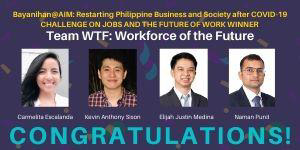


Team WTF: Workforce of the Future for Jobs and the Future of Work. Team members are: Kevin Anthony Sison, Carmelita Esclanda, Elijah Justin Medina, and Naman Punit.


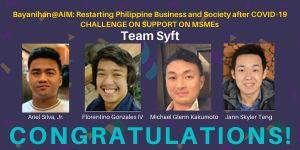
Team Syft for Support for MSMEs. Team members are: Michael Glenn Kakumoto, Jann Skyler Teng, Ariel Silva, Jr. and Florentino Gonzales, IV.

Each winning team received PhP50,000 in cash courtesy of Gold Sponsor Security Bank Corporation, and each team member was gifted a mobile phone by PLDT Enterprise.

In the midst of the pandemic and the adverse impact it has inflicted on the global economy, AIM wishes to thank and salute outstanding companies like Security Bank Corporation for their continuing support for activities that play a crucial role in nation building. The hackathon would not have been as successful if not for SBC’s generosity and solid support. The bank really stood by the hackathon during this difficult time.

The same goes to Metro Pacific Investment Corporation and PLDT Enterprise. Without their support, not to mention the crucial mentoring by Jojo and Dara, the hackathon would not have been the wonderful learning experience it has been for the participants.

Congratulations to the winners and thank you to all the teams for rising to the challenge to contribute to nation-building during this most critical time. You are truly the future of the country!

World Bank says coronavirus to shrink 2020 global output by 5.2%

WASHINGTON — The coronavirus will cause global economic output to contract by 5.2% in 2020, the World Bank said on Monday, warning that its latest forecasts would be revised downward if uncertainty over the pandemic and business lockdowns persist.

In its latest Global Economic Prospects report, the World Bank said that advanced economies are expected to shrink 7% in 2020, while emerging market economies will contract 2.5%, their first since aggregate data became available in 1960. On a per-capita GDP basis, the global contraction will be the deepest since 1945–46 as World War II spending dried up.

The updated forecasts show more damage to the economy than estimates released in April by the International Monetary Fund, which predicted a 3% global contraction in 2020.

The IMF plans to update its forecasts on June 24 and Managing Director Kristalina Georgieva has said that further cuts are “very likely.”

World Bank officials said their baseline scenario assumes that social distancing lockdowns and temporary business closures begin to ease at the end of June.

But the report shows a downside scenario in which lockdowns are extended by three months this year. Should that occur, the 2020 contraction would deepen to 8%–10% in advanced economies and 5% in emerging markets, with far more permanent business closures, a bigger collapse in global trade flows, layoffs and deep cuts in household spending.

“If that scenario materializes, the downside scenario, we are expecting a very sluggish recovery in 2021,” World Bank Prospects Group Director Ayhan Kose told reporters. “Global growth barely would begin to recover” at around 1.3% next year.

The new forecasts also increased the World Bank’s estimate of how many people will be pushed back into extreme poverty by the pandemic, to between 70 million and 100 million from a previous estimate of over 60 million. — Reuters

ADVERTISEMENT
ADVERTISEMENT