Home Blog Page 9428

There’s low risk of food spreading the virus, experts say after salmon panic

Food poses little risk of spreading the coronavirus, governments and industry groups from the US to Chile said, reassuring consumers after an outbreak in Beijing was blamed on imported fish.

The US Food and Drug Administration said it is “not aware of any evidence” to suggest that food can transmit the respiratory virus. The view was echoed by Kate Grusich, a spokeswoman for the Centers for Disease Control and Prevention (CDC), who said the poor survivability of coronaviruses on surfaces means “there is likely very low risk of spread from food products or packaging.”

Chile, the top seller of salmon after Norway, sought to persuade China that its fish is safe to import after orders were canceled. The Norwegian Food Safety Authority also said there were no known cases of infection via contaminated food.

Questions are being raised over the potential dangers of food after coronavirus infections were traced to the chopping board of a seller of imported salmon at a market in Beijing. While it’s possible an infected person contaminated the board, salmon has been taken off the shelves in major supermarkets while top experts are warning people not to consume the omega-3 rich fish.

There are only a couple of examples of where people have caught the coronavirus from animals. The Food and Agriculture Organization of the United Nations says that thoroughly cooked meat from healthy livestock is safe, but warns people to avoid meat from wild animals or sick livestock.

Health experts have confirmed that transmission can occur indirectly, by touching a contaminated surface or object, though the CDC said in late May that pathway probably isn’t the main way the virus spreads.

It’s unclear if the virus can be transmitted through frozen food that’s later thawed. David Hamer, a professor at Boston University School of Public Health and a physician at Boston Medical Center, said that although there is no evidence that COVID-19 can be transmitted through food, more research is needed.

“That raises a whole lot of concerning prospects around the global movement of the food supply,” he said. “This could set off a panic if people think their food could be a cause of infection.” — Bloomberg

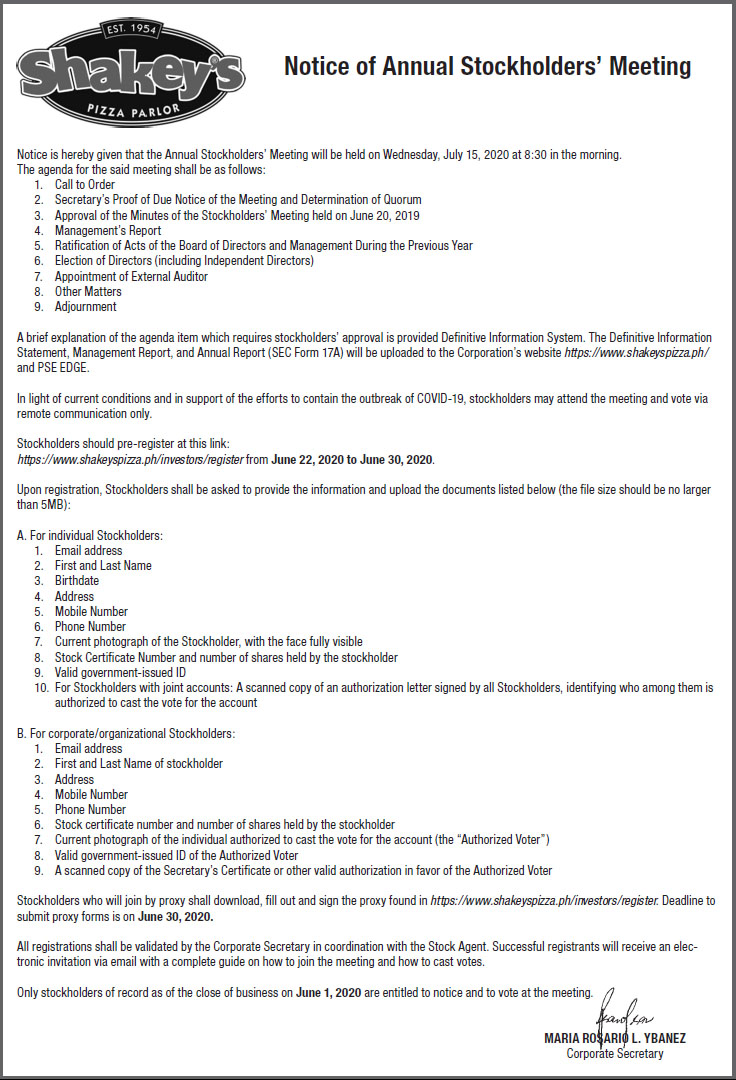
Shakey’s to hold annual stockholders’ meeting on July 15

Eduardo Cojuangco, food and beverage magnate, dead at 85

San Miguel Corp. (SMC) Chairman and Chief Executive Officer Eduardo “Danding” M. Cojuangco Jr., who built the Philippines’ largest food-and-drink empire, has died. He was 85.

His death was announced by the official Twitter account of the Philippine Basketball Association, in which he owned three teams.

SMC has yet to release a statement.

Mr. Cojuangco was an ally of the late dictator Ferdinand E. Marcos and cousin of former president Corazon C. Aquino. He went on political exile in 1986 and returned home to continue his political ambition, founding the Nationalist People’s Coalition in 1992. He ran for president but eventually lost to former president Fidel V. Ramos.

Through SMC, Mr. Cojuangco emerged to be one of the wealthiest Filipinos in the country, amassing a net worth of $1 billion (about P50.61 billion) in 2020 based on Forbes World’s Billionaires List. — Denise A. Valdez

PHL competitiveness still lags in Asia

By Jenina P. Ibañez, Reporter

THE Philippines inched just one notch higher in an annual global competitiveness report that placed the country among the lowest in Asia and the Pacific, as it showed no improvement in any of four key factors studied.

Switzerland-based business school International Institute for Management Development’s (IMD) 2020 World Competitiveness Report ranked the Philippines 45th out of 63 economies, up one spot from last year’s 46th. In 2019, the Philippines’ ranking rose four spots.

The country remained at 13th place among the 14 Asia-Pacific economies in the report. Singapore retained the top spot overall, followed by Denmark, Switzerland, and the Netherlands.

IMD attributed Singapore’s success to its “robust international trade and investment, employment and labor market measures,” alongside its stable educational system and technological infrastructure.

Hong Kong fell to fifth place globally from second the previous year, as its economy took a hit from widespread anti-government protests.

Taiwan bagged the 11th spot, followed by Malaysia (27th), Thailand (29th), and Indonesia (40th). Mongolia was the only Asia-Pacific economy behind the Philippines, coming in at 61st.

The prolonged trade war hurt the economies of both the United States and China. The United States slumped to 10th place from 3rd last year, while China slipped to 20th spot from 14th last year.

The study ranked each country’s competitiveness using 235 indicators grouped under four factors: economic performance, government efficiency, business efficiency, and infrastructure.

The Philippine ranking declined in three of the factors, falling six places to 44th from 38th in economic performance. The country slipped one spot to 42nd in government efficiency and one spot to 33rd in business efficiency.

The Philippine infrastructure ranking remained at 59th. Under this sub-factor, the country’s biggest weaknesses were in secondary school enrolment, communications technology, and number of patents in force, where it ranked 62nd in each.

The Philippines also had a poor showing for broadband subscribers, pollution problems, internet bandwidth, and public expenditure on education.

Legislative-Executive Development Advisory Council (LEDAC) private sector representative George T. Barcelon said in a phone interview the poor showing was caused in part by problems with ease of doing business and tax reform last year.

But he believes there is cause for optimism, if the government passes an improved tax incentives program and if the US-China trade war would result in investments shifting from China.

“Maybe this competitiveness (ranking) may not weigh heavily but… at the bottom line para sa mga negosyante, mag-i-invest kami ng negosyo, maasahan ba namin ’yung mga labor law, ’yung mga infrastructure, ’yung kuryente bababa ba? (The bottom line for businessmen is if we invest, can we rely on labor laws, infrastructure and lower cost of electricity?),” Mr. Barcelon said.

PhilExport President Sergio R. Ortiz-Luis, Jr. said Philippine competitiveness has been improving, and wondered if the new report may have been “factoring in 2020 too much.”

But he also believes the delays in the government budget and the infrastructure program last year may have caused problems.

“To improve from last year is about how to get out without too much stress from COVID-19. Medyo mabagal tayo — slower than the others,” Mr. Ortiz-Luis said.

The Asian Institute of Management’s (AIM) Rizalino S. Navarro Policy Center for Competitiveness, IMD’s Philippine partner, said in a press statement the IMD results reflect the immediate impact of the US-China trade war last year, as well as the shifts in executive opinion that it believes were shaped by the coronavirus disease 2019 (COVID-19).

“However, the full impact of the pandemic on macroeconomic factors are not captured in the results since the latest statistical data used in the study are from 2019.”

IMD said the ranking results are based on data from 2019, and responses to an executive survey in the first quarter of 2020. The group said that the impact of the pandemic is partially captured by these executives’ opinions on the effectiveness of the health system.

Philippine health infrastructure ranked 49th, dropping four places from the previous year’s 45th. In comparison, Singapore remained at fourth place, while Thailand improved to 22nd from 28th.

The AIM Center said the Philippines this year will face challenges in mitigating the economic impact of the pandemic, preparing the healthcare system, and offering aid to households and businesses. It said that the country will look to resuming the government infrastructure program in addition to business and consumer confidence.

IMD has been releasing its competitiveness ranking report for 32 years.

World competitiveness ranking 2020

World competitiveness ranking 2020

THE Philippines inched just one notch higher in an annual global competitiveness report that placed the country among the lowest in Asia and the Pacific, as it showed no improvement in any of four key factors studied. Read the full story.

World competitiveness ranking 2020

Coronavirus disrupts worship in Asia’s most Christian nation

By Denise A. Valdez, Reporter

CRISTINA G. TAPAO, 61, went to the Our Lady of the Holy Rosary Parish — just a tricycle ride away from her house in a small rural village near the Philippine capital — everyday.

That was before the government of Asia’s most Christian nation locked down the main island of Luzon in mid-March, suspending work, classes and public transportation and banning mass gatherings including religious meetings to contain a coronavirus pandemic.

BW Bullseye 2020-focusMrs. Tapao is one of the eight in 10 adult Filipinos who consider religion “very important” in their lives, according to a December 2019 poll by the Social Weather Stations.

“My day is not complete without it,” she said in Filipino by telephone. “When I wake up, I want to go to church first.”

The government of President Rodrigo R. Duterte banned religious gatherings to try to slow coronavirus infections that have sickened more than 26,000 and killed at least 1,103 people in the predominantly Catholic nation.

And rightly so, after religious meetings across the world became hotbeds for coronavirus disease 2019 (COVID-19) outbreaks. Half of South Korea’s cases can be traced back to a meeting of the Shincheonji Church of Jesus, while hundreds of Muslims got infected after worshiping at a mosque in Kuala Lumpur.

More than 500 members of an Episcopalian church In Washington, DC were forced to self-quarantine for two weeks after a rector who gave communion tested positive for the virus.

While the lockdown in most places in the Philippines has been eased, restrictions on mass gatherings including public worship remain, forcing religious groups to seek alternatives.

The Catholic Church has moved to virtual platforms for the weekly mass. The Catholic Bishops’ Conference of the Philippines (CBCP) issued a circular on March 13 ordering its churches to avoid large gatherings and use digital technology for communion.

“We wanted the people not to be deprived of the sacraments and the blessings that come from the church, so we just have to innovate and be creative,” CBCP Executive Secretary Fr. Jerome R. Secillano said by telephone.

The Catholic Church, majority of whose members don’t attend mass, seem to be experiencing some sort of religious revival, with more people embracing it as the global health crisis reminds people of life’s fragility.

LARGE SWATHS
Masses through radio, television and live Facebook streaming have drawn large swaths of viewers even from outside the country, Fr. Secillano said. “They became more prayerful. Even those who did not go to church are now forced to attend digital masses.”

Jehovah’s Witnesses, a minority Christian group known for their house-to-house preaching work worldwide, have also attracted many outsiders to their online meetings during the pandemic, spokesman Dean Jacek said by telephone.

“It’s very interesting because many of our congregations noticed an increase in attendance when we went online,” he said.

The Christian group that counts 223,000 members in the Philippines has been using online platforms such as Zoom Cloud Meetings to hold their midweek and weekend meetings. They have also been preaching from home using telephones and messaging apps to reach more people in their homes.

“We feel that some guests who attend our programs have noticed that the things happening now including the pandemic were prophesied in the Bible,” Mr. Jacek said. “As a result, it kind of encourages their faith.”

Evangelical Favor Church noticed a similar behavior among its members. “We believe that Jesus can actually bring hope, healing and provision to all those that seek him,” Senior Pastor James Aiton said in an e-mail. “We have seen people who never would have come to church beginning to tune in to our services.”

The group has been holding worship activities in several streaming platforms including Facebook, which attracted three million viewers in March, he said.

Meanwhile, the Iglesia Ni Cristo (Church of Christ) has been guiding families under it to hold their own worship services at home because not all members have access to fast internet, spokesman Edwil Zabala said in an e-mail.

The group, which has become a formidable influence in Philippine politics by encouraging its members to vote in elections, uses technology to spread its teachings.

“Using technology, the Iglesia Ni Cristo continues to accommodate the growing number of people who have expressed a desire to know more about the doctrines of the Bible that the Iglesia Ni Cristo upholds,” he said.

The COVID-19 pandemic has also affected the worship of more than 13 million Filipino Muslims, mostly on the southern Philippine island of Mindanao. Many of them were forced to celebrate Ramadan starting in April with a fast at home given the ban on mass gatherings.

While most religions seem to have been able to cope, those that rely on members’ tithes and donations have had to deal with dwindling money in church coffers.

‘WAKE-UP CALL’
“Our weekly giving has definitely taken a hit during this pandemic,” Mr. Aiton, the pastor, said. Members were encouraged to transfer money through online banking to cover the church’s operational costs and support charity.

While Jehovah’s Witnesses don’t require tithing and donations are voluntary, the organization already had online platforms for donations even before the lockdown, Mr. Jacek said. Of course, contributions for its worldwide work have been scarce presumably because some people have lost their jobs.

Still, local congregations have been receiving donations from members, which the group uses to help fellow brothers and sisters in need, Mr. Jacek said.

“Filipinos are not necessarily more religious now,” Ateneo de Manila University Associate Professor Jayeel S. Cornelio, an expert on religion and sociology, said in an e-mail. “The COVID-19 situation is a crisis that has simply revealed how religious Filipinos are.”

“Religious life is going to be even more vibrant because the quarantine became a wake-up call,” he said. In some instances, religion may be the only answer to grief, anxiety and loss, he added.

Mrs. Tapao, who went to church daily before the lockdown, listens to as many as four homilies a day through radio and social media.

“I long for the time when I can freely go to church to pray,” she said. “That’s the first thing I would do when the pandemic is over.”


Tax collection continues to slump in May — DoF

THE government’s tax haul slid by 50% in May as the deadline for income tax payments was once again deferred due to the extended lockdown.

Finance Secretary Carlos G. Dominguez III on Tuesday said the country’s two biggest revenue-generating agencies, Bureau of Internal Revenue (BIR) and Bureau of Customs (BoC), continued to see lower tax collections in May.

“The preliminary collections for the month of May for BIR and BoC are around 50% lower than last year’s and that again is because of the shutdown (of the economy). We will announce as soon as we have the firm figures for May as well as the cumulative figures from January to May but believe me, they are not very pretty,” Mr. Dominguez said in an online briefing.

Metro Manila remained under enhanced community quarantine throughout May, while most parts of the country saw a more relaxed lockdown.

Mr. Dominguez attributed the lower tax collections to the postponement of the 2019 income tax deadline, which was originally April 15.

The Department of Finance (DoF) chief said government revenues are expected to “catch up” by the end of the month, as the deadline for filing and payment of annual income tax returns was on June 15.

“As we announced a few weeks ago, (May collections) are quite bad, mainly because our tax deadlines have been postponed. However, we expect to catch up by the end of the deadline which is the end of this month, so we expect to collect the taxes that were due from income last year. They were supposed to be paid in April and we gave them time to file so that’s why compared to last year, our collections are quite low,” Mr. Dominguez said.

Revenues in May were still down despite the temporary 10% tariff on imported crude oil and refined petroleum products under Executive Order (EO) 113 issued on May 2.

In a document sent by the Finance chief to reporters on Tuesday, the increase in duties and VAT on all imported oil products covered under the EO generated P1.214 billion in additional revenues through mid-June.

Additional collections from liquefied petroleum gas (LPG) during the period reached P283.06 million, while those from naphtha totaled P3,325.

The Energy department last month said the oil import tariff hike could raise P6.78 billion in additional revenues for the government this year.

Preliminary data from the BoC showed imported oil products declined by 72.5% to 437.89 million kilograms (kg) in May from 1.592 billion kg reported in the same month last year.

BoC’s overall collections in May dropped 48.4% to P30.01 billion from P58.17 billion a year ago, and fell 10% short of the P33.33-billion target for the month.

This brought year-to-date collections to P210.18 billion, down 16.5% from P251.71 billion in May 2019 and failed to meet the P213.5-billion target.

The Development Budget Coordination Committee (DBCC) on May 12 slashed BoC’s collection target for this year to P541.703 billion from the P730-billion target set before the coronavirus pandemic.

For the BIR, latest available data showed its collection goal was also lowered to P2.26 trillion from the previous target of P2.576 trillion.

DBCC estimated government revenues will settle at P2.929 trillion this year, lower than the previously estimated of P3.17 trillion as the economy is expected to contract by 2-3.4%. — Beatrice M. Laforga

Philippines secures P75.5-billion loan from Japan

THE governments of the Philippines and Japan on Tuesday signed two loan agreements worth P75.5 billion (around 154 billion yen) for two major infrastructure projects in the Visayas and Mindanao.

Finance Secretary Carlos G. Dominguez III and Japan International Cooperation Agency (JICA) Chief Representative Eigo Azukizawa sealed the agreement for the P57-billion (119-billion yen) loan for the construction of a fourth Cebu-Mactan bridge and coastal road project, as well as P18.5 billion (35 billion yen) in supplemental financing for the second phase of the Davao City Bypass Construction Project.

Both projects are under the “Build, Build, Build” infrastructure program, which the government expects to help spur growth as the economy recovers from the coronavirus crisis.

Mr. Dominguez said interest rates for the loans are at 0.10% per annum for non-consulting services and 0.01% for consulting services, with loans maturing in 40 years, inclusive of a 12-year grace period.

“We express our heartfelt gratitude to the people and the Government of Japan… for their generosity and earnestness in supporting our infrastructure modernization program. Given the challenging circumstances, these projects bring more support to our economic recovery well beyond their nominal value,” Mr. Dominguez said during the loan signing ceremony.

JICA will finance 75% of the P76.4-billion Cebu-Mactan Fourth Bridge and the Coastal Road Project through official development assistance (ODA), while the remaining P18.8 billion will be sourced locally.

The Japanese government said it will also provide funding for the project’s detailed engineering design. Construction of the bridge linking mainland Cebu and Mactan island will start next year and is expected to be completed by 2029.

At the same time, the new loan for the Davao City Bypass Construction Project will supplement the 23.9 billion yen or around P9.27-billion loan JICA extended in 2015. Project construction is scheduled to start this year while the road is expected to be operational by 2023.

“In a broader sense, I hope that these projects will also contribute to the economic recovery of the country amidst the COVID-19 pandemic as we fully support your government’s pronouncement that restarting and accelerating the ‘Build, Build, Build’ program should be one of many strategies for reviving the Philippine economy,” Mr. Azukizawa said.

During the press conference, Finance Undersecretary Mark Dennis Y.C. Joven said the two loans bring to $1.5 billion the total financing extended by JICA to the Philippines this year.

“In terms of execution, we’ve already signed $40 million worth of project loans excluding these two loans, on top of this, we have a pipeline of $2.35 billion for the year, which includes both program loans and project loans, from JICA,” Mr. Joven said.

Mr. Joven said JICA has supported the government’s infrastructure projects, saying they will likely stick to the original pipeline of projects.

With more foreign loans coming in, Mr. Dominguez said the government will maintain a borrowing mix ratio of around 70:30 this year, in favor of domestic sources, and stay close to the previous years’ levels of 75:25.

To fund its coronavirus pandemic response, the government has raised a total of $6.508 billion via loans, bond sales and grants from foreign creditors as of early June. — Beatrice M. Laforga

Agus-Pulangi hydro plants set for rehab

By Adam J. Ang

STATE-OWNED National Power Corp. (Napocor) will be conducting various assessments and inspections of the Agus-Pulangi hydroelectric complex (APHC) in Mindanao ahead of its rehabilitation works once it can secure funds from the World Bank.

The Philippine government has sought the assistance of the international financial institution in supporting the much-needed rehabilitation of the Mindanao power generation facilities.

Napocor President and Chief Executive Officer Pio J. Benavidez told BusinessWorld that the company will start a feasibility study, as well as an environmental and social study on the hydropower plants once the agreement between the country and the bank is finalized.

Napocor’s plan has been submitted in a report to the National Economic and Development Authority on May 27.

The rehabilitation project is estimated to cost around $300 billion, according to a World Bank report released on May 26.

“Most of the APHC plants have been in operation for more than three decades and badly require rehabilitation to extend their operational life, recover capacity and energy output, and enhance safety of dams and reliability of supply,” it noted.

The Napocor-operated Agus-Pulangi complex features seven run-of-river hydropower plants with a total installed capacity of around 1,000 megawatts. It is owned by the Power Sector Assets and Liabilities Management Corp. (PSALM).

The power complex has been slated for rehabilitation under the Department of Energy’s (DoE) Mindanao Energy Plan 2018-2040 and the government’s flagship infrastructure program Build, Build, Build.

The World Bank claimed the rehabilitation of the power facilities will reduce Mindanao’s reliance on electricity from coal-fired power plants.

“In the medium term, increased energy generated from APHC will reduce the need to rely on further development of coal-fired power plants,” it said.

Meanwhile, a part of the complex’s rehabilitation plan is the construction of the Balo-i flood control project. The report highlighted the flooding situation in the midstream section of the Agus river which affects the operations of two hydropower units.

Flood protection dikes were supposed to be installed in the river’s low-lying section but security issues prevent the operator from building them.

It is expected that the World Bank funds will be rolled out in June next year.

Philippine office demand up 34% despite lockdown

buildings office spaces Taguig

By Denise A. Valdez, Reporter

DEMAND for office space grew 34% during the lockdown as the information technology and business process management (IT-BPM) industry continued to expand, going against expectations as many businesses suspended operations during the period.

In a statement Tuesday, real estate consultancy firm Leechiu Property Consultants (LPC) said demand for some 54,000 square meters (sq. m.) of office space were recorded from March 15 to May 31, or the period of the strict lockdown.

This resulted in 211,000 sq. m. of office demand for the first five months of the year, where 60% are in Metro Manila and 40% are in provinces.

“We expected zero demand in the second quarter of 2020 but despite the (lockdown), we’ve seen transactions concluded,” LPC President and CEO David T. Leechiu said in the statement. “Philippines is most likely the only office market in the world that is still growing in demand today.”

The Philippines started imposing quarantine measures since mid-March due to the coronavirus disease 2019 (COVID-19) pandemic. This forced most companies in “non-essential” businesses to require their staff to work from home, but exempted some such as the business process outsourcing (BPO) sector.

Of the recorded office space demand in the past five months, LPC said most came from the IT-BPM sector at 37%. Philippine offshore gaming operations (POGOs) comprised 13% of the demand, while the remaining 50% were divided among traditional offices, corporate tenants and flexible workspaces, among others.

“We…expect IT-BPM demand to surge once more by year-end when both the Philippines, US and other countries would have adapted to a new normal,” Mr. Leechiu said.

Aside from the resilience of IT-BPM, Mr. Leechiu said POGOs might make a comeback by the end of the month with 30-50% back in operations through a compromise agreement with the Bureau of Internal Revenue (BIR).

The Philippine Amusement and Gaming Corp. (Pagcor) decided in May to allow POGOs to resume operations once they settle taxes with the BIR and other obligations with Pagcor, the state agency that licenses casino gaming in the country.

“As soon as travel restrictions are lifted, we are optimistic that POGOs will be back to full capacity, and will start revisiting their expansion plans,” Mr. Leechiu said.

He also said some companies may move service operations from China to the Philippines, which would again further drive up office demand in the country. “They will do that by importing talent from China to operate from the Philippines following the POGO operating model,” Mr. Leechiu said.

In a virtual briefing in April, LPC said it estimated 800,000 to 1 million sq. m. of office transactions to be completed this year, about 43-54% lower from last year’s 1.75 million sq. m. Office supply is also seen dampened 44% to 842,000 sq. m. because of construction delays.

More German firms expect sales decline

THE number of German investors anticipating a significant decline in sales due to the pandemic has doubled since April, a survey conducted by the German Philippine Chamber of Commerce and Industry (GPCCI) said.

The number of companies expecting sales to drop by more than half doubled to 26% since April, while 30% of businesses anticipate sales to slide between a quarter to half.

Companies that expected no change in sales at all slipped to two percent by June from 18% in April.

The chamber on Tuesday released the result of its new survey conducted between June 5 to 12, collecting 87 responses. This updates an initial survey held in late March and early April.

Most German investors seek the reduction of red tape and an economic stimulus package as necessary for their business as they address the impact of the pandemic.

The survey found that 71% of the companies want government to reduce administrative burdens such as customs, permissions and licenses, while 59% want economic stimulus packages, and 53% are seeking corporate income tax reduction.

“Companies quickly need huge support to tackle these trying times and to emerge more competitive on the international level afterwards,” GPCCI Executive Director Martin Henkelmann said.

Among disruptions caused by the pandemic, 84% said travel restrictions had the biggest effect on their operations. Companies also said they had postponed investment projects (55%), experienced supply chain problems (54%), and cancelled participation in trade fairs and events (54%).

While 39% of respondents said the easing of the lockdown in both the Philippines and Germany was “very helpful,” 47% said that it was “moderately helpful.”

A majority of the respondents are seeing a long supply chain recovery period, with 47% saying that supply chain operations will recover by the end of the year and 30% saying that they expect recovery by June 2021. A quarter believe that operations will recover by September. — J.P. Ibañez

Roxas and Company studies P800-million equity placement

ROXAS and Company, Inc. (RCI) is looking at raising funds through an equity placement of up to P800 million with global investment group LDA Capital Ltd.

In a stock exchange disclosure Tuesday, RCI said its board of directors allowed the corporation to enter into a put option agreement for an equity placement commitment with LDA Capital.

A put option is an agreement that allows a company to sell an underlying security at a pre-determined price.

“This equity placement commitment is part of RCI’s fund-raising activities aimed at strengthening its subsidiaries, with the proceeds to be utilized for additional working capital and to support the reduction of bank debts to manageable levels,” RCI said.

Under the terms, LDA Capital Ltd. will be the investor and LDA Capital LCC will be the arranger of the transaction. RCI will control the timing and maximum amount of the put option, which should be within 36 months from the signing of the deal.

RCI’s board of directors also approved granting a call option to the investor, which essentially allows LDA Capital to buy up to 99 million common shares in RCI at P2.38 each.

The plan of the company is to sign the put option agreement today, June 17.

RCI is a Philippine firm with interests in real estate, sugar and ethanol manufacturing. Some of its subsidiaries are Roxaco Land Corp. and Roxas Holdings, Inc.

LDA Capital, on the other hand, is an alternative investment group engaged in global public equities, private equity and credit. On its website, it said some companies in its portfolio are Ansen Corp., GetSwift, L’Officiel USA and Smart Energy Sweden Group AB.

Shares in RCI at the stock exchange closed P1.90 each on Tuesday, up 10 centavos or 5.56% from the previous day. — Denise A. Valdez

ADVERTISEMENT
ADVERTISEMENT