ANY VACCINE developed to ward off the novel coronavirus would likely be limited in how long it would shield against infection, top US infectious disease expert Anthony Fauci said Monday.
“You can assume that we’ll get protection at least to take us through this cycle,” Mr. Fauci, director of the National Institute of Allergy and Infectious Diseases, said in an appearance on a live-streamed video conference hosted by the National Institutes of Health (NIH).
“We’re still knee-deep in the first wave” of the pandemic, Mr. Fauci said. Health officials are assuming a shot would offer a degree of protection, though it’s likely “going to be finite.”
A shot to protect against COVID-19 (coronavirus disease 2019) won’t work like the measles vaccine, which lasts throughout a person’s lifetime, Mr. Fauci said. “We may need a boost to continue the protection, but right now we don’t know how long it lasts.”
Mr. Fauci said he expects the American public will have an answer before the end of the year or by early 2021 as to whether one of the more than 140 experimental shots in development has proven safe and effective.
In the meantime, Mr. Fauci said public health measures such as wearing a mask, social distancing, and frequent hand-washing should be used as a vehicle to a safe re-opening. “It’s not an obstacle, it’s a pathway to do that. We can’t create this binary thing where it’s ‘us against them,’” he said.
NIH Director Francis Collins, who led the interview with Mr. Fauci, responded, saying: “Even this issue tends to get polarized, maybe even politicized. Imagine that!” — Bloomberg
IN INDONESIA, locals can soon fly from Jakarta to the beaches of Bali for a domestic vacation. Tokyo residents can escape the pandemic stress with a hike up Mount Fuji, and New Yorkers can head to the Hamptons on Long Island.
Residents of Singapore, a city-state smaller than New York City, have few such options, presenting a massive problem for its battered tourism industry. With borders closed to foreigners, hotels and tourist attractions need to count on ‘staycationers’ to plug the gap in an industry that brought in almost $20 billion in revenue last year. It’s a tall order.
“Unless we have a return to international business, the hotel industry is going to be decimated as up to 90% of our bookings come from international travelers,” said Michael Issenberg, chief executive officer of Accor SA’s Asia Pacific unit, the largest hotel operator in Singapore.
While tourism everywhere has been hammered by the pandemic, the gradual opening of some domestic travel has given a shot in the arm to airlines and hotels in places like Australia and Vietnam. Rosewood Hotel Group has seen occupancy rates as high as 70% at some of its China properties as leisure travel picks up, said CEO Sonia Cheng.
Singapore’s tourism sector faces a tougher challenge, as the hotels were just given a green light last week to request approval to welcome domestic tourists. Many locals like teacher Najeer Yusof prefer to save their money and wait for travel to resume in nearby hotspots like Thailand and Malaysia rather than spend it on a hotel down the street.
“There’s more to see and experience overseas at a cheaper cost,” said Mr. Yusof. There’s also the “awe factor — getting to see or experience something I won’t otherwise be able to in Singapore, like the mountains and national parks in Indonesia and activities like diving and surfing.”
Though the country of 5.7 million people has reopened its economy after a lockdown of more than two months, its borders are still largely closed. It recorded a historic low of just 750 foreign visitors in April, down from 1.6 million in the same month last year. May’s numbers weren’t much better, at 880.
“In the short-term, hotels, eateries and attractions can re-orientate to draw interest to staycations, attractions or food discounts,” said Selena Ling, head of treasury research and strategy at Oversea-Chinese Banking Corp. “However, our inherent small domestic market size implies it may not be a longer-term sustainable solution.”
Tourism has been an increasingly important industry for Singapore, helping to diversify the economy from its traditional strengths of finance, oil refining and shipping. Attractions including the Marina Bay Sands hotel and casino, the Universal Studios theme park and the Singapore Zoo have drawn tourists from around the world.
Last year, Singapore hosted a record 19.1 million visitors, while tourism receipts rose to S$27.7 billion ($19.8 billion), from S$26.9 billion the year before. Singapore’s tourism sector, which employs about 65,000 people, contributes about 4% to gross domestic product. The Singapore Tourism Board doesn’t track the share of local versus international tourism.
GATE’S CLOSED
The border closure means Singapore needs to persuade locals to spend more money at home. Even with overseas travel off limits, Singapore residents will still want to venture out, said Tourism Board CEO Keith Tan.
“They may therefore be open to take time off in their own city and rediscover all that Singapore has to offer,” he said in an e-mailed statement.
Singapore has set aside S$90 million for the tourism sector and a task force is developing domestic and international recovery plans to be shared soon, Mr. Tan added.
Hotels including the Shangri-la are also getting a small boost from the thousands of Singaporeans and expats who have been traveling abroad and are slowly being allowed back in. When they arrive, most are being forced to quarantine for 14 days in a hotel, at a cost of about S$2,000.
With occupancy running at just 15% for August, the iconic Raffles Singapore is offering a two-night special for about S$795, complete with a complimentary Singapore Sling, free breakfast, city tour and spa discounts.
Some tourist spots are also offering price cuts to attract residents who’ve been cooped up in their apartments for weeks. Sentosa Development Corp., which manages a resort island with attractions including Madame Tussauds and Universal Studios, has waived admission fees until the end of September, said Lynette Ang, the chief marketing officer.
Lo & Behold Group, which operates the Tanjong Beach Club just 15 minutes from the financial district, is launching a new concept called “Dine In Nature,” which includes curated gourmet picnic baskets. It hopes this “will fulfill a growing demand from local residents for polished, thoughtful dining experiences,” said Chief Operations Officer Andrew Ing.
For Singapore’s tourism industry, a full recovery isn’t likely before 2022, and largely depends on countries avoiding additional waves of the virus and the development of a vaccine, said Wong King Yin, a lecturer in marketing at Singapore’s Nanyang Technological University.
“Although domestic travel can be a solution at the beginning during the recovery stage, the tourism industry cannot rely on staycations to survive,” she said. — Bloomberg
Employers are wrestling with workplace safety in the age of COVID-19. Dogged by issues of cost, access, logistics, and employee privacy, testing isn’t part of most back-to-work plans. Image via Reuters.
From nursing homes in New York and a landfill in Utah to Disney World and the Las Vegas Strip, employers are wrestling with workplace safety in the age of COVID-19 and making fraught calculations about how to safeguard both their businesses and their employees.
Mass testing, a critical tool to stem the virus’s spread, would appear an obvious solution.
But dogged by issues of cost—diagnostic tests start at around $100 each—access, logistics and employee privacy, tests aren’t part of most back-to-work plans. As health-care companies that work with employers in this capacity are fond of saying, there’s no silver bullet.
Another major deterrent is that COVID-19 tests only measure that point in time, notes Lauren Vela, senior director for the Pacific Business Group on Health, which represents large employers like Microsoft Corp. and Walmart Inc. If a worker is infected shortly after being tested, it wouldn’t show up but everyone would be falsely reassured by the negative result.
Testing is “not really available, feasible or easy, and it’s not a solution you can do for every employee, every day,” Ms. Vela said.
So instead employers are favoring lower-cost, easier-to-implement interventions like temperature checks and symptom screening while also stocking up on masks, hand sanitizer, and cleaning wipes. While those measures help, asymptomatic individuals could still transmit the virus.
Image via Reuters.
Healthcare startup Buoy Health has been working with employers on COVID workplace issues. Only a few are taking an on-site testing approach.
“The cost of the test at scale is pretty prohibitive,” Andrew Le, a physician and Buoy’s chief executive officer, said.
But at Walt Disney Co. theme parks, actors working the live shows are demanding screenings before they return.
Performers sing, dance, and hand things to each other, noted Kate Shindle, president of the Actors’ Equity Association, the union that represents cast members at Broadway shows and Disney’s Florida resorts.
“There’s a lot of people who can do their work when they’re wearing a mask and gloves. Our people can’t do that,” Ms. Shindle said in an interview. “It’s just very important to our membership, who otherwise is overwhelmingly eager to get back to work.”
In a June 24 letter to its unions in California, Disney said it doesn’t think testing is a good idea, citing a high rate of false negatives and concerns that it creates “a false sense of security,” among other factors. Instead, it’s focusing on physical distancing, wearing effective face coverings, hand washing and sanitization.
‘NOT IN CONTROL’
Intermountain Regional Landfill in Utah, located about an hour’s drive from Salt Lake City, has made a different calculation. Cases in the state have surged in recent weeks and an employee recently had to stay home for three days because of a potential exposure through a family member who ended up testing negative.
That was “not only cumbersome and a loss of productivity, but really frustrating to know we’re not in control of it,” said Chief Financial Officer Adam Campbell.
Intermountain processes over four million pounds of waste a day and operations are easily disrupted even if only a few workers got sick. In the worst-case scenario, should infection hit all 15 employees and force a total work suspension, the business would face estimated losses of about $20,000 a day.
So Intermountain decided to test its workforce. It’s working with Atlas ID, a software company that had focused on employment verification systems before the pandemic, to work out how often to test and in which scenarios. It’ll cost about $2,000 a round.
“We could be testing for years at a high level and never even touch just missing one day’s worth of having to divert our waste,” Rob Richards, the landfill’s president and general manager, said.
INSURANCE HELP?
At nursing homes and assisted living facilities, which an analysis by the Foundation for Research on Equal Opportunity found account for 45% of virus deaths in the US, testing employees is mandatory for many. But the bill quickly adds up.
Len Russ owns Bayberry Care Center in New Rochelle, New York. His roughly 100 employees were tested twice a week for five weeks, at a cost of $20,000 a week. The screening did identify at least six sick employees, but Mr. Russ is still waiting to see how to cover the $100,000 tab. The lab that processed the tests will try billing employees’ insurance, though Russ said he doesn’t expect them to cover repeat testing.
Keene Valley Neighborhood House, an assisted living facility in upstate New York, has had success billing insurance, according to executive director Richard Rothstein. Yet employers are ultimately likely to bear these costs themselves through higher premiums.
The Centers for Disease Control and Prevention said on Friday that employers may use testing as part of a comprehensive approach to reducing the virus’s spread at work. But employers, many of whom are already facing massive losses from shutdowns, often find the cost doesn’t make sense. Antigen testing, which screens for active infections and provides rapid and cheap results, has promise but is only beginning to come to market.
Although antibody tests, which screen for past infections and are easier for labs to scale up, seemed like a solution, it isn’t clear what sort of immunity antibodies grant. And after the CDC said antibody tests shouldn’t be used in deciding to send people back to work, the Equal Employment Opportunity Commission issued a statement telling employers they can’t require the tests. Diagnostic tests for current infections are permitted.
Antigen testing, which screens for active infections and provides rapid and cheap results, has promise but is only beginning to come to market. Image via Reuters.
South of Los Angeles, EB Design builds decorative interiors for hotels and high-end restaurants, a group that was “basically decimated” during shutdowns, owner Eric Beneker said. He decided to test his 20 employees biweekly to ensure their safety, but couldn’t find information or resources on how to do it.
The company ended up booking appointments through facilities set up by local governments. It’s been time-consuming, though, as there were few open slots and long turnaround times. And they had to mislead the sites to get in because individuals have to be symptomatic to get tested.
“Is it the honest thing to do?” Mr. Beneker said. “Probably not, but we don’t have any other choice, and we’re not given any other choice.”
In May, two employees tested positive and EB Design closed down. The company paid a private lab to re-test everyone. It cost about $3,000 total, around 10% of the company’s payroll. It turned out neither had COVID-19. Could the company field that kind of bill regularly? “Hell no,” Mr. Beneker said.
“The problem is we’re so far down the road here with reopening of the economy,” he said. “While we’re trying, and we’re doing our best, we’re not getting the tools” needed to help.
Logistical challenges abound—results often take days or over a week to come in, supplies continue to be limited—but privacy issues often weigh as heavily.
Suffolk Construction partners with Buoy Health on its workplace safety plan. A testing facility is available as needed, but the builder isn’t implementing mass screenings, executive vice-president Alex Hall said, citing privacy concerns and the limited usefulness of the results.
“We get it. There’s an element of Big Brother around this situation anyway,” Mr. Hall said. “We want to be mindful of how people are feeling.”
The battle is also playing out in Vegas, where cases have surged since casinos began reopening last month.
Managers, unions, and other business leaders created a program with a hospital to test workers at the convention center. But it isn’t mandatory, according to Bethany Khan, a spokesperson for the Culinary Workers Union Local 226, which represents casino employees.
While Caesars Entertainment Corp. has made testing mandatory after a worker died from the virus in June, others haven’t. Ms. Khan said the union is pushing for regular testing and on Monday, it sued Harrah’s hotel, operated by Caesars, and MGM Resorts International’s Bellagio for not adequately protecting workers.
MGM said it’s working with health-care professionals to develop safety protocols, including mandatory testing for anyone with symptoms or exposure, as well as free ones for anyone who wants a test. “Nothing is more important to us than the safety of everyone inside of our properties,’’ the company said.
At a press conference last week, a bellman at The Signature at MGM Grand hotel spoke about falling ill in June.
“It was three months that we did social distancing, that we did lockdown in Las Vegas,” Sixto Zermeno said. “I go back to work, three days later I’m sick on the fourth day.” — Bloomberg
Major players in the cruise industry say their ships are safe even if there have been more than 3,000 COVID-19 cases and dozens of deaths associated with ships, according to the Cruise Lines International Association. Image via Reuters.
Two of the world’s largest cruise operators insist their ships are no more vulnerable to the spread of the new coronavirus than other public places.
The cruise industry has long pushed back at the idea that the close quarters on ships may be ripe conditions for the spread of disease. And major players continue to maintain that position, even though there have been more than 3,000 COVID-19 cases and dozens of deaths associated with ships, according to the Cruise Lines International Association. Top executives at Norwegian Cruise Line Holdings Ltd. and Royal Caribbean Cruises Ltd. were asked Sunday to acknowledge that people are more likely to get coronavirus on a cruise ship than in the general public.
“No, I don’t believe” that, Frank Del Rio, the CEO of Norwegian, said in a Zoom interview, where he was joined by Richard Fain, head of Royal Caribbean. “I think done correctly a cruise ship—because it is a controlled environment—can be among the safest places on Earth.”
Mr. Fain took exception to the framing of the question. “One of the things about an intellectual inquiry is it should start with an open mind,” he said. “With all due respect, the question didn’t suggest you started with an open mind.”
The CEOs said they have formed a new partnership on health protocols to implement when they start sailing again. The group, the Healthy Sail Panel, is being led by former US Food and Drug Administration Commissioner Scott Gottlieb and former US Health Secretary Mike Leavitt.
The industry has wrestled for years with the issue of shipboard illnesses, including outbreaks of the norovirus winter vomiting bug. The cruise association, the lobbying arm for the industry, citing data from the Centers for Disease Control and Prevention, says guests are far more likely to get norovirus on land than on a ship. But the CDC cites cruise ships, along with schools, health-care facilities and restaurants, as one of the “common settings of norovirus outbreaks.”
On March 8, the US State Department said Americans, especially those with underlying conditions, should avoid cruise travel due to “increased risk of infection.” In a separate memo updated June 3, the CDC said there’s a “high risk” of COVID-19 spread on cruise ships because people spend time close together, interact with travelers from around the world, and are served by crew members who may bring infections aboard from other ships.
Separately, a study in the CDC’s Morbidity and Mortality Weekly Report in March found traces of the coronavirus lingered in cruise-ship cabins for as many as 17 days after passengers left.
The Miami Herald has identified 3,644 total cases associated with cruise ships, including 738 on Royal Caribbean ships and 30 with Norwegian. Carnival Corp., the industry leader by market share, has had 2,278 cases. A New York Times report, which used CDC data from a Freedom of Information Act request, said the numbers are far higher.
Even after the US State Department’s warning, cruise ships kept departing for the better part of a week until the industry announced it was suspending new sailings on March 13. Since shutting down, the major lines have all tapped financial markets to raise cash and tide them over. — Bloomberg
Germany, home to bratwurst and schnitzel, has become a vegetarian haven, and a survey published by its agriculture ministry in May showed 26% of respondents eat meat or sausage daily, versus 34% in 2015. Image via Reuters.
The pandemic is poised to usher in the biggest retreat for global meat-eating in decades. Per-capita consumption is set to fall by almost 3% in 2020 to the lowest since 2011, according to data from the United Nations. Meanwhile, analysts across the globe are predicting declines not just per-capita, but also for overall demand in their regions.
That’s a dramatic turnaround for an industry that’s come to rely on steady growth. Notably, the shift is happening in every major market, including in the US, where it’s predicted that per-capita meat consumption won’t return to pre-pandemic levels until at least after 2025.
There’s a swirl of factors contributing to the change. The coronavirus economic fallout means consumers are cutting down on grocery bills. Restaurant shutdowns have hurt demand since people eat more meat when they dine out. In China, which accounts for about a quarter of world consumption, there’s growing distrust over animal products after the government suggested a link between imported protein and an outbreak in Beijing. Disruptions to production, like the plant outbreaks that sparked an industry crisis in the US, also created supply problems that led to less meat-eating.
Climate advocates have for years been calling for lower meat consumption. By some measures, agriculture accounts for more global greenhouse gas emissions than transport, thanks in part to livestock production. Meat and dairy alone are responsible for as much as 18% of global greenhouse gas emissions caused by humans.
What remains to be seen is to what degree the pandemic shift lasts. If consumers get used to having less meat through pandemic conditions, could that bring in a new era for global diets?
There are hints of a structural change taking place, with millions eating more plant-based proteins because of environmental concerns. Meanwhile, the explosion of coronavirus infections at slaughterhouses and processing plants—from the US to Brazil and Germany—have highlighted the industry’s toll on its employees who handle dangerous work for low pay and few benefits. It’s still too early to tell, though, whether the fresh public scrutiny over worker conditions will impact demand.
At the same time, now that consumers have gotten more used to cooking at home, that habit could stick, especially as the lockdown-crippled food-service industry is predicted to shrink. About 2.2 million restaurants worldwide could close, according to consulting firm Aaron Allen & Associates. The loss of food service is a “major demand shock that will take a long time to recover from,” said Altin Kalo, analyst at Steiner Consulting Group.
Before the pandemic, 50% of all meat was consumed outside of the home in the US, according to Boston Consulting Group.
“If restaurants structurally look different in the future, and the number of out-of-home eating occasions is permanently altered, then I think it’s fair to say there may be less meat consumption” going forward, said Boston Consulting Group’s agribusiness expert Decker Walker. “People are still going to consume the same amount of calories, but they will do it at home, where the meat percentage is lower.”
This year’s projected decline would also come after a drop in per-capita global consumption in 2019, when the African swine fever disease killed millions of hogs in China, boosting retail pork prices and curbing demand. The losses over two straight years will mean close to a 5% slump in per-capita consumption since 2018, according to data from the UN’s Food & Agriculture Organization.
There’s still a chance that total world consumption could rise this year. That’s because the population could be growing at a faster rate than meat production. Still, per-person reductions mark a turning point for the industry.
EUROPE
In the European Union, pork consumption is expected to fall to a seven-year low in 2020, with beef and chicken also hitting troughs, the US Department of Agriculture forecasts. The pandemic hit at a time when there was already signs of easing meat demand in parts of the bloc on environmental and animal-welfare concerns. Germany, home to bratwurst and schnitzel, has become a vegetarian haven, and a survey published by its agriculture ministry in May showed 26% of respondents eat meat or sausage daily, versus 34% in 2015.
“A balanced diet does not include meat and sausages every day,” German Agriculture Minister Julia Kloeckner said in a statement. “The number of those who occasionally consciously do without it has increased.”
CHINA
China’s pork consumption this year may drop by about 35% when compared with normal levels, before the pandemic and outbreaks of African swine fever, said Lin Guofa, a senior analyst at Bric Agriculture Group, a Beijing-based consulting firm. The country accounts for 40% of global pork demand.
Pan Chenjun, a senior livestock analyst with Rabobank, forecasts a similar decline. Higher prices, lower supply, COVID-19, and food-safety concerns are the major reasons behind the drop, she said in an e-mail. The nation’s meat imports, which have helped to make up for deficits left from swine fever’s impact, may have peaked in the first half of the year, she said.
“Global supply is full of uncertainty for the rest of the year,” she said.
BRAZIL
Even in Brazil—famous for its barbecues and churrascarias, where slabs of beef are cut at your table’s edge—meat consumption is going through an intense process of change, according to Wagner Yanaguizawa, an analyst at Rabobank Brazil. The pandemic is accelerating shifts in consumer interest in food safety, traceability and sustainability, he said.
And as the nation becomes the new epicenter of the coronavirus, a deep recession is expected with consequences to consumers’ purchasing power.
“Consumption of all animal proteins should fall amid lower income, but beef will definitely suffer more,” said Caio Toledo, risk management consultant and livestock head at StoneX. Brazil is the world’s third-largest beef consumer.
Production costs will rise over the long term along with land prices, while more companies should look to curb their environmental impact and shift away from deforestation to increase pastureland, he said. Eventually, that will make beef eating a luxury for consumers in different parts of the world, Toledo said.
US
American ranchers have been expanding their livestock herds in anticipation of a demand boom from China, where earlier pork shortfalls had sent prices soaring. But while shipments have increased, it’s never been the bonanza that farmers were hoping for.
Now that demand is falling both domestically and around the world, the US could be left with a meat glut that pressures farmer profits. Declines in the restaurant industry are a big part of the painful picture, said Will Sawyer, an animal protein economist at farm lender CoBank ACB.
“That food-services disruption globally really hurt us across the board, whether it’s exports or domestically,” he said.
Researchers at the University of Missouri’s Food & Agricultural Policy Research Institute, predict this year’s per-capita meat consumption will decline for the first time since 2014. And the measure is forecast to keep falling through at least 2025.
“We find ourselves in an environment today, and probably for the next 12 months, where meat supply, not just in the US, but probably on a global basis, is in excess of demand,” Mr. Sawyer said. — Bloomberg
The decision of the World Bank and the International Monetary Fund to meet virtually, rather than in person in Washington, was widely expected given rising infections in the United States, and continuing travel restrictions. — REUTERS
WASHINGTON — The World Bank and International Monetary Fund will hold their annual Fall Meetings online in October because of the novel coronavirus pandemic, World Bank President David Malpass said in a letter to the Bank’s governors.
Mr. Malpass also encouraged those countries that are considering appointing new executive directors to represent them on the Bank’s boards to factor gender diversity into their decisions. Only five of 25 current directors are women, he said.
The decision to meet virtually, rather than in person in Washington, was widely expected given rising infections in the United States, and continuing travel restrictions.
The two international finance institutions also held their Spring Meetings online in April, and IMF Managing Director Kristalina Georgieva and other officials have said they expect to shift more of their work to virtual meetings in the future.
In his letter, posted on the LinkedIn business networking site, Mr. Malpass underscored the Bank’s commitment to addressing the economic impact of the pandemic and helping developing countries take steps toward recovery.
“The COVID-19 crisis and economic shutdown threaten to reverse much of the development progress made in recent years and throw hundreds of millions of people back into poverty,” Mr. Malpass wrote.
He said the Bank had approved emergency health projects in over 100 countries and was providing working capital and trade finance for the private sector in developing countries.
The Bank’s preliminary and unaudited commitments in fiscal 2020 would likely total about $74 billion, up sharply from fiscal 2019, with total financing in the 15 months ending June 30, 2021, to reach as high as $160 billion, he wrote.
Mr. Malpass called again for additional steps to help some of the poorest countries deal with unsustainable debt burdens, in addition to an offer by the Group of 20 major economies to freeze debt-service payments through the end of the year. — Reuters
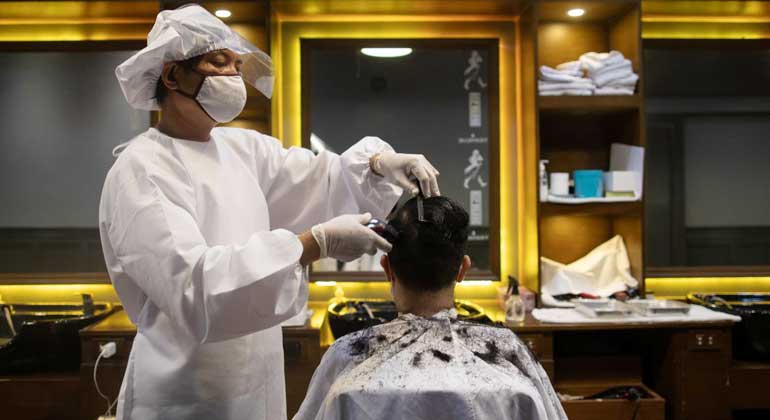
The Philippines is lifting the ban on non-essential travel and allowing hair treatment in salons even as infections rose by a quarter in the past week.
The task force on coronavirus has allowed Filipinos to resume non-essential travel to countries that will allow their entry, as long as they have round-trip tickets, visas, and health insurance, presidential spokesman Harry Roque said in a televised briefing Tuesday.
Departing passengers will also be required to sign declaration forms acknowledging they are aware of risks of traveling, and to undergo quarantine upon their return. Beauty salons in areas under the lowest quarantine level can also start offering hair color, treatment, and services other than haircuts, which resumed last month, Mr. Roque said.
Hair salons in areas under the lowest quarantine level can start offering hair color, treatment, and services other than haircuts, which resumed in June. Image via Reuters.
The Philippines has 46,333 confirmed coronavirus cases as of Monday, including 1,303 deaths. It has the second-highest number of infections in Southeast Asia after Indonesia, and has the fastest rise in cases since June 1 when the capital region reopened.
The Philippines is set to reopen a terminal in its Manila airport on Wednesday, allowing eight airlines including Cathay Pacific Airways Ltd. and Emirates Airline to operate. From July 7 to July 11, however, the government shut down its busiest elevated railway traversing north to south of Metro Manila after nearly 200 personnel tested positive for the virus.
Even so, key government officials are calling for further easing of virus curbs to reignite an economy facing its deepest slump in three decades. — Bloomberg
Tech companies are pausing reviews of their services in Hong Kong after China established a sweeping new national security law in the semi-autonomous city. Image via Reuters.
Facebook Inc., Google Inc., and Twitter Inc. suspended processing government requests for user data in Hong Kong, they said on Monday, following China’s establishment of a sweeping new national security law for the semi-autonomous city.
Facebook, which also owns WhatsApp and Instagram, said in a statement it was pausing reviews for all of its services “pending further assessment of the National Security Law.”
Google, a unit of Alphabet Inc, and Twitter said they suspended their reviews of data requests from Hong Kong authorities immediately after the law went into effect last week. Twitter cited “grave concerns” about the law’s implications.
Google said it would continue reviewing Hong Kong government requests for removals of user-generated content from its services. Twitter declined to comment, while Facebook did not respond to a request for comment.
Social networks often apply localized restrictions to posts that violate local laws but not their own rules for acceptable speech. Facebook restricted 394 such pieces of content in Hong Kong in the second half of 2019, up from eight in the first half of the year, according to its transparency report.
Tech companies have long operated freely in Hong Kong, a regional financial hub where internet access has been unaffected by the firewall imposed in mainland China, which blocks Google, Twitter, and Facebook.
In addition to the announcements by the US tech giants, TikTok, the short-form video app owned by China-based ByteDance, said it would pull out of the Hong Kong market within days.
TikTok was designed so it could not be accessed by mainland China, part of a strategy to appeal to a more global audience. Hong Kong is a small, loss-making market for the company, one source familiar with the matter said.
Asked about the moves by the US tech firms and prospects for media freedom, Hong Kong Chief Executive Carrie Lam told a news conference on Tuesday: “Ultimately, time and facts will tell that this law will not undermine human rights and freedoms.”
APPLE AND SIGNAL
Apple said Monday it does not receive requests for user content directly from the Hong Kong government. Instead, it requires authorities there to submit requests under a mutual US-Hong Kong legal assistance treaty. The US Department of Justice receives the requests and reviews them for “legal conformance,” Apple said.
“We’re assessing the new law, which went into effect less than a week ago, and we have not received any content requests since the law went into effect,” Apple said in a statement.
Apple said on its website that it makes an exception to working through legal assistance treaties for “emergency requests,” which it defines in part as “circumstance(s) involving imminent and serious threat(s) to… the security of a State.”
Data from Apple’s website showed it did not receive any emergency requests from Hong Kong between 2015, when it began keeping detailed records and June 2019, the most recent point in time for which it has disclosed requests.
China’s parliament passed the new national security legislation last week, setting the stage for the most radical changes to the former British colony’s way of life since it returned to Chinese rule 23 years ago.
Some Hong Kong residents have said they were reviewing their previous posts on social media related to pro-democracy protests and the security law, and deleting ones they thought would be viewed as sensitive.
Messaging app Signal, which promises end-to-end encryption, has seen a surge in sign-ups by Hong Kong residents in recent days.
“We’d announce that we’re stopping too, but we never started turning over user data to HK police. Also, we don’t have user data to turn over,” it tweeted on Monday. — Reuters
Students and pedestrians walk through the Yard at Harvard University, after the school asked its students not to return to campus after Spring Break and said it would move to virtual instruction for graduate and undergraduate classes. Image via Reuters.
NEW YORK — Foreign students must leave the United States if their school’s classes this fall will be taught completely online or transfer to another school with in-person instruction, the US Immigration and Customs Enforcement (ICE) agency announced on Monday.
It was not immediately clear how many student visa holders would be affected by the move, but foreign students are a key source of revenue for many US universities as they often pay full tuition.
ICE said it would not allow holders of student visas to remain in the country if their school was fully online for the fall. Those students must transfer or leave the country, or they potentially face deportation proceedings, according to the announcement.
Colleges and universities have begun to announce plans for the fall 2020 semester amid the continued coronavirus pandemic. Harvard University on Monday announced it would conduct course instruction online for the 2020–2021 academic year.
The ICE guidance applies to holders of F-1 and M-1 visas, which are for academic and vocational students. The State Department issued 388,839 F visas and 9,518 M visas in fiscal 2019, according to the agency’s data.
The guidance does not affect students taking classes in person. It also does not affect F-1 students taking a partial online course-load, as long as their university certifies the student’s instruction is not completely digital. M-1 vocational program students and F-1 English language training program students will not be allowed to take any classes online.
President Donald Trump’s administration has imposed a number of new restrictions on legal and illegal immigration in recent months as a result of the coronavirus pandemic.
In June, the administration suspended work visas for a wide swath of nonimmigrant workers that it argued compete with US citizens for jobs. The administration has also effectively suspended the admission of asylum seekers at the southern border with Mexico, citing coronavirus-related health risks as justification. — Reuters
The COVID-19 pandemic has negatively impacted the emotional and mental well-being of people all over the world. Health experts from the United Nations warned of a looming mental illness crisis.
During troubled times, people turn to organizations they trust — their employers being chief among them — for information. According to a study by Edelman, a global communications firm, employer communication is the most trusted source of pandemic-related information, ranking even higher than government and health company websites.
With employees putting their faith in companies, how can business leaders communicate effectively with their workforce? Carlo Mata, managing director at law firm White & Case Global Operations Center, shared three ways companies should communicate with employees during the Asia Future-of-Work Forum held on June 25.
1. With empathy
Every person experiences stress in their own way, in varying degrees, triggered by a unique set of reasons. In this case, it’s important to listen openly to their stories and make them feel that they are truly being heard.
“People need to feel and understand that we genuinely care for them. In our communication, we make sure that we acknowledge their feelings and priorities, which [are] health, safety, and well-being,” said Mr. Mata.
The Centers for Disease Control and Prevention advised keeping the focus on their suffering and not yours when you hold conversations with your employees. When they become emotional or start crying, allow them to do so without interruption.
2. Truthfully
With so much bad news already infiltrating screens and social media timelines, it may be tempting to shield your employees or to project excessive positivity. However, it may be better to give them information as it is. Your employees are expecting credible information; denying them of this may prove detrimental in the long run.
“We need to be realistic… During times of crisis, as leaders, we don’t ignore or mask problems; we lead through them. Our people can handle bad news better than no news at all,” said Mr. Mata.
One way to do this, as advised by management consulting firm McKinsey & Company, is to avoid sugarcoating bad news. When speculating, be clear that you’re doing so and avoid dropping “hard and fast estimates.” And don’t be afraid to show what’s going on behind-the-scenes. By being transparent, you’re building your employee’s trust in your organization.
3. Frequently
Your employees are already physically distant from each other; make sure to bridge that gap with constant communication. Harvard Business Review recommends keeping in touch no less than every other day. Depending on the situation, it may also be better to give timely updates instead of waiting to get all of the information.
“Every day, things are changing, information and regulations are changing. So we use every means possible to communicate with our team,” said Mr. Mata.
For Willis Towers Watson, a global advisory, broking, and solutions company, this means utilizing all possible channels such as text messaging, e-mail, and even microsites. You may also explore different kinds of virtual meetings to compensate for your typical face-to-face interactions, such as online game nights and virtual coffee chats.
FACTORY OUTPUT declined for the third straight month in May, the Philippine Statistics Authority (PSA) reported earlier this morning.
Preliminary results of the PSA’s latest Monthly Integrated Survey of Selected Industries showed factory output, as measured by the Volume of Production Index (VoPI), contracting by 40.3% year-on-year in May.
This steep decline was slower than the contractions in April 2020 and May 2019, which were recorded at minus 43.6% and 7.8%, respectively.
Year to date, the decline in factory output averaged 17.9% compared to the 8.8% decline in 2019’s comparable five months.
“The reduction in the indices of all industry groups pulled down the VoPI during the month with petroleum products (-91.4%), transport equipment (-79.3%), and, footwear and wearing apparel (-76.6%),” the PSA said in a statement.
A similar trend was observed in factory output as measured by the Value of Production index, which posted a 42.1% decline from minus 45.5% the previous month.
In comparison, IHS Markit Philippine Manufacturing Purchasing Managers’ Index (PMI), which uses a different set of variables, showed factory activity remaining in contraction in May, but at a slower pace compared to the previous month. That month, the country’s PMI improved to 40.1 from 31.6 previously.
A PMI reading above 50 indicates an improvement in business conditions from the preceding month.
Average capacity utilization — the extent to which industry resources are used in the production of goods — averaged 73.4% in May. Only five of the 20 sectors registered capacity utilization rates of at least 80%. — Lourdes O. Pilar
UK-based Reckitt Benckiser Group Plc. said on Tuesday that the US Environmental Protection Agency (EPA) has approved use of its Lysol Disinfectant Spray against COVID-19.
The US EPA said in a statement that the agency had approved two products, Lysol Disinfectant Spray and Lysol Disinfectant Max Cover Mist, based on laboratory testing that showed the products were effective against COVID-19.
Reckitt Benckiser reported record sales growth in the first quarter and predicted a stronger-than-expected performance in 2020 as customers stocked up on Lysol disinfectants, Mucinex cough syrup and Dettol soap ahead of the coronavirus lockdowns.
“Lysol is currently testing the efficacy of other disinfectant products in the brand portfolio,” Ferran Rousaud, marketing director for Lysol, said in a statement.
Lysol’s parent company has warned people against using disinfectants to treat the new coronavirus, after US President Donald Trump suggested researchers try putting disinfectants into patients’ veins.