Home Blog Page 9213

LeVert, Harris lead Nets past Clippers

CARIS LEVERT had 27 points and 13 assists, leading the Brooklyn Nets to a 129-120 victory over the Los Angeles Clippers on Sunday near Orlando.

Joe Harris scored 23 of his 25 points in the first half before fouling out late in the contest. Tyler Johnson scored 21 points, Garrett Temple added 19, and Jarrett Allen finished with 16 points and 16 rebounds for the Nets (34-36).

Kawhi Leonard had 39 points, six assists and four steals for the Clippers. Lou Williams scored 18 points, while Marcus Morris Sr. contributed 15. Terance Mann chipped in 14.

The Clippers (47-23), playing the second game of back-to-back contests, rested All-Star forward Paul George. Clippers guard Patrick Beverley (calf) missed his third straight contest.

The Nets held a double-digit lead for much of the fourth quarter before a four-point play by Morris cut the advantage to 120-114 with 1:54 left. After the two teams traded scoring possessions, Johnson made two foul shots with 59.5 seconds remaining to seal the win for the Nets.

Eleven straight points by Leonard to open the third allowed Los Angeles to tie the score at 74 less than three minutes into the quarter. After the two clubs exchanged 3-pointers, Brooklyn went on a 15-6 run for a 92-83 lead after a dunk by Rodions Kurucs with 4:26 remaining in the third.

But the Clippers rallied again, cutting the deficit to 95-94 on a 3-pointer by Williams at 1:40 left before the Nets took a 98-94 lead heading into the fourth.

The Nets roared to a 45-24 by the end of the first quarter by converting 18 of 21 shots from the floor — including 8 of 10 3-pointers. LeVert (17 points) and Harris (16) combined to outscore the Clippers by nine in the quarter.

Brooklyn led 74-63 at the break.

The Nets outshot the Clippers 55.3 percent to 48.4 percent for the game. They also connected on 20 of 43 3-pointers compared to 13 of 36 for the Clippers. — Reuters

HK tycoon arrested under national security law

HONG KONG — Hong Kong media tycoon Jimmy Lai became the highest-profile arrest under a new national security law on Monday, detained over suspected collusion with foreign forces as scores of police searched the offices of his Apple Daily newspaper.

Mr. Lai, 71, has been one of the most prominent democracy activists in the Chinese-ruled city and an ardent critic of Beijing, which imposed the sweeping new law on Hong Kong on June 30, drawing condemnation from Western countries.

His arrest comes amid Beijing’s crackdown against pro-democracy opposition in the city and further stokes concerns about media and other freedoms promised to the former British colony when it returned to China in 1997.

It “bears out the worst fears that Hong Kong’s National Security Law would be used to suppress critical pro-democracy opinion and restrict press freedom,” said Steven Butler, the Committee to Protect Journalists’ Asia programme coordinator. “Jimmy Lai should be released at once and any charges dropped.”

Ryan Law, Apple Daily’s chief editor, told Reuters the paper would not be intimidated by the raid.

“Business as usual,” he said.

The new security law punishes anything China considers subversion, secession, terrorism and collusion with foreign forces with up to life in prison. Critics say it crushes freedoms, while supporters say it will bring stability after prolonged pro-democracy protests last year.

Mr. Lai had been a frequent visitor to Washington, where he has met senior officials, including Secretary of State Mike Pompeo, to rally support for Hong Kong democracy, prompting Beijing to label him a “traitor.”

Hong Kong police said they had arrested seven men, aged 39-72, on suspicion of breaching the new security law, without naming them, adding that further arrests were possible.

Apple Daily, which posted on its Facebook page a livestream of dozens of police officers entering its premises, reported Mr. Lai was taken away from his home early on Monday. The paper said one of Mr. Lai’s sons, Ian, was also arrested at his home.

In the live feed, officers were seen roaming through the newsroom, rifling through files.

Staff were asked to show identity documents. Some executive offices were sealed off with red cordons. The police later wheeled in stacks of empty plastic containers.

Mr. Lai himself was brought back to the office in handcuffs later. One Apple Daily reporter asked Mr. Lai what he thinks of his arrest, and Mr. Lai responded: “They have to arrest me, what can I think?”

Police said they had a court warrant. The law allows police to search premises without one “under exceptional circumstances,” and also allows seizing documents, equipment and financial assets.

‘THIRD-WORLD’
An Apple Daily source said that other senior executives in the company were among those targeted and that police were searching their homes.

“We are arranging lawyers and so on to defend ourselves. We see this as straight harassment,” the source said, adding that Mr. Lai was arrested on suspicion of sedition, criminal fraud and colluding with foreign forces.

Shares of media company Next Digital, which publishes Apple Daily, plunged as much as 15.5%.

Hong Kong Journalists Association Chairman Chris Yeung said the search was “horrible.”

“I think somewhere in third-world countries there has been such kind of press freedom suppression; I just didn’t expect it in Hong Kong.”

Answering questions on Mr. Lai’s arrest, Taiwan Premier Su Tseng-chang told reporters in Taipei: “China should not treat Hong Kong this way.”

“We still urge the Chinese government to keep its promise and respect Hong Kong’s democracy and freedom,” Mr. Su said.

The law has steered China further on a collision course with the West, prompting countries including Australia, Canada and Britain to suspend extradition treaties with Hong Kong.

On major cases in Hong Kong, the central government in Beijing can claim jurisdiction. The legislation allows agents to take suspects across the border for trials in Communist Party-controlled courts.

CHILLING EFFECT
Mr. Lai was also arrested this year on illegal assembly charges, along with other leading activists, relating to protests last year.

In an interview with Reuters in May, Mr. Lai pledged to stay in Hong Kong and continue to fight for democracy even though he expected to be one of the targets of the new legislation.

Before Monday, 15 people had been arrested under the law, including teenagers.

The new legislation has sent a chill through Hong Kong. Activists have disbanded their organizations, while some have fled the city altogether, prompting, in some cases, arrest warrants in their name for suspected violation of the new law.

The United States on Friday imposed sanctions on Hong Kong leader Carrie Lam and other top officials for what it says is their role in curtailing political freedoms in the territory, drawing mockery and condemnation from Beijing.

The arrest reflects that Hong Kong “wasn’t intimidated” by sanctions, Hu Xijin, editor of Global Times, said in a tweet. Global Times is published by the People’s Daily, the official newspaper of China’s ruling Communist Party. — Reuters

Australia borders to stay shut as COVID-19 daily deaths surge

SYDNEY — Australian Prime Minister Scott Morrison said internal border closures were unlikely to lift before Christmas, as the country on Monday reported a record single-day rise in COVID-19 (coronavirus disease 2019) deaths.

There was, however, some evidence that drastic lockdown measures in the city of Melbourne were having an effect, with daily new infections in the state of Victoria slowing to a near two-week low.

“I am more hopeful of that today than I was in the course of the past week,” Mr. Morrison told reporters in Canberra, as he called on state leaders to cooperate to allow stranded residents to return home.

Australia’s federal political system has led to its eight states and territories taking different measures in response to the crisis, resulting in several internal border closures.

Victoria state, which is home to Melbourne, the country’s second-biggest city and the epicenter of its second coronavirus wave, reported 19 people had died from the virus over the past 24 hours. With some other states still to report daily new case and death numbers, that already marks the country’s biggest single-day rise in fatalities.

However, Victoria officials also reported 322 new coronavirus cases in the last 24 hours, the lowest single-day rise in new infections since July 29.

Melbourne, home to nearly 5 million people, has been in lockdown since early July, with people largely confined to their homes and business shuttered.

State Premier Daniel Andrews said on Monday he understood frustrations but declined to put an end date on the lockdown.

“If I could paint you a picture that had any kind of reliability for next week, let alone five weeks away, then, of course, I would,” Mr. Andrews said during a televised media conference.

With around 21,000 COVID-19 cases and 314 deaths, Australia has still recorded fewer infections and fatalities than many other developed nations.

It was considered a global leader early in the pandemic, when it was swift to close its international border, impose social distancing restrictions and implement mass virus testing.

But as the country began to reopen, community transmissions rose significantly in Victoria, where triple-digit daily new cases have now been recorded for weeks.

Authorities worry the spike in cases in Victoria has already spread to other states despite borders border closures.

Australia’s most populous state, New South Wales, reported 14 new cases and no deaths, on Monday. Twelve cases were linked to known clusters while another was a person in hotel quarantine after returning from overseas, leaving one case with no known links. — Reuters

Bill Gates says US virus testing has ‘mind-blowing’ problems

MICROSOFT Corp. founder and billionaire philanthropist Bill Gates said it’s “mind-blowing” that the U.S. government hasn’t improved Covid-19 testing that he described as slow and lacking fair access.

“You’re paying billions of dollars in this very inequitable way to get the most worthless test results of any country in the world,” Gates said on CNN’s “Fareed Zakaria GPS” on Sunday. “No other country has this testing insanity.”

“A variety of early missteps by the U.S. and then the political atmosphere meant that we didn’t get our testing going,” he said.

Gates cited long lines at commercial labs and delays in obtaining test results, meaning that “you pay as much for the late result as the timely result.” Meanwhile, “very wealthy people have access to these quick-turnaround tests,” he said.

“It’s mind-blowing that you can’t get the government to improve the testing because they just want to say how great it is,” Gates said.

Public officials have regularly cited delays in testing results in the U.S. as an impediment to quick contact tracking and isolation of people infected with the virus.

President Donald Trump has defended the U.S. record on testing as “the best ever, the best in the world,” telling Fox News last week that half of the country’s testing is “short-term.”

Gates reiterated that he expects the U.S. to largely get through the pandemic by the end of next year as therapeutics and a vaccine become available.

In a Bloomberg interview last week Gates said he’s funded vaccine development efforts by AstraZeneca Plc, Johnson & Johnson and Novavax Inc.

The Bill & Melinda Gates Foundation has pledged more than $350 million toward Covid-19 research. Much of that has gone toward funding research and manufacturing capacity that will help a vaccine be distributed globally. — Bloomberg

Philippine trash trawlers earn little from virus-boosted surge in plastics

Waste picker Virgilio Estueta, 60, carries bags of trash out of his junk shop amid the coronavirus disease 2019 (COVID-19) outbreak, in Quezon City, Metro Manila. Image via Reuters.

Virgilio Estuesta has picked through trash in the Philippines’ biggest city for four decades, and is noticing an unusually large amount of plastics during his daily trawl of about 15 kilometers.

Tough curbs re-imposed to combat a surge in daily coronavirus infections are squeezing income for the 60-year-old, as many of the junkyards and businesses in Manila that buy his recyclables have been closed since March.

Plastic items, such as bottles and containers, dominate the contents of the rickety wooden cart Mr. Estuesta pushes through the deserted streets, far more than metals and cardboard, yet the money they bring in is not enough to get by.

“It’s been really hard for us, it’s been difficult looking for recyclables that sell high,” he said. “Recently we’ve been seeing a lot more plastics, but the problem is they don’t really sell high.”

Environmentalists say the Philippines is battling one of the world’s biggest problems stemming from single-use plastics, and ranks among the biggest contributors to plastic pollution of the oceans. It has no reliable data for its plastics consumption.

Greenpeace campaigner Marian Ledesma said consumers and businesses are now using yet more single-use plastics, in a bid to ward off virus infections.

“The pandemic has really increased plastic pollution,” she added. “Just because there’s a lot more people using disposables now, due to misconceptions and fears around transmitting the virus.”

Since March 16, Manila has experienced lockdowns of varying levels of severity, in some of the world’s longest and tightest measures to curb the spread of the virus.

They are taking a toll on Mr. Estuesta, who hopes to start earning soon.

“When you go out, the police will reprimand you,” he said. “I was stuck at home and had to rely on government aid, which was not enough. I had to resort to borrowing money from people.” — Reuters

Former Wirecard manager died of blood poisoning in Manila — Bild

A former manager of Germany’s disgraced Wirecard AG died of blood poisoning in a hospital in Manila, Bild am Sonntag reported, citing the dead man’s mother.

Authorities in the Philippines have yet to confirm that the man, Christopher Bauer, is the former Asian executive of the payments firm who is part of an ongoing investigation into fraud. The German newspaper confirmed that it’s the same person after visiting the 44-year-old’s mother in the German town of Einhausen. She confirmed her son’s death and indicated that he passed away from natural causes.

His mother told the newspaper that her son had developed a boil and sought treatment at a Manila hospital, where he developed sepsis. He was in intensive care for several days before he died, the newspaper cited Anita Bauer as saying. His body was cremated and his widow in Manila has the urn with his ashes, the newspaper wrote.

Wirecard filed for bankruptcy in June after acknowledging that 1.9 billion euros ($2.3 billion) it had listed as assets probably didn’t exist. — Bloomberg

A new delivery service takes off in the Metro

A newcomer in the industry, Getmo is an online delivery service platform that provides courier, shuttle and shopper service to key areas inside and outside of Mega Manila.

Getmo was established when the high demand for transport and delivery service arose, especially now that the restrictions on the quarantine reinforced as the NCR and nearby provinces – Bulacan, Laguna, Rizal, and Batangas – are back to Modified Enhanced Community Quarantine.

Getmo has setup a delivery system through Viber and Messenger to bring commodities closer to consumers.

With services of parcel, food and grocery delivery, Getmo has partnered with its affiliate brands, AllHome, AllDay and Coffee Project, as in-house delivery service across all branches.

Getmo also caters to start-up businesses that does not have their own fleet and needs mode of transport for their products; Getmo offers affordable options for them. With Getmo’s new program, Rider-of-the-Day, one can have their deliveries reach multiple areas in a day, covering 50km for 8 hours for only P1,000.

Along with the brand’s objective to bring consumers their necessities conveniently, Getmo also aims to provide job opportunities especially to displaced workers and promotes gender-equal environment, welcoming anyone that meets the standard qualifications.

Getmo also provides shuttle service that helps get businesses back to operations by targeting work employees in aid of transport for work, given the suspension of public utility vehicles especially in Metro Manila and areas under MECQ.

Vista Malls, in partnership with Getmo has recently launched a program called Shopbuddy with Getmo, where assigned personal shoppers would shop for your needs and deliver straight to your home. Shopbuddy is live on four Vista Malls namely: Vista Mall Sta. Rosa, Vista Mall Taguig, Evia Lifestyle Center and NOMO – A Vista Lifestyle Center and soon to launch on 14 other Vista Mall branches.

To book a rider for Getmo’s delivery service, customers must send a message to either Getmo’s Viber number or Facebook Messenger, with the name, address of delivery, contact numbers, items to be delivered, and preferred delivery schedule. Rates will vary on location, with the base booking fee of only P 65.00. Customers can pay via GCash and bank transfer for easy, cashless transactions.

COVID’s spreading fast because billions don’t have water to wash

A severe household water shortage facing two out of five people in the world is undermining efforts to contain the coronavirus pandemic.

Frequent and thorough hand washing are among the most effective measures in restricting the spread of the virus because the primary routes of transmission are droplets and direct contact, according to the World Health Organization (WHO). Yet, some 3 billion people don’t have access to running water and soap at home, and 4 billion suffer from severe water scarcity for at least one month a year, the United Nations group UN-Water said.

“It is a disastrous situation for people living without access to safe water and safely managed sanitation,” UN-Water Chair Gilbert F. Houngbo said in an interview. “The chronic underinvestment has left billions vulnerable and we are now seeing the consequences.”

Years of deferred investments in clean water and sanitation are now putting everyone at risk as the virus spreads through developed and developing nations generating a cycle of infection and reinfection.

The world needs to spend $6.7 trillion on water infrastructure by 2030, according to the UN, not just for the urgent sanitation needs, but to tackle longer-term issues from the pandemic such as providing better irrigation to head off a potential food crisis, Mr. Houngbo said.

Some companies have stepped in to offer solutions for the most urgent problems. Japan’s Lixil Group Corp., which owns brands such as American Standard and Grohe, worked with Unicef and other partners to create an off-grid handwashing gadget that needs only a small amount of water in a bottle. For $1 million it will make 500,000 units in India to be donated to serve 2.5 million people before it starts retail sales.

It’s a rapid, short-term response to help fight the pandemic, but more sustainable investments are needed, such as installing piped water to more homes, said Clarissa Brocklehurst, a faculty member of the Water Institute at the University of North Carolina and a former water, sanitation and hygiene chief at Unicef.

WATER INEQUALITIES

The lack of access to basic water and sanitation is one more example of the lethal effects of inequality being exposed by the pandemic. The impacts of water mismanagement are felt disproportionately by the poor, who are more likely to rely on rain-fed agriculture for food and are most at risk from contaminated water and inadequate sanitation, the World Bank said.

Underprivileged people in cities are particularly vulnerable as they often live in densely populated areas where social distancing is hard, especially if they have to share a water source. Transmission in the Americas has been tougher to contain in poor urban areas that have limited access to water, sanitation and public health services, said Carissa Etienne, director of the Pan American Health Organization.

As many as 5.7 billion people could be living in areas where water is scarce for at least one month a year by 2050, creating unprecedented competition for water, said UN’s Houngbo.

By one estimate, each degree of global warming will expose about 7% of the world’s population to a decrease of renewable water resources of at least 20%. Limiting warming to 1.5 degrees Celsius, compared to 2 degrees, may reduce climate-induced water stress by as much as 50%.

“Handwashing for so long has been what I would call infantilized,” Ms. Brocklehurst said. “All of a sudden, it’s a matter of life and death and adults are teaching themselves handwashing songs.” — Bloomberg

[B-SIDE Podcast] China: Duterte’s Achilles’ heel

Political analyst Robin Michael Garcia talks about issues affecting Philippine attitudes toward China, among them the coronavirus pandemic and the increasing tension in the West Philippine Sea. 

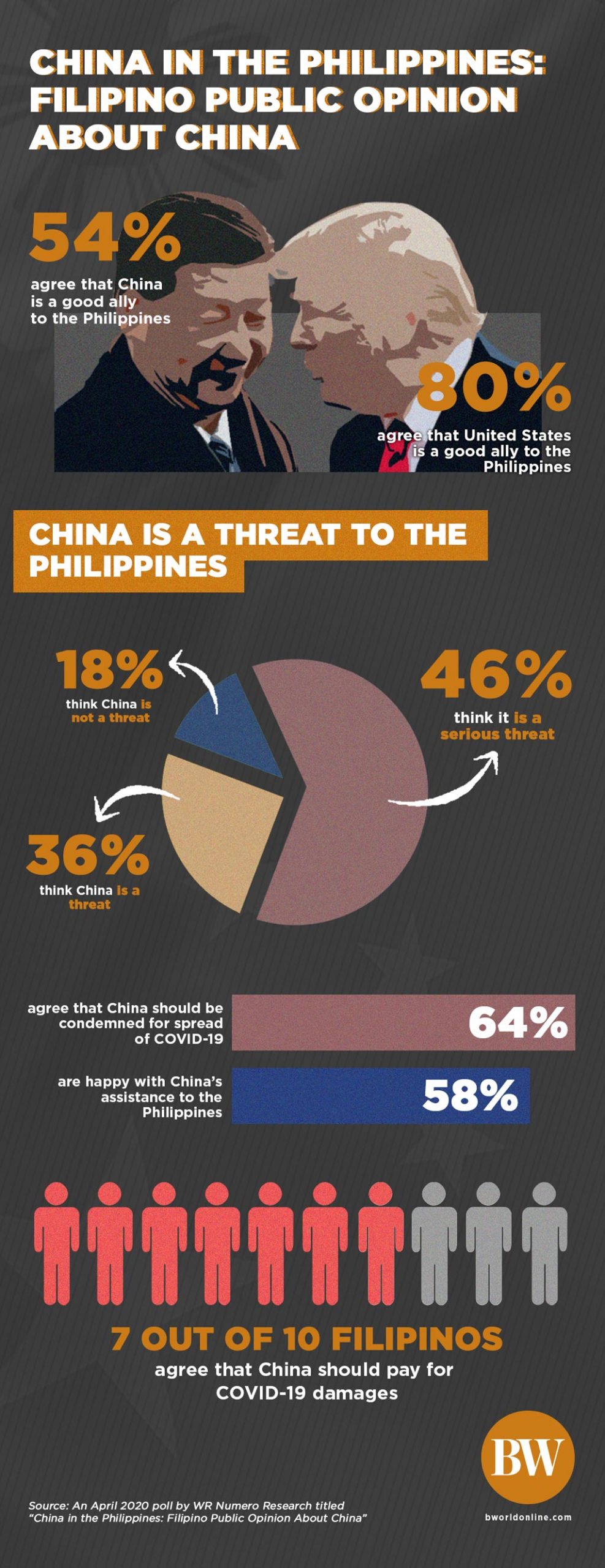
This episode jumps off from an April 2020 survey by polling and data analytics company WR Numero Research that found that 54% of Filipinos think of China as a good ally to the Philippines. Many things have changed since then and attitudes toward China are ambivalent. Mr. Garcia, CEO of WR Numero Research and an assistant professor at the University of Asia and the Pacific, tells BusinessWorld reporter Charmaine A. Tadalan what he thinks of Duterte’s foreign policy and how China could become the President’s Achilles’ heel.

TAKEAWAYS

The number of people that see China as a good ally will likely decrease if the economic benefits from China fail to materialize.

Mr. Garcia feels that the reason 54% of people still believe that China may be a good ally is because of the economic benefits that China may give, such as the Belt and Road Initiative. 

If these investments do not materialize, the numbers will probably dip below 54%.

The government should assert Philippine rights at sea as more Filipinos feel threatened by China. While the Department of Foreign Affairs has been sending diplomatic protests, the government should create a strategy to improve the country’s security policy 

“Rhetoric is not enough,” said Mr. Garcia. “We need to be able to create a grand strategy of improving our security policy, our security capabilities, alliance policy as well with the US and China.”

China and COVID-19 is the Duterte administration’s Achilles’ heel which may result in a decrease in his influence ahead of the 2022 elections.

“These two things may be separate but also interrelated because China is responsible for this whole mess. It will definitely affect the numbers because this is a cross-cutting issue that even the people who supported Duterte do not agree with Duterte on both,” said Mr. Garcia.

Terminating the Visiting Forces Agreement with the United States will put the Philippines at a weaker position against China’s growing aggression in the West Philippine Sea.

According to Mr. Garcia, a strong alliance with the United States is needed. “If this abrogation will continue then we will really, really be weak in the face of increasing Chinese aggression.”  

China is taking advantage of the pandemic to assert its claims in the West Philippine Sea. It is using the maritime issue to divert attention from its weak response to the COVID-19 crisis. 

The China Communist Party needs to project strength, said Mr. Garcia, and the Chinese government is rallying the country toward nationalism to distract the population from its internal problems. “That’s why from a perspective of insecurity, it’s now becoming more aggressive in the South China Sea,” he said.

Recorded remotely on July 15. Produced by Nina M. Diaz, Paolo L. Lopez, and Sam L. Marcelo.


Related episode:


One People. One Nation. Healing as One

Over the course of 57 years, the Land Bank of the Philippines (LANDBANK) has taken a more expansive and relevant role in the service of Filipinos and the nation. From delivering intensified support to the country’s agriculture sector, to becoming a reliable partner of the National Government and Local Government Units (LGUs) in driving progress, LANDBANK has remained committed in pursuing its brand promise – ‘We Help You Grow.’

Despite the challenging and rapidly changing banking landscape, LANDBANK through the years has successfully managed to strike a balance in fulfilling its dual role of promoting countryside development while remaining financially viable.

The Bank has stepped up its efforts to be more responsive than ever to the needs of Filipino farmers and fishers, as well as their organizations. It has exerted greater focus on directing its loans to programs and projects that help accelerate growth, generate employment, and revitalize local economies, especially in the countryside.

As a testament to its strong financial record, LANDBANK ranks among the top five commercial banks in the Philippines in terms of deposits, assets, capital, and loans. It is by far the largest formal credit institution in the rural areas, and the only bank present in all 81 provinces of the country that caters to the financing needs of Filipinos even in the farthest corners of the archipelago.

Today, as the country faces an unprecedented crisis of massive scale due to the coronavirus disease 2019 (COVID-19) pandemic, LANDBANK has risen to the demands of unhampered public service. The Bank continues to serve at the front lines to deliver essential and uninterrupted financial services to its mandated sectors, while carrying out various response and support measures to help Filipinos and the entire nation recover, rise, and heal as one.

“As we commemorate LANDBANK’s 57th founding anniversary, we thank all our customers and partners for your continued trust and support. We assure you that LANDBANK is committed more than ever in providing uninterrupted banking service, and contribute in implementing recovery measures. We are one with the National Government and the Filipino people in rising above this adversity,” said LANDBANK President and CEO Cecilia C. Borromeo.

Unwavering support and service in the time of COVID-19

Since the beginning of the COVID-19 outbreak, LANDBANK continues to provide its clients uninterrupted access to financial services, while performing a critical role in the delivery of various support initiatives to sectors most affected by the health crisis.

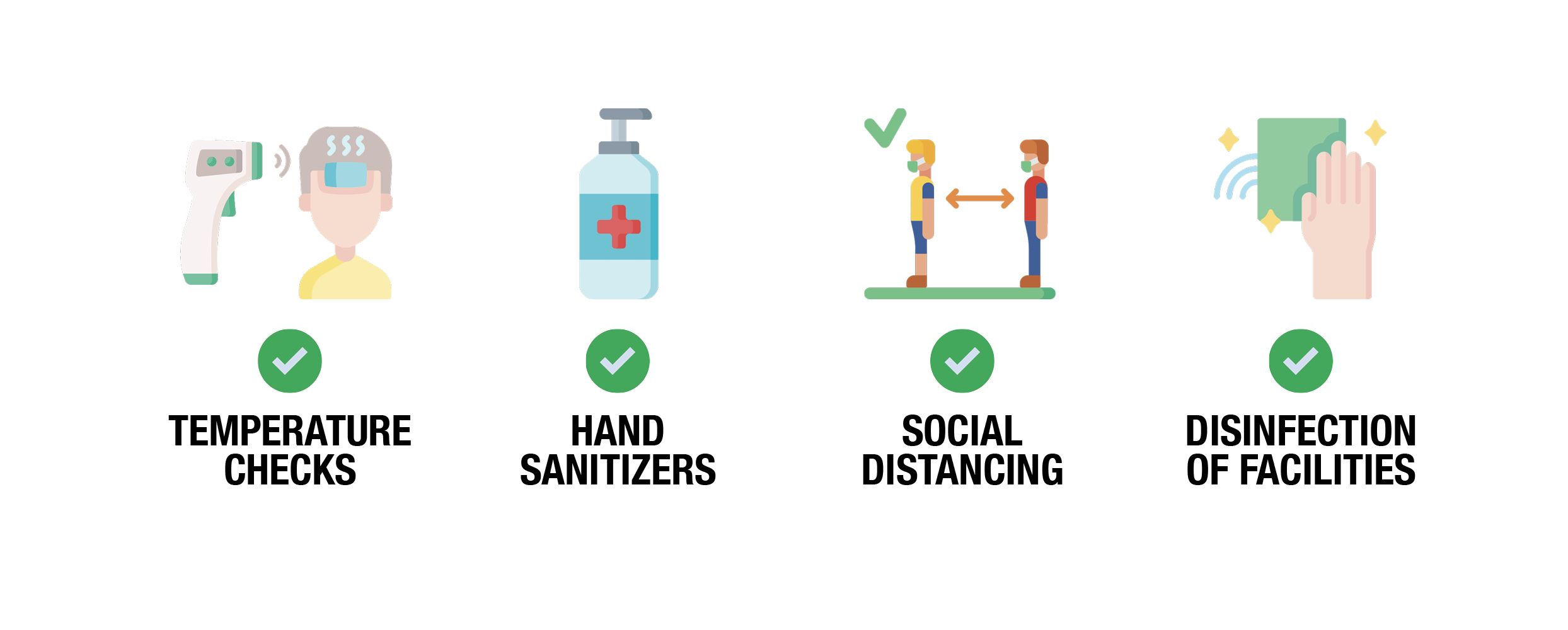
While many establishments have temporarily closed to stop the spread of the virus, majority of LANDBANK branches nationwide remain open. The Bank is implementing the following preventive measures to ensure public health and safety within Bank premises:
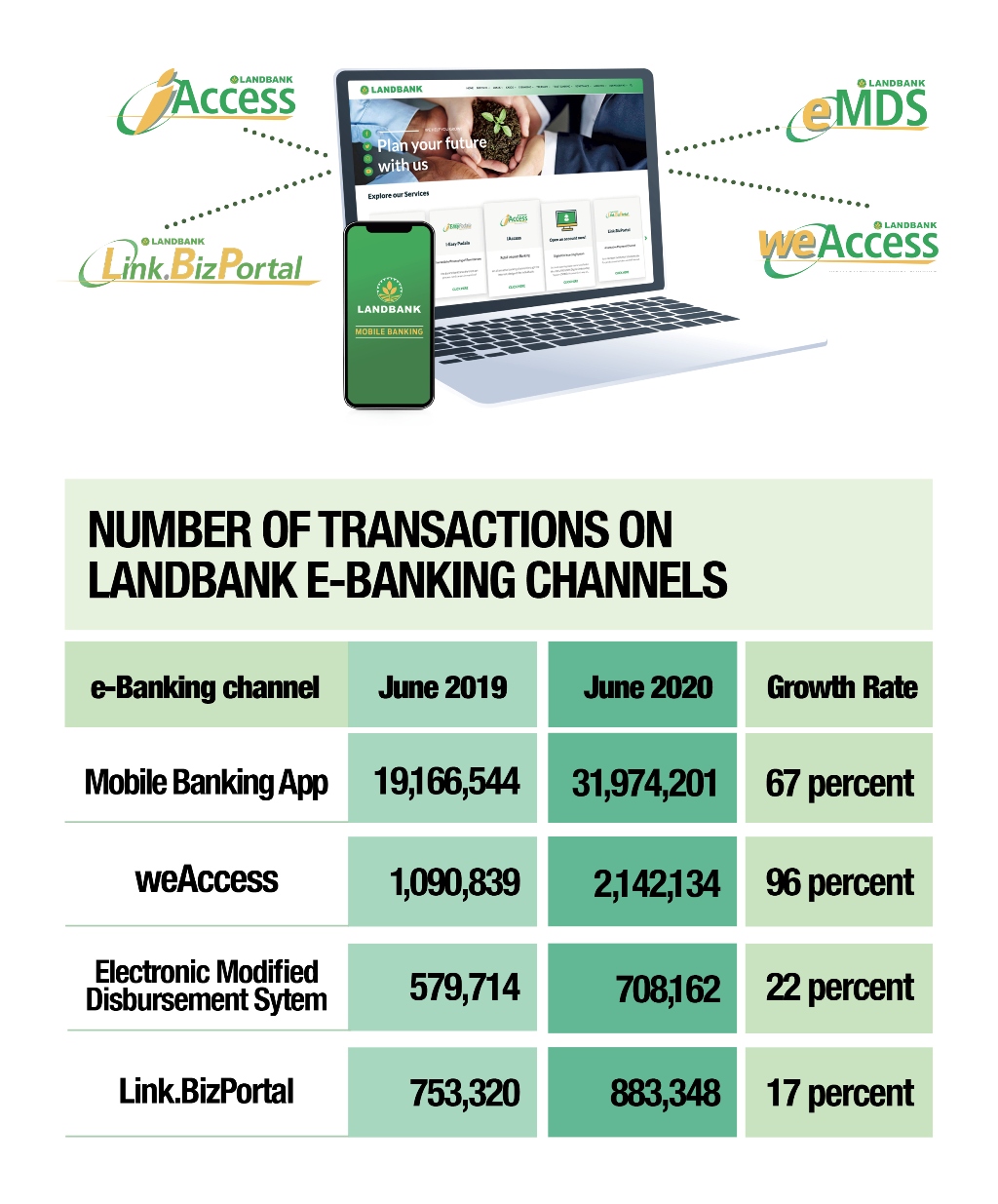
To avoid further spread of the deadly virus, LANDBANK’s electronic and digital platforms are fully operational, providing convenient banking for customers in the safety of their homes. As of end-June 2020, LANDBANK’s e-banking channels recorded a 24 percent surge in volume of transactions.
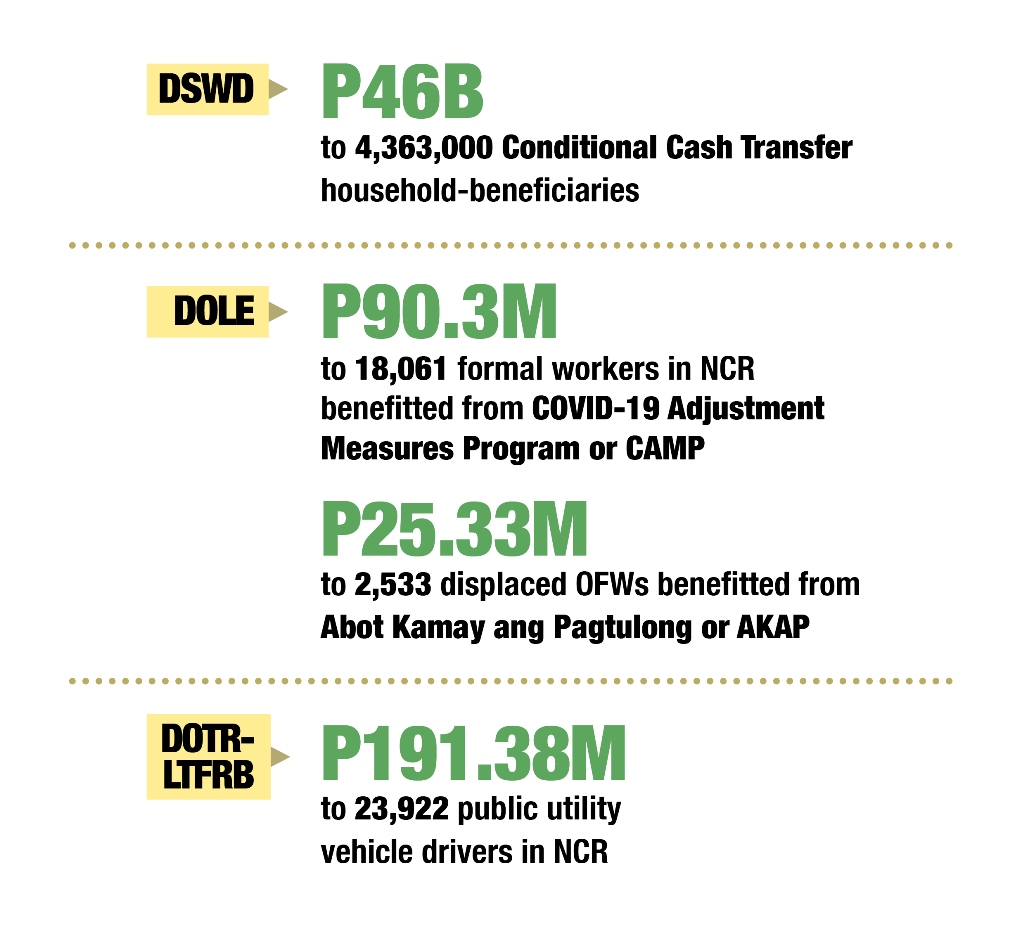
Meanwhile, LANDBANK supported the implementation of Republic Act No. 11469 or the “Bayanihan to Heal as One Act” as the main distribution arm in the delivery of various social amelioration programs (SAP) of national government agencies for qualified Filipino households severely affected by the pandemic. As of July 1, funds disbursed for these programs are the following:
In terms of providing timely and affordable credit to the affected sectors amid the virus-induced downturn, LANDBANK developed lending programs to finance various response and recovery measures.
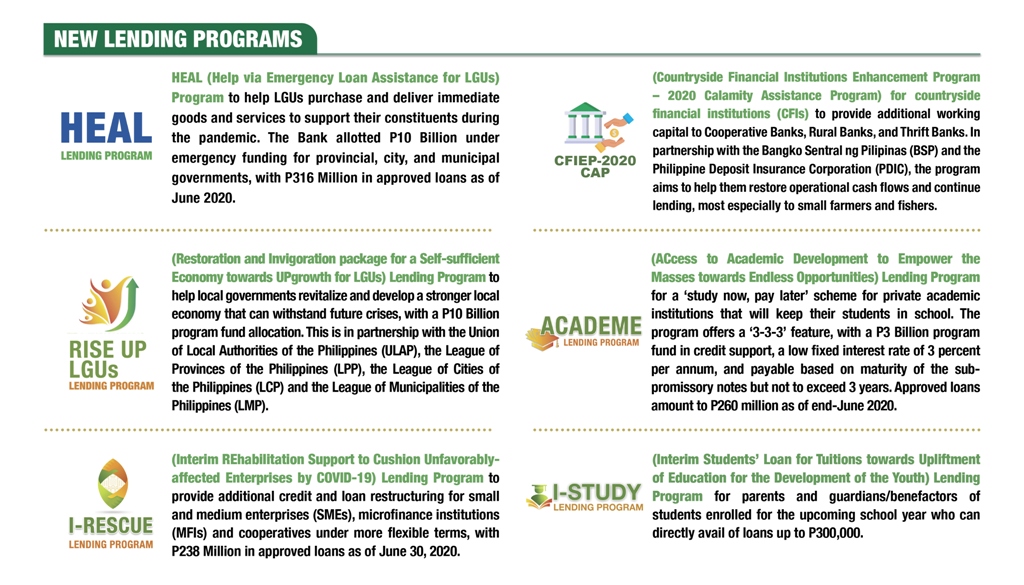
Relief for borrowers

Meanwhile, to minimize the financial burden of its clients amid the crisis, LANDBANK rolled out relief packages in the form of payment moratoriums for due dates falling during the previous enhanced community quarantine (ECQ) period. 
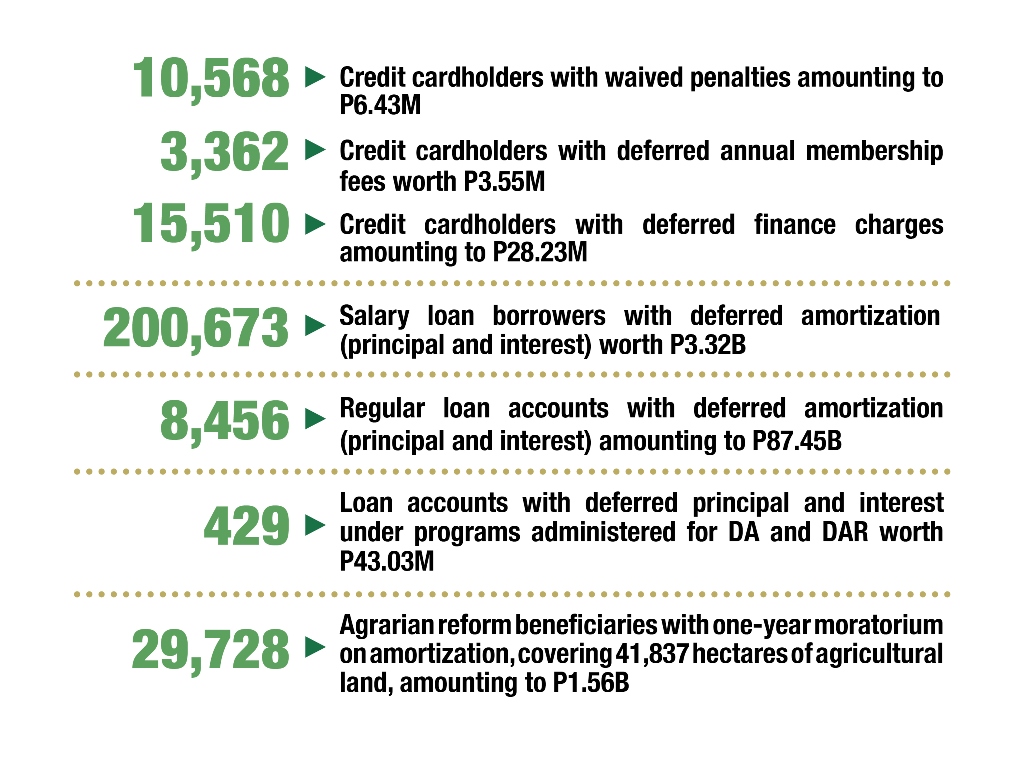
In response to the call of the Bangko Sentral ng Pilipinas (BSP) for relief measures that would benefit the general public and increase the use of digital payments during the COVID-19 pandemic, LANDBANK waived its fund transfer fees for PESONet and InstaPay channels until Dec. 31, 2020.

OFBank becomes fully-digital, branchless bank

Amid the onslaught of the COVID-19 pandemic, LANDBANK was still able to fulfill its promise of transforming its wholly-owned subsidiary, the Overseas Filipino Bank (OFBank), as a digital-only, first branchless Philippine government bank. OFBank clients across the globe can now enjoy the convenience of a safe, reliable, and secure digital banking experience anytime, anywhere.

As a digital-only facility, OFBank now utilizes the Digital Onboarding System with Artificial Intelligence (DOBSAI) to facilitate real-time account opening via the OFBank’s Mobile Banking App. There are three types of accounts available: the OFBank Visa Debit Card for overseas Filipinos (OFs) and overseas Filipino workers (OFWs), the OFBank Visa Debit Card for beneficiaries, and the OFBank Debit Card for beneficiaries below 18 years old.

The OFBank Visa Debit Card allows cardholders to receive secure and convenient real-time fund transfers. They may also use OFBank’s mobile facility to transfer funds to the OFBank and LANDBANK accounts of their beneficiaries, free of charge. 

Since the launch of OFBank as a fully-digital bank last June 29, a total of 7,131 overseas Filipinos and OFWs from 43 countries opened their accounts with OFBank as of July 30, 2020. And as it moves forward, it is looking to introduce an electronic multi-purpose loan system to further serve the financing requirements of its valued clients.

Support to Agriculture

Even in the face of a global health pandemic, LANDBANK remains steadfast in delivering intensified support to the agriculture sector, reaching more Small Farmers and Fishers (SFFs). 

Loans to Agriculture

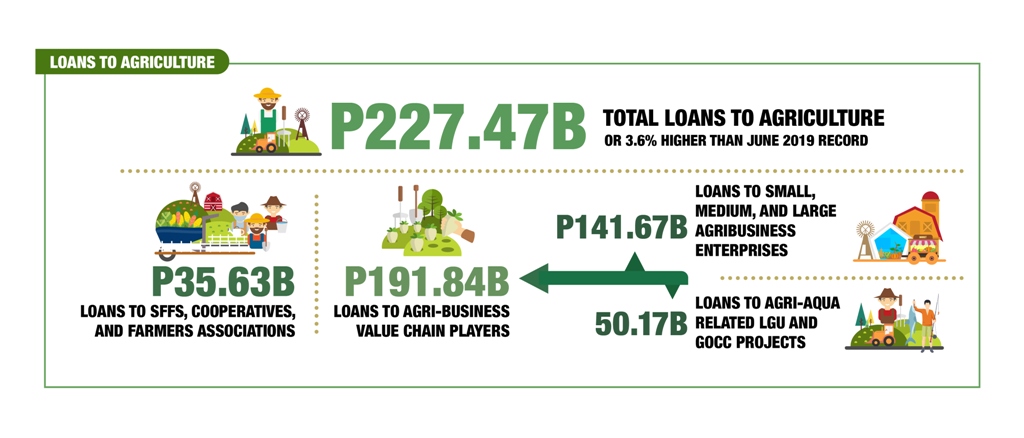
As of end-June this year, LANDBANK has extended loans to agriculture sector amounting to P227.47 Billion—P7.97 Billion or 3.6 percent more than the P219.5 Billion as of June 2019. 

Of these, P35.63 Billion was outstanding loans to small farmers, fishers, cooperatives, and farmers associations. This includes direct lending to farmers and fishers which grew by P219 Million or 18.37 percent from P1.19 Billion in May to P1.41 Billion in June. Meanwhile, loans to other players in the agri-business value chain stand at P191.84 Billion.
Assisting 2 Million SFFs

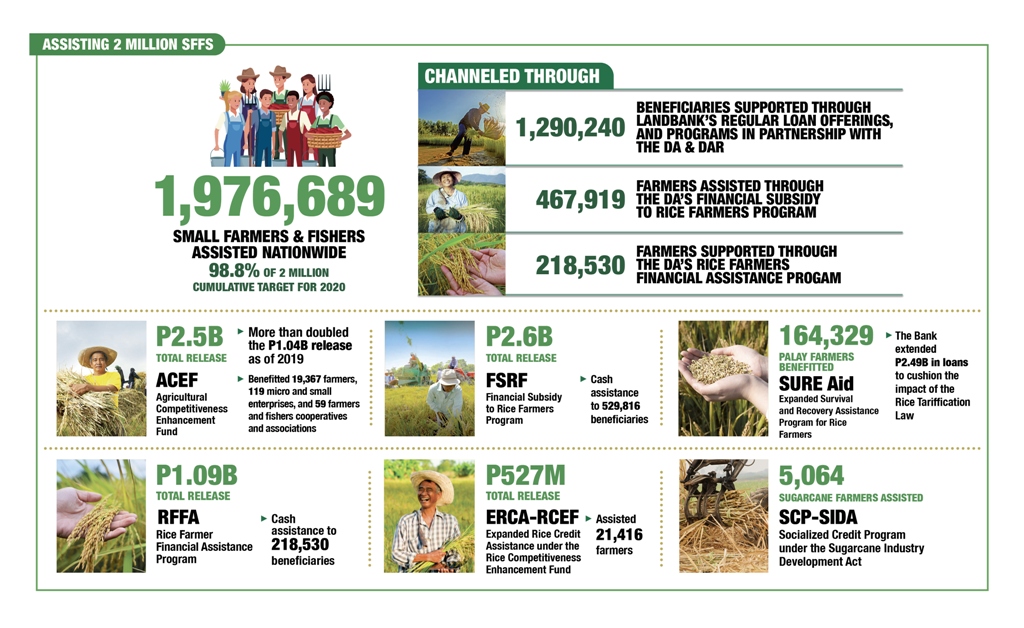
Also by the midpoint of the year, LANDBANK is already nearing its goal to reach its two (2) million SFFs cumulative target for 2020, with 1,976,689 SFFs assisted nationwide as of end-June. This represents 98.8 percent of the Bank’s target for the year.

Out of the total tally, 1,290,240 beneficiaries were supported through LANDBANK’s various regular loan offerings, and programs jointly implemented with the Department of Agriculture (DA) and the Department of Agrarian Reform (DAR) such as the following:
Financial Performance (as of June 30, 2020)

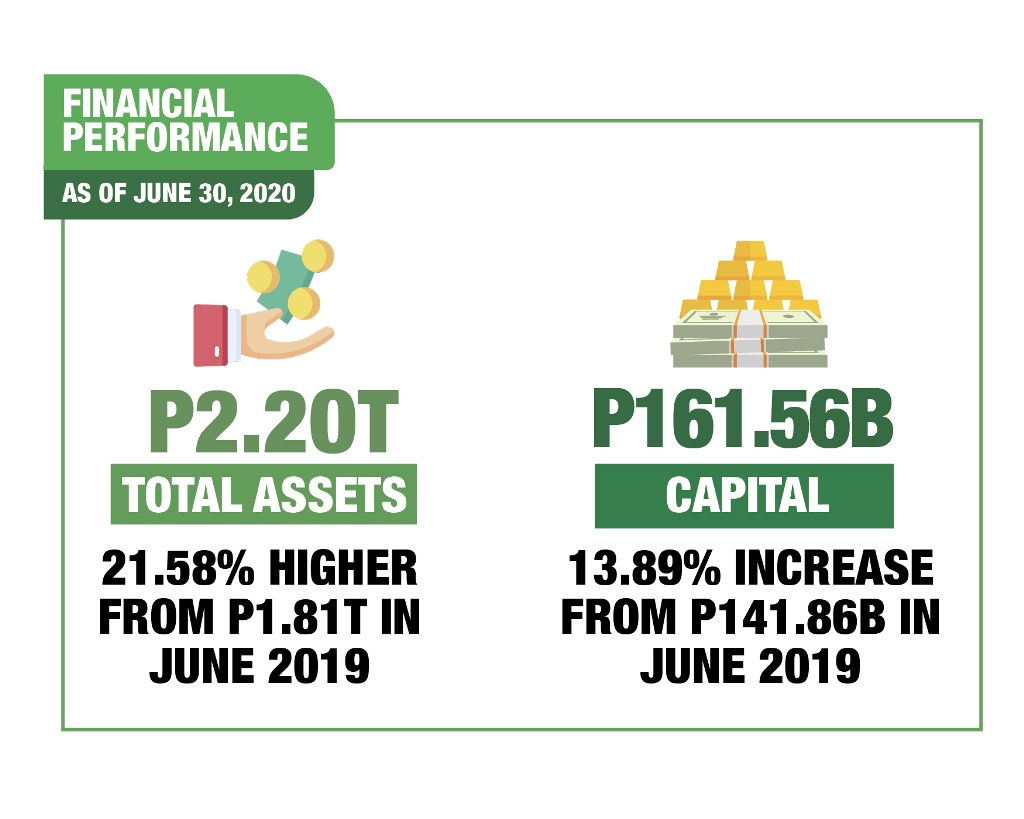
Despite the significant impact of COVID-19 to the economy, LANDBANK recorded stable financial numbers for the first half of the year with a net income of P10.02 Billion. 

Total assets grew to P2.2 Trillion driven by the 22.23 percent increase in deposits which surpassed the P2 Trillion mark. This fuels the Bank’s continued support to agriculture and other sectors affected by the pandemic.
Stories from the Frontlines

Passion to serve: Courage at sea in the face of adversity

PINAMALAYAN, Oriental Mindoro – Despite health and safety risks, LANDBANK Pinamalayan Branch employees, led by Branch Head Ferdinand E. Abas, braved the waters between Mindoro and Romblon on April 21 to reach the Municipality of Concepcion in Sibale Island, Romblon, to disburse cash cards to more than 200 Conditional Cash Transfer (CCT) beneficiaries of the DSWD affected by the pandemic.

Three hours of boat travel and a mountain hike later, they finally reached Concepcion for the successful pay-out. But on their way back, one of the engines of their small motor boat conked out. A passing boat of the Philippine Coast Guard (PCG) came to their rescue. But with its limited capacity, they had to travel in batches. 

Abas and the others patiently waited for the Coast Guard’s return but because it was already dark, their rescuers failed to locate them. It was already late at night when they safely got back to Pinamalayan on board their limping vessel after hours of fighting rough seas in total darkness.

“In my 25 years of service in LANDBANK, that was the first time my team and I faced such dangers. We could have postponed the pay-out, but we knew that the CCT beneficiaries urgently needed government assistance. I am thankful for my staff who remained true to their duties as Landbankers, with passion and dedication for public service,” Abas said.
Uninterrupted service: Flying through borrowed wings

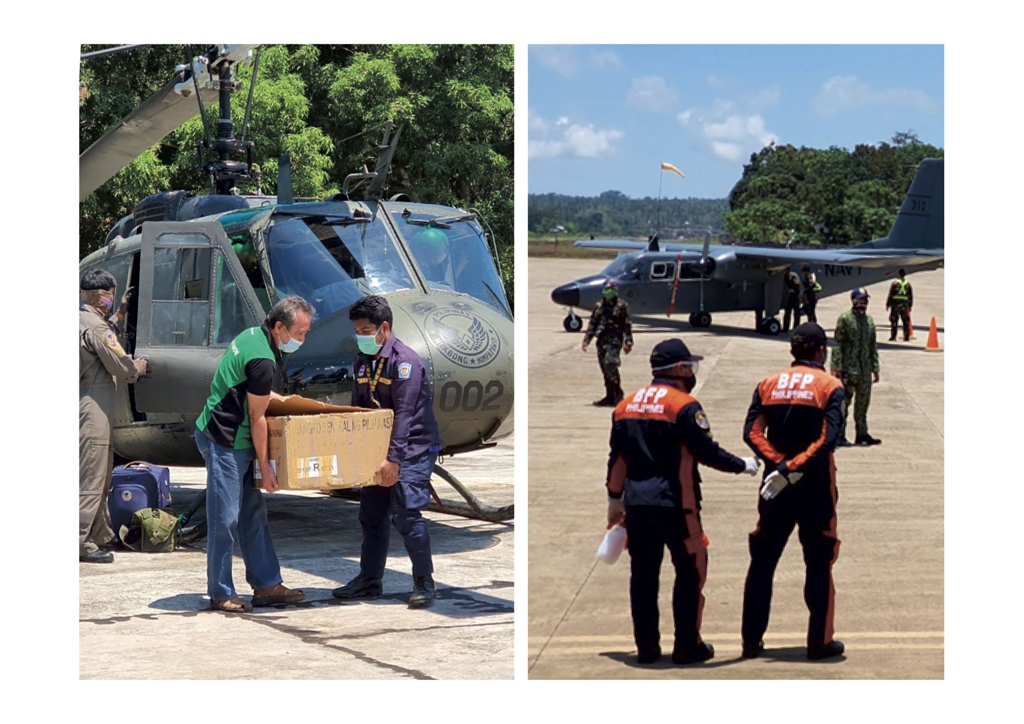
JOLO, Sulu – When commercial flights to and from Jolo airport were suspended due to COVID-19, LANDBANK Jolo Branch Acting Head Felix Friales had to figure out a way to fly in their cash supplies from the LANDBANK Cash Operation Unit in Zamboanga City to cater to the cash requirements of partner-agencies in implementing various social amelioration programs (SAP). 

Friales tapped the 11th Infantry Division of the Armed Forces of the Philippines (AFP), under the Western Mindanao Command (WestMinCom), to use one of its military aircrafts to transport the cash package. However, unlike commercial flights, the military plane had no fixed schedule of arrival in Jolo, further adding to their anxiety.

“Since this was the first time we used a military aircraft to transfer cash, we were really concerned whether the package would get to us in time for our operations. So when the cash finally arrived, it was a mixed feeling of relief and fulfilment,” he said.

For Frias, his long stay with LANDBANK serves as his driving force to commit to this level of uninterrupted service, adding that, “In this global pandemic, and when faced with a daunting task, Landbankers will continue to strive for excellent customer service, finding extraordinary means when faced with adversity.”

Dedicated Service: A beacon of light during darkness

NAGA CITY, Camarines Sur – On April 8, Bookkeeper Demi Medina, together with LANDBANK Naga Rotunda Branch Manager Melanie Avila and seven others, conducted the first-ever pay-out of the Department of Agriculture’s (DA) Financial Subsidy to Rice Farmers (FSRF) Program in Nabua town for 619 small rice farmers.

“The summer heat was at its peak, worsened by our face masks and gloves, and the packed venue of waiting beneficiaries. Suddenly, the electricity in the venue went out. But because there were still farmers waiting in line, we decided to continue the cash card distribution despite the blackout,” Medina said.

She and her fellow Landbankers resorted to using flashlights from their mobile phones as emergency light. Though exhausted, Medina and her companions felt a renewed sense of fulfillment.

“It was fulfilling to be able to help the farmers in Nabua, whose already meager income were severely affected by the pandemic. I now realize that our willingness to serve others truly makes our job more rewarding. By being a beacon of light amidst the darkness, you can make a difference, you can help change lives,” said Medina.


‘Substantial’ fiscal stimulus needed

PEOPLE line up at a remittance center in Marikina City as they wait to get financial aid from the government’s Social Amelioration Program, Sunday. — PHILIPPINE STAR/MICHAEL VARCAS

THE GOVERNMENT should come up with a “substantial” fiscal package to make up for the drastic drop in consumption that led to a deeper contraction in gross domestic product (GDP) in the second quarter.

“Substantial fiscal packages have shown to be useful to quell a festering recession and we need not look far with neighboring ASEAN countries employing aggressive spending measures,” ING Bank N.V. Manila Senior Economist Nicholas Antonio T. Mapa said in a note sent to reporters.

The Philippine economy shrank by 16.5% in the April to June period and fell into a recession for the first time since 1991. Growth drivers household consumption and investment significantly declined in the second quarter, given the closures of businesses and losses in income during one of the world’s strictest lockdowns.

The government now expects full-year GDP to contract by 5.5% on the widening impact of the pandemic.

Marikina Rep. Stella Luz A. Quimbo, co-chair of the House of Representatives’ panel on economic stimulus, said the government has to reverse the trend of declining consumption by putting cash in the hands of sectors most affected by the pandemic.

“The huge drop in consumption levels (P534 billion) in Q2 is not surprising, with so many Filipinos now without jobs. Consumption is an important driver of the multiplier effects of government spending on GDP,  hence, it contributed the most to the decline in Q2 GDP,” she said in a text message.

“Filipino households tend to spend more out of every additional peso if these are transfers from the government (e.g. conditional cash transfers) than their own income, so the multiplier effect of ayuda tends to be high,” she added.

Congress is set to approve the economic recovery measure, Bayanihan to Recover as One Act (Bayanihan II) this week.

Ms. Quimbo noted the P162 billion allocated for additional healthcare spending, wage subsidies and financial relief for critically impacted sectors under Bayanihan II is “less than ideal,” as it is a stop-gap measure rather than a comprehensive economic stimulus package. However, she said “any additional amount that the government is willing to spend is certainly welcome.”

The House of Representatives in June passed the P1.3-trillion ARISE (Accelerated Recovery and Investments Stimulus for the Economy) package, but economic managers rejected this, saying such an amount cannot be funded without new sources of revenue. It is still pending at the Senate.

Finance Secretary Carlos G. Dominguez III defended the proposed P180-billion economic stimulus plan, saying this already anticipated the sharp reduction in GDP in the second quarter and will be maintained to keep the budget deficit in check.

In a statement on Sunday, Mr. Dominguez said the stimulus package already incorporates P40 billion worth of tax credits.

“As we said, whatever stimulus package we have, it has to be affordable and it has to recognize the fact that this (corona) virus may not be defeated by the end of this year. So we have to keep, as they say, we have to keep our powder dry for next year as well,” he said. 

The P40 billion is expected to come from the reduction of the corporate income tax (CIT) from 30% to 25% through the Corporate Recovery and Tax Incentives for Enterprises (CREATE) which is pending in Congress and is targeted to be approved within the year.

Mr. Dominguez said the stimulus program also includes a P50-billion infusion into the banking system, which he estimated will generate P400 billion worth of economic activity. At the same time, P5 billion will be allocated for a credit guarantee program for troubled firms, which will have a multiplier effect of 20 times. Taken together, he said this will generate between P400 billion and P600 billion in economic activity.”

Senator Juan Edgardo M. Angara said Bayanihan II is meant to provide initial help, but should be  followed by other economic actions. “Kami naman sa Senado (In the Senate,) we have shown our willingness to work with our economic managers to pursue a successful recovery strategy,” he told BusinessWorld in a text message.

INCOME REPLACEMENT
Meanwhile, House Ways and Means Chair and Albay Rep. Jose Maria Clemente S. Salceda said they will continue to study the need for more income-replacement schemes, including a possible third tranche of the Social Amelioration Program (SAP).

He said there is a need to gauge how much of the decline in household consumption was due to income loss or lack of confidence, which is only considered as deferred consumption and can be revived by addressing policy and bolstering the healthcare system.

“Lost consumption due to lost income will have to be replaced with corresponding increases in government spending on subsidies. Otherwise, that will set future growth back for years,” Mr. Salceda told BusinessWorld in a text message.

“Clearly, we need to do better with providing social assistance. We have to find ways to provide our people with enough income replacement and enough substitute jobs for basic necessities,” he added.

For Asian Institute of Management economist John Paolo R. Rivera, it’s not just the amount of stimulus, but the timeliness of release and the coverage also counts.

“The point of these interventions is to at least allow people to have work and sustain consumption of essentials,” he said in a text message.

He said the government should consider beefing up the SAP in such a way that eligible households will receive it on time to make the stimulus effective and also boost consumption.

“Avoiding taxation (defined or proposed) on both essential and non-essential goods would also help stimulate consumption,” Mr. Rivera added. — Luz Wendy T. Noble

Gov’t debt payments up 42% in first half

THE National Government settled P547.347 billion in debt in the first half of 2020, up 42% from a year ago, data from the Bureau of the Treasury (BTr) showed.

The government’s debt service bill in the first six months accounted for a little over half of the P1.033-trillion debt payment target this year, based on the Budget of Expenditures and Sources of Financing report.

Latest BTr data indicated as of end-June, amortization made up 66% of the total at P359.67 billion, while the remaining 34% or P187.676 billion went to interest payments.

For the month of June, debt service payment fell 59% to P34.387 billion from P83.811 billion in June 2019, largely due to lower amortization. The June figure was 40% higher than May’s P24.642 billion.

In June, 80% of debt payments went to interest and 20% went to amortization.

Principal payments plunged by 83.55% to P6.826 billion in June, from P41.495 billion a year ago. This all went to external creditors as the government did not make principal payment to its local lenders during the month.

Interest payments totaled P27.56 billion, slipping by 5.28% year on year. Some 89% or P24.617 billion were paid to domestic creditors while 11% or P2.944 billion went to foreign sources.

In 2019, total debt payments reached P842.449 billion, up 16.1% from the previous year.

The government borrows from both domestic and foreign lenders to plug the budget deficit seen to hit 9.6% of gross domestic product this year amid rising pandemic expenses and weak state revenues.

The government targets to borrow P3 trillion this year, more than double the P1.4-trillion program set before the pandemic hit the country.

Gross borrowings in the first six months of the year reached P1.7 trillion, beating the P1.02 trillion raised for full-year 2019. Excluding the repayments made, net borrowings for the period reached P1.548 trillion.

The pandemic continues to pummel the economy, which is projected to contract by 5.5% this year following the 16.5% slump in the second quarter. — B.M.Laforga

ADVERTISEMENT
ADVERTISEMENT