

Home Blog Page 9167

Pop star Britney Spears wants her dad out of the picture

LOS ANGELES — Britney Spears wants her father to be removed as the person that controls her business and personal affairs in a major change to her 12-year court-appointed conservatorship.

Ahead of a court hearing in Los Angeles on Wednesday, the 38-year-old pop star’s lawyer filed documents saying the singer is “strongly opposed to having James (Spears) return as conservator of her person.” The document gave no reasons for her stance.

Jamie Spears was appointed conservator in 2008 after the pop star’s life spiraled out of control and she was hospitalized for psychiatric treatment.

After a career comeback, the “Toxic” singer pulled out of a Las Vegas concert residency last year and briefly entered a mental health facility. She has not performed publicly since October 2018 and the court documents said it was “her stated desire not to perform at this time.”

The long conservatorship for the former teen pop phenomenon has been the target of a vocal #FreeBritney campaign by fans. They believe she is being kept a prisoner and is sending cryptic signals begging to be freed through her social media accounts, which usually consist of selfies or her dancing at home.

The fans greeted news of her request to oust her father as a victory and plan a demonstration outside the downtown Los Angeles courthouse on Wednesday.

“We know our girl #FreeBritney happy with the news today! Huge step,” tweeted Junior Olivas, one of her most ardent fans.

Spears wants control over her affairs to be given to her care manager, Jodi Montgomery, who was made a temporary conservator last year after Jamie Spears suffered a bout of ill health, according to the court documents.

Jamie Spears has dismissed the #FreeBritney campaign as a joke.

“All these conspiracy theorists don’t know anything,” Spears told the New York Post earlier this month. “It’s up to the court of California to decide what’s best for my daughter. It’s no one else’s business.” — Reuters
SEC invalidates share purchases in The Medical City; acquiring entities prepare legal remedies

A SHAREHOLDER group’s acquisitions of majority shares in Professional Services, Inc. (PSI), The Medical City’s operator, were nullified by the corporate regulator for allegedly being illegal and fraudulent.

The ruling came after the Securities and Exchange Commission’s (SEC) special hearing panel in November last year penalized Viva Holdings (Philippines) Pte. Ltd., Viva Healthcare Ltd., Fountel Corp. and Felicitas Antoinette, Inc. (FAI) for violating the mandatory tender offer rules under the Securities Regulation Code (SRC) and committing fraud in taking over PSI.

In an Aug. 13 decision, the Commission en banc added in the said resolution a provision to declare null and void all their share purchases in PSI since Aug. 1, 2013.

The shares bought by the group will be considered unsubscribed and allocated for subscription by investors.

The SEC also ruled to cancel their share acquisitions in Splash Corp., San Miguel Corp. and Insular Life Assurance Co. Ltd., and to revert these as treasury shares.

PSI is to reimburse Viva Holdings, Fountel, and FAI for the subscriptions that were nullified, once these were sold and paid for.

In a statement, Fountel’s majority owner Jose Xavier “Eckie” B. Gonzales said the decision forces The Medical City to pay the acquiring entities at least P10 billion in cash that they had invested since 2013.

“We are disappointed with the questionable decision of the [SEC], which our legal team believes to be arbitrary, unfounded, and, to a certain extent, overreaching. Fortunately, the law provides remedies that will allow these errors to be corrected,” he said.

Mr. Gonzales, who chairs the hospital’s board, said the SEC decision “adds further pressure and uncertainty to a hospital network already straining with the many problems caused by the COVID crisis, including its cash flow.”

To recall, the four entities were found to have breached Section 18 of the SRC and Rule 19 of the implementing rules and regulations of the code, the accompanying penalties of which the SEC wanted them to be held solidarily liable for.

The Commission en banc added that they also violated Section 26 of the SRC, which prohibits fraudulent transactions in the sale of securities.

In 2013, Viva Healthcare, Viva Holdings, FAI, and Fountel entered into a cooperation and shareholders agreement (CSA), “which effectively transformed their business relation into beneficial ownership over each other’s shares.”

The SEC said the entities have increased their collective shareholdings in PSI to more than 50%, mainly through subscriptions in the firm’s capital stock increases, which the regulator approved in November 2013, July 2014, August 2017 and October 2017, respectively. These stock increases, though, were maintained as valid.

In the meetings where these stock increases were discussed, the entities’ intention to gain beneficial ownership, thus taking control of PSI, was not made known to the company.

“The directors and other shareholders of PSI only learned about the CSA in 2017, as a consequence of a negotiation for Ayala Healthcare Holdings, Inc. to acquire shares in the company,” the regulator noted.

The Commission en banc said the parties “succeeded in making it appear and convincing” PSI that their purchases were independent of each other and that these will not be used to control the management, governance, and conduct of the business of the company.

All the processes involved in the share purchases, such as subscription contracts, deeds of assignments, and deeds of sale, were “tainted with illegality and fraud,” it said.

Further, the Commission en banc ordered the SEC’s general counsel to immediately resolve all cases related to the conduct of the meeting and the election of the members of the board of directors of PSI.

In the statement, Mr. Gonzales said his group “will exhaust all legal means possible to ensure that the SEC’s decision will not affect the continuing operations of The Medical City.” — Adam J. Ang

IC sees minimal policy cancellations

THE INSURANCE Commission (IC) sees the number of clients surrendering their insurance policies remaining at normal levels despite the slowing economy as the pandemic highlights the need for protection in a country where the insurance penetration rate remains low.

Insurance Commissioner Dennis B. Funa, citing a report from the industry, said on Wednesday that insurers have not seen an unusual surge in cancellation of policies so far.

“To date, we have not experienced much surrenders. It’s very much at the same level as pre-COVID-19 period. We anticipate it to remain at the same level moving forward,” Mr. Funa said in a mobile phone message, quoting the report.

Mr. Funa said due to the ongoing pandemic, clients have seen the importance of protection, prompting them to allot money for insurance despite reduced incomes or lack of jobs amid slowing economic activity.

“It seems that is the situation across the industry. People will hold on to their insurance as long as they can because they know that is a protection they can rely on if the situation becomes worse,” he said.

The economy shrank 16.5% in the second quarter, plunging the country into a recession. The economic downturn has also caused hard-hit businesses to cut wages and lay off workers.

The country’s unemployment rate jumped 17.7% in April from the 5.1% recorded in the same month last year, or equivalent to a total of 7.25 million jobless Filipinos compared to the 2.27 million in April 2019, based on latest data.

Mr. Funa said policy cancellations will likely remain at pre-pandemic levels due to the country’s low insurance penetration rate.

“Maybe those that lost their jobs are among those that don’t have insurance in the first place. Mainly relying on their SSS (Social Security System) and PhilHealth (Philippine Health Insurance Corp.),” he said.

The insurance industry saw higher density last year, with the amount of premiums per capita at P2,812 in 2019, up 3.35% from P2,721 the year prior.

However, insurance penetration or the overall contribution of the insurance sector to the economy stood at 1.64% last year.

The industry posted an overall premium income of P304.639 billion in 2019, up five percent from the year prior. — B.M. Laforga

SEC clears Phoenix’s P3.5-B notes offering

THE Securities and Exchange Commission (SEC) gave the green light for Phoenix Petroleum Philippines, Inc. to offer its P3.5-billion commercial papers under its latest debt financing program.

The listed independent oil firm can now proceed with the offer and sale of the first tranche of its P7-billion debt papers upon receiving the corporate regulator’s permit to sell, it told the stock exchange, Thursday.

Phoenix will be offering P2 billion in the said issue, which has an oversubscription option of up to P1.5 billion. The company still has not specified where the proceeds from this offer will be for.

Earlier this month, the oil company said it is planning to put up a P7-billion commercial papers program.

Last week, Phoenix reported that limited inventory replenishment due to credit tightening made it difficult for it to recover in the second quarter, resulting in “weaker-than-expected” volume in domestic fuel.

“Regional and local developments within the industry and credit markets have tightened access to working capital. We saw this hamper our recovery in the (second quarter) as we had to divert resources to debt service and pull back on inventory replenishment,” Phoenix President Henry Albert R. Fadullon said.

Between April and June, the company suffered a net loss of P5 million, albeit, “significantly lower” than the first quarter’s losses.

The company will swing back to profitability in the next quarter, according to Mr. Fadullon. “We are confident and hopeful that the worst is behind us,” he added.

Shares in Phoenix inched down 0.53% to close at P11.28 each on Thursday. — Adam J. Ang

Streaming service inks deal with Universal for small biz soundtracks

A SWEDISH business-to-business streaming service that counts Spotify Technology SA as a minority owner has signed a global licensing agreement with Universal Music Group (UMG).

Stockholm-based Soundtrack Your Brand Sweden AB hopes the deal will provide the carrot needed to convince small business owners using private streaming accounts to move to its legal streaming alternative.

“I see this as probably the biggest event in the history of the company,” Chief Executive Ola Sars said in an interview. “Since Universal has about a 30% market share, a lot of people have artists from their catalog in mind when they try out the service.”

The streaming service, originally known as Spotify For Business, began building its own music library in 2017 and has since secured 9,000 deals with record labels and publishers.With the UMG agreement, the company has signed contracts with the three major labels that control large swathes of the market. It will now offer songs from artists such as The Weeknd and Katy Perry, making Soundtrack’s catalog fully comparable with that of the largest consumer streaming services, according to Sars.

PAUSE BUTTON
A key challenge facing Soundtrack has been a reluctance among business owners to move away from private accounts to a licensed music service that is about three times more expensive.

Sars hopes that industry organizations will now try to regulate the market in a similar way that sports broadcasters such as Sky Sports have done with pubs and bars showing Premier League soccer games in the UK.

“Now that we have an offering that is on par with consumer services, there is no reason to use those illegally,” Sars said. “We have shown that there are some 20 million businesses that are using consumer accounts. That’s about $2.7 billion in royalties that labels and publishers miss out every year.”

Sars admits getting licensing agreements in place has taken longer than he thought, and meanwhile, Soundtrack has been forced to cut jobs and shift its sales setup amid mounting losses. The company introduced a function to pause subscriptions for a limited period of time after the coronavirus pandemic impacted its end markets.

“We’ve had small business owners calling us, crying,” Sars said. “80% of clients that had to shut down paused their subscriptions instead of canceling. Those who canceled were probably hit so bad that they weren’t going to make it through.” — Bloomberg

Senator calls for review of OFW repatriation system

A SENATE RESOLUTION is seeking a review of the government’s handling of the repatriation program and other policies concerning returning overseas Filipino workers (OFWs).

Senate Resolution No. 497 proposed that the chamber look into the condition of the repatriated workers, claiming that assistance for displaced workers has been badly coordinated.

“There is an apparent lack of true understanding that the plight of the OFWs only begins with repatriation — that they wold need further assistance to rehabilitate and reintegrate themselves back to the society upon return to the Philippines,” Senator Leila M. de Lima said in a statement on Thursday.

“Bringing them home is but a step, not the whole process.”

The Department of Foreign Affairs reported as of Aug. 15, more than 135,000 overseas workers have been repatriated since February. This includes 52,600 seafarers and 82,651 land-based workers.

The department also said there are so far 9,900 confirmed coronavirus cases involving Filipinos overseas, including 3,300 under treatment. A total of 5,800 have recovered while more than 730 have died.

The Labor department said in June that it expects around 400,000 OFWs to be displaced by the coronavirus pandemic. Labor Secretary Silvestre H. Bello III also said that this is expected to reduce remittances by 30%-40% this year.

Ms. de Lima said displaced OFWs who were repatriated did not fare better here than overseas, citing reports that some have had to undergo prolonged quarantine.

Others have also raised concerns on the delays and inefficiencies in testing and document processing.

“The situation of OFWs in the Philippines is fraught with too much risk and uncertainty that around 191,000 displaced OFWs have chosen to forego a return to the country and take their chances abroad instead,” she said. — Charmaine A. Tadalan

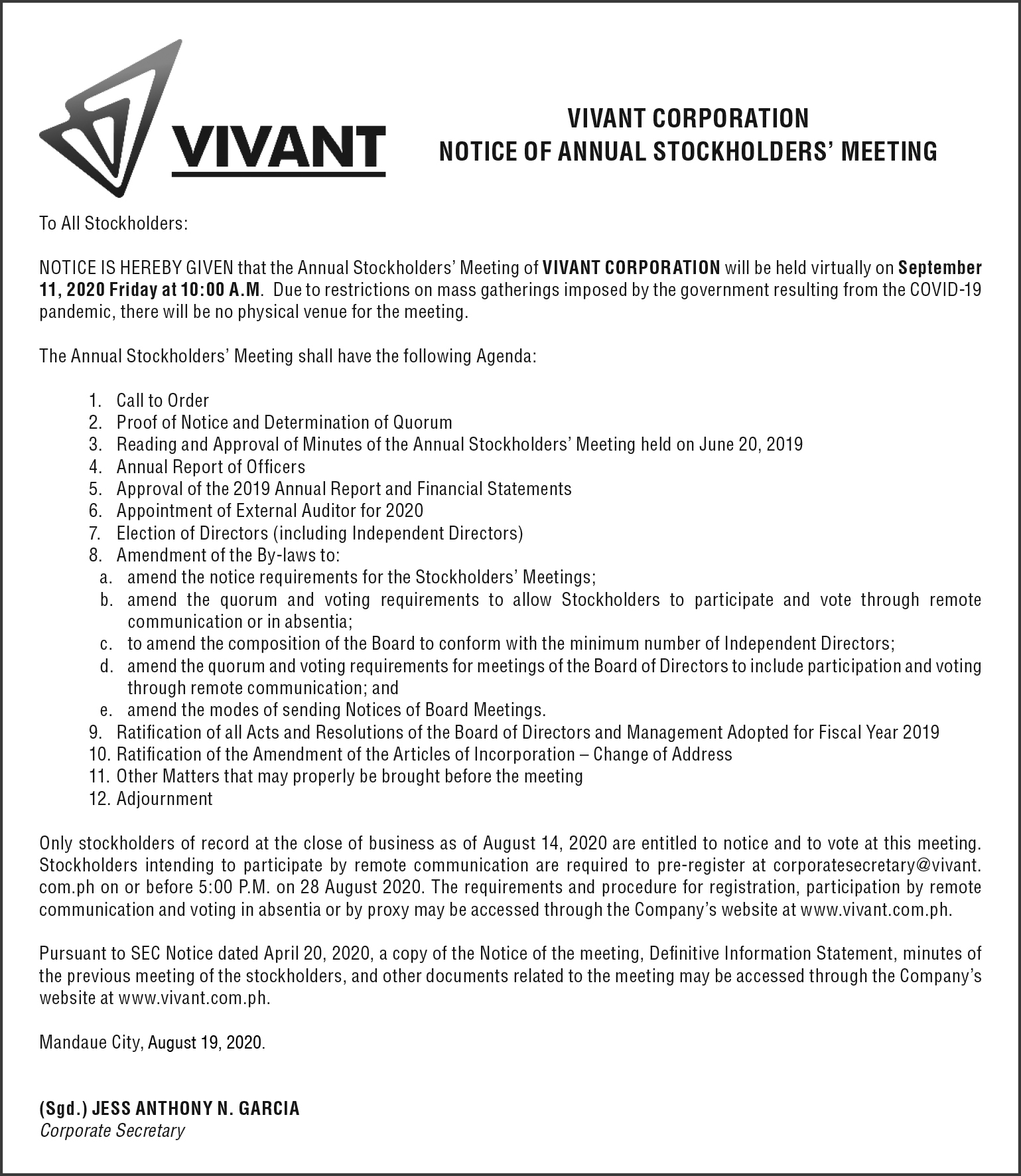
Vivant Corporation sets virtual annual stockholders’ meeting on September 11

SM Investments sets terms for bonds program

SM INVESTMENTS CORP. (SMIC) disclosed its proposed tenors for its P30-billion securities program applied with the Securities and Exchange Commission (SEC).

The listed firm on Thursday apprised the stock exchange about its proposed terms and conditions for its latest debt program.

It plans to issue the bonds with a tenor of three, five, and/or seven years under a three-year shelf registration with the SEC.

“The terms are subject to further changes based on market conditions and to appropriate regulatory approvals,” it noted.

The company eyes the first bond issuance of up to P10 billion, with an oversubscription option of up to P5 billion.

The said first tranche was rated PRS Aaa by the Philippine Ratings Services Corp. (Philratings), which is the highest credit rating it gives to corporate bonds. It means the bonds have minimal credit risk and that SMIC is deemed to have an “extremely strong” capacity to meet its financial commitments.

SMIC still has not specified where the proceeds of the debt program will be used for.

Shares in SMIC were unchanged at P900 each on Thursday. — Adam J. Ang

Stuff to do at home (08/21/20)

PPO Instrument Petting Zoo: Tuba

THE PHILIPPINE Philharmonic Orchestra’s Instrument Petting Zoo continues with its live online program with featured tuba player Benedicto dela Peret, Jr. on Sunday, Aug. 23, at 4 p.m., via the PPO Facebook page. Mr. Benedicto will talk about the tuba and demonstrate how it is played in the instrument petting zoo session. He will also perform classical pieces suited for the instrument. A project of the Cultural Center of the Philippines and the Philippine Philharmonic Orchestra (PPO), the Instrument Petting Zoo aims to promote appreciation for musical instruments of the orchestra and its music among children and families. It is held every Sunday at 4 p.m., and runs for several months.

Buwan ng Wika Workshops by the BGC Arts Center

IN CELEBRATION of the National Language Month, the Bonifacio Global City (BGC) Arts Center is holding a series of workshops including a Baybayin (an old Filipino writing system) workshop on Aug. 21 at 2 p.m., a calligraphy workshop featuring the Baybayin script on Aug. 28 at 2 p.m., and a webinar on how to save indigenous languages and species co-presented by the Mind Museum on Aug. 22, 3 p.m., via Facebook Live. The two Baybayin workshops will be held over Zoom and will require a donation to register. The requested donation amount is P400. To register for the workshops visit, https://www.bgcartscenter.org/whats-on/217/online-baybayin-workshops. For more information, visit the BGC Arts Center Facebook page.

Heneral Rizal on YouTube

AFTER premiering on the recently concluded Cinemalaya Independent Film Festival last week, the short film Heneral Rizal, directed by Chuck Guttierez and written by Floro Quibuyen, will be available to watch online via https://bit.ly/PansamanTanghalanHeneralRizal. The film is said to provide a closer look at General Paciano Rizal, the brave general and a loving older brother to National Hero, Dr. Jose P. Rizal. The short film sheds light on the real story of Paciano. Tanghalang Pilipino’s artistic director Nanding Josef plays the titular character in the film. While the film is free to view for everyone, the theater group is asking for donations for its ongoing fundraiser to help keep them continue with their mission to provide relevant artistic presentations. Donations can be made through https://bit.ly/KTXPantawidNgTanghalan.

Fully Booked Storytelling sessions and Komiks Writing Workshop

AS PART of its ongoing Local Lit Fest, Fully Booked is holding a live storytelling session of Marvino’s League of Superheroes by Rae Rival-Cosico on Aug. 22 at 2 p.m. at the Fully Booked Facebook page, and a Komiks (Filipino comics) writing workshop with Russell Molina (of Sixty Six/ Mr. Tino graphic novel fame) on Aug. 22 at 3 p.m. via Zoom. Registration for the workshop is priced at P700 and can be done via bit.ly/LLFKomiksWriting.

BP OnStream Masterclass with Matthew Ball

BALLET PHILIPPINES (BP) will be holding an online masterclass featuring Matthew Ball, the principal dancer of London-based The Royal Ballet on Aug. 21, 4:30 p.m. Registration is free and can be done via their website, ballet.ph.

Crisostomo Ibarra on BP OnStream

AFTER Gabriel Barredo’s Opera ballet, choreographed by Redha, was streamed on the Ballet Philippines (BP) website, BP will now be streaming the 2016 staging of Crisostomo Ibarra with choreography from Paul Alexander Morales, starting Aug. 15. Crisostomo Ibarra is the full-length ballet version of Jose P. Rizal’s Noli Me Tangere. The ballet can be streamed on ballet.ph.

Criteria for choosing retrenchment candidates

Our company, with about 700 workers, is losing money and we can no longer afford to keep some employees. The trouble is that it has become both a complex and an emotional exercise for us. We are thinking about coming up with objective criteria to help us decide which workers to let go. Can you please help us establish a system for our management committee? — Red Lantern

An effective item of workplace communication should be crisp, clear, and to the point. A good example of this is a house sign that I saw on the Internet: “No trespassing: Our guard dog can cover this distance in 2.3 seconds. How fast can you run?” That clearly communicates. The result is — no one will want to touch that fence, that yard, or that house.

To be effective communicators, we should always take the same approach, though not necessarily that threatening. But that’s only one side of a difficult journey. For one, members of a management committee may be adversely affected by the criteria that they’re trying to formulate. And for that reason, a raffle is recommended to choose who will be members of the following committees:

Committee One is tasked with defining the objective of the criteria. This includes the target number of employees to be retrenched, its effects on company operations, the business continuity plan, time line, and other factors, but without identifying the workers who will be affected.

Committee Two must be assigned to formulate the parameters and the weighting of each factor like seniority and merit, among others. In addition, it must be responsible for designing the form to be used.

Committee Three composed of the members of Committees One and Two who will be tasked to render final judgment with respect to all workers of their respective departments.

All three committees must be composed of department heads, regardless of their rank in the organization. The tricky part of this exercise is to agree on the coverage of retrenchment. In particular, all committees must decide the coverage of retrenchment. Would it include management executives or non-management people alone?

Indeed, that would be difficult to answer. If that happens, the company’s board of directors may help decide.

FIVE OBJECTIVE FACTORS
If you really want to impress upon the people that you have a fair, reasonable and objective process and are ready to defend your answers, you must decide based on the following criteria and their suggested weighting:

One is length of service (35%). This means following the rule of “first in, first out.” It defines candidates based on the number of years they have rendered for the company. That is a reasonable indicator as potential candidates are presumed to be receiving high pay and perks due to their years of service.

Two is people nearing retirement (30%). Your judgment must be grounded on the physical age of employees and not on the number of years they have spent in the company. You can cover people from 50 years of age and above. One caveat though. This approach may lead you to lose key people and their institutional memory unless you have a potent Knowledge Management Program.

Three is poor performance (20%). This is easy to understand as long as your organization has a well-established appraisal system. This means targeting people who received at least two instance “below average” ratings or its equivalent in the last three to five years. Given the tendency of many Filipino managers to play politics with their workers, it’s also best to consider workers who are receiving consistent average ratings in the last five years.

Four is attitude (10%). This includes people who after being given due process were found to have violated at least one company policy for the last three to five years. Before considering this factor, review your Code of Conduct and discover if there’s an amnesty period for minor offenses like tardiness that allow the workers to be given a clean slate after one year.

Last is red-circle pay (5%). This requires reviewing the record of all workers to determine if they’re receiving salaries over and beyond the allotted “price” for each job grade level and their job description. There could be a few of them. Just the same, you can’t ignore these people who are overpaid for the kind of work they’re doing. If you can solve this, you may also be successful in correcting salary distortions.

DOUBLE-EDGED SWORD
The above list may not be complete. You may include other factors that you feel are worthy of consideration depending on the nature of your business. Whatever you do, include a proviso where your management committee can make exceptions for certain people with special talents or unique skills that are difficult to acquire or learn, even if they’re near retirement or receiving extraordinary pay package.

Retrenchment is a double-edged sword. It can mean the company’s demise or survival. That’s why it’s necessary to compare the initial result with the company’s workplace demographics. You can probably give higher weighting to numbers one and two (length of service and those nearing retirement) as they can give you clear, immediate results.

On the other hand, maybe only a few people will fall under categories three, four and five. If that happens, you may not achieve the desired number of people to be retrenched. The cure is to focus your attention on the average performers. There are a lot of them who are working in the shadow of high-flyers and benefactors and yet they contribute to excessive operating costs.

By all means, allow each department head to make a decision with respect to their workers based on the agreed criteria. They know their own individual strengths and weaknesses, and they can also have their own biases to protect some bootlickers and deadwood. That alone is a good reason why you should create robust selection criteria that leaves no wiggle room in some matters.


Send anonymous questions to elbonomics@gmail.com or via https://reyelbo.consulting

The debt moratorium

One of the pressing issues of the day is the plan of Congress to provide a two-month moratorium or grace period on loan payments. It was originally a one-year debt moratorium under the house version of the Bayanihan II. The time frame  was criticized for its possible impact on the banking industry in terms of risk and liquidity.

A moratorium is intended to prevent the cash crunch induced by the enhanced community quarantine or lockdown. Revenue and customer starved companies shall be given enough time to pay back their debts. Small and medium enterprises are unlikely to have huge cash buffers and have little recourse but to defer loan payments.  The moratorium reduces the burden on companies adversely affected by the business disruptions.

The devastating effect on the economy is clear as the country enters one of its worse GDP decline in decades. With the virus still to depart, the medium-term economic scars will be palpable. Resumption of ordinary life does not seem to be within easy reach and a 60-day moratorium may not be sufficient to build up cash to settle debts. The long quarantine has definitely disrupted trade and commerce. With the Philippine economy largely consumption led, the pandemic has altered the landscape that has defined the country’s growth.

Some say that 60 days will not be enough. On the other hand, the original 1 year proposal seems too oppressive. It is a delicate balancing act.  Whatever final action is taken on the length of the moratorium, it is of course still speculative if the loans and interest obligations will be fully paid once it ends.  The banking sector nonperforming assets as a share of total could rise by a big number. Banks will be under pressure to proactively augment capital soon. But weaker banks will find it difficult to attract investors’ interest unless the economy finds a way to rebound.

The moratorium is intended to help debt-exposed borrowers.  But it also has an effect on the current lending activities of the banks.  With growth prospects weak and uncertain, only the brave entrepreneurs will invest in new ideas, premises,  machineries and ventures.  Jack Ma was even quoted to say that the objective of businesses in 2020 is simply to survive. But for those willing to move forward, invest and borrow, will the risk averse banks be ready to respond?

In response to many financial crises in the past, regulations have been forcing banks to be more risk averse. In the past, many of banks held only a fraction of their assets as reserves and they borrowed short term to make long-term loans or hold long term securities. This exposed banks to runs and forced the hand of regulators to impose stricter rules.

National and international regulations such as the Basel framework have required banks to fund themselves with more capital and encouraged them to take less risk. Core capital in balance sheets have to be increased radically. The risk weights supervisors attach to bank assets which is a measure of how uncertain the underlying loans and securities are have become stringent. And this makes the assets stronger, albeit leading to bankers claiming that their balance sheet has become a scarce resource.

The moratorium therefore represents a double-edged sword. Yes it helps our enterprises for now, but is it just postponing an eventual negative consequence? And with the banks burdened as they are, how will they confront the forthcoming past due debacle. Will the regulators, lawmakers and policy makers provide some kind of relief?  The future will especially be a concern for the smaller banks.

Another anticipated consequence here is the effect on shadow banking. As banks have become less competitive, nonbanks who are often tech savvy will fill in the gaps. Payments and other bank-like activities outside of the banking system will find greater traction.

The term shadow banking could apply to many financial institutions and activities. Anything that provides a vehicle for savers to deposit cash as well as for borrowers to access needed funds is considered within the ambit of shadow banking. For borrowers and savers, it is not necessary that the funds are intermediated through a formal bank. The financial system will evolve to accommodate innovators who will provide this service.

Shadow banking as term is rather pejorative and the players prefer the euphemism “market-based finance.” More notable is that this collection of nonbank financial institutions provide service, outside of normal banking regulations.  Will the rules on the moratorium cover these institutions? The financial system will naturally evolve and some institutions will take advantage of regulatory arbitrage when the rules are not able to catch up.

The moratorium is a necessary policy tool for now but policy makers should anticipate its medium to long term effects. The players behave according to the incentive mechanisms put in place.  There should be a think group calibrating effects of actions taken today.  Stress tests on the macroeconomy must be developed so that counter measures can be instituted when the red flags are seen, not only when the crisis is already in place.


Benel Dela Paz Lagua was previously Executive Vice-President and Chief Development Officer at the Development Bank of the Philippines.  He is an active FINEX member and a long time advocate of risk-based lending for SMEs.  The views expressed herein are his own and does not necessarily reflect the opinion of his office as well as FINEX.

Pilmico utilizes waste ash as cement for construction

Innovative eco-solution promotes cost efficiency

Aboitiz Group’s integrated agribusiness and food unit Pilmico Foods Corporation (Pilmico) has found yet another way to use the by-products of rice husks used as an alternative to bunker fuel in its feeds manufacturing plant. By extending the by-product’s purpose, the company is able to implement additional cost efficiency measures in its operations.

In 2018, Pilmico started using a biomass boiler that utilized rice husks as an alternative to bunker fuel for its feeds production process. The boiler generates steam to cook and sanitize the feeds by burning rice husks which are by-products of rice production sourced from partner rice mills.

The rice husks are processed in a biomass boiler as an alternative fuel source used to produce steam for PIlmico’s feed processing plant in Tarlac.
The rice husks sourced by Pilmico from partner millers are used as alternative fuel to produce steam needed to cook and sanitize animal feed products.

The biomass boiler is part of Pilmico’s efforts to reduce production cost and carbon footprint. Through the use of rice husks, Pilmico was able to cut more than 60% of its bunker fuel use.

With the increasing bunker fuel costs and heightened concerns about the environmental impacts of non-renewables, reduced bunker fuel consumption of companies can address both concerns. Pilmico’s use of alternative biomass fuel in its operations reduced their overall production costs and emissions. This increased profitability, energy efficiency, and environmental sustainability in the communities the group operates in.

In constant search for sustainable alternatives, civil engineers of the Pilmico Animal Nutrition Corporation (PANC) discovered other potential uses of the rice husks’ by-product.

The ash wastes from burned rice husks are now being used as an alternative mix for cement for the facilities’ construction needs.

Waste ash, a by-product of the rice husks used in the biomass boiler, is now used by Pilmico to augment concrete mixtures used in concrete slabs, curbs and gutters, perimeter fences, and concrete slats in swine pens. The mix is composed of 20% waste ash and 80% cement, together with necessary aggregates for concrete mixtures.

“When we started using the biomass boiler almost two years ago, we saw process improvement and reduced costs. But in Pilmico, we know that the challenge does not stop there. If you find a solution for something, you continue to improve that to ensure that it stays relevant,” said Engr. Michael D. Cayabyab, Maintenance Mechanical Supervisor-Central Maintenance Department (CMD) of PANC.

To minimize cost and further reduce wastes from Pilmico’s Tarlac feeds and farms facility, PANC’s engineers conducted research to explore other supplemental uses of waste ash from the biomass boiler. After a series of experiments, they were able to establish a concrete mix from waste ash that would reduce actual cement usage by 20%.

Every day, the biomass boiler produces around 80 bags of rice husk waste ash. PANC’s civil engineers conducted research that will utilize this and manage the oversupply of waste ash, and at the same time, provide solutions that will reduce construction project costs for swine farm and meat cutting facility.

Used in Pilmico’s Slaughterhouse and Meat Cutting facility in Tarlac, the waste ash mixture supplemented the concrete mix for road perimeters including curb and gutter that controls water flow by coursing it to specific drainages. This helps avoid flooding around the facility. Meanwhile, the perimeter fence that surrounds the entire facility is also made of the same waste ash and cement mixture.

Using the waste ash, the PANC engineering team created precast concrete slabs for the curbs and gutters in Pilmico’s Slaughterhouse and Meat Cutting facility in Tarlac

The waste ash and cement mixture is also used for the concrete slats in Pilmico’s swine farm. These slats are used for the elevated flooring of the swine pens that have a flushing system underneath for easier cleaning and maintenance.

Concrete slats produced from cement mixed with rice husks’ waste ash are used in Pilmico’s swine farm. These slats facilitate an easier flushing system that allows regular and thoroughly-cleaned swine raising facility.

According to PANC’s Central Maintenance Department (CMD), the precast concrete slabs used for the road perimeters are highly efficient and beneficial because the construction team was able to produce their preferred specifications, allowing them to build with better quality and efficiently-produced materials.

“Guided by Pilmico’s core value of innovation, we improved the original initiative of using rice husks for our feeds production process. With that, we are able to create more uses from the by-products of the by-products [rice husks] we are using,” added Engr. Cayabyab.

ADVERTISEMENT
ADVERTISEMENT