

Home Blog Page 9146

AC Energy accelerates renewable energy expansion in the Philippines

Strong government support, enabling policies, technology improvements, and abundant resources make investing in renewable energy an attractive prospect in the Philippines.

For AC Energy, Ayala Corporation’s power generation arm, the Philippines remains to be a core market, and the company reinforces its strong commitment to invest in much needed energy projects in the country as it takes strides to expand and diversify its generation portfolio, and significantly increase its renewables capacity.

As AC Energy moves toward playing a significant role in helping the country’s energy security, the company is keen on ensuring a stable supply of power generation to sustain its long-term strategy of shifting its portfolio to renewable energy. The company is focusing on strategic investments and operates thermal assets to complement its renewable assets and ensure power reliability.

Driving RE expansion in the Philippines

AC Energy’s rapid growth in the Philippines was underpinned by a combination of asset infusion, acquisitions and new greenfield projects.
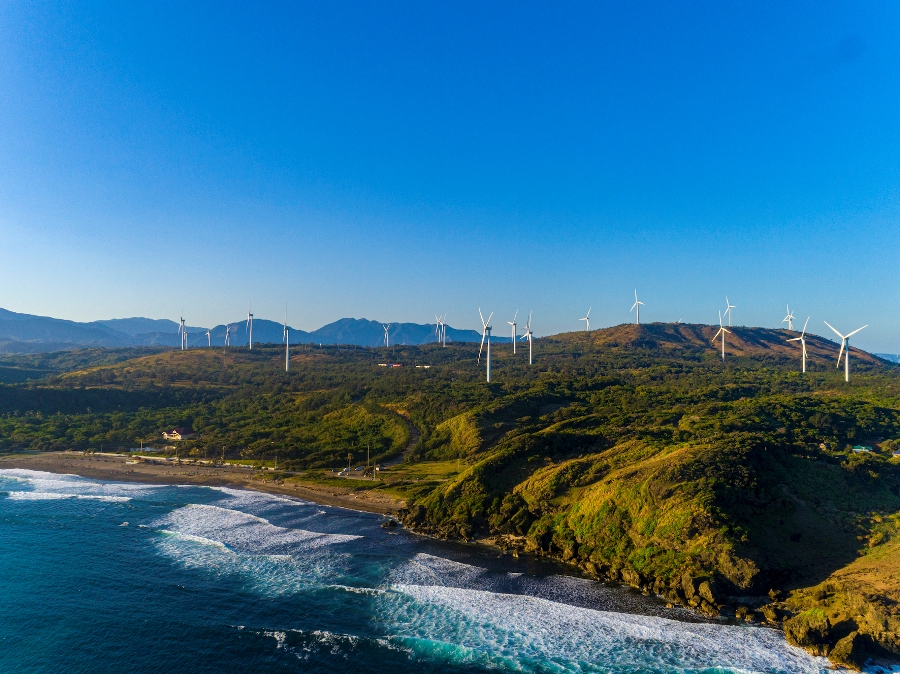
Less than a year since its integration, AC Energy’s listed platform (PSE: ACEN) executed its turnaround plan effectively and established a clear growth path, aggressively growing its generation capacity from 416 MW to over 990 MW, with renewable assets comprising 45% of its total portfolio at 447 MW.

Most recently, AC Energy completed the infusion of its onshore assets to ACEN, increasing the latter’s outstanding capital stock to 13.69 billion shares. With the closing price of P2.80/share last August 25, 2020, ACEN’s implied market capitalization stands at P38.33 billion.

“While we are facing significant challenges amidst the current crisis, ACEN remains committed to investing in the country and drive renewables expansion,” said Eric Francia, ACEN President and CEO. “We take the long view when investing, and we also recognize that investments are very much needed urgently to help reignite the economy and create jobs. This is the true meaning of sustainable investing.”

Earlier this year, AC Energy announced its plans to integrate its international business, and recently received the Philippine Stock Exchange’s nod to change its stock symbol from ACEPH to ACEN. The shift to ACEN signifies the forthcoming integration of AC Energy’s onshore and offshore business into a unified platform. Apart from its existing projects in the Philippines, Vietnam, Indonesia and India, AC Energy has also identified Australia and Myanmar as key target markets.

Pivot towards renewable energy

As AC Energy prepares to scale up its renewables business, the company has adopted an Environment and Social Policy that is aligned with the United Nations Sustainable Development Goals. The policy will be integrated into the company’s business strategies, performance management and governance, highlighting its determination to be sensitive to the environment and its host communities as the company provides reliable, affordable and sustainable energy, and transition to a lower carbon portfolio.

To support its renewable energy investments, AC Energy made its debut in the capital markets last year and raised US$410 million in Green Bonds, the first publicly syndicated US dollar Green Bonds in Southeast Asia to be certified by the Climate Bonds Initiative. The company then capped 2019 with the world’s first US dollar-denominated senior perpetual fixed-for-life green notes at an aggregate principal amount of US$400 million. “AC Energy is in an excellent position to reach 5,000MW of renewables capacity by 2025, and realize its aspiration to be the largest listed renewable platform in Southeast Asia,” said Francia.

Regional Updates (08/26/20)

Sulu governor opposes martial law, says economic development is what province needs

SULU GOVERNOR Abdusakur M. Tan is opposed to a declaration of martial law in the province, which was proposed by the top military officers following Monday’s twin blasts in the capital Jolo that killed 14 people and wounded over 70 others. “Hindi ako papayag dyan. Nagawa na natin yan noon (I will not agree to that. Because we have done that before)… Military intervention is just one aspect of the solution. What we need in Sulu is to try a different tact and method like educational and economic development,” Mr. Tan said during a multi-sectoral meeting on Wednesday streamed live on the provincial government’s Facebook page. “I had been there in the ‘70s, and I don’t want it to happen again,” he said during the meeting attended by security forces and civil society groups, among other sectors. At the same time, Mr. Tan expressed full backing to the military and the police in their security measures. “We will support you for helping us,” he said. At the same time, the governor called on local government units and the communities to help in addressing the problem of extremism.

POLICE SUPPORT
In Manila, Police chief Archie Francisco F. Gamboa said they are supporting the proposal to place Sulu under martial law to give security forces “more  operational flexibility” in pursuing the Abu Sayyaf Group that is suspected to be behind the bombings. Palace Spokesperson Harry L. Roque, meanwhile, said  President Rodrigo R. Duterte will decide on a martial law declaration based on the recommendations of the police and the military. “Kapag ang report naman ay nagtugma na sapat na dahilan ito sa martial law, ikukunsidera naman po yan ng Presidente (If the report justifies the reasons for martial law, this will be considered by the President),” he said in an interview over government-run PTV station. — with reports from Gillian M. Cortez and Emmanuel Tupas/PHILSTAR

Medical teams, equipment to be deployed to Bacolod City as COVID-19 cases surge

MEDICAL TEAMS from the Philippine Army and neighboring areas will be deployed to Bacolod City after Mayor Evelio R. Leonardia made an urgent call for help on Tuesday from the national government “before our health care system completely bogs down.” In a statement on Wednesday, Mr. Leonardia said Lt. Gen. Roberto T. Ancan of the military’s Visayas Command Center “promised to field, as soon as possible, a medical team composed of army doctors, nurses, and support health workers.” Medical equipment will also be sent after a needs assessment. The mayor also said Secretary Carlito G. Galvez Jr., chief implementer of the national action plan for the coronavirus disease 2019 (COVID-19) crisis, also gave assurance that nurses and doctors from other parts of the Western Visayas Region as well as the neighboring Central Visayas will be sent to help Bacolod’s health care sector. “Our need for medical staff to fill up the gap in our hospitals is great, Mr. President. Patients have already died in their homes for failing to avail of emergency hospital services,” the mayor said in his Aug. 25 letter addressed to President Rodrigo R. Duterte. “The recent spike in local transmissions of COVID-19 in our City has filled up, in no time, the 149 COVID beds in our 7 hospitals (1 government, 6 private). The situation was worsened because many of the medical staff in these hospitals has tested positive for the virus and had to go on quarantine/isolation,” he explained. Department of Health Regional Director Marlyn W. Convocar said the hospitals are already preparing to increase the city’s COVID bed allocation by another 98 while additional health workers and personal protective equipment will be provided.

WESTERN VISAYAS
A team from the national task force on COVID-19 were off to the Western Visayas Region on Wednesday, with Iloilo City as their first stop then Bacolod. The group will be led by Presidential Assistant for the Visayas Michael Lloyd Dino and Environment Secretary Roy A. Cimatu, who also headed the team that was sent to Cebu at the height of its COVID-19 outbreak. As of Aug. 25, region had 3,651 COVID-19 cases, with 2,043 active. Of the active cases, the biggest number is in Iloilo City with 604, followed by Bacolod with 460. The rest are in the following: Negros Occidental, 313; Iloilo province, 239; Guimaras, 37; Capiz, 21; Antique, 11; and Aklan, 2. The remaining 334 cases are categorized as returning residents or persons authorized to be outside residence. — MSJ

National Government Fiscal Performance

THE National Government’s budget deficit ballooned to a record P700 billion as of end-July, as pandemic expenses continued to rise while revenues fell amid the economic slowdown. Read the full story.

National Government Fiscal Performance

7-month deficit exceeds 2019 record

By Beatrice M. Laforga, Reporter

THE National Government’s budget deficit ballooned to a record P700 billion as of end-July, as pandemic expenses continued to rise while revenues fell amid the economic slowdown.

The Bureau of the Treasury (BTr) on Wednesday released its cash operations report showing the seven-month budget deficit at P700.6 billion, nearly six times the P117.9 billion during the same period a year ago. It also exceeded the P660.2-billion deficit recorded for the entire 2019.

“The year-to-date budget deficit hit P700 billion, translating to roughly 3.7% of GDP (gross domestic product), a deterioration from the 3.2% posted at the end of 2019 but far less severe than the doomsday threshold set by the (Finance department) of roughly 9%,” said Nicholas Antonio T. Mapa, a senior economist of ING Bank N.V. Manila.

The fiscal balance once again slipped into the red in July with a P140.2-billion deficit, from a P1.8-billion surplus in June.

July revenues declined by 11.2% to P234.5 billion as uncertainty over the pandemic continues to weigh on economic activity, the Treasury bureau said.

Tax revenues, which accounted for 85% of the total, fell 10.4% from a year ago to P212.3 billion. The Bureau of Internal Revenue’s (BIR) collections declined by 11.8% to P159 billion, while the Bureau of Customs (BoC) generated 8.8% lower collections at P49.8 billion. This was partly offset by the taxes generated by other offices, which almost doubled to P3.5 billion.

“BoC’s July performance was lower compared with the P54.6 billion achieved in the same month a year ago, weighed down by disruptions to trade caused by the lockdown,” the Treasury bureau said.

Revenues from non-tax sources also declined by 18.7% to P22.2 billion in July. BTr’s income dropped by 47% to P7.6 billion, partly due to the remittance of dividends earlier this year. Non-tax income of other offices increased by 12.4% to P14.6 billion.

State spending in July jumped by 10.4% from a year ago to P374.7 billion, with primary spending — or expenditures net of interest payments — rising 9.3% to P315.3 billion and interest payments growing by 16.5% to P59.4 billion.

The BTr said the higher disbursement was mainly due to the release of the second tranche of the government’s cash aid program for Filipinos whose livelihoods were affected by the lockdown.

In the seven months to July, BTr data showed overall revenues went down by an annual 6.8% to P1.688 trillion as tax collections declined by 11.7% to P1.429 trillion.

Taxes collected by the BIR slipped by 10.53% to P1.115 trillion during the January to July period, while BoC collections fell by 15.3% to P303 billion. Tax revenues of other agencies also went down by 23% to P10.3 billion due to the impact of the health crisis on business activities and government operations. This was partly offset by the 34% jump in non-tax revenues to P259.2 billion.

Higher dividends from state corporations and other service income drove BTr’s revenues 87% higher to P190.9 billion as of end-July, exceeding its P82.3-billion target for the entire year. Non-tax revenues from other offices, meanwhile, slid by 25.7% to P68.3 billion.

State spending for the first seven months of the year rose by 23.8% to P2.388 trillion on the back of the 26% growth in primary spending to P2.141 trillion and the 7% increase in interest payments to P247.1 billion.

Year-to-date interest payments as a share of revenues grew to 14.64% from 12.75% a year ago because of lower tax collections. As a percentage of expenditures, interest payments improved to 10.34% from 11.97% as spending accelerated.

The fiscal gap is widely expected to balloon this year but it could have been bigger if the government was not “financially constrained” to spend more, said Cid L. Terosa, a senior economist at the University of Asia and the Pacific.

“I believe that spending was not enough to cushion the impact of the pandemic on the economy since GDP growth slid further and the unemployment rate ballooned by double digits,” Mr. Terosa said via e-mail on Wednesday.

The economy plunged into a recession as GDP shrank by a record 16.5% in the second quarter. Unemployment rate hit 17.7% in April from 5.1% a year earlier, equivalent to 7.25 million Filipinos out of work.

Mr. Terosa said the country’s fiscal balance is expected to remain in deficit for the rest of the year with faster spending seen to “arrest the downward trajectory of economic growth and to shore up the country’s ability to address pandemic-related socio-economic concerns.”

“Revenues will continue to lag behind spending and slump relative to levels achieved last year, but it might improve slightly relative to previous months given less restrictive quarantine conditions in the remaining months of the year,” he added.

ING Bank’s Mr. Mapa said the deficit-to-GDP ratio gives the government “more than ample fiscal space” to allow for faster and bigger spending plans to “salvage some form of growth for the economy.”

“With the rest of the economy mired in recession, the Bayanihan II fiscal recovery bill and possible other outlays should help stimulate growth in the coming months, although the window for spending to generate enough critical mass to prevent five quarters of contracting GDP is closing fast,” he said in a note e-mailed to reporters on Wednesday.

Congress has passed the “Bayanihan to Recover as One Act,” which allots for P140 billion in funding to hard-hit sectors and P25 billion in standby appropriations, bringing the total stimulus package to P165 billion. The measure has been transmitted to Malacañang for President Rodrigo R. Duterte’s signature.

National Government Fiscal Performance

House panel OK’s tax perks for SMC airport

By Arjay L. Balinbin, Senior Reporter

THE House ways and means committee on Wednesday approved a proposal to exempt a San Miguel Corp. (SMC) subsidiary from all taxes while it is constructing the P740-billion international airport in Bulacan province.

The tax exemption is included in the substitute version of House Bill No. 7241 which seeks to grant San Miguel Aerocity, Inc. a 50-year franchise to build, develop, establish, operate, and maintain an airport in Bulakan town.

“During the 10-year construction period, the grantee shall be exempt from any and all direct and indirect taxes and fees of any kind, nature or description, which emanates exclusively from the construction, development, establishment, and operation of the airport and the airport city,” according to a copy of the substitute bill.

The SMC unit will be exempted from income, value-added, percentage, excise, and documentary stamp taxes, customs duties and tariffs, taxes on real estate, buildings and personal property, business and franchise, and supervision fees.

At the end of the construction period, San Miguel Aerocity will remain exempt from income tax and taxes on real estate, buildings and property for the remainder of its franchise, according to the bill. The tax exemptions will expire “as soon as it is determined by a competent authority that the grantee has fully recovered its investment cost” on the airport project.

In a phone message to BusinessWorld, Finance Assistant Secretary Maria Teresa S. Habitan said the department is “not okay” with the proposed grant of tax incentives.

“The Bulacan Airport was an unsolicited bid. Under the BoT (build-operate--transfer) law, the government must not provide subsidies or guarantees to proponents. We take that to mean including tax perks,” Ms. Habitan said.

House ways and means committee Chairman Albay Rep. Jose Maria Clemente S. Salceda said the panel had tempered the tax incentives to be granted to SMC’s unit under the substitute bill.

“On its own, the project was already going to be beneficial, as a P740-billion infrastructure investment that will come entirely out of the private sector’s hands, Mr. Salceda said at the hearing. “That’s 4% of GDP (gross domestic product). In return, we are being asked to provide some tax concessions. By tempering the tax provisions, we made sure that the Filipino people will get even more economic benefits for less taxpayer cost,” he added.

Gusto kong matuloy ang project na ito (I want this project to push through). But we need stronger guarantees of returns for the public,” he said, noting that the airport project “will make a lot of money.”

The House panel also agreed the SMC subsidiary will be entitled to generate income from the Airport City, after a competent authority has determined that it has fully recovered its investment cost, equivalent to a project internal rate of return (IRR) of 12% per annum. But for IRR in excess of 12%, 100% of the income will be remitted to the National Government.

“There will be hotels and restaurants in the surrounding Airport City, so we want to make sure that the franchise’s tax privileges only extend to the airport operations,” Mr. Salceda said of the project, which will cover 2,500 hectares and accommodate 100 million passengers annually.

Bureau of Internal Revenue Assistant Commissioner Manuel V. Mapoy said during the hearing the tax incentives “should be limited only to the airport construction and not the airport city.”

“If this project fails, baka delikado ang financial system natin. I don’t see from the records how many passengers will pass through Bulacan. I don’t see where we’re going guaranteeing and granting a 50-year franchise,” Aklan Rep. Teodorico T. Haresco, Jr. said at the hearing.

ACT-Teachers party-list Rep. France L. Castro added: “Talong-talo ang mga mamamayan dito dahil sa 5-10 years na tax exemption (Citizens will lose big because of the five to 10 years of tax exemption).”

Gabriela Rep. Arlene D. Brosas also raised concerns about the farmers and residents who will be displaced by the construction of the airport, but SMC Holdings Operations head Edgar L. Dona said the company has programs for affected residents.

SMC and the Transportation department signed the concession agreement for the airport in September 2019. Under the deal, San Miguel will build, operate and maintain the New Manila International Airport for 50 years. The project includes the construction of an 8.4-kilometer toll road, which will link the gateway to the North Luzon Expressway. — with a report from Beatrice M. Laforga

2020 targets for BIR, BoC slashed anew

The Customs bureau is tasked to generate P506.15 billion in revenues this year. — PHILIPPINE STAR/EDD GUMBAN

THIS YEAR’S collection targets of the government’s main revenue-generating agencies have been slashed once again, as economic activity remains sluggish due to the pandemic.

Based on the latest Budget of Expenditures and Sources of Financing, the Bureau of Internal Revenue (BIR) and Bureau of Customs (BoC) now aim to collect a combined P2.192 trillion this year. This is a fifth lower than the P2.8 trillion the two agencies collected in 2019.

The BIR’s target was lowered by 3% to P1.686 trillion, from the  P1.744 trillion goal revised last May. The BoC’s collection target is now at P506.15 billion, down 6.6% from the previous goal of P542 billion.

For 2021, the BIR and BoC’s combined collection goal was hiked to P2.52 trillion, up by 15% from this year’s target.

The BIR aims to generate P1.904 trillion, while the BoC is expected to collect 25% or P619.5 billion. Compared with their targets this year, these are higher by 12.9% for the BIR and 22.4% for the BoC.

Other tax-collecting offices were tasked to generate P17.8 billion next year.

“Where tax revenue collections are dwindling — and when government spending is most critically needed — government has to resort to deficit spending,” President Rodrigo R. Duterte  said in his 2021 budget message published on Wednesday.

The revenues collected will support the state’s P4.5-trillion spending plan next year.

Mr. Duterte said the implementation of the tax measures under the Comprehensive Tax Reform Program (CTRP) will “continue to strengthen” the tax base and support higher collections.

He said the Tax Reform for Acceleration and Inclusion Act (TRAIN) is expected to generate P133.9 billion in additional revenues next year, while the second package or the Corporate Recovery and Tax Incentives for Enterprises pending in Congress could contribute P26.1 billion.

However, with the expected P97.2-billion reduction in revenues when the corporate income tax is lowered to 25% from 30% now, Mr. Duterte said the estimated tax receipts from the CTRP will be reduced to P62.7 billion next year.

The President ordered the economic team to fast-track the digitalization of the government’s financial management operations such as developing digital taxation, establishing related infrastructure and the use of technology in collecting taxes and releasing funds.

“With this at hand, we expect to limit the need for physical tax payment transactions at the BIR, thereby reducing unnecessary exposure to COVID-19 infections, but more importantly, promoting contactless and less corruption- prone transactions,” he added.

For 2022, the BIR and BoC collection targets were at P2.84 trillion, broken down into P2.178 trillion for the BIR and P663.1 billion for the BoC.

They are expected to account for 76% and 23% of the P2.86-trillion total tax revenues that year, respectively.

As of July, taxes collected by the BIR fell by 10.53% from a year ago to P1.115 trillion, while Customs collections also went down by 15.3% to P303 billion

Economic managers expect the economy to shrink by 4.5-6.6% this year before bouncing back to 6.5-7.5% growth next year. —  B.M.Laforga

Central bank flags potential systemic risks from global recession

By Luz Wendy T. Noble, Reporter

THE central bank vowed to ensure financial stability in the market, as it raised the possibility that “systemic risks may materialize” due to the global recession.

“Systemic risks may seem like a high-level concept but it really just means that financial authorities are looking for any sign that the operations of the financial market may be impaired to the detriment of the general public,” BSP Governor Benjamin E. Diokno said in a statement after a  meeting with the Financial Stability Policy Committee (FSPC).

Systemic risk is the potential for an event at the company level to trigger severe instability or the collapse of an entire industry or economy.

“Pursuing financial stability requires us to manage systemic risks and we do this because our primary goal is to protect the welfare of the public,” he said.

Pressed for details, Mr. Diokno said the FSPC is looking into many factors to gauge the possibility of systemic risks.

“For example, was the economy weak or strong at the start of the pandemic? What’s the country’s debt-to-GDP ratio? How strong or weak the banking system [is] before the pandemic and so on. As you can see, no two countries are alike,” Mr. Diokno said in a text message.

In July, Mr. Diokno said they had yet to see any indications that the financial market had been impaired as a result of the pandemic.

In a bid to manage financial stability, the FSPC said ensuring liquidity will be critical to recovery and the transition to a new economy.

“Among the steps that the FSPC is considering is a new instrument that will allow banks to mobilize the liquidity already with them by taking a view on future GDP (gross domestic product) growth,” the BSP said.

It said boosting risk assessment practices for bank credit “is continuously aligned with spot yields in the securities market.”

Most lenders implemented more stringent lending standards for both enterprises and households due to reduced tolerance for risk as the pandemic raged, a BSP study showed. The same trend was seen during the global financial crisis.

Risk management systems imposed by regulators are vital to guard against systemic risks that may materialize, said Rizal Commercial Banking Corp. Chief Economist Michael L. Ricafort.

“If banks have huge losses from loan defaults, that could threaten their capital. Large market losses is also a risk to bank’s capital, that is why regulators have placed limits on trading activities,” he said in a text message.

Impaired and impacted banks may in turn be unable to act as financial intermediaries which are much needed at a time of crisis, said ING Bank N.V. Manila Senior Economist Nicholas Antonio T. Mapa.

“More businesses will close, incomes will drop further, loan payments will freeze and banks will get hit again and so on and so forth,” Mr. Mapa said in an e-mail.

Mr. Ricafort said banks have been required by BSP to have a business continuity plan to ensure continued operation even in the face of extreme situations such as calamities and the current pandemic.

Gross nonperforming loans (NPL) or credit unsettled at least 30 years past due date surged 26.7% to P273.6 billion in June from P215.9 billion a year ago. This, as the industry’s total credit portfolio dipped 1.27% to P10.82 trillion from P10.96 trillion in June last year.

With this, the banking industry’s gross NPL ratio stood at 2.53% from 2.43% in May.

The BSP expects NPL to reach around 4.6% by end-December 2020 due to the pandemic. This is much lower than the 17.6% peak in 2002 at the aftermath of the Asian financial crisis.

“If banks come under fire due to souring loans, it may drag the economy further into recession and government will need to step in to save the system from imploding,” Mr. Mapa said.

Amid the rise in bad loans, lenders have beefed up provisions for credit losses by 48.5% year on year to P300.3 billion in June.

Banks’ capital adequacy ratio stood at 12.73% as of end-June, well beyond the 10% minimum required by the BSP.

Amid the possibility that such systemic risks can materialize, Mr. Mapa said the government has the responsibility to address the main problem.

“[The] government needs to do all it can to nip the risk in the bud by addressing the root cause of the systemic risk, which is the drop in income and loss of jobs caused by the pandemic. Prevention always trumps the cure and the government may end up spending more if it waits for these systemic risks to materialize,” Mr. Mapa said.

8990 eyes up to P9-B bond offer

MASS HOUSING developer 8990 Holdings, Inc. is planning an issuance of up to P9-billion fixed rate notes to refinance existing bonds maturing by the end of the year.

In a disclosure to the exchange on Wednesday, 8990 said its board of directors has approved offering peso-denominated notes with a base size of up to P5 billion and an oversubscription option of up to P4 billion.

The plan is to sell the notes only to qualified institutional buyers, which means it would not require registration with the Securities and Exchange Commission.

“The fixed rate notes are intended to pay off our 5-year bonds due in October,” 8990 Investor Relations Officer Patricia Victoria G. Ilagan said in a text message to BusinessWorld.

8990 has tapped BDO Capital & Investment Corp. as the sole issue manager, lead arranger and sole bookrunner, and RCBC Capital Corp. as co-arranger for the planned offering.

“The final terms of the notes will be determined after the bookbuild process and prior to the issuance thereof. The company shall provide the necessary updates regarding this in due course,” it said.

The notes will be listed at the Philippine Dealing & Exchange Corp. (PDEx).

8990 currently has three securities listed at PDEx: the P8.41-billion bonds maturing in October, P375.5-million bonds maturing in July 2022, and P218.91-million bonds maturing in July 2025.

In the first half of the year, 8990 recorded a 47% drop in attributable net income to P1.48 billion, as its revenues fell 30% to P4.91 billion. In a regulatory filing, it said the decline was due to the lockdown to contain the coronavirus pandemic, which hampered its business operations and sales especially in the second quarter. — Denise A. Valdez

SMIC cuts size of first tranche of debt issuance to about P10 billion

SM Investments Corp. (SMIC) is reducing the size of its planned bond offering to up to P10 billion from the original P15 billion.

In an Aug. 25 letter to the exchange, the Sy-led conglomerate said it had amended its prospectus for the planned initial offering of its proposed P30-billion debt securities program.

The base issue size for the first tranche has been trimmed to P5 billion from P10 billion, while the oversubscription option will remain at P5 billion. The bonds will have a tenor of three years and six months.

To recall, SMIC applied for the shelf registration of a three-year P30-billion bond program with the Securities and Exchange Commission in mid-July. In the prospectus, the company indicated an initial bond issuance amounting to P10 billion with an oversubscription option of up to P5 billion.

SMIC said then that the initial tranche was given a PRS Aaa credit rating by local debt watcher Philippine Ratings Services Corp. (PhilRatings). PRS Aaa is the top credit rating given by PhilRatings, which means the obligation has minimal credit risk and the issuing company has an “extremely strong” capacity to fulfill its financial commitment.

“Further details on the offer will be made available to the public once finalized,” SMIC said.

The company also listed P5.6-billion bonds at the Philippine Dealing and Exchange Corp. in July, its fifth listed securities based on records from the fixed-income exchange.

SMIC’s earnings dropped 69% to P7.09 billion in the first half of the year, as its revenues declined 21% to P185.53 billion due to the impact of the coronavirus pandemic to its malls and banking businesses.

Shares in the company at the stock exchange gained P6 or 0.68% to close at P887 each on Wednesday. — Denise A. Valdez

Tax court maintains decision ordering BIR to pay back Consunji energy unit

A COURT upheld its decision to order the Bureau of Internal Revenue (BIR) to pay back P27.34 million to Semirara Mining and Power Corp. (SMPC), while it denied the petition of the bureau’s commissioner for a review of the order.

SMPC told the stock exchange on Wednesday that it received a copy of the Court of Tax Appeal (CTA) en banc’s decision to deny due to lack of merit the BIR commissioner’s petition for a review of its previous order to refund the power company.

The issue stemmed from SMPC’s payment under protest of the said amount in value-added tax (VAT) and excise tax for its first partial shipment of imported diesoline in 2013.

The company was supposed to be exempted from paying duties for its importation of 36 million liters of diesoline under Presidential Decree (PD) No. 972 or the Coal Development Act. The Department of Energy (DoE) certified its tax exemption.

In that year, the Consunji-led company sought the help of the Regional Trial Court (RTC) in Makati City to prevent the BIR and the Bureau of Customs (BoC) from imposing an advance payment of VAT on its importation of diesel fuel for its own use and consumption under Revenue Regulations No. 2-2012.

The power firm asserted its right for a refund while under said regulation, as it is also exempted from paying VAT under its coal contract and the PD 972.

“SMPC contested the application of said regulation as it effectively diminishes its exemption granted by law and impairs the rights under its COC (Coal Operating Contract) pursuant to the non-impairment clause of the constitution,” it said.

In November 2013, the RTC issued a preliminary injunction against the BIR, BoC, and the Department of Finance (DoF) regarding the regulation. The parties filed motions for reconsideration but were denied in February of the following year.

The regional court then declared inapplicable the said revenue regulation in SMPC’s importation of petroleum products for being tax-exempt.

As the BIR denied its claim for a tax refund, SMPC on Sept. 2, 2015, brought its case to the CTA. Three years later, the court ordered the BIR commissioner to pay back the amount to the company.

Shares in SMPC went down 1.6% to close at P9.25 each on Wednesday. — Adam J. Ang

A chef has recreated Chandler’s grilled cheese in Friends — and it’s great

By Kate Krader

THE year 2020 was supposed to be a big one for fans who had reached capacity on reruns of the hit show Friends.

A much-hyped live reunion was slated for March as a drum roll to help launch HBO Max. The coronavirus shut down that party. The show was rescheduled for the end of summer, but that’s been pushed back, too. “The cast of Friends will be there for you … eventually,” reported Variety.

The show’s popularity has stayed strong since it went off the air in 2004: In 2018, Netflix spent $100 million to keep running episodes through 2019. Fans watched 54.3 million hours of the show that year, making it one of the top two on Netflix, according to Neilsen ratings.

Now a book is here for those desperate to restart their relationship with Monica, Rachel, Joey, Ross, et al. Friends: The Official Cookbook, by Amanda Yee (Insight Editions; $30; Sept. 20) contains 70-plus recipes and a ton of nostalgic pictures. The recipes are based on references from episodes over the course of the show’s 10 seasons. There are such cult favorites as Phoebe’s grandmother’s cookies, as well as random ones such as the G. Stephanopoulos Pizza (based on an erroneous pie delivery) and Wedding Pigs in a Blanket.

As far as pop culture cookbooks go, this one’s an outlier. The results are surprisingly solid, created by a professional chef, not Monica (actress Courtney Cox), who plays one on TV. Author Yee, a big fan of Friends, started the restaurant Blues Woman in Copenhagen and cooks with James Beard-nominated chef Bryant Terry; the two are collaborating on the book Black Food, scheduled for 2021. “My hope is that people will be able to slow down and continue to nurture new and old relationships through the sharing of a meal,” she says about the Friends cookbook and the memories it inspires.

Yee’s recipe for a bang-up grilled cheese includes an Emmy-worthy tomato jam, something you can use to pump up a multitude of dishes, including turkey burgers and cheese plates.

Friends fans will know the grilled cheese backstory from the first season. Chandler hates Thanksgiving because it’s the day his parents told him they were getting divorced, so he prepares a “traditional holiday feast”: grilled cheese, tomato soup, and the fake onion ring Funyons. Yee hacks the meal by turning the soup into a sweet, spiced jam that’s spread on the bread; the Funyons are reconfigured as caramelized onions that are stuffed into the sandwich before it’s skillet-grilled. The choice of cheese is up to the reader.

The result is a crispy, melty sandwich studded with sweet onions, and a tomato puree that hints at ketchup. But it still evokes Chandler and Friends: “Cut the sandwiches into squares, diagonals, or whatever shape the pilgrims didn’t use,” is the recipe’s final direction.

It’s a smart, fun trick. Even as a die-hard classicist on the grilled cheese front, I will make this version again — probably before the Friends reunion finally comes to pass.

The following recipe is adapted from Friends: The Official Cookbook by Amanda Yee.

Tester’s notes: You can use a store-bought tomato jam, but this one is simple, plus this is cherry tomato season. And unless you insist on American cheese in your grilled cheese, a stronger-flavored one such as sharp Cheddar or pepper Jack will work best with the sweet jam.

CHANDLER’S GRILLED CHEESE

WITH TOMATO JAM

Makes 4 sandwiches

Tomato Jam

1 tbsp. ground cumin

1 lb. cherry tomatoes

1/2 tsp. grated fresh ginger

Zest and juice of 1/2 lemon

1/2 cup brown sugar

1/2 cup water

1/2 medium onion, sliced

1/2 tbsp. vegetable oil

Grilled Cheese

1/2 tbsp. olive oil

1 yellow onion, sliced

Unsalted butter, softened

8 slices sourdough bread

8-12 slices cheese of your choice

Make the tomato jam: In a medium heavy pot, combine all the ingredients over high heat. Let the mixture come to a boil, stirring occasionally, then reduce the heat to low. Simmer until the jam thickens, about one hour. Let cool completely, then transfer to the refrigerator for at least three hours, or overnight.

Make the grilled cheese: Heat and add the oil. Add the onion slices and cook over moderate heat, stirring occasionally, until soft and golden, about 10 minutes. Transfer to a bowl. Wipe off the pan with a paper towel.

Butter one side of each slice of bread. Flip the slices so they are all butter-side down on the work surface. Smear a generous layer of tomato jam on half of the bread slices, and top with one to two tablespoons of caramelized onions. On the other bread slices, place two to three slices of cheese.

Set the pan over moderate heat. Working in batches, take the bread slices with the cheese and place butter-side down in the pan and toast for about three minutes, until the cheese is melted and the bread is browned. Set the toasts cheese-side down on the caramelized onion slices. Transfer the whole sandwich back to the pan, un-toasted side down, and cook for two to three minutes, until brown. Give the sandwich a firm pat with the spatula, to make sure the cheese is sticking to the onions, and remove from heat. Repeat with remaining sandwiches.  Bloomberg

Manila Water subsidiary closes drinking water division

THE PURIFIED drinking water business unit of Manila Water Total Solutions Corp. (MWTS), a subsidiary of Manila Water Co., Inc., will be permanently closed on Oct. 31.

In a stock exchange disclosure on Wednesday, Ayala-led Manila Water said MWTS’ Healthy Family Business Division will close due to recurring losses and the inability to financially sustain its business operations.

“While the Healthy Family Business Division has in recent years made strong efforts to improve operations and profitability, the ever-increasing competition in the bottled water industry and the recent economic challenges have proved too difficult to cope and keep the business afloat,” Manila Water said.

The Healthy Family brand was launched in 2015 and ventured in the business of providing purified drinking water to customers.

MWTS will continue its operations based on its main purpose of engaging in water, wastewater and environmental services, Manila Water said.

In a separate disclosure, Manila Water said it has received a copy of the decision by the Philippine Competition Commission (PCC) regarding the proposal of Razon-led Trident Water Co. Holdings, Inc. to acquire shares in the company.

The water concessionaire said the PCC decided that the proposed acquisition of Trident Water will not result in the ‘substantial lessening’ of competition.

“The Commission resolved to take no further action with respect to the proposed transaction between Trident Water and Manila Water,” the disclosure said.

On Tuesday, PCC approved the move of Trident Water to acquire 51% voting interest in Manila Water.

Trident Water, a subsidiary of Prime Metroline Infrastructure Holdings, Inc., will secure the controlling stake after a subscription of 820 million common shares from the unissued capital stock of Manila Water.

On Wednesday, shares of Manila Water at the stock exchange rose 6.66% or P0.88 to close at P14.10 per share. — Revin Mikhael D. Ochave

ADVERTISEMENT
ADVERTISEMENT