Home Blog Page 9011

Germany beats Ukraine 2-1 for first win in four games

KIEV — Germany scored once in either half to beat hosts Ukraine (2-1) in the Nations League on Saturday for their first win in four matches and their first ever victory in this competition.

Matthias Ginter put them ahead in the 20th minutes after good work from Antonio Ruediger, and Leon Goretzka pounced on a mistake by Ukraine keeper Georgiy Bushchan to head in their second goal four minutes after the restart.

Despite having the rested Bayern Munich and RB Leipzig players back in the line-up, the Germans, who did not win a game in the 2018/19 edition, were far from their best.

In a sloppy first half, they repeatedly lost possession, allowing Ukraine to quickly counter attack before Ginter’s goal settled their nerves.

Having conceded equalizers in each of their three previous matches, Germany were eager to add to their lead on Saturday and carved out several good chances.

But Bushchan had a good day making a string of saves before he let the ball slip out of his hands, allowing Goretzka to score in the 49th.

He then again was on hand to stop them scoring, superbly palming a Serge Gnabry shot wide.

A 77th minute penalty by Ruslan Malinovskyi woke up the 20,000 crowd allowed in the Ukrainian capital’s Olympic stadium but the Germans managed to protect their lead despite desperate late attacks from the hosts.

“Obviously, I am happy we won, but we could have been leading 3-0 or 4-0,” Germany coach Joachim Loew said.

“In some cases, we gave up the ball too easily. When we were 2-0 up they were tired and we should have played more counter attacks maybe. But overall, we were solid and did not allow them too many chances,” he said.

On Tuesday, Ukraine host Spain while the Germans, who had not won a single game in the inaugural 2018/19 competition, take on Switzerland. — Reuters

Spain edges Switzerland to stay top of Nations League group

MADRID — Mikel Oyarzabal scored early to help an underwhelming Spain secure a scrappy 1-0 victory over Switzerland in the Nations League on Saturday, keeping them top of their group.

The Real Sociedad forward snatched the only goal of the game in the 14th minute after Switzerland tried to play the ball out from the back, but failed miserably, leaving Oyarzabal with a simple finish.

Barcelona’s teenage talent Ansu Fati and Oyarzabal spurned further chances as Luis Enrique’s side failed to add to their lead.

Spain lead League A Group 4 with seven points from three games, two points ahead of Germany, who beat Ukraine (2-1).

Former Barcelona coach Luis Enrique had picked an experimental side with plenty of youth and Spain did enough to win but were far from their best at the Alfredo di Stefano stadium at Real Madrid’s training ground.

Switzerland carved out the first chance of the game, but keeper David de Gea reacted well to deny Loris Benito, before the visitors handed Spain the lead on a platter.

Goalkeeper Yann Sommer misplaced his pass to Granit Xhaka because of Spain’s high press, with Mikel Merino nipping in to steal the ball and feed Real Sociedad team mate Oyarzabal, who finished with ease.

“The goal isn’t their mistake, it’s our good play,” said Luis Enrique. “It was great work by our team that was rewarded by a goal.”

Fati, who became Spain’s youngest ever goalscorer in their previous Nations League outing against Ukraine in September, might have doubled the lead early in the second half but his strike was blocked.

Oyarzabal then hit the side netting from close range and Wolverhampton Wanderers winger Adama Traore made his first competitive appearance with a bright cameo from the bench after making his debut on Wednesday against Portugal.

“In the final third we weren’t able to finish and we have to keep working on that, me especially,” said Traore. “But we leave here with the three points.” — Reuters

Brosseau’s homer lifts Rays past Yanks to seal ALDS

MIKE BROSSEAU belted a go-ahead homer in the eighth inning to propel the Tampa Bay Rays to the American League Championship Series with a 2-1 victory over the New York Yankees on Friday in San Diego.

Austin Meadows launched a solo homer in the fifth inning for top-seeded Tampa Bay, which posted a 3-2 series win over fifth-seeded New York in the best-of-five American League Division Series (ALDS).

Tampa Bay advances to face Houston in Game 1 of the ALCS on Sunday night. The Rays did not play the Astros during the truncated 60-game regular season, but the Astros defeated the Rays in five games during the 2019 ALDS.

Brosseau exacted revenge after Aroldis Chapman (0-1) threw over his head in an at-bat on Sept. 1. With one out in the eighth inning Friday, Brosseau capped a 10-pitch at-bat by depositing a fastball from the fireballer over the wall in left field to stake Tampa Bay to a 2-1 lead.

Diego Castillo (1-0) picked up the win after striking out four batters over the final two innings.

“I was just trying to get a runner on, get the next guy up,” said Brosseau, who came off the Rays’ bench in the sixth inning and went 2-for-2.

“Obviously going up there trying to find a barrel. Hoping I can lift one. Thankfully, it happened.”

And once he hit it?

“I knew it felt good,” Brosseau said. “I haven’t had much playing time, so it’s kinda hard to read the dimensions, especially from daytime to nighttime, but it felt good off the bat.”

Aaron Judge recorded the first hit of the game while leading off the fourth inning, and it was a big one. The New York slugger sent a 1-0 fastball from Nick Anderson into the short porch in right field for his third homer of the postseason and 11th career in the playoffs. The homer was the second allowed by Anderson in 2020.

The 6-foot-7 Judge was unable to prevent Meadows’ solo homer, the Rays’ only other hit, from clearing the right field wall with two outs in the fifth inning, however. Judge hit his head on the overhang of the 8-foot fence as Meadows took Gerrit Cole deep for Tampa Bay’s first hit of the game. That hit was the only one allowed over 5 1/3 innings by Cole, who struck out nine batters and walked two.

Rays starter Tyler Glasnow walked two and fanned two in 2 1/3 hitless innings.

Each team finished with three hits.

Yankees manager Aaron Boone said, “It’s awful. The ending is cruel, it really is. … In what’s been a real year of peaks and valleys for us on the field, too, I feel like, in a lot of ways, we’re playing our best baseball right now. We lost to a really good team that I thought played a really good game against us, obviously being able to hold us down tonight.”

New York honored Whitey Ford’s uniform No. 16 on its left sleeves for Friday’s game. Ford, who is the Yankees’ all-time wins leader with 236, died while watching Game 4 of the ALDS on Thursday. He was 91. — Reuters

Rays’ Snell opposes Astros’ Valdez in ALCS opener

TAMPA Bay ace Blake Snell will oppose fellow left-hander Framber Valdez when the Rays face the Houston Astros on Sunday in the opener of the American League Championship Series (ALCS) at San Diego.

Snell, 27, will be making his fourth postseason start and sixth overall appearance of his career. He is 1-2 with a 2.81 ERA.

One of the losses came against Houston in Game 2 of last year’s American League Division Series when he allowed one run and four hits in 3 1/3 innings in a 3-1 loss. Snell later made two hitless relief appearances in the series.

In this year’s postseason, Snell allowed just one hit in 5 2/3 scoreless innings in a win over the Toronto Blue Jays in Game 1 of the first-round series. He lost to the New York Yankees in Game 1 of the ALDS when he gave up four runs and six hits over five innings.

The 2018 Cy Young Award winner went 4-2 with a 3.24 ERA in 11 regular-season starts this season. He is looking for a long outing on Monday.

“My goal is to go as deep as I can go to help the bullpen out and give us a very good chance at winning,” Snell said on Saturday. “I’ve got to be more efficient. I’ve got to limit the damage. That was something I didn’t do well with three home runs against the Yankees. I’m very happy with how I feel, but it’s just me getting in my zone and understanding what I do best.”

The 26-year-old Valdez emerged as a solid pitcher for the Astros this season and went 5-3 with a 3.57 ERA in 11 appearances (10 starts).

He has won both of his postseason starts and has a 1.50 ERA. He pitched five shutout innings in a win over the Minnesota Twins in Game 1 of the first round and gave up two runs and five hits over seven innings while beating the Oakland Athletics in Game 2 of the ALDS.

He was genuinely in awe of receiving the Game 1 assignment in the ALCS.

“I feel really proud and really thankful for the opportunity this year,” Valdez said on Saturday. “It means a lot to me for the manager (Dusty Baker) to show that much confidence in me. I’ve demonstrated they can have that confidence in me with the effort I put forth this season. I’m super thankful for the moment and super happy to be here.” — Reuters

Tennis’ new darling

Given the dominance with which Iga Swiatek claimed the French Open ladies’ singles championship, it’s hard to imagine she just graduated from high school. True, the nature of the Grand Slam stop and the extraordinary circumstances behind the tournament’s latest staging helped set up her singular accomplishment. Then again, there can be no discounting her efforts en route to becoming just the fourth player in tennis annals (after Mats Wilander in 1982, Gustavo Kuerten in 1997, and Jelena Ostapenko three years ago) to break into the win column on tour with a major title.

Granted, Swiatek has had brushes with success that underscore her elite-level skill set. In 2018, she paired a French Open juniors doubles title with a Wimbledon girls’ singles crown. She then rose through the ranks, reaching her first Women’s Tennis Association Tour final and breaking the Top 100 the next year. Prior to her sterling run at Roland Garros, she marked the season with respectable fourth- and third-round finishes at the Australian Open and United States Open, respectively. That said, there was little indication that she would then run roughshod over the field, which remained formidable despite the absence of such notables as Naomi Osaka and Ashley Barty for safety reasons and the second-round withdrawal of Serena Williams due to injury.

Indeed, Swiatek would go on to trounce the likes of Marketa Vondrousova, Eugenie Bouchard, Simona Halep, and Sofia Kenin en route to her inaugural podium finish. And she didn’t so much beat them as give them thorough beatings; she didn’t lose a set through the fortnight, and dropped only 28 games all told. So transcendent was her play that peers and tennis greats alike couldn’t help but sing her praises in the aftermath. Among the living legends who believe she has multiple Grand Slam wins in her future: John McEnroe, Martina Navratilova, and Chris Evert.

Such lavish commendations can be ingredients for spoilage, especially for fast-rising talents still lacking in experience. Swiatek, however, seems to be built differently. She carries herself with humility, and admits that she remains a work in progress. At the same time, she understands that she needs to place as much importance on the soundness of mind as of body. She travels to events with both coach Piotr Sierzputowski and psychologist Daria Abramowicz, and considering her poise on court and in the sidelines at Roland Garros, she clearly learns her lessons well.

Which, in a nutshell, is why Swiatek has become tennis’ new darling. She’s basking in well-deserved glory even as her star’s still rising, and looks to be for some time to come.


Anthony L. Cuaycong has been writing Courtside since BusinessWorld introduced a Sports section in 1994. He is a consultant on strategic planning, operations and Human Resources management, corporate communications,  and business development.

Agri dep’t says food imports to be ‘last resort’ measure only

THE Department of Agriculture (DA) said additional food imports remain a “last resort,” to be tapped only if domestic sources are unable to meet demand during and beyond the coronavirus disease 2019 (COVID-19) pandemic.

“Our vision of a food-secure and resilient Philippines with prosperous farmers and fisherfolk remains, amid the COVID-19 pandemic and onto the new normal. We will only allow imports to fill in the deficit or what we cannot produce locally,” Agriculture Secretary William D. Dar said.

Mr. Dar was responding to claims that the current DA policy has made the country more import dependent.

Citing data from the Philippine Statistics Authority (PSA), Mr. Dar said the country has been increasingly dependent on imported food over the past 30 years.

“In 2016, import-dependency was at 22.5%, which slightly inched up to 22.7% in 2017, and jumped to 29.2% in 2018 — as local food production was not able to keep pace with population growth during that three-year period,” the PSA reported.

Mr. Dar said the food sufficiency ratio for aggregated food commodities fell to 79.4% in 2018 compared to 86.8% in 2017 according to PSA’s food balance sheets data.

Food balance sheets give an indication of how adequate food supply is relative to the population’s nutritional needs.

“PSA figures also show that the country has been importing several major food items, as a percentage of total national requirement: rice 14%; corn 12%; pork 14%; dressed chicken 6%; beef 39%; onions 38%; garlic 91%; coffee 71%; and peanut 75%,” the DA said.

Fermin D. Adriano, Mr. Dar’s adviser on political economy, said that low farm productivity is the cause of weak local food production, unable to service the population of 110 million.

“While our population growth during the last decade, from 2008 to 2018, averaged around 1.7% to 1.8%, our agricultural sector grew an annual average of only 1.3% for the same period,” Mr. Adriano said.

“In economic parlance, this is a simple case of local demand outstripping local supply. Thus, importation is a necessary recourse to ensure that our people will not go hungry,” he added.

Meanwhile, Mr. Dar said the DA has been investing in the modernization and industrialization of the agriculture sector to address the low productivity, with the focus on boosting resilience, competitiveness, and sustainability.

“Realizing this vision will require dedicated efforts among major agri-fishery industry stakeholders, led by the DA, to continuously empower farmers, fisherfolk, and entrepreneurs, and for the private sector to help increase farm productivity and profitability, taking into account sustainability and resilience,” Mr. Dar said. — Revin Mikhael D. Ochave

Consumer complaints to DTI surge during height of lockdown

CONSUMER COMPLAINTS received in the year to date have surged past 45,000, with complaints rising across-the-board for both online and offline transactions, many of them logged during the lockdown, according to the Trade department.

The Department of Trade and Industry (DTI) said it received 45,542 complaints as of Oct. 2, significantly higher than the 10,918 total for 2019, Trade Undersecretary Ruth B. Castelo said in an online event on Friday.

Complaints about online transactions rose to 13,981 so far, compared to 2,457 complaints for the full year preceding. Complaints about offline transactions rose to 31,561, from 8,461 last year.

The bulk of the online complaints involved “deceptive” sales practices, defective products, unreasonable prices, and poor customer service, Ms. Castelo said.

Ito po ‘yung mga nature of complaints that we received, the highest of which is deceptive or liability for product and service — ‘yung mga defective products that you receive, kasi you order it online, it will be delivered to you and then for all you know, sira pala siya (The online complaints were mainly about deceptive practices and lack of liability on the part of the seller, in which you discover the product is defective when it is delivered.”)

Most of the complaints about online transactions involved major e-commerce platforms like Shopee and Lazada, while a few were logged by sellers on social media platforms like Facebook.

Around 8,000 of the complaints about online transactions were submitted during the April to May period, or at the height of the strict lockdown. The department received 1,044 in September.

Lazada Philippines said sellers on online platforms should share liability risk to deter scams, saying that removing responsibility from the seller would encourage scammers.

The company’s daily seller onboarding totals tripled in July compared to February. — Jenina P. Ibañez

British businesses view PHL retail as recovery play

THE British business chamber said it continues to seek out investors in the retail as well as the food and beverage sectors despite the pandemic, banking on the recovery of the economy over the long term.

The chamber’s first online trade fair will see fewer potential investors than the pre-lockdown in-person meetings, British Chamber of Commerce of the Philippines Executive Director Chris Nelson said in a phone interview Friday.

“We’ll have fewer companies than we’d anticipate at our physical events, but don’t forget (that in) our physical events, we’d visit like five or six cities. But we’re very optimistic that based on this success that it will lead to others,” he said.

Mall foot traffic has remained low throughout the lockdown, with the Trade department noting that it has remained below half its pre-lockdown levels back in July.

Listed property companies may continue to experience declining profits over the rest of the year, with researchers from brokerages AAA Southeast Equities, Inc. and Philstocks Financial, Inc. saying that weak mall traffic is being tracked as a recovery indicator.

Mr. Nelson is, however, optimistic about the return of retail in the long term.

“There are opportunities within the retail sector. Retail, we think, will come back,” he said, but notes that investors are looking at the longer-term situation and are monitoring the government’s pandemic-containment measures.

“What are the opportunities? Do you have a significant market here? Clearly, the Philippines has a 110 million (population).”

Foreign chambers have been supporting changes to the Retail Trade Liberalization Act to open up the sector to more foreign companies by lowering the minimum-paid up capital.

The Philippine Retailers Association opposes a drastic reduction to protect micro-, small-, and medium-sized businesses.

Investment interest would depend on the Philippine government’s encouragement of foreign direct investment and economic stimulus measures, Mr. Nelson said.

The Philippines was ranked the fourth most restrictive out of 84 economies on the FDI Regulatory Restrictiveness Index compiled by the Organization for Economic Cooperation and Development, based on 2019 data. — Jenina P. Ibañez

Vocational graduates post top hiring rates in ADB study

HIGH SCHOOL GRADUATES with additional technical or vocational training posted higher rates of hiring than those who only finished secondary school or entered college, according to a study by the Asian Development Bank (ADB).

A survey of 3,000 individuals between 2015 and 2016 showed that technical and vocational education and training (TVET) courses had a hiring rate of 94% compared to the average of 90% for those that started or finished high school, and those that entered or completed college, the bank said in a recent working paper.

The bank said there is a positive correlation between wages and TVET.

“TVET graduates are more likely to be employed and receive a higher wage than those who were only taught at secondary school or below. The results are statistically significant for both the Heckman-corrected OLS (ordinary least squares) model and the PSM (propensity score matching) technique,” according to the study, “The impact of vocational training on labor market outcomes in the Philippines.”

It also found that TVET graduates are less likely to be unemployed or leave the labor market than those who completed high school, and have more potential of being employed compared to those who partially pursued tertiary education. However, the statistical significance varies across a number of factors.

“These results provide the answer to the question posed in the title of the paper: TVET is not irrelevant in the labor market job but can be effective in securing employment and obtaining a better wage than for those who do not pursue post-secondary education,” the ADB said.

It also said that there was a “puzzling result” of the study, which found that those with combined vocational training and tertiary education got lower wages, indicating that the combination may not be rewarded in the labor market.

The country’s basic education system, before 2011, consisted of six years of elementary school and four years of high school. This was lengthened to add kindergarten and two more grades starting in 2016.

The Technical Education and Skills Development Authority is the agency responsible for TVET. — Beatrice M. Laforga

On the REIT track

After the first Real Estate Investment Trust or REIT listing recently, several real estate developers and potential REIT Sponsors are considering converting their portfolio of assets into REITs, and many domestic and foreign investors are eager to participate in future REIT listings. With such significant interest from across the industry, the focus is on larger listings and more successful REIT conversions.

Our REIT law provides an advantageous tax regime to a REIT Company (REITCo) as long as the REITCo complies with the necessary requirements. However, this undertaking is not merely an exercise in applying for and maintaining one tax regime in lieu of another. The REIT journey begins with an assessment of the opportunity with guiding principles grounded on maximizing shareholder value, articulating the value story, preparing the organization for the operational changes as well as the myriad external communications and reporting requirements to the capital markets, all in addition to the tax considerations.

STARTING THE REIT JOURNEY
Considering the complexity of parts, how can an organization embark on such a journey? With the above guiding principles, the organization can start with an evaluation of capital structure and regulatory requirements that will maximize deal value and liquidity.

Tax and capital markets considerations will still drive the overall transaction structure, while the analysis of capital structure will involve an assessment of debt capacity.

A Sponsor can transfer to a REIT real property that is subject to a mortgage by way of a taxable transfer (i.e., an outright sale to a REIT together with the mortgage) or by way of a tax-free transfer under Section 40(C)(2) of the Tax Code. In the case of the latter, however, if the amount of the liabilities assumed by the REITCo plus the amount of the liabilities to which the property is subject exceed the total of the adjusted basis in the property transferred, then the excess shall be recognized as a gain on the part of the transferor, which shall be taxed accordingly.

Apart from such incidental transfers of liabilities to a REITCo, the REITCo itself can issue publicly traded debt, or incur bank debt to finance acquisitions of REITable assets. The total borrowings and deferred payments of a REITCo that has a publicly disclosed investment credit grade rating by a duly accredited or internationally recognized rating agency may exceed 35% (which is the default ceiling) but may not exceed 70% of its deposited property.

CONSIDERATIONS TO MAKE
Leverage is one means to maximize returns to shareholders and introducing debt into the REIT structure should be considered early on, since it may bring with it issues on seniority of debt claims, approval of creditors, and costs of refinancing.

Another area to consider would be the regulatory framework. This includes an assessment of the ease in the actual transfer of title, actual sale or transfer of the assets, alternatives to lease renewal, any restrictions that may limit the assets to be transferred, and most importantly, an assessment of the timeliness of securing rulings from the Bureau of Internal Revenue (BIR) confirming tax-free transfers to a REITCo.

Strategic analysis of the asset portfolio and its potential for sustained growth beyond the initial listing are of equal importance in evaluating the benefits of a REIT conversion. Within the pool of assets in a portfolio, the challenge is to identify which of those are REITable assets, including the current tax incentives the property is enjoying versus the tax incentives the REIT offers, as well as those assets that can provide steady streams of income and cash flow. In case a building is decided to be part of the REITable assets, the question of whether a Sponsor-owned land will be transferred as well or will be leased out to the REIT company is another important consideration given its impact on the future valuation, cash flow and calculated distributable income. These considerations will involve heavy modelling and optimization with various scenario analyses.

Analysis of cost structures is just as important. This is because while a REIT Company can operate within a lean infrastructure, standalone costs should be identified and considered in the overall return analysis. Identifying which are centralized costs previously incurred by the Sponsor and which are standalone costs once a REIT is set-up is critical to a REIT operating model. It would be useful to compare pre-REIT and post-REIT scenarios to benchmark the costs and better analyze the value creation potential of a REIT conversion.

Lease analyses are also cornerstones in the benefit analysis of a REIT conversion. A true analysis of the leases is required to ensure that lease agreements are reflected in the financial statements in accordance with the current reporting standards. A review of the lease terms, rates, renewal provisions and remaining economic life of the REIT assets will be critical to ensure that these satisfy not just the tax and accounting requirements but also the commercial implications. Appropriate valuation of the assets and leases is also necessary to validate the REIT status and transaction structuring.

THE REIT STRATEGY
It also goes without saying that, with all the above considerations, the resulting accounting impact must be carefully evaluated to ensure that the correctness of application of the accounting standards and the anticipated outcome in the financial statements is as it should be. The appropriate accounting method for recognition and measurement of the asset transfers, leases, fair value measurement, and revenues for both the Sponsor and the REITCo must be properly applied.

This may be a daunting task for some organizations contemplating a REIT listing. Setting up a framework in the form of a “gating” mechanism to guide the organization will be useful to aid in the analysis of whether to continue with the listing journey or defer to the future when a more opportune time is best for the organization. A simple framework can start with the evaluation of alternatives and selection of a REIT strategy where the organization can conduct a feasibility and readiness assessment, prior to deciding whether to go ahead or not. After which, it can develop a plan to implement the selected REIT strategy and then execute the REIT conversion.

Embarking on and getting your REIT conversion journey on the right track can be challenging, but ultimately, rewarding. However, as with all things, timing will be different for each organization and it will greatly depend on the readiness of the organization, and ideally, the right market conditions.

This article is for general information only and is not a substitute for professional advice where the facts and circumstances warrant. The views and opinions expressed above are those of the authors and do not necessarily represent the views of SGV & Co.


Marie Stephanie C. Tan-Hamed And Veronica A. Santos are a Strategy and Transactions Partner and a Tax Principal, respectively, of SGV & Co.

The Rice Tariffication Law in a time of transition

Some politicians — pro-administration and anti-administration — and organized farmers have recently stepped up the call for amending the Rice Tariffication Law (RTL). This comes in the face of what they claim as a drop in fresh palay (unmilled rice) prices to as low as P12 in some areas, an existential threat to farmers.

The opposition is understandable. The RTL is a transformative but disruptive reform. The disruptiveness of the reform means an unavoidable transition. The road to the final destination has a lot of zig zags. The pandemic has compounded the transition problems. But once we hurdle the transition, we should be on a better footing to improve farmers’ productivity and wellbeing and at the same time secure consumer welfare.

The gains from RTL, although already immediately tangible mainly in terms of lower rice prices, will be significantly felt in the longer run. The unavoidable costs to farmers in the short run give ammunition to those opposing RTL. The costs should nevertheless be mitigated through government subsidies.

Thus, even doing cost-benefit analysis at this time will not be able to capture the substantial gains from RTL in the medium term and the long term. That the transition takes time means that we have yet to reach a stable equilibrium.

Unfortunately, the debate regarding RTL is not complete if studies do not present counterfactual options. The criticisms unfortunately suffer from not presenting these. As a colleague from Action for Economic Reforms remarked, “people who usually target the RTL normally say it’s a ‘bad’ reform in that farmers are worse off. But relative to what? Compared to what scenario?”

For balance, government agencies likewise have to give more attention to adopting the counterfactual approach. A case in point is the debate on the rationalization of fiscal incentives, as expressed in the Corporate Recovery and Tax Incentives for Enterprises (CREATE) bill. Senator Ralph Recto used a National Economic and Development Authority (NEDA) paper to criticize CREATE. Recto’s argument was that incentives were necessary to have new investments and new employment. But the NEDA paper merely described the situation wherein the companies enjoying incentives generated X amount of investments and Y number of workers. But if the study presented the counterfactual argument, it would have established that the outcome on new investments and new employment would be the same, even if companies did not enjoy the incentives.

In the short term then, the government has to pour resources like the cash transfers, price support, and production subsidies to provide amelioration and compensation to farmers. We have to stay the course, even as we recognize that the transition can take longer in light of the pandemic.

The RTL provides the platform and infrastructure to increase the productivity and incomes of farmers even as the competition arising from freer importation will benefit consumers.

Competition can be further enhanced, resulting in more affordable prices for consumers. As Prof. Ramon Clarete has said the government can undertake measures to facilitate competition. These are actions that encourage more players in the rice trade.

To help the farmers, the challenge is to lower production costs at the same time increase productivity. This will necessarily involve the reform and modernization of the whole supply chain. Given the relatively broader fiscal space, thanks to the tax reforms, the government has the resources to finance the modernization of the whole supply chain in the rice industry.

We hope that the farmers, who understandably are affected by the RTL, will realize that it is more practical and beneficial for them to avail themselves of the benefits or opportunities from RTL, instead of pursuing a futile campaign to have it reversed.

In the transition, it is necessary to demonstrate the effects of the RTL. The Department of Agriculture (DA) can adopt pilot areas or advanced implementation sites in Luzon, Visayas, and Mindanao. This means that the DA and its regional offices and other executive agencies have to be proactive in identifying and helping farmers’ organizations overcome the multifarious problems and make them success stories. Civil society organizations can partner with DA and the farmers’ groups in establishing these advanced implementation sites.

To be sure, both private and public investments are necessary to modernize the rice sector. In this regard, the binding constraints that prevent private investments from flowing to rice and agriculture have to be removed. The reforms will cover banking, credit, crop insurance, property rights, land use, and training of a new generation of farmers. A most critical challenge is how to achieve more productivity through economies of scale. In this regard, the DA’s clustering and consolidation program deserves full support.

It also goes without saying that the reforms cannot be limited to the rice sector alone but should extend to the whole of agriculture. For instance, rice farmers should be encouraged to do multi-cropping. In some areas, where initial endowments and other geographical as well as institutional factors inhibit rice production, the government must help farmers shift to other commercially viable crops.

Organizationally, it is critical for the DA to march in step to implement the RTL and to pursue the reform agenda to consolidate and sustain the gains. Part of marching in step is to return the National Irrigation Authority to the DA fold. After all, irrigation is a most critical input to improve efficiency in rice production.

Further, DA must learn a new culture and new methods of work especially in the wake of the positively disruptive effect of RTL. A culture of transparency and inclusivity is the way to go. Open up a dialogue even with those organizations or forces critical of RTL. After all, we are secure in the superiority of our position. Being inclusive and being transparent can influence critical organizations into becoming constructive. This, in turn, will reduce conflict, and the costs arising from hostile partisanship.

At the same time, adopt a data-driven and evidence-based policy-making approach. Let data, evidence and science triumph over political and ideological biases.

Transparency, too, leads to better policy-making as it enables policy-makers to get more information for policy formulation and implementation. It likewise reduces systemic corruption.

Last but not least, ensure policy and reform continuity for the next administration. Lock-in the reforms, and this can be done by securing concrete gains in the next two years in terms of having stable affordable prices for consumers and having initial productivity gains for farmers.


Filomeno S. Sta. Ana III coordinates the Action for Economic Reforms.

www.aer.ph

Is it time for an agriculture rebound under Secretary William DAR’s leadership?

Many were surprised when in the second quarter of this year the agriculture sector outpaced industry and services. GDP declined year on year by 16.3% in real terms. Industry and services tanked, having contracted by at least 15.7%. But not the farming and fisheries sector, which posted the lone positive growth of 1.5%. For at least the first half of this year, agriculture’s performance provided the silver lining for the Philippine economy in the months of the COVID-19 pandemic.

The unexpected development is easy to explain, the result of exempting the sector from the stranglehold of a COVID-19 economic lockdown. From this likely one-off performance emerges a view that the sector can at least do better than its performance over nearly half a century has been. Agriculture growth has been slowest and contributed the least to the country’s GDP. The sector contributes only about a fifth of the growth of the country’s GDP in a normal year, in contrast to industry and services, which on average over the last six years have pulled up overall economic growth. In 2018, while the GDP grew by 6.2%, that of agriculture and fishing registered 0.8%.

The dismal economic performance of the sector is reflected the sector’s declining farm productivity and its shrinking tradability.

Falling farm yields. With few exceptions, farm yield growth rates of over 20 crops and two aquaculture products have generally been low or declining in recent years. Rice, the country’s largest crop, had a compounded annual productivity growth rate (CAGR) of -0.15% from 2014 to 2018. In contrast, that of corn farming, two-thirds of which involves planting genetically modified hybrid yellow corn used in animal feeds had a positive albeit insignificant growth at 0.79%. (See Chart 1.)


IFPRI in 2018 compared our sector’s land and total factor productivity indices with our ASEAN neighbors and we have a lot to catching up to do.

The land productivity estimates of selected ASEAN countries in 1990, 2000, 2010, and 2014 did rise for all countries. But the Philippines, which started out in 1990 with the second highest index after Vietnam, lost this advantage to all except Indonesia and Thailand. Our land productivity growth was the slowest. (See Chart 2.)


The total factor productivity (TFP) growth for the same countries and period shows that we had higher growth than Malaysia and Vietnam in the 1990s. TFP growth then decelerated for all, except for Thailand and Vietnam and with our TFP experiencing the slowest growth. In the last period, 2010-2014, TFP of the sector contracted. (See Chart 3.)


Shrinking tradability of the sector.
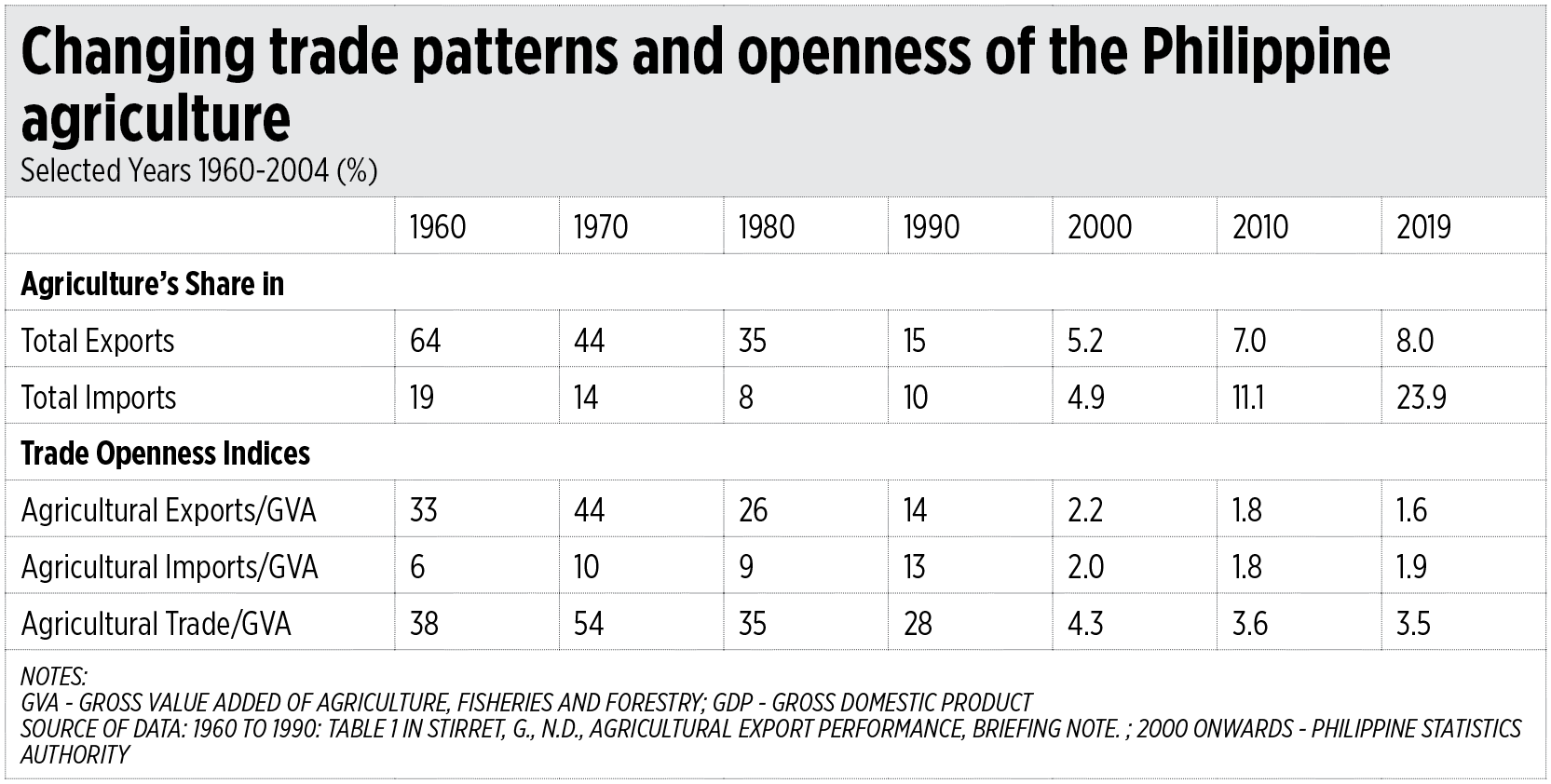
The capability of the sector to engage in international trade has deteriorated significantly. In 1960, agriculture accounted for 60% of the total exports of the country. Sixty years later, the figure went down to 8%. Agricultural imports were 19% of the total in 1960 and increased to 24% in 2019. Import substituting industries in agriculture turned out not to be competitive enough so that when trade protection of them was lowered in compliance with the country’s obligations in the WTO Agreement on Agriculture, food imports, particularly rice, increased.

Trade openness indices show a pattern of shrinking tradability of the sector and a reduced capacity to trade internationally. In 1960, a third of the value added from agriculture were exported. That number dropped to only 1.6% in 2019.

Despite their rising share in the country’s total imports, imported agricultural products ended after 60 years with having a share of only 1.9% of gross value added (GVA), a third of what they used to have in 1960. The total tradability part of the sector plunged from 38% in 1960 to only 3.5% in 2019.

Agriculture Secretary William D. Dar took the helm of the Department at a unique and opportune time. He started his term with rice policy-induced inflation, which we solved by letting go of the National Food Authority (NFA). He fought his first major policy battle on rice tariffication and decided to take the less traveled road of supporting the Rice Tariffication Law (RTL). It was a bold step, abandoning the tradition of costly rice self-sufficiency programs and NFA rice import monopoly. (See the Table.)


However, he continues to face the pressure of showing that letting go of import restrictions in rice is good for the sector. He needs to put in place complementary programs to import liberalization to increase rice farm productivity and incomes of rice farmers. As it is right now, import liberalization, which pushes rice prices down, is creating new friction on the farming side of the industry, feeding the embers of the opposition to RTL.

Secretary Dar has the Rice Competitiveness Enhancement Fund (RCEF) to use in his effort to deliver a new rice industry of the country. The fund is rigidly designed by law, but nonetheless he is sitting on at least a P10-billion fund yearly.

Akin to that momentous decision he had to take of supporting the RTL, he is now called upon to effectively convert the RCEF into higher rice productivity even as the industry is opened up to import competition.

Past administrations had simply poured money into the rice industry to demonstrate they had used the resources for their intended use. Their investments boiled away into thin air, leaving white elephant infrastructure facilities as proof that budgets were used, but farmers remained poor.

Repeating the way his predecessors spent public resources for the rice industry would likely create the same legacy for his administration, and, down the road, raise the likelihood of a failed experiment in liberalizing rice import policies.

What road less traveled in public spending in the rice industry should he take this time?


Ramon L. Clarete is a professor at the University of the Philippines School of Economics.