Home Blog Page 895

Toyota Financial Services launches P2-billion bond offer

PHILSTAR FILE PHOTO

TOYOTA Financial Services Philippines Corp. (TFSPH), the automotive financing and leasing arm of GT Capital Holdings, Inc., has launched its P2-billion maiden bond offering to fund asset growth and diversify its funding sources, the listed conglomerate said on Monday.

The bonds will be issued in up to two series: two-year Series A bonds due 2027 with a fixed rate of 5.7725% and three-year Series B bonds due 2028 with a rate of 5.9418%.

The offer period will run from Oct. 6 to 13, according to GT Capital. First Metro Investment Corp. and ING Bank N.V. Manila Branch are the joint lead arrangers and bookrunners for the transaction. Both firms will also serve as the selling agents, alongside Metropolitan Bank & Trust Co. and BPI Capital Corp.

TFSPH aims to reach a wider investor base that includes both institutional and individual investors, GT Capital said.

Philippine Rating Services Corp. (PhilRatings) assigned TFSPH an issuer credit rating of PRS Aaa with a stable outlook.

In the first quarter of fiscal year 2025, TFSPH’s total revenues rose by 11% to P3.9 billion, while loan receivables increased by 9% to P159.4 billion.

TFSPH is 60% owned by Japan-based Toyota Financial Services Corp. and 40% by GT Capital. — A.L. Balinbin and B.M.D. Cruz

Philippines to open January rice import window, extend ban through end-2025

PHILSTAR FILE PHOTO

By Kenneth Christiane L. Basilio

The Philippines will implement a one-month rice import window in January next year and reimpose a halt from February to April, as the government extends its rice import ban until end-2025, its Agriculture chief said on Monday, in a plan “more or less” approved by President Ferdinand R. Marcos, Jr.

Agriculture Secretary Francisco P. Tiu Laurel, Jr. said the government plans to allow about 300,000 metric tons of rice imports in January 2026, an amount he said would be sufficient to support local stocks for consumption.

“I believe we have to import by January just to be sure,” he told lawmakers at a House of Representatives hearing in Filipino. “Our imported stocks, which we stopped in September, are estimated to run out by the end of November and we’ll be running on local stocks in December.”

“That kind of situation is quite risky,” he added.

Mr. Marcos earlier suspended rice imports for 60 days starting Sept. 1 to protect Filipino farmers during the harvest season and stabilize rice prices. The suspension was originally supposed to end on Nov. 2 and applies only to regular milled and well-milled rice.

“We will extend the rice import stoppage until the end of 2025,” Mr. Tiu Laurel said.

He said the Philippines, the world’s top rice buyer, had imported about 3.5 million metric tons (MMT) of rice as of end-September, overshooting this year’s rice import target by 800,000 tons.

“We should be at the 2.7 [MMT levels] in imported rice, so we are… in excess,” he said. “The monthly import volume should only be around 300,000 tons, or 3.6 MMT a year.”

Philippine water company Maynilad files preliminary prospectus for planned IPO

BW FILE PHOTO

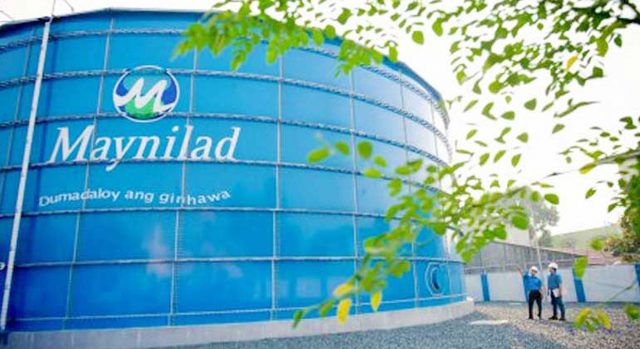
MANILA/SINGAPORE – Maynilad Water Services Inc said it had submitted a preliminary prospectus for its planned initial public offering to the Philippine Stock Exchange PSE.PS and corporate regulator, moving closer to what could be the country’s biggest listing this year.

The filing contains details on its business and financial accounts and kicks off preparations for institutional investor roadshows in the coming days, the Philippine water utility said in a statement late on Sunday.

The submission of its preliminary prospectus marks another step in its mission to deliver safe, sustainable and reliable water and wastewater services, Maynilad President and CEO Ramoncito Fernandez said in the statement.

The company’s statement did not say how much it planned to raise in the IPO. Reuters in January reported that Maynilad had enlisted banks, including Morgan Stanley MS.N and UBS UBSG.S, to assist with a more than $500 million IPO in the Philippines.

The company initially targeted a July debut but later postponed the listing, first to October and then to no later than November 7, according to disclosures on its website.
Under its 25-year concession, Maynilad must list shares by January 2027.

Majority owned by Metro Pacific Investments, DMCI Holdings and Japan’s Marubeni, the utility serves Metro Manila’s west zone and Cavite province.

The IPO proceeds will fund water and wastewater projects, network expansion and system upgrades, according to its preliminary prospectus. — Reuters

Rome calls on US to reconsider extra anti-dumping tariff on pasta imports

PEOPLE walk past the Colosseum in Rome, Italy, July 31, 2020. — REUTERS

ROME – Rome is working closely with the European Commission to press the United States to reconsider an additional anti-dumping tariff on pasta imports which would effectively double their price, the Italian foreign ministry said.`

The decision to impose an extra duty of 91.74% is the result of proceedings by the U.S Department of Commerce which found that two major Italian producers were allegedly selling pasta at unfairly low prices – a practice known as dumping – between July 2023 and June 2024.

These would be on top of the 15% U.S. tax on most imports from the 27-nation EU, and would be applied from January 2026.

The Italian foreign ministry said in a statement late on Saturday it contested the findings and the new tariffs, and was assisting companies in protecting their rights through the embassy in Washington.

With almost $800 million in exports, the U.S. is one of Italy’s top three export markets for pasta, a staple of the country’s culinary heritage and a substantial export commodity.

In 2024, Italy’s total pasta exports were worth over 4 billion euros ($4.70 billion) with almost 2.5 million tons sold abroad, according to data by national statistics agency ISTAT.

Italy’s main business lobby Confindustria on Thursday cut its economic growth forecasts for this year and next, citing the impact of U.S. tariffs and geopolitical tensions on exports. — Reuters

OPEC+ to raise oil output from November by 137,000 bpd

Crude oil is dispensed into a bottle in this illustration photo. — REUTERS

The group comprising the Organization of the Petroleum Exporting Countries plus Russia and some smaller producers has increased its oil output targets by more than 2.7 million bpd this year, equating to about 2.5% of global demand.

The shift in policy after years of cuts is designed to regain market share from rivals such as US shale producers.

Brent prices fell below $65 per barrel on Friday, as most analysts predict a supply glut in the fourth quarter and in 2026 due to slower demand and rising US supply.

Prices are trading below this year’s peaks of $82 per barrel but above $60 per barrel seen in May.

In the run-up to the meeting, Russia and Saudi Arabia, the two biggest producers in the OPEC+ group, had different views, sources have said.

Russia was advocating for a modest output increase, the same as in October, to avoid pressuring oil prices and because it would struggle to raise output owing to sanctions over its war in Ukraine, two sources said this week.

Saudi Arabia would have preferred double, triple or even quadruple that figure – 274,000 bpd, 411,000 bpd or 548,000 bpd respectively – because it has spare capacity and wants to regain market share more quickly, sources said ahead of the meeting.

OPEC views the global economic outlook as steady and market fundamentals as healthy because of low oil inventories, it said in a statement on Sunday.

WALKING A TIGHTROPE

Scott Shelton at TP ICAP Group said oil prices may rise on Monday by up to $1 per barrel as the November production increase turned out to be modest.

Jorge Leon at Rystad Energy said: “OPEC+ stepped carefully after witnessing how nervous the market had become … The group is walking a tightrope between maintaining stability and clawing back market share in a surplus environmentUS.”

OPEC+ output cuts had peaked in March, amounting to 5.85 million bpd in total. The cuts were made up of three elements: voluntary cuts of 2.2 million bpd, 1.65 million bpd by eight members and a further 2 million bpd by the whole group.

The eight producers plan to fully unwind one element of those cuts – 2.2 million bpd – by the end of September. For October, they started removing the second layer of 1.65 million bpd with the increase of 137,000 bpd.

The eight producers will meet again on Nov. 2. — Reuters

UK’s Mobilist named cornerstone investor in Maynilad IPO

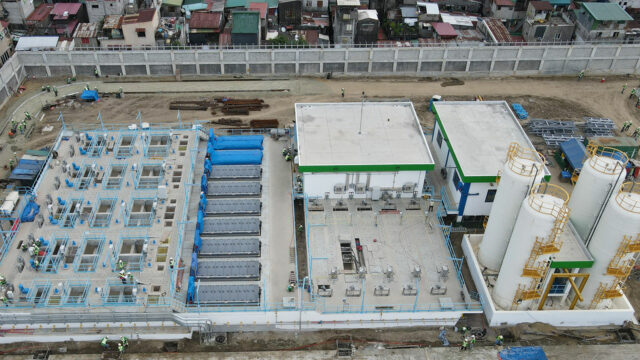
THE CAMANA WATER Reclamation Facility in Maypajo, Caloocan City. — BW FILE PHOTO

MAYNILAD Water Services, Inc. has identified the United Kingdom’s Mobilist program as one of the cornerstone investors in its planned initial public offering (IPO), according to its preliminary prospectus dated Oct. 3.

Mobilist, a flagship program of the UK’s Foreign, Commonwealth and Development Office (FCDO), aims to mobilize institutional capital toward sustainable investments in emerging and frontier markets.

The West Zone water concessionaire said Mobilist is among the cornerstone investors that have entered or are expected to enter into separate agreements to purchase offer shares at the final offer price.

Other cornerstone investors identified are the International Finance Corp. (IFC) and the Asian Development Bank (ADB), which are considering investments of $100 million and $145 million, respectively.

The cornerstone investment agreements with IFC, ADB, and Mobilist are subject to final execution and to the final determination of the offer price. These agreements require that the final offer price does not exceed P15 per share.

Maynilad’s IPO will cover up to 1.66 billion common shares, including 24.9 million primary shares and 249.05 million overallotment option shares, priced at up to P20 apiece.

The offering also includes an upsize option of up to 354.70 million secondary common shares.

Aside from Mobilist, other institutional investors expressing interest include Robeco Switzerland Ltd., which is offering up to $20 million, as well as abrdn Malaysia Sdn. Bhd., Maven Investment Partners Ltd. – Hong Kong Branch, Maybank Asset Management Singapore Pte. Ltd., and QRT Master Fund – Torus Fund SP.

Maynilad has rescheduled its IPO to no later than Nov. 7 to allow cornerstone investors more time to complete their evaluation.

The offer period is set from Oct. 23 to 29, with the listing on the Philippine Stock Exchange targeted for Nov. 7.

The company said it intends to use the net proceeds from the sale of primary shares for capital expenditures and general corporate purposes.

BPI Capital Corp. serves as the domestic lead underwriter, while The Hongkong and Shanghai Banking Corp. Ltd., Morgan Stanley Asia (Singapore) Pte., and UBS AG, Singapore Branch act as joint global coordinators and joint bookrunners.

Maynilad provides water and wastewater services to parts of Manila, Quezon City, and Makati, as well as Caloocan, Pasay, Parañaque, Las Piñas, Muntinlupa, Valenzuela, Navotas, and Malabon. It also serves the cities of Cavite, Bacoor, and Imus, and the towns of Kawit, Noveleta, and Rosario in Cavite province.

Metro Pacific Investments Corp., which holds a majority stake in Maynilad, is one of three Philippine units of Hong Kong-based First Pacific Co. Ltd., the others being Philex Mining Corp. and PLDT Inc.

Hastings Holdings, Inc., a unit of PLDT Beneficial Trust Fund subsidiary MediaQuest Holdings, Inc., has an interest in BusinessWorld through the Philippine Star Group, which it controls. — A.L. Balinbin and S. Talavera

Poll: BSP to keep policy rate on hold

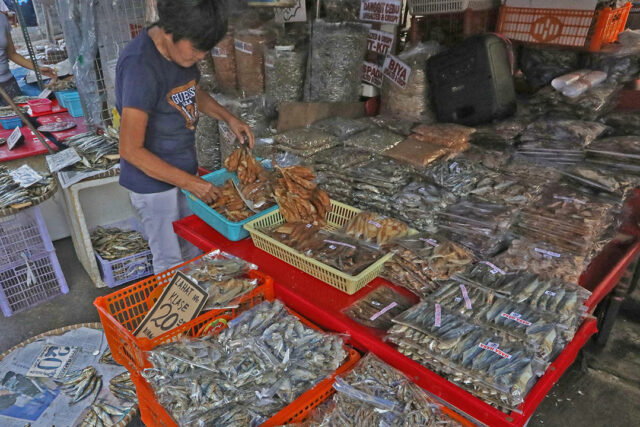
A VENDOR sells dried fish at a market in Manila. A BusinessWorld poll conducted last week showed 10 of 16 analysts expect the Monetary Board to pause monetary easing at its Oct. 9 meeting. — PHILIPPINE STAR/EDD GUMBAN

By Katherine K. Chan

THE BANGKO SENTRAL ng Pilipinas (BSP) will likely keep interest rates on hold this week as inflation risks linger, according to most analysts polled by BusinessWorld.

A BusinessWorld poll conducted last week showed 10 of 16 analysts expect the Monetary Board to pause monetary easing at its Oct. 9 meeting, keeping the benchmark rate at 5%.

On the other hand, six analysts anticipate a 25-basis-point (bp) rate cut, citing below-target inflation and the need to support economic growth. If realized, this would bring the benchmark rate to 4.75%.

Analysts’ Expectations on Policy Rates (October 2025)

The central bank has so far lowered borrowing costs by a total of 150 bps since the start of its easing cycle in August last year.

Security Bank Chief Economist Angelo B. Taningco said upside inflation risks would likely prompt the Monetary Board to hold rates steady on Thursday.

“I expect the Monetary Board to pause from rate cuts largely due to the inflation acceleration and upside inflation risks from potential extension of rice import ban and rice tariff hike,” he said in an e-mail.

September inflation data will be released on Oct. 7. A BusinessWorld poll of 12 analysts yielded a median estimate of 1.9% for September inflation, faster than the 1.5% in August, reflecting the impact of recent typhoons on food prices, as well as higher pump prices and electricity rates. This was within the BSP’s 1.5-2.3% forecast for the month.

The 60-day suspension on imports of regular milled and well-milled rice took effect on Sept. 1. However, the import ban is expected to be extended by another 30 days.

Moody’s Analytics economist Sarah Tan said a pause would allow the BSP to evaluate how its past rate cuts impacted the economy, particularly on domestic demand and lending activity.

“The central bank will also weigh the balance between supporting growth and ensuring inflation expectations remain anchored. Global oil price volatility, the impact of recent typhoons on food supply, and the Fed’s policy stance are also important considerations,” Ms. Tan said in an e-mail.

Philippine National Bank economist Alvin Joseph A. Arogo said a pause would minimize the depreciation pressure on the Philippine peso since the BSP eased more than the US Federal Reserve so far this year.

The local unit closed at P58.196 per dollar on Sept. 30, weakening by P1.066 or 1.83% from its P57.13 finish on Aug. 29.

“A pause from the BSP will also be more supportive of the peso given the current USD/PHP levels, which lie above the 58-level despite a generally weak dollar,” Metropolitan Bank & Trust Co. (Metrobank) said in a separate commentary.

Metrobank said the BSP will likely wait for the release of third-quarter gross domestic product (GDP) data on Nov. 7 before making policy adjustments.

“We project household consumption and investment to remain tepid while the lagged effects of the BSP’s previous RRP (reverse repurchase rate) reductions begin to make a significant impact. We expect this to be the reason for the BSP to deliver another reduction to the RRP during its last meeting for 2025 in December,” it added.

In the first semester, the economy expanded by 5.4%, slower than the 6.2% growth posted last year. This was slightly below the government’s 5.5-6.5% target range for this year.

“With the central bank describing the current policy rate as the ‘Goldilocks rate,’ policymakers may require a firmer justification for an immediate adjustment to monetary policy,” Chinabank Research said in a note.

RATE CUT
On the other hand, some analysts expect a 25-bp rate cut at this week’s meeting as inflation remains below the BSP’s 2-4% target and the pace of economic growth is still a concern.

Earlier, BSP Governor Eli M. Remolona, Jr. said they are open to delivering a cut this month if the country’s economic output further weakens.

Union Bank of the Philippines Chief Economist Ruben Carlo O. Asuncion said they expect a 25-bp cut on Thursday “to preempt downside risks to growth.”

“While inflation remains benign and below target, the BSP is likely to prioritize supporting economic momentum amid subdued fiscal spending, persistent external headwinds (and) recent weather-related disruptions that could weigh on activity,” Mr. Asuncion said.

Azril Rosli, economist at Maybank Investment Banking Group, said in an e-mail that sluggish investment spending and uncertainty from the US tariffs will also weigh on the outlook for growth.

Meanwhile, Michael L. Ricafort, chief economist at Rizal Commercial Banking Corp., said in a Viber message that the BSP could match the Fed’s rate cuts with 25-bp cuts each at the October and December meetings.

“These Fed rate cuts could be matched locally by the BSP so that healthy interest differential would eventually be maintained to help support/stabilize the peso exchange rate, import prices, and overall inflation,” he said.

The Monetary Board’s last meeting for this year is on Dec. 11.

Miguel Chanco, chief emerging Asia economist at Pantheon Macroeconomics, said the BSP could have another rate cut in December as GDP growth in the third quarter likely weakened.

“We still see another 25-bp cut coming in December, as we expect the Q3 GDP report due in November to be weak enough to convince the Board to ease policy at least one final time,” he said in an e-mail.

In a note, Bank of the Philippine Islands Lead Economist Emilio S. Neri, Jr. said there is a higher probability the BSP will cut in December if third-quarter GDP confirms “potential demand softness.”

“With rates already near neutral and inflation seen converging to 3% by 2026-2027, we think the scope for further easing after this is limited,” Mr. Neri said.

“Nonetheless, the BSP could still deliver up to two more cuts if the economy continues to operate below potential. They may also decide to move in tandem with the Federal Reserve’s moves, especially if markets expect aggressive cuts after Powell’s term ends in May 2026.”


Corruption scandal threatens to cool demand for luxury real estate in Philippines

A silhouette of the skyline is pictured at sunset in Quezon City, Metro Manila, Philippines, Nov. 27, 2020. REUTERS/ELOISA LOPEZ

By Beatriz Marie D. Cruz, Reporter

A WIDENING corruption scandal involving Philippine government officials and public works contractors threatens to cool demand for luxury real estate projects, according to property analysts.

“Heightened scrutiny of public officials and politically exposed persons (PEPs) — particularly if investigations lead to asset seizures or wealth tracing, can initially cool demand in the luxury segment, especially in areas known for trophy assets like Makati, Bonifacio Global City, or upscale resort destinations,” Joe Curran, chief executive officer (CEO) at KMC Savills, said in an e-mail to BusinessWorld.

In the short term, this may result in price stagnation and a slower turnover of ultra-luxury properties, which typically range over P100 million, he said.

A corruption probe into anomalous flood control projects has embroiled government officials, including senators, congressmen and the Public Works department, as well as government contractors. They face allegations of pocketing billions of pesos meant for flood mitigation projects.

The scandal has intensified following the circulation of social media posts featuring relatives of public officials and contractors who displayed their luxury homes, private jets and shopping trips, prompting widespread public criticism online.

Joey Roi H. Bondoc, director and head of research at Colliers Philippines, said there have been talk that some property developments are reporting weaker take-up since the corruption investigation began in August.

“What we have been hearing is that some of these developers that are catering to the luxury market have recorded slower sales since this flood control issue came out,” Mr. Bondoc said via telephone.

“Anecdotally, that’s what I can share — the upscale luxury developers are feeling the pinch of these investigations and have admitted that they have recorded slower sales since this issue came out,” he added.

If corruption-fueled transactions in luxury real estate become more publicized, individuals with questionable sources of income will likely delay their acquisitions, Mr. Curran said.

Others may secretly liquidate their assets or redirect investments offshore, he added.

Mr. Curran also noted that many luxury brands operating in the Philippines, whether via flagship stores or retail pods in integrated resorts, are “sensitive to wealth sentiment, not just raw spending power.”

“This could affect tenant mix, marketing strategies, and the velocity of leasing in high-end commercial and mixed-use developments,” he said.

According to Mr. Curran, some luxury real estate transactions in emerging markets have historically been vehicles for wealth storage or laundering.

“If corruption probes lead to a greater public awareness of ill-gotten wealth, a cultural shift toward ‘clean money’ consumption or stricter capital flows enforcement — then the tone of luxury branding may evolve. Expect more emphasis on lifestyle, craftsmanship, legacy brands, and less on overt extravagance or display,” Mr. Curran said.

The government must also push for reforms and implement anti-money laundering and counter-terrorism financing protocols to improve buyer confidence, he added.

The corruption crackdown should also lead to improved rule of law, which can only enhance the Philippines’ investment appeal, he added.

Developers, brokers, and investors should also follow environmental, social, and governance principles, and target high-net-worth buyers who value integrity than prestige, Mr. Curran said.

“In summary, while corruption investigations may temporarily cause unease in niche parts of the luxury real estate market, they are ultimately healthy for long-term transparency and market maturity,” he said.

SUBSTANDARD PROJECTS
Meanwhile, substandard government infrastructure projects may dampen the value of property developments in nearby areas, according to a developer.

“This will generally slow down the speed of value appreciation of property developments in or near areas in dire need of infrastructure projects. These [infrastructure projects] are required to improve vehicle and pedestrian accessibility, and protection against the ever-increasing uncertainty of weather-related events,” Havitas Properties President and CEO Jonathan F. Caro said in an e-mail.

“The resulting floods are an offshoot of the result of substandard public infrastructure projects leading to flooded streets — we are seeing just now especially on social media why it is happening in the first place.”

Corruption linked to flood control projects may have cost the Philippines over P118 billion in economic losses since 2023, the Department of Finance said earlier.

Government’s debt service bill surges to P665B in August

BW FILE PHOTO

THE NATIONAL GOVERNMENT’S (NG) debt service bill soared in August as amortization and interest payments surged, the Bureau of the Treasury (BTr) reported.

The latest data from the Treasury showed that the debt service bill more than tripled (256.96%) to P664.72 billion in August from P186.22 billion in the same month last year.

Month on month, the debt service bill also went up by 515.17% from P108.06 billion in July.

Debt service refers to the payments made by the government on domestic and foreign borrowings.

In August, amortization payments more than quadrupled (350.86%) to P601.62 billion from P133.44 billion in the same month in 2024.

The bulk or 90.51% of the debt payments in August were made up of amortization payments, BTr data showed.

Principal payments on domestic debt surged by 389.93% to P597.89 billion in August from P122.03 billion a year ago.

Amortization paid on foreign debt, on the other hand, slumped by 67.29% to P3.73 billion in August from P11.4 billion in the same month a year ago.

On the other hand, interest payments increased by 19.56% to P63.11 billion from P52.78 billion a year earlier.

Domestic interest payments went up by 17.82% to P46.38 billion in August from P39.36 billion in the same month last year.

This was composed of P24.85 billion for fixed-rate Treasury bonds, P16.87 billion for retail Treasury bonds, and P4.62 billion for Treasury bills, and others (P34 million).

Interest payments for foreign borrowings climbed by 24.65% to P16.73 billion in August from P13.42 billion a year prior.

Rizal Commercial Banking Corp. Chief Economist Michael L. Ricafort attributed the larger debt service bill to the P516-billion government securities (GS) that matured in August.

“This is an unusual increase in NG principal payments,” he said in a Viber message over the weekend.

END-AUGUST
For the first eight months of the year, the NG debt service bill inched down by 0.6% to P1.54 trillion from P1.55 trillion in the same period last year.

The eight-month tally was 75.01% of the P2.05-trillion debt service program this year.

Amortization payments, which made up the bulk of the total, declined by 8.07% to P956.74 billion as of end-August from P1.04 trillion a year ago. This was 79.32% of the P1.21-trillion full-year amortization program.

Principal payments on domestic debt slipped by 12.63% to P768.52 billion, while external payments increased by 16.84% to P188.22 billion.

Meanwhile, interest payments went up by 14.66% to P584.15 billion in the January-to-August period from P509.44 billion in the same period a year ago.

This was 68.88% of the P848.03-billion programmed interest payments for 2025.

Interest payments on domestic debt stood at P429.12 billion, 18.31% higher year on year than P362.72 billion a year ago.

Of the total interest payments on domestic debt, P292.14 billion went to fixed-rate Treasury bonds, P99.71 billion to retail Treasury bonds, P30.36 billion to Treasury bills (T-bills), and others (P6.91 billion).

On the other hand, external debt inched up by 5.66% to P155.03 billion in the first eight months from P146.72 billion a year ago.

Mr. Ricafort said the government is still on track to meet its P2.05-trillion debt service program.

He said the debt service bill may have gone up in September as P288 billion in Treasury bonds matured.

“After that, no more large NG GS maturities for the rest of 2025. Next large GS maturities that would increase NG debt servicing would be in February 2026 and April 2026 at P200 billion each,” Mr. Ricafort said. — Aubrey Rose A. Inosante

Economists keep Philippine GDP growth forecasts as corruption allegations unfold

PHILIPPINE STAR/MIGUEL DE GUZMAN

LOCAL ECONOMISTS kept their growth forecasts for the Philippines unchanged for now, even as a widening corruption scandal weighs on investor sentiment.

“We’re keeping an eye on governance issues like corruption because they can affect investor confidence and, ultimately, growth,” Ruben Carlo O. Asuncion, chief economist at Union Bank of the Philippines said in a Viber message on Oct. 2.

“But for now, our baseline view remains unchanged and we will continue to monitor macro data as they become available,” he said.

Mr. Asuncion said the bank kept its 5.5% gross domestic product (GDP) growth outlook for this year and 5.7% for 2026, supported by stronger domestic demand and recovery in infrastructure spending.

The government is targeting 5.5-6.5% GDP growth this year, and 6-7% in 2026.

The Independent Commission for Infrastructure, Congress and Ombudsman are conducting investigations into allegations of corruption in government infrastructure projects, particularly flood control projects under the Department of Public Works and Highways.

Emilio S. Neri Jr., lead economist at Bank of the Philippine Islands, said the 2025 growth projection remains at 5.6%, citing minimal declines in government spending through August.

“We will wait for clearer evidence of any sizeable declines among our leading growth indicators before we revise,” Mr. Neri told BusinessWorld in a Viber message.

Pantheon Macroeconomics Chief Emerging Asia Economist Miguel Chanco said he is not expecting any growth forecast revisions anytime soon, as their 5.3% forecast for 2025 and 5.4% for 2026, are already on the “downbeat side.”

“The risks, even to our already-soft projections, are arguably now more skewed to the downside, particularly for the second half of this year and early next,” he said.

Rizal Commercial Banking Corp. Chief Economist Michael L. Ricafort said it is still possible to achieve the government’s growth targets.

Mr. Ricafort said the government probe is expected to “realistically” dampen growth in state infrastructure spending and weigh on GDP, though the impact may be offset by the reallocation of certain flood control projects to other departments.

Meanwhile, Reyes Tacandong & Co. Senior Adviser Jonathan L. Ravelas has trimmed his growth forecast for this year from 6% to 5.7%, but not due solely to the flood control mess.

The downward revision takes into consideration the impact of US tariffs,  upside risks to inflation and political noise, he said.

Institutions like the Asian Development Bank (ADB) and the International Monetary Fund (IMF) have downgraded their Philippine growth forecasts, citing elevated global uncertainties.

In its latest Asian Development Outlook, the ADB trimmed its Philippine growth forecast to 5.7% in 2026 from 5.8% in its July projection. It also kept its growth forecast unchanged at 5.6% this year.

ADB Country Director for the Philippines Andrew Jeffries earlier said corruption remains a “heightened risk” but will further monitor.

For this year, the IMF cut its 2025 forecast to 5.4%, slightly lower than its 5.5% projection in July. It also slashed its 2026 outlook to 5.7% from 5.9% previously, amid global uncertainties and geopolitical tensions.

MORE SUPPORT FOR MONITORING AGENCIES
Meanwhile, Economy Secretary Arsenio M. Balisacan earlier called for increased support for research and development monitoring and evaluation, as well as for regional development councils (RDCs) tasked with overseeing infrastructure initiatives, including flood mitigation projects.

“I find also quite missing, the lack of appreciation of what monitoring and evaluation can do,” Mr. Balisacan told a Senate Finance Committee hearing on Oct. 3.

“We don’t provide enough support to good studies doing impact assessment, monitoring assessment of completed and ongoing projects, especially for completed projects so that we don’t keep repeating mistakes over and over again.”

Mr. Balisacan also called for more resources for RDCs, who are on the ground monitoring projects.

“We have that committee, and they’re supposed to know and able to monitor these various infrastructure projects, including flood control projects. But they don’t have resources to be able to do that function, especially as a difficult region (such as) Mimaropa (Mindoro, Marinduque, Romblon, and Palawan,” he said. — Aubrey Rose A. Inosante

Startup QC welcomes fresh batch of innovators to Cohort 4

Quezon City further strengthened its role as a leader in local startup ecosystem development, as Mayor Joy Belmonte and the Startup QC Program Committee announced the nine innovative startups for this year’s Cohort 4.

Following a rigorous evaluation process held on Aug. 15, the committee carefully reviewed and deliberated applications submitted by early-stage startups from diverse sectors. Out of these, nine were identified as standout ventures worthy of endorsement to Mayor Joy Belmonte for further support and recognition under the program.

The nine startups represent a range of industries, including sustainability, information technology, health, and business management solutions. These finalists will join the growing roster of Startup QC awardees who are breaking barriers and building solutions that address real challenges in their communities, while creating pathways for sustainable economic growth.

Among this year’s finalists is Briyo Energy, which develops low-cost bamboo-based wind and hydro turbines designed to cut carbon emissions by 90% while delivering clean power to off-grid communities.

Carisle Media Corp., the team behind Hireable, offers a smarter freelance hiring platform that uses AI-driven matching, KPI tracking, and trial-hiring funnels to improve long-term outcomes for businesses and freelancers alike.

Household services also took the spotlight with Kazam, a one-stop app that connects homeowners with kasambahays, providing flexible, reliable, and on-demand household help.

Sports and recreation are represented by Laro (Synergize Sports Technology, Inc.), an all-in-one hub where players can discover, book, and join sports or tabletop games while also linking with venues and communities.

On the energy front, Nascent Technologies Corp. is introducing a drop-in sodium-ion battery specifically built for tropical conditions. The battery promises three times longer life, zero maintenance, and safer, greener performance.

In health tech, Agapai Technologies Corp. has created an AI-powered app to help parents detect developmental delays early and connect with care professionals in real time.

For businesses, Kahero Apps, Inc. provides a mobile-ready point-of-sale system with expense tracking and multi-branch management features, giving entrepreneurs smarter, real-time control of their operations.

Real estate innovation is driven by Soolok Properties, Inc., a platform that aggregates below-market homes, speeds up transactions, and offers ready-to-move-in options within 45 days.

Finally, Xamun Technologies, Inc. enables companies to build enterprise-grade software in weeks using an AI-powered, no-code system that still gives teams full control of the process.

Since its launch in 2023, the Startup QC Program has grown from a pioneering initiative into a strong advocacy for multi-sectoral innovation. To date, the program has received more than 200 applications, awarding equity-free grants of P16 million for 16 startups across various industries (P1 million/each), including sustainability, information technology, education, fintech, and creative enterprises.

Mayor Joy Belmonte emphasized the city’s commitment to supporting the startup ecosystem emphasizing the power of innovation to uplift lives and create equal opportunities for all.

The nine endorsed startups of Cohort 4 were formally introduced at the Startup QC Kick-Off Event last Sept. 19. From there, the teams will advance to the second phase of the program, where they will undergo intensive, tailor-fit mentoring and coaching with industry leaders and experts. This stage is designed to refine their enterprises, strengthen their business models, and further develop their products and services, preparing them to scale and create real impact in their respective sectors.


SparkUp is BusinessWorld’s multimedia brand created to inform, inspire, and empower the Philippine startups; micro, small and medium enterprises (MSMEs); and future business leaders. This section will be published every other Monday. For pitches and releases about startups, e-mail to bmbeltran@bworldonline.com (cc: abconoza@bworldonline.com). Materials sent become BW property.

DoE allows Meralco to start bidding for 200 MW of renewable supply

PHILIPPINE STAR/JESSE BUSTOS

By Sheldeen Joy Talavera, Reporter

THE DEPARTMENT OF ENERGY (DoE) has cleared Manila Electric Co. (Meralco) to proceed with the bidding for 200 megawatts (MW) of renewable baseload power.

Speaking to reporters last week, Energy Undersecretary Mario C. Marasigan said the department had issued a certificate of conformity (CoC) for Meralco’s proposed competitive selection process (CSP).

“We cleared the first 200 [MW], but we deemed that the compliance of Meralco should be based on the observation of the PCC (Philippine Competition Commission) and ERC (Energy Regulatory Commission),” he said.

“So, in that sense, we deemed it okay to release the certificate of conformity,” he added.

Distribution utilities like Meralco conduct CSPs to procure power supply through a transparent and competitive bidding process aimed at securing the least-cost electricity.

Meralco submitted its terms of reference to the PCC and ERC for review. The issuance of a CoC by the DoE is a regulatory requirement before a CSP can begin.

The proposed 200-MW CSP will enable Meralco to comply with its obligations under the Renewable Portfolio Standards, which require distribution utilities to source a portion of their energy supply from eligible renewable energy sources.

The bidding forms part of Meralco’s plan to secure over 2,100 MW of capacity under its long-term supply procurement plan covering 2026 to 2046.

Mr. Marasigan said the decision now lies with Meralco on whether to proceed with the CSP if the company believes it has already addressed the regulators’ feedback.

“It’s up to them. If they feel that they have already complied with the comments of the PCC and ERC, then they can proceed,” he said.

Meanwhile, he said the DoE has yet to receive comments from the PCC and ERC on other proposed CSPs, such as the 600 MW of baseload and 450 MW of mid-merit power.

Lawrence S. Fernandez, vice-president and head of utility economics, said the company has yet to receive any CoC.

At present, Meralco is seeking ERC approval for its 20-year power supply agreement with First Quezon Biogas Corp. to source 1.25 MW of baseload supply from the latter’s biogas plant.

As the country’s largest private distribution utility, Meralco serves over eight million customers across Metro Manila and nearby areas.

Meralco’s controlling stakeholder, Beacon Electric Asset Holdings, Inc., is partly owned by PLDT Inc. Hastings Holdings, Inc., a unit of PLDT Beneficial Trust Fund subsidiary MediaQuest Holdings, Inc., has an interest in BusinessWorld through the Philippine Star Group, which it controls.

ADVERTISEMENT
ADVERTISEMENT