NEW YORK — US jeweler Tiffany & Co. and French luxury goods giant LVMH are in talks to settle their dispute over a $16 billion takeover at a price slightly lower than that initially agreed, sources familiar with the matter said on Tuesday.
The negotiations were based on a price in the range of $131–$134 for each Tiffany share, against the $135 price when the deal was first agreed on last November.
An agreement at the bottom of that range would save LVMH, led by billionaire businessman Bernard Arnault, about $480 million on the initial $16.2 billion purchase price.
The initial deal ran into trouble last month when the French group said it could no longer complete the transaction by the Nov. 24 deadline.
It cited a French political intervention preventing it from doing so, but also what it described as the jeweler’s “dismal” performance during the coronavirus crisis.
The two sides are facing off in a Delaware court, with Tiffany seeking to force LVMH to honor the deal. The case is due to be heard in early January.
CNBC earlier reported that the two parties were in indirect talks to settle the dispute.
Both LVMH and Tiffany did not immediately respond to Reuters requests for comment.
Tiffany shares rose almost 5% to $128.78 on Tuesday after reports of a potential end to the dispute.
Louis Vuitton owner LVMH agreed last year to buy Tiffany in its biggest acquisition yet, betting it could restore the US jeweler’s luster by investing in stores and new collections.
The deal was designed to boost LVMH’s smallest business, the jewelry and watch division that is already home to Bulgari and Tag Heuer, help it to expand in one of the fastest-growing industry sections and strengthen its US presence.
New York–based Tiffany, founded in 1837 and known for its signature pale blue boxes, retains a resonance as the go-to purveyor of engagement rings that only a handful of rivals can match.
Tiffany also said on Monday that it had received the nod from the European Commission for the deal’s completion, thus clearing all regulatory hurdles. — Greg Roumeliotis/Reuters
OKCHEON, South Korea — As the coronavirus pandemic began sweeping through South Korea late in February, doctor Nam Ha-jong received an order to report overnight to Daegu, a city that was to become the epicenter of infections.
With little formal training in treating virus victims and just two hours of instruction in the use of personal protective gear, the 30-year-old was sent to track down likely patients.
As fear of the new disease gripped the country, Nam went door to door from dawn to dusk each day, wearing full protective gear to perform the testing of members of an obscure religious group at the centre of the outbreak.
“We were exhausted, scared, and felt like being thrown in as a shield to fight against an enemy that no one knew about,” said Nam, who spent three weeks working in Daegu, a city of about 2.4 million southeast of the capital, Seoul.
A nurse and driver helped him run tests at the homes of suspected victims. Many in the religious group wanted to keep secret even the fact of having been tested, so Nam had to shoo away curious neighbors.
Nam was one of 1,900 young men conscripted from medical school to serve a term of 36 months as a public health doctor instead of regular military service.
That is compulsory in South Korea, which is technically still at war with the North, since the neighbors ended the Korean War with only a truce, instead of a peace treaty.
After eight months on the frontlines of the virus battle, the young doctors are credited with pulling off the strategy to target hotspots with rapid, mass testing and contact tracing.
As in the military, they were given no choice, often feeling their efforts went unrecognized, even as South Korea eventually flattened the curve of infections and won global praise for its response.
“Now I feel some people are taking us for granted,” Nam, who now works at a test center in Okcheon county, a two-hour drive south of Seoul, said in an interview.
Refusing to serve would have brought punishment in the form of a service extension of five times the length of the hotspot deployment, which typically lasts several weeks.
Experts say the doctors’ efforts were responsible for more than 2.5 million tests among a population of 50 million, as well as a program of stringent contact tracing.
The doctors are “indispensable,” said Park Yoon-hyung, a specialist in preventive medicine at Soonchunhyang University.
However, he added, “The general public don’t usually appreciate their work, because they think of their service as something obvious.”
As many as 1,000 of the doctors rotated through Daegu in March to fight an outbreak that racked up the largest number of infections outside China.
That deployment paved the way for a four-fold increase in daily virus tests, said Sejin Choi of the Korean Association of Public Health Doctors.
UNHERALDED
In normal times, the routine of a public health doctor can be uneventful, from prescribing blood pressure pills to the elderly or giving vaccinations, usually among a handful of patients.
Now, with dozens of new virus cases each day, the junior doctors, who receive average monthly pay of 2.5 million won ($2,200), are the mainstay of about half the nearly 600 test centers nationwide.
Dozens are contact tracing specialists, Association data shows, and several hundred staff the government’s “living care centers” for those suffering mild symptoms.
Always at the ready to rush to any new major disease cluster, the doctors can also be assigned as airport quarantine officers to guard against external infections.
“Our role is little known outside,” said Choi Seung-jin, one of the conscripted doctors who spent six weeks at a temporary testing facility near Seoul’s Incheon airport.
“But our job has never subsided,” added the 32-year-old, who will complete his service next April. “I am constantly worried that cases can explode at any time. I have stopped wishing for this to be over soon.” — Ju-min Park/Reuters
LONG AND grueling hours on the road mostly because of the horrendous traffic at EDSA will soon be over for motorists as the Department of Public Works and Highways (DPWH) advances its move to solving the Metro’s traffic woes.
The DPWH, led by Secretary Mark Villar, is poised to significantly complete its grand EDSA Decongestion Masterplan by 2022. Composed of a network of infrastructure projects, the masterplan aims to make it possible for motorists to reach every city in Metro Manila as well as go from North Luzon Expressway (NLEX) to South Luzon Expressway (SLEX) and vice versa in as short as 20 minutes to as long as 30 minutes.
For Secretary Villar, the achievements of the program will finally realize the promise of President Rodrigo Duterte to decongest EDSA. “When the EDSA Decongestion Program is completed, we will be able to free up major thoroughfares by at least 120,000 vehicles. By 2022, every city in Metro Manila will be reachable within a 20- to 30-minute time frame,” he added.
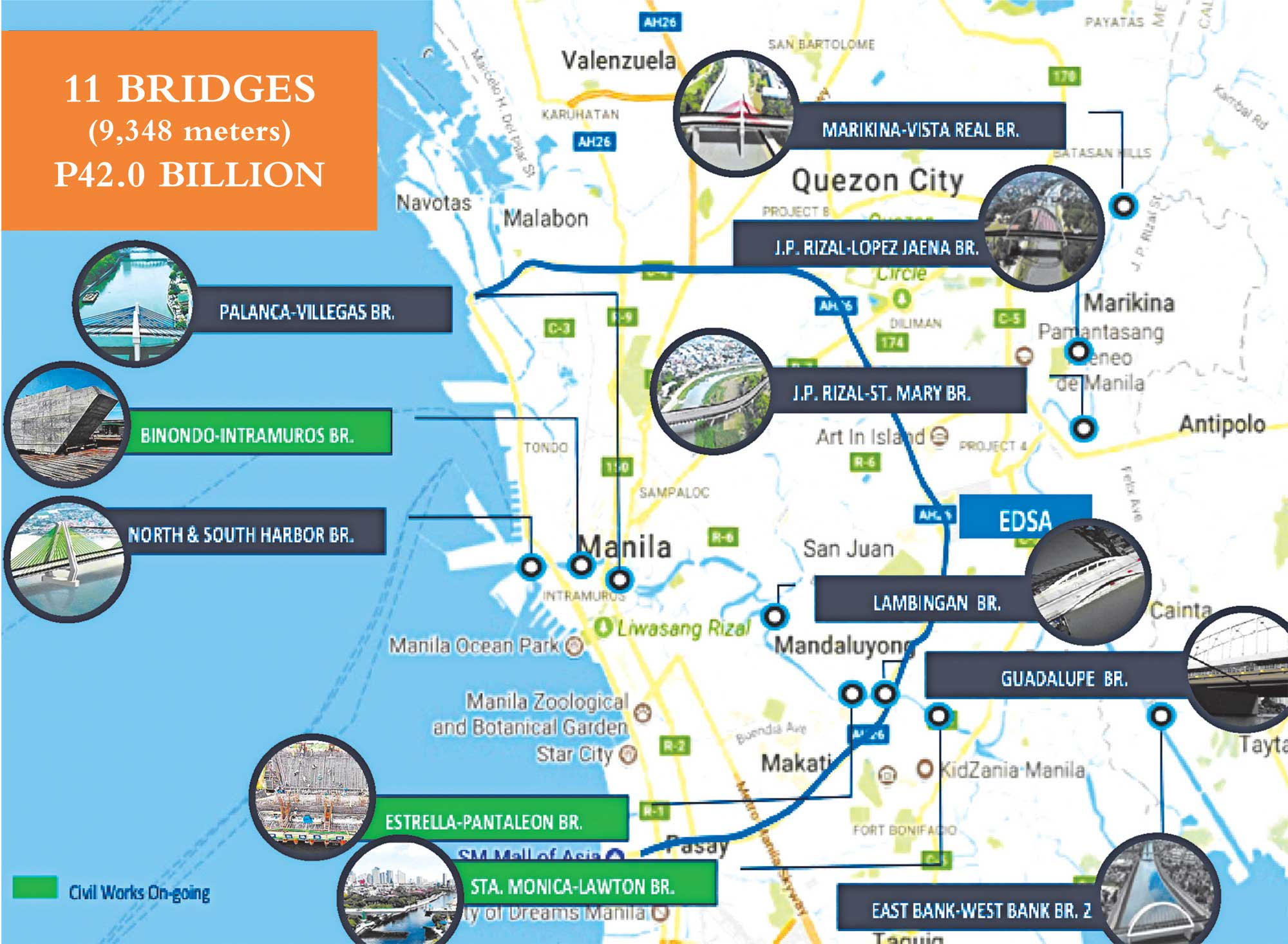
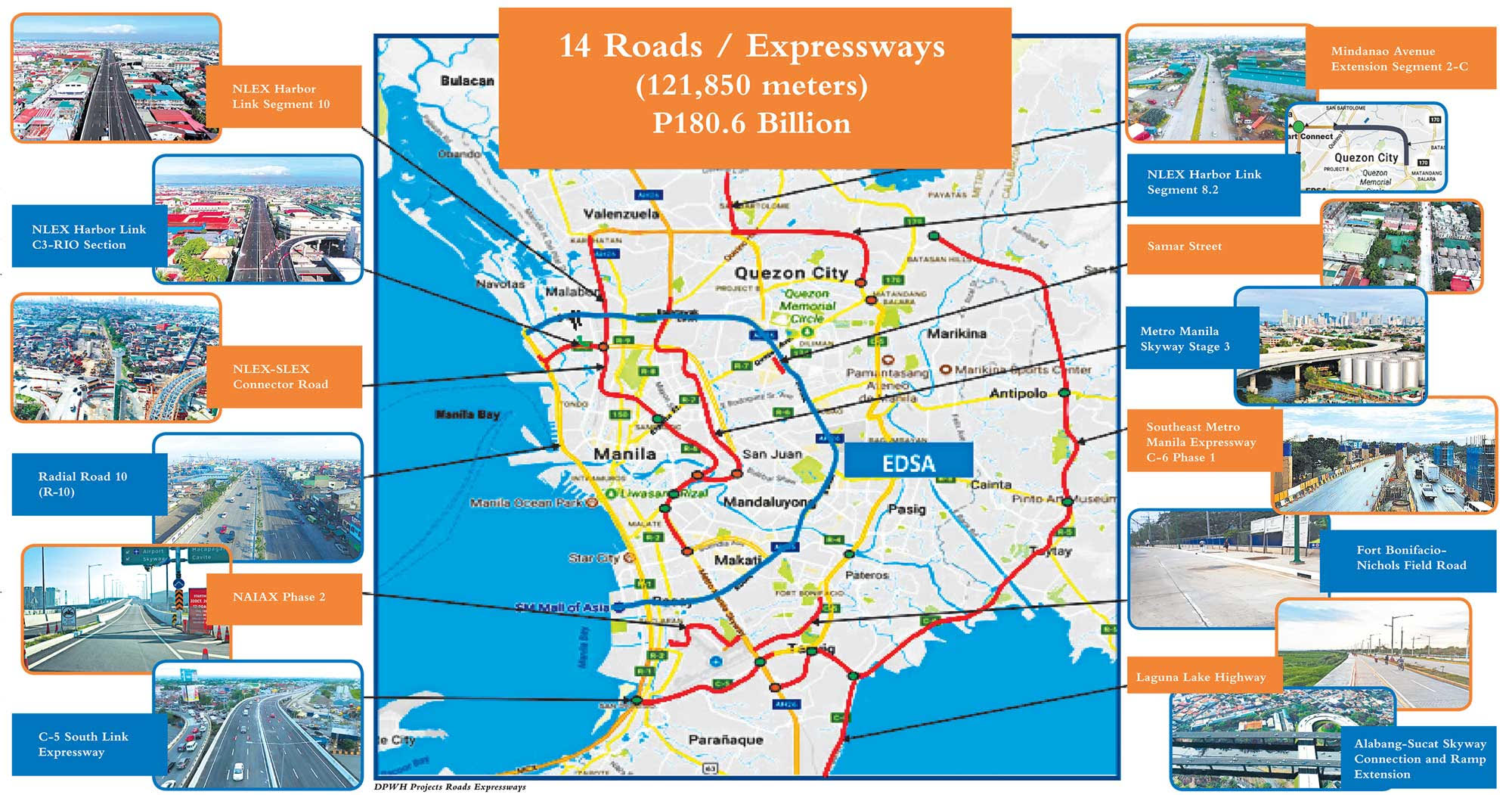
The program involves 14 roads and expressways spanning 121,850 meters and amounting to P180.6 billion, coupled with 11 bridges spanning 9,348 meters and worth P42 billion.
Among the projects at the forefront of the masterplan is the soon to open Metro Manila Skyway Stage 3 project, an 18.83-kilometer elevated expressway starting from Buendia, Makati City to NLEX in Balintawak, Quezon City. Completed earlier in October, this P44.86 billion project of conglomerate San Miguel Corp. will cut travel time from Buendia to Balintawak from two hours to 15-20 minutes. It will decongest EDSA and other major roads in Metro Manila by as much as 55,000 vehicles per day.
Complementing this project is the NLEX-SLEX Connector Road of the Metro Pacific Tollways Corp. (MPTC). The eight-kilometer, four-lane elevated expressway extends the NLEX southward from the end of Segment 10 in C3 Road, Caloocan City to PUP Sta. Mesa in Manila. The connector road also links to the Skyway Stage 3. According to DPWH, the project is currently 11% complete and is set to be finished by March 2022. Once completed, the project will reduce travel time from SLEX to NLEX from two hours to 20 minutes, benefitting 35,000 motorists daily.
Also set for completion by 2022 is MPTC’s C5 South Link Expressway. The project, worth P12.65 billion, is a 7.70-km, six-lane expressway from R-1 expressway to SLEX/C5. It will slash travel time from 40 minutes to 10 minutes. The Merville to C5/SLEX portion of the project, also known as Segment 3A-1, was opened to traffic in July last year; while Segments 2 and 3A2 broke ground last July.
The Southeast Metro Manila Expressway, a 32.66-km toll road from Skyway/FTI in Taguig City to Batasan Complex in Quezon City, will also be able to serve motorists by 2022. The P45.29 billion project will cut travel time from Bicutan to Batasan from one hour and 50 minutes to 26 minutes, benefitting as much as 88,338 motorists per day. The first section of the project, traversing from Skyway/FTI to C5/Diego Silang, is currently 12% complete, according to the department.
As motorists look forward to those projects for about two years, they can look forward to the completion of four projects by next year, including the Fort Bonifacio-Nichols Field Road, Mindanao Avenue Extension (Segment 2C), Laguna Lake Highway, and the Southbound portion of the Alabang-Sucat Skyway Connection and Ramp Extension.
The Fort Bonifacio-Nichols Field Road project, in particular, widens the 3.3-km Nichols Field Road from four lanes to six lanes.
Through this project, the DPWH explained, adjacent thoroughfares like EDSA, South Superhighway, and C5 will be decongested and travel time going in and out of Bonifacio Global City will be lessened. The project is 60% complete at present.
The Mindanao Avenue Extension (Segment 2C), meanwhile, is a 3.2-km, four-lane divided highway at the intersection of NLEX to Gen. Luis Avenue that will connect the areas of Valenzuela, North Caloocan, Quezon City (Novaliches), and NLEX. Once finished, the extension will cut travel time between Quirino Highway and General Luis Road from one hour and 30 minutes to 20 minutes. It is already 74.35% complete, according to the department.
The Laguna Lake Highway, on the other hand, is already substantially completed. The 6.94-km, four-lane divided highway will bring down travel time from Taytay, Rizal to Bicutan, Taguig from one hour to only 30 minutes.
All these upcoming road and expressways will form a basket of solutions to decongest EDSA, alongside already completed projects under the current administration such as the NLEX Harbor Link Segment 10, NLEX Harbor Link C3-R10 Section, NAIA Expressway Phase 2, and the widening of Radial Road 10 and Samar Street.
BRIDGES AND BIKE LANES
Aside from the new and expanded roads and expressways, new bridges will largely contribute in easing traffic along EDSA and other major roads in Metro Manila. DPWH said a four-lane bridge across Pasig River connecting Lawton Ave. in Makati City and Sta. Monica Street in Pasig City is poised to open next year. The Binondo-Intramuros bridge and the Estrella-Pantaleon bridge are also targeted for completion next year. Also, construction of three bridges crossing the Pasig River and Manggahan floodway under a Chinese financing facility is in the pipeline, while three more bridges crossing Marikina River will be built via funding through Asian Developments Bank’s financing facility.
The DPWH will also be embarking on a P7.93 billion Metro Manila Priority Bridges Seismic Improvement Project, which will entail the replacement of outer bridges and substructure of the Guadalupe bridge and the vertical geometry improvement of the Lambingan bridge.
Along with building roads and bridges to decongest traffic, the DPWH also supports the promotion of active modes of transport as bike lanes will be incorporated in the future projects of the department.
Particularly, Sec. Villar has issued a policy prescribing the standard design of bicycle lanes along national highways. Through Department Order No. 88 series of 2020, the secretary continued, the construction of new national roads and bridges or future expansion of projects (e.g., road/bridge widening, diversion/bypass roads, among others) shall incorporate a bicycle facility contingent on the prevailing road and traffic conditions but will have no less than 2.44 meters of bicycle path width.
In addition, the desirable width of three meters is set for a two-directional separated bike lane, unless under constrained condition, upon which the absolute minimum of 2.44 meters will be followed.
“With bike-friendly infrastructure, we aim to promote road safety to all and encourage the public to consider biking as a safe mode of transportation beneficial to their physical health, the environment through reduced greenhouse gas emissions and noise pollution, to traffic, and to public roads that render less wear and tear,” Sec. Villar said
The Energy department said it will impose a moratorium on the endorsement of greenfield coal power plants. — PHILIPPINE STAR/ MICHAEL VARCAS
THE Department of Energy (DoE) on Tuesday declared a moratorium on new coal power plant projects, while allowing foreign investors to fully own geothermal plant projects in the country.
The decision to halt the endorsements of greenfield coal-fired power plants came after its recent assessment showed the need for a shift to a “more flexible” power supply mix.
“This would help build a more sustainable power system that will be resilient in the face of structural changes in demand and will be flexible enough to accommodate the entry of new, cleaner, and indigenous technological innovations,” Energy Secretary Alfonso G. Cusi told world leaders in a virtual conference held in Singapore on Tuesday.
Mr. Cusi said the DoE is committed to accelerating the development of the Philippines’ resources, while “pushing for the transition from fossil fuel-based technology utilization to cleaner energy sources to ensure more sustainable growth for the country.”
The DoE is in the process of updating its Philippine Energy Plan for the next two decades.
However, the ban on endorsing new coal-fired power plants will not affect those that were already given prior endorsements, Energy Undersecretary Felix William B. Fuentebella told reporters in a message.
“We need to prepare for the influx of RE (renewable energy) under the recent policies issued by the DoE. Hence, the need for more flexibility,” he said.
As of August, there are 3,436 megawatts (MW) of committed coal-fired power projects in Luzon, including the big projects of Meralco Powergen Corp. and GNPower Dinginin Ltd. Co., a joint venture of the Ayala and Aboitiz groups.
The DoE has also endorsed 135 MW of coal-run power projects in Visayas, and 420 MW of such projects in Mindanao.
Also, there are almost 10,000 MW indicative coal-fired power plant projects across the country, some of which may not receive government endorsements. “That one we need to sort out,” Mr. Fuentebella said.
The ban will remain in effect until such time that the country will be needing additional baseload power, according to the DoE official.
Although it welcomed the order, sustainability think tank Center for Energy, Ecology, and Development (CEED) said there are still environmental concerns over the existing coal-run power plants in the country.
“That is still concerning and alarming vis-a-vis pollution, climate imperative, and costly electricity in the country,” CEED Director Gerard C. Arances said.
FOREIGN OWNERSHIP Meanwhile, the upcoming open bidding round for renewable energy service contracts will allow the participation of foreign players that will own large-scale geothermal exploration, development, and utilization projects.
The DoE passed on Oct. 20 a circular providing the guidelines for the third Open and Competitive Selection Process (OCSP3) in the awarding of renewable project contracts.
“From an investment perspective, OCSP3 allows for 100% foreign ownership in large-scale geothermal exploration, development, and utilization projects,” Mr. Cusi claimed.
Big geothermal projects are those with an initial investment cost of about $50 million and are under Financial and Technical Assistance Agreements (FTAAs), signed off by the Philippine president. — Adam J. Ang
Many home-based sewing businesses in Taytay, Rizal have closed in recent months as demand plunged amid the pandemic. A garment worker is seen at a factory in Taytay in this photo taken on May 1, 2013. — REUTERS/ROMEO RANOCO
By Jenina P. Ibañez, Reporter
TWENTY-FOUR-YEAR-OLD Marie E. Llaneta’s garment shop in Rizal province east of Manila, the capital, was one of about 6,000 stalls that had to shut down in mid-March amid a Luzon-wide lockdown meant to contain a coronavirus pandemic.
Home-based sewing businesses in the province also had to close shop as a result, and the once bustling “textile avenue” in the town of Taytay with its cloth, garter, zipper and button sellers went quiet.
Customers remain few and far between as the shops gradually reopen amid easing quarantine restrictions despite rising infections that have sickened over 370,000 and killed more than 7,000 people in the Philippines.
“We had to let go of our two workers,” Ms. Llaneta said by telephone in Filipino. “We make very little profit and we don’t have a budget anymore for manpower because we have to pay rent. That’s why we’re the ones doing the selling now.”
The COVID-19 pandemic has had a severe impact on the Philippine garment industry, cutting exports by almost 40% to major buyer countries and putting the livelihoods and employment of more than 600,000 workers at risk, according to the International Labour Organization (ILO).
Asia’s textile manufacturers have experienced plummeting sales, closed factories and lower wages due to the coronavirus, it said in a study released this month.
About 65 million people work in the textile industry in the region’s 10 major textile-producing nations — the Philippines, Bangladesh, Cambodia, China, India, Indonesia, Myanmar, Pakistan, Sri Lanka and Vietnam — or 75% of all textile workers worldwide.
The global textile trade collapsed in the first half, ILO said in a study. Exports to the major buying regions in the European Union, US and Japan fell by as much as 70%. Manufacturers’ supply chains were disrupted, with shortages of cotton, cloth and other necessary materials, it added.
Taytay, informally called the “garment capital of the Philippines,” supplies a bulk of locally made clothes in the country, according to Mayor George Ricardo Gacula.
“About 60% of our economy is in garments,” he said in a phone interview, adding that a quarter of about 300,000 people in his town work in the garment industry.
The area also has thousands of manufacturers, from big factories to home-based clothing makers.
The town’s garment stalls could have lost at least P500 million in sales during the stricter lockdown, according to Roderick F. Santos, officer-in-charge of the Taytay Tourism Council for Culture and the Arts.
Some buyers that resell the clothing to various regions in the country are making their way back, he said in an online interview.
E-COMMERCE “What we are missing are the walk-in clients,” he added, referring to people who drop by the clothing bazaars on their way home from nearby cities. Some stall owners have turned to e-commerce to reach them.
At the parking lots, hired jeepneys from Batangas province and cars with Central Luzon plates have been replaced with logistics trucks and delivery app motorcycles.
The loss of walk-in buyers means that related businesses such as fastfood restaurants and ambulant vendors have all lost sales, Mr. Santos said.
“The garment industry is the no. 1 tourist attraction of our town,” he said. “Last year, the entire province placed ninth in the country in terms of tourist arrivals. And Taytay, Rizal is a contributing factor to that.”
Ms. Llaneta has started selling on the internet, finding that while interest in her products is high, purchases remain low.
Making up for the losses, the Taytay garment industry started making and selling face masks made from retaso — small remnants of cloth.
“Our economy restarted because of upcycling, or retaso,” Evans Joy S. Garcia, a member of the local garment producers’ board, said by telephone in mixed English and Filipino. “A few think that this material can’t be used again, but we can use them to make face masks,” she added.
“The quality has improved as time went on, and they’ve moved from retaso to stock lot cloth to new cloth to produce face masks,” Ms. Garcia said.
The government has tapped local manufacturers to sell personal protective equipment. Mr. Gacula said the Trade department had sent them samples from the US Centers for Disease Control and Prevention to copy and mass produce.
Ms. Garcia said the small size of the businesses had let them quickly adapt and shift their production to items such as face masks, but she was concerned about the low pay rate.
Two groups have offered them a labor rate of P3 per face mask, 40% lower than the usual P5 rate, she said. “We don’t want the seamstresses to have small salaries or they’d leave us.”
Prices of sewing materials such as garter and velcro have also spiked, forcing personal protective equipment sellers to increase prices.
Ms. Garcia said the government should help the local industry by regulating prices, offering training for small business owners and prioritizing the purchase of locally made products.
All Star Tiangge, where Ms. Llaneta runs her stall, started reopening its doors at the start of September. Customers can only come in through one entrance, where they have their temperature checked and complete a health checklist.
Neighboring stall owners barely make conversation to retain physical distancing, she said.
“It’s really survival of the fittest,” Mr. Santos said. “If you own a stall in the tiangge, what you might have earned years ago may not be the same at the moment. Even though it’s the ‘-ber’ months already, I don’t see that many people coming in.”
The Tourism office has been meeting with e-commerce companies to try to replicate the bazaar experience online with video clips of the stalls.
But Ms. Llaneta remains wary about shifting to e-commerce.
“It’s hard because not everyone who buys online trusts the photos. Some doubt if it’s the same as the actual product. It’s better if they walk in.”
While sales are down, she plans to keep selling the dresses, joggers and hoodies at her stall. “I’ll still sell garments. I have to.”
The Philippines ranked 8th in the Sustainable Trade Index 2020. — PHILIPPINE STAR/ EDD GUMBAN
THE PHILIPPINES outranked other emerging markets in Asia as it moved up one spot to 8th place in the Sustainable Trade Index 2020, according to the Economist Intelligence Unit bi-annual report commissioned by Hinrich Foundation.
The country was given above average scores in both the economic and social pillars to earn an overall score of 55.9 out of a 100 scale in the report released on Tuesday. The Philippines ranked 9th in the 2018 survey.
Out of the 20 Indo-Pacific economies studied for economic growth, social capital development, and environmental protection, the highest ranked countries Japan and South Korea both had scores of 75.1.
Chris Clague, The Economist Intelligence Unit managing editor and global editorial lead on trade and globalization, cautioned that the Philippines’ improved position is mainly due to holding “steady” in terms of policies and practices rather than implementing “substantial progress.”
The Philippines’ score in the economic pillar rebounded to 9th place, where it was in 2016 before falling to 15th in 2018. The report said that growth per capita GDP improved slightly, along with the depth of the financial sector and gross fixed capital formation.
The country’s economic rank remained around the same in export market concentration, trade costs, and technological innovation, which the report said are indicators where the country needs to make gains.
“Moving up by not regressing is not an encouraging trend for an economy that, like Vietnam, has been marked by many as representing the future of the Asian region,” the report said.
The Philippines also made continued gains in the social pillar, moving up to sixth place from 10th in 2018 and 19th in 2016, although the report noted that it benefited from changes in the labor standards indicator, which was expanded to measure goods produced by forced and child labor.
The social pillar measures inequality, gender discrimination, labor standards, education, political stability, and human trafficking. Under this pillar, the Philippines made advances due to the low volume of goods produced by forced labor and limited gender discrimination in hiring.
“The list of goods produced by child labor in the country, however, is distressingly long and varied, ranging from fruits and vegetables, rice and meat, precious metals and manufactured goods,” Hinrich Foundation said.
“That needs to change, and not just for sustainable trade.”
The Philippines’ environmental pillar score was around the global average, where top countries Japan and Singapore received high scores for their use of carbon pricing schemes and their low water pollution.
The Philippines was classified as a low-income economy, along with Bangladesh, Cambodia, India, Indonesia, Laos, Myanmar, Pakistan, Sri Lanka, and Vietnam.
The ranking of other Asian emerging markets dropped, including Sri Lanka which fell from 7th to 9th.
Vietnam, which Mr. Clague described as the “region’s current darling in terms of shifting supply chains,” saw the biggest decline to 16th.
“It’s probably useful to question that narrative… Vietnam has potential, to be sure, but in terms of population… and there’s a limit to the amount of global supply chains that can be diverted to the country,” he said.
Japan and South Korea shared the top rank, the first time that two countries tied in the index.
“Japan and South Korea are two of the only three countries in the index that have carbon pricing schemes in place, for that they are rewarded with a higher score in the index,” Mr.Clague said during Tuesday morning’s press briefing ahead of the Sustainable Trade Index 2020 launch.
Carbon pricing is a new indicator included in the environmental pillar of the sustainability evaluation.
Hong Kong, which led in the 2018 index, dropped to 4th. Singapore was 3rd while Taiwan, the United States, and China were ranked 5th to 7th, respectively.
The third edition of the report also assessed the importance of sustainable trade for developing more resilient national and community-level economies in the face of the coronavirus pandemic.
“The COVID-19 (coronavirus disease 2019) pandemic has provided a stark and painful reminder of why the concept of sustainable trade is so critical,” Hinrich Foundation Founder and Chairman Merle A. Hinrich said in a statement.
“Imbalanced trade practices have played a key role in aggravating the health, economic and social outcomes of the pandemic. It is now crucial for Asia to strike a balance between short-term goals and long-term resilience — especially as it looks to recover from COVID-19.” — Jenina P. Ibañez and Marifi S. Jara
THE PHILIPPINES outranked other emerging markets in Asia as it moved up one spot to 8th place in the Sustainable Trade Index 2020, according to the Economist Intelligence Unit bi-annual report commissioned by Hinrich Foundation. Read the full story.
THE GOVERNMENT’S debt stock is expected to rise on the back of stimulus spending and weaker tax collections, but the ASEAN+3 Macroeconomic Research Office (AMRO) expects a strong economic rebound could reduce this over the long term.
Based on its latest assessment, AMRO said the Philippines, Indonesia, Malaysia and Thailand will see their debt profile and financing capacity “worsening somewhat” this year through 2021 as the coronavirus pandemic weighs on their fiscal position.
“Debt levels will increase in the short term but a strong growth recovery will lower future debt to GDP levels,” AMRO said in a working paper titled “A Framework for Assessing Policy Space in ASEAN+3 Economies and the Combat against COVID-19 Pandemic” published Tuesday.
It said the Philippine government mainly relies on the local debt market to fund its ballooning deficit seen to hit 9.6% of gross domestic product (GDP) this year, while the bulk of its external financing are sourced from development lenders such as the World Bank and the Asian Development Bank (ADB).
AMRO expects the country’s GDP to shrink by 7.6% this year as the pandemic hampers economic activities, before growing by 6.6% in 2021. It said it may take until 2022 before the Philippine economy goes back to its pre-pandemic growth rate.
The government projects the country’s overall debt to hit P10.16 trillion by yearend as it borrows more to make up for the falling tax collections and higher spending during the pandemic. With this, the debt stock is estimated to rise to 53.9% of GDP this year, and further to 58.3% in 2021 and 60% in 2022. In 2019, debt stock reached a record low of 39.6% of GDP.
When the pandemic began, AMRO said the Philippines was in a good financial position after lowering its debt stock level and improving the capacity to raise more revenues through tax reforms.
The report assessed the policy space of selected emerging economies in the ASEAN+3 region in the future, including the Philippines, China, Japan, Korea, Indonesia, Malaysia, Singapore, Thailand and Hong Kong.
“Policy makers across the world have deployed unprecedented policy measures to mitigate the impact of the COVID-19 pandemic on the economy. The extraordinarily large economic stimulus packages could significantly narrow policy space in the future,” AMRO said.
The Philippines is also among the emerging Asian markets that have large fiscal buffers, and has more room for expansionary fiscal policy, based on AMRO’s assessment of debt sustainability indicators. The Philippines and Hong Kong are followed by Indonesia, Korea, Thailand, and Malaysia with “moderate room”; while China has “some room” for a bigger debt stock. Japan and Singapore are left with limited space.
Considering the other indicators, AMRO noted the Philippines and Malaysia “are less vulnerable” to external risks because non-residents hold a lower share of government securities.
Meanwhile, AMRO said none of the countries studied were showing any symptom of a buildup in credit bubbles.
“The Philippines’ fiscal position has improved quite significantly after the GFC (Global Financial Crisis of 2008) with government debt declining from more than 70% to around 40% of GDP. The government has enhanced its tax mobilization capacity and tax administration efficiency by pushing forward tax reforms,” it said.
AMRO said limitations on fiscal policy may largely depend on the funding capacity of domestic investors, while the state also moves to improve line agencies’ ability to implement programs and spend more efficiently.
Also, AMRO warned the stimulus packages launched by countries during the pandemic will have a long-term impact on the fiscal position of emerging markets.
“When economies emerge from the current crisis, both public and private indebtedness are expected to increase significantly. The financial system is also likely to become more fragile owing to loan losses and impaired balance sheets of borrowers. In addition, a likely prolonged period of accommodative monetary policy may also lead to rising financial imbalances going forward,” AMRO said.
Macroeconomic management will also be more difficult if inflation rises.
“The reduced fiscal policy space necessitates strong commitment to fiscal discipline and a credible medium-term plan to keep debt levels in check. Once the pandemic subsides, regional economies must start rebuilding their respective policy spaces by prioritizing fiscal discipline and prudent debt management,” it added.
Finance Secretary Carlos G. Dominuez III has said the government will maintain its “fiscal stamina” when it comes to stimulus spending to ensure that it can battle a prolonged crisis. — Beatrice M. Laforga
MANILA — The Philippine central bank does not see an immediate need to ease monetary policy further given the slew of indicators that point towards economic recovery from the contraction caused by the coronavirus pandemic, its governor said on Tuesday.
Bangko Sentral ng Pilipinas (BSP) Governor Benjamin Diokno told Reuters the economy, which fell into recession for the first time in 29 years in the second quarter, will “bounce back” next year, with “real growth” to start in 2022.
While inflation affords the central bank room to ease monetary policy, Mr. Diokno said in an interview the BSP “right now is not inclined to do that.”
Diokno said his optimism comes from a series of positive economic indicators like easing unemployment, growth in remittances and improving conditions in the manufacturing sector.
“These are signs that the economy is growing or recovering, but it will continue to grow more strong in the next few quarters,” Mr. Diokno said.
The Philippine central bank has been among Asia’s most aggressive in easing policy, cutting its benchmark rate by a total of 175 basis points so far this year, to reduce the economic fallout from the pandemic.
It also slashed lenders’ reserve requirement ratios, and pumped over a trillion pesos worth of liquidity into the financial system. It next meets on Nov. 19, its second to the last meeting this year.
“Inflation is the least of our worries,” Mr. Diokno said.
He said inflation will likely average between 1.75%-2.75% this year, well inside the central bank’s 2%-4% target.
Due to the impact of the coronavirus pandemic the Philippines, for years among the world’s fastest-growing economies, is forecast to see a 6.9% economic contraction this year, the World Bank has said, the biggest since the 1980s and worse than the government’s projected 6.6%-4.5% decline. — Reuters
THE country’s lone refiner Petron Corp. will be closing its 180,000 barrel-per-day refinery in Bataan “very soon” as it continue to bear losses from a challenged, refining environment and uneven playing field, its top official said on Tuesday.
The listed fuel firm is set to follow the move of its rival Pilipinas Shell Petroleum Corp. that announced two months ago the permanent shutdown of its 110,000 barrel-per-day refinery in Tabangao, Batangas due to worsened margins and the slump in fuel demand during the coronavirus pandemic.
Unless the Philippines will be able to provide a level-playing field for oil refiners and importers, the company will have to close its refining facility to plug billions in losses incurred especially from various taxes, Petron President and Chief Executive Officer Ramon S. Ang told reporters in an online briefing.
“’Pag ‘di maging level-playing field ang Petron refinery with the importers, magsasara na rin kami siguro,” the official said. (If there won’t be a level-playing field between the refinery and importers, we may have to close.)
Oil refiners are imposed with a 12% input value-added tax (VAT) for imported crude oil, which will be refined and later sold as finished products to the market. Finished products are also levied with a 12% output VAT and excise tax. Meanwhile, importers only carry VAT and excise taxes for the importation of finished products.
Mr. Ang claimed the company suffers losses from selling finished fuel during times of price fluctuations in the global oil market, making it impossible to recover prior costs in paying taxes.
He said “the only way” to save the refinery is going to Congress and asking lawmakers to amend the tax regime for the downstream oil industry.
Asked to comment, the Finance department said while it recognized the concern, it’s more of a “supply chain issue rather than a tax issue.”
“We don’t need to change our tax laws on this,” Finance Secretary Carlos G. Dominguez III told reporters in a message.
“It’s happening worldwide; refinery margins are getting squeezed. Big oil companies have been shutting down their refineries in various parts of the world,” he added.
Petron earlier reported that it incurred P15 billion in inventory losses in the six months to June. It recorded P14 billion in net loss in the same period with the price collapse and poor refining margins.
Closing the refinery would help in reducing its losses, Mr. Ang said. The company would not go on default as it still earns from its fuel stations, and that its parent San Miguel Corp. can cover its debts and other obligations, he added.
Shares in Petron inched down 0.62% to close at P3.20 each.
FUEL SUPPLY IMPACT The Department of Energy (DoE) sees no adverse impact on fuel supply with the impending closure of Petron’s refinery.
“There is none,” said Oil Industry Management Bureau Rino E. Abad, “as long as mag-transition sila nang maayos sa full importation gaya ng ginawa ng Shell (as long as they would properly transition to full importation like what will Shell do).”
Pilipinas Shell earlier said it would convert its refinery into a full importation terminal that will still cater to the fuel needs of its customers in Luzon. The closure of the said facility is part of the wider rationalization scheme of its parent Royal Dutch Shell PLC to reduce the number of its refineries around the world to 10 by the end of the year from 17 a year ago.
Petron, for its part, would also have to convert its refinery into a small importation terminal, Mr. Ang said.
IMPORT DEPENDENCE Meanwhile, consumer group Laban Konsyumer, Inc. said the loss of a local refining sector would place the country “at the mercy” of foreign oil traders and suppliers.
“It will make us dependent on foreign supply and prices,” Victorio Mario A. Dimagiba, its president, claimed.
The Philippines’ implied import dependence is expected to jump to 67% by 2025 from 48% over the past decade, though this could “rise further depending on the outcome of Petron’s decision,” Fitch Solutions said in a research note last week.
As the country becomes more dependent on energy imports, its economy will also get “tied to fluctuations” in international power prices.
The research agency said this high dependence poses risks, such as added burden on foreign exchange reserves or the ability to attract foreign investment.
There is also the risk of depreciatory pressures for the domestic currency, while the risk of import inflation or disinflation will become “more elevated.”
In the first half of 2020, the total petroleum import volume slumped to 5.954 billion liters, lower than in the same period in 2019, according to a recent report of the DoE’s oil bureau.
Imported fuel made up over a half of the country’s total fuel demand of 10.794 billion liters. Diesel and gasoline were the top imported products.
Petron and Pilipinas Shell, both of which closed their refineries in May, recorded a 19% decline in combined refining output to 3.878 billion liters between January and June.
With one or no refiner, the Philippines is seen to pay an additional $600,000 to $900,000 each year on oil imports, Fitch said.
Energy Secretary Alfonso G. Cusi in a statement said both Energy and Finance Departments are working together to look into this taxation concern.
“At the same time, we are also evaluating how a closure scenario would impact pricing, as well as the country’s energy security,” he added.
The DoE will respect whatever decision Petron will come up soon, the official said. — with Beatrice M. Laforga
SAN MIGUEL Corp. has applied to launch the second tranche of its preferred shares offering, which will generate funds to support its repayment of loans and additional investments in its P734-billion Bulacan airport project.
In a disclosure to the exchange on Tuesday, the company said it has filed an updated registration statement with the Securities and Exchange Commission to issue up to P20-billion preferred shares.
The proposed offering is composed of up to 266,666,667 Series 2 preferred shares priced at P75 each, which will come from San Miguel’s shelf registration of 533,333,334 preferred shares.
It likewise applied with the Philippine Stock Exchange (PSE) to lift the trading suspension for the second tranche of its shelf-registered preferred shares.
To recall, San Miguel’s board of directors had approved in August the shelf registration of 533,333,334 preferred shares, which may be issued in tranches over a three-year period.
San Miguel offered the first tranche earlier this month, consisting of 266,666,667 preferred shares at P75 each. They are tentatively scheduled to list on the PSE on Oct. 29.
Based on its updated prospectus as of Oct. 26, the company looks to offer 133,333,400 preferred shares and allot up to 133,333,267 shares as an oversubscription option for the second tranche of the offering. These will likewise be listed and traded on the main board of the PSE.
It estimates to raise P19.89 billion net proceeds from the offering, assuming the full exercise of the oversubscription option.
“The use of proceeds for this offer will be for refinancing of the existing obligations of the company and for additional investments in the airport and airport-related projects of the company, and in Bank of Commerce,” the company said in its prospectus.
The proceeds from the first tranche of its share sale are meant to support San Miguel’s Bulacan airport project and P62.7-billion Metro Rail Transit Line 7 construction project.
The company has tapped BDO Capital & Investment Corp., China Bank Capital Corp., PNB Capital and Investment Corp., RCBC Capital Corp., and SB Capital Investment Corp. as joint issue managers, joint lead underwriters, and bookrunners for the offering.
It also engaged Philippine Commercial Capital, Inc. as co-lead underwriter and joint bookrunner.
San Miguel booked an attributable net loss of P7.59 billion in the first semester of 2020, a turnaround of its earnings of P13.23 billion a year ago, as a result of the coronavirus pandemic to its fuel and beer businesses.
San Miguel shares closed at P101.10 apiece on Tuesday, down P1.90 or 1.84% from the last session. — Denise A. Valdez
CEBU AIR, Inc. (CEB), the listed operator of budget carrier Cebu Pacific, announced on Tuesday that it is investing $5.61 million to buy the 51% stake of SIA Engineering Co. Ltd. (SIAEC), the aircraft maintenance, repair, and overhaul (MRO) unit of Singapore Airlines, in their joint venture company Aviation Partnership (Philippines) Corp. (APPC).
APPC is currently 51% owned by SIAEC and 49% by CEB, the listed airline operator said in a disclosure to the stock exchange. CEB is acquiring 905,641 shares in APPC at $6.19 each.
Citing its quarterly financial statement ending June 30, CEB said APPC’s net asset value is P447.47 million, and SIAEC’s 51% ownership is equivalent to $4.50 million.
“The acquisition is in line with CEB’s overall strategy to more closely align its line maintenance operations and strategic objectives with CEB’s network and service requirements, for significant operational efficiencies and optimization of resources for an even stronger competitive advantage,” it said.
APPC was established in 2005 to provide line maintenance, light aircraft checks, technical ram handling and other MRO services to the budget carrier and other airlines. It is based in Manila, Cebu, Davao, and Clark, among others.
CEB said its ownership of APPC is not going to have a material impact on its net assets or earnings per share for 2020.
In a separate disclosure, CEB said it had also signed a share sale and purchase agreement with SIAEC to divest its 35% shareholding in SIA Engineering (Philippines) Corp. (SIAEP).
It will sell 4,883,424 shares in SIAEP priced at $1.58 each, which will generate $7.74 million in cash for CEB.
SIAEP, which is currently 65% owned by SIAEC, provides airframe maintenance, repair, de-lease checks, cabin retrofits and overhaul services for 737, A320, and A330 aircraft, as well as line maintenance services in Clark, Pampanga, CEB said.
The airline operator noted the divestment is in line with its strategy to “streamline its fleet management and rationalize its aircraft base maintenance, repair and overhaul offerings to optimize its operational efficiency and further strengthen its core competencies.”
SIAEC and CEB established SIAEP in 2008 as a joint venture firm. CEB said the net carrying value of its 35% investment in SIAEP is $7.50 million as of June 30.
Shares in CEB on Tuesday closed 4.05% lower at P39.05 apiece. — Arjay L. Balinbin




 “We had to let go of our two workers,” Ms. Llaneta said by telephone in Filipino. “We make very little profit and we don’t have a budget anymore for manpower because we have to pay rent. That’s why we’re the ones doing the selling now.”
