Home Blog Page 88

JICA-supported project to boost forest monitoring in PHL

THE Japan International Cooperation Agency (JICA) and the Department of Environment and Natural Resources (DENR) have agreed to implement a four-year technical cooperation project to strengthen forest monitoring and conservation efforts in the Philippines.

In a statement on Monday, JICA said the two parties recently signed the Record of Discussions for the project “Enhancing Forest Monitoring Capacity for Sustainable Management and Conservation of Forests.”

The project seeks to develop and operationalize a near real-time forest disturbance alert system while enhancing forest management capacities in selected sites.

JICA said the project covers areas including the Upper Magat and Cagayan River Basin in Nueva Vizcaya and the Pampanga River Basin in Nueva Ecija.

“Continued monitoring and management are necessary to protect these areas from threats such as illegal logging and forest fires and to sustain forest restoration efforts,” JICA said.

The agency said the project’s forest disturbance alert system will be linked with the expanded Lawin forest monitoring system, which is used for monitoring forests, biodiversity, and related threats.

JICA said its experts will work closely with DENR’s Forest Management Bureau and Biodiversity Management Bureau to implement the initiative.

The project will also include capacity-building measures through training programs and policy recommendations.

According to JICA, the initiative builds on gains from the Forestland Management Project (FMP), a 12-year development cooperation program implemented from 2012 to 2024.

The FMP promoted community-based forest management and livelihood development in selected watersheds in Luzon and Panay, and established 71,300 hectares of tree and agroforestry plantations. — Vonn Andrei E. Villamiel

Transparency sought over subsidy rollout

A jeepney driver queued at Quezon Memorial Circle in Quezon City to receive P5,000 cash assistance to help them cope with rising fuel prices, March 25, 2026. — PHILIPPINE STAR/MIGUEL DE GUZMAN

THE government must improve transparency in disbursing subsidies to sectors hit by the ongoing oil crisis, a governance expert said.

“In providing subsidies, more transparency, participation and accountability are needed,” Joy G. Aceron, convenor-director of transparency group G-Watch, said in a Facebook Messenger chat.

She warned that government assistance programs have been subjected to corruption schemes like kickbacks, ghost distribution, as well as inclusion or exclusion errors in the past.

“Using existing tried-and-tested institutional arrangements with robust accountability mechanism, was more efficient and less vulnerable to abuse that newly created processes,” she added.

Ms. Aceron added that the government must consider the current situation and effects of the Middle East conflict to the country, along with crafting necessary scenarios and options for response.

“Providing the people the big picture situation would justify the necessary response,” she said. “Without transparency on how we are affected, there is the danger that this situation could be abused to justify spending that we don’t need, and allocations that are not needed are always vulnerable to corruption.”

Hansley A. Juliano, a political science lecturer at the Ateneo de Manila University, said that government must have a constant Commission on Audit oversight and engagements with civil service organizations in the disbursement of subsidies.

“We are clearly no longer allergic to socialized spending anyway (as witnessed in free tuition in higher education). We just need to ensure the conditions that facilitate this come into play,” he said in a Messenger chat.

Mr. Juliano added that it would be an “insult” to the public for the government to deny government aid “since it basically ruins the social contract underlying taxation.”

He said that a Senate bill seeking to provide a supplemental budget may likely stall in Congress amid potential infighting.

Senator Ana Theresia N. Hontiveros-Baraquel filed Senate Bill No. 1986 seeking a P53.8-billion supplemental budget to provide emergency aid to vulnerable sectors hit by Middle East conflict, these include subsidies for the transportation, agriculture, and migrant workers.

“The passage of such a bill will be a coup argument for lawmakers keen on scoring points from their supporters,” he added.

The Marcos administration has been scrambling to respond to the escalating conflict in the Middle East. It has allocated about P230 billion in assistance and subsidies for affected sectors and Filipinos, according to the Budget department.

The ongoing conflict between the United States, Israel, and Iran has placed uncertain pressure towards global oil supply as Tehran continues to block the Strait of Hormuz, a vital chokepoint that carries about 20 million barrels of oil per day, in response to continued US-Israeli aggression.

Meanwhile, the government was urged to ban the presence of officials during relief distributions and payouts, as well as the use of guarantee letters for burial and educational purposes.

In January, the Department of Interior and Local Government (DILG) ordered the immediate removal of officials’ name and image in government-funded projects, through Memorandum Circular No. 2026-006.

“The good side is it is the starting point. But again the issue is the implementation, more importantly the monitoring and evaluation within and among LGUs [local government units],” University of the East Political Science Professor Eric Daniel C. de Torres said via Messenger chat, raising a concern on the implementation of the campaign in far flung areas.

He added the need to institutionalize the policy through an enabling law which would also prevent department heads from using their agencies as platforms to run for office. — Adrian H. Halili and Kaela Patricia B. Gabriel

PSEi slides to 4-month low as Iran war escalates

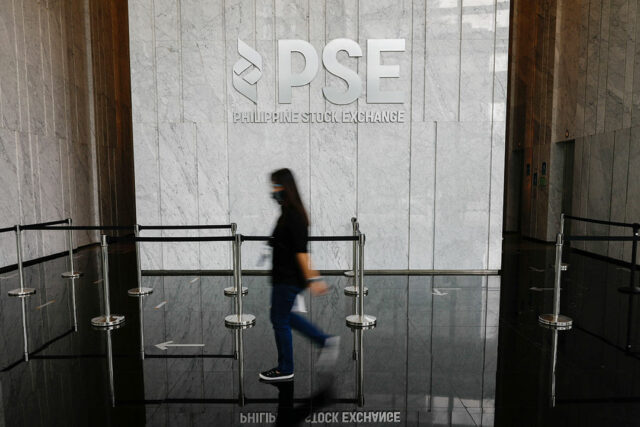
The lobby of the Philippine Stock Exchange in Taguig City, Sept. 30, 2020. — REUTERS

THE MAIN INDEX sank to an over four-month low on Monday as the war in the Middle East escalated further, worsening market worries over the economic fallout from the conflict.

The benchmark Philippine Stock Exchange index (PSEi) fell by 1.73% or 103.34 points to close at 5,869.49, while the broader all shares index went down by 1.19% or 40.01 points to end at 3,295.85.

This was the PSEi’s worst close so far this year and is its lowest finish since it ended at 5,813.71 on Nov. 19.

“The Philippine market opened the week lower as the Middle East war entered its fifth week, the conflict continued to escalate despite ongoing efforts to reach a diplomatic resolution,” Regina Capital Development Corp. Head of Sales Luis A. Limlingan said in a Viber message.

“The prolonged tensions have continued to weigh on market risk appetite, as both geopolitical and economic factors persistently dampen investor sentiment. External uncertainties and macroeconomic pressures continue to drive cautious trading behavior across markets.”

Philstocks Financial, Inc. Research Manager Japhet Louis O. Tantiangco said in a Viber message that the market kicked off the shortened trading week on a sour note amid fading hopes of a de-escalation in the conflict. “Global oil prices remain elevated while the peso depreciates, further keeping worries over the Philippines’ inflation outlook high.”

The Israeli military said on Monday that Iran launched multiple waves of missiles at Israel, and an attack had also been launched from Yemen for only the second time since the US-Israeli war began, Reuters reported.

The latest attacks came a day after President Donald J. Trump said the US and Iran had been meeting “directly and indirectly” and that Iran’s new leaders have been “very reasonable,” as more US troops arrived in the region.

Stocks slumped in Asia on Monday as investors dug in for a protracted conflict, bringing a spike in inflation and the risk of recession to much of the globe.

Meanwhile, oil prices looked poised to extend their gains. Brent crude futures jumped $2.43, or 2.16%, to $115 a barrel by 0342 GMT after settling 4.2% higher on Friday.

Majority of sectoral indices closed lower on Monday. Financials slid by 3.25% or 61.41 points to 1,827.44; mining and oil sank by 2.41% or 380.76 points to 15,380.12; holding firms dropped by 2.30% or 106.29 points to 4,515.32; property retreated by 1.89% or 37.36 points to 1,936.23; and industrials went down by 0.97% or 86.26 points to 8,749.35.

Meanwhile, services edged up by 0.03% or 0.83 point to 2,719.12.

Decliners outnumbered advancers, 126 to 74, while 60 names closed unchanged.

Value turnover went down to P8.29 billion on Monday with 746.28 million shares traded from the P8.95 billion with 2.47 billion issues that changed hands on Friday.

Net foreign selling ballooned to P1.55 billion from the P95.54 million in the previous session. — A.G.C. Magno with Reuters

Beermen tap seven-footer Patton versus win-less guest team Macau

JUSTIN PATTON — FIBA.BASKETBALL

Games on Tuesday
(Ninoy Aquino Stadium)
5:15 p.m. – Rain or Shine vs Blackwater
7:30 p.m. – San Miguel vs Macau

AFTER its 26-point beatdown from Bol Bol-led TNT, San Miguel Beermen (SMB) decided to bring a seven-footer and NBA-caliber import for itself moving forward.

The Beermen tapped Justin Patton, a 7-foot-1 center and 2017 NBA Draft first-round selection with stints with Minnesota, Philadelphia, Oklahoma City and Houston, to take over from Marcus Lee in the ongoing PBA Commissioner’s Cup.

Mr. Patton was activated in time for the Beermen’s Holy Tuesday duel with winless guest team Macau at the Ninoy Aquino Stadium.

With the 6-foot-11 Mr. Lee in tow, the reigning Philippine Cup kingpin limped to a woeful 1-2 start. Following a meager four-point output on SMB’s 112-119 loss to Titan and 10 in the 103-99 bounceback win over Converge, Mr. Lee turned in a 30-14 game against Mr. Bol but the squad badly lost, 92-118, prompting the switch.

The 28-year-old Mr. Patton makes his PBA debut against the Black Knights (0-4) at 7:30 p.m., looking to give the Beermen the W before the league goes on a Lenten break.

Meanwhile, Rain or Shine (ROS) (3-0) is determine on keeping its spotless mark and solo leader status as it battles upset-conscious Blackwater (1-2) in the 5:15 p.m. curtain raiser.

The Elasto Painters have overcome tremendous adversities on their way to the summit, especially in hard-earned wins against TNT and Meralco.

Import Jaylen Johnson was thrown out for fighting in the last six minutes against the Tropang 5G but Yeng Guiao’s gritty charges still pulled through, 112-109. Then with Mr. Johnson serving his one-game suspension against the full-powered Bolts, the E-Painters rose to the challenge and prevailed, 109-102.

Mr. Johnson returns to active duty on Tuesday, plugging a big hole in the ROS arsenal as it braces for Robert Upshaw, the 7-foot Bossing import whose 35-14 game last time around helped them post a 97-91 stunner over Magnolia. — Olmin Leyba

Sinner beats Lehecka in rain-hit Miami finale to capture ‘Sunshine Double’

JANNIK SINNER — FACEBOOK.COM/MIAMIOPENTENNIS

JANNIK SINNER beat Czech Jiri Lehecka, 6-4 6-4, in a rain-hit Miami Open final on Sunday to become the first man to complete the coveted “Sunshine Double” without dropping a set.

The Italian world number two won 92% of his first-serve points and saved all three break points he faced en route to a victory that extended his string of Masters 1000 matches without dropping a set to 17.

“We did a lot of work to be in this position, so I’m really, really happy, and I’m also happy to go back home now,” Sinner said after the match.

“Making the Sunshine Double here for the first time, it’s incredible. It’s something I would have never thought, because it’s also difficult to achieve, and yeah, we made it somehow, so I’m very happy.”

Sinner, who played around with a soccer ball ahead of a match that was delayed by about 90 minutes due to rain, broke early for a 3-1 lead and then leaned on his serve to close out the opening set with a hold at love.

The rain returned during the opening game of the second set, forcing players off the court for about 90 minutes, during which Sinner again kept loose with a soccer ball that he passed around with members of his team.

World number 22 Lehecka, playing in his first Masters 1000 final, fought off five break points over a pair of service games in the second set followed by a hold at love to go 4-3 up before Sinner took over.

Sinner made good on his sixth break point opportunity of the second set to pull ahead, 5-4, and then closed it out on his serve when he sent a forehand volley to the open court on his first championship point.

Sinner is the first man since Roger Federer in 2017 to win the Indian Wells and Miami titles back-to-back, a feat known as the “Sunshine Double” given the tournaments’ respective locations in California and Florida.

By doing so, Sinner joins a club that, in addition to Federer, also includes Novak Djokovic, Andre Agassi, Marcelo Rios, Pete Sampras, Michael Chang and Jim Courier. — Reuters

Pinoy booters eye Asia Cup ticket against Tajikistan in AC Qualifiers

PHILIPPINEMENSNATIONALFOOTBALLTEAM

Match on Tuesday
(Hisor Stadium, Tajikistan)
10 p.m. (Manila Time) – Tajikistan vs Philippines

THE 2027 AFC Asian Cup (AC) is within sight and the Philippine men’s football team is bent on reaching it.

The Pinoy booters go all out against an equally determined Tajikistan side on Tuesday night at the latter’s home turf, Hisor Stadium, as they dispute a coveted ticket to the Continental meet at the conclusion of the AC Qualifiers.

The Tajiks and the Filipinos are level on points atop Group A with 13 markers on four wins and one draw going to the last window. But with the hosts enjoying the edge on goal difference, +11 against +10, coach Carles Cuadrat’s charges would need a victory, nothing less, in the 10 p.m. match (Manila time) to advance.

“We will approach the match against Tajikistan with the intention of securing three points and qualifying for the next AFC Cup,” said Mr. Cuadrat after concluding their training camp in Turkey for this virtual KO gig on the road.

The Philippines and Tajikistan battled to a 2-2 draw in the first leg over in Clark and for the Tajiks, a similar stalemate in the return leg would be enough to send them through as Group A winner.

As it embarks on the mission to return to the Asian Cup after its maiden appearance in 2019, the Philippines assembled a crack crew led by Fil-German winger Raphael Obermair from Bundesliga club Paderborn 07 and 2019 campaigners Daisuke Sato, Manny Ott and Kevin Mendoza.

Veterans Amani Aguinaldo and Patrick Deyto and regulars like Bjorn Kristensen, Sandro Reyes, Zico Bailey and Jarvey Gayoso are also on board. — Olmin Leyba

Shai Gilgeous-Alexander, Oklahoma City Thunder make late run, hold off New York Knicks, 111-100

SHAI GILGEOUS-ALEXANDER scored 30 points to lead the Oklahoma City Thunder to a 111-100 home win over the New York Knicks on Sunday night.

The Thunder (59-16) have won 14 of their last 15 and moved 2 1/2 games ahead of San Antonio for the top spot in the Western Conference.

Oklahoma City led by 11 early in the fourth quarter after a 10-3 run.

But the Knicks cut the deficit to 92-91 with a 13-3 run of their own.

After Alex Caruso’s 3-pointer for Oklahoma City with 6:20 remaining, Gilgeous-Alexander scored the Thunder’s next nine points to help them stretch out the lead.

Gilgeous-Alexander has now scored 20 or more points in 135 consecutive games, extending his NBA record.

Oklahoma City guard Jalen Williams scored 22 points on 7-of-11 shooting in more than 28 minutes, his most minutes since Jan. 15 and most points in the four games since returning from a hamstring injury.

Jalen Brunson led New York (48-27) with 32 points.

The Knicks trailed for almost the entire first half and were tied three times before taking their only lead in the third quarter.

New York stayed in the game with their 3-point shooting, going 11 of 24 beyond the arc in the first half while Oklahoma City was just three of 12.

Late in the third quarter, Knicks coach Mike Brown was called for a technical foul after arguing that the Thunder’s Cason Wallace should’ve been called for a foul after defending Brunson’s shot.

Wallace was fouled on the other end by Josh Hart.

It was the second technical foul of the season on Brown, with the other coming March 4 in New York’s 103-100 home loss to the Thunder.

In that earlier game, Brown was frustrated by a no-call on what he felt was an offensive foul by Gilgeous-Alexander.

On Sunday, Gilgeous-Alexander was 13 of 16 from the free-throw line, as Oklahoma City attempted 38 free throws to New York’s 17.

Hart, Karl-Anthony Towns and Mikal Bridges had 15 points each for the Knicks and Towns added 18 rebounds.

In the first minute of the second half, Towns’ elbow caught Oklahoma City’s Chet Holmgren, leading to a flagrant foul call.

The Knicks have dropped back-to-back games after winning seven consecutive. — Reuters

Hyo Joo Kim wins Ford title, beats Nelly Korda for second straight week

HYO JOO KIM won for the second straight week on the LPGA Tour — and for the second straight week, she fended off Nelly Korda to do so.

The native of South Korea posted a final-round, 3-under-par 69 to finish 28-under 260 and successfully defend her title at the Ford Championship on Sunday in Chandler, Arizona.

Kim alternated 61s and 69s over the four days at Whirlwind Golf Club’s Cattail Course. A double-bogey 6 on the eighth hole and a bogey at the par-4 16th weren’t enough to stop Kim, who posted three birdies on each side of her card.

Kim set the LPGA’s 54-hole scoring record on Saturday but came up three shots shy of tying the tour’s 72-hole scoring record of 257 (Sei Young Kim, 2017).

World No. 2 Korda made two eagles in her round of 67 — at the par-5 second and 17th holes — but settled for runner-up again at 26 under. Last week, Kim edged Korda by one shot at the Fortinet Founders Cup.

Korda followed her second eagle with a birdie at No. 18 for a late push, but Kim made her par to cement the two-stroke win.

Kim, 30, has called Korda her favorite player and praised her playing partner after the battle.

Minami Katsu of Japan posted a 65 and placed third at 23 under. New Zealand’s Lydia Ko, who opened the tournament with a 60, shot 68 on Sunday and settled for fourth at 20 under.

In Gee Chun of South Korea (68) rounded out the top five at 19 under. — Reuters

No. 2 UConn stuns No. 1 Duke on Braylon Mullins’ last-second heave

WASHINGTON — UConn’s Braylon Mullins missed his first four 3-point attempts on Sunday. On his fifth, the freshman sank one of the all-time great shots in NCAA Tournament history.

Mullins nailed a 35-footer with 0.4 seconds remaining, and No. 2 seed UConn completed a miraculous 19-point comeback to defeat No. 1 Duke, 73-72, and reach its third final four in four years.

“Yeah, still a loss of words. Still processing all of what just happened,” Mullins said. “Man, I’m just happy that was the one that went down tonight.”

Mullins’ heave marked the only time UConn (33-5) led in the East Region final since 2-0. It came after opting not to foul on a Duke inbound play with 10 seconds remaining.

The Blue Devils (35-3) neared halfcourt before Silas Demary, Jr. deflected Cayden Boozer’s pass and Alex Karaban fed Mullins, who squared his feet and let fly.

Now Mullins is returning to Indiana for a final four, a year after he earned McDonald’s All-America honors there with Greenfield-Central High School.

Tarris Reed, Jr. scored 26 points and finished a rebound shy of his third tournament double-double to keep the Huskies in it while they struggled from beyond the arc.

UConn finished 5 of 23 there (21.7%) after hitting just one of their first 18, yet still snapped the nation’s longest active winning streak at 14 games.

Demary finished with 11 points, and Solo Ball and Mullins each had 10 as UConn remained alive for a third national title under UConn coach Dan Hurley and seventh overall.

“It’s been a season where we’ve been dealt with injuries to key players at critical points of the year that we’ve had to overcome, and we’ve had to show a lot of fortitude and resilience and just kind of claw our way through the season,” Hurley said. “Thought just the game was a microcosm of that. We fought, we clawed, put ourselves in position to take advantage of a mistake that they made.”

The Huskies will face No. 3 seed Illinois, which eliminated No. 9 Iowa, 71-59, on Saturday in the South Region final, in Saturday’s early game.

Cameron Boozer scored 27 points and grabbed eight rebounds in what is likely his final collegiate game, with the Naismith Award favorite likely to be an NBA draft lottery selection in June.

His freshman twin Cayden finished with 15 points and six assists before committing the fatal turnover — one of eight after halftime — and Dame Sarr had 10 points.

Coach Jon Scheyer finished a game shy of back-to-back final four appearances in his fourth season as Mike Krzyzewski’s successor.

Karaban keyed a game-winning 8-2 stretch by sinking his only 3 of the contest — after averaging 22 points in his first three tournament games — with 50 seconds left for a 70-69 deficit.

Cameron Boozer pushed Duke up 72-69 on a basket, then Demary sank one of two free throws when Duke fouled intentionally with 10 seconds remaining.

Sarr inbounded from the baseline to Cameron Boozer, who returned the pass, then found Cayden Boozer on the left, who dribbled forward and then tried to pass over a trap.

Demary deflected it, Mullins reached it and fed Karaban on the wing. Cameron Boozer closed on Karaban, who returned the ball to Mullins.

The Huskies tackled their deficit in pieces, first cutting an early 19-point deficit to 15 by halftime, then using an 8-1 run to get within seven.

After Duke restored its lead to double figures, another 10-2 UConn run closed it to within 67-65 when Solo Ball took advantage of Isaiah Evans’ turnover, raced up the court and completed a three-point play with 3:42 left. — Reuters

Israel reports second attack from Yemen as Middle East conflict escalates

A family gathers the remaining furniture from an apartment damaged by an airstrike, amid the US-Israeli conflict with Iran, in Tehran, Iran, Mar. 12, 2026. — REUTERS

WASHINGTON/ISLAMABAD — The Israeli military said on Monday that Iran launched multiple waves of missiles at Israel, and an attack had also been launched from Yemen for only the second time since the US-Israeli war began.

It said two drones from Yemen were intercepted early Monday but gave no further details. Yemen’s Iran-backed Houthi militia entered the war on Saturday, firing missiles at Israel, escalating a conflict that has engulfed the Middle East.

Israel’s military also said the Air Force was carrying out strikes on Tehran on Monday, targeting what it described as military infrastructure.

The latest attacks came a day after President Donald J. Trump said the US and Iran had been meeting “directly and indirectly” and that Iran’s new leaders have been “very reasonable,” as more US troops arrived in the region.

Pakistan, which is acting as an intermediary between Tehran and Washington, said it was preparing to host “meaningful talks” in the coming days aimed at ending the month-long Iran war. It was not clear whether the US and Iran had agreed to attend.

“I think we’ll make a deal with them, I’m pretty sure, but it’s possible we won’t,” Mr. Trump told reporters on Sunday evening as he traveled aboard Air Force One to Washington.

Mr. Trump said he thought the US had already accomplished regime change in Tehran after strikes killed the country’s supreme leader and other top officials but said twice that their replacements seemed “reasonable.”

An initial Israeli strike on Feb. 28 killed Iran’s Supreme Leader Ayatollah Ali Khamenei, who was replaced by his son Mojtaba.

The war has spread across the Middle East, killing thousands, causing the biggest disruption ever to energy supplies and hitting the global economy.

Iran’s parliament speaker, Mohammad Baqer Qalibaf, has accused the US of sending messages about possible negotiations while at the same time planning a ground invasion.

“As long as the Americans seek Iran’s surrender, our response is that we will never accept humiliation,” he said in a message to the nation.

The US Department of Defense has dispatched thousands of troops to the Middle East, giving Mr. Trump the option of launching a ground offensive.

ISRAELI STRIKES
Israel’s military said it had launched over 140 airstrikes on central and western Iran, including Tehran, over the 24 hours to Sunday evening, hitting ballistic missile launch sites and storage facilities, among other targets.

Iranian state media reported strikes had hit Mehrabad airport and a petrochemical plant in the northern city of Tabriz.

Four weeks of intense US-Israeli bombardment has failed to silence Iran’s missile and drone batteries, with Kuwait on Monday reporting it had intercepted five drones in areas under its protection.

A chemical plant in southern Israel near the city of Beersheba was hit by a missile or missile debris on Sunday as Israel fended off multiple salvos from Iran.

Iran also continues its effective blockade of the Strait of Hormuz, which carries 20% of global oil and gas shipments, spiking oil prices and spreading economic pain around the world.

Yemen’s Iran-aligned Houthis joined the conflict on Saturday, launching their first attacks on Israel and raising the prospect they could target and block a second key shipping route, the Bab el-Mandeb Strait.

Stocks slumped in Asia on Monday as investors dug in for a protracted conflict, bringing a spike in inflation and the risk of recession to much of the globe. Japan’s Nikkei index was down more than 3%.

Meanwhile, oil prices looked poised to extend their gains, with Brent headed for a record monthly rise. Brent crude futures LCOc1 jumped $2.43, or 2.16%, to $115 a barrel by 0342 GMT after settling 4.2% higher on Friday.

Global airlines have begun to hike fares and cut capacity to cope with the surge in the oil price, but analysts warn the industry’s ability to remain profitable may depend on whether consumers pull back on flying as energy costs threaten household budgets.

MORE US TROOPS ARRIVE
Several hundred special operations personnel have arrived in the region, the New York Times reported on Sunday, citing two military officials. That comes on top of thousands of US Marines that came on Friday aboard an amphibious assault ship, the first of two contingents, the US military has said.

Reuters has reported that the Pentagon has been considering military options that could include ground forces, although Mr. Trump has not approved any of those plans, according to multiple news outlets.

In an interview with Financial Times published on Sunday, Mr. Trump said he wanted to “take the oil in Iran” and could seize the export hub of Kharg Island. Taking control of Kharg would require ground troops.

The island handles 90% of Iran’s oil exports and seizing it would give the United States the ability to severely disrupt Iran’s energy trade, placing enormous pressure on Tehran’s economy.

The majority of Americans are opposed to the war and a military escalation, which would risk a protracted crisis, would likely weigh further on Mr. Trump’s already low approval ratings ahead of November midterm elections for Congress.

Israeli Prime Minister Benjamin Netanyahu said on Sunday he had ordered the military to further expand its operations in southern Lebanon, citing continued rocket fire by Iran-backed Hezbollah militia.

Israel has said it will seize a chunk of southern Lebanon to create a “buffer zone” against Hezbollah, stoking fears among Lebanese of Israeli military occupation that could deepen instability and stoke further displacement. Reuters

WTO talks end in deadlock after Brazil blocks deal on e-commerce duties

WORLD TRADE ORGANIZATION

YAOUNDE — World Trade Organization (WTO) talks ended deadlocked early on Monday as Brazil blocked a bid by the US and other countries to extend a moratorium on customs duties for electronic transmissions, dealing a fresh blow to the embattled trade body.

WTO Director-General Ngozi Okonjo-Iweala said the e-commerce moratorium had expired, meaning countries could apply duties on electronic goods such as digital downloads and streaming. But she said the WTO hoped to be able to restore the moratorium and that Brazil and the US were trying to reach agreement on it.

“They need more time and we didn’t have the time here,” she said.

Expectations had been low going into the meeting, but failure to even agree an extension to the e-commerce moratorium was a serious setback to the WTO, which has been struggling to remain relevant as countries increasingly work around it.

The marathon talks at the meeting in Cameroon did make progress on drafting a plan for broader reform of the organization, though agreements are still pending.

WTO talks would continue in Geneva, said the conference chair, Cameroon Trade Minister Luc Magloire Mbarga Atangana. They are expected to be in May, WTO officials said.

Failure to reach a collective decision in Yaounde was a “major setback for global trade,” said Britain’s Business and Trade Secretary Peter Kyle.

The talks were seen as a test for the WTO’s relevance after a year of trade turmoil and major disruptions due to the Iran war. But ministers could not agree to extend the moratorium more than two years following objections from Brazil, diplomats said.

US WANTED PERMANENT EXTENSION
Diplomats worked throughout Sunday to close the gap between Brazil, which had originally sought a two-year extension, and the US, which wanted a permanent one, by drafting a proposal for a four-year extension with a one-year sunset buffer, concluding in 2031.

Brazil later proposed a four-year extension, with a review clause halfway through, but that was not supported, diplomats told Reuters.

Developing countries have opposed a lengthy extension, arguing that the moratorium denies them potential tax revenue that they could invest back into their countries.

A US official said Brazil had opposed a “near-consensus document,” adding: “It’s not US versus Brazil. It’s Brazil and Turkey versus 164 members.”

Meanwhile a Brazilian diplomat said “the US wanted the sky,” and that Brazil wanted to be prudent in renewing the moratorium by only two years as in previous ministerial conferences, given rapid changes to digital trade.

Another diplomat present said that US Trade Representative Jamieson Greer made delegates “uncomfortable” as he suggested there “would be consequences,” if the US did not get a long-term moratorium extension.

Business leaders lamented the outcome of the talks, with International Chamber of Commerce Secretary General John Denton saying it was “particularly concerning at a time of real strain on the global economy.”

John Bescec, Microsoft’s director of customs and trade affairs, said: “Business was expecting more certainty and predictability… Instead, we got the exact opposite.”

Getting a deal on the e-commerce moratorium was seen as key to securing support for the WTO from the US, which under President Donald J. Trump has retreated from global multilateral institutions.

DRAFT REFORM PLAN EMERGING
A draft of a reform roadmap, seen by Reuters, that provided a timeline for progress and sets out the key issues to address was close to being agreed in Cameroon, diplomats said, before the talks ran out of time.

Discussions will continue in Geneva on improving decision making in a consensus-based system that has long been stymied by a few countries, and the trade benefits extended to developing countries.

The reform debate comes amid efforts to rework WTO rules to render subsidy use more transparent and make decision making easier. The US and European Union argue China in particular has taken advantage of current rules to their detriment. Reuters

Myanmar junta chief nominated for presidential vote as transition looms

Myanmar's military leader Senior General Min Aung Hlaing participates in a parade commemorating the 81st Armed Forces Day in Naypyidaw, Myanmar, March 27, 2026. — REUTERS/STRINGER/FILE PHOTO

MYANMAR junta chief Min Aung Hlaing was nominated by a lawmaker on Monday for a parliamentary vote that will select the new president of the war-torn Southeast Asian nation, as the powerful general seeks a political role.

Mr. Min Aung Hlaing, who has led Myanmar’s military since 2011, was one of two people named as vice-presidential candidates by lawmakers from the country’s newly convened lower house of parliament.

The country’s upper house will also nominate a vice-presidential candidate, with both houses to select a president from the three in a later vote. The date for that vote has not been announced.

“Senior General Min Aung Hlaing is proposed as a vice-presidential candidate,” Kyaw Kway Htay, a lawmaker from a military-aligned party, said on the floor of the lower house of parliament, according to a live broadcast of proceedings on state media.

The move follows a controversial election held amid raging conflict in December and January, won by the military-backed Union Solidarity and Development Party but widely derided as a sham by the United Nations and many Western countries.

Myanmar has been gripped by violence since a 2021 coup, in which the military, also known as the Tatmadaw, unseated the democratically elected government of Nobel Peace Prize winner Aung San Suu Kyi.

LONGSTANDING GOAL
Under the country’s military-drafted 2008 Constitution, analysts say that presidential candidates cannot be active-duty military personnel or civil servants at the time of their nomination.

In a rare public signaling of transition by the military that has dominated Myanmar for decades, Mr. Min Aung Hlaing’s deputy said last week that the secretive institution’s leadership was set for a reshuffle.

“This has been Min Aung Hlaing’s goal all along,” said independent analyst Htin Kyaw Aye, pointing to the general’s potential presidential role.

“It’s just a shift from ruling as a military leader to ruling as president.”

Born to a family from Myanmar’s south, Mr. Min Aung Hlaing studied law before entering the military and rising steadily through the ranks, culminating in his promotion to military chief in 2011.

A rigid military leader and considered a ruthless operator, Mr. Min Aung Hlaing has also relied on a finely tuned ability to manage the country’s elites, using tactics that include handing important positions to loyalists and punishing political rivals, Reuters has reported. Reuters

ADVERTISEMENT
ADVERTISEMENT