Home Blog Page 868

Yuchengco firm secures P498-M loan for Nueva Ecija solar project

STOCK PHOTO | Image from Freepik

SAN JOSE Green Energy Corp. (SJGEC) has secured a P498-million term loan facility from Rizal Commercial Banking Corp. (RCBC) to partly finance the development of its 19.6-megawatt direct current (MWdc) solar power project in Nueva Ecija.

In a statement on Monday, SJGEC said it signed an omnibus loan and security agreement with RCBC as the lender for the San Jose Solar Power Project.

RCBC Capital Corp. acted as lead arranger, while RCBC Trust Corp. served as facility agent and security trustee.

SJGEC is a subsidiary of Rizal Green Energy Corp. (RGEC), a joint venture between Yuchengco-led PetroGreen Energy Corp. (PGEC) and Japan-based TAISEI Corp. PGEC is the renewable energy arm of listed firm PetroEnergy Resources Corp. (PERC).

RGEC’s project portfolio includes the 27-megawatt-peak (MWp) Dagohoy solar project in Bohol, the 25-MWp Bugallon solar project in Pangasinan, and the 40-MWp Limbauan solar project in Isabela.

The company said the San Jose Solar Power Project is in the final stages of securing regulatory approvals ahead of its targeted commercial operations in the third quarter.

The facility is PGEC’s eighth utility-scale renewable energy project and is expected to generate an average of 27 gigawatt-hours annually, offsetting at least 18,900 metric tons of carbon dioxide emissions per year.

“This milestone underscores the shared commitment of PGEC and RCBC, both Yuchengco Group of Companies (YGC) members, in increasing the country’s power supply, advancing sustainable energy, and fostering a greener future for the Philippines,” the company said.

PERC is targeting to expand its generation capacity to 500 MW by 2029 from the current 145 MW. — Sheldeen Joy Talavera

F1 movie could not have been made without Hamilton, says director

Brad Pitt in F1: The Movie (2025) — IMDB

MONTREAL — Brad Pitt’s soon-to-be-released Formula One movie could not have been made without Lewis Hamilton, director Joseph Kosinski said on Friday.

The Apple Original film F1, with action scenes filmed at race weekends with the Liberty Media-owned sport’s cooperation, is due in cinemas and IMAX internationally on June 25 (including the Philippines where it has been rated PG by the MTRCB), and in North America on June 27.

Mr. Kosinski told reporters after an advance showing at the Canadian Grand Prix that the involvement of Mr. Hamilton, who joined Ferrari this season after winning six of his seven titles at Mercedes, had been key.

The 40-year-old Briton is credited as a co-producer while his Dawn Apollo production company was also involved.

Mr. Kosinski, who directed the hit Top Gun: Maverick, explained how Mr. Hamilton was the first person he reached out to with the idea of a movie.

“I sent him an e-mail and just said ‘I want to tell the story in your world. I want to make it as authentic as possible. Will you help me?’” he said.

“And luckily Lewis said yes… He had actually talked to me earlier about playing a role in Top Gun: Maverick. So that’s how I knew Lewis.”

Mr. Hamilton, who had to turn down a part in that Tom Cruise film because of his racing commitments, acted as go-between with Formula One and as a consultant advising on technical accuracy and authenticity.

He was also a driver advisor to Mr. Pitt and co-star Damson Idris.

“At Hungary for instance, he said, ‘If Brad’s going to let someone pass during a blue flag and he wants it to be as tight as possible, he’s going to only do that at turn six,’” recalled Mr. Kosinski.

“That kind of detail… from a seven-time world champion who lives and breathes this world every day, I couldn’t have gotten that from anywhere else.”

Mr. Hamilton also contributed to the story and served as an inspiration for one scene where Mr. Pitt’s character talks about why he races in spiritual terms.

“So his involvement has been amazing. We couldn’t make the film without him.”

Producer Jerry Bruckheimer referred to Mr. Hamilton’s insistence on authenticity also in the sound of the film, citing an example at Silverstone where the Briton had pointed out a corner was taken in second gear but the audio was of fourth gear.

“It’s that kind of detail that went into this,” he said.

Mr. Hamilton has said Mr. Pitt’s speed is real and the movie will be the most authentic racing film yet.

Formula One is hoping the movie cements the appeal of the Netflix docu-series Drive to Survive that has boosted Formula One’s popularity and growth worldwide particularly in the key US market.

“I think there’s this perception that Drive to Survive turned America onto F1 but I think there’s just so many more people out there that don’t know anything about it,” said Mr. Kosinski.

“So there’s a lot of potential still there.” — Reuters

Navigating the digital revolution: Trust and innovation in the Philippines

STOCK PHOTO | Image by vectorjuice from Freepik

As the Philippines accelerates its digital transformation journey, the integration of artificial intelligence (AI) and robust cybersecurity measures has become paramount. These technologies present unprecedented opportunities to drive economic growth, improve services, and make everyday life better for Filipinos. However, they also bring new challenges that require careful navigation to build trust and ensure sustainable progress.

A recent global study conducted by KPMG and the University of Melbourne, “Trust, Attitudes and Use of Artificial Intelligence: A Global Study 2025,” reveals a complex relationship between AI adoption and trust. Surveying over 48,000 individuals across 47 countries, the research found that while 66% of respondents use AI regularly, only 46% actually trust it. Furthermore, although 83% believe AI will deliver wide-ranging benefits in the future, many express concerns regarding misinformation, job displacement, and data privacy.

In the workplace, the survey uncovered a troubling trend. Sixty-six percent of respondents rely on AI-generated outputs without verifying their accuracy, and 56% have encountered AI-related errors. Even more alarming, 48% admitted uploading sensitive company data into public AI tools, exposing significant data security risks. These findings underscore the urgent need for AI literacy and robust governance frameworks that promote responsible and secure AI use.

As digital transformation expands, cybersecurity emerges as a critical pillar in maintaining stakeholder trust. Insights from KPMG’s Cybersecurity Considerations 2025 report for the Technology, Media, and Telecommunications (TMT) sector emphasize that embedding trust into AI systems, designing for resilience, and securing cloud environments and supply chains are top priorities for organizations navigating today’s complex digital landscape. Although the report focuses primarily on the TMT sector, its recommendations resonate across industries.

One of the most important shifts recommended is moving from siloed cybersecurity functions toward integrated, organization-wide security strategies. Embedding security into every product, service, and process from the earliest stages of development helps reduce risk and fosters a culture of security awareness throughout organizations. This shift-left approach encourages proactive risk mitigation rather than reactive firefighting. Additionally, with businesses increasingly relying on complex supply chains and third-party vendors, modernizing supply chain security is vital to address vulnerabilities and improve overall operational resilience.

In the Philippines, the digital landscape is evolving rapidly, with AI and digital technologies playing a pivotal role in the country’s economic development. Yet, the challenges highlighted in global studies are also deeply felt locally. To harness the full potential of digital transformation, organizations must prioritize building trust through transparency, education, and strong governance. Investing in AI literacy programs tailored to the Filipino workforce will empower employees to use AI tools responsibly and effectively. At the same time, clear policies on data usage and AI application must be developed and enforced to protect sensitive information and maintain stakeholder confidence.

Strengthening cybersecurity across all sectors is equally critical to support inclusive growth. This requires not only deploying the right technologies but also building the right capabilities, from risk assessment and threat detection to incident response and recovery. Cybersecurity should no longer be viewed solely as an IT concern. It must be a core component of business strategy and public trust.

Building this trusted digital future calls for broad collaboration. Business organizations, like the Management Association of the Philippines (MAP), play an essential role by fostering connections among industry leaders, government agencies, and startups. Through initiatives, such as the upcoming MAP x KPMG Technology Summit on June 17 at Shangri-La The Fort, MAP and R.G. Manabat & Co. (KPMG in the Philippines) are creating vital platforms for dialogue and shared learning. The Summit will cover key topics, including digital transformation, lessons from past failures, cybersecurity, data privacy, and innovation.

The Summit will also highlight and celebrate promising new ideas through the awarding of the KPMG in the Philippines Academic Innovation Challenge winner, recognizing outstanding student innovations, and the Global Tech Innovator (GTI) Competition in the Philippines winner, which honors exceptional technology-driven enterprises. These initiatives demonstrate that nurturing talent and fostering innovation are essential to building a resilient and trusted digital economy. By spotlighting bright minds and emerging businesses, we encourage a culture where creativity and responsible technology deployment drive the nation forward.

Policymakers must also enact comprehensive regulations that address the ethical and practical dimensions of AI and cybersecurity. Educational institutions are equally critical, preparing a digitally literate workforce by embedding AI and cybersecurity topics into curricula and offering specialized training programs. Meanwhile, professional organizations and industry associations have opportunities to raise awareness, set standards, and bridge gaps between technology adoption and understanding through forums, joint initiatives, and public education campaigns.

The path to a digitally transformed Philippines holds immense promise but also demands vigilance and responsibility. By addressing trust in AI and reinforcing cybersecurity frameworks, our nation can build a resilient digital infrastructure that fosters inclusive and sustainable growth. Through collective effort and thoughtful leadership, the Philippines can navigate the complexities of the digital age and emerge as a regional leader in responsible innovation.


Jallain Marcel S. Manrique is co-vice chair of the MAP Technology Committee. He is partner head of Technology Consulting of KPMG R.G. Manabat & Co.

map@map.org.ph

jsmanrique@kpmg.com

Cashalo secures $75-million loan facility to expand products, boost credit access

FACEBOOK.COM/CASHALOPH

DIGITAL financial services provider Cashalo has secured a loan facility of up to $75 million from global private investment firm Community Investment Management LLC (CIM) to support its expansion in the Philippines.

The loan facility will support Cashalo’s goal to expand underserved Filipinos’ access to credit, it said in a statement on Monday.

It added that it will use the fresh funding to invest in its core business of digital lending and expand its product offerings.

“This partnership will enable us to accelerate our mission to expand financial inclusion and social mobility throughout the Philippines,” Cashalo President Luke Stidham said. “With CIM’s backing, we have an incredible opportunity to uplift even more Filipino communities by scaling our impact and ensuring more Filipinos are included in the financial system.”

“We’re proud to support Cashalo’s mission in the Philippines. Their data-driven approach, commitment to transparency, and inclusive strategy reflect the future of responsible digital lending,” Bernhard Eikenberg, CIM partner for emerging markets strategy, said.

Cashalo has a customer base of eight million and provides credit services via its mobile app. It is operated by Paloo Financing, Inc., which is registered with the Securities and Exchange Commission as a financing company.

Cashalo has granted almost five million loans to Filipinos to date, it said.

It recently marked its first anniversary as part of US-based financial technology (fintech) company Empower Finance, Inc., also rolling out a refreshed brand identity to mark its new chapter.

“In the past year, Cashalo has significantly expanded its digital lending capabilities, improving customer experiences and increasing opportunities for financial inclusion across the country,” it said.

“We look forward to continuing our investments in the Philippines to drive financial inclusion,” said Warren Hogarth, co-founder and chief executive officer of Empower Finance. “Cashalo is uniquely positioned to lead the way in delivering scalable, data-driven credit solutions that truly make a difference in people’s lives.” — A.R.A. Inosante

Entertainment News (06/17/25)


Kate Torralba to perform at MUSICMEX

FILIPINO singer-songwriter and multidisciplinary artist Kate Torralba will be representing the Philippines at the first edition of MUSICMEX, a premier music showcase festival dedicated to fostering collaborations, cultural exchanges, and business opportunities in music. The event will take place in Mexico City, Mexico with Ms. Torralba performing on June 19 at Jardin Jacarandas.


Indian Embassy holds International Day of Yoga

BECAUSE June 21 is the International Day of Yoga (IDY) as decreed by the United Nations in 2014, the Embassy of India will be holding a yoga session at the sports complex of the University of Perpetual Help System DALTA in Las Pinas City on that date, from 8 to 10 a.m. The event aims to spread more awareness on the universal message of yoga, which integrates the mind, body, and soul. At the event, participants will practice a one-hour yoga session led by yoga experts. It is open for registration via the embassy’s pages.


Everyone’s KPOP Manila at Robinsons Galleria

THERE will be a celebration of K-pop at Robinsons Galleria in Ortigas on June 21. Visitors can look forward to interactive fan booths and K-variety show-inspired games, a K-POP Cover Dance Festival, and special performances from guest P-pop groups. It is open to all. This is a project of the Korean Cultural Center in the Philippines and Seoul Shinmun, in partnership with the Korea Copyright Protection Agency – Manila Office and Philippine K-pop Convention Inc.


Visually impaired director makes short film on PWDs

THE short film Ballad of a Blind Man, written and directed by award-winning filmmaker Charlie Vitug, can now be viewed online. It explores themes of abuse, feminism, and emancipation through the story of a demure and loving daughter named Bea, who cares for her ailing and overbearing blind father. The piece premiered during the Manila Film Festival 2024 as a nominee for Best Cinematography. Ballad of a Blind Man is available on youtube.com/@charlievitugproductions.


Saxophonist Kenny G live in Manila

IT WILL BE a night of smooth jazz when saxophonist Kenny G takes the stage at Cubao’s New Frontier Theater on July 15, 8 p.m. He will be performing timeless classics, from the romantic strains of “Songbird” to the heartfelt notes of “Forever in Love.” His hit track “Going Home” will be part of the setlist, an unofficial national closing tune for businesses across China. Tickets, priced from P5,500 to P12,000, are on sale via ticketnet.com.ph.


HoYo FEST 2025 brings games to life

THE official fan celebration of HoYoVerse, the global gaming company behind popular titles like Genshin Impact, Honkai Impact 3, Honkai: Star Rail, and Zenless Zone Zero, will run from July 24 to 27 at the SMX Convention Center in Mall of Asia, Pasay City. This year’s event will include additions like the Artist Alley, a space where local creators can sell fan-made HoYoVerse-inspired merchandise, and a stage segment featuring live performances from cosplayers, musicians, and fan artists. Tickets go on sale starting June 24 via the official HoYo FEST website, https://hoyo.link/wqjjLntrY.


ATEEZ returns with GOLDEN HOUR: Part.3

AWARD-WINNING Korean all-star group ATEEZ is back with their 12th EP, GOLDEN HOUR: Part.3, released ahead of their upcoming In Your Fantasy world tour. The record aims to capture the “fevered energy of a summer night — a fleeting burst of freedom and escape that quenches a deep, almost insatiable thirst.” It is out now on all digital music streaming platforms.


Ju Ji Hoon to attend Manila fan meet

SOUTH KOREAN actor Ju Ji Hoon is coming to Manila for the first time for his 2025 Asia Tour Fan Meeting, JUNIVERSE. It will be held on Aug. 2 at the Newport Performing Arts Theater, Pasay City. Known for performances in K-Dramas and movies like Princess Hours, The Devil, Hyena, Kingdom, and Along With the Gods, Mr. Ju will be interacting with fans for the event. Tickets go on sale on June 21 via SMTickets.com and SM Tickets outlets. It is presented by Wilbros Live.

Who really holds the rights to trees and carbon in the Philippines?

STOCK PHOTO | Image from Freepik

By Angela Arnante

THE PHILIPPINES sits on a goldmine of forest and carbon wealth. But an unclear and short-sighted property rights regime is choking its potential; existing rules are partially to be blamed.

Forest lands, which are State-owned lands, span 15.8 million hectares or half of the country’s total land area. The 1987 Constitution states that all lands of the public domain, forest lands included, belong to the State. It can either manage them directly or partner with private entities, as long as Filipino citizens own at least 60% of the company involved and these agreements last 25 years, renewable for another 25. This legal framework along with existing policies, designed to regulate the exploitation of natural resources like mining and logging, now constrains investment in regenerative and non-extractive activities such as reforestation and carbon sequestration.

SHORT-TERM TENURE STIFLES LONG-TERM INVESTMENTS
The current tenure framework on forest lands does not match the biological and economic realities of forest and carbon development. While fast-growing trees like falcatta can be harvested in six to 15 years, high-value hardwoods such as narra, mahogany, and teak, and famous dipterocarp species like yakal and lauan take 20 to 25 years to mature just for a single-growth cycle. On top of this, renewing agreements can take anywhere from a year to even over a decade, leaving some existing investors in limbo and potential ones at bay.

A similar challenge exists for green and blue carbon projects — those that protect or restore ecosystems while capturing and storing carbon dioxide to help fight climate change and generate income through carbon credits. Whether involving tree plantations or mangrove ecosystems, these initiatives typically require project lifespans of 25 to 100 years to generate credible climate benefits and financial returns. However, legal agreements on forest lands remain capped at 25 years, renewable for another 25 years. This mismatch undermines investor confidence and reduces the bankability of carbon projects in the country.

UNCLEAR OWNERSHIP OF TREES AND CARBON
Moreover, a fundamental question remains unresolved: who owns the trees, and the carbon sequestered in forest lands? On private land, ownership is clear. On forest lands, however, it is less so.

Under the Revised Civil Code, ownership of land extends to what is attached to it. But can an exception be made for planted trees and sequestered carbon in forest lands? Can legal ownership of renewable resources be separated from land ownership?

Current forest tenure agreements generally recognize that tenure holders own the trees they plant, but this recognition is not backed by a stable legal framework. Such uncertainty dampens project sustainability. A more explicit legal separation between land, tree, and carbon rights, therefore, is needed to assure tenure holders, local communities, and investors.

Other countries offer more progressive models. In Australia and New Zealand, ownership of land, planted trees, and carbon credits can be distinct and transferable. This legal clarity enables dynamic investment flows and long-term planning — conditions that are lacking in the Philippine context.

POLICY INSTABILITY UNDERMINES SECTOR CONFIDENCE
The Philippine government has a history of implementing blanket bans as band-aid solutions to a systemic problem. Since the 1970s, the Philippine government has issued 44 different logging bans. The most far-reaching is Executive Order No. 23 (2011), which prohibits the harvesting and transport of timber from natural and residual forests. While intended to curb illegal logging and promote forest recovery, the policy inadvertently harmed legitimate tree farmers and wood processors, many of whom have ceased operations due to supply constraints. Regrettably, illegal logging persists — often at a larger scale than what regulated tenure holders could produce. A blanket, reactive approach to forest governance penalizes compliant stakeholders while failing to address systemic enforcement.

TIME FOR A PARADIGM SHIFT
A shift in perspective is essential: tree planting and carbon farming are renewable, nature-based practices and should not be regulated under the same legal framework as non-renewable resource extraction, such as mining or fossil fuel development. As environmental priorities, methodologies, and technologies evolve, so too must the legal tools used to manage natural resources.

The most direct solution would be to amend or repeal constitutional restrictions that limit the duration of tenure on forest lands. But for now, below are low-hanging policy proposals that offer promising solutions:

• Legally define carbon rights as separate from land rights, establishing who owns carbon credits and under what conditions they may be traded (Carbon Rights bill).

• Legally classify planted trees as personal property, distinct from land ownership (Tree Growing Agreement bill).

• Extend the maximum lease period of private lands for foreigners from 75 years to 99 years (amendments to the Investor’s Lease Act). This measure has already been ratified by both the House and Senate and is just awaiting the President›s signature. This bill includes agroforestry and ecological preservation as part of the activities that can be undertaken.

• Make comprehensive data on forest lands publicly accessible (Integration of forest lands in the national cadastre system).

Together, these reforms would lay the foundation for a more modern, climate-aligned system of resource governance.

Finally, there is a need to strengthen the property rights of the indigenous peoples (IPs) as private landowners who can directly enter business with either local or foreign investors. The IPs own vast hectares of land, most of them in the uplands, making them suitable for forestry and carbon-related projects. Their lands are private in nature and therefore they should not be asking for permits or clearances from the State when it comes to the utilization of natural resources in their domains. Moreover, as long-standing stewards of the land, they have safeguarded our forests for centuries, making them natural leaders in forest conservation and management.

SECURE PROPERTY RIGHTS DRIVE SUSTAINABILITY
Ultimately, tree plantation activities or carbon farming depend on a strong property rights regime. Investors, local communities, and indigenous groups need clear legal assurances that the trees they plant and the carbon they sequester can be owned, traded, and passed on.

The Philippines stands at a crossroads. It can remain bound by outdated frameworks and miss out on the opportunities of the green and blue economies — or it can enact forward-looking reforms that align the governance of resources with the demands of climate action and sustainable development.

Who owns the trees and the carbon? The answer should be just as simple: The person or community who planted and cared for them. The State’s role should be to ensure a clear and stable property rights system that supports responsible stewardship — not to impose and promulgate outdated rules designed for extractive industries on regenerative, sustainable activities.


Angela Arnante is a public policy advocate and is the assistant director of Policy and External Relations at the Foundation for Economic Freedom.


ACEN unit secures approval for 943-MW wind project in Australia

ACENRENEWABLES.COM.AU

ACEN AUSTRALIA, a subsidiary of ACEN Corp., has secured approval from the Independent Planning Commission (IPC) of New South Wales for its planned 943-megawatt (MW) wind project with a 320-MW energy storage facility.

“The approval is a significant milestone for ACEN, as we progress development of our 13-gigawatt pipeline across Australia,” ACEN Australia said in a statement last week.

The IPC approval, dated June 11, includes conditions on water sourcing, soil and water management, and a decommissioning and rehabilitation plan.

The commission also addressed concerns raised by the community and stakeholders by setting conditions related to bushfire management and the continuation of aviation activities at nearby aerodromes.

“Given the fact the project is in a relatively early cohort of projects for the Central-West Orana Renewable Energy Zone (CWO REZ), the Commission finds its cumulative impacts with those of existing and approved projects to be acceptable,” it said.

The company thanked the local community, the Warrumbungle Shire Council, and stakeholders “for their continued feedback and support throughout the development phase of the project.”

The Valley of the Winds project will consist of up to 131 wind turbines and is expected to generate enough electricity to power about 500,000 homes annually.

EnergyCo, the infrastructure planner for the state’s REZ, will develop a high-voltage transmission line to connect the project to the National Electricity Market. 

The wind project is one of 19 selected through the national tender process for Australia’s Capacity Investment Scheme (CIS). It is “the biggest project” awarded a CIS agreement to date, the company previously said.

In its application, ACEN Australia said the project involves an estimated capital investment of $1.68 billion and is expected to generate up to 400 construction-related jobs and up to 50 operational roles.

“As we progress towards the construction stage, we remain committed to ongoing consultation and engagement with the community, local businesses, and project partners,” ACEN Australia said.

ACEN, the listed energy platform of Ayala Corp., has approximately 7 GW of attributable renewable capacity in operation, under construction, and in committed projects.

The company operates across multiple markets, including the Philippines, Australia, Vietnam, India, Indonesia, Laos, and the United States. — Sheldeen Joy Talavera

Asialink gets P120-M credit line to boost lending to MSMEs

ASIALINK Finance Corp. has secured a P120-million credit line from Taiwan’s Mega International Commercial Bank Co. Ltd. (Mega ICBC) to boost lending to small businesses.

The partnership will help expand micro, small, and medium enterprises’ (MSMEs) access to financing, Asialink said in a statement.

“Our partnership with Mega ICBC is a meaningful step in widening our capacity to serve more MSMEs across the country. At the heart of this collaboration is our belief that inclusive financing leads to inclusive growth because when small businesses succeed, local economies thrive,” Asialink President and Chief Executive Officer Samuel Z. Cariño said.

The financing company said it will use the additional funding to support MSMEs, including small retailers, service providers, and transport operators, and provide them with working capital to grow their businesses, which would help lead to the creation of more jobs.

“The agreement also advances Asialink’s goal of strengthening grassroots enterprise development as a pathway toward broader and more inclusive economic growth,” it said.

The partnership is also in line with Mega ICBC’s objective of supporting organizations to help drive inclusive development.

“More than their strong growth outlook, we chose to partner with Asialink because of their clear commitment to making financial services accessible to Filipino communities. We believe in Asialink’s mission to uplift underserved entrepreneurs and are proud to support their efforts in creating a more inclusive financial ecosystem in the Philippines,” Mega ICBC Vice-President and General Manager Kuo Yao-Yu said.

In January, Asialink received a $130-million credit facility from the International Finance Corp., the private sector lending arm of the World Bank Group. In December last year, it also signed a $115-million financing package with the Asian Development Bank to expand its working capital.

Both funding packages aim to boost support for small businesses in the Philippines, particularly those owned or led by women.

Last week, Mr. Cariño said that it will release in July a loan product called the Women’s Access to Inclusive Support, which is targeted towards women entrepreneurs.

The company targets to reach P24 billion in loan releases this year, he said.

Mr. Cariño added that he is optimistic that the firm’s net income will hit P2 billion this year, up from P1.1 billion in 2024.

Asialink secured a P4-billion strategic investment from Malaysian equity firm Creador in February last year. — A.M.C. Sy

David Beckham and Gary Oldman awarded knighthoods

Gary Oldman, seen here in a scene from the 2017 film The Darkest Hour, has been knighted in King Charles’ annual birthday honors list. — IMDB

LONDON — Former England soccer captain David Beckham and actor Gary Oldman were knighted in King Charles’ annual birthday honors list on Saturday, while sculptor Antony Gormley was made a Companion of Honor.

Mr. Beckham, 50, joined Manchester United as a trainee in 1993, going on to make almost 400 appearances for the club where he won a string of titles and cups.

He subsequently played for Real Madrid, LA Galaxy, and AC Milan, as well as captaining his country 58 times and making 115 appearances.

His marriage to fashion designer and former Spice Girl Victoria Beckham in 1999 cemented a celebrity status which went far beyond his sporting exploits.

Mr. Oldman, 67, started his career on the stage, where he was a member of the Royal Shakespeare Company, before rising to prominence in film. He won the best actor Oscar for playing Winston Churchill in the 2017 drama Darkest Hour.

He also had roles in the Dark Knight Trilogy and the Harry Potter movie series and more recently starred in the TV spy drama Slow Horses.

Other famous names receiving honors included damehoods for musical theater star Elaine Paige, novelist Pat Barker, and ceramics maker Emma Bridgewater.

Roger Daltrey, lead singer of rock band the Who and a patron of the Teenage Cancer Trust, received a knighthood for services to charity.

More than 1,200 people received honors for their achievements, with a particular focus on those who had given their time to public service, the government said.

King Charles’ official birthday was celebrated with the annual “Trooping the Color” military parade in London on Saturday. His actual birthday is on Nov. 14. — Reuters

On oil price shocks and inflation, growth and wage coercion

The Israel-Iran war is now five days old, and the immediate impact is a crude oil price hike. From an average of $61-$62 per barrel from early April to early June 2025, West Texas Intermediate (WTI) crude quickly jumped to $68-$73 per barrel from June 13 onwards. The war looks like it will last for several weeks or months, so elevated world oil prices will be with us.

I checked data on the previous wars in the Middle East, the oil price hikes that followed, and the inflation rates of G7 countries and selected Asian nations at the time. China and Vietnam do not have inflation data from the 1970s so I removed them from the list.

Four periods that had oil price shocks are covered: 1.) 1974, mainly as a result of the big Yom Kippur war in October 1973, which saw Israel fighting against Egypt and Syria; 2.) 1979-1980, mainly a result of the Iran civil war, and political instability in Saudi Arabia and Syria; 3.) 1999-2000, mainly due to the Palestinian intifada vs Israel, civil wars in Indonesia, Liberia, and Yugoslavia, the First Russo-Chechen War, and the India-Pakistan war; and, 4.), 2011, which saw civil wars in Libya (when Khadaffy was toppled), Syria, Lebanon, and the Iraq insurgency.

All G7 countries experienced high inflation during those four periods except Canada in 1979-1980, and Japan in 2000 and 2011. The Philippines and other Asian nations also experienced higher inflation on those periods except in 2000 (see Table 1).

So, if the current price of $68-$73 per barrel remains for several weeks and months, the Philippines’ inflation rate can quickly jump from 1.4% in April and 1.3% in May, to 1.8-2.5% in June-July onwards. The economic team should prepare contingency measures for this possibility.

LEGISLATED WAGE HIKE AND THE ECONOMIC TEAM
See these recent reports in BusinessWorld: “House approves P200 wage hike bill” (June 5), “Labor condemns failure of minimum wage bill despite willingness to compromise on P100 hike” (June 12), “Economic managers warn wage hike bill to slash GDP growth” (June 12).

I say “bravo” to the government’s economic team — Cabinet Secretaries Frederick Go, Ralph Recto, Arsenio Balisacan, Amenah Pangandaman, and Ma. Cristina Roque — for taking a clear position about the dangers of legislated wage hike, instead of going through the regional wage negotiations.

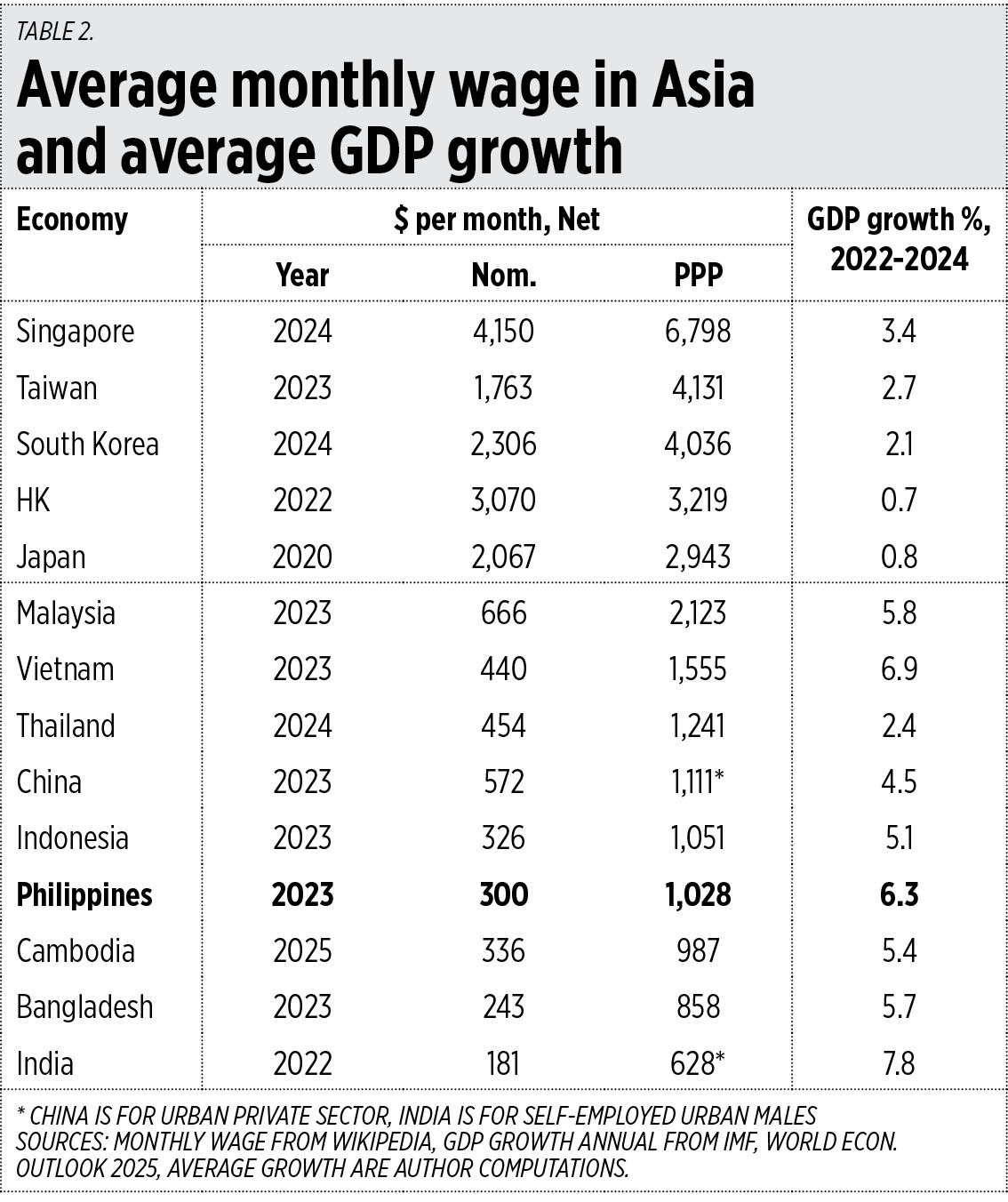
I checked recent data on wages in Asia and GDP growth over the past three years, and the simple comparison yielded a not-surprising result: economies with high wages — above $2,500/month at purchasing power parity (PPP) values — grew slowly, from 0.7% to 3.4%, while economies with lower wages — below $2,500/month — had higher average growth, from 4.5% to 7.8% with the exception of Thailand (see Table 2).

Here are six facts about wages and employment that socialist-leaning activists do not or cannot comprehend.

1. Employment in private enterprises is a private contract between employees and employers, not between employees and government or NGOs, media, and academics.

2. Wage is a function of productivity, not the number of kids a worker has, and not the number of legislators and NGOs making noise about wage intervention.

3. Productivity varies within the same corporation, so workers doing similar jobs in the same corporation have varying wages and benefits.

4. The most degrading experience for people is not being hired at all, and not being “exploited” by employers; so the real minimum wage is zero, not P600/day or so.

5. The most liberating environment for workers is having plenty of jobs available, including ease of hiring themselves and creating jobs for their friends via entrepreneurship.

6. “Easy to hire and easy to fire” is consistent with expanding jobs opportunities; “hard to fire” leads to hard to hire unless workers are highly productive and can use machines and robots to replace other workers.

The Philippines’ wage-setting at the regional wage boards and tripartite meetings among government, employers, and labor unions is itself a violation of wage as a function of productivity but it is a good compromise.

Congress has erred in attempting to legislate a big wage hike nationwide and ignoring the role of productivity as a determinant of wage adjustments. But Congress has redeemed itself by not passing the bill for bicameral approval and ratification.

The economic team is correct in opposing a legislated wage hike; the detractors and socialist-leaning activists are wrong. My unsolicited advice to the latter — they should try being entrepreneurs themselves and very likely they will behave and reason out as the current employers are.


Bienvenido S. Oplas, Jr. is the president of Bienvenido S. Oplas, Jr. Research Consultancy Services, and Minimal Government Thinkers. He is an international fellow of the Tholos Foundation.

minimalgovernment@gmail.com

RCBC inks partnership with Hungry Workhorse to launch API marketplace for fintechs

RIZAL COMMERCIAL Banking Corp. (RCBC) on Monday signed a partnership with Hungry Workhorse Consultancy, Inc. for its rollout of application programming interfaces (APIs) for financial technology (fintech) companies via its online marketplace to boost their digital capabilities.

Under the partnership, RCBC will offer the APIs on the marketplace enabled by Hungry Workhorse, which is the official Philippine partner of India-based APIwiz. The platform for RCBC’s Digital Marketplace 2.0 is built on APIwiz’ centralized API management system and APIOps framework.

Under the agreement, Hungry Workhorse will provide design thinking, implementation support, and digital talent development.

“This API-first approach also unlocks exponential impact in scaling inclusive digital finance, fostering co-creation and collaboration with key fintech players both locally and globally,” RCBC Executive Vice-President and Chief Innovation and Inclusion Officer Angelito M. Villanueva said in a speech at Monday’s event.

“By bridging capabilities across the ecosystem, RCBC is able to deliver more accessible, tailored, and affordable financial solutions to millions of Filipinos, whether they are in the country or overseas,” he said.

The partnership is in line with the Bangko Sentral ng Pilipinas’ (BSP) proposed guidelines on digital financial marketplaces released in February, which seeks to allow banks and electronic money issuers to offer their own financial and nonfinancial products and services as well as those from third-party providers via a single platform to better meet customers’ needs.

Mr. Villanueva added that the marketplace would give RCBC more revenue streams and improve cost savings.

He said the first 30 priority APIs will be made available on the marketplace within 90 days, which will include products related to digital remittance, banking as a service or embedded finance, savings, and insurance.

The marketplace is already seeing a lot of demand from local fintechs, including possible applicants for digital banking licenses, as well as incumbent banks, Mr. Villanueva told reporters on the sidelines of the event.

“In fact, that’s why we’re rushing this because there are quite a number of them who want to partner with us, and they want to execute immediately. So, as soon as we have all these APIs ready, we can implement all those initiatives,” he said.

RCBC’s attributable net income rose by 10.26% year on year to P2.43 billion in the first quarter,

Its shares went down by 15 centavos or 0.60% to close at P25 apiece on Monday. — Aaron Michael C. Sy

Philippines improves in life-work balance list

The Philippines rose 14 places to 45th out of 60 countries with a score of 44.62 out of 100 in the 2025 Global Life-Work Balance Index by global human resource platform Remote. The country was the second lowest among its peers in the East and Southeast Asian region. The index evaluates countries based on their workplace factors that assess their life-work balance for employees. Remote defines life-work balance as the rewarding of results compared to time spent at desk, facilitating time off for employees to recharge, and supporting parental life-work balance through fair leave policies.

Philippines improves in life-work balance list