Home Blog Page 846

MPIW defends tariff adjustment, says increase to sustain operations

ILOILOWATER.COM

METRO PACIFIC Iloilo Water (MPIW) said the recent tariff increase approved by regulators is necessary to sustain its water distribution operations in Iloilo City amid rising costs.

“This tariff adjustment does not fund infrastructure projects or capital expenditures,” MPIW Commercial Department Head Kathleen Sadio said in a media release on Wednesday.

“It ensures we can continue operating efficiently, meeting regulatory standards, and delivering consistent service even as inflation, energy costs, bulk water supply costs, and operational demands increase,” she added.

The Local Water Utilities Administration (LWUA), which oversees more than 500 water districts nationwide, approved the tariff adjustment that raised MPIW’s basic charge to P28.67 per cubic meter (cu.m.) from P20 per cu.m.

MPIW said the increase is “vital to support operational expenses such as power, chemicals, labor, and fuel,” emphasizing that it will not be used for capital expenditures.

Ms. Sadio said the company has been subsidizing bulk water supply costs in recent years, prompting the adjustment.

Despite the higher rates, the company said its tariffs remain among the lowest in Metro Iloilo and compared with other highly urbanized cities.

MPIW said it has invested P4.2 billion in water-related projects since taking over operations in 2019.

“We’ve been operating at a loss for six years, but we’re not backing down,” Ms. Sadio said. “Even in the face of continuously rising bulk water supply costs, operational and material costs, and regulatory issues, we’ve made significant progress — because this is our commitment to Iloilo.”

The company plans to invest P11 billion over the next five to ten years, including the ongoing P5-billion desalination facility project in Iloilo.

MPIW said project implementation has faced challenges such as coordination with regulatory agencies, supply chain issues, weather disruptions, and permitting delays.

“We’ve refined some of our processes to be more coordinated and responsive to on-the-ground realities,” Ms. Sadio said. “We now implement phased construction, strengthen collaboration with the Department of Public Works and Highways and local government units, and intensify our public communication to minimize disruption.”

The company aims to reduce its non-revenue water (NRW) level — or treated water lost through leaks, pilferage, or outdated pipelines — to 35% by 2027.

MPIW is a joint venture between Metro Iloilo Water District and Metro Pacific Water (MPW) that provides water services to Iloilo City and the municipalities of Oton, Sta. Barbara, Cabatuan, Maasin, San Miguel, Pavia, and Leganes.

MPW is the water infrastructure investments subsidiary of Pangilinan-led conglomerate Metro Pacific Investments Corp. (MPIC).

MPIC is one of the three key Philippine units of Hong Kong-based First Pacific Co. Ltd., the others being Philex Mining Corp. and PLDT Inc. Hastings Holdings, Inc., a unit of PLDT Beneficial Trust Fund subsidiary MediaQuest Holdings, Inc., has a majority share in BusinessWorld through the Philippine Star Group, which it controls. — Sheldeen Joy Talavera

Drawn-out battle

PHILIPPINE STAR/EDD GUMBAN

One may think that this would be a historic golden moment for voter education. That all these revelations linking both elected and appointed government officials to anomalous deals would be enough to convince voters about the need to choose according to national — and less personal — interests come elections.

I mean, how often does one see such widespread rage at corruption? A survey which Octa Research conducted on Sept. 25-30 showed 60% of respondents expressing anger and 30% fear and anxiety at the extent of corruption being revealed in flood control projects1.

Yup: all these revelations should lead to better choices of officials… well, perhaps in a perfect world.

Better temper that hope, says a veteran of one election watchdog who has conducted voter education for decades. The reason, he said, is simple: it is difficult for one to think of the good of the community for the next three to six years, if his/her kids have nothing to eat today. Give such a person P1,000-P5,000 (or even just promise a bigger amount), and you have their deepest thanks — and, chances are, their vote as well — compared to someone who proclaims lofty ideals and has even backed conviction with a solid track record… but has not connected with voters at such a personal level.

That logic is made more graphic when one remembers that socioeconomic classes D and E account for 78% and 16%, respectively, of the country’s registered voters, while ABC folks make up just 6%.2 The latest available Social Weather Station (SWS) survey, conducted on June 25-29, found nearly half (49%) of Filipino families — estimated at around 13.7 million — rating themselves mahirap or poor3, and 16.1% saying that they had nothing to eat “at least once in the past three months” (involuntary hunger was highest in Metro Manila and in the Visayas, both at 21.7%)4.

INSUFFICIENT
The focus of change, then, shifts to politicians and bureaucrats, who ought to know better. To paraphrase the Good Book: from those to whom much has been given, much will be demanded.

It may be far too extreme to think that corrupt lawmakers and other officials have conspired to keep many of our countrymen poor in order to profit from their poverty, but there is no question that their crimes ride on this longstanding social ill.

Which is why, Mr. Voter Educator says, much depends on practically whipping officials into line by installing systems and procedures that force them to reform. “Values education,” he observed, “on its own is not enough.” Something is needed to bolt such values securely into place.

His view jibes with the observation of former Finance chief Jesus P. Estanislao, who had set up the Institute for Solidarity in Asia in 2001 to prod governance reform in the public sector, that many state officials who initially embraced good governance slid back to old ways in the face of bureaucratic resistance and inertia.

Hence, the need to press on with electoral and other political reforms with greater urgency, including those making campaign finance (contributions and expenses) more transparent; party system reforms such as those ensuring that parties are based on unique platforms, and overhauling the badly coopted party-list system; the passing of an anti-dynasty enabling law; the lifting of bank account secrecy; freedom of information; strengthening civil society engagement with government in order to make sure that officials do their jobs properly; further tightening procurement processes; as well as strengthening institutions like the Commission on Elections and the Commission on Audit, etc.

“If you design a system that would compel officials to account for their decisions and actions because there are consequences should they fail to do so, then they will act accordingly,” Mr. Voter Educator said.

Reformers should also find ways to bypass Congress for these reforms whenever necessary.

For example, it has been nearly four decades since the first attempts to legislate an enabling law for the 1987 Constitution’s anti-dynasty provision. None of these attempts succeeded. How could they, with dynasties capturing an increasing chunk of congressional and local government seats.5 Solution: launch a people’s initiative for such a law — an option mulled for several years now and resurrected recently by the 1Sambayan group founded by former Supreme Court associate justice Antonio T. Carpio.6

There have been some studies examining the relationship of political dynasties and poverty in these families’ areas of jurisdiction/influence, with each cited as the cause of the other — but what is clear is that they are linked. Hence, there is no sufficient anti-poverty strategy without dismantling political dynasties.

STEEPER CLIMB
This is not to say that voter education takes a back seat, even if it will take “generations” to yield the desired results, Mr. Voter Educator says.

But much clearly depends on helping the disadvantaged get on their feet in order to eventually escape their political and economic capture by a corrupt elite. And that, in turn, would mean a better government for us all. The fight against poverty, then, is clearly a fight for each one of us.

With top Finance and Bangko Sentral officials admitting that corruption can be expected to chip away at economic growth prospects and may have even held off a much-desired sovereign credit rating upgrade from S&P Global Ratings7, it has become clear that poverty alleviation now faces a more grueling uphill battle.

For both the national and local governments, this means that it cannot be business as usual for this campaign, especially since our economic growth will in no way achieve the sustained minimum 8% cited by many economists as needed to hit the official 8-9% poverty incidence target by the time this administration ends in 2028, from an estimated 12-13% this year. This is where out-of-the-box thinking will come in handy, such as that social media post about an unidentified (therefore, unverified) local government that hired the homeless to keep streets clean.

The government can also be more proactive and creative in attending to the needs of communities and sectors displaced by changing policies and circumstances, e.g.:

• convince rice farmers (who cannot compete with Indian, Thai and Vietnamese counterparts and reel from the impact of rampant smuggling besides) to shift to high-value crops and give them all the incentives and means to do so (note that agriculture has the biggest concentration of the poor);

• give the families of fishermen who have been prevented by China from fishing in their traditional grounds viable alternatives;

• make sure that those who will be displaced by government action are first given sufficient means and time to adjust to alternatives (think those who found themselves suddenly jobless when Boracay was suddenly closed on environmental grounds in 2018, public jeepney operators now struggling to meet payments on loans incurred for new units, and families relocated from project sites who find their new accommodations without electricity, potable water and plumbing, and far from any potential source of income.)

The “community pantries” that blossomed during the pandemic demonstrated the ingenuity, generosity, and commitment which ordinary folks find in themselves, especially when the going gets tough.

‘ONE OF US’
Those seeking ideas on how they can best help the poor may gain insights and inspiration from first apostolic exhortation of Pope Leo XIV, Dilexi Te (“I have loved you” from Rev 3:9) that was published just last Oct. 4.8

Among others, Dilexi Te said that;

• “… [T]he old forms of poverty that we have become aware of and are trying to combat are being joined by new ones, sometimes more subtle and dangerous…”

• “ In fact, there are many forms of poverty: the poverty of those who lack material means of subsistence, the poverty of those who are socially marginalized and lack the means to give voice to their dignity and abilities, moral and spiritual poverty, cultural poverty, the poverty of those who find themselves in a condition of personal or social weakness or fragility, the poverty of those who have no rights, no space, no freedom.”

• “… [T]he illusion of happiness derived from a comfortable life pushes many people towards a vision of life centered on the accumulation of wealth and social success at all costs, even at the expense of others and by taking advantage of unjust social ideals and political economic systems that favor the strongest. Thus, in a world where the poor are increasingly numerous, we paradoxically see the growth of a wealthy elite, living in a bubble of comfort and luxury, almost in another world compared to ordinary people.”

• “Looking beyond the data — which is sometimes ‘interpreted’ to convince us that the situation of the poor is not so serious — the overall reality is quite evident: ‘Some economic rules have proved effective for growth, but not for integral human development. Wealth has increased, but together with inequality, with the result that ‘new forms of poverty are emerging.’ The claim that the modern world has reduced poverty is made by measuring poverty with criteria from the past that do not correspond to present-day realities… Poverty must always be understood and gauged in the context of the actual opportunities available in each concrete historical period.”

• “We need to be increasingly committed to resolving the structural causes of poverty… One structural issue that… needs to be addressed as quickly as possible has to do with the locations, neighborhoods, homes and cities where the poor live and spend their time.”

• “All… have a duty to make their voices heard, albeit in different ways, in order to point out and denounce such structural issues, even at the cost of appearing foolish or naïve. Unjust structures need to be recognized and eradicated by the force of good, by changing mindsets but also, with the help of science and technology, by developing effective policies for societal change.”

• “Let me state once again that the most important way to help the disadvantaged is to assist them in finding a good job, so that they can lead a more dignified life by developing their abilities and contributing their fair share.”

• “The poor are not there by chance or by blind and cruel fate. Nor, for most of them, is poverty a choice.”

• “No Christian can regard the poor simply as a societal problem; they are part of our ‘family.’ They are ‘one of us’.”

That’s just a taste of what this excellent treatise contains.

As with any papal document, those interested can derive unique personal applications only if they were to read it on their own, and not just rely on news reports, which almost always miss the most important points.

1 https://tinyurl.com/2a6x2e6h

2 https://tinyurl.com/2aekpqf9

3 https://tinyurl.com/25evel5t

4 https://tinyurl.com/yp92dod2

5 https://tinyurl.com/28mhfpxx

https://tinyurl.com/2qgblbsl

6 https://tinyurl.com/26qlepah

7 https://tinyurl.com/2xk8sluc

8 https://tinyurl.com/239rwn7z


Wilfredo G. Reyes was editor-in-chief of BusinessWorld from 2020 through 2023.

Bistro Group opens first Dave & Buster’s in PHL, talks new ownership

FIGHT ME: despite the possible mess, gaming arcades and restaurants together were always a good idea. The Bistro Group knows that, which is why their latest import is American chain Dave & Buster’s.

Named after founders David “Dave” Corriveau and James “Buster” Corley, the chain was founded during the Golden Age of arcades, the 1980s. Mr. Corley operated a bar; Mr. Corriveau had an arcade. The two noticed their customers crossing over to each other’s establishments and decided to merge.

During a preview on Oct. 10 at its first Philippine branch in Bridgetowne’s Opus, guests were treated to casual dining treats, which included Filipino dishes like a Bagnet Adobo rice bowl, but then, since it’s an American chain, they also brought out the burgers. While we enjoyed the breakfast-inspired burger, topped with an egg, we especially liked the desserts — chocolate cake, cheesecake, and strawberry shortcake.

This is the chain’s first location in Southeast Asia, following India’s opening in the wider Asian region. “It’s a huge market,” said Antonio Bautista, chief international development officer at Dave & Buster’s in an interview with BusinessWorld. “There’s an incredibly ever-growing middle class that wants to spend money on entertainment.”

We must have spent around three hours in the arcade playing all sorts of games (some for the first time), from shooting hoops, to shooting zombies, to shooting clowns, and shooting at Godzilla himself (through virtual reality, of course); racing through the streets of Los Angeles; and even nice, wholesome fairground games (like blasting water through holes or pounding mallets).

“What we want is when people leave, thinking when (they) will come back again,” said Mr. Bautista. While their first branch is in Opus, he said, “We know that we’ve committed to five (branches) with The Bistro Group. We think there is room for more, but we leave that in the hands of our partners.”

On the decision to open in the Philippines, he said, “That was driven, like most decisions, by who our partner is. I have had the privilege of knowing The Bistro Group for two decades. They are one of the most reputable F&B operators, not just in the Philippines, but in Southeast Asia. When I knew that they were interested in the brand, the rest came easy.”

NEW OWNERS
Except Dave & Buster’s is coming in at a period of change for The Bistro Group.

Founded in 1994, the group started with TGIFriday’s (still running in the Philippines), and has been known for bringing popular concepts from abroad, the most recent before Dave & Buster’s being Brazil’s Fogo de Chao.

This month, Inoza Business Holdings, Inc., an affiliate of Progeny Global Holdings that operates the Bounty Fresh brand led by the Chen family, acquired listed holding company A. Soriano Corp.’s (Anscor) stake in The Bistro Group for P1.91 billion, according to a BusinessWorld story.

“The deal follows the Philippine Competition Commission’s approval in August of Inoza’s acquisition of a majority stake in TBG,” the story said (https://tinyurl.com/2k5968mj).

“With the acquisition (by) the Bounty group, it’s business as usual. They like growth, we’re ever-growing. There’s a key alignment as far as the culture, the growth, and most importantly, with people,” Jean Paul Manuud, president of The Bistro Group, told BusinessWorld. “We all believe in the future growth of Bistro, including the brands that we have.

“I don’t think there are changes that are going to happen. They embrace the brand, they embrace the company, they embrace the people,” he said. “It will continue. They embrace the growth path. In fact, we will be more aggressive.”

Dave & Buster’s is located at the third floor of Opus in Bridgetowne, Quezon City. — Joseph L. Garcia

Yields on term deposits fall as BSP signals further rate cuts

BW FILE PHOTO

YIELDS on the Bangko Sentral ng Pilipinas’ (BSP) term deposits fell on Wednesday on strong demand for short-term papers amid expectations of further monetary easing.

Bids for the central bank’s term deposit facility (TDF) reached P188.91 billion, well above the P130 billion auctioned off and the P140.077 billion in tenders seen last week for a P100-billion offer. Both tenors were oversubscribed, leading to a full award of the offering.

Broken down, the seven-day deposits fetched P87.195 billion in bids, higher than the P60 billion placed on the auction block and the P56.8 billion in tenders for a P50-billion offer a week ago.

Accepted yields were from 4.75% to 4.92%, lower and wider than the 5.03% to 5.08% band seen the week prior. This caused the weighted average accepted rate for the one-week papers to decline by 21.03 basis points (bps) to 4.8487% from 5.059% previously.

Meanwhile, the 14-day papers attracted P101.715 billion in demand, more than the P70 billion on offer and the P83.277 billion in tenders seen the previous week for the P50 billion placed on the auction block.

Banks asked for rates ranging from 4.767% to 4.95%, declining and widening from the 5.06% to 5.09% margin recorded a week earlier. This caused the average rate of the two-week deposits to fall by 20.59 bps to 4.874% from 5.0799%.

The BSP has not auctioned off 28-day term deposits for five years to give way to its weekly offerings of securities with the same tenor.

Both the TDF and BSP bills are used by the central bank to mop up excess liquidity in the financial system and better guide market rates towards the policy rate.

“TDF average auction yields were again slightly lower week on week after the latest and largely unexpected 25-bp BSP rate cut to a new three-year low of 4.75% on Oct. 9,” Michael L. Ricafort, chief economist at Rizal Commercial Banking Corp., said in a Viber message.

“BSP Governor Remolona gave more dovish signals lately compared to previous statements… Thus, another 25-bp BSP rate cut is possible in the next rate-setting meeting on Dec. 11,” he said. “The series of BSP rate cuts in recent months and possible BSP and Fed rate cuts in the coming months led more investors to lock in yields before they go down further in the coming months.”

Last week, the Monetary Board cut benchmark interest rates by 25 bps for a fourth straight meeting to bring the policy rate to 4.75%. It has now slashed borrowing costs by a cumulative 175 bps since kicking off its easing cycle in August 2024.

BSP Governor Eli M. Remolona, Jr. said further rate cuts are possible until next year as inflation remains manageable and as they want to support growth as the widening corruption scandal involving government infrastructure projects has affected business sentiment and the outlook for the economy, adding that they are now looking at a neutral rate between 4% and 5%.

Analysts now expect the BSP’s rate-cut round to continue until early next year, with most expecting a terminal rate of 4.25%.

Meanwhile, US Federal Reserve Chair Jerome H. Powell left the door open to further rate cuts on Tuesday and said the end of the central bank’s long-running effort to shrink the size of its holdings may be coming into view, Reuters reported.

His comments, viewed by some as dovish, lifted markets slightly and reinforced expectations of more easing this year, with roughly 48 bps worth of cuts priced in by December.

The Fed cut its benchmark policy rate by a quarter of a percentage point to the 4%-4.25% range at its meeting last month. — Katherine K. Chan with Reuters

BPO industry leads agentic AI adoption in PHL

FREEPIK

By Almira Louise S. Martinez, Reporter

THE BUSINESS process outsourcing (BPO) industry is leading the adoption of agentic artificial intelligence (AI) in the Philippines as companies transition from experimentation to application of AI solutions, the International Business Machines Corp. (IBM) said.

“In the Philippines, we have seen in the BPOs a lot of AI usage in call centers in terms of intent analysis or conversation summarizations,” IBM APAC Head of Client Engineering Anup Kumar told BusinessWorld in a virtual interview.

I will say they are the leaders for sure. They are the ones who have the necessary means to move forward with the piece.

Agentic AI uses “agents” for specific tasks with minimal human supervision. These systems can work autonomously and make decisions based on data, probability, and patterns learned from interactions.

Unlike traditional AI models, which still require human intervention, agentic AI exhibits “autonomy, goal-driven behavior, and adaptability,” IBM said.

“It started from typical machine learning, to becoming like an AI assistant, to now a bit of an autonomous agent or assistant,” Mr. Kumar said.

While many industries are already using agentic AI solutions in their operations, some sectors find it harder to tap these technologies, he said.

“I think the biggest challenge at the moment is the organizational challenge itself,” Mr. Kumar said. “An organization has to start thinking about how the agent will help and also how to start trusting it.”

The cost of deploying agentic AI is another hurdle, he added.

“A lot of the way people are building it is through LLMs (large language models) hosted on cloud providers, and the bigger you’re using, the bigger it costs. So, that is also preventing a lot of customers from going mainstream.”

As agentic AI continues to evolve, organizations need to be able to adapt so that they can leverage the potential of these technologies, he said.

“While I will say that some part of agentic AI, like in terms of workflow automation by using tools, is doing multiple agent orchestration, I will say theres a need for a bit more maturity in terms of the technology,” he added.

In 2024, the BPO industry employed around 1.4 million in the Philippines. It has also generated about $38 billion in revenue, making it a vital part of the country’s economy.

The 2025 Work Trend Index report by Microsoft revealed that 60% of Philippine leaders are extremely familiar with AI agents, while only 42% of employees are familiar with the technology.

It added that about 89% of Philippine leaders said they are confident about having AI agents as digital team members to expand their workforce capacity in the next 12 to 18 months.

SEC says 3 groups face charges for unauthorized investment-taking

SEC.GOV.PH

THE Securities and Exchange Commission (SEC) said the Department of Justice (DoJ) has filed criminal charges against three entities for soliciting investments from the public without the required licenses.

In a statement on Wednesday, the SEC said the DoJ found sufficient evidence to charge Eton Phil Non-Specialized Wholesale Trading, SCET Colleens Corp., and a group led by a casino junket operator for violations of the Securities Regulation Code (SRC).

“The groups were charged for engaging in unauthorized investment-taking activities without securing the necessary licenses from the SEC,” the corporate regulator said.

Under Sections 8 and 28 of the SRC, entities offering securities to the public must first secure registration and a secondary license from the SEC. Violations carry penalties of up to P5 million in fines and imprisonment of up to 21 years.

For Eton Trading, prosecutors recommended filing cases against its two founders and 12 agents. The company allegedly offered investment contracts for frozen meat products with promised monthly profits of 20% to 50% on placements ranging from P5,000 to P100,000.

The SEC issued a public advisory against Eton Trading in February 2023 and a cease-and-desist order (CDO) in July of the same year.

Meanwhile, the DoJ also recommended filing charges against SCET Colleens and its three directors for multiple violations of the SRC, including 28 counts of fraud related to transactions with investors.

SCET Colleens allegedly offered investment packages with monthly returns of 5% to 8%, and total returns reaching P1.08 million. The SEC earlier issued a CDO against the company in September 2021 and later revoked its registration in 2023.

The third group, reportedly led by a casino junket operator, allegedly solicited investments through unregistered entities — Philippine National ESports League, Horizon Players Club, and Team Z — promising annual returns of up to 111% secured by postdated checks. The SEC issued a permanent CDO against the group in October 2024.

BusinessWorld tried to reach out to the concerned parties for comment, but no public contact information or company profiles were available. — Alexandria Grace C. Magno

Enforced empathy

SECRETARY Giovanni “Banoy” Lopez takes the MRT-3.

Secretary Giovanni “Banoy” Lopez ordered his subordinates at the Department of Transportation (DoTr) to commute by public transportation at least once a week. The intent is for them to experience first-hand the delays, crowding, and other difficulties that ordinary commuters face daily.

“This… is to ensure the effective implementation of transportation projects and programs by allowing DoTr officials to gain first-hand experience of various public transport systems and better understand the daily struggles of commuters,” read the memorandum released Sept. 15.

Mr. Lopez ordered his senior officials to ride jeepneys, buses, and trains. Covered by the directive were the heads at the Land Transportation Office (LTO), the Land Transportation Franchising and Regulatory Board (LTFRB), the Light Rail Transit Authority (LRTA), and the Philippine National Railways (PNR).

By now, the directive is a month old. Mr. Lopez’s goal, I presume, is to make his officials better understand the hardships of the commuting public using all modes of public transport. Officials must also submit reports after each weekly commute, sharing observations, recommendations, and action plans.

While I laud the Lopez directive, I wonder why it needed a formal department order. The good secretary, in my opinion, seems to be intent on institutionalizing empathy in his office. As if a mere memorandum could make officials more empathetic and transform them into better public servants.

If empathy is the essence of public service, why must it be codified in memos and directives? The DoTr memorandum implicitly admits that empathy has lost its place in the DoTr bureaucracy, and that transport officials have become too insulated from the daily struggles of commuters, who are among the very people they serve.

Nothing proves this point more than the case of one of his undersecretaries who was ordered to explain the use of a protocol plate and blinkers on a private vehicle that was involved in a traffic altercation caught on video. Mr. Lopez ordered his undersecretary to explain why he shouldn’t be sanctioned.

The official, who is now on an indefinite leave of absence, had skipped a scheduled hearing on the incident at LTO. But his driver showed up, and LTO recommended revoking the driver’s license and impounding the vehicle, which was registered to a private company.

The incident highlights the clash between Mr. Lopez’s order for his people to experience the burdens of ordinary commuters, and the apparent perpetuation of official privilege. The protocol plate incident reveals the limits of the order and, in a way, diminishes it to nothing more than a symbolic gesture.

True public service rests on empathy and responsiveness. Yet, when institutions fail to nurture that mindset, government ends up institutionalizing what should be innate. It is ironic that public officials still need to be told to be among the people. Obviously, something has gone wrong in our public service culture.

Rank has clearly brought insulation. Officials sit in comfort while the rest of us wallow in traffic and floods. The result is a widening empathy gap. Lopez’s memo is a forced corrective. Servant leadership puts the needs of the people first. Officials may have forgotten they are public servants, first and foremost.

Without a formal order, the empathy campaign risks being symbolic. A memo from the secretary helps ensure compliance, consistency, and accountability. If it were merely voluntary, many officials might not participate, especially those used to private cars or service vehicles, or who do not wish to be inconvenienced.

By requiring senior officials to report observations and suggestions, the order also provides legal and administrative weight to data gathering and service assessment. If linked to performance evaluations, budgets, or project decisions, the exercise could actually have a more meaningful impact.

Without the memorandum, the public might dismiss the empathy initiative as hypocrisy. The mandate, at least, makes the effort official business. In other countries, though, such an order is unnecessary. Public officials ride transit as a matter of course. In Europe, for instance, some ministers even use a bicycle to get to work.

The Lopez memo underscores the distance that has grown over the years between rulers and the ruled. And in the case of his undersecretary, whose privilege was allegedly unchecked, the department’s attempt at empathy now risks collapsing into hypocrisy.

But honestly, is a weekly commute by senior officials really enough to inform transport policy? Can it truly make a difference? Can a once-a-week experience capture the complexity of public transportation issues, and lead to long-term solutions rather than stop-gap measures? Mr. Lopez needs to prove critics wrong.

There is also room for abuse. Officials could game the system by choosing easy routes or less crowded times, just to meet their “commuting day” requirement. Practical concerns also arise: security, safety, and time lost. Burdened officials might push back, arguing that the directive hampers their work.

Empathy, in my view, can be a valuable policy tool, especially when combined with solid data and empirical evidence. But empathy should not be contrived or mandated. Ideally, experiencing the system should be an instinctive part of transport policymaking. Opinion and learning come from experience, and not just from reading a report.

The Lopez order is a step in the right direction. But the real test is whether it can produce concrete reforms. Too early to tell, still. However, the effort must eventually translate into better conditions, more reliable systems, safer commutes, and improved infrastructure.

Otherwise, it risks becoming mere public relations. Lip service, and nothing else. A populist move meant to influence public opinion, if not entertain, without real connection to reform or change. To avoid this, the reports and feedback must feed directly into transport planning and help shape policy.

Public service is supposed to be rooted in empathy. Yet officials now need a memo to remind them to live through what their constituents endure daily. This paradox highlights the gap between the ideal of servant leadership, which is knowing the pulse of the people, and the reality of bureaucratic detachment.

Mr. Lopez means well. I do not think it is his intent to embarrass his subordinates. Rather, he is requiring them to feel what they should already understand. Empathy should flow naturally in public service. But for those who may have forgotten, Mr. Lopez’s corrective measure may indeed be necessary.

The danger is that commuting once a week turns into a staged act. And that undermines genuine empathy, which demands consistency, presence, and action, not token gestures. The order will matter only if it leads to reforms and solutions. Otherwise, it reduces empathy to ritual.

The protocol-plate scandal should not be just a footnote. Let it be the moment when mandate and accountability collide. If handled well, the probe can deepen the credibility of the DoTr’s empathy experiment. If mishandled, it will deepen public cynicism: that empathy from officials is just a pose.

Ultimately, public service should not have to require reminders to feel the pulse of the people. Empathy should be innate as it is the heartbeat of governance. If making it mandatory is necessary, it is because officials have forsaken their purpose, disregard accountability, and abuse their privileges.


Marvin Tort is a former managing editor of BusinessWorld, and a former chairman of the Philippine Press Council.

matort@yahoo.com

The World’s Best Bar in 2025 is Hong Kong’s Bar Leone

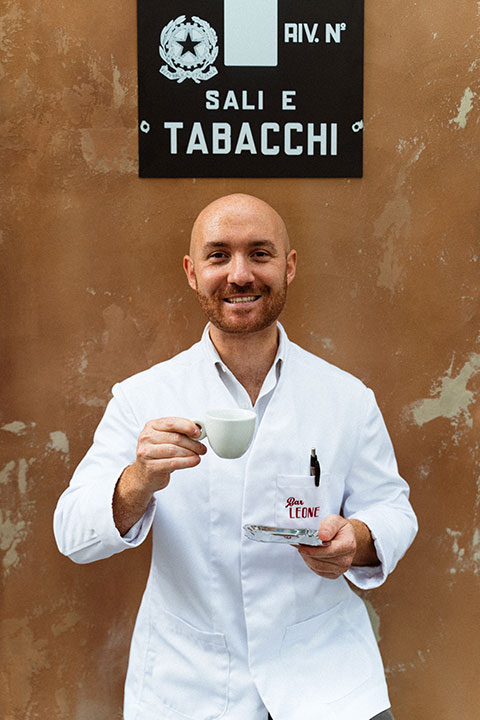
BAR LEONE’s Lorenzo Antinori

AN ITALIAN-THEMED bar that opened its doors less than three years ago in Hong Kong has been selected the world’s best — the first time for an Asian venue.

Bar Leone, famous for outstanding Negronis, olive oil sours, and other drinks, rose to No. 1 in the World’s 50 Best Bars list from second place last year. Spearheaded by cocktail master Lorenzo Antinori, a Roman bartender who previously worked in London and Seoul, the unpretentious venue was chosen as Asia’s best bar for the past two years.

The ascension comes as the Asian hub pushes to revive its ailing food and beverage scene following years of draconian pandemic-era rules that led to an exodus of expatriates and a slump in the number of visitors. While the number of tourist arrivals has been recovering steadily, it’s still below a peak seen in early 2019, before widespread protests also curbed the city’s appeal to international travelers.

“We want to share this with the city of Hong Kong, and the Asia bar community,” Mr. Antinori told Bloomberg. “I truly believe that Hong Kong has one of the best bar scenes in the world. It’s really about having a vision, creating spaces that are not just necessarily concept-driven, but places that have a true identity and speak to guests in a very direct way.”

Last year’s winner, Handshake Speakeasy in Mexico City, dropped to No. 2 on the list. The bilevel bar in the Colonia Juarez neighborhood, inspired by the Prohibition era, serves classically inspired drinks featuring molecular gastronomy with an on-site laboratory and a lab manager.

Coming in third, fourth, and fifth places, respectively, were Barcelona’s Sips and Paradiso and London’s Tayer + Elementary.

In an attempt to replicate Bar Leone’s success in mainland China, Mr. Antinori and co-founder Justin Shun Wah are set to open a branch in Shanghai in November. They also teamed up with barman Simone Caporale from Sips to open another venue in Hong Kong earlier this year. Their Cuba-inspired Montana reflects the colorful atmosphere of the Caribbean island and Miami in the 1970s, with a menu featuring cocktail classics such as the daiquiri, El Presidente, and the Montana.

The ranking for best bars is created by 50 Best, which has been publishing the list since 2009 and throwing a party to mark it since 2012. The same organization ranks the world’s 50 best restaurants.

The list was compiled with input from more than 800 industry experts from 29 regions, including bartenders, drinks writers and cocktail experts, according to the organizer. Each voter was required to name their eight best cocktail experiences from the previous 18 months, with the final ranking adjudicated independently by Deloitte.

The event marking the 17th edition took place on Oct. 8 at Hong Kong’s Kai Tak Cruise Terminal, located at the end of the city’s old airport runway overseeing Victoria Harbour. The list was announced in an Asian city for only the second time — it was held in Singapore in 2023.

The list of bars ranked 51st to 100th was revealed last month, highlighting venues from 35 destinations. Europe had the largest regional representation here, with 15 bars including Madrid’s Angelita (51), Berlin’s Wax On (57) and Naples’ L’Antiquario (63).

While landing the top position is expected to lead to more guests waiting in line outside of the Bar Leone in Hong Kong’s Central district, Mr. Antinori is not foreseeing major changes to the place. “Conviviality, sharing tables and food and drinks. Whatever you read on the menu is what you get. Bar Leone is a very digestible experience. It’s very comfortable,” he said. “Tonight, we are going to celebrate with some tequila.” — Bloomberg

Singlife offers digital insurance products via AUB’s HelloMoney e-wallet

SINGLIFE Philippines, Inc. has partnered with Asia United Bank Corp. (AUB) to offer digital insurance products via the HelloMoney e-wallet as they look to expand their customer base.

Users will be able to explore, purchase, and manage life insurance products on AUB’s e-wallet ecosystem HelloMoney and Hello Pag-IBIG through the Singlife microsite. Products currently available on the Singlife Shop on the HelloMoney app are Cash for Income Loss (Accidents), which covers up to P1.8 million in case of disability or death due to accidents, and Cash for Medical Costs, which provides up to P1.3 million for hospitalization or upon diagnosis for 125 listed critical conditions.

“So, the partnership is basically allowing the HelloMoney users to access Singlife products within the HelloMoney app. This is a good match because Singlife offers their products digitally only, and similarly, that’s also the thrust of HelloMoney by making banking products and services available via our digital channel using the HelloMoney app,” AUB Executive Vice-President and Operations & Information Technology Group Head Wilfredo E. Rodriguez, Jr. said at an event on Wednesday.

Singlife and AUB plan to roll out more insurance solutions on HelloMoney, he said, adding that the microsite gives AUB a new revenue stream through platform fees and lets the bank reach underserved segments.

Mr. Rodriguez said they expect steady revenue growth and customer acquisition for HelloMoney for this year as they continue to expand the e-wallet’s offerings.

“If you talk of the past, we’ve been doing very well in the last four to five years. In fact, since 2022, we’ve had one record year after the other, and it seems that that will continue this 2025 as well.”

The e-wallet is on track to add 1.2 million to 1.5 million more customers this year from 5 million at end-2024, he said, as HelloMoney currently has 6 million customers.

For their part, Singlife Philippines Chief Executive Officer Lester Cruz said the partnership will help increase customer awareness about their products through HelloMoney.

“The customer growth from the side of Singlife Philippines has been really quite encouraging. We grew our premium-paying customer base by tens of thousands on a monthly basis… I hope it continues all the way to the end of the year. This is our best year of customer growth so far alongside all the other metrics,” he said. — Aaron Michael C. Sy

Cybersecurity needs a rethink in the age of agentic artificial intelligence

STOCK PHOTO | Image by Gerd Altmann from Pixabay

By Asha Hemrajani and Ian Monteiro

ARTIFICIAL INTELLIGENCE (AI) has entered a new phase. It is shifting from passive tools to autonomous agents that can plan and act across digital and physical systems, often for extended periods and in concert with other agents. Their interacting and collaborating capabilities are scaling quickly, allowing them to perform increasingly complex tasks with minimal human input, across sectors such as banking, e-commerce, and logistics.

These systems are improving efficiency, but they also raise the stakes for cybersecurity as many of them were not built with security in mind.

Agentic AI systems can be attacked. As they interact with enterprise systems, other agents, and humans, the cybersecurity attack surface expands, exposing them to new threats such as impersonation attacks, prompt injections and data exfiltration.

The boundaries between appropriate autonomous use and deliberate misuse are blurring as enterprises permit AI agents to use apps on users’ behalf more frequently. Malicious agents can also take advantage of the same interfaces that authentic agents employ.

Safeguarding agentic AI in enterprise systems is therefore emerging as one of the defining upcoming cybersecurity challenges.

Recent state-linked campaigns such as UNC3886, reported in Singapore, revealed how adversaries try to exploit trusted enterprise platforms to gain persistent access. Similar risks will arise as agentic systems become more deeply integrated into operations. Protecting them is no longer optional; it is a strategic imperative.

CYBERSECURITY AS A STRATEGIC ENABLER
Traditional cybersecurity frameworks were designed for systems with predictable behaviors. Agentic AI breaks that predictability. It learns, adapts, and operates with varying degrees of autonomy, creating new layers of uncertainty that static defenses cannot contain.

For governments and large enterprises operating critical infrastructure, this shift requires a fundamental change in mindset. As agentic AI becomes embedded in decision-making, operations, and citizen services, cybersecurity must evolve from a defensive function to a strategic enabler of trusted autonomy.

Purposeful and appropriate agentic AI deployment is critical. The right safeguards are needed for such deployments. Deeper testing of how AI systems interact, along with clear human oversight and escalation management is essential, especially in critical infrastructure.

Security must now be adaptive, context aware, and integrated into business and operational strategy. It is no longer just about preventing attacks. It is about maintaining the trustworthiness of autonomous systems that are starting to influence decisions at national and enterprise scale.

The distinction between securing AI deployment and leveraging AI in cybersecurity is also one that needs to be recognized. Guardrails for this nascent field are still in a formative phase, but ethical and practical implementation realities are important pieces of the puzzle that cannot be ignored.

Fundamental signposts in cybersecurity also need revisits and rethinks. Identity, data and attack surfaces take on different complexions that are still evolving, and there are contradictory philosophies in concepts such as Zero Trust that need adaptation to the growing impact of AI.

REFRAMING DIGITAL RISK GOVERNANCE
Governance frameworks must evolve alongside technology. Two issues are becoming urgent.

First, the spectrum of autonomy must be understood. Agentic behavior is not a binary state. Treating a basic automation script as equivalent to a self-directing system results in misplaced controls and uneven risk management. Oversight and safeguards should correspond to degrees of autonomy, not broad labels.

Second, accountability must be redefined. If an agentic AI system executes an action that is harmful, who should bear responsibility? Without clear boundaries, legal and ethical gaps will persist, and adversaries may exploit them. Boards, chief information security officers, and regulators need shared accountability models that reflect how agentic AI systems work.

These questions are already visible in data governance disputes, algorithmic bias cases, and AI incidents where AI systems have behaved in unexpected ways. Unless accountability frameworks get better defined, accountability gaps will widen.

SECURING AGENTIC AI IN  CRITICAL INFRASTRUCTURE
Agentic AI deployment in critical infrastructure entities raises unique risks. Agentic AI promises gains in efficiency and resilience, but its vulnerabilities could cause cascading disruptions if compromised.

Protecting these systems requires new approaches to securing AI apps and agents.

It is essential that critical infrastructure entities retain control as they adopt more autonomous AI-driven systems.

Hence, the focus needs to be on detection and stopping attacks (such as direct and indirect prompt injection, data poisoning) on models/AI apps and agentic-AI workflows. Policy control for AI use such as blocking risky requests, data-leak prevention for AI apps, and detecting unsanctioned AI agents in use, among others, are also essential.

Equally important is ensuring resilience in agentic AI systems by governing the non-human identities (NHIs), the digital identities backbone of agentic AI. Enterprises will need to exercise proper oversight of NHIs in terms of access control, guardrails, and traceability.

CONVENING FOR RESILIENCE IN AGENTIC AI
No single government, enterprise, or regulator can address these challenges on their own. For agentic AI systems to be safe and resilient, collaboration across borders and sectors is needed.

Across ASEAN, economies like Singapore, Malaysia, and the Philippines are building stronger partnerships between government, industry, and academia to prepare for the next wave of AI-driven threats. Platforms such as GovWare in Singapore play an important role in connecting regional voices and advancing dialogue on shared cybersecurity challenges that affect the entire ASEAN digital ecosystem.

The real value of such forums lies in bringing together policymakers, enterprises and innovators to address accountability, interoperability and resilience together.

BUILDING TRUST IN THE AGE OF AUTONOMY
As agentic AI becomes part of daily operations, the real challenge is not only technical but human. Trust will depend on the people who design, deploy, and oversee these systems, and on their ability to step in when things go wrong.

Events like GovWare help translate complex AI and cybersecurity issues into shared understanding and practical collaboration. They remind us that resilience is built through people working together, not machines acting alone.

Ultimately, technology is only as trustworthy as the intent and integrity of those who create and use it. A secure digital future will depend on our collective willingness to stay curious, accountable, and connected, because trust is built by people, not algorithms.


Asha Hemrajani is a senior fellow at the S. Rajaratnam School of International Studies, Nanyang Technological University. Ian Monteiro, CEO and founder of Image Engine, organizer of the GovWare Conference and Exhibition, co-authored this article to offer an industry view on advancing trust and resilience in the era of agentic AI.

mWell, DICT to integrate digital health services into eGov PH app

METRO PACIFIC Investments Corp.’s (MPIC) digital healthcare platform mWell has partnered with the Department of Information and Communications Technology (DICT) to integrate digital health services into the government’s eGov PH application.

In a statement on Wednesday, mWell said the partnership seeks to develop the country’s first national digital health integration within a government platform, enabling users to access doctors, medical records, and other health services online.

Under the memorandum of understanding, the DICT and mWell will collaborate to embed a digital Health ID into the eGov PH app, giving users access to primary care doctors, specialists, and mental health professionals. Patients will also be able to view and store their medical records securely.

“This collaboration supports the government’s Digital Philippines agenda by bringing healthcare closer to Filipinos wherever they are,” DICT Secretary Henry R. Aguda said.

mWell President and Chief Executive Officer Chaye Cabal-Revilla said the integration aims to establish a unified digital network linking government, providers, and patients.

mWell said it has been working with the DICT to reach geographically isolated areas through its OnTheGo Clinic-In-A-Bag program, which provides telemedicine services to remote communities, including indigenous peoples and soldiers in conflict zones. The company has also introduced drone-based medicine delivery and its BangkaHealth telemedicine service for coastal areas in Sulu.

mWell, part of the MPIC group, operates an artificial intelligence-powered digital clinic and electronic medical records platform. The company also recently acquired KonsultaMD to expand its telemedicine and e-prescription services.

MPIC Chairman, President, and Chief Executive Officer Manuel V. Pangilinan said the partnership will support efforts to expand mWell’s coverage nationwide.

MPIC is one of the key Philippine units of Hong Kong-based First Pacific Co. Ltd., which also holds interests in Philex Mining Corp. and PLDT Inc.

Hastings Holdings, Inc., a unit of the PLDT Beneficial Trust Fund subsidiary MediaQuest Holdings, Inc., holds a majority stake in BusinessWorld through the Philippine Star Group, which it controls. — Alexandria Grace C. Magno

Proposal to cut up to P400B out of proposed budget 2026

My hypothesis on the ongoing corruption scandal in the country: As the size of the budget goes up yearly, the extent of corruption and waste also increases at a proportional rate (if not at higher proportion) as the overall budget expansion.

The reason why I make this hypothesis — it is an unproven theory — is because the budget deficit and the public debt keep rising. Meaning past spending did not result in higher productivity of our people and government institutions that are supposed to “outgrow the debt.”

If past spending on public physical infrastructure (roads, bridges, irrigation canals, etc.) and social infrastructure (education, healthcare, monthly cash, free seeds, etc.) were not wasted or inefficient, the resulting productivity increase would have allowed our economy to grow faster, with revenues larger to control the deficit and pay back the debt. This did not happen.

See also recent reports in BusinessWorld on the subject: “Corruption issues hurting US investor interest in the Philippines — Romualdez” (Oct. 10), “Analysts call for more transparency in bicameral committee meetings for budget bill” (Oct. 13), “House approves P6.793-trillion budget bill on final reading” (Oct. 14), “Flood control scam derails S&P credit rating upgrade for Philippines” (Oct. 15), and, “Corruption scandal to slow Philippine growth, says Recto” (Oct. 15).

With the above hypothesis, I make this proposal — that the budget for 2026 and the next few years be curtailed so that the annual budget deficit is not larger than P1 trillion a year, and the deficit/GDP ratio move towards a maximum of 3.5% by 2028.

This is a tough goal since the current average budget deficit is around P1.55 trillion a year. So, I propose cutting the budget of certain agencies based on these considerations.

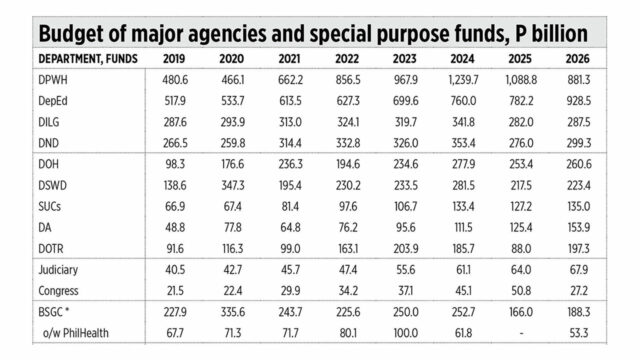
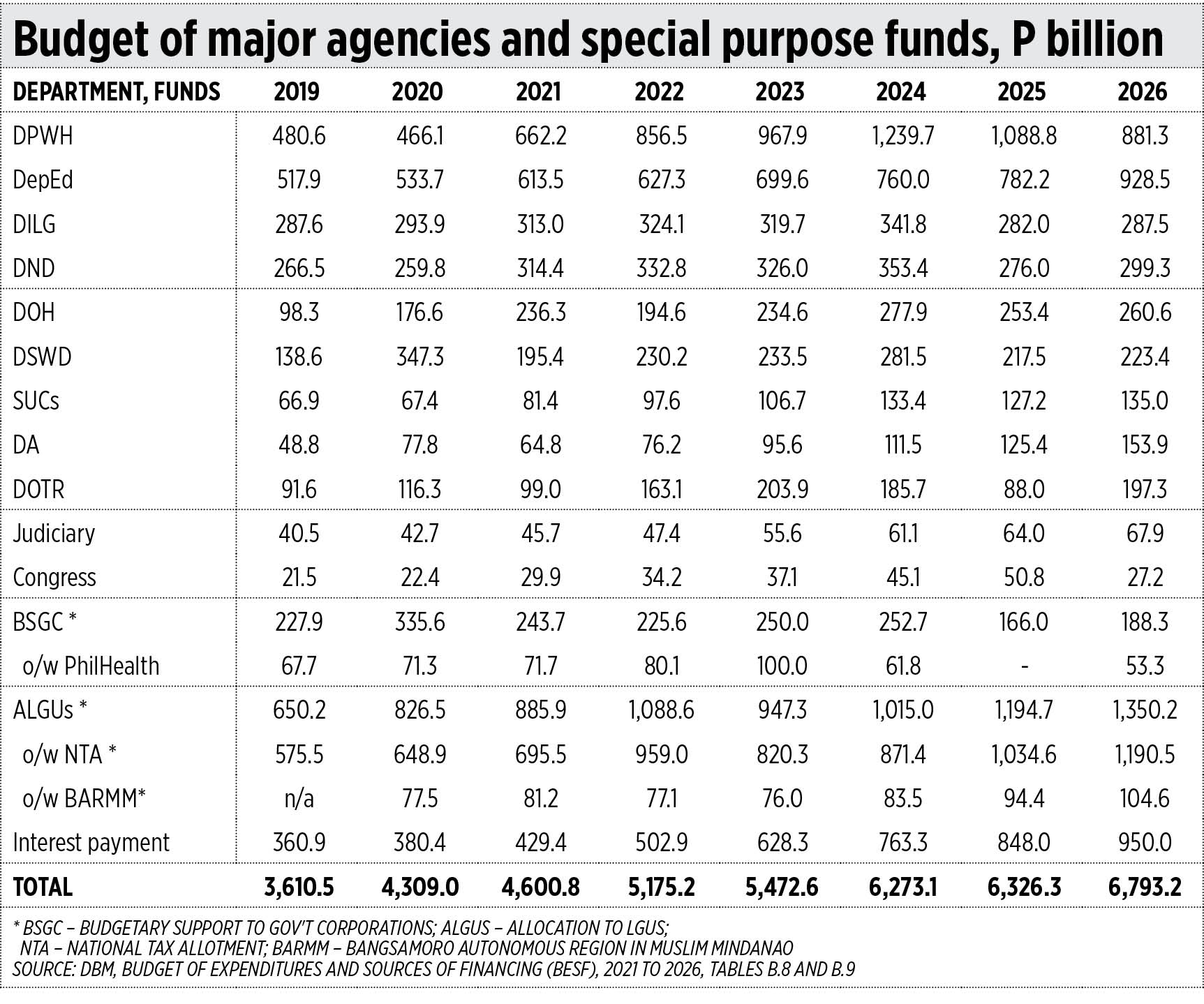
First, consider that the overall budget has nearly doubled from P3.61 trillion in the pre-lockdown year 2019 to P6.33 trillion in post-lockdown 2025. Interest payments alone for our public debt are projected to more than double from P361 billion to P848 billion over the same period.

So, agencies and departments with 2025 budgets that are twice their 2019 level are candidates for spending cuts because the virus crisis, which was used as the basis for the huge rise in their budgets, is no longer here. These include the Departments of Public Works and Highways (DPWH), Health (DoH), Social Work and Development (DSWD), Agriculture (DA), and state universities and colleges (SUCs). See the table for details.

Thus for 2026, the Senate may consider limiting the budget of these agencies: the DoH to P230 billion while the Philippine Health Insurance Corp. or PhilHealth subsidy is kept at around P60 billion, leading to savings of P25 billion; the DSWD up to P200 billion, with savings of P23 billion; the DA up to P130 billion, with savings of P24 billion; the SUCs up to P130 billion, with savings of P5 billion; the Department of Transportation up to P190 billion, with savings of P7 billion. This leads to a savings sub-total of P84 billion.

The rest of the departments may have to deal with across-the-board reductions in their budgets of 5% to 8% — that would come to around P150-P200 billion in additional savings.

Then cut the subsidies to government corporations like the National Irrigation Administration (NIA) from an average of around P60 billion/year to only P30 billion; remove the Power Sector Assets and Liabilities Management Corp. (PSALM) subsidy of P8 billion/year; and the National Electrification Administration (NEA) subsidy of around P4 billion/year. This will result in around P42 billion in savings.

The Bangko Sentral ng Pilipinas’ cut in interest rate should help reduce our interest payment to not more than the programmed P950 billion.

Overall, a spending cut of up to P400 billion can be made in the 2026 budget. This will be a big respite in our budget deficit and annual borrowings.

I hope that President Ferdinand R. Marcos, Jr., Budget Secretary Amenah F. Pangandaman, and Senate President Tito Sotto would consider these proposals. Also, the rest of the economic team, and the House leadership when the Bicameral Committee is formed for this.

When agencies feel the tightness in overall spending and their agency budget, they will tend to be more careful, more efficient, and less wasteful in their spending to avoid another round of public backlash.


Bienvenido S. Oplas, Jr. is the president of Bienvenido S. Oplas, Jr. Research Consultancy Services, and Minimal Government Thinkers. He is an international fellow of the Tholos Foundation.

minimalgovernment@gmail.com

ADVERTISEMENT
ADVERTISEMENT