Home Blog Page 840

GCash finds no evidence of data breach, assures users

Following reports of user data being sold on the dark web posted by a user on the Deep Web Konek online forum on October 26, GCash Has released an official statement today assuring users that their e-wallet funds and user information were not compromised and continue to be safe and secure.

Based on an internal investigation by the company’s cybersecurity experts, GCash has declared that the alleged exposed dataset does not match the data on their internal systems.

Earlier today, the National Privacy Commission (NPC) released a statement on their website stating that they are launching an investigation on the alleged breach. The NPC has advised users to monitor their accounts and practice cybersecurity measures such as regularly changing their MPIN, passwords, and enabling additional security measures.

“We continue to work closely with the BSP, NPC, and CICC to monitor and validate information from all possible sources and ensure that our systems remain protected,” GCash has added in its statement.
The GCash advisory in full:

NO EVIDENCE OF DATA BREACH
Your funds and information are safe and secure.

GCash is aware of an online post alleging that user information is being sold on the dark web.

There is no evidence of any breach in GCash systems. All customer accounts and funds remain secure.

Upon swift investigation of our cybersecurity experts, the alleged dataset does not match data from GCash systems. Additionally, many entries are incomplete, invalid, or do not belong to GCash users.

These findings strongly indicate that the data being circulated did not originate from GCash.

We continue to work closely with the BSP, NPC, and CICC to monitor and validate information from all possible sources and ensure that our systems remain protected.

GCash remains fully committed to safeguarding customer data, strengthening our defenses, and upholding the trust of millions of Filipinos. – EGG

Lawyers for Christ (LFC): How faith, ethics, and advocacy bridge law and morality

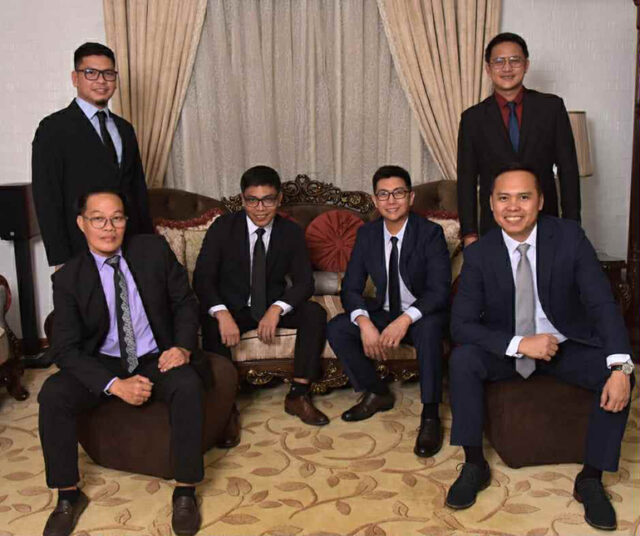
In a time when legal battles often seem detached from moral values, a new movement is rekindling the connection between faith and the pursuit of justice. Lawyers for Christ (LFC), founded in December 2024 by Zephaniah “Khalid” Mesa, stands as a testament to how law and spirituality can coexist — not in conflict, but in harmony — for the service of God and the Filipino nation.

Rooted in Faith, Driven by Purpose

For its founder, Zephaniah “Khalid” Mesa, Lawyers for Christ was born out of a deep conviction: that legal practice must go beyond courtrooms and case files. It should mirror the compassion, integrity, and humility that come from walking in faith.

“Law isn’t merely a system of rules,” Mr. Mesa shares. “It’s a ministry — a means to bring light, truth, and healing to society.”

Through LFC, he hopes to unite Christian lawyers who view their careers as both a calling and a mission — to defend justice while upholding Christ-like principles.

Faith as the Foundation of Justice

At the heart of Lawyers for Christ lies an unshakable belief: Jesus Christ is Lord over all — even in the halls of law and governance.

“We are not just lawyers. We are Christian lawyers,” emphasizes Atty. Ronald Tolledo, co-founder and president of LFC. “Our vision is to transform society by grounding justice in biblical truth.”

To Atty. Tolledo and his fellow founders, Lawyers for Christ isn’t simply a professional organization. It’s a fellowship of believers who see the legal profession as a sacred responsibility — to advocate with compassion, lead with integrity, and serve with faith.

Mission and Mentorship

LFC is built upon two guiding pillars:

  1. To uphold justice through integrity and faith.
  2. To mentor the next generation of Christian lawyers.

Though still in its early stages with six founding members, LFC is already cultivating relationships with law students and scholars who aspire to blend excellence in law with devotion to God. By nurturing these young minds early, the organization envisions a new wave of legal practitioners whose moral compass remains steadfast amid challenges.

From Fellowship to Faith-Based Think Tank

More than a community, Lawyers for Christ aims to become a Christian think tank that contributes meaningfully to public discourse. Its members aspire to craft Christ-centered policy proposals and provide faith-based solutions to national issues.

Among its cornerstone initiatives is CARE — Christian Arbitration for Reconciliation and Equity. This program offers an alternative to the traditional court system through mediation grounded in biblical principles, helping disputing parties find peace and reconciliation without hostility.

“In a society where conflicts too often end in division, CARE brings the ministry of healing,” Atty. Tolledo explains. “We are attempting great, if not impossible, things for God — because we believe justice and grace can coexist.”

A Movement of Service and Sincerity

For Mr. Mesa and the LFC founders, true success is not measured by the size of the membership but by the sincerity of each member’s faith and commitment. The group welcomes both practicing lawyers and students who share the same desire — to pursue justice anchored in divine truth.

Lawyers for Christ stands not as another legal association, but as a movement — a higher calling for those who wish to serve both God and the nation.

Join the Mission

As LFC continues to grow, it invites Christian lawyers, students, and advocates who wish to be instruments of justice and faith to join its mission.

To learn more or support Lawyers for Christ, contact 0920-226-0721.

Together, let us build a justice system that reflects not just the law of man — but the love of God.


Spotlight is BusinessWorld’s sponsored section that allows advertisers to amplify their brand and connect with BusinessWorld’s audience by publishing their stories on the BusinessWorld Web site. For more information, send an email to online@bworldonline.com.

Join us on Viber at https://bit.ly/3hv6bLA to get more updates and subscribe to BusinessWorld’s titles and get exclusive content through www.bworld-x.com.

Monetary Board’s Diokno sees more easing as graft woes weigh

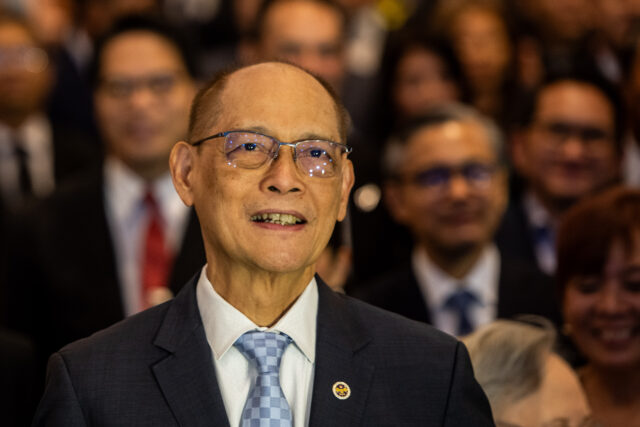
Benjamin Diokno in 2023. Credit: LISA MARIE DAVID/BLOOMBERG

The Philippine central bank may cut its key interest rate again in December and further next year, as the economic fallout from a corruption scandal may linger through the end of 2026, an official said.

“I would expect another 25 basis points cut” at the next meeting in December, Bangko Sentral ng Pilipinas (BSP) Monetary Board member Benjamin E. Diokno said in an interview with Bloomberg Television’s Avril Hong on Monday.

Further rate cuts are possible “maybe sometime next year,” as policymakers assess economic growth and employment data, with inflation under control, according to Mr. Diokno.

The BSP reduced its benchmark interest rate by a quarter point this month as a corruption scandal in the government’s flood-control projects has threatened the country’s economic outlook. Its next rate-setting meeting is scheduled for Dec. 11.

Mr. Diokno, who once helmed the central bank as well as the finance and budget departments, said the economy may “slow down a bit” due to the corruption controversy and trade uncertainties. He said 2026 will be “a transition period” as President Ferdinand Marcos Jr. fixes the problem.

In July, Mr. Marcos exposed corruption in flood-control projects worth billions of pesos. Many of the projects were either substandard or nonexistent, leading to investigations that have implicated key public works officials and several lawmakers, who have denied wrongdoing. The allegations fueled a broad exit by foreign investors in the stock market.

“We will probably be able to recover from this mess by the end of next year. And 2027 and 2028, we’ll be back on track.”, Mr. Diokno said.

The Philippine peso last week fell to its lowest level against the dollar since February. It was little changed at 58.635 at 11:05 a.m. in Manila on Monday. The benchmark stock index was down 1.3%.

Mr. Diokno said the central bank will only intervene in the foreign exchange market if the peso’s weakness affects the BSP’s inflation target range of 2% to 4%. “The BSP does not target a specific rate,” he said. – Bloomberg

Hong Kong court sentences three people to prison over bomb plots in 2019 and 2020

REUTERS

HONG KONG — A Hong Kong court on Monday sentenced three people to prison terms of up to 18 years over three bomb plots in 2019 and 2020.

In September, a jury found Ho Cheuk-wai, 41, Lee Ka-pan, 31, and Cheung Ka-chun, 35, guilty of conspiracy to cause explosions with intent to endanger life or property.

Ho received a sentence of 18 years, while the other two were sentenced to 16 years and eight months.

Judge Johnny Chan said Ho was the mastermind, showed no remorse, and had no grounds for a reduced sentence. Lee and Cheung, he said, were first-time offenders and were each granted a four-month reduction.

“The court must provide sufficient deterrence, so the need for defendant’s rehabilitation is less important than the former point,” Chan said.

“Also, if remorse is limited or superficial, there’s no way to talk about rehabilitation and correction.”

The defendants were accused of planting a homemade bomb in a hospital toilet at Caritas Medical Centre in Kowloon and of placing a bag containing two bombs on a train at Lo Wu station. Both devices detonated, but no injuries were reported.

A group called “92 Sign” claimed responsibility on the Telegram messaging app, saying it wanted medical workers to strike and the government to close the borders to curb the spread of the Covid-19 virus.

They were also accused of planting a bomb near a car park in a residential neighborhood ahead of a memorial event for a student who died during the city’s 2019 pro-democracy protests.

The defendants were tried under the United Nations Anti-Terrorism Ordinance, which was implemented in Hong Kong following a Security Council resolution on countering terrorism.

All the defendants pleaded not guilty to the charges. Five other defendants were acquitted.

The trio appeared calm and smiled as the judge handed down the sentence, while their relatives burst into tears in court.— Reuters

US fighter jet, helicopter crash in South China Sea during routine drills

Image from WIKIPEDIA.ORG

A US fighter jet and military helicopter crashed in the South China Sea on Sunday, during what the US Pacific Fleet described as “routine operations” involving the USS Nimitz carrier strike group.

A two-man F-18 fighter jet and an MH-60R multirole helicopter carrying five crew members “went down in the waters” of the disputed waterway in separate incidents during routine drills by the US Navy’s Carrier Strike Group 11, according to the US Pacific Fleet. All personnel were safely recovered.

“The cause of both incidents is currently under investigation,” it said in a Facebook post on Monday.

The crashes, which happened within 30 minutes of each other, took place in one of the world’s most contested waterways, where tensions between the Philippines and China continue to simmer over contesting sea claims.

Beijing continues to lay its sovereignty over the energy-rich waters despite a 2016 ruling by a United Nations-backed court that voided its claims.

The Southeast Asian nation has stepped up efforts to push back against China’s sweeping claims, conducting naval drills with allies including the US as it leans on multinational cooperation to bolster maritime security.

At 1,092 feet, the USS Nimitz is one of the US Navy’s nuclear-powered supercarriers and is built to deploy squadrons of fighter jets on short notice at sea, long-serving as a projection of American military might overseas.

Now in the South China Sea after a three-month stint in the Middle East, the 50-year-old carrier is expected to return to the US for decommissioning following its Asia leg, USNI News reported. — Kenneth Christiane L. Basilio

DigiPlus earns first ASEAN Golden Arrow Award for corporate governance excellence

Representing DigPlus were (from left) Celeste Jovenir (VP of Investor Relations, Corporate Communications and Sustainability), Atty. Carol Padilla (Corporate Secretary), and Atty. Kristine delos Reyes (Chief Legal and Compliance Officer).

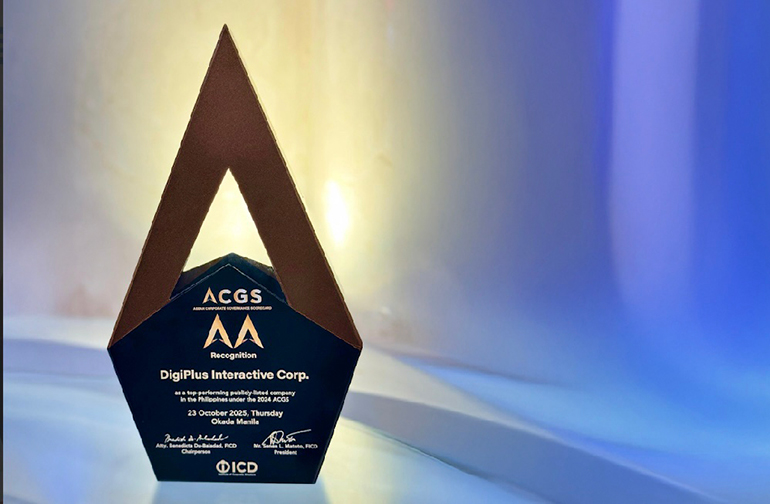
DigiPlus Interactive Corp. (DigiPlus), the country’s digital entertainment provider behind BingoPlus, ArenaPlus, and GameZone, achieved a major milestone in corporate governance excellence by earning its first-ever Golden Arrow Award.

The recognition was conferred on Oct. 23, 2025, during the awarding ceremony organized by the institute of Corporate Directors (ICD), the Philippines’ Domestic Ranking Body (DRB) for the ASEAN Corporate Governance Scorecard (ACGS).

DigiPlus received a 2-Golden Arrow Award, one of the five levels of distinction granted to publicly listed companies that demonstrate outstanding corporate governance performance.

The Golden Arrow Recognition is among the Philippines’ most prestigious corporate honors, recognizing companies that lead in transparency, accountability, and integrity.

Anchored on the ACGS framework, it evaluates how effectively organizations uphold shareholder rights, engage stakeholders, promote sustainability, ensure transparency, and maintain strong board oversight in alignment with both local and international governance standards.

“Earning our first Golden Arrow affirms DigiPlus’ commitment to upholding the highest standards of corporate governance,” said DigiPlus Chairman Eusebio H. Tanco. “We are proud to be recognized among the country’s most trusted, publicly-listed companies and remain focused on creating a long-term value for our shareholders, stakeholders, and the customers and the communities we serve by leading with transparency, accountability, and integrity.”


Spotlight is BusinessWorld’s sponsored section that allows advertisers to amplify their brand and connect with BusinessWorld’s audience by publishing their stories on the BusinessWorld Web site. For more information, send an email to online@bworldonline.com.

Join us on Viber at https://bit.ly/3hv6bLA to get more updates and subscribe to BusinessWorld’s titles and get exclusive content through www.bworld-x.com.

German foreign minister to meet India’s Goyal, NATO’s Rutte after postponing China trip

A German national flag flies atop the illuminated Reichstag building in Berlin, Germany. — REUTERS

BERLIN — German Foreign Minister Johann Wadephul will meet NATO’s Secretary General Mark Rutte, Indian Trade Minister Piyush Goyal and other senior policymakers during a trip to Brussels starting on Monday, a spokesperson for his ministry said.

The visit comes after Wadephul postponed a trip to China, originally scheduled to start on Sunday, because Beijing confirmed only one of his requested meetings, in a sign of rising tension with Berlin over trade and security matters.

During the trip to Brussels, Wadephul will also meet with European Commission President Ursula von der Leyen, EU Trade Commissioner Sefcovic and EU foreign policy chief Kaja Kallas, the spokesperson for Germany’s foreign ministry said.

“The focus of the consultations with representatives of the EU and NATO – the organizations that bring together our most important and closest partners and allies – will be on continued support for Ukraine and European security and defense capabilities,” the spokesperson said.

Another focus of the talks will be international trade issues, including prospects and potential solutions for ensuring a smooth supply of important raw materials, in particular rare earths and computer chips, two areas that are subject to bottlenecks.

India’s Goyal is in Brussels for trade policy talks, the spokesperson said.

The EU and India are working to meet a year-end deadline for signing a free trade pact.— Reuters

EU considers more flexible climate target in hunt for deal, draft shows

STOCK PHOTO | Image by Bruno from Pixabay

BRUSSELS — European Union countries are negotiating proposals to give industries a more flexible path to meeting climate goals, a draft EU document showed, as the bloc attempts to win support from governments for a new 2040 emissions-cutting target.

The EU is negotiating a legally-binding target to cut net greenhouse gas emissions 90% by 2040, and is racing to approve the goal before world leaders gather for the UN’s COP30 climate summit on November 6.

However, months of negotiations have so far not yielded a deal, as some governments have pushed back on green measures, and raised concerns over how to finance the low-carbon transition alongside priorities like defense and revitalizing industries.

A draft EU compromise proposal, seen by Reuters, showed countries have drafted plans that would allow the EU to review the 2040 target every two years – potentially allowing Brussels to weaken the goal in future.

The draft would also fix into law a commitment that if forests absorb less CO2 emissions than expected, or technologies to remove CO2 from the atmosphere develop slower than planned, other industries will not be forced to cut emissions faster to deliver the 2040 goal.

“Possible shortfalls in one sector should not be at the expense of other sectors,” said the draft, dated October 25.

NO CHANGE ON CARBON CREDITS QUOTA
The new compromise reflects demands made by EU government leaders at a summit last week, where they debated the “enabling conditions” needed to meet green goals while avoiding higher energy bills for citizens and supporting businesses grappling with cheap Chinese imports and US tariffs.

EU countries’ ambassadors will negotiate the proposal next week, before their climate ministers attempt to approve the target on November 4.

The draft proposal did not change the 90% emissions-cutting target, nor the 3% of the goal that can be met by buying foreign carbon credits, rather than domestic efforts – although countries are still debating this. French President Emmanuel Macron said last week credits could potentially cover up to 5%.

In an attempt to win over skeptical governments, the European Commission has promised changes to other green measures, including price controls in an upcoming carbon market for transport fuels, as demanded by Poland and the Czech Republic. Brussels is also considering weakening its 2035 combustion engine car ban after pressure from Germany and Italy.

A spokesperson for Denmark, which holds the rotating EU presidency and drafted the document, declined to comment.— Reuters

Gross borrowings fall in September

REUTERS/THOMAS WHITE/ILLUSTRATION

THE NATIONAL Government’s (NG) gross borrowings declined by 65% in September, reflecting a slowdown in public spending.

The latest data from the Treasury showed that total gross borrowings fell by 64.89% to P128.913 billion in September from P367.183 billion in the same month a year ago.

Month on month, gross borrowings slid by 74.65% from P508.527 billion in August.

Domestic borrowings, which made up 93.51% of the total, slipped by 16.98% to P120.548 billion in September from P145.2 billion in the same month last year.

This was composed of P111.848 billion in fixed-rate Treasury bonds (T-bonds) and P8.7 billion in Treasury bills (T-bills).

External borrowings, which mainly consisted of project loans, plunged by 96.23% to P8.365 billion in September from P221.983 billion in the previous year.

“This (lower gross borrowings) could very much reflect the lower share of foreign borrowings to the total borrowing mix of the government and could also reflect prudence of some private sector borrowers by reducing US dollar-denominated and other foreign borrowings in view of foreign exchange risks involved,” Rizal Commercial Banking Corp. Chief Economist Michael L. Ricafort said in a Viber message.

The peso closed at P58.196 per dollar on Sept. 30, down by 35.1 centavos from its P57.845 finish on Dec. 27, 2024.

“(The) lower amount of approved foreign loans reflected that cautiousness vs. potential forex (foreign exchange) losses that entail US dollars and other foreign loans,” Mr. Ricafort said.

Philippine Institute for Development Studies Senior Research Fellow John Paolo R. Rivera said in a Viber message that the lower borrowings reflected slower government spending, particularly on infrastructure, and the government’s “deliberate recalibration of financing strategy” for the fourth quarter.

“While this moderation in borrowings can help ease immediate pressure on yields and debt servicing costs, it also raises two cautions such as if the underlying budget deficit remains large or rises further, the NG may need to ramp up borrowings again potentially at less favorable terms,” Mr. Rivera said.

The NG’s gross borrowings stood at P2.4 trillion in the January-to-September period, up by 4.11% from P2.3 trillion a year ago. This made up 92.11% of the revised P2.6-trillion financing program for 2025.

Domestic debt rose by 9.16% to P1.96 trillion in the period ending September from P1.795 trillion a year ago. This accounted for 92.83% of the P2.04-trillion domestic borrowing program this year.

Broken down, domestic debt was composed of P1.05 trillion in fixed-rate Treasury bonds, P425.61 billion in retail Treasury bonds, P300 billion fixed-rate Treasury notes, and P181.15 billion in T-bills.

As of end-September, gross external debt stood at P434.597 billion, down by 13.84% from P504.447 billion a year ago. This made up 89.03% of the P488.174-billion external borrowing program this year.

Broken down, foreign debt was composed of P191.965 billion in global bonds, P171.307 billion in program loans, and P71.325 billion in project loans.

External borrowings as of end-September were padded by the global bond issuance that raised $3.3 billion or P192 billion in late January but settled in February. — Aaron Michael C. Sy

PHL anticipates stronger trade flows from key ASEAN deals

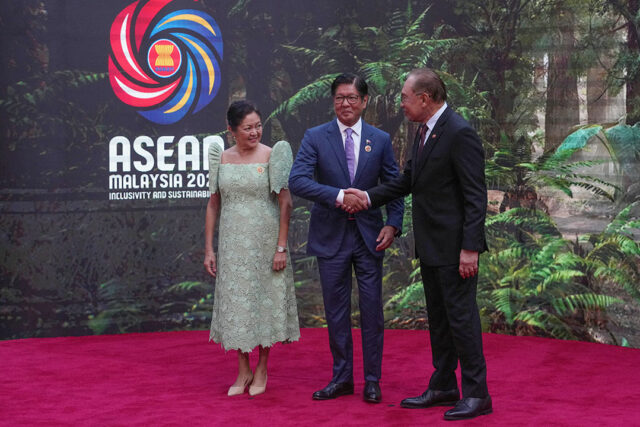
MALAYSIA’S Prime Minister Anwar Ibrahim (right) greets Philippine President Ferdinand R. Marcos, Jr. and his wife Liza as they arrive to attend the 47th Association of Southeast Asian Nations (ASEAN) Summit in Kuala Lumpur, Malaysia, Oct. 26. — RAFIQ MAQBOOL/POOL VIA REUTERS

By Chloe Mari A. Hufana, Reporter

KUALA LUMPUR — The Philippines expects stronger regional trade and investment flows as two key trade pacts — the Association of Southeast Asian Nations (ASEAN)-China Free Trade Area (ACFTA) 3.0 Upgrade and the Second Protocol to Amend the ASEAN Trade in Goods Agreement (ATIGA) — promise to modernize economic cooperation across the regional bloc.

At a news briefing here on Sunday, Palace Press Officer Clarissa A. Castro quoted Special Assistant to the President for Investment and Economic Affairs Frederick D. Go as saying the ATIGA upgrade will keep the intra-ASEAN trade pact relevant amid evolving global trade conditions.

“The enhanced agreement offers significant benefits, particularly through improvements in trade facilitation measures, transparency provisions, dispute settlement mechanisms, and the inclusion of new and emerging trade elements,” she said.

The amended ATIGA was inked by Trade Secretary Ma. Cristina A. Roque on Saturday and was turned over to the ASEAN leaders on Sunday.

Ms. Castro said the new provisions, including mutual recognition of Authorized Economic Operators, will allow certified traders faster cargo clearance throughout ASEAN.

The agreement also promotes self-declaration of origin, electronic certification (e-form B), and the acceptance of digital documentation, making cross-border trade easier for Philippine businesses.

“Businesses will find it easier to comply with administrative requirements self-declaration of origin, the implementation of the Electronic Certificate of Origin (e-Form D), and the acceptance of digital documentation,” Ms. Castro added.

Meanwhile, the Philippines and Canada aim to finish free trade agreement negotiations by 2026, vowing to accelerate talks following a bilateral meeting at the 47th ASEAN Summit between President Ferdinand R. Marcos, Jr. and Canadian Prime Minister Mark Joseph Carney.

They talked about efforts to deepen a trade relationship valued at more than $3 billion, covering sectors such as manufacturing, defense, and both conventional and clean energy.

Mr. Carney, in a separate statement, outlined Canada’s strategy to double its non-US exports over the next decade, positioning Southeast Asia as a key partner in that effort.

Canada and the Philippines agreed to fast-track negotiations on a bilateral free trade agreement, with the goal of completing talks by 2026.

They also committed to advancing a broader Canada-ASEAN free trade pact, which they aim to conclude during the Philippines’ ASEAN chairmanship the same year.

The two leaders also welcomed the prospect of a bilateral visit “at the earliest opportunity” and agreed to maintain close coordination as both countries look to expand trade and investment cooperation.

Meanwhile, Ms. Castro said the ACFTA 3.0 upgrade will make the ASEAN-China partnership “more modern, more comprehensive, and better aligned with today’s global realities.”

Citing Foreign Affairs Secretary Ma. Theresa P. Lazaro, Ms. Castro said the revised framework will deepen cooperation in digital and green economies, enhance sustainable supply-chain connectivity, and promote the empowerment of micro, small and medium enterprises (MSMEs) within regional value chains.

The ACFTA 3.0 Upgrade expands the original pact, which was signed in 2002, by introducing provisions on competition, consumer protection, digital economy, green economy, and supply-chain connectivity, on top of trade in goods, customs procedures, and investment cooperation.

The pact with China was ASEAN’s first FTA outside the bloc and remains one of the most important partnerships of the bloc.

Beijing is the largest trading partner of the bloc since 2019, reaching $507.9 billion in 2019, according to ASEAN’s website.

The ASEAN-China FTA in 2005 quadrupled the trade between the two.

ASEAN studies lecturer at De La Salle-College of St. Benilde Josue Raphael J. Cortez said the upcoming signing of the ACFTA 3.0 Upgrade underscores ASEAN’s commitment to strengthening ties with major global powers while ensuring its economies remain adaptable and competitive.

The enhanced pact reflects the bloc’s readiness to address global trade challenges, green transition, and sustainable growth — priorities shared with key partners such as China, the US, and the European Union, he added.

“With China showing further commitment to embrace green prosperity, we may expect that this partnership will signal deepened ties between the 11-country membership and Beijing not just on tech transfer, but also in devising ways on how we may effectively navigate green transition together,” he said via Facebook Messenger.

“At the same time, in recognition of the integral role MSMEs play in bolstering the Southeast Asian economies, this may also be a way for the sector to gradually embrace digitalization, which is now the name of the game in conducting business.”


DoE seeks challengers for hydrogen exploration site in southern Zambales

By Sheldeen Joy Talavera, Reporter

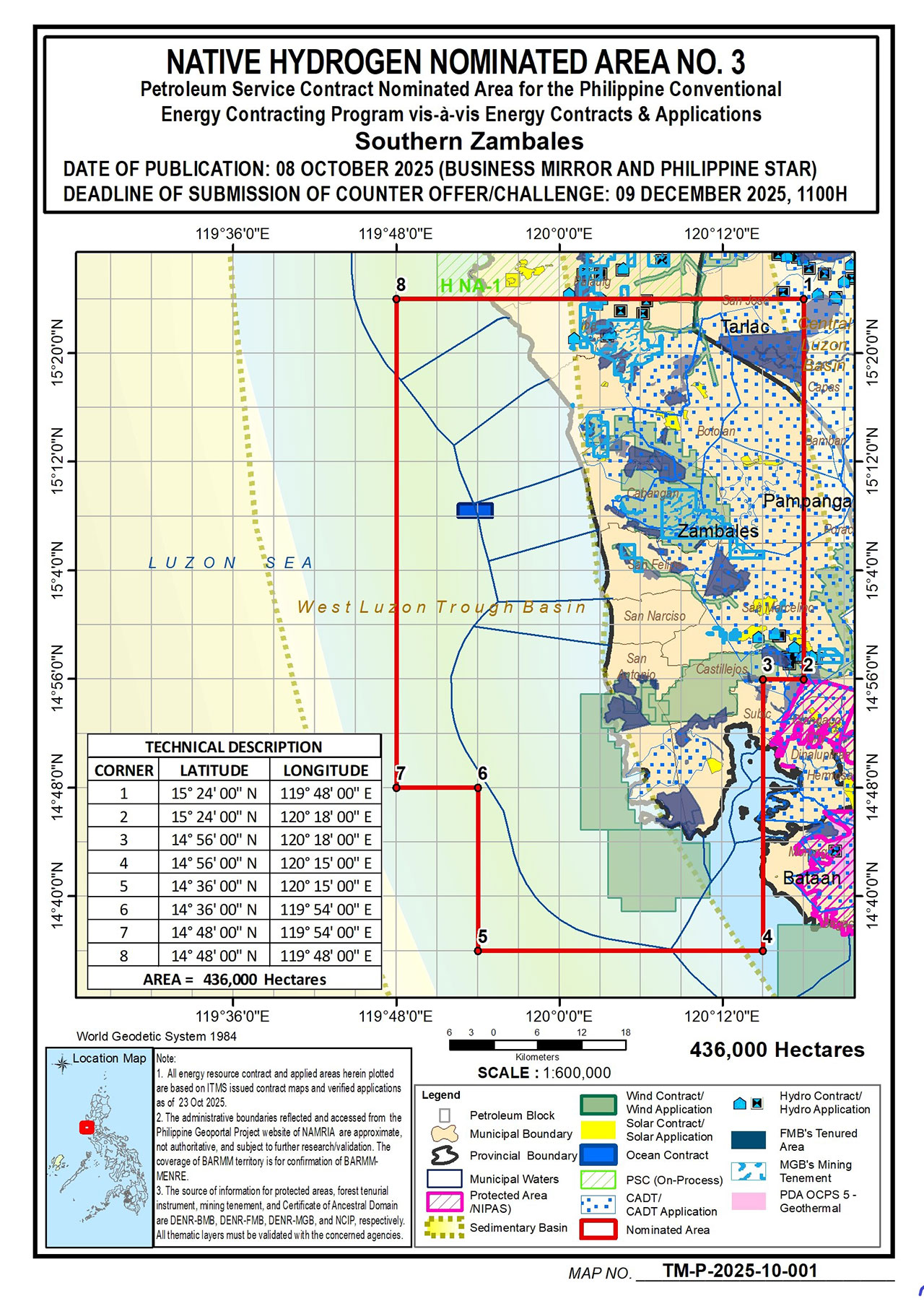
THE Department of Energy (DoE) is inviting interested industry players to submit competing proposals to explore potential native hydrogen resources in a nominated area in southern Zambales, with four more in the pipeline.

In an invitation published on its website, the DoE said that interested companies can submit a challenge for a nominated area spanning 436,000 hectares to secure a contract under the Philippine Conventional Energy Contracting Program.

Applicants may submit their counter offers until Dec. 9, 11 a.m.

Edgar Benedict C. Cutiongco, president of the Philippine Petroleum Association, said that the newly nominated area application for native hydrogen exploration marks “a strategic expansion of the Philippines’ hydrogen frontier.”

Southern Zambales — part of the geologically significant Zambales mountain range — contains ultramafic rocks capable of producing native hydrogen through a natural geochemical process called serpentinization, he said.

“This nomination signals growing momentum in the search for naturally occurring hydrogen, also known as white hydrogen, which is gaining global traction as a clean energy investment,” Mr. Cutiongco told BusinessWorld.

Demujin F. Antiporda, DoE director for the Energy Resource Development Bureau, told BusinessWorld that there are four more nominated areas that will be up for challenge. These include two hydrogen contracts, and two development and production petroleum service contracts.

Mr. Antiporda said that foreign firms submitted these nominated areas.

“We are the first one who offered a bid round in the world for hydrogen,” he said, adding that hydrogen development is still at an early stage globally.

The Philippine government recently awarded eight new petroleum service contracts, representing a potential investment of around $207 million over a seven-year exploration period.

The awarding of service contracts provides an opportunity to explore potential petroleum and hydrogen resources in key areas across the Sulu Sea, Cagayan, Cebu, Northwest Palawan, East Palawan, and Central Luzon.

Several local and foreign companies secured petroleum service contracts, including Pangilinan-led PXP Energy Corp., Australia’s Triangle Energy (Global) Limited and Gas 2 Grid Pte. Ltd, United Kingdom’s Sunda Energy Plc., Israel’s Ratio Petroleum Ltd, and US-based Koloma, Inc.

With contracts in place, the companies can start their respective work programs, which include geological and geophysical studies, seismic surveys, and drilling activities, as appropriate, to assess the potential of the contract areas.

While seeking to increase the utilization of indigenous petroleum resources, the Philippines is also exploring the potential of hydrogen as an alternative fuel to reduce dependence on imported oil.

The Philippines sees the potential of the development and domestic production of hydrogen and its derivatives as a “promising, innovative, and eco-friendly” energy solution that can substantially support the ongoing energy transition efforts.

“With multiple ultramafic-rich zones across the archipelago, the country is uniquely positioned to lead in this emerging field,” Mr. Cutiongco said.

“The combination of favorable geology and a progressive fiscal regime makes native hydrogen exploration a compelling next step beyond traditional hydrocarbon development.”

Mr. Cutiongco said that this would not only strengthen the Philippines’ energy roadmap but also open new avenues for investment, research and regional collaborations with its Association of Southeast Asian Nations peers.

2 BusinessWorld reporters win awards

BEATRIZ MARIE D. CRUZ

TWO BusinessWorld reporters were recognized at the 34th annual awards of the Economic Journalists Association of the Philippines (EJAP) on Friday.

Beatriz Marie D. Cruz received the award for Reporter of the Year for Finance. Ms. Cruz has been with BusinessWorld for three years, and currently covers the Property, Technology, and Launchpad beats.

Luisa Maria Jacinta C. Jocson was awarded Reporter of the Year for Banking. Ms. Jocson was a senior reporter for BusinessWorld who covered the Bangko Sentral ng Pilipinas (BSP) beat until August this year.

The Philippine Star was named Business News Source of the Year.

Other awardees include Jasper Arcalas from the Philippine Star (Agriculture and Mining), Lenie Lectura from BusinessMirror (Energy), Darwin Amojelar from Manila Standard (Macroeconomy), Meg Adonis from the Philippine Daily Inquirer (Capital Markets), Lorenz Marasigan from BusinessMirror (Telecommunications and Transportation), and Louella Desiderio from the Philippine Star (Trade and Industry).

Gerard de la Peña from TV5 won for Business Feature of the Year.

Special awards were also given to former EJAP presidents for their feature stories on business reporting. Awardees include former Malaya Business Insight reporter Jimmy Calapati (first place), InsiderPH Founder and CEO Daxim Lucas (second place), and Mr. De la Peña (third place).

The board of judges was chaired by Synergeia Foundation Chief Executive Officer (CEO) and former Finance Undersecretary Milwida M. Guevara.

The board also included former Agriculture Undersecretary Mercedita A. Sombilla, former Trade Undersecretary Adrian S. Cristobal, Jr., former Finance Undersecretary Cesar V. Purisima, former Metro Pacific Tollways Corp. President and CEO Rodrigo E. Franco, former Securities and Exchange Commission Chairperson Teresita J. Herbosa, Philippine Institute for Development Studies Senior Research Fellow Jose Ramon G. Albert, and University of the Philippines School of Economics Professor Sarah Lynne S. Daway-Ducanes.

EJAP, the umbrella organization of business journalists in the country, handed out the awards in partnership with the Ayala Group.