Home Blog Page 8392

COVID-19 travel insurance becoming a vacation staple

Coronavirus disease 2019 (COVID-19) insurance policies are increasingly joining passports and sunscreen as vacation staples, creating opportunities for insurers as more countries require mandatory coverage in case visitors fall ill from the coronavirus.

Airline bookings are on the rise in some regions, driving cautious hopes of a revival in summer traffic, but also raising fears among tourist destinations of getting hit with bills should vacationers become stranded by the virus.

More than a dozen countries from Aruba to Thailand require COVID-19 coverage for visitors, with Jordan the latest to consider such protections, organizers of an emergency services plan told Reuters.

The market for all types of COVID-19 travel coverage is estimated to be between $30 billion to $40 billion a year, according to travel insurance consultant Robyn Ingle, with companies like AXA and AIG underwriting protection.

But a surge in demand for COVID-19 coverage also means insurers could be on the hook for big payouts should another wave of infections lead to large numbers of cancellations or tourists getting sick.

“Travel insurance and protection services are taking off at pace with travel as it resumes, said Dan Richards, chief executive for travel risk and crisis management firm Global Rescue.

COVID-19 insurance benefits typically cover treatment up to $100,000, and could include coronavirus testing costs and services like evacuation or local burial or cremation. These benefits, introduced by insurers in mid-2020, are sold either as add-ons or as separate policies with coverage for illness or quarantine.

Jeremy Murchland, president of Indiana-based travel insurance company Seven Corners, said travelers are now “more likely to insure their trips,” as more countries require COVID-19 coverage.

A travel insurance plan that includes trip protection, medical expense coverage for COVID-19 and protection for baggage and personal effects typically costs 4% to 8% of the dollar value of the trip, Mr. Murchland said.

While the pandemic has battered travel, demand for coverage has created opportunity for the hard-hit insurance industry and a niche to develop new products, companies said.

For example in June, Seven Corners introduced an optional medical travel plan with coverage for coronavirus expenses, Mr. Murchland said. By year’s end, the product with coronavirus coverage generated about 80% of total medical travel plan sales.

Seven Corners also saw a 20% rise in travelers buying highly priced “cancel for any reason” policies in 2020. The policies cover cancellation costs related to the virus.

Some countries have mandated travel insurance for incoming visitors—either by including it in their entry or visa fees or by requiring proof of coverage, said insurer World Nomads.

Jordan is evaluating whether to require a mandatory flat fee for visitors as part of a program from Global Rescue and the Global Travel and Tourism Resilience Council, said council co-chair Taleb Rifai. The program, which costs up to $100 per person, covers certain disasters and illnesses like COVID-19.

Jordan’s Tourism Bureau was not available for comment.

It is not clear how coverage demand will evolve as many more people become inoculated against the coronavirus with vaccines.

Frank Comito, a special advisor to the Caribbean Hotel and Tourism Association, said some budget travelers have complained about mandatory coverage. And some countries could discontinue or relax the requirement as “we move away from the pandemic.”

Mr. Rifai, former secretary-general of the UN’s World Tourism Organization, said he expects countries will continue requiring coverage as the vaccines “will take years” to roll out globally. — Allison Lampert and Noor Zainab Hussain/Reuters

Meghan accuses UK royals of racism, says ‘didn’t want to be alive’

LONDON — Meghan, the wife of Prince Harry, accused Britain’s royal family of raising concerns about how dark their son’s skin might be and pushing her to the brink of suicide, in a tell-all television interview that could send shockwaves through the monarchy.

The 39-year-old, whose mother is Black and father is white, said she had been naive before she married into royalty in 2018, but that she ended up having suicidal thoughts and considering self-harm after pleading for help but getting none.

Meghan said that her son Archie, now aged one, had been denied the title of prince because there were concerns within the royal family about “about how dark his skin might be when he’s born.”

“That was relayed to me from Harry, those were conversations that family had with him,” Meghan recounted in an interview with Oprah Winfrey aired on CBS late on Sunday.

Meghan declined to say who had aired such concerns, as did Harry, who said his family had cut them off financially and that his father Prince Charles, heir to the British throne, had let him down and refused to take his calls at one point.

Buckingham Palace had no immediate comment about the interview, which aired in the early hours of Monday morning in Britain.

The sit-down conversation with Ms. Winfrey was the most anticipated royal interview since Harry’s late mother Princess Diana shared intimate details of her failed marriage to Charles in 1995, denting the heir’s reputation and the family’s standing in the eyes of the British public.

Nearly three years since her star-studded wedding in Windsor Castle, Meghan described some unidentified members of the royal household as brutal, mendacious, and guilty of racist remarks.

She also accused Kate, the wife of her husband’s elder brother Prince William, of making her cry before her wedding.

While the family came in for open criticism, neither Harry nor Meghan attacked Queen Elizabeth directly.

Still, Meghan said she had been silenced by “the Firm”—which Elizabeth heads—and that her pleas for help while in distress at racist reporting and her predicament had fallen on deaf ears.

“I just didn’t want to be alive anymore. And that was a very clear and real and frightening constant thought. And I remember how he (Harry) just cradled me,” Meghan said, wiping away tears.

‘REALLY LET DOWN’
Harry and Meghan’s announcement in January 2020 that they intended to step down from their royal roles plunged the family into crisis. Last month, Buckingham Palace confirmed the split would be permanent, as the couple looks to forge an independent life in the United States.

Harry, 36, said they had stepped back from royal duties because of a lack of understanding, and he was worried about history repeating itself—a reference to the death of his mother Diana who was killed in a 1997 crash as her car sped away from chasing photographers.

Asked what his mother would say about events, he said: “I think she would feel very angry with how this has panned out and very sad.”

He felt “really let down” by his father, and added: “My family literally cut me off financially.”

Harry denied blindsiding Queen Elizabeth, his grandmother, with his decision to shun life within the monarchy, but said his father stopped taking his calls at one point.

“I had three conversations with my grandmother, and two conversations with my father before he stopped taking my calls. And then he said, can you put this all in writing?”

Detractors say the couple wanted the limelight, but were not willing to live with the attention it brought. To supporters, their treatment shows how an outdated British institution lashed out against a modern, independent biracial woman.

LIES AND TEARS
There have also been allegations of bullying against Meghan which appeared in The Times newspaper in the buildup to the couple’s appearance. Buckingham Palace said it would investigate the claims, adding it was “very concerned.”

Meghan told Ms. Winfrey that people within the royal institution not only failed to protect her against malicious claims but lied to protect others.

“It was only once we were married and everything started to really worsen that I came to understand that not only was I not being protected but that they were willing to lie to protect other members of the family,” Meghan said.

Meghan denied a newspaper story that she had made Kate, Duchess of Cambridge, cry before the wedding and said it was a turning point in her relations with the media and the palace.

“The reverse happened,” Meghan said. “A few days before the wedding she (Kate) was upset about something, pertaining to yes the issue was correct about the flower girl dresses, and it made me cry. And it really hurt my feelings.”

Meghan, who said they were not paid for the interview, conceded she had not realized what she was marrying into when she joined the British monarchy and “went into it naively.”

The couple also revealed that Meghan, who is pregnant with their second child, was expecting a girl.

Harry said Meghan had “saved” him from his trapped royal life. “I would disagree, I think he saved all of us. You made a decision that certainly saved my life,” Meghan said.

“This is in some ways just the beginning for us.” — Michael Holden and Guy Faulconbridge/Reuters

Game of drones: Chinese giant DJI hit by US tensions, staff defections

SHENZHEN — Chinese drone giant DJI Technology Co. Ltd. built up such a successful US business over the past decade that it almost drove all competitors out of the market.

Yet its North American operations have been hit by internal ructions in recent weeks and months, with a raft of staff cuts and departures, according to interviews with more than two dozen current and former employees.

The loss of key managers, some of who have joined rivals, has compounded problems caused by US government restrictions on Chinese companies, and raised the once-remote prospect of DJI’s dominance being eroded, said four of the people, including two senior executives who were at the company until late 2020.

About a third of DJI’s 200-strong team in the region was laid off or resigned last year, from offices in Palo Alto, Burbank, and New York, according to three former and one current employee.

In February this year, DJI’s head of US R&D left and the company laid off the remaining R&D staff, numbering roughly 10 people, at its flagship US research center in California’s Palo Alto, four people said.

DJI, founded and run by billionaire Frank Wang, said it made the difficult decision to reduce staffing in Palo Alto to reflect the company’s “evolving needs.”

“We thank the affected employees for their contributions and remain committed to our customers and partners,” it said, adding that its North American sales were growing strongly.

“Despite misleading claims from competitors, our enterprise customers understand how DJI products provide robust data security. Despite gossip from anonymous sources, DJI is committed to serving the North American market.”

It did not comment on the other US staff departures that current and ex-employees spoke of, although it told Reuters last year its global structure was becoming “unwieldy to manage.”

DJI, which has become a symbol of Chinese innovation since it was founded in 2006, is one of dozens of companies caught in the crossfire of trade and diplomatic hostilities between Washington and Beijing, like Huawei and Bytedance.

Staff sources and competitors say the company’s brand reach, technical know-how, manufacturing might, and sales force mean it won’t lose its crown anytime soon in the multi-billion-dollar US and global markets for non-military drones.

But a December order adding the company to the US Commerce Department’s “Entity List” along with the closure of its R&D operation in California could affect its ability to serve the needs of US customers, according to three former senior executives and two competitors.

The Commerce Department listing, enacted over allegations including DJI enabled “high-technology surveillance,” prohibits the company from buying or using US technology or components.

The same month, Romeo Durscher, DJI’s US-based head of public safety, who had played a central role in building the company’s business in providing drone technology to non-military US government departments and agencies, left his job.

Mr. Durscher, a former NASA project manager and an influential figure in the drone industry, now works at Swiss company Auterion, a competitor to DJI.

He said he left DJI because he was disheartened by the staff cuts and what he described as internal power struggles between the US team and its China headquarters. He added that the US reorganization complicated the task in dealing with the fallout from US-China tensions and winning government business.

“It’s not an easy decision to leave the market leader that’s really far ahead of everyone else,” said Mr. Durscher, who joined DJI in 2014. “But those internal battles were distracting from the real purpose and in 2020 it got worse … we lost tremendous talent at DJI and that’s very unfortunate.”

US SECURITY CONCERNS

Privately held DJI doesn’t publish sales figures. The US Department of Defense estimated the American non-military market was worth $4.2 billion last year. Consultancy DroneAnalyst said DJI controlled almost 90% of the consumer market in North America and over 70% of the industrial market.

The December listing by the Commerce Department, and the prohibition on buying US parts, may impact the firm’s mobile apps, web servers, and some battery and imaging products, said David Benowitz, head of research at DroneAnalyst and a senior figure with DJI’s enterprise team, which works with industrial customers, in Shenzhen before he left last summer.

DJI said in December that the ban would not affect US customers’ ability to buy and use its products.

The listing followed other official blows. In October, the U.S. Department of the Interior said it would only buy drones from companies okayed by the Department of Defense, which last August published a list of five approved drone suppliers to the federal government—four American and one French.

DJI said there was no “broad-based US government ban on purchasing DJI drones.”

“Congress considered that approach last year and rejected it, because … such a ban would be challenging for many companies and government bodies that rely on drones,” it added.

‘WE’RE STILL PRIMITIVE’

Mr. Benowitz said persisting US-China tensions and the push by Washington to support DJI’s rivals could see the company’s North American market share decline. He added that, while the federal government comprised a relatively small part of DJI’s business, its restrictions could have a “chilling effect,” with other buyers worried about tougher measures in the future.

“We’re at a point where there are too many market opportunities for one player to dominate,” he said.

Yet he added alternatives to DJI were relative minnows, though both policy support and security concerns over Chinese drones had brought them growth in the last year. Competitors to DJI include France’s Parrot and California-based Skydio.

Chris Roberts, chief executive officer of Parrot Inc., Americas, said 2020 had been a significant year for the company in the United States, having been named an approved supplier by the Defense Department and won business from emergency services and security agencies.

Skydio announced $170 million in D-round funding last week and said it had a valuation of over $1 billion.

“DJI makes good hardware but we are still very early in the market, and very primitive compared to what ultimately should exist,” Skydio CEO Adam Bry told Reuters.

PHANTOM DRONE FLEETS

When Mr. Durscher joined DJI back in 2014, the company’s Phantom series was transforming drones from a niche hobby to a mainstream gadget. He said he was particularly drawn by the chance to bring drones into the kit of fire and rescue departments.

He said the technological advances of smaller rivals in the last year were tempting for some public-safety agencies, who might say “let’s go with this drone now so we don’t have to deal with the data security.”

He added that change could come as government departments and companies looked to replace drone fleets that are nearing the end of their life cycles.

A fleet is typically expected to last three to four years, according to Mr. Benowitz.

Mr. Durscher and several other staff compared DJI’s internal rivalry over projects to Game of Thrones, the TV series where rival factions vie for power. He said this resulted in a rotating door of Shenzhen bosses, and that he reported to 12 different managers in his six years at the company.

Mr. Durscher’s departure from DJI followed those of other key executives in North America last year, including director of business development Cynthia Huang.

Ms. Huang, who now works with Mr. Durscher at Auterion, said she became increasingly frustrated because she felt DJI wasn’t able to meet all the growing demands of the enterprise market. Additionally, she said, job cuts over the past year added to the reasons she decided to leave. The losses in Palo Alto, Burbank, and New York had followed cuts made to DJI’s global sales and marketing teams, which Reuters reported in August.

“Some of the people that we lost in those layoffs, it didn’t make sense,” said Ms. Huang, who was hired in 2018 to take the lead in building DJI’s enterprise business in North America. “The continued exodus of talent was discouraging.” — David Kirton/Reuters


[B-SIDE Podcast] ASEAN’s ‘troubled little sibling’ and the fragility of democracy

Myanmar is in the middle of a bloody coup, where, as of this episode’s recording, at least 50 people have been killed since it began in February. Pro-democracy activists are taking to the streets, protesting the military’s attempt to reverse the victory of Aung San Suu Kyi and the National League of Democracy (NLD).

In this episode of B-Side, Atty. Michael Henry Ll. Yusingco, a senior research fellow at the Ateneo Policy Center, speaks with BusinessWorld reporter Kyle Aristophere T. Atienza talks about the fragility of democracy and draws parallels between the mass demonstrations in Myanmar and the 1986 People Power Revolution.

TAKEAWAYS

Myanmar has gained a reputation of being the “problem member” of the Association of Southeast Asian Nations (ASEAN).

While a number of countries around the world have already spoken against the revival of military rule in Myanmar and have committed to restoring democracy in the Southeast Asian country, the Philippines—considered the oldest democracy in Southeast Asia—and other neighboring countries have only given a tepid response to the newest erosion of democracy in the region. 

“They should not forget that all governments in our region have the responsibility to defend their people. Whether we believe it or not, all ASEAN member states adhere to constitutional principles like democracy, rule of law, human rights,” said Mr. Yusingco. “For all ASEAN member states, we can all hold each other to account for all of our governments to defend the rights of their people. The government should never forget that.”

At the same time, Mr. Yusingco said that the Philippine government’s response was expected. “We will always be calculated, we will always be tempered in our response. And the reason for that is, that kind of way has worked for us. … We have never been at war with each other.”

‘People power’ is not just about the mass movements or the rallies. People power is about organizing at the community level.’

Prior to headline-making protests, civil societies in Myanmar were already organizing at the grassroots level. “What we’re seeing now is just a result of that span of work,” said Mr. Yusingco. “That is now where democracy is alive in Myanmar.” 

The Philippines has become ‘too complacent’ with its democracy, and should learn from the crisis in Myanmar.

We have free speech, we have free assembly but let’s look at the quality of our public discourse,” said Mr. Yusingco, who added that political dynasties represent the biggest threat to Philippine democracy.

Political dynasties equate to bad governance, he said. If we continue on this path of electing political dynasties to leadership positions, … our democracy will further deteriorate.

The Philippines can avoid a democratic crisis, Mr. Yusingco continued, “by not voting for political dynasties in 2022 and by helping non-dynastic candidates run.

This B-Side episode was recorded remotely on February 26. Produced by Paolo L. Lopez and Sam L. Marcelo.

Bad loans pick up anew in January

NONPERFORMING loans (NPLs) held by big banks rose again in January, after a debt moratorium expired at the end of 2020.

Data from the central bank showed the bad loan ratio stood at 3.7% in January, inching up from the 3.61% in December and the 2.16% recorded a year ago.

Gross NPLs edged 0.15% higher to P392.256 billion from P391.657 billion in December, but 67% up from the P234.987 billion logged in January 2020.

Loans are considered nonperforming once they are left unpaid at least 30 days beyond the due date. They are deemed risky to lenders’ asset quality as these have a high risk of default.

As soured loans started to pile up, banks’ total loan portfolios declined 2.34% to P10.608 trillion in January from the P10.862-trillion level in December and by 2.57% from the P10.888 trillion a year earlier.

“The slight pick up in the NPL ratio may be partly attributed to the end of the 60-day extension of loan/debt payments under Bayanihan II,” Rizal Commercial Banking Corp. Chief Economist Michael L. Ricafort said in a Viber message.

Republic Act No. 11494 or the Bayanihan to Recover as One Act provided for a one-time 60-day loan moratorium which expired on Dec. 31, 2020. Starting January, borrowers had to resume debt-servicing or incur penalties.

In January, past due loans reached P505.837 billion, jumping by 4.9% from the P482.115 billion the prior month and by 58% from the P319.643 billion in January last year. This brought its ratio to 4.77% from 2.94% in January 2020.

Meanwhile, restructured loans fell 6.17% to P194.473 billion from P207.278 billion but surged 335% from the P44.697 billion seen a year ago.

As asset quality deteriorated, lenders boosted their allowance for credit losses by 1.09% to P371.102 billion from the prior month’s P367.094-billion level and by 72% from the P215.204 billion last year.

Banks’ NPL coverage ratio, which gauges the allowance for potential losses due to bad loans, stood at 94.61% from the 91.58% in January 2020.

Mr. Ricafort said banks’ NPL ratio could still pick up in the coming months.

He said the passage of Republic Act No. 11523 or the Financial Institutions Strategic (FIST) Law could be an offsetting factor as it will allow banks to sell their nonperforming assets to FIST corporations with tax perks.

Fitch Ratings on Friday, however, said that while the FIST could help banks unload their soured loans, “the pace of disposal will likely hinge on implementation and economic recovery.”

Mr. Ricafort said easing of restriction measures would provide “some sustainable solutions” to the adverse impact of the pandemic as it will allow sales, employment and livelihood to pick up in both the formal and informal economy.

“All of these improve the ability to pay off many businesses, consumers, and other institutions, thereby would help sustain reduction/improvement in banks’ NPL ratio,” Mr. Ricafort said.

The NPL ratio peaked at 17.6% in 2002 in the aftermath of the Asian Financial Crisis. Fitch Ratings expects this to reach 4.5% to 5% by end-2021 with more bad loans likely to pile up in the first half of 2021. — Luz Wendy T. Noble

Philippines falls in Tholons’ Digital Nations list

By Arjay L. Balinbin, Senior Reporter

THE Philippines dropped out of the top 10 in a list of countries that are considered attractive destinations for technology, digital and innovation, and business process management, after seeing a decline in the workforce population amid the pandemic.

From fifth place in 2020, the Philippines now ranks 18th in the Top 50 Digital Nations, according to the latest Tholons Global Innovation Index.

At the same time, Metro Manila and Cebu City both saw their rankings slide in Tholons’ Top 100 Super Cities list. Metro Manila slipped to 8th spot from 2nd place last year, while Cebu City plummeted to 52nd place from 12th spot a year ago.

Philippines slips in Tholons 2021 ranking of ‘Digital Nations’

In the innovation index, the Philippines fell 13 spots, even as its scores rose to 0.65 (up 12%) in digital and innovation, and to 0.62 (up 29%) in super cities.

However, its score for workforce population slumped by 95% to 0.04. This was one of the lowest scores for the workforce population — an indicator of the talent pool available that can be skilled or re-skilled to serve cross industries in services.

The Philippines also scored 2.34 in the diversity and inclusion area, a new indicator in this index that assesses nations in terms of women’s equality, pay gap, women in leadership roles, and funding made available to women entrepreneurs. This was among the highest scores for this area globally.

It should be noted, however, Tholons increased its emphasis on digital factors in this year’s index to 40% from 25% last year, when it attributed traditional factors with 75% weightage.

The parameters considered for digital and innovation, an area where the Philippines saw some improvement are: open innovation ecosystem; number of startups; startup diversity and maturity; innovative policies and incentives; investors; unicorns; cybersecurity; global digital competitiveness; digital literacy rate; digital evolution; digital talent and high-tech patent grants; business agility; and usage of robotic process automation, artificial intelligence and cloud.

The United States bounced back to the top spot on the innovation index, from third place in 2020. India slipped to second place from last year’s top ranking, followed by Canada (third from fourth), Germany (fourth from 35th), and Singapore (fifth from ninth).

Other Southeast Asian nations also saw their rankings slide on the list, namely Vietnam (25th from 13th), Malaysia (33rd from 26th), Thailand (35th from 27th), and Indonesia (50th from 20th).

SUPER CITIES
Metro Manila saw its ranking slip as a “super city” after getting lower scores — 0.38 (down 66%) in the talent, skill and quality indicator; 0.26 (down 72%) in business catalyst; 0.41 (down 62%) in cost and infrastructure; and 0.80 (down 23%) in risk and quality of life. Its score improved to  3.16 (up 84%) in terms of innovation and capital.

Meanwhile, Cebu’s score in the talent, skill and quality indicator was unchanged at 0.77. Its scores were mixed — 0.40 (down 47%) in business catalyst, 0.89 (up 7%) in cost and infrastructure, 0.93 (up 6%) in risk and quality of life, and 0.85 (down 33%) in innovation and capital.

Toronto topped the list of super cities, followed by Singapore (second from ninth), Bangalore (third from first), San Francisco (fourth from 30th), and Dublin (still fifth) .

Other super cities in Southeast Asia included Kuala Lumpur (17th from 18th), Hanoi (50th from 31st), Bangkok (51st from 79th), Ho Chi Minh (58th from 39th), Penang (77th from 88th), and Jakarta (85th from 52nd).

“Organizations will need more active engagement strategies, if they want to thrive and succeed,” Tholons, a global strategic consulting, digital innovation and investment advisory group, said in the report.

“Leading businesses are adopting ‘human-AI’ collaboration. As social distancing becomes the norm, in many industries, robots are transitioning faster than expected from regulated environments to unregulated environments. Corporations and governments are looking for more and newer ‘contact-less’ solutions,” it added.

Sought for comment, Terry L. Ridon, convenor of InfraWatch PH, said via e-mail: “We have serious concerns on the methodology of the Tholons index, in which we are seeing downward trends of 95% on workforce population, 66% in talent, skill and quality indicators, 72% in business catalyst, 62% in cost and infrastructure, and 84% in innovation and capital.”

“Outside of the coronavirus crisis, there is nothing substantially different from the previous year on Filipino talent, business environment and innovation to warrant the substantial reduction of ratings in these areas,” he added.

Mr. Ridon noted, however, that the results should be viewed as a continuing challenge to further improve the quality of the country’s workforce, especially in artificial intelligence (AI), machine learning, robotics, and biotechnology areas.

“Instead of a focus on graduates readily available for overseas deployment, such as those in the healthcare sector, higher education should also focus on training a new set of graduates who can globally compete within the country,”’ he said.

He expects Manila and Cebu to remain the main hubs for innovation and talent pool.

“But a clear nexus should be made between academe and industry to produce professionals who can provide the needed knowhow for the current zeitgeist for AI, robotics, machine learning, among others,” Mr. Ridon explained. “The government, through the Commission on Higher Education, plays a major role in defining this nexus.”

For his part, Claro dG. Cordero, Jr., director and head of research at Cushman & Wakefield, said the Philippines is exhibiting the challenges of “mature/traditional markets, made more complicated by the ongoing pandemic.”

To address concerns over its workforce population, he said the Philippines should step up its efforts to further expand the talent pool by attracting labor that can adapt to more digital enhancements in the industry.

“Relevant stakeholders must provide more skills enhancements, as well as ensure competitiveness of the industry to provide secure, safe and rewarding career pathing — factors that continuously pose threats to talent availability,” Mr. Cordero noted.

On the decline of Manila and Cebu’s rankings, Mr. Cordero noted the imbalance between demand and supply in business process outsourcing and technology innovation needs to be addressed for the cities to regain their competitiveness.

“There needs to be a specific focus on sourcing skilled labor to address substantial reduction in training overheads and increasing complexity of the roles within the BPO sector,” Mr. Cordero explained.

“There should also be more diversity in skill enhancements, such that — while the majority of demand for BPO services is still being driven largely by English-speaking industrialized countries, there is an increasing demand for multilingual operators who can serve different marketplaces. Cebu and Manila, being the biggest BPO markets locally, need to continually work with its neighboring areas and provinces to ensure strategic hiring practices and to harness a consistent regulatory environment,” he added.

PHL pushes for freer rice trade in ASEAN

TRADE Secretary Ramon M. Lopez is pushing for the inclusion of rice in a list of essential goods exempt from restrictive trade measures in the Association of Southeast Asian Nations (ASEAN) during the coronavirus disease 2019 (COVID-19) pandemic.

The 10 member states in November signed a memorandum of understanding committing to refrain from new and unnecessary non-tariff trade measures on a list of 152 essential goods, consisting mostly of medical products, to prevent supply disruption during the COVID-19 pandemic.

Mr. Lopez called for the inclusion of staple food like rice in a potential expanded list during an online meeting with ASEAN economic ministers on March 2-3, the Department of Trade and Industry (DTI) said in a press release on Sunday.

“It is imperative for ASEAN to show to our stakeholders that Member States are determined to ensure the smooth flow of these essential goods in these challenging times,” he said.

“In fact, even in normal circumstances, it is incumbent upon Member States to refrain from implementing unnecessary non-tariff trade measures.”

The ASEAN economic ministers are looking at expanding the essential goods list to include food and agricultural products.

Member states may still impose restrictions in cases of a public health emergency, but must conform with international trade obligations.

More Philippine companies in 2019 reported burdensome non-tariff measures compared with Asia-Pacific economies, a joint report of the United Nations Economic and Social Commission for Asia and the Pacific and the United Nations Conference on Trade and Development said.

LOWER TARIFFS
Meanwhile, the Finance department is supporting moves to lower tariffs and ease other non-tariff barriers on food products as a way to temper the continued rise in consumer prices in the near term.

Finance Undersecretary Gil S. Beltran said in an economic bulletin that inflation will remain elevated in the coming months if supply issues are not addressed immediately.

“Likewise, the price rise is due mainly to regulated products with high tariff rates and non-tariff barriers… Economic decision makers need to ease these protective barriers to provide more competition to heavily protected domestic suppliers,” he added.

Pressed for details, Mr. Beltran said in a text message that easing trade barriers on fish, meat, cereals, rice and other food items, should be a priority since strict “regulations lead to high inflation.”

Headline inflation hit a 26-month high in February, accelerating by 4.7% year on year on rising food and transport prices, the Philippine Statistics Agency reported on Friday.

This was higher than 4.2% in January and 2.6% a year ago. It was also within the central bank’s 4.3%-5.1% estimate for the month but exceeded the 2-4% annual target.

The increase in food costs alone climbed to 6.98% last month from 6.64% in January as prices of meat and vegetables surged by 20.7% and 16.7%, respectively.

The interagency Committee on Tariff and Related Matters (CTRM), which the National Economic and Development Authority (NEDA) co-chairs with the Trade department, proposed to lower the most favored nation (MFN) tariffs for pork and rice to address the expensive food costs.

“We are fast-tracking policies determined to stabilize food supply to ensure that households affected by COVID-19 and the quarantines will not be doubly affected by the increase in food prices,” Acting Socioeconomic Planning Secretary Karl Kendrick T. Chua said in a statement on Friday.

The move to lower tariffs for pork and rice follows the earlier proposal of the Agriculture department to hike the minimum access volume (MAV) for pork imports to 404,000 metric tons (MT) from 54,000 MT.

The higher MAV threshold meant more imports will be charged at the lower 30% rate while those above the quota will pay a 40% tariff. The move is meant to temper high meat prices due to the ongoing African Swine Fever (ASF) outbreak, but has yet to be approved by President Rodrigo R. Duterte.

University of Asia and the Pacific economist George N. Manzano said lower tariffs and more pork imports would be a quick response to address supply-side issues on high food prices.

However, Mr. Manzano who is also a former tariff commissioner, warned the short-term solution could have an adverse impact on the local agricultural sector.

“It will make certain agri industries less attractive to investments. But these are pandemic days, where shipping needed supplies to the capital from the other regions is not easy due to the restrictions,” he said in a Viber message on Sunday.

“The government can aim for calibrated and temporary tariff reduction until the domestic suppliers can recover from the effects of the swine disease,” he added. — Jenina P. Ibañez and Beatrice M. Laforga

Climate change risk mitigation good for fiscal metrics

By Luz Wendy T. Noble, Reporter

RESPONDING to climate change risks will benefit the Philippines in terms of debt servicing, as well as boost its credit rating, an International Monetary Fund (IMF) official said.

“Joining the global effort to tackle the climate crisis will not only help protect the planet, but can also help strengthen public finances in the Philippines,” IMF Representative to the Philippines Yongzheng Yang said in an e-mail to BusinessWorld.

Although the Philippines entered the crisis with a “favorable” debt position due to its macroeconomic policies in the past, Mr. Yang noted the country’s debt level will inevitably rise along with other economies due to the pandemic.

An IMF paper published by economists Serhan Cevik and Joao Tovar Jalles found that countries that are less resilient to climate change risk may have to incur higher cost of government borrowing. It showed that an increase of 10 percentage points in climate change vulnerability is associated with an over 150 basis points increase in long-term government bond spreads of emerging markets and developing economies.

“These results highlight the importance of improving resilience to climate change in managing public debt sustainability, especially for emerging markets and developing economies,” Mr. Yang said.

In its 2019 Article IV Consultation and Staff Report for the Philippines, the IMF said the country faces “significant” risks from its standing as one of the most vulnerable to climate change.

While it noted the Philippines has taken some steps to combat climate change, the IMF said more can be done through the allocation of more resources and initiatives for climate change adaptation and mitigation. Boosting resilience against climate change could also help the country battle against a rise in poverty incidence, it added.

The World Bank estimated an average of P177 billion is lost in public and private assets due to typhoons and earthquakes in the Philippines every year.

Climate change risks are also considered by debt watchers in assigning credit ratings.

In a report released last Friday, S&P Global Ratings said their economic assessment on sovereigns include potential adjustment for volatility in economic output that could be caused by constant exposures to natural disasters or adverse weather conditions.

“Environmental risks are embedded in our assessment on the Philippines’ creditworthiness. Natural disasters may have an impact on a government’s fiscal position, especially where significant aid is distributed to hard-hit regions, and revenues are adversely impacted,” S&P analyst Andrew Wood said in an e-mail to BusinessWorld.

S&P in May 2020 affirmed its BBB+ long-term credit rating for the country, citing expectations for recovery in 2021 following the crisis caused by the pandemic. It expects the economy to grow by 9.6% this year following a record 9.5% contraction in 2020.

“The government has in the past maintained modest fiscal deficits, even in years where the Philippines suffered damaging weather events,” Mr. Wood said.

The country’s budget deficit in 2020 stood at P1.371 trillion, equivalent to about 7.63% of the gross domestic product. This is more than double the P660-billion gap in 2019 which is about 3.38% of the country’s economic output.

Finance Secretary Carlos G. Dominguez III, who is also the chairperson of the Climate Change Commission, has said the government’s recovery programs should be tailor-fitted to attract investments in domestic renewable energy, sustainable urban planning, and climate-smart agriculture.

Market regulators set to probe unlisted shares of Abra Mining

MARKET regulators have teamed up to look into the case of Abra Mining and Industrial Corp., which the stock exchange earlier found to be selling shares beyond the number listed on the local bourse.

“The Securities and Exchange Commission (SEC), The Philippine Stock Exchange, Inc. (PSE) and Philippine Depository & Trust Corp. (PDTC) are working closely together to investigate the trading of unissued and unlisted shares of Abra Mining and Industrial Corporation (AR), and to pursue the necessary actions to protect investors,” the market regulators said in a joint statement released on Saturday.

The PSE suspended the trading of Abra Mining shares on Thursday, after the company was found to be violating three rules based on reports and disclosures.

The number of the company’s fully paid issued and outstanding shares is over Abra Mining’s listed shares, which is not allowed according to PSE rules as all fully paid issued and outstanding shares should be listed.

Abra Mining’s lodged PDTC shares also outnumber the company’s listed shares when only approved securities should be lodged with the registry for trading.

“In a parallel preliminary fact-finding investigation, the SEC found that AR had 258.96 billion shares lodged with PDTC as of February 16, 2021. The number exceeds by 186.01 billion shares the 72.95 billion shares the company has listed with PSE,” regulators said.

In their statement, the regulators said they had found more discrepancies.

“In its 2019 audited financial statements, AR only reported an issued and outstanding capital stock comprising 99.29 billion shares,” the market regulators added.

Finally, the company was found selling issued and outstanding shares despite not being reported on the company’s PDTC books, violating the provisions of Republic Act No. 11232 or the Revised Corporation Code (RCC) of the Philippines.

The RCC provides that shares, even if not fully paid, should be reflected in the company’s books.

Stock certificates must also be signed by the president or vice-president of the corporation, to be supported by a signature from the secretary or assistant secretary, before being set with the corporation’s seal.

Certificates are issued only when the subscription has been paid. This already includes interest and, for delinquent shares, the expense.

To lodge securities with PDTC, certificates must be delivered to the transfer agent.

Transfer agents act as the extension of the corporation’s corporate secretary, and are the only officials who have the authority and responsibility to certify that all of the company’s shares qualify for the lodging requirements of PDTC and the PSE.

The securities will only be deemed fungible and may be used to settle trades if these are lodged in the central depository.

“Among the requirements is that the transfer agent must issue or register only those securities of the corporation that are authorized for issuance and listing by the PSE, and must timely notify PDTC if the shares delivered are found not valid or defective,” the market regulators explain.

Defective securities are defined as those “which are counterfeit, invalid, forged, improperly altered, nonnegotiable, subject to an adverse claim, not free from any liens, encumbrances, assessments or charges of any kind, subject to any restriction or prohibition on transfer through the PDTC system.”

However, the market regulators also said that Abra Mining’s transfer agent confirmed and cleared every single one of its shares listed on the system.

“The SEC, in coordination with the PSE and PDTC, will continue investigating the issue not only to resolve the current incident, but also to find system-wide measures to prevent its recurrence. In the meantime, AR was ordered to submit its proposed actions to address the discrepancies in its issued, outstanding, listed and lodged shares,” the market regulators said. — Keren Concepcion G. Valmonte

Five firms keen to negotiate sale of P1.85B Malaya plant

FOUR Filipino companies and a Chinese construction firm have expressed interest in 650-megawatt Malaya thermal power plant through a negotiated sale, the state agency tasked to sell the asset said about a month after reducing its floor price prompted by several failed bids.

Over the weekend, the Power Sector Assets and Liabilities Management Corp. (PSALM) said it had received letters of interest (LoI) from companies that wanted to take part in the negotiated sale of the plant and its underlying land in Pilila, Rizal.

State-led PSALM identified the companies as Sta. Clara International Corp., VBB Trucking Trading and Consultancy Services, Inc., Fort Pilar Energy, Inc., AC Energy Philippines, Inc., and foreign firm China Gezhouba Group Co., Ltd.

The five companies, which submitted the letters of interest on or before the deadline, are allowed to participate in the third round of the Malaya plant’s negotiated sale, according to PSALM’s rules.

“PSALM looks forward to a successful privatization process for the Malaya Power Plant. We are excited that five firms expressed interest to join the process. We have lowered the minimum offer price already. Hopefully, this round will allow us to finally sell the Malaya Power Plant,” PSALM President and CEO Irene Joy Besido-Garcia said in a statement.

The agency said the minimum price offer for the Malaya plant and its assets was further reduced to around P1.85 billion from P2.01 billion, which was the minimum price offered in the second round of negotiated sale.

PSALM said that it would hold a pre-negotiation conference for the five interested buyers on March 9 to discuss issues and concerns about the terms of the sale. The deadline for offer submission is on April 23 at noon.

The Department of Energy earlier said that the mounting bill for the Malaya power plant had forced PSALM to pursue a negotiated sale for the asset, citing unsustainable maintenance costs and years of failed auctions.

In its 37th status report on the implementation of Republic Act No. 9136 or the Electric Power Industry Reform Act or 2001, the department said that it costs around P1.2 billion a year to maintain the plant. The number was based on the Malaya plant’s upkeep from 2010 to 2019.

In September, PSALM declared a failure of its third-round auction to privatize the power plant and its assets, since the two pre-qualified bidders Panasia Energy, Inc. and AC Energy Philippines did not submit a bid. The auction floor price at that time was pegged at P2.19 billion, less than half of the previous round’s P4.48-billion minimum.

PSALM had said that the Malaya plant remained operational. The power source is dispatched as a “must-run” unit, or a facility that is compelled to run and provide the needed power to ensure reliability of supply in the grid.

PSALM is privatizing energy assets to settle financial obligations assumed from the National Power Corp. — Angelica Y. Yang

A watch for every season

HAVING 140 years of timekeeping in its history, Seiko has made it an imperative to explore the true nature of time. Their findings are recorded in their designs, made to reflect time’s passage through the planet, as reflected by the seasons.

In a keynote address at the Grand Seiko Online Summit 2021, Shinji Hattori, Chair and CEO of the Seiko Watch Corp., discussed his great-grandfather, Seiko founder Kintaro Hattori. Seiko celebrated the 160th anniversary of his birth in 2020, while 2021 marks the 140th anniversary of the company’s founding when Mr. Hattori was only 21 years old. The company was founded during the Meiji Era, when Japan opened its doors to the West. “Everything was changing, even the way that the Japanese told time changed. The old system, in which time units varied with seasons, changed to more precise western systems. It was in this change that he saw his chance.”

The senior Mr. Hattori, who founded the company in 1881, began by importing clocks, but expanded to watchmaking by the 1890s. His great-grandson Shinji Hattori lives by his grandfather’s maxims: “He always stated that Seiko should always be one step ahead of the rest,” he said, and “Don’t run; but always keep going.” With these in mind, Mr. Hattori announced that they have opened a new company for Grand Seiko (Seiko’s luxury line) in New York, opening a new studio, and several boutiques. “We did all this as part of our strategic vision; not for overnight success, but for the good of our customers in the long run,” he said.

“His words still resonate with me today. They continue to inspire me, and all of us at Seiko as we face new challenges and look to build a better future.”

A TRIBUTE TO THE SEASONS
Grand Seiko’s new collection is hinged on the caliber Hi-Beat 36000 9SA5. It delivers a precision rate of +5 to -3 seconds a day and has a power reserve of 80 hours, with a Dual Impulse Escapement they developed themselves.

Outside, the dials reflect a marriage of art and nature; occupying space and recording time in tune with the new caliber. For example, the Series 9 case replicates the look and feel of grained wood, to reflect the rings that show a tree trunk’s age.

Akio Naito, Deputy COO and Director of Seiko said, “We recognize not four, but 24 seasons. In Japan, each of the four seasons is experienced in six phases.” Each segment is called a sekki, each with a special name, and these experiences are reflected in a series of four watches.

Shunbun, denoting the spring equinox, has a green dial and rose gold accents to show the promise of Sakura blossoms. Summer is reflected with Shōsho, showing the early summer sun and wind creating ripples on a lake’s surface. Kanro, a watch with a dark face, tries to show clouds moving across an autumn moon. Finally, TŌji absorbs the winter solstice with a snow dial and an orange hand, showing a winter sunset. The spring and summer watches are powered with the caliber 9S86, while the autumn and winter watches are powered by the 9R66. The spring and summer watches are slated to be launched worldwide in May, while the autumn and winter watches are slated to come out in September.

“The Japanese affinity and respect for the natural environment lies at the heart of every Grand Seiko. Our view of the nature of time is experienced in the precision of its movements and the artistic design of each piece,” said Mr. Naito. — Joseph L. Garcia

Isuzu PHL picks up the all-new D-Max

The third generation of the popular pickup finally arrives

By Kap Maceda Aguila

IT WAS not an overstatement when Isuzu Philippines Corp. (IPC) said that arrival of its pickup model’s all-new iteration has been much-awaited. The third generation of the Isuzu D-Max debuted way back in 2019 (in Thailand), and local fans and industry observers had been twiddling their thumbs in anticipation of the local release.

The reason is pretty obvious, if you ask the country’s top truck brand for more than two decades. The market knows that Isuzu knows how to engineer workhorses like trucks and, yes, pickup trucks. IPC President Hajime Koso said that, after six years of research and four million kilometers of testing, Isuzu now presents the “ultimate” pickup.

“We are very excited to introduce this model to the Philippine market — a market that has been particularly special for us since there are a lot of scenic routes and challenging terrains all over the country that a pickup and 4×4 enthusiast would love to traverse, especially on the weekends. Because of that, we’ve made sure that the all-new D-Max will have a wide range of choices to cater to every consumer’s needs,” he continued.

The brand now positions the pickup with three key values: bold, emotional, and smart — and is seen to “break the barrier between trucks and passenger cars.”

Indeed, there appears to be a decidedly polished image for the D-Max in that it boasts more bells and whistles typical of sedans and even SUVs — not the kind you’d expect in “utilitarian” pickups. It’s not a new concept of course, this “sedanification” of light commercial vehicles, but this iteration of the D-Max surely represents Isuzu taking the fight to its rivals in the segment.

While we’re on the topic, there are lofty expectations that come with the arrival of the D-Max. The company is looking at growing its category share from 8% last year to 15% when 2021 is done. Replying to a question from “Velocity” during the Q&A portion of the launch last week, IPC Product and Marketing Department Head Robert Carlos said that the D-Max, with its complement of 4×4 variants is also eyeing to capture 30% of that particular niche. “The competition is tough, that’s why we loaded it up, particularly the LS-E,” he averred.

Now onto the shiny new things of the D-Max.

Powering the all-new model is a choice between a new engine and an improved one. The new 3.0-liter 4JJ3-TCX uses a “highly advanced Isuzu common rail system” good for 190ps and 450Nm; the RZ4E-TC “promises faster acceleration and better overtaking performance” from an enhanced output of 150ps and 350Nm.

Another comes in the form of a single-piece aluminum tail shaft, along with an impressive 800mm water-wading capability. Inside, the D-Max gets a redesigned steering wheel given tilt and telescopic adjustment for increased convenience. Even the gear lever for both MT and AT variants has been altered for “better gear selection and control.” The pickup also receives a Terrain Command Select Dial, and electronic differential lock for all-terrain capability.

Isuzu said the D-Max has a new front suspension geometry, larger side rails in its chassis and eight cross members for better torsional rigidity. The ride and safety promise to be bettered by a new rear leaf spring design, ultra-high tensile steel-reinforced cabin, and a semi mid-ship engine design (the last is in aid of weight distribution).

Its infotainment system is predicated on a 10.1-inch screen with Bluetooth connectivity, Apple CarPlay, Android Auto and voice control — finding expression in a “dynamic sound system.” Isuzu has also improved the navigation system. “The new D-Max also comes with a welcome light system which automatically illuminates the cabin room when the driver is approaching the vehicle. Along with this (is) a new auto lock system, follow-me-home light function, new turn indicator function and a remote start functionality,” reported IPC.

The vehicle comes with a slew of safety features: anti-lock brakes, electronic brakeforce distribution with brake assist, electronic stability control with traction control system, hill start assist and hill descent control, and a brake override system.

For the top variant (the 3.0 LS-E), Isuzu throws in an advanced driver assist system that “employs state-of-the-art sensors and a first-in-its-class Smart Duo Cam that enables the D-Max to constantly monitor the surrounding environment.” Isuzu piles on the active and passive safety measures: forward collision warning, autonomous emergency brake, turn assist, pedal misapplication mitigation, adaptive cruise control, manual speed limiter, lane departure warning, blind spot monitoring, rear cross traffic alert, parking aid, and multi-collision brake.

The D-Max also comes with seven air bags, and has been given a five-star safety rating by the ASEAN New Car Assessment Program (NCAP).

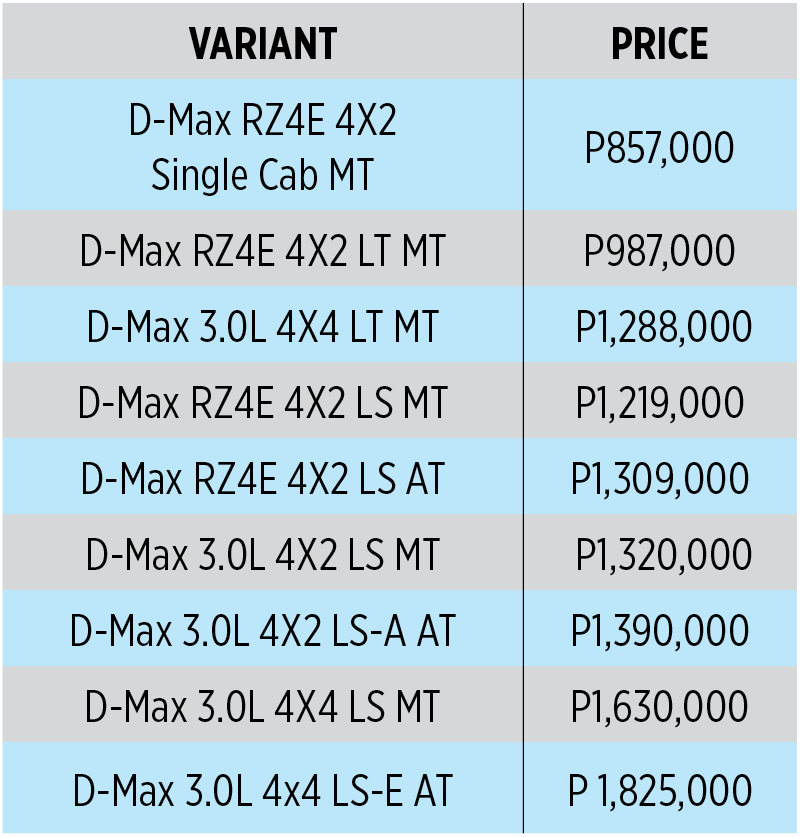
The pickup is available at the special introductory prices below.

IPC also shared that the first 200 customers who will reserve and purchase the vehicle will receive a special-edition Isuzu D-Max Miniature. Additionally, 50 limited-edition D-Max G-Shock watches will be raffled off to all qualified customers nationwide. For more information, visit www.isuzuphil.com or an Isuzu dealership.

ADVERTISEMENT
ADVERTISEMENT