Home Blog Page 8391

Climate change risk mitigation good for fiscal metrics

By Luz Wendy T. Noble, Reporter

RESPONDING to climate change risks will benefit the Philippines in terms of debt servicing, as well as boost its credit rating, an International Monetary Fund (IMF) official said.

“Joining the global effort to tackle the climate crisis will not only help protect the planet, but can also help strengthen public finances in the Philippines,” IMF Representative to the Philippines Yongzheng Yang said in an e-mail to BusinessWorld.

Although the Philippines entered the crisis with a “favorable” debt position due to its macroeconomic policies in the past, Mr. Yang noted the country’s debt level will inevitably rise along with other economies due to the pandemic.

An IMF paper published by economists Serhan Cevik and Joao Tovar Jalles found that countries that are less resilient to climate change risk may have to incur higher cost of government borrowing. It showed that an increase of 10 percentage points in climate change vulnerability is associated with an over 150 basis points increase in long-term government bond spreads of emerging markets and developing economies.

“These results highlight the importance of improving resilience to climate change in managing public debt sustainability, especially for emerging markets and developing economies,” Mr. Yang said.

In its 2019 Article IV Consultation and Staff Report for the Philippines, the IMF said the country faces “significant” risks from its standing as one of the most vulnerable to climate change.

While it noted the Philippines has taken some steps to combat climate change, the IMF said more can be done through the allocation of more resources and initiatives for climate change adaptation and mitigation. Boosting resilience against climate change could also help the country battle against a rise in poverty incidence, it added.

The World Bank estimated an average of P177 billion is lost in public and private assets due to typhoons and earthquakes in the Philippines every year.

Climate change risks are also considered by debt watchers in assigning credit ratings.

In a report released last Friday, S&P Global Ratings said their economic assessment on sovereigns include potential adjustment for volatility in economic output that could be caused by constant exposures to natural disasters or adverse weather conditions.

“Environmental risks are embedded in our assessment on the Philippines’ creditworthiness. Natural disasters may have an impact on a government’s fiscal position, especially where significant aid is distributed to hard-hit regions, and revenues are adversely impacted,” S&P analyst Andrew Wood said in an e-mail to BusinessWorld.

S&P in May 2020 affirmed its BBB+ long-term credit rating for the country, citing expectations for recovery in 2021 following the crisis caused by the pandemic. It expects the economy to grow by 9.6% this year following a record 9.5% contraction in 2020.

“The government has in the past maintained modest fiscal deficits, even in years where the Philippines suffered damaging weather events,” Mr. Wood said.

The country’s budget deficit in 2020 stood at P1.371 trillion, equivalent to about 7.63% of the gross domestic product. This is more than double the P660-billion gap in 2019 which is about 3.38% of the country’s economic output.

Finance Secretary Carlos G. Dominguez III, who is also the chairperson of the Climate Change Commission, has said the government’s recovery programs should be tailor-fitted to attract investments in domestic renewable energy, sustainable urban planning, and climate-smart agriculture.


Market regulators set to probe unlisted shares of Abra Mining

MARKET regulators have teamed up to look into the case of Abra Mining and Industrial Corp., which the stock exchange earlier found to be selling shares beyond the number listed on the local bourse.

“The Securities and Exchange Commission (SEC), The Philippine Stock Exchange, Inc. (PSE) and Philippine Depository & Trust Corp. (PDTC) are working closely together to investigate the trading of unissued and unlisted shares of Abra Mining and Industrial Corporation (AR), and to pursue the necessary actions to protect investors,” the market regulators said in a joint statement released on Saturday.

The PSE suspended the trading of Abra Mining shares on Thursday, after the company was found to be violating three rules based on reports and disclosures.

The number of the company’s fully paid issued and outstanding shares is over Abra Mining’s listed shares, which is not allowed according to PSE rules as all fully paid issued and outstanding shares should be listed.

Abra Mining’s lodged PDTC shares also outnumber the company’s listed shares when only approved securities should be lodged with the registry for trading.

“In a parallel preliminary fact-finding investigation, the SEC found that AR had 258.96 billion shares lodged with PDTC as of February 16, 2021. The number exceeds by 186.01 billion shares the 72.95 billion shares the company has listed with PSE,” regulators said.

In their statement, the regulators said they had found more discrepancies.

“In its 2019 audited financial statements, AR only reported an issued and outstanding capital stock comprising 99.29 billion shares,” the market regulators added.

Finally, the company was found selling issued and outstanding shares despite not being reported on the company’s PDTC books, violating the provisions of Republic Act No. 11232 or the Revised Corporation Code (RCC) of the Philippines.

The RCC provides that shares, even if not fully paid, should be reflected in the company’s books.

Stock certificates must also be signed by the president or vice-president of the corporation, to be supported by a signature from the secretary or assistant secretary, before being set with the corporation’s seal.

Certificates are issued only when the subscription has been paid. This already includes interest and, for delinquent shares, the expense.

To lodge securities with PDTC, certificates must be delivered to the transfer agent.

Transfer agents act as the extension of the corporation’s corporate secretary, and are the only officials who have the authority and responsibility to certify that all of the company’s shares qualify for the lodging requirements of PDTC and the PSE.

The securities will only be deemed fungible and may be used to settle trades if these are lodged in the central depository.

“Among the requirements is that the transfer agent must issue or register only those securities of the corporation that are authorized for issuance and listing by the PSE, and must timely notify PDTC if the shares delivered are found not valid or defective,” the market regulators explain.

Defective securities are defined as those “which are counterfeit, invalid, forged, improperly altered, nonnegotiable, subject to an adverse claim, not free from any liens, encumbrances, assessments or charges of any kind, subject to any restriction or prohibition on transfer through the PDTC system.”

However, the market regulators also said that Abra Mining’s transfer agent confirmed and cleared every single one of its shares listed on the system.

“The SEC, in coordination with the PSE and PDTC, will continue investigating the issue not only to resolve the current incident, but also to find system-wide measures to prevent its recurrence. In the meantime, AR was ordered to submit its proposed actions to address the discrepancies in its issued, outstanding, listed and lodged shares,” the market regulators said. — Keren Concepcion G. Valmonte

Five firms keen to negotiate sale of P1.85B Malaya plant

FOUR Filipino companies and a Chinese construction firm have expressed interest in 650-megawatt Malaya thermal power plant through a negotiated sale, the state agency tasked to sell the asset said about a month after reducing its floor price prompted by several failed bids.

Over the weekend, the Power Sector Assets and Liabilities Management Corp. (PSALM) said it had received letters of interest (LoI) from companies that wanted to take part in the negotiated sale of the plant and its underlying land in Pilila, Rizal.

State-led PSALM identified the companies as Sta. Clara International Corp., VBB Trucking Trading and Consultancy Services, Inc., Fort Pilar Energy, Inc., AC Energy Philippines, Inc., and foreign firm China Gezhouba Group Co., Ltd.

The five companies, which submitted the letters of interest on or before the deadline, are allowed to participate in the third round of the Malaya plant’s negotiated sale, according to PSALM’s rules.

“PSALM looks forward to a successful privatization process for the Malaya Power Plant. We are excited that five firms expressed interest to join the process. We have lowered the minimum offer price already. Hopefully, this round will allow us to finally sell the Malaya Power Plant,” PSALM President and CEO Irene Joy Besido-Garcia said in a statement.

The agency said the minimum price offer for the Malaya plant and its assets was further reduced to around P1.85 billion from P2.01 billion, which was the minimum price offered in the second round of negotiated sale.

PSALM said that it would hold a pre-negotiation conference for the five interested buyers on March 9 to discuss issues and concerns about the terms of the sale. The deadline for offer submission is on April 23 at noon.

The Department of Energy earlier said that the mounting bill for the Malaya power plant had forced PSALM to pursue a negotiated sale for the asset, citing unsustainable maintenance costs and years of failed auctions.

In its 37th status report on the implementation of Republic Act No. 9136 or the Electric Power Industry Reform Act or 2001, the department said that it costs around P1.2 billion a year to maintain the plant. The number was based on the Malaya plant’s upkeep from 2010 to 2019.

In September, PSALM declared a failure of its third-round auction to privatize the power plant and its assets, since the two pre-qualified bidders Panasia Energy, Inc. and AC Energy Philippines did not submit a bid. The auction floor price at that time was pegged at P2.19 billion, less than half of the previous round’s P4.48-billion minimum.

PSALM had said that the Malaya plant remained operational. The power source is dispatched as a “must-run” unit, or a facility that is compelled to run and provide the needed power to ensure reliability of supply in the grid.

PSALM is privatizing energy assets to settle financial obligations assumed from the National Power Corp. — Angelica Y. Yang

A watch for every season

HAVING 140 years of timekeeping in its history, Seiko has made it an imperative to explore the true nature of time. Their findings are recorded in their designs, made to reflect time’s passage through the planet, as reflected by the seasons.

In a keynote address at the Grand Seiko Online Summit 2021, Shinji Hattori, Chair and CEO of the Seiko Watch Corp., discussed his great-grandfather, Seiko founder Kintaro Hattori. Seiko celebrated the 160th anniversary of his birth in 2020, while 2021 marks the 140th anniversary of the company’s founding when Mr. Hattori was only 21 years old. The company was founded during the Meiji Era, when Japan opened its doors to the West. “Everything was changing, even the way that the Japanese told time changed. The old system, in which time units varied with seasons, changed to more precise western systems. It was in this change that he saw his chance.”

The senior Mr. Hattori, who founded the company in 1881, began by importing clocks, but expanded to watchmaking by the 1890s. His great-grandson Shinji Hattori lives by his grandfather’s maxims: “He always stated that Seiko should always be one step ahead of the rest,” he said, and “Don’t run; but always keep going.” With these in mind, Mr. Hattori announced that they have opened a new company for Grand Seiko (Seiko’s luxury line) in New York, opening a new studio, and several boutiques. “We did all this as part of our strategic vision; not for overnight success, but for the good of our customers in the long run,” he said.

“His words still resonate with me today. They continue to inspire me, and all of us at Seiko as we face new challenges and look to build a better future.”

A TRIBUTE TO THE SEASONS
Grand Seiko’s new collection is hinged on the caliber Hi-Beat 36000 9SA5. It delivers a precision rate of +5 to -3 seconds a day and has a power reserve of 80 hours, with a Dual Impulse Escapement they developed themselves.

Outside, the dials reflect a marriage of art and nature; occupying space and recording time in tune with the new caliber. For example, the Series 9 case replicates the look and feel of grained wood, to reflect the rings that show a tree trunk’s age.

Akio Naito, Deputy COO and Director of Seiko said, “We recognize not four, but 24 seasons. In Japan, each of the four seasons is experienced in six phases.” Each segment is called a sekki, each with a special name, and these experiences are reflected in a series of four watches.

Shunbun, denoting the spring equinox, has a green dial and rose gold accents to show the promise of Sakura blossoms. Summer is reflected with Shōsho, showing the early summer sun and wind creating ripples on a lake’s surface. Kanro, a watch with a dark face, tries to show clouds moving across an autumn moon. Finally, TŌji absorbs the winter solstice with a snow dial and an orange hand, showing a winter sunset. The spring and summer watches are powered with the caliber 9S86, while the autumn and winter watches are powered by the 9R66. The spring and summer watches are slated to be launched worldwide in May, while the autumn and winter watches are slated to come out in September.

“The Japanese affinity and respect for the natural environment lies at the heart of every Grand Seiko. Our view of the nature of time is experienced in the precision of its movements and the artistic design of each piece,” said Mr. Naito. — Joseph L. Garcia

Isuzu PHL picks up the all-new D-Max

The third generation of the popular pickup finally arrives

By Kap Maceda Aguila

IT WAS not an overstatement when Isuzu Philippines Corp. (IPC) said that arrival of its pickup model’s all-new iteration has been much-awaited. The third generation of the Isuzu D-Max debuted way back in 2019 (in Thailand), and local fans and industry observers had been twiddling their thumbs in anticipation of the local release.

The reason is pretty obvious, if you ask the country’s top truck brand for more than two decades. The market knows that Isuzu knows how to engineer workhorses like trucks and, yes, pickup trucks. IPC President Hajime Koso said that, after six years of research and four million kilometers of testing, Isuzu now presents the “ultimate” pickup.

“We are very excited to introduce this model to the Philippine market — a market that has been particularly special for us since there are a lot of scenic routes and challenging terrains all over the country that a pickup and 4×4 enthusiast would love to traverse, especially on the weekends. Because of that, we’ve made sure that the all-new D-Max will have a wide range of choices to cater to every consumer’s needs,” he continued.

The brand now positions the pickup with three key values: bold, emotional, and smart — and is seen to “break the barrier between trucks and passenger cars.”

Indeed, there appears to be a decidedly polished image for the D-Max in that it boasts more bells and whistles typical of sedans and even SUVs — not the kind you’d expect in “utilitarian” pickups. It’s not a new concept of course, this “sedanification” of light commercial vehicles, but this iteration of the D-Max surely represents Isuzu taking the fight to its rivals in the segment.

While we’re on the topic, there are lofty expectations that come with the arrival of the D-Max. The company is looking at growing its category share from 8% last year to 15% when 2021 is done. Replying to a question from “Velocity” during the Q&A portion of the launch last week, IPC Product and Marketing Department Head Robert Carlos said that the D-Max, with its complement of 4×4 variants is also eyeing to capture 30% of that particular niche. “The competition is tough, that’s why we loaded it up, particularly the LS-E,” he averred.

Now onto the shiny new things of the D-Max.

Powering the all-new model is a choice between a new engine and an improved one. The new 3.0-liter 4JJ3-TCX uses a “highly advanced Isuzu common rail system” good for 190ps and 450Nm; the RZ4E-TC “promises faster acceleration and better overtaking performance” from an enhanced output of 150ps and 350Nm.

Another comes in the form of a single-piece aluminum tail shaft, along with an impressive 800mm water-wading capability. Inside, the D-Max gets a redesigned steering wheel given tilt and telescopic adjustment for increased convenience. Even the gear lever for both MT and AT variants has been altered for “better gear selection and control.” The pickup also receives a Terrain Command Select Dial, and electronic differential lock for all-terrain capability.

Isuzu said the D-Max has a new front suspension geometry, larger side rails in its chassis and eight cross members for better torsional rigidity. The ride and safety promise to be bettered by a new rear leaf spring design, ultra-high tensile steel-reinforced cabin, and a semi mid-ship engine design (the last is in aid of weight distribution).

Its infotainment system is predicated on a 10.1-inch screen with Bluetooth connectivity, Apple CarPlay, Android Auto and voice control — finding expression in a “dynamic sound system.” Isuzu has also improved the navigation system. “The new D-Max also comes with a welcome light system which automatically illuminates the cabin room when the driver is approaching the vehicle. Along with this (is) a new auto lock system, follow-me-home light function, new turn indicator function and a remote start functionality,” reported IPC.

The vehicle comes with a slew of safety features: anti-lock brakes, electronic brakeforce distribution with brake assist, electronic stability control with traction control system, hill start assist and hill descent control, and a brake override system.

For the top variant (the 3.0 LS-E), Isuzu throws in an advanced driver assist system that “employs state-of-the-art sensors and a first-in-its-class Smart Duo Cam that enables the D-Max to constantly monitor the surrounding environment.” Isuzu piles on the active and passive safety measures: forward collision warning, autonomous emergency brake, turn assist, pedal misapplication mitigation, adaptive cruise control, manual speed limiter, lane departure warning, blind spot monitoring, rear cross traffic alert, parking aid, and multi-collision brake.

The D-Max also comes with seven air bags, and has been given a five-star safety rating by the ASEAN New Car Assessment Program (NCAP).

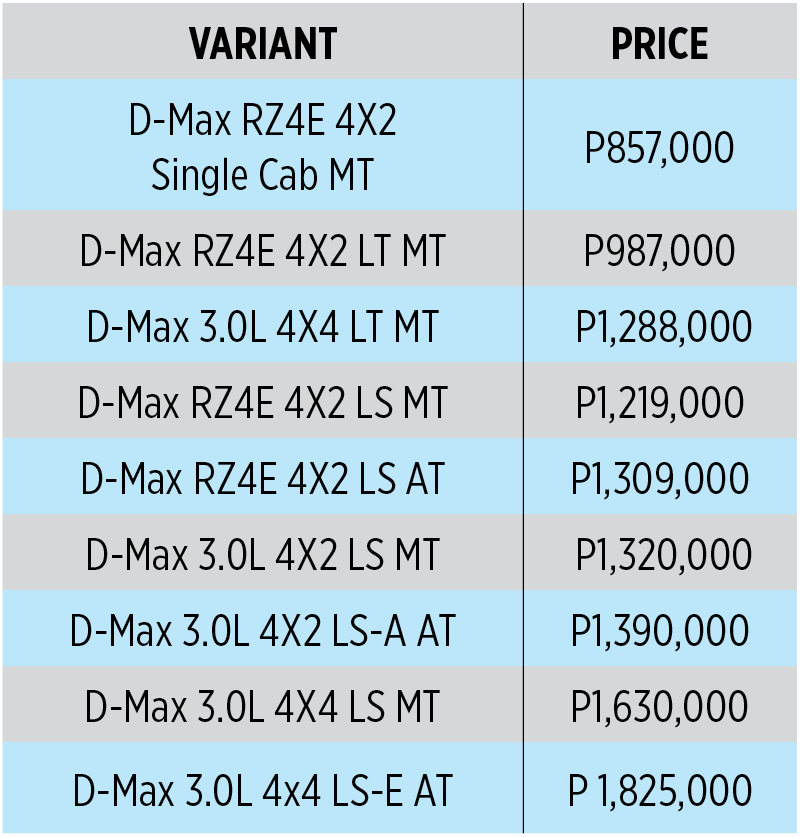
The pickup is available at the special introductory prices below.

IPC also shared that the first 200 customers who will reserve and purchase the vehicle will receive a special-edition Isuzu D-Max Miniature. Additionally, 50 limited-edition D-Max G-Shock watches will be raffled off to all qualified customers nationwide. For more information, visit www.isuzuphil.com or an Isuzu dealership.

Monde Nissin eyes market expansion in US via Quorn

MONDE NISSIN CORP., the manufacturer of Lucky Me! instant noodles and SkyFlakes biscuits, is planning to further expand in the United States through its Quorn Foods brand, which offers consumers healthier alternatives to meat.

The brand has tapped US athletes to be its brand ambassadors. It has also entered a partnership with the Boston Red Sox Major League Baseball team as part of its collaboration with the Liverpool Football Club.

Quorn Foods previously boasted a 10.5% market share in the US, after focusing on the frozen foods category in several states.

“Quorn Foods will look to further deepen its foothold in these regions and broaden its presence in other parts of the country by focusing on expanding the product portfolio with localized innovations and increasing brand awareness,” the company said in its preliminary prospectus filed with the Securities and Exchange Commission on Thursday.

“Quorn Foods will focus on retail and food service channels with selected product groups such as chicken,” Monde Nissin added.

The brand is set to launch its own vegan sausage, a dinosaur-shaped chicken product for children called “Roarsomes,” and a variety of other “chicken-style” products.

Quorn Foods will be prioritizing investing in its production capacity in the US. A new management role based in the US was appointed in February 2021 to steer the direction for the brand’s planned expansion.

In addition, Quorn Foods said it revamped its senior management team, which “now has a strong balance of functional and industry experience, combined with a diverse global background” and also engaged several researchers to look into the health benefits and overall product performance.

After working with Greggs, KFC, Costa and Pizza Hut in the United Kingdom, and Hooters in the US, the brand also plans to expand globally.

“Quorn Foods will start by leveraging off its existing presence in key European markets, developing the right localized portfolio for selected markets and preparing for long-term high growth. Additionally, it will prepare for future opportunities in selected Asian markets, especially where it or [Monde Nissin] has an existing presence,” Monde Nissin said. — Keren Concepcion G. Valmonte

Couturier Ben Farrales, 89

ESTEEMED fashion designer Benjamin S. Farrales, died on March 6. He was 89. Otherwise known as Mang Ben to friends and high society clients, Mr. Farrales was hailed as the “Dean of Philippine fashion.”

Born in Cotabato in 1932, the multicultural milieu in that region would set the tone for his designs. The intricate local dress of the Muslim women and the indigenous people of the area colored his work at a time when many designers looked to the West. While indigenous fabrics and embellishments are experiencing a renaissance now, Mr. Farrales had been using these materials since his career started.

In an excerpt from the book Ben Farrales, Fifty Years in My Fashion by Abe Florendo, he recounted how he started out as a sweeper and a go-fer for a high-end dress shop in the 1950s. After two years in this apprenticeship, he opened his own shop in Malate. Here, socialites zipped in and out, and his career took off while dressing some of the nation’s best-known names.

Quoting again from In My Fashion, the couturier said, “Back then, women had money to spend. There were endless parties. Women nonchalantly changed clothes twice or three times a day. Rich families vied with one another for the grandest weddings, birthdays, and debutante balls. They knew what they wanted and they could talk endlessly about clothes.”

The official page of Designers Circle Philippines released a statement saying, “A tremendous loss for the world of fashion —  The Designers Circle Philippines mourns the passing of the ‘Dean of Philippine Fashion, Mang Ben Farrales.’

“We find it heavy in our hearts to grasp that a few days after we have endorsed him for the National Artist Award for Fashion and a few more steps before he was accorded this recognition, Mang Ben is no longer with us. But as Filipino designers, we will continue to celebrate and commemorate his legacy!”

His passing drew an outpouring of reactions from the fashion industry on social media.

Fashion designer Francis Libiran said in a Facebook post, “Rest In Peace Mang Ben Farrales. You will be sorely missed.” Jewelry designer Gerry Sunga also posted in Facebook, “Farewell for now Dearest Mang Ben. Maraming, maraming salamat po sa pagmamahal (thank you for the love)… the whole Fashion industry mourns of your passing and will miss you.”

Model Marina Benipayo posted a photo in which she wears one of his creations with the caption, “It was an honor, Mang Ben Farrales. Rest peacefully in God’s loving arms.” Actress Teresa Loyzaga did the same with a post showing her wedding gown, saying “Thank you for being a wonderful Ninong (godfather) to me. You will be missed. I love you! Rest easy.”

“Truly a legend and a trailblazer. His designs not only pushed fashion forward but I feel like it was always ahead of its time    while being timeless,” said Jodinand Aguillon, founder of Filipiniana vintage store Glorious Dias, in an Instagram message.

The passing of Mr. Farrales ends an era in fashion, with him serving as a link to a more glamorous past. In a story from 2013, BusinessWorld witnessed a retrospective of Mr. Farrales’ designs at Philippine Fashion Week. “To close the show, Mr. Farrales was taken onstage to the tune of his favorite song, ‘My Way.’ As he made his way to the end of the runway, confetti rained down on him and his models as an aria played in the background. He received a standing ovation from the crowd. The fantasy figures he created —  brides, queens and goddesses —  made real by his models, stood around him and joined the crowd in celebration.”

In 2015, Mr. Farrales was awarded the Gawad CCP para sa Sining Disenyong Pangmoda (Fashion Design). In a video by the Cultural Center of the Philippines, he said, “I know what I stood for and what I want, and the doors opened to me. When you have the talent, you will never lose.” — Joseph L. Garcia

Dassault Aviation: Manila airport should match growing business aviation market

By Arjay L. Balinbin, Senior Reporter

AIRPORT infrastructure in the Philippine capital should adapt to the growing business aviation market, business jet maker Dassault Aviation said, noting that Clark and Subic airports are not ideal locations for Manila-based businessmen.

“The growth of the Philippines’ business aviation market, very specifically in the region of Manila, is extremely dependent on the evolution of infrastructure,” Jean-Michel Jacob, Asia Pacific president of Dassault Aviation civil aircraft, told BusinessWorld in a recent e-mail interview.

He noted that airport infrastructure should “support the growth of general aviation and business aviation.”

“Some measures have led many business jet operators to move out of Manila and relocate to Clark Airport or Subic Bay International Airport, which are available to business jets but not the most convenient airports for Filipino business people who are based in Manila,” he said.

“This is probably the most critical challenge the general aviation and business aviation sector faces in the Philippines today, aside from the COVID-19 (coronavirus disease 2019) pandemic.”

To recall, Transportation Secretary Arthur P. Tugade issued Department Order No. 2016-019 on Oct. 9, 2016 directing aviation agencies to undertake the necessary measures to implement the transfer of all general aviation, except for helicopter operation and emergency medical airlift services, from the Ninoy Aquino International Airport (NAIA) to other alternative gateways.

Mr. Tugade noted the NAIA congestion had become a critical issue “necessitating immediate and concerted government action.”

Despite the pandemic situation, the fleet of business jets in the Philippines remains “stable,” according to Mr. Jacob. “Business jet owners choose to retain their aircraft.”

The public health crisis has also triggered some appetite among some private customers who no longer want to travel via commercial airlines due to their “erratic schedule and concerns about sanitary hazards” on-board these flights, he said.

The company, he noted, receives more inquiries from Philippine-based customers these days about its Falcon business jets.

“Dassault Aviation answers to these inquiries for business jets proposing the type of aircraft most adapted to the prospective buyer requirement — Falcon 2000LXS and Falcon 900LX to fly non-stop to different destinations in Australasia; Falcon 6X, Falcon 7X and Falcon 8X for non-stop intercontinental flight to Europe and the Americas,” Mr. Jacob said.

“We are in active discussions and certainly expect to secure some contracts with these potential customers, who have shown an interest in our aircraft, depending of course on how the pandemic will affect the Philippines from a health and economic stand-point,” he added.

Dassault Aviation expects the current regulations imposed on travelers, especially on those arriving in the Philippines or flying overseas, to ease in the second half of the year given the ongoing vaccine rollout.

The Manila International Airport Authority (MIAA) recently completed the upgrade of NAIA’s airside facilities.

“The MIAA is confident that when additional airside-related projects are completed within the years 2021 and 2022, it can, on its own, achieve the goal of 60 commercial flight movements per hour,” the Department of Transportation said in a statement in February.

Manila’s main airport has been operating beyond its 30.5 million passenger capacity, handling 45.3 million passengers in 2018, 42 million in 2017 and 39.5 million in 2016.

The MIAA board had revoked the P109-billion NAIA rehabilitation project proposed by Megawide Construction Corp. and its foreign partner GMR Infrastructure Ltd. It also rejected the appeal filed by the Megawide-GMR tandem.

According to Mr. Tugade, MIAA General Manager Ed V. Monreal had spearheaded improvements at the NAIA terminals even before any talks of unsolicited proposals.

Truly electrifying

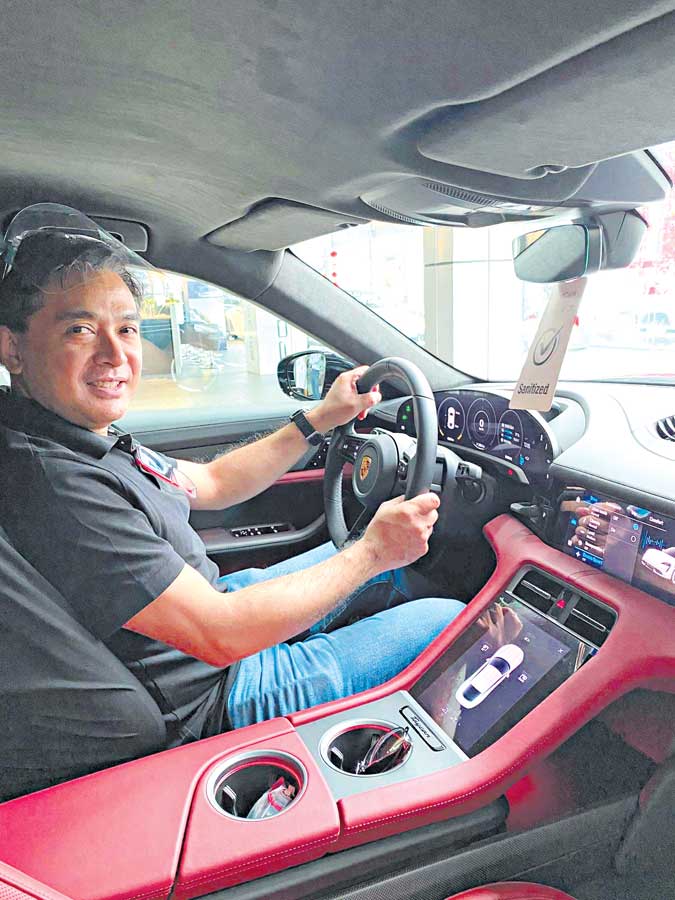
On the road aboard the Porsche Taycan Turbo S

MORE THAN top speed, the zero-to-100kph benchmark is something most car owners can relate to. It is also a performance measurement that Porsche has dominated since 1975, when the seminal Porsche 911 Turbo set a then-record five-second run.

Today, many high-performance cars — even sedans and SUVs — can accelerate from standstill to 100kph in five ticks. Several models can do it in four seconds; a few can do it in three.

But only a select handful can break the 100kph barrier in less than three seconds.

And the crown still belongs to Stuttgart.

I have driven the all-electric Porsche Taycan and it absolutely rules the zero-to-100 contest with its 2.8-second official clocking. But you know what? From behind the wheel and with unofficial timing from a smartphone, it registered a 2.3-second time (Porsche is traditionally conservative with its performance claims and usually allows the global media to repeatedly better its claims).

Bursting with an awe-inspiring 1,050Nm of torque and equipped with Porsche’s superbly effective Launch Control (plus all-wheel drive), there is no engine roar, no tire squeal, and no letup on the massive forward thrust — just sheer, furious, unrelenting acceleration that makes you feel lightheaded.

And all I had to do was step on the brake with my left foot, flick the tiny dash-mounted gear lever to Drive, floor the accelerator pedal with my right foot, wait for the Launch Control light to illuminate on the instrument panel (which turns on in an instant), then release the brake pedal while keeping my right foot floored.

If your head is not resting on the headrest, it will slam backwards from the incredible g-force as the car rockets forward almost like it was catapulted from a sling shot. The sensation you feel in your stomach is akin to a roller-coaster ride that suddenly drops down a steep vertical slope. Literally breathtaking.

The Taycan is Porsche’s first full-electric model and is now available locally — no less than the flagship version, the AWD Taycan Turbo S. (The “entry-level” rear-wheel drive Taycan, which is anticipated to be priced almost half of the Taycan Turbo S, is expected to arrive in March.)

The Taycan Turbo S generates 761ps to match its 1,050Nm of torque. This four-door sports car brings supercar performance and matches it with a driving range of up to 412 kilometers (the distance from Manila to Vigan). It’s the first production electric vehicle with a system voltage of 800 volts instead of the usual 400 volts common among electric cars, allowing for quick battery-charging times.

The Taycan Turbo S uses a high-powered DC Charger that can deliver up to 175kW of power—the first of such type in the Philippines. Fitted with a 15-inch touchscreen display interface and a Combined Charging System Type 2 plug, this unit can charge the Taycan Turbo S from 10% to 80% capacity in about 30 minutes, which is good for a range of nearly 300 kilometers. The 175-kW charger can yield up to 65 kilometers of driving range from a single five-minute charge. Yet another neat feature is the Taycan’s navigation system that shows a map outlining the driving radius of the car given its current state of battery charge.

Each Taycan from Porsche Philippines comes with a Porsche Mobile Charger Connect, an AC charger with a five-inch touchscreen display including smart features such as adjustable current rating, charging history and PIN lock. The charger can be plugged into any household socket, or into an industrial socket for faster overnight (nine hours) charging.

Despite its four-door body style, the Taycan is a genuine sports car more closely related to the iconic 911 than the similar four-door (but substantially longer) Panamera. Your body sits just as close to the ground in the Taycan as in the 911, yet despite the numerous humps we encountered around Greenhills and Green Meadows, the car never scraped its belly (the air suspension is height-adjustable). True to the brand, the Taycan pairs typical Porsche performance with Porsche’s vaunted everyday usability. It’s no surprise that the Taycan quickly became the best-selling Porsche car in many markets.

The level of craftsmanship and the use of the most luxurious materials in the cabin is pure Porsche. Space in the back is best described as adequate — certainly not confining or claustrophobic but falling short of “legs crossed” space. If you want to be chauffeur-driven in a four-door Porsche, the Panamera is still the car for you. The Taycan is for those who want the driving dynamics of a 911 but need real-world space for backseat passengers.

And in that respect, the Porsche Taycan absolutely shines. It brings with it more than a half-century of Porsche motorsports heritage and takes it to the next level in terms of performance and technology. That it helps by helping eliminate exhaust emissions in our pollution-choked world and being a wonderfully performing automobile is much more than just the icing on this delectable cake.

Digital shows here to stay as fashion week gets a makeover

NEW YORK —  From models strutting inside an empty museum to designers absenting themselves from the catwalk calendar, this season’s virtual fashion weeks have been re-styled with a new look many expect will endure when traditional runway shows resume.

Coronavirus disease 2019 (COVID-19) restrictions forced New York, London, Milan, and Paris fashion weeks to go virtual in the past year, with brands rethinking how to keep the buzz of catwalk shows online. While many are optimistic of a return to the events usually attended by buyers, editors, and celebrities, digital presentations —  which have opened up fashion week to a wider audience —  are likely to stay on.

“Digital first is absolutely something that we will continue to see,” British Fashion Council Chief Executive Caroline Rush told Reuters.

While streaming shows is nothing new, the pandemic has accelerated a shift in an industry that in recent years turned to social media to target younger spenders.

Some labels, including Gucci and Tommy Hilfiger, sat out fashion week this season. Versace is presenting its collection after its usual showcase, Milan Fashion Week, ends.

“We will see physical runway shows from these very large brands who can afford to put on multimillion dollar entertainment events. But they may not be during the traditional fashion week and they may have audiences that are primarily made up of customers,” Lauren Sherman, chief

correspondent for The Business of Fashion, said.

“There’s been a real shift in the balance of power that was already happening… But now there’s proof of concept that if you want to ignore fashion week, it’s probably not going to hurt your bottom line.”

Foregoing the usual expensive catwalk events, most brands streamed pre-recorded videos on a fashion week platform. On show this season were plenty of bright colors to lift moods in an industry that saw stores, factories, and studios shut in the pandemic.

“A large part of fashion week outside of the shows was the community getting… together and feed(ing) off of that creativity and so, with that lacking, it’s not the same,” designer Rebecca Minkoff, one of the few to hold a live presentation in New York, said.

“But for those who are able to be creative and innovative, now is the time to figure out how you pivot and for those that do, I think there is great opportunity.” —Reuters

ERC approves Tarlac Electric’s P300-million capex program

TARLAC ELECTRIC, Inc. has secured regulatory approval for its 2019 to 2020 capital expenditure (capex) program for projects amounting to P300.96 million, or lower than the distribution utility’s proposed cost.

In a decision published on its website on March 2, the Energy Regulatory Commission (ERC) said that the approved amount covered the upgrading of the Maliwalo substation; and upgrading of the full supervisory control and data acquisition systems in six areas.

The capex also covered the construction of communication towers for the utility’s offices and substations; acquisition of extra servers and storage systems for its network; acquisition of additional cyber security and threat protection project and purchase of service vehicles.

Tarlac Electric previously asked the ERC to approve P304.10 million to fund its various capex projects. The commission approved a lower amount based on its own calculations of the company’s capex projects.

Based on the approved project costs, the ERC directed Tarlac Electric to pay around P2.26 million in permit fees.

The decision was signed by ERC Chairperson and Chief Executive Officer Agnes VST Devanadera and two commissioners on Dec. 16, 2020. The decision was promulgated on Tuesday.

On Nov. 20, 2020, Tarlac Electric said that it was looking to raise P603.75 million in a public offering to comply with requirements under its legislative franchise. The firm earlier said in a prospectus that it wanted to register four million issued and outstanding common shares, from which it will offer 1.75 million shares at P345 apiece.

Tarlac Electric is a private electric distribution utility that has been supplying electric power to residentials and commercial establishments for over 70 years. In 2018, it reported a peak demand of 79,900 kilowatt, and a customer base of about 80,000.

Distribution utilities are obliged to provide services and connections to customers within their franchise area. They must upgrade and expand their facilities to meet growing customer demand. The ERC ensures that the pass-through costs sought by utilities are justified. — Angelica Y. Yang

Rates of Treasury bills, bonds to rise as inflation hits fresh peak

YIELDS ON government securities on offer this week will likely continue rising after February inflation hit a 26-month high.

The Bureau of the Treasury (BTr) wants to borrow P20 billion via the Treasury bills (T-bills) on Monday: P5 billion each from the 91- and 182-day debt papers and P10 billion via the 364-day instruments.

On Tuesday, the BTr will auction off P30 billion in reissued 10-year Treasury bonds (T-bonds) with a remaining life of six years and one month.

The rates of the T-bills will likely inch up by up to five basis points (bps) at this week’s auction, Security Bank Corp.’s Chief Investment Officer for Trust and Asset Management Group Noel S. Reyes said, while a bond trader expects the short-term papers’ yields to rise by as much as 10 bps.

“Market is still fixated on inflation given rising oil and commodities prices,” Mr. Reyes said via Viber on Saturday.

Consumer prices rose faster for a fifth straight month to a 26-month high in February as food prices continued to surge, the Philippine Statistics Authority (PSA) reported on Friday.

Preliminary data from the PSA showed headline inflation at 4.7% last month, picking up from 4.2% in January 2021 and 2.6% in February 2020. The February inflation result marked the fastest pace since the 5.1% in December 2018.

The latest headline figure was a tad lower than the 4.8% median in a BusinessWorld poll but fell within the 4.3%-5.1% estimate given by the Bangko Sentral ng Pilipinas (BSP) for February.

Year to date, February inflation settled at 4.5%, beyond the BSP’s 2-4% target for the year.

Meanwhile, Mr. Reyes said the reissued 10-year T-bonds could fetch an average rate close to 4%, while the trader gave a 3.65-3.75% forecast range.

The trader said there continues to be ample demand for government securities despite the expected uptick in yields, but the volume of bids could be lower than the high tenders seen at the start of 2021.

The Treasury last week raised P20 billion as planned via the T-bills from P41.052 billion in bids, even as rates increased across the board.

Broken down, it borrowed the programmed P5 billion via the 91-day debt papers as tenders reached P7.595 billion. The three-month papers fetched an average rate of 1.04%, up from the 0.875% seen at the Feb. 22 auction.

It also raised P5 billion as planned from the 182-day T-bills from P8.462 billion in bids. The average rate for the six-month debt went up to 1.226% from 1.067% previously.

Lastly, the government made a full P10-billion award of the 364-day debt papers from tenders worth P24.995 billion. The one-year securities saw yields climb to 1.68% from the previous rate of 1.527%.

Meanwhile, the last time the BTr offered the series of reissued 10-year bonds  on offer on Tuesday was on Jan. 19, when it raised P30 billion as planned after attracting P82.5 billion in demand.

The bonds fetched an average rate of 2.719%, down from 2.791% seen at the previous offering in December.

At the secondary market on Friday, the yields on the three-month, six-month and one-year T-bills were at 1.082%, 1.195%, and 1.683%, based on PHL Bloomberg Valuation Reference Rates published on the Philippine Dealing System’s website.

Meanwhile, the seven-year tenor — the closest benchmark remaining life of the 10-year bonds on offer on Tuesday — was quoted at 3.479%.

The bond trader added the continued rise in US Treasury yields could also drive local government bond rates up.

The benchmark 10-year US Treasuries’ yield hit 1.56% on Friday, up by 11 bps from 1.45% on Monday, based on the US Treasury’s website.

The BTr wants to raise P160 billion from the local bond market this month, broken down into P100 billion of T-bills to be offered weekly and P60 billion via auctions of T-bonds every other week.

The government is looking to borrow P3 trillion this year from local and foreign lenders to help fund its budget deficit seen to hit 8.9% of gross domestic product. — Beatrice M. Laforga