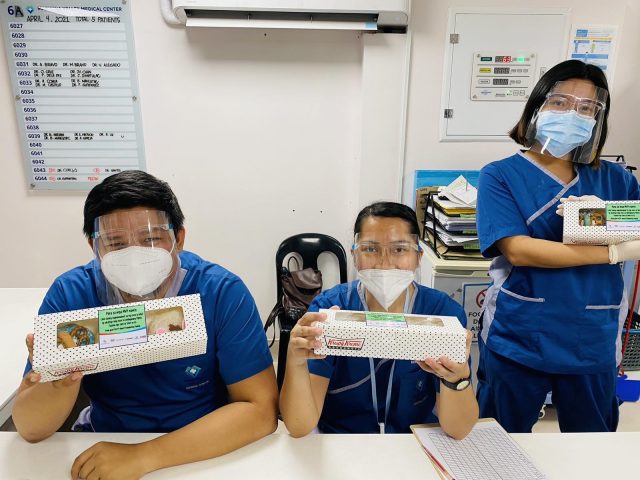
The country’s largest integrated telco, PLDT, Inc., its social outreach arm, PLDT-Smart Foundation, together with Tulong Kapatid, the corporate social responsibility consortium of foundations and companies led by Manuel V Pangilinan, has stepped up efforts to support frontline healthcare workers and affected communities during the second round of enhanced community quarantine (ECQ) at the National Capital Region.
On a daily basis, the group has been providing over 5,000 packed meals sourced from partner food outlets to frontline healthcare workers from Asian Hospital and Medical Center, Cardinal Santos Medical Center, Delgado Memorial, Delos Santos Medical Center, Makati Medical Center, Manila Doctors Hospital, Marikina Valley Medical Center, Our Lady of Lourdes Hospital, and Sacred Heart of Malolos.
“This is our way of supporting frontliners, and contributing a steady source of income to our partner food entrepreneurs during this challenging time. We are fully committed to help healthcare workers and affected communities combat the pandemic,” said Manuel V Pangilinan, PLDT Chairman, and CEO.
On Easter Sunday, the Pangilinan-led companies also provided hot meals and treats to public healthcare facilities including AFP Medical Center, Diliman Doctors Hospital, East Avenue Medical Center, Lung Center of the Philippines, National Kidney and Transplant Institute, Philippine Children’s Medical Center, Philippine General Hospital, PNP General Hospital, as well as Rizal Medical Center.
Created with RNI Films app. Preset ‘Agfa Precisa 100’
“The support means a lot to our doctors and nurses. We remain thankful and hopeful on this Feast of the Resurrection,” said Dr. Troy Baquir of East Avenue Medical Center.
Meanwhile, PLDT, together with the Alagang Kapatid Foundation, has provided hygiene kits and food packs to indigent communities severely affected by the lockdown. PLDT also partnered with the Makati Medical Center Foundation to provide blankets to the Armed Forces of the Philippines and Philippine National Police quarantine facilities as well as some frontline healthcare workers from the Makati Medical Center.
Tulong Kapatid, which includes Alagang Kapatid Foundation, Makati Medical Center Foundation, Maynilad, Metro Pacific Investments Foundation, PLDT, Smart, PLDT-Smart Foundation, Inc., and One Meralco Foundation, together with other Pangilinan-led companies, is set to provide more meals and PPEs to frontline workers nationwide.
The United States has put Johnson and Johnson (J&J) in charge of a plant that ruined 15 million doses of its coronavirus disease 2019 (COVID-19) vaccine and has stopped British drugmaker AstraZeneca Plc from using the facility, a senior health official said on Saturday.
J&J said it was “assuming full responsibility” of the Emergent BioSolutions facility in Baltimore, reiterating that it will deliver 100 million doses to the government by the end of May.
In a separate statement late Sunday, Emergent said it expects to align with the US government and AstraZeneca to ramp down manufacturing for AstraZeneca’s COVID-19 vaccine at its Baltimore plant.
The Department of Health and Human Services has also increased Emergent’s order by $23 million for expansion of production specific to J&J’s vaccine doses, Emergent added.
“The $23 million will be used for the purchase of biologics manufacturing equipment specific to Johnson & Johnson’s COVID-19 vaccine for the potential expansion of manufacturing of that bulk drug substance into a third suite of Emergent’s Baltimore Bayview facility,” the company said.
The Department of Health and Human Services facilitated the move, the health official said in an email, asking not to be named due to the sensitivity of the matter.
AstraZeneca, whose vaccine has not been approved in the United States, said it will work with President Joseph R. Biden, Jr.’s administration to find an alternative site to produce its vaccine.
White House officials did not immediately respond to a request for comment.
The development, first reported by the New York Times, further hampers AstraZeneca’s efforts in the United States. The government has criticized the drugmaker for using outdated data in the results of its vaccine trial. It later revised its study.
Workers at the Emergent BioSolutions plant several weeks ago conflated ingredients for the J&J and AstraZeneca vaccines, the Times said earlier in the week. J&J said at the time the ruined batch had not advanced to the fill-and-finish stage.
The government’s move to have the facility make only the J&J single-dose vaccine is meant to avoid future mix-ups, the Times said, citing two senior federal health officials.
The top US infectious disease doctor told Reuters on Thursday the country may not need AstraZeneca’s vaccine even if it wins approval.
The United States has loan deals to send Mexico and Canada roughly 4 million doses of the AstraZeneca vaccine, made at its US facility. — Shubham Kalia/Reuters
TOKYO — Japan may need to compile a supplementary budget for the current fiscal year to combat the economic blow from the coronavirus pandemic, a senior ruling party official was quoted as saying in a television program that ran on Sunday.
“If there’s any shortage of funds, we’d like to always respond aggressively including by compiling a supplementary budget,” Toshihiro Nikai, the ruling Liberal Democratic Party’s secretary-general, said in the program.
Prime Minister Yoshihide Suga, however, voiced caution over the idea of compiling a supplementary budget, stressing that the existing pool of funds would be sufficient to meet any unforeseen costs.
“We can respond flexibly to any necessary (spending) under the previous fiscal year’s third extra budget and this fiscal year’s state budget,” he told parliament on Monday.
Japan’s parliament last month passed a record 106.6 trillion yen ($963 billion) budget for the fiscal year that began in April, which features a 5-trillion-yen fund set aside for emergency spending related to the pandemic.
Government officials have said the emergency reserves would be enough to meet near-term spending to deal with the crisis.
But some analysts anticipate more spending to be announced as politicians clamor for the fiscal tap to be kept wide open, with the economy expected to have suffered a contraction in the first quarter due to soft consumption. — Leika Kihara/Reuters
Nestlé Philippines has attained a 50-50 gender balance for management positions, strengthening the representation of women in leadership roles. As for senior positions, 47% (vice presidents and upwards) are held by women.In photo is KJ Aguinaga, recently appointed as the first female factory manager at Nestlé in the Philippines.
In celebration of International Women’s Month, Nestlé Philippines recently held a series of online fora for its employees and external stakeholders tackling issues, challenges, and approaches in fostering diversity and inclusion in the workplace.
This year’s theme for the celebration is #ChoosetoChallenge, a call to action for all people to step up and challenge gender bias and inequality.
“At Nestlé Philippines which has been present in the country for 110 years, building diversity and inclusion in the workplace where everyone can thrive is a top priority. The pursuit of gender balance is key to Nestlé’s approach for accelerating diversity and nurturing inclusivity in our workforce,” said Chairman and CEO Kais Marzouki.
Nestlé Philippines provides men and women in its technical teams’ equal opportunities for advancement. Production lines of factories have been rendered “women-friendly” through process automation and tools.
Mr. Marzouki shared a number of the company’s milestones towards achieving gender balance:
Balance in Leadership Roles – Nestlé Philippines has attained a 50-50 gender balance for management positions, strengthening the representation of women in leadership roles. As for senior positions, 47% (vice presidents and upwards) are held by women.
Globally, Nestlé’s vision is to increase the representation of women in its top 200 senior executive positions through the Nestlé Gender Balance Acceleration Plan. Since its launch, the plan has driven a 25% increase in women for top senior executive positions.
Equal Pay – Nestlé has pledged to accelerate equal pay globally, which means that women and men are rewarded equally or similarly for performing the same work. Since 2019, monitoring for equal pay at Nestlé Philippines shows that in the last two years there have been no significant gender pay gaps at all levels in the workforce. Proactive prevention measures of total rewards review systems and talent management are in place to maintain equal pay across all levels in all roles.
Parental Support Policy – Women are empowered to excel in every role they play. The Nestlé Philippines Parental Support Policy was launched in February 2020 as a gender-neutral policy in response to evolving parental roles. Through this policy, fully paid leave for the primary caregiver is extended from 15 weeks to 18 weeks, while fully paid leave for the secondary caregiver is extended from 9 days to 4 weeks. The company uses the terms primary and secondary caregivers to signify support for all forms of family set-ups: biological or adoptive, including same-sex, and single parents, and legal guardians.
Balance in Candidate Sourcing – In sourcing talents, balanced representation is maintained regardless of role, by ensuring there is at least one female candidate in the pipeline.
Nurturing an environment in which Women can Thrive
Nestlé Philippines has made its factories’ production lines “women-friendly” through process automation and tools, giving men and women in its technical teams equal opportunities for advancement.
In a first for Nestlé in the Philippines, a female factory manager heading one of its production facilities was recently appointed.
The Makati Administrative Office has been certified as a Mother-Baby Friendly workplace with complete breastfeeding facilities. Today, All Nestlé factories are likewise equipped with breastfeeding facilities to support Nestlé moms. Paid lactation breaks are provided, as are daycare services.
ILO-ECOP Training for Women Employees in Business Soft Skills – Nestlé Philippines is the first food and beverage company in the country chosen to pilot the In Business Soft Skills Training Methodology of the International Labor Organization (ILO), facilitated by the Employers Confederation of the Philippines (ECOP). The initiative seeks to support enterprises in upskilling and broadening the critical soft skills of female employees working in Science, Technology, Engineering, and Mathematics (STEM)-related positions.
“Building diversity and inclusion in the workplace is a journey requiring a sustained commitment and unwavering focus. While we take pride in our milestones, what really counts is that these are making us a better and stronger organization, as the trusted Kasambuhay of Filipinos. The investments are worthwhile, not only for the organization but for society as a whole, because we all benefit from human empowerment, and in particular, empowered women,” Mr. Marzouki said.
PHUKET, Thailand — In Thailand, it’s the all-important tourism sector that has jumped to the head of the coronavirus disease 2019 (COVID-19) vaccination line, with the country’s most popular resort island embarking on a mass inoculation program two months ahead of the rest of the country.
The island of Phuket aims to deliver shots to at least 460,000 people—most of its population—as it gears up for July 1, when vaccinated overseas visitors will no longer be required to quarantine.
Phuket also has its own international airport and tourists would be able to roam the island freely without posing any coronavirus risk to the rest of Thailand’s population.
“If we can build immunity for 70–80% of the population on the island, we can receive foreign tourists who have been vaccinated without the need for quarantine,” Phuket’s Vice Governor Piyapong Choowong told Reuters.
While medical workers, members of the cabinet and the elderly were the first to be vaccinated, Thailand’s decision to prioritize Phuket over other parts of the country underscores the central role of tourism to the economy.
Spending by foreign tourists accounted for 11–12% of GDP pre-pandemic and the sector has been devastated by the virus with 1.45 million jobs lost since last year.
Just 6.7 million foreign tourists visited Thailand in 2020, spending some $11 billion. That compares with nearly 40 million in 2019, when they spent $61 billion.
The government wants to see at least 100,000 tourists come to Phuket in the third quarter. It also hopes that as vaccinations worldwide progress it will see a spike in demand in the fourth quarter and that nationwide some 6.5 million visitors will have spent 350 billion baht ($11 billion) by the end of the year.
“It’s a challenge. But that will contribute to GDP to some extent,” said Tourism Authority of Thailand Governor Yuthasak Supasorn.
“We don’t expect tourists will come in like a broken dam but we hope to have quality visitors with high spending.”
Visitors from Europe, the United Arab Emirates and the United States are expected to return first, Mr. Yuthasak said.
Strict 14-day quarantine requirements for overseas visitors have helped Thailand limit coronavirus infections to around 29,100 cases and 95 deaths but have proven to be too great a hurdle for most tourists.
Programs to attract long-term tourists who test negative for the coronavirus have largely flopped, even with creative measures such as quarantine at golf resorts.
Songklod Wongchai, an analyst at Finansia Syrus, believes Thailand could see a quick rebound in tourism, citing the example of the Maldives which has seen hotel occupancy rates bounce back to 70-80% despite cases of the virus.
“Pent-up demand may come back faster than expected. I think the Land of Smiles will start smiling again,” he said. — Prapan Chankaew and Orathai Sriring/Reuters
SEOUL — South Korea’s LG Electronics Inc. said on Monday it will wind down its loss-making mobile division—a move that is set to make it the first major smartphone brand to completely withdraw from the market.
Its decision to pull out will leave its 10% share in North America, where it is the No. 3 brand, to be gobbled up by smartphone titans Apple Inc., and Samsung Electronics.
The division has logged nearly six years of losses totaling some $4.5 billion, and dropping out of the fiercely competitive sector would allow LG to focus on growth areas such as electric vehicle components, connected devices, and smart homes, it said in a statement.
In better times, LG was early to market with a number of cell phone innovations including ultra-wide angle cameras, and was once in 2013 the world’s third-largest smartphone manufacturer behind Samsung and Apple.
But later, its flagship models suffered from both software and hardware mishaps which combined with slower software updates saw the brand steadily slip in favor. Analysts have also criticized the company for lack of expertise in marketing compared to Chinese rivals.
Currently, its global share is only about 2%. It shipped 23 million phones last year which compares with 256 million for Samsung, according to research provider Counterpoint.
In addition to North America, it does have a sizeable presence in Latin America, where it ranks as the No. 5 brand.
“In South America, Samsung and Chinese companies such as Oppo, Vivo and Xiaomi are expected to benefit in the low to mid-end segment,” said Park Sung-soon, an analyst at Cape Investment & Securities.
While other well-known mobile brands such as Nokia, HTC, and Blackberry have also fallen from lofty heights, they have yet to disappear completely.
LG’s smartphone division—the smallest of its five divisions, accounting for about 7% of revenue—is expected to be wound down by July 31.
In South Korea, the division’s employees will be moved to other LG Electronics businesses and affiliates while elsewhere decisions on employment will be made at the local level.
LG will provide service support and software updates for customers of existing mobile products for a period of time which will vary by region, it added.
Talks to sell part of the business to Vietnam’s Vingroup fell through due to differences about terms, sources with knowledge of the matter have said. — Joyce Lee and Heekyong Yang/Reuters
Economic growth can and should be inclusive, and the way to get there is to connect small businesses and individuals with the networks that drive the modern economy.
In this episode of B-Side, we’ll hear from Alison L. Eskesen, vice-president at the Mastercard Center for Inclusive Growth.
Ms. Eskesen, a seasoned international development executive with more than 20 years of experience at the intersection of development and finance, tells BusinessWorld reporter Patricia B. Mirasol how the Center advances sustainable, equitable economic growth and financial inclusion around the world.
“Connecting small businesses and individuals to those networks leads to revenue growth and prosperity, which over time leads to more job creation in underserved communities,” Ms. Eskesen said. “That’s where you see this lift of entire communities, and not just one or two individuals who may have been supported.”
Takeaways
Connecting microbusinesses to the digital economy requires both systemic and individual changes.
The challenges of connecting microbusinesses to the digital economy are both systemic and individual. At the systemic level, it requires infrastructure and connectivity so everyone can participate regardless of their geographic location or socioeconomic status. At the individual level, it requires bridging the knowledge gap as well as allaying the fear of change by developing skills and know-how in them.
“It’s addressing questions such as, how can meaningful financial inclusion be extended to the underbanked?,” said Ms. Eskesen.
Entrepreneurs should have access to tools tailored to their needs.
Collaborating with regional partners is a way to take the particular needs of entrepreneurs into account so financial products could be created to meet those needs. Solutions have to be looked at from end-to-end to empower change. Organizations creating solutions should also be cognizant of the fact that certain locales have cultural considerations that are not relevant elsewhere.
In South Asia, for instance, the role of family and the expectation of women in families plays a huge role in creating a ceiling as to how engaged or successful a woman entrepreneur might be. “Either that’s because her husband may take over a business once it gets to a certain size,” she said, “or because her mother-in-law expects her not to be outside the house for such a long time.”
Education and professional know-how are the keys to addressing inequality.
In Indonesia, Ms. Eskesen said, the government is focused on skilling because it wants the digital economy to be a larger part of their GDP (Gross Domestic Product). The Center’s Mastercard Academy 2.0 is in line with this goal, as it aims to empower 100,00 Indonesians with the necessary digital skills to succeed.
The Center also rolled out its girls-for-tech curriculum in Indonesia, and is providing STEM (Science, Technology, Engineering, and Mathematics) education for 60,000 girls over the next three years.
“We know from research that girls around the age of 14 years start to decide that they are no longer good nor interested in STEM and thus take themselves off that educational pathway,” Ms. Eskesen said, “which then leads to gender imbalance for future jobs in the digital economy.”
In the Philippines, the Center works with the Landbank of the Philippines and local government units with the goal of bringing in 10.2 million Filipinos into the formal economy and having them banked. 82% of those 10.2 million, added Ms. Eskesen, are not previously banked.
Tertiary school subsidies have been also given to students in the poorest schools, together also with the help of Landbank and the government.
“This is important because we don’t want to see the challenges that COVID-19 has brought to disrupt education,” said Ms. Eskesen. “That creates ripple effects that continue and linger [even past] this pandemic.”
As we come out of this pandemic, data inequality will continue to become a bigger problem and create a chasm that’s difficult to overcome.
Data can be used to empower and enable civil society and policymakers to have the necessary information to make better decisions, which is why inequality over data access also has to be addressed as the world comes out of the pandemic.
One initiative meant to tackle this issue is data.org, a platform that began as a collaboration between the Center and the Rockefeller Foundation. It hosted a $10 million challenge around solutions that look to solve access to credit around the world, with seven just declared winners.
“We are waiting to see how they develop these solutions and roll them out to the market,” Ms. Eskesen said.
Access to credit, for example, is a challenge for mom-and-pop shops because most are informal, do not have collateral that traditional banks are willing to accept, and are therefore locked out of the banking system.
The Center was able to work around this challenge in Kenya by asking for the sales data—often going back years—of these shops from Unilever, one of their partners. They were then able to get one of their banking partners to lend loans to these mom-and-pop shops on a recreated cash flow based on the said data. The result was the creation of a digital credit facility that brings in thousands of small businesses previously unable to access these financial services.
“This was in Kenya, but because we did that with Unilever, we are able to think about how we can replicate it in different markets,” said Ms. Eskesen. “When we creatively think of how we can bring in all the different pieces, we get an almost plug-and-play approach that we can then really think about replicating.”
Metrobank FVP Chorie Chan shares why a balanced portfolio starts with sufficient saving
Money matters so let us go back to the basics of money manners. Very often, one equates saving to investing. The starting point is about generation of income, accumulation of money, building one’s stash, and growing our balances in the bank. At some point, one begins to ask, what’s next?
While it is everyone’s aspiration to achieve financial stability and eventually financial security, it is imperative that the roadmap is clear. Here are some steps you can take.
Evaluate your personal balance sheet.
How much funds come in? Pause, take a step back, and take note of what you have now. What is your net income after taxes or your paycheck + income from other sources? Deduct expenditures. Classify into recurring and non-recurring.
Recurring expenses are common, programmable, and expected such as utilities, food, insurance premiums, education, loan amortizations, and IOUs. Add to the tab, average expenses on recreation, travels, clothes, etc.
Non-recurring items are those that may not necessarily happen in the normal course of everyday life. One may splurge in the latest television model, replace a vehicle, or worst, have health-related emergencies.
Assess your cash position.
Are you a net saver or are you a net user of funds? After summing up all credits to income and debits from expenses, what is left, if any, becomes one’s savings?
After all the math is done and one is counting on a regular paycheck or cash flow, it is safe to estimate the level of savings in the foreseeable future.
Determine your plans and personal objectives.
Do you have any plans and personal projects in the near, medium, and long-term? What are your big dreams for you and your family?
Begin with the end in mind before you go a step further. It is not uncommon that you don’t know the answers. That is an answer in itself. If there is any cloud of uncertainty, then it is best to set funds aside in a readily accessible account and take time to ascertain future moves.
Saving versus investing
The starting point of investing is saving. However, not all savers are investors, at least just yet. The road between both diverges on the following criteria:
Purpose. When one is at the early life stage of building up account balances and accumulating wealth, one may safely say that the purpose is to save.
Use. What am I saving for? Is there a need for these funds anytime? In case the unforeseeable happens, are these the only funds I can dip into? If the answer is on the affirmative, then the use of funds is for savings.
Time horizon. Am I going to need these funds any given day, hence the need to be liquid at all times? If yes, then save now.
Risk appetite. Conservative preservation of capital or the nest egg is critical. Keep it that way and save.
Objective. Safety. With balances left in your bank account, do not rush into investing. Ask yourself what your financial objectives are. Are these funds for emergency purposes and therefore, liquidity is paramount? Is it for more capital accumulation and long-term growth? Is it for building wealth to be passed on to the next generation?
If the answer is liquidity, the safety and accessibility are your objectives. Keep them safe and accessible. Save.
Why proceed to investing instead of settling for only saving? While saving is a perfect starting point, one must not stay idle excess funds there. As has been said, it is the surest way to wipe out wealth. Inflation makes your money lose value as it erodes your purchasing power. Investing, on the other hand, can further maximize what you now have. Investors graduate into a different mindset beyond the aforementioned answers of savers.
Purpose: To earn a considerable yield versus target benchmarks
Use: No immediate liquidity requirements
Time horizon: Medium to long-term
Objective: Long-term growth
Risk appetite: Can tolerate a considerable amount of risk
How will you find the right balance between saving and investing, then? It is imperative that while one is on the crossroads between saving and investing, financial education and literacy must be sought. Easy access to information with the vast channels through the internet, fund managers, banks, and even among family and friends is an enabler in itself. Understand the instruments and tools out there. Even when you do not have the investible funds ready, explore and thirst for information on various asset classes which are attune to the type of potential investor that you are or may become someday.
Depending on your personal objectives and use of funds, you may create a portfolio mix that allots a certain portion to savings and another to investments. One does not have to be a hotshot, big-time customer to become an investor. With the availability of investment products, each investor has an opportunity to participate in the financial markets. Retail investors may tap pooled funds which is the gateway to tap various asset classes while customers with sizable investible funds may tailor fit their portfolio and directly invest in securities of their choice.
Select a sound and stable institution where you will deposit your hard-earned savings. Entrust your investments to professional and reputable investment specialists or portfolio managers with excellent track record of consistency and sound financial management. Put value in the market leadership, unparalleled diversity, and investment distribution capacity of your financial advisors.
As a last message, people ask me when is the best time to save? I would say yesterday. When is the best time to invest? The past is gone so the answer has got to be today. Waste time, no more. Begin your journey from saving to investing and enjoy the vast discovery!
SM Investments Corporation will hold its virtual annual stockholders’ meeting on April 28, 2021, at 2:30 p.m. For more information, please visit https://www.sminvestments.com/asm2021
Metro Manila, Bulacan, Cavite, Laguna and Rizal will remain under a strict lockdown until April 11. — PHILIPPINE STAR/ MICHAEL VARCAS
By Beatrice M. Laforga and Gillian M. Cortez, Reporters
THE EXTENSION of the strict lockdown in Metro Manila and nearby provinces will likely drag on Philippine economic growth and drive investors away, several economists said on Sunday.
Extending the enhanced community quarantine (ECQ) in the country’s main economic hub, as well as Bulacan, Cavite, Laguna and Rizal, could shave at least one percentage point off gross domestic product (GDP) this year and further slow economic recovery, Michael L. Ricafort, chief economist at Rizal Commercial Banking Corp. said in a note on Sunday.
This could also lead to further downward revisions in growth forecasts as prolonged restrictions will continue to weigh on household spending and investments, Security Bank Corp. Chief Economist Robert Dan J. Roces said on Sunday.
Metro Manila, Bulacan, Cavite, Laguna and Rizal will remain under ECQ until April 11, the Palace said on Saturday. Restrictions have been tightened after coronavirus disease 2019 (COVID-19) cases continued to spike. On Sunday, the Health department reported 11,028 new COVID-19 infections, bringing the number of current active cases to 135,526 (Read related story “Philippines adds 11,000 more covid-19 cases”).
“The ECQs should work and offset the near-term economic effects once testing, tracing and treatment is scaled up as should be the intent of the current lockdowns. Absent of these factors, then a protracted and probable further lockdowns will only be detrimental in the longer run to the economy,” Mr. Roces added.
Prolonging the lockdown was “inevitable” to curb the spread of the virus after the government failed to flatten the infection curve, according to Ateneo School of Government Dean Ronald U. Mendoza.
Mr. Mendoza said the move could cause businesses and investors to be more risk averse if the government relies on lockdowns to curb the spike in infections.
“We are once again using the blunt instrument of a lockdown instead of building a sophisticated and evidence-based test-trace-treat system, that, once in place, will allow us to open the economy and restore consumer confidence again,” he added.
National Economic and Development Authority (NEDA) Undersecretary Rosemarie G. Edillon earlier said the agency has reviewed the impact of the extended lockdown on the economy but did not provide details.
The government expects the economy to grow by 6.5-7.5% this year, after the record 9.5% slump in 2020.
The Development Budget Coordination Committee (DBCC) will have to meet again to review its current macroeconomic forecasts, Budget Secretary Wendel E. Avisado said late last week. However, there is still no final date set for the DBCC meeting.
“In a situation where we are experiencing systems failure — overwhelmed critical care facilities, disorganized contact tracing and the like — we cannot avoid using the lockdown instrument,” said Filomeno S. Sta. Ana III, co-founder and coordinator of the group Action for Economic Reforms (AER) on Sunday.
While on lockdown, the government, however, has to ramp up effective testing and tracing, maintain efficient referral and data systems, and raise enough funds to support relief and medical interventions, Mr. Sta. Ana added.
The Finance department in an economic bulletin over the weekend said the government will remain conservative in its fiscal response, since its “prudent debt policy” implemented over the years helped the Philippines strengthen buffers against the impact of the coronavirus pandemic.
“This is one of the reasons for the strong confidence of investors in the Philippine economy. Nevertheless, we must continue to prudently manage our fiscal situation and continue to observe fiscal responsibility,” the Department of Finance said.
Mr. Ricafort said the passage of the law that slashed corporate income tax and streamline incentives will partially offset the adverse impact of a prolonged lockdown, since the stimulus is equivalent to up to 1% of gross domestic product per year.
‘BILLIONS’ IN LOSSES Employers Confederation of the Philippines (ECoP) President Sergio R. Ortiz-Luis, Jr. said the extended ECQ will cost the economy “billions” in losses, unlike the first week which fell during Holy Week.
“Itong another extension of one week…Bilyon-bilyon ang cost sa economy ito at sa gobyerno especially (Another extension of one week…this will cost billions to the economy and especially to the government),” he said in a radio interview on DZBB, Sunday.
Mr. Ortiz-Luis said the government’s “lack of foresight” and inconsistent policies have contributed to the losses.
He said more businesses will likely close down, as the coronavirus outbreak worsens.
Federation of Free Workers Vice-President Julius H. Cainglet said the one-week ECQ extension will affect workers who will be deprived of daily wages and are not assured of any assistance from the government.
“Under strict ECQ, those reporting for work would also have to pay more for transportation. Not to mention the threat and danger of contracting the virus as the COVID-19 infection rate continues to increase by the day,” he told BusinessWorld.
Partido Manggagawa Chairperson Renato B. Magtubo also told BusinessWorld on Sunday that ECQ without any appropriate aid for affected workers will “do more harm than good.”
“ECQ or any other form of lockdowns alone would not be sustainable to address the rising cases of COVID-19 as experienced in the NCR and nearby provinces without addressing the need for vaccination, massive testing, isolation and treatment for those found positive as well as providing aid to workers and companies affected by the lockdown,” he said.
Associated Labor Unions — Trade Union Congress of the Philippines (ALU-TUCP) Spokesperson Alan A. Tanjusay said the government needs to give out additional cash assistance, since the P1,000 provided by the local government units is not enough to survive another week of ECQ.
“We appeal to the government to instead fix the cash assistance at P4,000 per household regardless of how many people in a household, instead of P1,000 per person and maximum of P4,000 per household,” he told BusinessWorld on Sunday.