Home Blog Page 8245

Corporate leaders plan new push on US voting rights, will reconsider campaign donations

Flickr / GPA Photo Archive / CC BY-SA 2.0

Most CEOs on a call to discuss a new push against US state voting restrictions said in a poll they will reassess donating to candidates who fail to support voting rights, while many will consider holding back investments in states that restrict voting access, according to people familiar with the matter.

Some business executives are putting together a new statement calling for the protection of US voting rights, the latest corporate backlash against moves by Republican politicians to change election rules in Georgia and other states, the sources said.

About 100 chief executive officers, investors, lawyers, and corporate directors participated in a private Zoom call on Saturday organized by Yale professor Jeffrey Sonnenfeld to discuss a new response to Georgia’s election law and voting restrictions contemplated by other states such as Texas and Arizona, according to the sources.

All CEOs who participated in a poll during the call agreed they will re-evaluate political donations to candidates based on their track records on voting rights, while 48% said they might reconsider or reduce investments in states that restrict access to voting. Some one-quarter of CEOs refrained from voting on several questions in the poll.

Georgia’s decision last month to strengthen identification requirements for absentee ballots and make it a misdemeanor to offer food and water to voters waiting in line, among other changes, prompted many US companies, including Delta Air Lines Inc. and Coca-Cola Co., to issue statements criticizing the law.

Major League Baseball pulled this year’s All-Star Game from Atlanta to protest the restrictions.

Republican officials, including US Senate Minority Leader Mitch McConnell and Texas Governor Greg Abbott, criticized the companies for their response, accusing them of wading too much into politics.

Georgia Republican Governor Brian Kemp says the law is “another step to making our elections fair and secure.”

But the measure has been slammed by Democratic President Joseph R. Biden, Jr., and faces legal challenges from civil rights groups that contend it is aimed at suppressing voting among Blacks and other racial minorities in a state that went for Biden in last November’s election and elected two Democratic US senators in January.

Former President Donald J. Trump and his Republican allies have made baseless allegations that he lost the November election because of widespread voter fraud, claims that multiple courts across the country rejected.

On the invitation-only call, former American Express Co. Chief Executive Kenneth Chenault and Merck & Co CEO Kenneth Frazier said they were looking to gather support to back a new statement pushing back against the wave of new restrictive voting-rights bills, one of the sources said.

Some participants in the call signed up to the new statement during the call.

Participants noted that the proposed laws disproportionately targeted low-income areas, and that any civil unrest or attack on US democracy could derail potential economic growth.

“We as business leaders should be much stronger on not allowing people to undermine the 2020 election. The integrity of the system is integral,” Reid Hoffman, co-founder of professional networking site LinkedIn, said on the call. — Jessica DiNapoli/Reuters

After outcry, VICE removes images adding smiles to Khmer Rouge victims

VICE

PHNOM PENH — Cambodia condemned images published by US media group VICE featuring newly colorized photographs of the Khmer Rouge “killing fields” victims, saying the images were an insult to the dead because some mugshots had been altered to add smiles.

VICE removed the article and photos later on Sunday, saying they did not meet its editorial standards and it was investigating.

The artist behind the work, Matt Loughrey, declined to comment.

In the article published on Friday, Mr. Loughrey said his project to colorize images from the notorious Tuol Sleng prison, or S-21, aimed to humanize the 14,000 Cambodians executed and tortured there.

However, the article caused a backlash on social media after comparisons with the original black-and-white photos showed that some subjects were smiling only in Mr. Loughrey’s color images. The VICE article did not contain the original images.

“To play around by using technology to put make-up on the victims of S21… is a very grave insult to the souls of the victims of #genocide,” exiled Cambodian politician Mu Sochua wrote on Twitter.

Cambodia’s Ministry of Culture had issued a statement calling on VICE to remove the images.

“We urge researchers, artists and the public not to manipulate any historical source to respect the victims,” the ministry said.

Mr. Loughrey, who in the VICE interview said he had worked with victims’ families to restore the photos, declined to comment when contacted by Reuters.

VICE removed the article late on Sunday, and on Monday issued a statement.

“The article included photographs of Khmer Rouge victims that Loughrey manipulated beyond colorization,” the statement said, adding they did not meet its editorial standards. “We regret the error and will investigate how this failure of the editorial process occurred.”

At least 1.7 million Cambodians died in the extremist Khmer Rouge’s reign of terror in Cambodia from 1975 to 1979. — Prak Chan Thul and Kay Johnson/Reuters

Heart of the community: England’s pubs reopen after painful pandemic year

PIXABAY

LONDON — As England’s pubs open their doors for the first time in months on Monday, landlady Vanda Pera hopes it marks the end of coronavirus disease 2019 (COVID-19) lockdowns that put her village pub under strain and drove hundreds more like it out of business.

Ms. Pera, who runs The Crown Inn in Capel in southern England, has held online quiz nights, delivered meals to residents, and even given away unsold beer over the last year. Now, she is eager to get back behind the bar.

“I’ve got so many events booked and lined up to … let everybody know that we’ve survived and say ‘let’s just carry on’,” Ms. Pera told the Thomson Reuters Foundation.

“People are learning that it’s not just about drinking—it’s about just coming out and being in a different space that’s safe and nice,” she said by phone.

A British institution, pubs are traditionally at the heart of community life—from crowded city drinking holes where workers flock after the office to rural meeting places that are often the only place for villagers to mingle.

But the impact of COVID-19 restrictions was the death knell for some in an industry already struggling under pressures that see hundreds of pubs disappear each year.

About 2,000 pubs closed for good during the pandemic, estimated the British Beer and Pub Association in March, with experts and publicans saying they fear more will be shuttered.

Landlords faced repeated lockdowns that forced them to close, lost money on spoiled food and drink due to fast-changing rules, and grappled with a brief requirement for customers to order a “substantial meal” with their drinks.

For now, they can only open outdoor spaces, meaning many smaller, mainly city pubs without gardens or big terraces are still unable to resume trade.

Indoor socializing is expected to resume in May under plans to steadily ease curbs, but pubs are likely to remain subject to social distancing rules for some weeks and the government is mulling vaccine passports for the hospitality sector.

IMPORTANCE AND VALUE’
The full extent of pandemic-linked pub closures will only become clear over the coming months, said Nik Antona, national chairman of The Campaign for Real Ale (CAMRA), who fears restrictions on pubs have created a sense that they are unsafe.

“The damage is already done,” he said. “We’re potentially going to see more pubs go because they were holding out for later in the year for when everything is lifted, but then the customers just don’t come.”

But the loss of so many pubs and tight restrictions on socializing during the pandemic have underscored their role as community hubs.

“It’s had a massive impact,” said Mr. Antona. “We had heard of people just not seeing each other for weeks on end.”

People who have a “local” they visit regularly tend to feel more socially engaged and contented, and are more likely to trust other members of their community, according to a 2016 study by University of Oxford researchers with CAMRA.

Pubs are used as meeting spaces by organizations from book groups and elderly social clubs to meetings for parent-teacher associations, support groups, and even local councils, said Mr. Antona.

In rural areas like Capel, they are often one of the few places that are regularly open.

“The pandemic has reinforced the importance and value of pubs … with many publicans being the ones to provide vital services, resources and support to local people,” said John Longden, chief executive of not-for-profit Pub is The Hub.

Vivienne Kay, 80, who regularly met a friend to walk their dogs and collect takeaway lunches from The Crown Inn said the outings were a bright spot during lockdown.

“Over the last year we haven’t had much contact with anybody and it’s just been an absolute lifesaver,” she said.

VILLAGE HEART
The pandemic could spur landlords to expand their offerings, from launching projects tackling loneliness to running community shops or amenities like allotment gardens and libraries.

“To survive and thrive pubs need to be so much more than places to socialize and eat and drink,” said Mr. Longden, whose organization offers advice on launching extra services.

Community ownership schemes in which local groups buy and run their local could provide a way forward for struggling pubs, said Michele Bianchi, a researcher at Glasgow Caledonian University in a recent article.

Caron Hall helped organize a community buyout of her local—The Shrewsbury Arms in the Midlands village of Kingstone—in 2019 after the previous owners announced plans to sell it for development as housing.

“If we were to lose the pub there’s no heart to the village any more, there’s nowhere for people to get together,” she said ahead of Monday’s reopening.

At The Crown Inn, Ms. Pera said she looked forward to welcoming back villagers who had connected with each other through the pub’s online activities under lockdown—forming friendships across age barriers.

“They would never usually be together in the bar—but they will be now when we come back to being together,” she said. — Sonia Elks/Thomson Reuters Foundation

Globe’s #OneGlobeVsCOVID campaign wins Bronze at PR Awards Asia

Globe Telecom’s #OneGlobeVsCOVID campaign brings home the Bronze Award for Best Crisis Management Strategy at the recently concluded 2021 PR Awards Asia. Globe was the only Philippine company to be shortlisted in the prestigious regional award-giving body.

Given its purpose of treating people right to create a Globe of Good and recognizing the significant role it plays as a telco, Globe immediately mobilized all facets of the business to deliver assistance and innovative service to its customers at the height of the pandemic.

The #OneGlobeVsCOVID campaign activated all the resources of the Globe ecosystem from mobile and broadband services, digital finance, telemedicine and more, to assess, understand, and respond with viable solutions for Filipinos and their immediate needs. In a short amount of time, Globe’s products, services, and programs across the board were reprogrammed and communicated through Globe’s digital and PR efforts. These included revamping and coming up with compelling customer offers, empowerment programs, educational content, and heartwarming messages of hope — purposeful actions that signify Globe is one with the Filipinos in going through and conquering the new normal.

During this time, Globe ramped up its connectivity services by generously upgrading additional data allocation of its existing promos, bill extensions for its customers and clients, as well as waiving data and call charges to give their customers immediate access to LGU and COVID-related hotlines. Globe also provided free and unlimited wifi in 74 hospitals, 21 LGUs, and 110 supermarkets and groceries nationwide.

Globe ran donation drives that raised funds and provided essential equipment to healthcare workers and other frontliners of this pandemic. Apart from cash assistance, provision of complete sets of personal protective equipment (PPEs), test kits, and meals, Globe was also able to turn over 1,500 mobile phones with call & text promos for hospital workers, as well as military and police personnel.

The telco giant’s overall Covid-19 response yielded over Php 1.2 billion worth of assistance across its wide network of stakeholders.

“The impact of the health crisis has been unprecedented and massively disruptive.  We knew that we had to act fast and deliver services that would allow our customers to cope.  We did all we could to respond immediately to help our employees, customers, partners, and other stakeholders,” said  Ernest Cu, Globe President, and CEO.

Globe makes sure that all its efforts and programs are aligned with the United Nations’ Sustainable Development Goals and most of the programs developed under the #OneGlobeVsCOVID campaign contribute to 10 of the 17 UN Sustainable Development Goals.

To know more about Globe’s contributions to attain sustainability, visit https://www.globe.com.ph/about-us/sustainability.html.


China considers mixing COVID-19 vaccines to boost protection rate

REUTERS

BEIJING — China’s top disease control official has said the country is formally considering mixing coronavirus disease 2019 (COVID-19) vaccines as a way of further boosting vaccine efficacy.

Available data shows Chinese vaccines lag behind others including Pfizer and Moderna in terms of efficacy, but require less stringent temperature controls during storage.

Giving people doses of different vaccines is one way to improve vaccines that “don’t have very high rates of protection,” Gao Fu, the director of the Chinese Centers for Disease Control and Prevention, said on Saturday, without specifying whether he was referring to foreign or domestic vaccines

“Inoculation using vaccines of different technical lines is being considered,” Mr. Gao told a conference in the Chinese city of Chengdu.

Mr. Gao said that taking steps to “optimize” the vaccine process including changing the number of doses and the length of time between doses was a “definite” solution to efficacy issues.

Two injections of a vaccine developed by China’s Sinovac Biotech, when given shorter than three weeks apart, was 49.1% effective based on data from a Phase III trial in Brazil, below the 50% threshold set by World Health Organization (WHO), according to a paper published by Brazilian researchers on Sunday ahead of peer review.

But data from a small subgroup showed that the efficacy rate increased to 62.3% when the doses were given at intervals of three weeks and longer. The overall efficacy rate for the vaccine was slightly above 50% in the trial.

China has developed four domestic vaccines approved for public use and a fifth for smaller-scale emergency use. An official said on Saturday that the country will likely produce 3 billion doses by the end of the year.

No detailed efficacy data has been released on vaccines made by China’s Sinopharm. It has said two vaccines developed by its units are 79.4% and 72.5% effective respectively, based on interim results.

Both vaccine makers have presented data on their COVID-19 vaccines indicating levels of efficacy in line with those required by WHO, a WHO panel said in March.

China has shipped millions of its vaccines abroad, and officials and state media have fiercely defended the shots while calling into question the safety and logistics capabilities of other vaccines.

“The global vaccine protection rate test data are both high and low,” Mr. Gao told state tabloid Global Times on Sunday.

“How to improve the protection rate of vaccines is a problem that requires global scientists to consider,” Mr. Gao said, adding that mixing vaccines and adjusting immunization methods are solutions that he had proposed.

Mr. Gao also rejected claims by some media reports that he said Chinese COVID-19 vaccines have a low protection rate, telling Global Times that it was “a complete misunderstanding.” — Reuters

Blinken warns of China’s ‘increasingly aggressive actions’ against Taiwan

STOCK PHOTO | Image by SW1994 from Pixabay

WASHINGTON — US Secretary of State Antony Blinken said on Sunday the United States is concerned about China’s aggressive actions against Taiwan and warned it would be a “serious mistake” for anyone to try to change the status quo in the Western Pacific by force.

“What we’ve seen, and what is of real concern to us, is increasingly aggressive actions by the government in Beijing directed at Taiwan, raising tensions in the Straits,” Mr. Blinken said in an interview with NBC’s “Meet the Press.”

Beijing on Thursday blamed the United States for tensions after a US warship sailed close to Taiwan.

The United States has a longstanding commitment under the Taiwan Relations Act to ensure that Taiwan has the ability to defend itself and to sustain peace and security in the Western Pacific, Blinken said.

Asked if the United States would respond militarily to a Chinese action in Taiwan, Mr. Blinken declined to comment on a hypothetical.

“All I can tell you is we have a serious commitment to Taiwan being able to defend itself. We have a serious commitment to peace and security in the Western Pacific.

“We stand behind those commitments. And in that context, it would be a serious mistake for anyone to try to change that status quo by force.”

Taiwan has complained over the last few months of repeated missions by China’s air force near the island, which China claims as its own.

The White House on Friday said it was keeping a close watch on increased Chinese military activities in the Taiwan Strait, and called Beijing’s actions potentially destabilizing.

Also on Friday, the US State Department issued new guidelines that will enable US officials to meet more freely with officials from Taiwan, a move that deepens relations with Taipei amid stepped-up Chinese military activity around the island.

State Department spokesman Ned Price said the new guidelines had followed a congressionally mandated review and would “provide clarity throughout the Executive Branch on effective implementation of our ‘one China’ policy”—a reference to the longstanding US policy under which Washington officially recognizes Beijing rather than Taipei. — Reuters

[B-SIDE Podcast] REITs 101: Understanding real estate investment trusts

Follow us on Spotify BusinessWorld B-Side

Real estate investment trusts (REITs) have been called democratizers of wealth, allowing small investors to invest in big real estate projects.

The Philippines has two REIT listings on the market, with the second listing holding the record for the most number of retail investors. Officials from the exchange have expressed hope that more real estate developers will consider offering REITs. 

In this B-Side episode, Christopher John J. Mangun, research head of AAA Southeast Equities, Inc., introduces BusinessWorld reporter Keren Concepcion G. Valmonte to REITs and their advantages.

TAKEAWAYS

REIT is a unique financial vehicle that has features of different types of investments.

A REIT can be traded in the stock market, which means investors may earn through price appreciation when share prices go up. However, because it is traded on the public market, REITs are “subject to volatility and price fluctuations.”

Similar to time deposits or investing in government bonds, REIT investments also guarantee cash dividends. 

“It gives a guaranteed cash dividend, this is similar to what you would receive in a time deposit or in government bonds or treasury bills. So these are investments that have a fixed dividend yield and although it isn’t fixed for the REITs, they are required to submit or distribute the earnings of the company on a yearly or a quarterly basis so you get the best of both worlds,” Mr. Mangun explained. 

These dividends will come from the earnings posted by REITs, 90% of which will be distributed to its shareholders. 

“The main difference between REITs and regularly listed property companies is that REIT companies are required to distribute those earnings as a dividend,” Mr. Mangun said.

It is one of the best investments, especially for retail investors.

Retail investors will be given the opportunity to invest in dividend income-earning properties. Mr. Mangun noted that real estate is considered one of the safest assets in the world, but an investor would need capital to develop properties before earning returns. 

“But from the REIT, you can just buy the REIT and make money off of the dividends already from these big companies,” Mr. Mangun said.

REIT offerings help companies maximize the value of their properties. 

Mr. Mangun pointed out that current REIT offerings include properties that are already assets of listed companies.

Through a REIT listing, these companies were also able to raise more capital. 

“They were able to raise more funds which would allow the parent companies to develop more real estate or more landbank so I think this is a win-win for investors and for companies,” Mr. Mangun said. 

Investing in a REIT can tell you a lot about how markets work. 

REITs are “an easy way to learn about how markets work,” while also allowing investors to earn money.

Before investing in a REIT, investors should take a look at the company’s prospectus to check what the company is doing with the proceeds, if it will acquire new properties through debt or through higher leases. Investors should also see how much these companies earn on a yearly basis.

“It is important that we know how much these companies are making because that translates into the dividend yield, this tells you how much you will be earning on a yearly basis,” Mr. Mangun said. 

This B-Side was recorded remotely on March 25, a day after the REIT of DoubleDragon Properties Corp., DDMP REIT Inc., debuted at the Philippine Stock Exchange, making it only the second listing after Ayala Land’s REIT offering in 2020. Produced by Paolo L. Lopez and Sam L. Marcelo.

Follow us on Spotify BusinessWorld B-Side

Severe slump may amplify risks for Philippine banks – IMF

PHILIPPINE STAR/ MICHAEL VARCAS

By Luz Wendy T. Noble, Reporter

PHILIPPINE banks may experience “systemic solvency distress” if the economic impact of the coronavirus disease 2019 (COVID-19) turns out to be worse than initially expected, the International Monetary Fund (IMF) said.

“While banks can withstand the exceptionally severe shocks in the baseline, they could experience a systemic solvency impact if additional downside risks materialize,” the IMF said in its Financial System Stability Assessment on the Philippines.

“The economic shock would weigh on corporate earnings and then spill over to banks. Bank stress could limit credit supply, reducing economic growth noticeably even more,” it added, noting the Philippines’ recession last year was worse than what it had experienced during the Asian Financial Crisis.

The IMF report was finalized on March 9 after virtual missions were conducted on Oct. 20 last year. ​However, the IMF said the Philippines​, at that time,​ was already recovering and that its macroeconomic fundamentals are more solid than its standing in the late 1990s. Gross domestic product (GDP) contracted by a record 9.6% in 2020, and is expected to grow by 6.5% to 7.5% this year.​

In its baseline scenario, the IMF said banks’ total capital adequacy ratio (CAR) will drop from 15.6% to 11.7% by 2022, still above the 10% minimum requirement.

“However, CAR falls to 9.3% in the adverse scenario, and 4.9% in the severe adverse scenarios. The second-round effects from such distress might reduce the real GDP level by an additional 4 to 9 percentage points in adverse scenarios. However, CARs start to recover in 2022 as the economy recovers,” the IMF said, adding these should be interpreted cautiously given heightened uncertainty.

Sought for comment, Bangko Sentral ng Pilipinas (BSP) Governor Benjamin E. Diokno said the IMF stress tests consider a scenario where it would take longer to contain the COVID-19 pandemic.

“This will affect people, the companies they work at, and the financial market. To address possible financial stability complications, we have invested a great deal of effort into mapping the business connections between firms, between industries and between economic activities. This gives us a network view of what we have referred to before as the possibility of ‘slow burn contagion.’ This network is a very important tool for preemptive surveillance,” he said in a Viber message to BusinessWorld.

Mr. Diokno noted servicing of debt is a major focus for now, as many households and companies lost income during the pandemic.

“We have to give those who are temporarily distressed the opportunity to get back on track. Part of that is making sure there is liquidity and that we are flexible enough in handling debts as they fall due. We think of the needs of borrowers, but also be fair to those who lent money. Of course, it is natural for uncertainties to get reflected in the financial market and so calming markets with information and policy direction is as important,” he said.

Separately, BSP Deputy Governor Chuchi G. Fonacier said the central bank has been conducting stress tests in light of how assumed scenarios could impact banks’ capital.

“Based on our assessment, the banking system remains healthy and has maintained solid footing as evidenced by the sustained growth in assets, deposits, and capital, as well as positive net profit, adequate capital and liquidity buffers and ample loan loss reserves,” Ms. Fonacier said in a text message to BusinessWorld.

Despite pressures caused by the pandemic on banks’ performance and asset quality, Ms. Fonacier said the CAR of the industry both on solo and consolidated bases remain well above the minimum threshold of 10% set by the BSP.

The Philippine banking system’s cumulative net income dropped by nearly a third (32.6%) to P155.218 billion in 2020 from P230.671 billion as lenders hiked their loan loss provisions due to the crisis, based on BSP data. Allowance for credit losses in January stood at P371.102 billion, surging by 72% from the P215.204 billion a year earlier.

Central bank data also showed the banking industry’s bad loan ratio stood at 3.7% in January, picking up from the 3.61% in December and the 2.16% a year earlier. This, as gross nonperforming loans (NPL) jumped by 67% to P392.256 billion from a year earlier.

NO DIVIDENDS?
Faced with these significant downside risks, the IMF said authorities should limit Philippine banks from distributing dividends as a precautionary measure.

“If downside risks materialize, banks should recognize NPLs and restructure them promptly with additional capital as needed. This is supported by a counterfactual policy analysis and the experience after the AFC, which suggest that such actions could improve GDP with sustained credit provision,” the IMF said.

The central bank should also allow forbearance measures to lapse as scheduled and avoid introducing new measures.

“Forbearance does not address the underlying issues in weak banks and hampers banks’ ability to continue providing credit and ultimately may even undermine financial stability. Instead, the authorities should continue to use the flexibility of the tools available in the accounting and Basel capital framework, and, looking at the future, further develop and use macroprudential tools and buffers,” the IMF said.

A 60-day mandatory loan moratorium lapsed at the end of 2020.

REGULATORY GAPS
The multilateral lender also identified reforms needed to strengthen the central bank’s supervision to maintain financial stability.

“Material gaps remain on BSP’s legal powers related to conglomerate supervision, and bank secrecy laws are limiting the effectiveness of supervision, but also have wider financial sector implications,” the IMF said.

Mr. Diokno said the Financial Sector Forum which includes the BSP, the Securities and Exchange Commission, the Insurance Commission, and the Philippine Deposit Insurance Corp., are working together with a mandate to “have a better and holistic view of market institutions” while abiding within laws.

“If we believe that the risk decisions of financial institutions, either individually or collectively, pose a threat to the health of the whole financial system, then these matters are discussed at the Financial Stability Coordination Council,” Mr. Diokno said.

Meanwhile, Quirino Representative Junie E. Cua, who also heads the House Committee on Banks and Financial Intermediaries, said IMF’s concern is over the BSP’s lack of supervisory power in terms of looking into how transactions by affiliates of a conglomerate affects banks also within the group.

“We have big banks that are owned by conglomerates and these banks of course will lend to other affiliates of their parent firm,” Mr. Cua said in Filipino over a phone call on Sunday.

“We have tasked the BSP to propose what measures can be done to address possible situations wherein the failure of a conglomerate’s affiliate can affect the soundness of the conglomerate-owned bank,” he added.

Pending at the House of Representatives is House Bill 8991, which seeks to allow the central bank to look into accounts of bank officials provided there is “reasonable ground” that fraud, serious irregularity or unlawful activity has been committed by said officials.

“What it [the bill] can prove is that we are serious in providing sufficient authority to the BSP to regulate the banking industry for the protection of the general depositing public,” Mr. Cua said.

In its assessment, the IMF also said the country is still at risk of being included in the “gray list” of the Financial Action Task Force, or countries that are found to have lax regulations against “dirty money” and terrorism financing.

The Philippines has addressed its deficiencies in terms of technical compliance through the passage of the Republic Act No. 11521 in January which amended the Anti-Money Laundering Act and Republic Act No. 11479 or the controversial Anti-Terror Act of 2020 in July.

Anti-Money Laundering Council Executive Director Mel Georgie B. Racela has told BusinessWorld last week the next step is to prove the country can demonstrate “effective implementation” of its tighter rules against money laundering and terrorism financing.


Inflation seen to remain elevated throughout Q2

PHILIPPINE STAR/ MICHAEL VARCAS
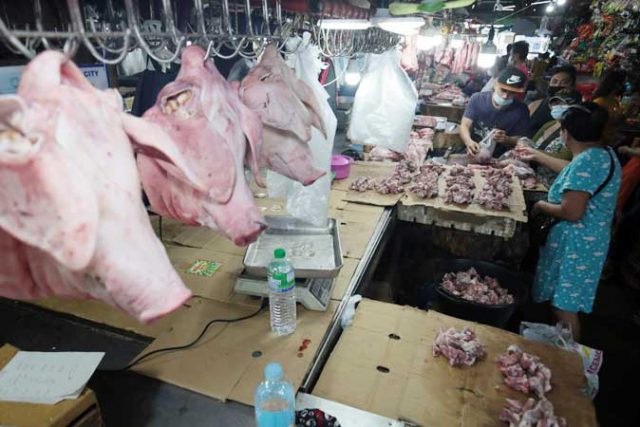
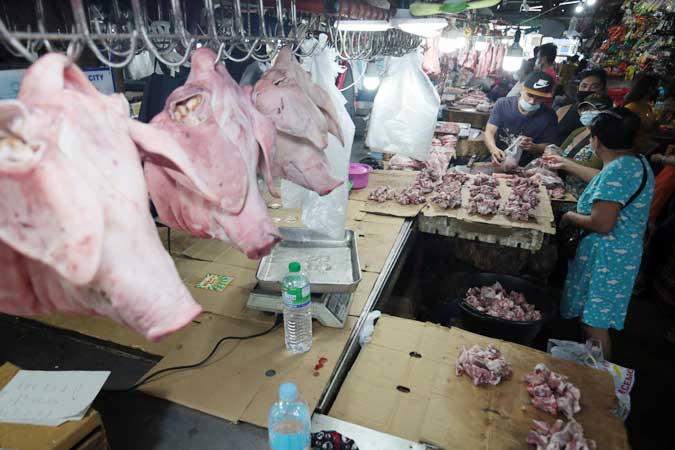
THE 60-DAY price ceiling on select pork and chicken products in Metro Manila ended on April 8. — PHILIPPINE STAR/ MICHAEL VARCAS

DESPITE the slight easing in March, inflation is expected to remain elevated in the second quarter with the lifting of the price caps on some meat products and rising global commodity prices, analysts said.

“We currently forecast Philippines inflation to average 4.0% over the course of 2021 but note inflation will generally remain more elevated in the first half of 2021,” Michael Langham, senior Asia country risk analyst for Fitch Solutions, told BusinessWorld in an e-mail.

“Food prices will continue to apply upward pressures and supply-chain disruptions externally are being aggravated by the disruptions to logistics in the Philippines caused by COVID-19 (coronavirus disease 2019) containment measures,”

The consumer price index (CPI) rose 4.5% in March, breaching the central bank’s 2-4% target for a third straight month but easing from the 4.7% in February, the Philippine Statistics Authority reported on Tuesday. The slight easing was attributed to slower increase in food prices.

The lifting of the price ceiling on selected meat products and the continued African Swine Fever (ASF) outbreak will likely cause an uptick in food prices and put upward pressure on the broader CPI in the next few months, according to Katrina Ell, senior Asia-Pacific economist at Moody’s Analytics.

The 60-day price ceiling on select pork and chicken products in Metro Manila ended on April 8.

“Elevated inflation comes at a particularly unfortunate time for the Philippines economy, which is grappling with localized COVID-19 outbreaks, subsequent restrictions and a sluggish vaccine rollout,” Ms. Ell said in an e-mail to BusinessWorld.

“Higher prices for key consumer goods erode purchasing power and put pressure on households that are already being strained,” she added.

Ms. Ell said policies that could help farmers rebuild pig stocks once ASF is better contained will help curb the price spike.

The central bank expects inflation this year to reach 4.2% before easing to 2.8% in 2022.

“To bring inflation down, authorities could seek to implement tax cuts and supply-side support measures — although the latter will have a lagged effect. However, we maintain the view that policy makers will see these inflationary pressures as temporary and accept that price growth may run hotter than targeted in the near term, focusing policies on supporting an economic rebound,” Mr. Langham said.

The Bangko Sentral ng Pilipinas (BSP) has kept the key policy rate at a record low of 2% in March, citing the need for a continued accommodative stance until the economy’s recovery becomes more solid. The central bank has assured it will act should second-round effects of inflation such as higher wage and transport hikes become more pronounced.

BSP officials have said non-monetary measures will better address inflation induced by low supply in some food commodities. — Luz Wendy T. Noble

Gross borrowings plunge in February

REUTERS

THE National Government’s gross borrowings stood at P53.912 billion in February, plunging 89% from P479.23 billion a year ago when the Treasury sold retail Treasury bonds (RTB).

Latest data from the Bureau of the Treasury (BTr) showed the borrowings in February were 92.41% lower than the P710.32 billion raised in January when the Treasury renewed its P540-billion loan with the central bank.

However, the two-month gross borrowings remained 30.73% higher at P764.229 billion against the P584.565 billion a year ago.

Broken down, domestic borrowings totaled P37.196 billion in February, 91% lower than the P405.76 billion in 2020 when the Treasury raised P311 billion via the three-year RTBs.

The annual RTB sale was held in March this year, with BTr, raising P463 billion from new funds and swap subscriptions.

Local borrowings consisted of P30 billion of Treasury bonds and P7.196 billion in Treasury bills.

The government did not make any amortization payments of its local debt.

External gross debt went down 77.25% to P16.716 billion in February from P73.484 billion a year ago. This comprised P14.34 billion in program loans from foreign lenders and P2.376 billion in project loans.

The Treasury repaid P2.131 billion of its foreign debt that month, bringing its net foreign borrowings for the month to P14.585 billion.

For the January-February period, total domestic borrowings reached P717.96 billion, up 60.64% year on year.

Gross foreign debt, meanwhile, fell 66.38% from a year ago to P46.272 billion in the two-month period.

Excluding the P125-billion redemptions made of its external obligations, the BTr recorded P639.22 billion in net borrowings in January-February.

The government is looking to raise P3 trillion this year from domestic and external lenders to help fund its budget deficit, which is seen to hit 8.9% of gross domestic product.

The government runs on a fiscal deficit as it spends more than the revenues it generates in order to boost economic growth. Since last year, the deficit cap has ballooned to multi-year highs as tax collection slumped due to the recession and state spending increased.

The BTr raised P24 billion via the sale of three-year yen-denominated Samurai bonds on March 30. Proceeds are scheduled to be settled on April 13.

Finance Secretary Carlos G. Dominguez III has said the government will soon tap the US dollar bond market before rates skyrocket.

Mr. Dominguez added the government will start winding down its debt by early next year as part of its fiscal consolidation plan. — Beatrice M. Laforga

Rolex updates the classics

Lady-Datejust

FOR the Watches and Wonders 2021 virtual industry in Geneva, Rolex released new iterations of its classics, the Explorer, the Datejust, and the Oyster Perpetual.

The pieces were presented via an online press conference last week. First up was the Explorer and the Explorer II. This year, the Oyster Perpetual Explorer is available in a yellow Rolesor version, which combines Oystersteel and 18-karat gold. Oystersteel is corrosion-resistant and designed for challenging conditions — appropriate, considering that the Explorer was born as a collaboration with mountaineers, facing a trial at Mount Everest itself.

New dials, meanwhile, become the face of the changes with the Oyster Perpetual Datejust 36. A green face is inspired by tropical forests and palm trees, while another face is executed in fluted gold.

The Daytona, meanwhile, gets a new look with 18 carat yellow, white, or Everose gold. Meteorite dials — a unique feature —  are made by Rolex with “metallic meteorite according to very strict aesthetic criteria,” according to a press release, making each piece unique (how many meteorites fall to earth every day, anyway?

Even in days like these, diamonds continue to be a girl’s best friend. Two new looks for Day-Date 36 and the Lady-Datejust show them encrusted in diamonds. 

The Lady-Datejust is a treat: almost every inch of it, from middle case, bezel, dial to bracelet, is covered in diamonds (1,089, to be exact), and highlight the Roman numerals on the dial, along with the date window, perfectly.

The Day-Date, while already having diamonds on the dial and bezel, does not scrimp on the luxury either. Alligator leather straps in colors that match the hour markers hang from the watch (the choices are coral, turquoise, and burgundy), making for a surprisingly youthful and bold new selection. — JLG

Pandemic lends modern twist to French vintage fashion sales

GOING under the gavel at the April 13 Louis Vuitton and Others auction by Gros & Delettrez is a 30 cm. 2000 LOUIS VUITTON “Alma” bag in Monogram canvas and natural leather and a 26 cm LOUIS VUITTON “Little Noah” bag in red leather, both with an estimated price of 280 to 320 euros; and a 1992 LOUIS VUITTON “Saint Cloud” bag in blue cob leather, with an estimated price of 200 to 250 euros. — PHOTO FROM GROS-DELETTREZ.COM

PARIS — In Artcurial’s auction house overlooking the shuttered boutiques of the Champs Elysees avenue in Paris, vintage fashion expert Clara Vivien is overseeing the sale of hundreds of Chanel jackets, shoes and jewelled accessories — all online.

Paris may be the world’s fashion capital, but a third COVID-19 lockdown is once again sending lovers of luxury who have time to spare and money to spend on to their screens in search of  the next vintage Chanel dress or Hermes handbag.

Vintage was already enjoying a revival, Ms. Vivien said, driven by a growing discomfort with “fast fashion” among consumers and increasing environmental awareness. But the pandemic shifted more of it online.

“Vintage is exploding on the second-hand market,” Ms. Vivien said. “People can’t walk into boutiques and so shop at online auctions.”

Handbags sell particularly well. “People who bought a Chanel or a Hermes bag today delight in the knowledge that their investment doesn’t stop growing, and with the pandemic increases with no end in sight.”

Fashion and online vintage clothing sales more than quadrupled at online auction in France in 2020 compared with pre-pandemic levels to 6.2 million euros, according to the online auction house aggregator Interencheres.

Antoine Saulnier, an auctioneer at Gros & Delettrez, said vintage fashion sales that before the pandemic might have attracted 100 online buyers were now drawing five or ten times that number.

“Prices are rising on some items as a result,” said Mr. Saulnier as he prepared for the sale of nearly 600 Vuitton artefacts last week.

One collector who should know is Olivier Chatenet, a flamboyant 60-year-old stylist who spent his young adult life scouring the French capital’s flea-markets and auction houses in the Drouot neighborhood with his father. His private collection is a treasure trove of Ungaro dresses, Chloe blouses, and Sonia Rykiel overcoats. Several years ago he sold his entire Yves Saint Laurent collection —  all 4,000 items.

“I try to be careful and buy at the right price,” Mr. Chatenet said. But he admits he is not always successful.

“That moment the auction begins, when you have the item before you and you’re overtaken by a frenzied desire to own it, you end up buying for more than you meant.” — Reuters

ADVERTISEMENT
ADVERTISEMENT