Home Blog Page 8240

Eagle Cement income down 44% amid lockdown

COMPNAY HANDOUT
EAGLE CEMENT’s expansion in Bulacan is seen to increase its production capacity by 1.5 million metric tons. — COMPNAY HANDOUT

EAGLE Cement Corp. reported a net income of P3.4 billion in 2020, falling by 44% as company operations were hit by lockdown measures imposed in mid-March last year in the wake of the pandemic.

“The halting of our operations due to pandemic-related restrictions took a hit on our results in the first half of 2020, but the remaining half proved that we are well-positioned to bounce back,” Eagle Cement President and Chief Executive Officer John Paul L. Ang said in a statement on Monday.

Full-year net sales dropped by 30% to P13.9 billion from P19.8 billion in 2019.

The listed cement manufacturer said it generated P8 billion in sales in the second half of the year, 35% higher than the company’s sales in the first half of 2020.

However, total sales in the second semester is still 14% lower than the P9.3-billion sales seen in the same period the previous year.

“We will continue to work on aggressive marketing and better pricing strategies for this year and this will be complemented by focusing on cost control initiatives in our operations, which will enable us to deliver better returns in 2021,” Mr. Ang said.

Eagle Cement also said it is in a “solid financial position,” which may help the company post a double-digit growth after the economy reopens and once vaccinations are widely rolled out.

Meanwhile, the cement maker’s expansion in Bulacan is expected to increase its production capacity by 1.5 million metric tons (MTT), allowing Eagle Cement to produce an annual cement capacity of 8.6 MTT.

“We are prepared to cater to the market’s demand now and in the future with our expansion underway,” Mr. Ang said.

The Bulacan expansion is said to be completed by the second quarter of the year, which will feature its fifth finish mill, third packhouse, and other supporting facilities.

On Monday, Eagle Cement shares at the stock exchange rose by 5.45% to close at P11.60 from P11 per share. — Keren Concepcion G. Valmonte

Metro Retail Stores incurs nearly P450-M loss

METRORETAIL.COM.PH

LISTED Metro Retail Stores Group, Inc. reported a P449.59-million net loss in 2020, a reversal of its P775.64-million net income in the previous year, as sales were heavily affected by the coronavirus disease 2019 (COVID-19) pandemic.

Revenues declined by 15% to P31.43 billion from P37.05 billion. Net sales amounted to P31.29 billion in 2020, dropping by 15% from P36.79 billion.

“In the middle of March 2020, department stores were temporarily closed brought about by the COVID-19 outbreak,” the company said in a disclosure on Monday.

“These were gradually opened, but were faced with customer traffic [constraints] since community quarantine is still in effect and as consumers prioritized the purchase of essential goods in general,” it added.

Its food retail business inched up by 1.1% to P24.43 billion from P24.16 billion. Sales from its general merchandise business, meanwhile, fell by 45.7% to P6.85 billion from P12.63 billion the previous year.

Blended same store sales also declined by 19.3% versus the 2.2% growth seen in 2019.

The company recorded a 42.6% drop in rental income to P146.8 million from P255.8 million after the “temporary closure of non-essential tenants” and the extension of rental concessions to renters who continued to operate.

Meanwhile, sales costs declined by 12.7% to P24.96 billion from P28.59 billion.

“Cost of sales declined slower than net sales since the food business which typically has a higher cost of sales compared to our general merchandise business continued to thrive despite the COVID-19 outbreak, while our general merchandise business declined,” the company said.

Operating expenses for the year amounted to P6.78 billion, 8.3% lower than the P7.39-billion incurred from the previous year due to the disrupted operations of department stores.

However, the decrease in operating expenses was offset after the company recognized non-recurring expenses as it streamlined operations and rationalized stores and its work force, costing the company some P270.2 million.

Comprehensive loss for the year totaled to P493.87 million, a reversal of its total comprehensive income of P738.71 million in 2019.

Shares of Metro Retail Stores at the stock exchange declined by 1.49% or P0.02 on Monday to close at P1.32 apiece. — Keren Concepcion G. Valmonte

Recession drama Nomadland wins best film at BAFTA awards

Nomadland — IMDB.COM

LONDON —  US recession drama Nomadland, about a community of van dwellers, was the big winner at Britain’s BAFTA awards on Sunday, scooping best film and prizes for its Chinese-born director Chloe Zhao and leading actress Frances McDormand.

The British Academy of Film and Television Arts ceremony was held virtually over two nights, with nominees joining in by video, due to the coronavirus disease 2019 (COVID-19) pandemic.

However film stars Hugh Grant and Priyanka Chopra Jonas appeared in person at London’s Royal Albert Hall while Renee Zellweger and Anna Kendrick joined from a Los Angeles studio to present the awards.

Nomadland, which has already picked up prizes this awards season, stars 63-year-old Ms. McDormand as a widow, who in the wake of the US economic recession, turns her van into a mobile home and sets out on the road, taking on seasonal jobs along the way.

“We would like to dedicate this award to the nomadic community who so generously welcomed us into their lives,” Ms. Zhao, who won the director category, said in her acceptance speech.

“Thank you for showing us that ageing is a beautiful part of life, a journey that we should all cherish and celebrate. How we treat our elders says a lot about who we are as a society and we need to do better.” Nomadland also won for cinematography.

Outstanding British film went to #MeToo revenge movie Promising Young Woman, which also won original screenplay.

The academy also paid tribute to Prince Philip, Queen Elizabeth’s husband, who died on Friday, aged 99. Prince Philip was named BAFTA’s first president in 1959. His grandson Prince William is BAFTA’s current president.

Following an outcry last year when BAFTA presented an all-white acting contenders list, more than half of this year’s 24 nominees were actors of color.

Film veteran Anthony Hopkins won the leading actor category for portraying a man with dementia in The Father.

“I’m at a time in my life where I never expected to get this,” the 83-year-old told reporters of the award, adding his age had made making the movie “easy.”

Youn Yuh-jung won supporting actress for Minari, in which she plays a grandmother who travels from South Korea to the United States to look after her grandchildren.

The 73-year-old, who has won a Screen Actors Guild award and has been nominated for an Oscar for her performance, drew laughs in her acceptance speech when she jokingly said it was particularly meaningful to be recognized by “British people, known as very snobbish people.”

Daniel Kaluuya, who has swept this awards season for his portrayal of late Black Panther activist Fred Hampton in Judas and the Black Messiah, won supporting actor.

Brokeback Mountain and Life of Pi director Ang Lee received the BAFTA Fellowship, the academy’s top honor, for his contribution to film. —  Reuters

Emperador reports robust market expansion overseas

EMPERADORBRANDY.COM

EMPERADOR, Inc. said its brandy and scotch whisky businesses recorded growth in markets across several countries last year.

The listed brandy and whisky manufacturer said in a stock exchange disclosure on Monday that for 2020, its brandy segment posted growth in countries such as United Kingdom at 376%, Mexico at 44%, Canada at 74%, and United States at 24%, which are significant markets of the company’s international business.

Emperador said its Tres Cepas Brandy, under its subsidiary in Spain, expanded its market shares in Guinea and Cameroon.

It added that wholly owned subsidiary Whyte and Mackay UK posted improvements and is now the second-largest selling blended scotch brand in the United Kingdom.

“Its single malt brand, Jura, is currently the number one single malt in the United Kingdom in terms of sales volume in groceries and supermarkets across the country. It is also currently the fastest growing single malt brand in Sweden and The Netherlands,” the company said.

Further, Whyte and Mackay’s whisky business in China posted a 200% growth after its sales volume via e-commerce recorded a 227% expansion last year.

Glenn D. Manlapaz, Emperador International chief executive officer, said the company is optimistic that the momentum can be continued this year, adding that stronger production and distribution volume of brandy and whisky products are expected across its international markets.

“Emperador is the only Filipino consumer brand company today that is not only present across the different continents of the world, but also dominates most of the brandy and whisky markets in several countries where the products are sold,” Mr. Manlapaz said in the disclosure.

In 2020, Emperador increased its earnings to owners by 18% to P8 billion due to the strong performance of its international businesses, while its revenues amounted to P52.6 billion.

On Monday, shares of Emperador at the stock exchange improved 0.39% or four centavos to end at P10.40 apiece. — Revin Mikhael D. Ochave

Philippine office buildings feeling the pinch from POGO firms’ exodus

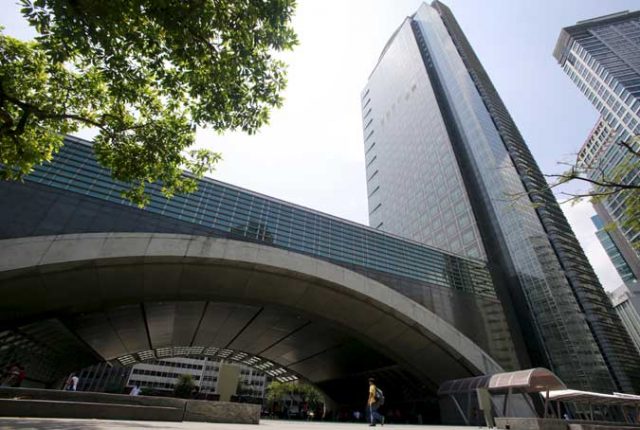
THE central business district in Makati City is seen on March 11, 2016. — REUTERS/ROMEO RANOCO

By Jenina P. Ibañez, Reporter

GROWING DEMAND for office spaces from outsourcing companies is unlikely to offset losses from the exodus of Philippine Offshore Gaming Operators  (POGOs), potentially up to 2022, analysts said.

Business process outsourcing (BPO) firms have an opportunity to take up economic zone spaces vacated by POGOs to avail of government incentives, Colliers Philippines Senior Research Manager Joey Roi H. Bondoc said in a phone interview.

But BPO firms are reducing office space requirements, he said, as they await coronavirus disease 2019 (COVID-19) vaccines and set up “hybrid” operations.

“Part of the operations will still be work from home, part of the operations will be on site,” he said.

Businesses have been limiting on site operations to comply with government health protocols and protect their workforce amid the pandemic.

Morgan McGilvray, senior director of occupier services at Santos Knight Frank, said that growing demand in outsourcing is focused on remote work, with companies hesitating to lease additional office spaces until they are able to bring 100% of their workers back on site.

Office demand should surge when 100% occupancy is allowed, Mr. McGilvray added, projecting a fourth quarter or early 2022 recovery.

“Growth in BPO demand will help offset some of the POGO losses, but POGO losses will likely exceed the BPO growth expected in 2021 and possibly 2022,” he said in an e-mail.

Santos Knight Frank projects outsourcing demand for the first half of 2021 to be low at 50,000 square meters (sq.m.) of new lease-up, which could go up to 150,000 sq.m. in the second half.

Lobien Realty Group, in turn, said that POGO office space in 2019 took up 1.2 million sq.m., which has since been cut by 70%. The company noted a 3-4% growth forecast from the outsourcing industry if the vaccine is rolled out and the global market sustains demand.

“That 3% or 4% growth if ever it happens would amount to 250,000 square meters to about 350,000 square meters at most. Therefore, not enough to absorb the current office supply in 2021 which is at 765,000 square meters,” LRG Chief Executive Officer Sheila Lobien said in an e-mail.

“On top of all these, there are many vacant spaces left by POGOs and up to today those spaces are still not tenanted.”

Office market demand remains low due to a slow vaccine roll out, Ms. Lobien added.

Despite this, Mr. Bondoc said the back-office operations of a number of multinationals, e-commerce firms, and telecommunications companies have been taking up office space across Metro Manila, which could become more aggressive with a successful vaccine roll out.

This poses some recovery after vacated office spaces outpaced occupied office spaces last year.

“(This year,) so far the figures are encouraging because we’re seeing net take up so far,” he said.

The winners at the 2021 BAFTA Awards

Best Film —  Nomadland

Outstanding British Film — Promising Young Woman

Director — Chloé Zhao (Nomadland)

Original Screenplay — Promising Young Woman

Adapted Screenplay — Christopher Hampton, Florian Zeller (The Father)

Leading Actress — Frances McDormand (Nomadland)

Leading Actor — Anthony Hopkins (The Father)

Supporting Actress — Yuh-Jung Youn (Minari)

Supporting Actor — Daniel Kaluuya (Judas and the Black Messiah) 

Outstanding Debut by a British Writer, Director or Producer — Remi Weekes (His House)

Film not in the English Language — Thomas Vinterberg, Sisse Graum Jørgensen (Another Round)

Documentary — Pippa Ehrlich, James Reed, Craig Foster (My Octopus Teacher)

Animated Film —  Pete Docter, Dana Murray (Soul)

Original Score — Jon Batiste, Trent Reznor, Atticus Ross (Soul)

Casting — Lucy Pardee (Rocks)

Cinematography — Joshua James Richards (Nomadland)

Editing — Mikkel E.G. Nielsen (Sound of Metal)

Production Design — Donald Graham Burt, Jan Pascale (Mank)

Costume Design — Ann Roth (Ma Rainey’s Black Bottom)

Make up and Hair — Matiki Anoff, Larry M. Cherry, Sergio Lopez-Rivera, Mia Neal (Ma Rainey’s Black Bottom)

Sound — Jaime Baksht, Nicolas Becker, Phillip Bladh, Carlos Cortés, Michelle Couttolenc (Sound of Metal)

Special Visual Effects — Scott Fisher, Andrew Jackson, Andrew Lockley (Tenet)

British Short Animation — Mole Hill, Laura Duncalf (The Owl and the Pussycat)

British Short Film — Farah Nabulsi (The Present)

EE Rising Star Award — Bukky Bakray

NOW Corp. eyes fund-raising this year

NOW-CORP.COM

NOW Corp. announced on Monday that it is planning to raise funds this year, with the proceeds partly going toward the company’s planned expansion projects.

“NOW Corp. intends to execute the transaction within the year to raise capital to strengthen and broaden its capital base as well as to promote a wider dispersion of the common shares of the company to a broad spectrum of public institutional investors,” the listed company told the local bourse.

The company plans to raise funds by way of top-up placement.

“NOW Corp. also plans to use the proceeds of the transaction to partially finance its planned expansion projects,” it added.

It said it appointed PNB Capital and Investment Corp. on April 8 as its issue manager, financial advisor and bookrunner for a “placing and subscription transaction.”

“The mandate covering the said appointment will be ratified by the board in a meeting called for that purpose. The terms and conditions of the transaction, when finalized, will likewise be promptly disclosed to the Exchange,” it also said.

On March 3, the company announced that its affiliate, NOW Telecom, Inc., received a favorable decision from the Anti-Red Tape Authority (ARTA) on its application for assignment of frequencies for the exercise of its cellular mobile telephone system provisional authority.

“An order of automatic approval was issued for the assignment in favor of NOW Telecom of 220 megahertz including 5G frequencies,” NOW Corp. said in a news release.

“With this ARTA ruling and award of frequencies, NOW Telecom aims to emerge as a formidable player in the telecom mobile industry,” said Rene L. Rosales, NOW Telecom president and chief operating officer.

NOW Corp. shares closed 9.79% higher at P3.14 apiece on Monday. — Arjay L. Balinbin

When a current-generation platform can do wonders

Warhammer: Chaosbane — WARHAMMER-CHAOSBANE.COM/

Video Game Review
Warhammer: Chaosbane
Sony PlayStation 5

Devil May Cry 5: Special Edition
PS5

Bridge Constructor:
The Walking Dead
PS5

Warhammer: Chaosbane is, at its core, a solid title. While its release didn’t do much to reinvent the action-role-playing-game genre, its solid mechanics combine with its grim and dark — if familiar — Warhammer backdrop to provide a worthwhile experience of combat, exploration, and adventure. It was already a standout on the Sony PlayStation (PS) 4 and Microsoft Xbox One. Now, it finds a home on the PS5 and Xbox Series X, and, with better hardware to leverage, it goes for the fences with even harder swings and rounds the bases with aplomb.

For starters, Warhammer: Chaosbane runs much, much better on current-generation consoles, taking full advantage of cutting-edge specs to provide a visceral experience of frenetic splendor. Whether hacking through mobs or weaving spells in between timely dodges, gamers are treated to intense eye and ear candy, all thanks to its superior rendition on the PS5. The upgrades might not seem like much in the face of its invariably engrossing gameplay, but its capacity to maintain high graphical fidelity at a crisp, smooth 60 frames per second pays off in spades. It loves to bask in its atmosphere, and it is amply rewarded. From the dark, dank fortifications of Nuln to chaos-infested sewers and far flung winter wastes, its Warhammer origins shine through at its core.

As earlier noted, Warhammer: Chaosbane’s gameplay is topnotch. Gamers get to pick from among a handful of characters — the robust imperial soldier Konrad Vollen, the lithe wood-elf scout Elessa, the illustrious high-elf mage Prince Elontir, and the frenzied slayer Bragi Axebiter — and find their way around and through Chaos’ minions. The characters’ appearances may not be fully customizable, but skill progression and unique traits more than make up for the absence of the feature. All characters play differently, emphasizing different approaches when it comes to doing battle and feeling punchy and satisfying to use — from employing powerful sweeping attacks to using magical spells that bounce off walls. There’s a calm grace to the wood-elf scout’s dodges, especially when combined with her magical arrows, while there’s a more primal feeling in the slayer’s deadly thrusts.  And while these are really mostly set dressing (after all, a typical soldier’s sweep attack fulfills almost the same function as the slayer’s), it’s the strict adherence to the Warhammer setting that enables it to double down on the fun factor.

Make no mistake; Games Workshop has been rather lax with its use of the Warhammer intellectual property, and not all games in the Warhammer and Warhammer 40,000 franchises have been good, or even interesting. In developing Warhammer: Chaosbane, however, Eko Software has paid proper respect to the source material, pulling lore characters straight from its rulebooks and crafting stories around their existence. Gamers will meet named characters from the Warhammer fiction, interact with the Warhammer Fantasy’s known heroes, and face off against some of its worst monsters and villains. They’ll travel the Warhammer Fantasy’s world, explore its blasted settings, and find themselves immersed by the stories that unfold. If a game can be judged by atmosphere alone, then Warhammer: Chaosbane cannot but be a classic.

For the avowed fan of the Warhammer franchise who loves hack-and-slash offerings, Warhammer: Chaosbane on the PS5 is a godsend, and a definite must-buy. It’s a smooth, fun experience that promises keen attention to its setting that few other Warhammer games can approximate. For the average action RPG lover, it may prove to be less enticing. Still, it’s a cautious recommendation at worst. It may not be innovative, but it’s certainly entertaining and engaging, and a prime example of how exceptional use of a current-generation platform can do wonders.

THE GOOD:

  • Keen attention to detail in regard to the Warhammer setting
  • Fun action and exploration mechanics, especially when combined with responsive controls and unique characters
  • Appealing amount of content that enriches the Warhammer lore

THE BAD:

  • Nothing new or innovative, with other action RPGs feeling similar to it combat-wise
  • Occasional bugs
  • Solid, but can come off as a run-of-the-mill, repetitive hack-and-slash offering

RATING: 8/10

POSTSCRIPT: It’s refreshing to see the Devil May Cry franchise stand on its own two legs, especially in the face of its humble origins. The first title was released back in 2001, and it was a triumphant, if awkward, combination of action, survival horror, and dark fantasy. Devil May Cry, directly inspired by the writings of Dante Alighieri’s Divine Comedy and the gameplay of the Resident Evil series and Onimusha Warlords, decided to blend these together to create an unsettling, claustrophobic action game that rewarded exploration and aggression. Its resounding success cemented itself as one of Capcom’s strongest intellectual properties. The series has had its hiccups since then, but its greatness was assured in light of its outstanding start.

The franchise’s roller-coaster ride notwithstanding, Devil May Cry 5 proved to be the best of the series by far when it was launched in 2019. Featuring over-the-top storytelling combined with responsive controls and iconic characters, it wound up meeting gamers’ expectations. It offered three distinct characters as vessels for unparalleled demon slaying, and could well have been flawless had it not been hampered by the horsepower limitations of consoles already on their last legs.

Which, for all intents, is why the release of Devil May Cry 5: Special Edition on the PS5 is to be celebrated. It offers a chance for gamers to re-experience it at its finest. With smoother frame rates, better-looking textures, faster load times and all available downloadable content bundled in, it brings the entire franchise to the cutting edge. Simply put, it’s an utter joy to behold.

The narrative remains. In Devil May Cry 5: Special Edition, Hell itself is unleashed into the world as the demon lord Urizen seeks to strengthen himself by using the blood of humans as its fuel. Only by finding and destroying the roots of the tree it uses to harvest blood can Dante, Nero, and the mysterious V hope to stop its progress. And to do that, they have to make full use of what skills and powers they have available to them, and eradicate any and all traces of demonic presence they can find.

This means engaging in the exquisite combat system of Devil May Cry 5: Special Edition. The characters tumble, roll, and dodge their way out of enemy attacks, sending the opposition into the air and jugging them for maximum damage. It might sound just like every other beat-’em-up title, but unlike every other beat-’em-up title, gamers are encouraged to mix and match moves to continually raise the combo meter; rewards come by way of constant alterations in attack patterns and approaches to engagements. Fortunately, the significant differences between each character — from Nero’s Devil Arm and grabs to Dante’s stance changes — encourage experimentation of the environment, unlocked abilities, and special moves while skirting the edges of risk.

Of course, none of this would work if Devil May Cry 5: Special Edition didn’t run better. It still features the same distinctive art style, but everything about it looks and plays better compared to its 2019 base counterpart. Textures have a higher graphical fidelity, the framerate is much smoother, landing a consistent 60 fps even during the tenser moments, and even touts the ability to use ray-tracing to generate graphical consistency. Technical and performance improvements likewise abound, and are especially noticeable during stage transitions and saving/loading instances.

And then there’s, of course, the DLC. Devil May Cry 5: Special Edition comes packed with all previously released additional content; apart from the base game, it boasts of the Bloody Palace update, all the pre-order bonuses, and the Vergil DLC — at no additional cost. It’s a slew of extra content, and turns what is an already-stellar base game into a veritable masterpiece.

Devil May Cry 5: Special Edition does make a few missteps, though they’re not unique to its own circumstance. It may be the definitive edition, but those who already own the previous release may find it hard to double dip given the absence of any new material. And it bears noting that the same flaws that the original suffered from outside of console limitations are more or less still present.

That said, Devil May Cry 5: Special Edition is a worthy addition to any gamer’s library. It highlights its value as a PS5 launch release, and gives gamers, and avid followers of the franchise, a heady look at what is to come.

THE GOOD:

  • Devil May Cry at its finest, running smoothly and crisply
  • Comes packed with all previously released content
  • A somewhat silly but eminently accessible story mode

THE BAD:

  • Hardly any new features
  • Can prove difficult game for newcomers to the genre
  • Sometimes feels a bit floaty depending on the chosen character

RATING: 9.5/10

THE LAST WORD: It’s difficult to imagine media around AMC’s The Walking Dead franchise as being anything but completely serious. All the same, Bridge Constructor: The Walking Dead is able to distinguish itself without feeling utterly ridiculous. True, it still has a somewhat serious plot to keep things going, but it’s lamp-shaded by cartoony aesthetics and physics puzzles that border on the absurd. And guess what? It works for the most part. If nothing else, it proves that games from the Walking Dead franchise don’t need stories at the Telltale Games level, or dramatic gunplay, or spine-tingling horror in order to thrive. They just need a bit of passion, some self-awareness, and good game mechanics to keep them going.

In Bridge Constructor: The Walking Dead, gamers are asked to do exactly that — build a bridge from one end of the map to the other in order to get people to safety. Featuring interesting physics challenges alongside light strategy elements, it presents a unique way with which to appreciate the franchise. It latches on to a simple, even simplistic, idea, but manages to stay engrossing for a considerable part of its runtime in light of its stellar design and interface. Right from the onset, it compels the formation of bridge foundations en route to creations that are limited only by imagination. The stages get increasingly more challenging, reducing the amount of resources available even as the franchise’s Walkers come into play as barriers to exit. Adaptation is, therefore, critical to success, as is the need to settle into a comfortable rhythm of assessing the challenge at hand, experimenting, failing, and finally, winning.

And that’s all there is to Bridge Constructor: The Walking Dead. It doesn’t have an overarching narrative that binds stages together. It’s not out to be profound or send a significant message. Its visuals are sufficient but unimpressive, mostly relying on its clarity and charm to keep gamers immersed, and what little dialogue it offers is spartan in its characterizations. There are no dark plots, no new motivations to show old favorites in a new light. All it wants to do is get gamers to build a bridge that equates survival with connecting the starting point to the finish line.

Bridge Constructor: The Walking Dead doesn’t test the PS5’s limits with its workmanlike audio-visual presentation. It doesn’t engage in plentiful amounts of drama or gore, but it gets gamers stuck neck-deep in bite-sized (pun wholly intended) brain teasers. At an accessible price tag of $9.99, it’s a hearty recommend.

THE GOOD:

  • Boasts of enough depth to keep gamers entertained
  • Decent game mechanics
  • Surprisingly affordable given the amount of content it has on offer

THE BAD:

  • Somewhat iffy control schemes
  • Shallow dialogue and simplistic graphics do not look particularly appealing on the PS5
  • Gets somewhat repetitive in the later stages

RATING: 7.5/10

Open spaces and fast internet are priorities for PHL buyers — Ohmyhome

PHOTO COURTESY OF OHMYHOME

WORKING FROM HOME is shaping the property-buying decisions of Filipinos, according to online real estate platform Ohmyhome.

“Balconies in condominiums and gardens in house and lots are popular right now, as are smart homes or areas with fast internet connectivity,” said Julian Carlo Y. Sison, Ohmyhome’s marketing manager, at a recent webinar.

Interest in house and lots increased across the board, particularly outside Metro Manila.

“In the past, overseas Filipino buyers would invest in condominium units,” said Cielo A. Dumlao, Ohmyhome’s account manager. “This pandemic, most of our inquiries from them are of house and lots.”

The continued preference for house and lots, Mr. Sison said, will depend on future work-from-home (WFH) setups. “If a lot of companies continue to allow their employees to WFH, then we can see this interest in house and lots holding true even post-pandemic,” he said.

In addition, 62% of Filipino buyers on Ohmyhome are looking for properties that are less than P10 million, with 40% of the inquiries being for properties in the P1-5 million range. Additionally, 33% of the inquiries are for projects that offer stretched financing price schemes for up to 60 months to pay.

OUTSIDE METRO MANILA
Makati City is the top area of interest among property seekers, with condominiums under P10 million getting the most inquiries. “Buyers are taking advantage of friendlier payment terms and buyer’s market conditions,” said Mr. Sison.

While the financial hub is the most desirable zip code, more than half of buyers (56%) are considering places outside Metro Manila. Interest is gaining traction in southern provinces such as Cavite and Batangas, as well as northern areas such as Pampanga, Subic, and San Juan. Improvements in CALAX (Cavite-Laguna Expressway), CAVITEX (Manila-Cavite Expressway), and SLEX (South Luzon Expressway) — together with developments in the Pampanga metropolis like the Clark International Airport — have spurred this trend.

On the platform, the top five properties according to buyer interest are SMDC Mint Residences in Makati, Avida Cloverleaf Tower 2 in Quezon City, Lumina San Juan in La Union, Bria Lipa in Batangas, and Suntrust Verona in Cavite. All properties offer units within the P550,000 to 10 million peso range.

Ohmyhome offers pre-selling, ready-for-occupancy, and resale properties to buy, sell, or rent in both its application and website. Individual homeowners can list their properties for free in its do-it-yourself platform, which has more than 1,300 listings.

There are an additional 40,000 units listed from developer-partners such as Vistaland International Marketing, Inc., Suntrust Properties, Avida Land, Honeycomb Builders, Inc., SM Development Corporation, and Bria Homes. The real estate platform also operates in Singapore and Malaysia. — Patricia B. Mirasol

San Miguel plans to fully redeem $800-M outstanding notes due 2023

SANMIGUEL.COM.PH

SAN MIGUEL Corp. (SMC) disclosed on the Singapore Stock Exchange that it plans to fully redeem on April 26 its outstanding notes under its US$800 million with 4.875% rate note program due in 2023.

SMC said the notes will be redeemed at 100% of redemption price, together with interest accrued until redemption.

“The notes will be canceled as of the optional redemption date and interest shall cease to accrue on and after the optional redemption date,” the company said in its disclosure to the Singapore bourse, a copy of which was also made available at the Philippine Stock Exchange.

The notes should be surrendered for redemption under the procedures of Euroclear and Clearstream, Luxembourg as these were issued in global form.

Upon redemption and cancelation, the notes will be delisted from the Singapore Exchange Securities Trading Ltd. — K.C.G. Valmonte

Gov’t fully awards Treasury bills

THE GOVERNMENT made a full award of the Treasury bills (T-bills) offered on Monday even as rates inched up for most of the tenors amid easing inflation.

The Bureau of the Treasury (BTr) raised P25 billion as planned via the T-bills on Monday, as the offer was more than twice oversubscribed, with total bids at P54.743 billion. However, this was lower than the P64.5 billion in tenders seen at last week’s auction.

Broken down, the BTr raised P5 billion as programmed via the 91-day debt from P11.032 billion in bids. The three-month papers fetched an average rate of 1.325%, up by 3 basis points (bps) from 1.295% last week.

It also borrowed P8 billion as planned from the 182-day T-bills after the tenor attracted P15.846 billion in tenders. The average rate of the six-month instruments rose by 4.9 bps to 1.695% from 1.646% previously.

Lastly, the government made a full P12-billion award of the 364-day securities as demand reached P27.865 billion. The average yield of the one-year debt, meanwhile, dipped by 0.9 bp to 1.903% from last week’s rate of 1.912%.

“[The auction saw] good results with healthy tenders and rates within secondary levels tempered by lower inflation print in March,” National Treasurer Rosalia V. de Leon told reporters via Viber after Monday’s auction.

A bond trader said by phone that the average yields quoted for the T-bills still fell within market expectations, even with the slight increase in the rates for the 91- and 182-day papers.

Headline inflation eased to 4.5% in March from 4.7% in February, mainly on the back of a slower increase in food prices, the Philippine Statistics Authority (PSA) reported last week.

However, the February print was higher than the 2.5% seen in March 2020 and still beyond the 2-4% annual target of the central bank.

The Bangko Sentral ng Pilipinas (BSP) expects headline inflation to average 4.2% this year before easing to 2.8% in 2022. BSP officials have said the inflation path is likely to ease below the midpoint of the 2-4% target towards the fourth quarter.

BSP Governor Benjamin E. Diokno has said the central bank will remain accommodative to support economic recovery but will continue to watch out for  potential second-round inflation effects, such as wage and transport fee hikes.

The Treasury plans to raise P170 billion from the local debt market this month: P100 billion via weekly offerings of T-bills and P70 billion from fortnightly auctions of Treasury bonds.

The government is looking to borrow P3 trillion this year from both domestic and external sources to help fund its budget deficit, which is seen to hit 8.9% of gross domestic product. — B.M. Laforga

Q1 office space demand gets a lift from e-commerce

BW FILE PHOTO

E-COMMERCE expansion backed some recovery in office space demand in the first quarter, Leechiu Property Consultants (LPC) said.

Office space demand in the first quarter grew to 109,000 square meters (sq.m.) from the 89,000 sq.m. in the fourth quarter last year, although it remains lower than the 158,000 sq.m. in the first quarter of 2020.

Demand from the outsourcing sector declined to 33,000 sq.m. in the first three months from 64,000 sq.m. in the same period last year. Philippine Offshore Gaming Operators (POGOs) activity completely flatlined due to China’s clampdown and new tax regulations on the industry, LPC said.

But office space demand from other sectors grew to 76,000 sq.m. in the first quarter from 67,000 sq.m. in the same three-month period in 2020, which can be attributed to the e-commerce sector.

“Not all industries were affected badly by the pandemic. There are certain industries like e-commerce which have really accelerated their pace in terms of more and more people such as us in some form of lockdown have now transitioned and adapted to new behaviors and has given rise to more opportunities for these e-commerce firms to expand, not only in office but also in their warehouses” LPC Associate Director Mikko Barranda said in an online briefing on Monday.

Office space demand in the first quarter was still dominated by business process outsourcing firms at 30%, falling from the 38% share in the fourth quarter of 2020.

But e-commerce demand grew to 17% compared to the 7% in the preceding quarter.

LPC Chief Executive Officer David T. Leechiu said that the office space sector is slowly recovering without the POGO sector, noting that demand would be higher if the tax structure was not tweaked.

“We probably would have maintained the office demand from pre-COVID, from the first quarter 2020 numbers,” he said. — Jenina P. Ibañez

ADVERTISEMENT
ADVERTISEMENT