Home Blog Page 8192

No red alerts expected on Luzon grid during dry months

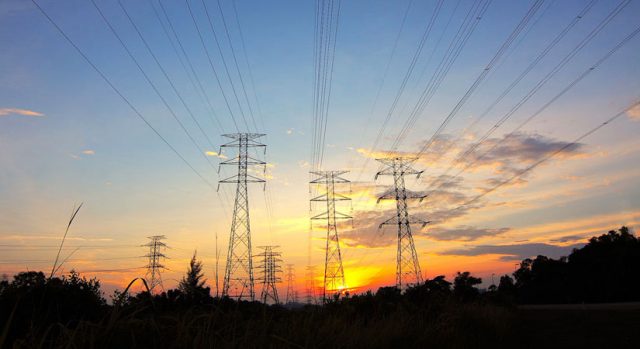
THE DEPARTMENT of Energy (DoE) said Thursday that it does not expect to issue any red alerts on the Luzon grid in the next nine weeks, after releasing an updated power outlook from the transmission company.

However, the DoE added yellow alerts are possible until July.

“Since (our) latest meeting with NGCP (National Grid Corp. of the Philippines) on 14 April, the Luzon grid will no longer have any red alerts as far as summer is concerned, according to the projection. We may have yellow alerts on weeks 15 to 18, and weeks 21 to 25,” DoE Spokesman Felix William B. Fuentebella said at a virtual briefing. The DoE said its method of reckoning dates puts the Philippines at Week 16.

When reserves fall below ideal levels, the NGCP issues a yellow alert. This is subsequently downgraded to a red alert when the power supply situation worsens.

During the briefing, Assistant Secretary Redentor E. Delola said yellow alerts could be issued due to extended outages at several power plants. “We have experienced some forced outages of power plants, with others on extended outages. The (outage) schedule of the 647-MW Sual 2 coal plant was extended, and it had a huge impact on supply. We also experienced extended outages at the 300-MW Calaca Unit and GNPower Mariveles,” Mr. Delola said.

“Given these extended outages, we see that there is a possibility of yellow alerts… because of a thinning of reserves,” he added.

The Luzon grid is expected to register peak demand of 11,841 MW, as projected by the NGCP. Mr. Delola said hitting the peak is unlikely.

“We will have a demand that’s substantially lower than 11,841 megawatts. In fact, the IEMOP (Independent Electricity Market Operator of the Philippines) said that the demand will only reach around 10,511 MW,” he said.

Mr. Fuentebella said the raising of yellow alerts on the grid do not result in power interruptions, adding that only red alerts trigger rotating ‘brownouts.’

“When the grid is on a yellow alert, we watch the system. When a huge plant goes on an outage (during this period), that will trigger a red alert and rotating brownouts. Yellow alerts sometimes happen when the power supply goes below the threshold,” he said. — Angelica Y. Yang

New lockdown threatening economic recovery

REUTERS

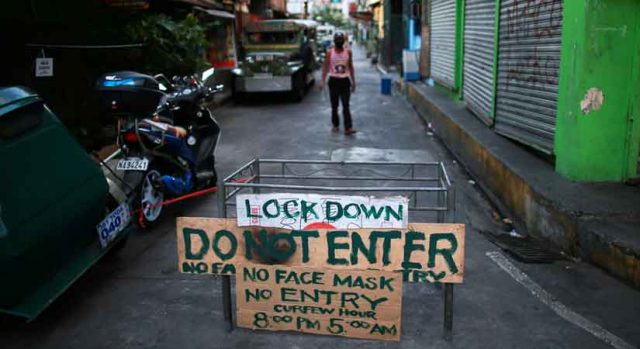
THE new lockdown imposed on Metro Manila and nearby provinces is threatening the economic recovery, according to First Metro Investment Corp. (FMIC) and University of Asia and the Pacific (UA&P).

“The uncertainties (as to duration and extent) arising from the new quarantine restrictions (Enhanced Community Quarantine, ECQ, as the most stringent) imposed by the government since Holy Week as COVID cases surged to new highs can sideswipe the still-fragile recovery,” FMIC and UA&P said in their April issue of The Market Call released Thursday.

The new lockdown will exert upward pressure on prices, especially with supply chains disrupted again. However, it said the decline in global oil prices will temper inflation.

Headline inflation eased to 4.5% in March from 4.7% in February, mainly because of the slower rise in food prices. The central bank expects inflation to average 4.2% this year, exceeding the official target range of 2-4%.

Stricter quarantine measures coupled with a slow vaccine rollout will likely keep the stock market volatile, they said.

“The PSEi (Philippine Stock Exchange index) seems to have steadied at a higher level than end-March and should recover more definitively after the economy posts more positive macroeconomic data and firms’ earnings improve in Q1-2021 relative to the previous quarter,” they said.

Despite the weakening economic outlook, the report noted signs of a rebound in imports and the continued expansion of factory output.

Goods imports rose 2.7% to $7.60 billion in February, rebounding from a 12% decline the month before.

Meanwhile, factory activity in March, as measured by the Philippine Manufacturing Purchasing Managers’ Index (PMI), remained above the 50-point mark, which separates growth from contraction. The PMI declined to 52.2 last month from 52.5 in February, but marked a third month of expansion.

Government spending, which rose 37.3% in February, could also drive growth. FMIC and UA&P are expecting the government to ramp up spending further for the rest of the year, especially for infrastructure.

The report added that spillover effects from the global economic recovery could ease the domestic slowdown, via Overseas Filipino Worker remittances and exports.

“Nonetheless, the long view seems to favor more positivity. Since prior to the pandemic, the economy has shown the ability to grow consistently above 6% per annum while the country can afford to stack up more debt as its debt-to-GDP ratio is at 41.5%. While the latter rose to 54.6% in 2020, the economic managers have shown some aversion to more huge borrowings as a way of getting back into the fast growth track,” it said. — Beatrice M. Laforga

Maynilad hoping for ‘early’ conclusion to water deal review

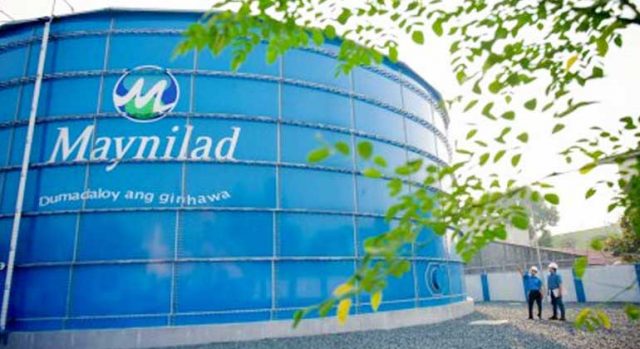
WEST ZONE water supplier Maynilad Water Services, Inc. said it is hoping for a conclusion to the review of its concession agreement with the government “as soon as possible.”

At a virtual briefing Thursday, Maynilad President and Chief Executive Officer Ramoncito S. Fernandez said the company has started formal communications with the government on the new agreement, adding that he expects a fair and reasonable review.

“As far as the timetable is concerned, I do not have any projection or forecast for when it would be finished. But Maynilad is expecting it to finish early so that we can continue all the programs for the long-term water supply and improvement of services to Metro Manila,” Mr. Fernandez said.

“We are just hoping that it will be finished as soon as possible so that we can implement the plans we have laid out in our concession,” he added.

Mr. Fernandez had no further comment on the negotiations, other than to say that the company’s position has been affected by events such as the COVID-19 pandemic.

“These factors have affected our decision. Let’s leave it at that. Then we will go to talks with the government and that is part of what we will have to discuss,” Mr. Fernandez said.

Justice Secretary Menardo I. Guevarra has announced that a copy of the revised water deal with east zone water provider Manila Water Co., Inc. was sent to Maynilad. The government is awaiting a response.

On March 31, Mr. Gueverra confirmed that the government, represented by the Metropolitan Waterworks and Sewerage System, signed a revised water concession agreement with Manila Water.

Under the new agreement, Manila Water is not allowed to pass on corporate income tax to customers and implement foreign currency differential adjustments.

Manila Water will also implement a tariff freeze until Dec. 31, 2022 as part of the new water deal, to help consumers weather the pandemic.

Asked about the upcoming end to the current five-year rate rebasing period in 2022, Mr. Fernandez said the company cannot start with a clean slate in terms of the staggered rate increases it was due to implement during the period.

Hindi puwede iyon. (It cannot be.) We have investments in the past and they have to be considered,” Mr. Fernandez said.

Mr. Fernandez confirmed that the company has started drafting its five-year plan for the next rate rebasing period.

“We have started actually. As in any five-year plan, it requires a lot of planning and data — also checking the actual results of what we have started,” Mr. Fernandez said.   

Maynilad and Manila Water deferred their approved rate hikes for 2021 under the current rate rebasing period to show solidarity with consumers. They also did not implement rate hikes in 2020 under pressure from the administration, which considers their original concession agreements to be onerous.

Maynilad provides water to Caloocan, Pasay, Parañaque, Las Piñas, Muntinlupa, Valenzuela, Navotas, Malabon, Manila, Makati, and Quezon City, as well as parts of Cavite province including Bacoor, Imus, Kawit, Noveleta, and Rosario.

Metro Pacific Investments Corp., which has a majority stake in Maynilad, is one of three Philippine units of Hong Kong-based First Pacific Co. Ltd., the others being Philex Mining Corp. and PLDT, Inc.

Hastings Holdings, Inc., a unit of PLDT Beneficial Trust Fund subsidiary MediaQuest Holdings, Inc., has an interest in BusinessWorld through the Philippine Star Group, which it controls. — Revin Mikhael D. Ochave

DTI makes tax pitch to Japan auto wiring firms

THE DEPARTMENT of Trade and Industry (DTI) said it has been promoting the new tax regime to attract investment from Japanese manufacturers of auto wiring harnesses.

The DTI held a virtual roundtable with six Japanese companies Tuesday for potential expansion projects and new operations in the case of companies that have not decided to locate in the Philippines as yet.

Some of the companies “are still completing their expansion and diversification plans,” DTI Special Trade Representative Dita Angara-Matha said in a statement Thursday.

Wiring harness manufacturing qualifies for incentives like income tax holidays under the recently signed Corporate Recovery and Tax Incentives for Enterprises (CREATE) Act, Trade Undersecretary Rafaelita M. Aldaba said.

CREATE cuts corporate income tax and rationalizes incentives, making them more time-bound and performance-based.

Executives from two firms that have already committed to building wiring harness plants in the country attended the meeting. Sumitomo Wiring Systems, Ltd. announced in September that it broke ground on a new factory in Pangasinan, while Yokowo Co., Ltd. said it will invest P230 million in a Bataan facility.

The Philippines exported almost $1.9 billion worth of wiring harnesses last year, almost half to Japan, Trade Secretary Ramon M. Lopez said.

“With wiring harness applications expanding beyond the automotive industry to the telecommunications, aerospace, medical fields, and other ICT areas, support for upgrading Philippine-based wiring harness operations have become all the more imperative,” he said.

“The total collective value of the new and expansion investment projects from this group of Japanese locators is conservatively estimated at P10.5 billion. Additional jobs created by the same investments are projected to reach 18,650.” 

Separately, Manila Economic and Cultural Office Chairman and Resident Representative Angelito Banayo said in a forum in Taipei that the Philippines is seeking partnerships with Taiwan businesses in manufacturing, infrastructure investments, and information communications technology.

“With experts projecting Taiwan’s economic growth at 4.64% this year, I believe greater cooperation and partnership with Taiwan’s businesses would be a good platform to launch a comeback as the pandemic hopefully subsides,” he said. — Jenina P. Ibañez

HSBC urges greater ASEAN commitment to climate-change mitigation measures

PHILSTAR

SOUTHEAST ASIA needs to commit to major investments designed to address climate change, including projects in infrastructure, power, and food security, HSBC Group said.

Speaking at the Path to Net Zero webinar Thursday, Joseph Incalcaterra, chief ASEAN economist at HSBC Bank, said policymakers, governments and the private sector should ensure their projects are more responsive to climate change since the region is vulnerable to extreme weather disturbances.

Mr. Incalcaterra added that these early investments can also mitigate climate change’s impact on the region’s economy, noting that taking the same measures later will be more expensive.

He said infrastructure should be in place to protect against rising sea levels and flooding. The cost of infrastructure can be shared with the private sector to make it more manageable.

“There’s also implications on food security from global warming and climate change. This is a very present risk for Southeast Asian economies which have very large food weightings in CPI (consumer price index) baskets and any increase in prices and food disruptions will have a big impact on development,” he added.

The Philippines and Indonesia are among the most vulnerable to food security risk, he said citing the World Bank’s findings, noting that these countries are highly reliant on food imports.

Typhoons traversing the Philippines are also worsening, as are droughts, he said.

“This is another reason for policymakers in the region to take immediate action to prevent the negative side effects.

While Southeast Asia, and the rest of Asia, are vulnerable to climate change, he said the region is also among the largest emitters of greenhouse gases.

Much of the greenhouse emissions come from energy generated from fossil fuels like coal.

“For some countries over the recent years, the only way to effectively bring electricity to the masses, to industrialize, to reduce poverty, (was) coal… by far the cheapest option and the only option for energy security. That was the reality that many countries are facing,” he said.

He said HSBC expects the renewable energy capacity of ASEAN to double in the next decade, with signs pointing to the declining cost of renewables in India and Indonesia.

“Electrification will only be effective if we address and secure abundance supply of low-carbon electrical power, so we’re going to see massive investment in renewable energy generation not just to displace electricity that’s currently generated by burning fuels, but to also displace the transport system and… energize growth opportunities in many Southeast Asian countries,” according to Jonathan Drew, a managing director at HSBC.

On the demand side, climate change mitigation also calls for consumers to reduce their power consumption to reduce their carbon footprint.

Mr. Drew said there is a need to raise capital and fund projects to address climate change mitigation, which the bank estimates at $100 trillion by 2030 globally and across all sectors.

He said half of that investment is expected to happen in Asia with Southeast Asia accounting for a large part.

Investment in the transport sector is expected to be the largest component, followed by energy, power and water.

He said capital to support the renewable shift is available from the private sector and fixed-income markets.

“This is no longer a niche market, this is a huge, high volume of capital flowing to address this challenge,” Mr. Drew said. — Beatrice M. Laforga

ARTA to issue warnings to agencies not yet on TradeNet

THE Anti-Red Tape Authority (ARTA) is set to issue notices of warning to trade-related government agencies who are not signed up to the TradeNet system, a platform designed as a single window to facilitate trade permits in Southeast Asia.

In a statement Thursday, the Bureau of Customs (BoC) said the ARTA made the decision during the Tuesday meeting of the National Single Window – Technical Working Group.

It said ARTA will send warnings to agencies for not complying with the Ease of Doing Business and Anti-Red Tape Advisory Council Resolution No. 12 and ARTA Memorandum Circular No. 2021-01.

The resolution requires 73 agencies to join TradeNet by the second week of April. These include offices that process and issue licenses, permits, clearances, and certifications relating to the movement of trade goods.

“ARTA also reported that those who will still fail to comply will be subjected to investigation or appropriate administrative action including but not limited to violations of RA (Republic Act) 11032, AO (Administrative Order) 23, RA 6713, and RA 3019,” it added.

TradeNet is the customs and trade online platform linking the Philippines to the ASEAN Single Window. The online platform allows the government to transact and exchange customs and other trade-related documentations with its counterparts in Southeast Asia.

The government is targeting to sign up 76 agencies to the platform by 2022. ARTA had not replied to queries about how many agencies have joined at deadline time.

A survey conducted by the Finance department’s TradeNet Project Management Office indicates that a majority of agencies with trade regulatory functions have their own information technology (IT) departments, while “a number” of agencies have adopted automated systems for trade-related processes.

Those with IT departments and automated systems will receive priority in linking up to TradeNet.

Customs Commissioner Rey Leonardo B. Guerrero was present at the meeting along with ARTA Director-General Jeremiah B. Belgica, and BoC Deputy Commissioner Allan C. Geronimo. These officials oversee the National Single Window-Technical Working Group for TradeNet.

The Philippines joined the ASEAN Single Window in December 2019. The Department of Finance has said the window is expected to reduce trading costs and encourage small enterprises to use preferential tariffs in force within ASEAN.

The platform aims to simplify trade processes for 7,400 products. — Beatrice M. Laforga

PHL raw sugar output seen at 2.1 million MT — USDA

REUTERS

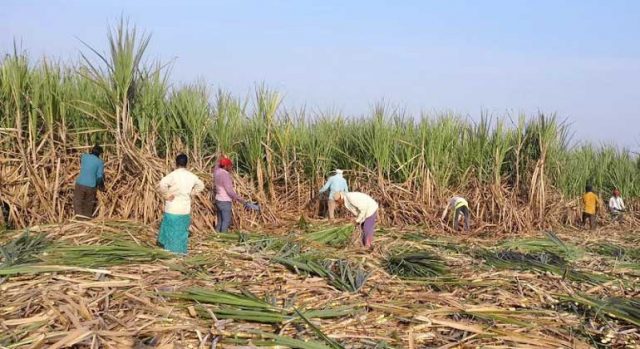
PHILIPPINE RAW SUGAR output for the crop year 2021-2022 starting in September is expected to be flat at 2.1 million metric tons (MT), according to the United States Department of Agriculture (USDA).

In a report, USDA’s Foreign Agricultural Service said the flat projection for output is due to low farm productivity and unfavorable climate.

“Factors limiting growth include the slow decline in sugarcane area and low farm productivity, particularly in areas outside Negros Island that pull down the national average. While the industry aims to boost yields, results are not expected for two to three years when funds and implementation strategies are in place,” the USDA said.

“Climate will remain a major factor as drought or too much rain have an adverse effect on production, while crop diversification is also a possibility, as some farmers may decide to shift to more profitable options,” it added.

The USDA said its projection could be altered by proposals to liberalize the sugar industry. It cited a study conducted by the National Economic Development Authority in October which yielded policy recommendations to strengthen output, cut costs, and improve support initiatives.

“Stakeholders believe that the proposed trade liberalization would place significant challenges on the sugar industry, which is not yet equipped to face open competition,” the USDA said. — Revin Mikhael D. Ochave

DoF will seek to pass remaining tax bills before national elections

WWW.DOF.GOV.PH

THE DEPARTMENT of Finance (DoF) said it will “work hard” to ensure the passage of the last two tax reform bills before the campaigning heats up for the 2022 national elections.

In a webinar Thursday, Finance Undersecretary Antonette C. Tionko said the start of the campaign period for the 2022 elections will slow the progress of remaining tax bills and other measures pending in Congress. However, she said the DoF is determined to pass the remaining measures to complete the administration’s Comprehensive Tax Reform Program (CTRP).

“Obviously once the filing of candidacy (starts), they will likely not be interested in passing that. However, there is no stopping our trying to pass them. If it’s been certified as urgent by the president, then certainly it will take precedence,” Ms. Tionko said in the webinar arranged by the British Chamber of Commerce of the Philippines, Inc.

The national elections take place in May 2022, with a 90-day campaign period before votes are cast.

“The next two packages are land valuation, which is bound to be political, and PIFITA. I think this time, we will work hard to pass these to complete the tax reform,” she added.

The proposed Real Property Valuation and Assessment Reform Act and the Passive Income and Financial Intermediary Taxation Act (PIFITA) were the third and fourth packages of the CTRP, respectively.

The third package is meant to create a uniform property valuation system to address conflicts and inconsistencies in the valuation of land. The measure is also expected to generate more revenue for local government units.

The House of Representatives approved its version of the property bill on third reading in November 2019, while the Senate version is still pending at committee level.

PIFITA, which seeks to simplify the schedule of taxes on financial instruments to 26 separate rate packages from 80, was approved at the House in September 2019 while the counterpart bill remains pending in the Senate.

In light of the decline in tax collections due to the pandemic, Ms. Tionko said the government is also looking at more revenue-generating tax bills to compensate.

“For the packages, we can expect them to be passed in the House but in the Senate, that’s where it will take a long time,” she said.

At the forum, Alex B. Cabrera, chairman and senior partner at PwC Philippines, said there is potential for the government to tap electronic commerce as a source of additional revenue if the tax regime is overhauled to cover major online sellers.

The Bureau of Internal Revenue collected P127.4 billion in taxes in March, 13% short of its P146.3-billion target after the hard lockdown imposed towards the end of the month dampened business activity This total was also 3.2% lower year on year.

The Bureau of Customs exceeded its collection target for the third straight month, outperforming the March goal by 14% with collections of P54.5 billion. — Beatrice M. Laforga

Being left behind: Framing the challenge right

Being left behind in economic growth and political stability is not a new experience for the Philippines. We were mostly cellar dwellers in the 1980s and 1990s until we decided to pursue policy and structural reforms for the last 30 years. We embraced competitive market solutions and addressed many self-defeating distortions in the goods and labor markets, as well as those in international trade and finance. We deregulated industries and liberalized markets. As a result, factor productivity and economic efficiency improved. Favorable demographic factors and technology transfer extended our output frontiers. Focus on infrastructure promised more self-sustaining economic growth.

COVID-19, being a crisis like no other, changed the rules of the game. At the time that we were about to join the upper middle-income group in 2020 with at least a single A-credit rating, some sins of the past caught up with us.

Much neglect of the public health system rendered our pandemic mitigation efforts less effective than what is required by the rapidly spreading COVID-19. We failed to use appropriate technology to establish our capability to do medical surveillance in terms of testing, tracing, and isolating infected individuals. Treatment posed a bigger challenge because government and private hospitals were both stretched to the limits. They ran out of wards, rooms, and beds. Many patients sick of COVID-19 lost their lives outside the emergency rooms waiting to be admitted.

This is the narrative of Bloomberg’s COVID Resilience Ranking which we covered in our past column. We managed to score only 51.9 and ranked 35 out of 53 major economies included in the study. Some causalities are apparent. Those leading countries in vaccine rollout such as Israel, the UAE, the UK, and the US have recorded sharp declines in mortalities. The World Bank also showed the poverty implications of COVID-19 to emphasize that effective pandemic mitigation leads to quicker economic bounce back.

We might be missing the train.

This was illustrated in an IMF blog by my friend Chang Yong Rhee, Asia Pacific Department director, and Katsiaryna Svirydzenka (“The Future of Asia: What a Difference a Year Can Make,” March 17). They cited a few Asia-Pacific countries showing increasing signs of normalcy, one year into the global health pandemic. They include Australia where the Sydney Opera resumed live performances. Melbourne hosted the Australian Open tennis tournament. Japan is continuing its planning of the 2020 Summer Olympics. China is focusing on the Beijing 2022 Winter Games.

But have we reached herd immunity to allow us to restore economic and social normalcy?

Outside the region, BBC news reported that “Israel may be reaching herd immunity.” Herd immunity is attained when enough of a country’s population has been vaccinated to provide protection against infection and prevent transmission. The estimate is at least 65% to 70% of the population must be vaccinated.

A key to a clear direction towards herd immunity is the sustained decline in daily caseloads even if more and more restrictions are lifted. The BBC report quoted Dr. Sarah Pitt, a virologist at the University of Brighton, actually cautioning against making conclusions about herd immunity. She said that to be convinced, we should see the sustained fall and stability of cases at lower levels.

First quarter 2021 performance shows Israel coming down fast with the vaccine rollout. This trend is also true for the UK and the US which pioneered in rapid jab administration. As a result, we are seeing more and more photos from these countries lifting restrictions, like mask mandate, without driving another upsurge in infection rates.

Which brings us back to the science of lockdown.

As Gideon Lichfield wrote in MIT Technology Review of March 17, the challenge of the global pandemic was to “flatten the curve.” He was prescient to argue that as long as the virus is with someone, “breakout can and will keep recurring without stringent controls to contain them.” He quoted London’s Imperial College proposal for a science of lockdown: impose more extreme social distancing measures every time ICU admissions spiked and ease them every time they fell.

Of great use in this activity would be Israel’s cell phone location data and Singapore’s exhaustive contact tracing methodology. They are possible instruments for ascertaining who is infected and who is not to restore the world’s ability to socialize safely.

Another related issue here is whether herd immunity is possible to be achieved. We recall the shift done by an independent data scientist Youyang Go with respect to his popular COVID-19 forecasting model from “Path to Herd Immunity” to “Path to Normality.” He argued that reaching herd immunity is not likely because of, one, vaccine hesitancy among the world’s population; two, emergence of new variants; and, three, the delayed arrival of vaccines for children. Current mitigation methodologies are challenged by the uncertainty of the vaccines’ ability to prevent transmission; uneven vaccine rollout; and immunity that may not last forever.

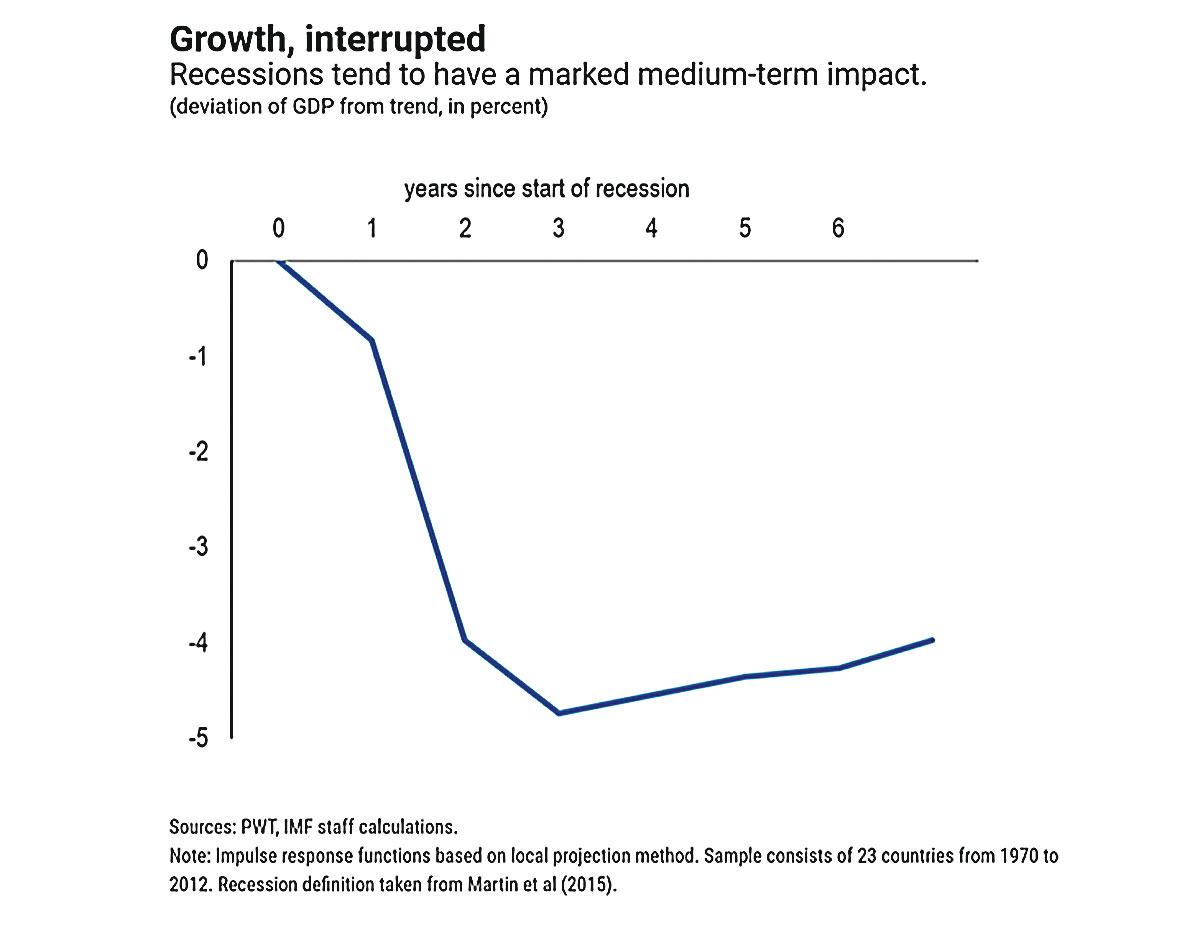
This is the reason why we found it wise for the APD staff to suggest that it is too early to say whether the region is “back to health.” Economic scarring has been serious including those on productivity growth, increasing debt, aging population, rising inequality and managing climate change. Its impact is long lasting. On average, it takes around five years before pre-recession output levels are restored, if at all.

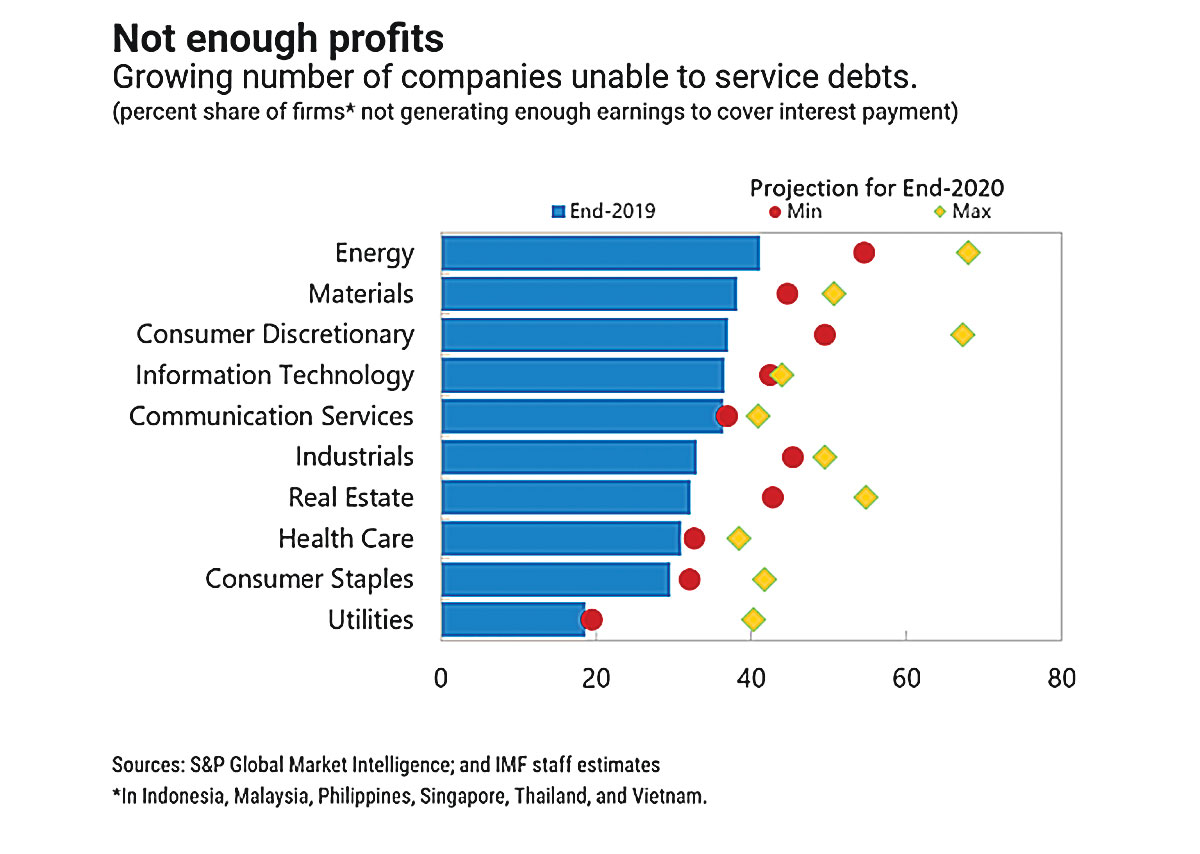
With depressed business activities, profitability of firms is severely impaired leading to increasing reliance on borrowings. Even with public support and central bank regulatory forbearance, corporate insolvencies could be a common result and in turn, drive up non-performing loans. This is shown in the chart covering Indonesia, Malaysia, Philippines, Singapore, and Vietnam.

The Fund’s suggestions on healing the economic scars of the pandemic to help usher in economic recovery are very much at play in the Philippines. Economic reforms are critical in supporting productivity growth and investment. The Philippines has been a continuing pioneer in fiscal reforms, simplification of business processes and infrastructure upgrades. Social safety nets for displaced workers and other vulnerable sectors are actively used to cushion the social impact of the pandemic.

More specific suggestions came from Chang Yong 10 months ago (“Reopening Asia: How the Right Policies Can Help Economic Recovery;” June 30, 2020). He prioritized close coordination between monetary and fiscal policy which was actually done in the Philippines although observers thought that there was a bigger scope for fiscal policy at this time to do more while monetary policy could afford to conserve ammunition.

Resource allocation was also proposed to secure corporate solvency and adequate capital base for banks. In the Philippines, banks by themselves put up more loan loss provisioning to strengthen their ability to absorb potential losses due to increased corporate distress. Various forms of inequalities were also proposed to be addressed to ensure a more durable crisis mitigation. Authorities implemented policies promoting financial inclusion through greater use of the digital platforms and democratizing the opening of bank deposits, reducing tariffs to help bring down consumer prices and rationalize the tax system.

But first things first.

In the last several months, government planners issued strong calls for re-opening the economy to save jobs. These were supported by the business sector. Unfortunately, they were not exactly aligned with the medical sector’s recommendation based on having a flatter curve to save lives.

In last Tuesday’s cabinet meeting with the President, National Economic and Development Authority Secretary Karl Chua correctly framed the challenge: “We need to help each other to solve this COVID-19 spike so that we can slowly open the economy again and bring back jobs and incomes of people.” Pandemic mitigation first; slowly open the economy, second; and bring back jobs and incomes of people, third.

C’est le ton qui fait la musique.


Diwa C. Guinigundo is the former Deputy Governor for the Monetary and Economics Sector, the Bangko Sentral ng Pilipinas (BSP). He served the BSP for 41 years. In 2001-2003, he was Alternate Executive Director at the International Monetary Fund in Washington, DC. He is the senior pastor of the Fullness of Christ International Ministries in Mandaluyong.

In context: Block-timing and truth-telling

CHINATOWN NETWORK FACEBOOK ACCOUNT

ABS-CBN has canceled its block-timing agreement with Chinatown News TV apparently in reaction to the spate of criticism it had been getting on Twitter and Facebook. If it had continued, it would have detracted from the heightened credibility of the network and the renewed public confidence in it that were among the positive consequences of the government’s denial last year of its application for the renewal of its franchise.

Journalists’ and artists’ groups, media advocacy organizations, and human rights and press freedom defenders supported ABS-CBN then, and so did 75% of the population. Ordinary folk also weighed in by recalling how its news reporting had helped them prepare for the typhoons, floods and other catastrophes that regularly afflict their communities.

When the now canceled agreement became public, this time Netizens, among others, expressed their disappointment through social media because of the context in which it was signed: the country’s continuing problems with Chinese aggression in the West Philippine Sea. Only a few days earlier, China’s warships had harassed and chased to within 90 miles of Palawan province a civilian ship on which an ABS-CBN news team looking into the situation of Filipino fisherfolk was aboard. The network’s block-timing agreement with CNTV therefore surprised many.

“Block-timing” is a practice in which an individual or group buys “blocks” of time from a radio or television network to air its own programs in behalf of its political, economic, or other interest. Under that all too brief agreement with CNTV, the ABS-CBN News Channel (ANC) would have aired its programs during certain times, presumably not only in the Chinese common language (Putonghua) that is still known as Mandarin in the Philippines, but also in English and Filipino. The practice gives anyone who can afford to pay for it the opportunity to disseminate without being challenged information, even if false, as well as their views on whatever issue they wish to focus on. Politicians campaigning for public office, for example, regularly buy blocks of time on television and radio. They or their hirelings present issues in a one-sided way, and attack their rivals without the latter’s being able to defend themselves. It is one of the means through which one can air one’s version of events without having to acknowledge and give equal time to opposing views. Because block-timing is fraught with ethical and professional infirmities, the self-regulatory Kapisanan ng mga Brodkaster ng Pilipinas (KBP) has expressed concern about the practice, but has failed to stop its use for even the most malignant purposes.

Managed by Filipinos of Chinese origin, would-be ABS-CBN block-timer CNTV is an advocate of China’s “One Belt One Road” (OBOR) infrastructure program that would link some 70 countries to that country supposedly to foster trade and development. OBOR has been criticized as China’s way of luring other nations into its orbit in furtherance of its strategic aim of global economic and political dominance. The station also implied in one of its recently released videos that the West Philippine Sea should be shared by China and the Philippines.

When asked why the company was entering into a block-timing agreement with ABS-CBN, a CNTV spokesperson said it was because of the bigger network’s credibility. Translation: CNTV wanted to enhance the credibility of its own programs and to extend their reach through the use of ABS-CBN’s digital and online platforms. Perhaps its officers believed that if it had gone through, the arrangement would soften most Filipinos’ outrage over China’s claim that some 80% of the West Philippine Sea are part of its territory, and allay their fears that the Philippine government’s construction projects with China are debt traps.

But despite the Duterte regime’s seeming unconcern with China’s militarization of the West Philippine Sea and its other acts of aggression in it and its entering into billions of dollars’ worth of projects under the much touted — and much delayed — “Build, Build, Build” program, China is nevertheless the one country an overwhelming number of Filipinos trust the least. They instead trust the most China’s leading adversary, the United States. The distrust of China has been fueled by such acts as its occupying Philippine reefs and shoals, its sea craft’s driving Filipino fisherfolk away from their traditional fishing grounds and even stealing their catch, sinking a Filipino fishing boat, etc. These acts have helped strengthen anti-Chinese biases in Philippine culture despite centuries of interaction with that civilization, and on the other end, the supremacy of pro-US sentiments. The media are the leading means through which such sentiments are expressed and reinforced. The home and the educational system also help, but the mass reach of the media makes them more influential.

Not only in the Philippines has the weakness of Chinese cultural influence been a hindrance to the realization of its current hegemonic ambitions. In addition to US military might, China is also hindered by US cultural power. It is a power based on the dominance of that country’s culture industry, which daily floods the planet with unending streams of news reports, songs, movies, television programs and other vectors of Western values and ideas.

Even Al Qaeda’s Osama bin Laden was getting his news from Time-Warner’s CNN. When Russia was still the leading member of the Union of Soviet Socialist Republics (USSR), one could watch in Moscow such US movies — dubbed in Russian, of course — as Rambo, and US television serials like Days of Our Lives. But because of their familiarity with the English language that the US forced on their forebears when the Philippines was still its colony, Filipinos don’t even need to have translated the Hollywood movies, the news programs, or the police and crime serials, situation comedies, cartoons, fantasy shows and other products for television the US media giants bombard the globe with.

Aware of how influential the US is on the minds and consciousness of billions of people, and of its own weakness in that area, China has launched a cultural offensive, encouraging the learning of China’s common languages, reminding such countries as the Philippines of its Chinese cultural heritage, providing scholarships, and sponsoring visits to China. But it is also aware of the need for favorable publicity via the news media in advancing and defending its political, economic and strategic interests.

This is the larger context in which the cancellation of the CNTV agreement with ABS-CBN must be understood. Initially at least, the latter network seemed to have missed the implications on its own advocacy when it signed the agreement.

Hopefully the cancellation of that scheme was not only in reaction to the criticisms against it, but also in the realization that its support for Philippine rights and sovereignty over its territorial waters would have been compromised.

The cancellation is neither a matter of censorship nor discrimination, but of complying with ethical and professional standards. Like any other media organization, CNTV is protected by Article III Section 4 of the Philippine Constitution which guarantees everyone’s rights to free expression, free speech and press freedom. It also has every right to its advocacy, which in fact it has been airing through its own facilities. The issue is whether that advocacy is factually based, and, if it is not, whether any other media entity should help advance it to the detriment of its own convictions — and to the further injury of the fundamental journalistic responsibility of truth-telling.


Luis V. Teodoro is on Facebook and Twitter (@luisteodoro).

www.luisteodoro.com

Reflections on mission and joy

BEDNEYIMAGES-FREEPIK

A period of silence allows us time and space to think about our lives and the direction that we are taking. In the whirling chaos around us, there should be a quiet refuge where we can hold on with faith and grace.

During the prolonged crisis, people have undergone a series of professional setbacks and/or personal losses. The mood has been somber, sad and sorrowful. There are feelings of pain, helplessness, frustration and despair.

However, there are some moments of hope and light.

Here are some enlightening points and reflections from two wise men who talked about truth, mission, and joy.

“The Truth has two facets: the meaning of the text and the historical truth; the actual chronology of events. Outside the truth, there are Critical thinking and Fundamentalist reading.

“If you don’t have full control, it is because you don’t have a choice. You are not all-powerful. God does not exercise complete control in the world and our own lives because He chose to create an open system.

“In the Open System, there are unintended consequences: the possibility of physical evil such as sickness, death, accidents, and natural disasters; the possibility of moral evil: Sin.

“The intended consequences of the open system are: a universe of freedoms with people and nature; the possibility of Love.

“The interacting causes in the open system are: God’s will (good cause); laws of Nature (natural causes); structure and culture (social causes); human freedom (human causes); good and evil spirits (spiritual causes).

“These causes lead to the codetermination of events.

“Embrace it all — both the sadness and joy. Let go God through you.

“Letting Good, one learns how to deal with fear. Believe in the Good. Commit to the Good. Discern the Good.

“Letting Evil, one learns how to deflect anger. Defy and resist evil. Forgive the evil-doers. Take and transform the pain.

“Letting God. One learns about sadness and joy in a ‘mathematical equation.’

“Share in sadness — and halve it. Share in joy — and double it.

“Reveal to others a world super-saturated with the Lord’s presence and goodness.

“Two metaphors: Drop the rock. Let go of the umbrella.

“There’s always been a rainbow hanging over your head.”

— Father Johnny Go, S.J., “Pins of Light” Lenten retreat

Climbing the second mountain is the stage in our lives when we ascend to a more spiritual plane. According to Fr. Carmelo Caluag, we should give people three things at the different stages of life:

“… Something to live on…. Something to love for.

“… Something to die for.”

“We are now at the stage of Something to die for.

“What is our Mission?

“It is the meeting point between your deep gladness and a deep hunger of the world.”

He shared this excerpt from The Second Mountain by David Brooks:

“Here I want to shift now to the highest layer of joy… moral joy… this is the highest form of joy… because this is the kind that even the skeptics can’t explain away. The skeptics could say that all those other kinds of passing joy are just brain chemicals in some weird formation that happened to have kicked in to produce some odd sensation.

“But moral joy has an extra feature. It can become permanent. Some people live joyfully day by day. Their daily actions are aligned with their ultimate commitments. They have given themselves away, united and wholeheartedly. They are so grateful to have found their place and taken their stand. They have the inner light.”

Pope Francis, Bishop Desmond Tutu, and the great cellist Yo-Yo Ma have this unique inner light.

The author was once seated with the Dalai Lama who did not say anything particularly illuminating or profound during lunch. However, he noticed that the Dalai Lama would burst out laughing.

“He would laugh, and I wanted to be polite, so I would laugh, too. He laughed, I laughed. He is just a joyful man. Ebullience is his resting state.

“Happiness is the proper goal for people on those on their first mountain. And happiness is great. But we only get one life, so we might as well use it hunting for big game: to enjoy happiness, but to surpass happiness toward joy.

“Happiness tends to be individual. We measure it by asking, ‘Are you happy?’

“Joy tends to be self-transcending. Happiness is something that you pursue; joy is something that rises up unexpectedly and sweeps over you. Happiness comes from accomplishments; joy comes from offering gifts. Happiness fades; we get used to things that used to make us happy. Joy doesn’t fade.

“To live with joy is to live with wonder, gratitude and hope. People who are on the second mountain have been transformed. They are deeply committed. The outpouring of love has become a steady force.”

Pope Francis once said, “This is a moment to dream big, to rethink our priorities — what we value, what we want, what we seek — and to commit to it in our daily life on what we have dreamed of. What I hear at this moment is similar to what Isaiah hears God saying through him: Come, let us talk this over. Let us dare to dream.”


Maria Victoria Rufino is an artist, writer and businesswoman. She is president and executive producer of Maverick Productions.

mavrufino@gmail.com

Super League shelved

ITALIAN club Juventus also pulls out from proposed European Super League. — JUVENTUS FB PAGE

MANCHESTER, ENGLAND — The European Super League collapsed on Wednesday as eight of the 12 founding members from England, Italy and Spain abandoned the breakaway project under massive pressure from fans, politicians, soccer officials, and even the British royals.

Founder and Juventus chairman Andrea Agnelli told Reuters he was reluctantly calling time on the new league after six English clubs withdrew on Tuesday, with Inter Milan and Atletico Madrid following suit and AC Milan indicating they would, too.

“The voices and the concerns of fans around the world have clearly been expressed about the Super League, and AC Milan must be sensitive to the voice of those who love this wonderful sport,” the Italian club said in a statement.

However, Real Madrid president Florentino Pérez, the Super League chairman, struck a defiant tone, saying the project was not dead and he was still talking with AC Milan and remaining clubs Barcelona, Juventus, and Real.

“The project is on standby,” Pérez told Spanish radio program El Larguero. “We are going to keep working.

“I’m convinced that if this project doesn’t work, another similar one will.”

Agnelli said he still believed in the merits of the Super League despite the overwhelming criticism and had no regrets about how the breakaway had been conducted.

“I remain convinced of the beauty of that project,” he told Reuters.

Juventus itself conceded there were limited chances of the project being completed in its original form.

The Italian club said in a statement that clubs that intended to leave had yet to complete the necessary procedures under the Super League agreement.

Agnelli quit on Sunday as chairman of the European Club Association (ECA), which represents over 200 clubs. The ECA said Paris Saint-Germain president Nasser Al-Khelaifi would replace him, adding that recent events were a reminder that “owners are merely custodians of their clubs.”

‘RIGHT RESULT’
The Super League argued it would increase revenue for the top soccer clubs in Europe and allow them to distribute more money to the rest of the game.

However, the sport’s governing bodies, other teams and fan organizations said the league would only boost the power and wealth of elite clubs, and that the partially closed structure went against European football’s long-standing model.

Players, fans, pundits and politicians celebrated the U-turns of the English teams on Tuesday that left the league in tatters and pushed other founding members to jump ship.

“This is the right result for football fans, clubs, and communities across the country. We must continue to protect our cherished national game,” British Prime Minister Boris Johnson said.

Britain’s Prince William, president of the English Football Association, who had criticized the planned breakaway, said in a signed tweet: “I’m glad the united voice of football fans has been heard and listened to.”

The founding members were Arsenal, Chelsea, Liverpool, Manchester City, Manchester United and Tottenham Hotspur from England, AC Milan, Inter and Juventus from Italy and Spain’s Atletico Madrid, Barcelona and Real Madrid.

Barcelona had yet to comment on the Super League by late on Wednesday.

Two sources told Reuters the clubs that withdrew from the Super League could face breakup fees for backing out.

Inter Milan, Juventus and AC Milan will not be punished by the Italian Football Federation (FIGC) over their involvement in the Super League, FIGC chief Gabriele Gravina said.

Liverpool’s principal owner John Henry apologized in a video on the club’s website and social media on Wednesday.

“It goes without saying, but it should be said that the project put forward was never going to stand without the support of the fans,” he said.

“I, alone, am responsible for the unnecessary negativity brought forward over the past couple of days. It’s something I won’t forget. And shows the power the fans have today and will rightly continue to have.”

Manchester United’s co-chairman Joel Glazer apologized in an open letter to supporters for failing to show respect for the English game’s “deep-rooted traditions.”

“We continue to believe that European football needs to become more sustainable throughout the pyramid for the long term. However, we fully accept that the Super League was not the right way to go about it,” Glazer wrote. — Reuters