Home Blog Page 8148

Philippines vows to continue maritime exercises in South China Sea

US NAVY/HANDOUT VIA REUTERS/FILE PHOTO

MANILA – The Philippines will continue maritime exercises inside its 200-mile Exclusive Economic Zone (EEZ) in the South China Sea, the country’s defense minister said on Sunday, despite a call by China to stop actions that it said could escalate disputes.

The Philippine coastguard and fisheries bureau started maritime exercises last month, having boosted its presence in the area to counter the “threatening” presence of Chinese boats.

China claims almost the entire South China Sea, through which about $3 trillion worth of ship borne trade passes each year, despite a 2016 ruling by an arbitration tribunal in The Hague that Beijing’s claim was inconsistent with international law.

“The conduct of maritime patrol in the WPS (West Philippine Sea) and Kalayaan Island Group by the Philippine Coast Guard and the Bureau of Fisheries and Aquatic Resources will continue,” Defence Secretary Delfin Lorenzana said in a statement, using the local name for the South China Sea.

“The government will not waver in its position,” he said.

The lingering presence of hundreds of Chinese boats in the Philippines’ EEZ has revived tensions between the countries, despite President Rodrigo Duterte’s friendship with Beijing.

Lorenzana said his comments echoed the stance of Duterte on the issue, citing the latter’s “very firm and straightforward” orders for the Philippine military to “defend what is rightfully ours without going to war and maintain the peace in the seas”.

While Duterte still considers China as “a good friend”, the Philippine leader last week said: “There are things that are not really subject to a compromise … I hope they will understand but I have the interest of my country also to protect.”

Lorenzana said the Philippines “can be cordial and cooperative with other nations but not at the expense of our sovereignty and sovereign rights”. — Reuters

Ortigas Land amplifies work-life balance at Ortigas East with the Glaston Tower

As work gets reshaped, offices are beginning to be modified to aptly adapt to the changing needs of organizations and their employees. Now, the fitting office for any professional is one where the work-life balance is constantly realized, through easy access from homes a few walks away or a short drive from various points in the Metro, breathable and environment-friendly spaces, as well as access to spaces for quick eats and strolls, among other things.

Located at the redeveloped Ortigas East, a project of Ortigas Land with 90 years of experience in the real estate industry, is the soon-to-rise Glaston Tower that is designed to address these fresh demands of organizations and workforces, and so be an ideal workspace and a prime address for local and multinational businesses.

With elegant and functional workspaces sprawled across its 25 office floors, the 34-storey Glaston Tower is built for forward-thinking companies who value their workforce’s well-being as well as a healthy and modern working environment.

The Glaston Tower’s 349 office units — which come in Prime Units, Prime Suites, Glass Suites, and Glass Units — are intricately designed to give much room for optimal collaboration and productivity at work. Certain arrangements are even proposed to accommodate corporate, design/creative, and insurance/finance offices.

In addition, the Glaston Tower has welcoming Ground-Level and Sky Lobbies, as well as spacious and minimally-designed restrooms with shower area on each floor. The tower also has 15 high-speed elevators, eight levels of podium parking, and two levels of basement parking.

The Glaston Tower is also equipped with automatic fire alarm and sprinkler system, 24-hour security and building maintenance, key card system access, 100% back-up power on all common areas, and integrated CCTV security system in select common areas.

Aside from flexibility and functionality, sustainability is also set to mark the Glaston Tower as it is designed with amenities that maximize the use of natural resources such as sunlight, rainwater, and fresh air. The tower also utilizes VRF/VRV multi-split air conditioning system.

With its design compliant with the Philippine Green Building Code, the Glaston Tower is targeting to achieve LEED (Leadership in Energy and Environmental Design) Certified level using the LEED for Core & Shell v4.0 Rating System.

Greater advantage to professionals

Strategically placed in a mixed-use development that can be easily accessed through Ortigas Avenue, C5, and Julia Vargas Avenue, the Glaston Tower is set to add to the great advantage the 16-hectare Ortigas East aims to bring.

With its proximity to the three upcoming residential Verdánt Towers, potential occupiers at Glaston Tower have the opportunity to stay in a place a few walks from their offices. The Maple at Verdánt Towers, the first of these residential buildings, is built to sustainable standards, which makes it better for the environment and safer for residents.

Shopping options are also within reach at the Glaston Tower. There are retail stores featuring diverse, healthy, and sustainable brands, coupled with international and local dining options, designer boutiques, and state-of-the-art entertainment.

In addition, the Glaston Tower is surrounded by open green spaces, with 40% of Ortigas East allotted for parks and open spaces. This is coupled with a good pedestrian- and bike-friendly road network consisting of an improved six-lane boulevard and two four-lane roads with ample sidewalks, making Ortigas East a walkable community.

With these enhancements to Ortigas East, residents and city dwellers can make the most out of these spaces to enjoy a balanced lifestyle — from getting active in a quick run or bike ride, getting productive working in the office or at home, to being relaxed in the coziness of a well-built home.

Ortigas East firmly believes in balance and harmony not only in personal lives, but also in people’s lives at work. With its latest signature development, the Glaston Tower, the refreshed development seeks to give professionals the opportunity to enjoy the great advantages of balanced living.

Recently, the Glaston Towers has just topped off and is on track in terms of its construction schedule. Only a few units remain in the office tower with 90% of units sold.

For inquiries about The Glaston Tower, call Ortigas Land at (+632) 7477-1393 or chat with their agent at www.ortigas.com.ph.

AC Motors recognizes increased opportunity with online commerce, extends partnership with AutoDeal

AC Motors, the automotive wing of Ayala Corporation, has renewed its partnership with AutoDeal.com.ph for another consecutive year as part of its plan to provide more customer-centric buying experiences online.

The company’s continued investment into digital commerce is part of a global trend following the halt of traditional automotive business operations which occurred during the lockdowns imposed by COVID-19 restrictions in 2020. The renewal of the partnership will enable consumers from across the Philippines to effortlessly connect with all Kia, Volkswagen, and Maxus dealerships as well as select Honda dealers via AutoDeal’s online marketplace.

When it comes to the topic of digital commerce, AC Motors are among the most bullish players in the market, not only seeking the opportunity to connect with a broad audience but to provide the appropriate level of service required to convert digital metrics into real-world sales.

“Online marketing is the great equalizer. In the past, only big brands with huge ATL media budgets could effectively communicate to the mass market. Digital media was then considered a niche with advertisers allocating only 10% of their budget. Covid-19 accelerated the Philippine market’s shift to digital media. The traditional purchase funnel can now be reshaped. We now find ourselves at equal footing with the other brands on a race to win in the digital space.” said AC Motors President Antonio Zara.

“Autodeal spearheaded the digital transformation of the industry well before players themselves realized the impending change. It is now by far the leading auto portal in the Philippines. They continue to reinvent themselves as new players start to emerge.” he added.

Kia began their first year of partnership with AutoDeal back in March of 2020, onboarding a total of 41 dealerships onto the platform in a few short weeks. Since then, the brand has seen exponential results over the last twelve months; with AutoDeal fulfilling a commitment to contribute to three hundred sales in its first term. Together with Maxus and Volkswagen, the trio of brands will be aiming for further success in 2021 through an enhanced commitment to consumers and brand new products to boot.

“We’ve had a long-standing relationship with Ayala’s automotive division ever since the formation of AutoDeal in 2014. Our latest partnership renewal is a natural progression that signifies how brands are becoming more attentive to the quality of the service that they provide online. We’re happy to be among the partners that AC Motors has chosen for this endeavor, and look forward to continuing to work actively with their teams to provide convenient and efficient online buying options for their consumers.” says AutoDeal co-founder and CEO Daniel Scott.

Through the partnership, all AC Motors brands get access to customers through the AutoDeal.com.ph platform—an online marketplace that enables consumers to find the best deal on their next vehicle from highly rated dealerships across the country. In addition, commercial partners are given access to a wide range of technology, including a comprehensive lead-management system with intuitive mobile applications for sales agents and managers.

The application of the technology enables brands like AC Motors to be attentive to the quality of service that their brands are providing online by keeping track of things like dealership response times and sales conversion rates.

“Our platform goes beyond lead-generation. We exhaust an enormous amount of resources to ensure that the experience given to car buyers across our platform is of the highest quality. This has led us to create an online experience that is equally as beneficial for the consumer as it is for the dealer. As a result, we’ve been able to evolve our business model to provide a committed sales output, which we believe offers our partners not only a guaranteed return on investment but also significant peace of mind.” added Scott.

AC Motors’ partnership with AutoDeal contributes to approximately seventeen percent of AutoDeal’s partner network, which grew by 72% in 2020. With more than 25,000 confirmed purchases via the platform last year, AutoDeal accounts for roughly 11% of the overall market – offering growing opportunities for partnered brands year on year. The company’s contribution to digital commerce goes even further when you take into consideration that their sister technology company, SirQo provides the inquiry management system for the website of several of the country’s leading automotive brands.

The AutoDeal partnership is just one of the many digital innovations that AC Motors are investing in. When asked about the future of automotive retail and the role that digital will play in serving customers anywhere, Mr. Zara stated that:

“It is more a question of how we can serve in “anyway” than “anywhere”.  Beyond digital showrooms which have become common in the marketplace, we are now piloting live presentations in some of our brands.  We are committed to ensuring our consumers online shopping experience and it is for this reason we are investing in new technologies to put the customer at the center of our communication mix.  At the same time, we continue to expand our company-owned and independent franchise dealer network since traditional stores remain important to consummate a sale.  While the market is ready for virtual dealer processes, it is not ready for a virtual dealer.”

With an ambition to reach a 10% industry market share by 2025, AC Motors looks to further embrace technology as an integral part of their customer’s journey. To find out more about AC Motors and AutoDeal visit www.acmotors.com.ph and www.autodeal.com.ph.

Inflation likely quickened in April — poll

PHILIPPINE STAR/MICHAEL VARCAS
Analysts said rising global oil prices may have also contributed to the uptick in inflation. — PHILIPPINE STAR/MICHAEL VARCAS

By Luz Wendy T. Noble, Reporter

HEADLINE INFLATION in April likely quickened beyond the official target range for a fourth straight month, as the price ceiling on selected pork and chicken products was lifted and transport costs remained elevated, according to analysts.

A BusinessWorld poll of 17 analysts last week yielded a median estimate of 4.7%, nearer the upper end of the 4.2% to 5% estimate given by the Bangko Sentral ng Pilipinas (BSP) for April.

If realized, inflation would be faster than the 4.5% print in March as well as the 2.2% a year earlier. It would also mark the fourth straight month of inflation overshooting the 2-4% target set by the BSP, and the quickest print since the 5.1% in December 2018.

Analysts said higher meat prices likely fueled a faster increase in the consumer price index (CPI), after the lifting of the 60-day price cap on selected pork and chicken products on April 8.

“We think that pork prices will remain elevated and will continue to be a huge contributor to CPI food’s upward pressure on headline (inflation),” UnionBank of the Philippines, Inc. Chief Economist Ruben Carlo O. Asuncion said.

To curb the continued spike in pork prices, President Rodrigo R. Duterte last month signed Executive Order (EO) 128 which slashed tariffs for pork imports for one year.

Some analysts believe the EO was not able to immediately lower pork prices.

Security Bank Chief Economist Robert Dan J. Roces said pork prices likely remained high in April, as the tariffs were just recently implemented.

“Imported pork inventory to be sold in May and June would likely be from the higher tariff rate, but July onwards will benefit from Executive Order 128,” Alvin Joseph A. Arogo, vice-president and head of equity research division at Philippine National Bank (PNB), said.

The prices of typical Filipino family food staples such as rice and fish also remained high, Bank of the Philippine Islands lead economist Emilio S. Neri said.

Analysts said rising global oil prices may have also contributed to the uptick in inflation.

“The headline rate is set to jump this month due to higher fuel price inflation, as last year’s plunge in global oil prices enters the annual comparison,” Alex Holmes, an economist at Capital Economics, said.

Year to date, prices of gasoline, diesel, and kerosene increased by P7.60, P5.70 and P4.95 per liter, respectively, as of April 27.

“The transport basket inflation may have accelerated due to private fuel costs while transport fares remain elevated due to the one-off development of banning more than one passenger for tricycles,” Security Bank’s Mr. Roces said.

The April inflation data will be released on May 5.

Analysts believe the BSP will remain accommodative to support an economy struggling to recover amid a prolonged pandemic.

“We expect the BSP to keep rates steady as it views inflation this year to be transitory and also to bolster the economic recovery,” Mr. Roces said.

The central bank expects the CPI to rise by 4.2% this year, faster than the 2.6% in 2020.

BSP Deputy Governor Francisco G. Dakila, however, said in April that they do not see inflation to go beyond 5% at any time during 2021.

By 2022, the BSP projects headline inflation to ease to 2.8%.

“The biggest issue facing the country now remains the elevated number of COVID-19 cases, which has substantially dented economic activity. In its future policy meetings, we expect the BSP to steer its focus more towards growth and less towards inflation,” HSBC Global Research economist Noelan Arbis said.

Economic managers expect the economy to grow by 6.5% to 7.5% this year although multilateral agencies and think tanks have already downgraded their growth outlook for the country due to the ongoing virus surge.

The central bank will have its next policy setting on May 13. In March, the BSP kept the key policy rate at a historic low of 2%.

Analysts’ April inflation rate estimates

Gov’t gross borrowings hit P1.4T in 1st quarter

A Philippines peso note is seen in this picture illustration, June 2, 2017. — REUTERS/THOMAS WHITE/ILLUSTRATION

THE National Government’s gross borrowings reached P1.382 trillion in the first quarter, following the retail Treasury bond (RTB) sale in March, as the country continued to raise funds for its pandemic response.

Latest data from the Bureau of the Treasury (BTr) showed that the tally was 44.45% higher than the P956.718 billion recorded in the first quarter of 2020.

This was mainly due to the surge in new debts incurred in March, when total borrowings climbed 65.87% to P617.3 billion from P372.151 billion in the same month last year.

Month on month, gross borrowings surged by 1,045% from P53.91 billion in February.

In particular, domestic borrowings went up 60.87% to P584.12 billion in March, thanks to the P463 billion in fresh funds raised from the sale of three-year RTBs on March 4.

Last year, the Treasury offered RTBs in February.

Local borrowings also included P79 billion in Treasury bonds (T-bonds), which were offered fortnightly, and another P41.8 billion in net Treasury bills (T-bills).

Excluding the P51.86-billion amortization payments made that month, the government’s net borrowings totaled P532.26 billion.

Foreign borrowings, meanwhile, more than tripled to P33.2 billion in March from P9.047 billion the year before. This was composed of P29 billion in program loans and P4.15 billion in project loans.

The government repaid P17.786 billion in foreign debt, which trimmed its net external borrowings for the month to P15.39 billion.

For the first quarter, local borrowings hit P1.3 trillion, up 60.5% from P810.032 billion a year ago.

Gross external debt, meanwhile, reached P79.45 billion, or only half of the P146.686 billion borrowed the year before.

Less all the amortization payments made during the period, the Treasury’s overall net borrowings stood at P1.187 trillion last quarter, up 48.3% compared with the P800.6 billion recorded in 2020.

The government is looking to raise P3 trillion this year from domestic and external lenders to help fund its budget deficit, which is seen to hit 8.9% of gross domestic product. — Beatrice M. Laforga

Coronavirus not a death sentence for Philippines illegal wildlife trade

VARIOUS wildlife species, including venomous spitting cobras and pit vipers, were discovered hidden inside bamboo chimes and lanterns to be exported to Taiwan on Feb. 18, the Customs bureau reported. — COURTESY OF THE BUREAU OF CUSTOMS

By Angelica Y. Yang, Reporter

FULLSCALE Reptiles and Exotics got at least two-dozen inquiries from prospective buyers at the height of the coronavirus pandemic in August after posting an ad for a Brazilian rainbow boa — the snake’s trademark iridescent and holographic sheen clearly seen on the photo — on its Facebook page.

The reptile pet store, which sells tame boa constrictors, green iguanas and Sulcata tortoises, among other animals, says it’s a “trusted and legal source of exotic animals” and has more than 100,000 followers on the social media platform.

Conservation experts have said the coronavirus that emerged in late 2019 is a zoonotic disease — it likely came from wildlife — highlighting the devastating impact wildlife trade can have on human health and economies.

BusinessWorld tried to reach out to the store owner, who did not immediately reply to questions.

“Our early assessment shows that wildlife trafficking has continued, especially within national jurisdictions, despite restrictions in movements within and between countries in Southeast Asia during pandemic lockdowns,” said Elizabeth John, a spokesperson for Traffic, a wildlife trade monitoring network.

“The pandemic and its reported links to wildlife trade seem to have done little to dissuade traffickers,” she said in an e-mail.

Other zoonotic diseases include severe acute respiratory syndrome, Ebola, bird flu, and Middle East respiratory syndrome coronavirus.

“Its exact origins are still unknown, but COVID-19 is suspected to have originated in bats and may have jumped to humans via an intermediary wild species in a China wildlife market,” said the World Wildlife Fund.

The Asian Development Bank estimates the value of the illegal wildlife trade globally at $10 billion to $23 billion a year, making wildlife crime the fourth-most lucrative illegal business after narcotics, human trafficking, and arms.

“The Philippines is a consumer, source, and transit point for illegal wildlife trade, threatening endemic species populations, economic development, and biodiversity,” it said in a 2019 report.

ONLINE SHIFT
The value of illegal wildlife trade in the Philippines is about P50 billion a year ($1 billion), which includes the market value of wildlife and its resources, their ecological role and value, the cost of habitat damage during poaching and loss in potential ecotourism revenue.

Philippine authorities seized about P5.44 million worth of wild animals from both local and international trade last year, 92% less than a year earlier, as the Environment department’s Biodiversity Management Bureau sent out fewer workers during the pandemic.

“There were fewer people to enforce the law last year,” Emerson Y. Sy, a wildlife researcher for more than 20 years, said by telephone. “When you go online, you can see that the illegal trade of wildlife hasn’t abated.”

More than 300 Philippine wildlife trade groups had been created on Facebook since President Rodrigo R. Duterte locked down the entire Luzon island in mid-March last year to contain a coronavirus pandemic, Mr. Sy said.

Many of these groups had been taken down by the social media platform in the past weeks, he added.

Mr. Sy said travel restrictions during the global health crisis have forced poachers to limit their trade to Luzon-based bird species.

Before the pandemic, the Palawan Hill Myna and blue-naped parrot — both on the International Union for Conservation of Nature’s “red list” of threatened species — were highly traded.

Rogelio D. Demellentes, Jr., who has worked with a Philippine task force against the illegal trade of ivory and wild animals, said traffickers continued with their illegal activities through Facebook.

The 47-year-old wildlife law enforcer and his team at the Environment department continued to track and apprehend animal traffickers during the crisis, at the risk of getting infected with the coronavirus.

“When we catch them, we don’t know if they’re infected with COVID-19,” he said by telephone.

Theresa Mundita S. Lim, executive director at the ASEAN Centre for Biodiversity, said travel restrictions could spell both “good and bad news for the country’s wildlife.”

“Movements of poachers and other would-be violators have been restricted leading to a decrease in illegal activities, such as poaching and illegal harvesting, and collection of wildlife and forest products,” she said in an e-mailed reply to questions.

FEWER PATROLS
“Communities have also reported increased sightings of wildlife that are usually disturbed during peak tourism season.”

But the lockdown had also meant a decline in state patrols and enforcement, Ms. Lim said. Joblessness during the health crisis “might also drive people to revert to these illegal activities such as fishing in marine sanctuaries, or hunting and poaching,” she added.

Ms. Lim said the pandemic had spurred countries including the Philippines into action. Mr. Duterte had called for a halt in wildlife crimes to prevent the spread of diseases.

“Illegal wildlife trade poses huge risks not just to the country’s natural assets, which include wildlife species, but also to public health, as we have seen in the COVID-19 pandemic,” she said. The practice has also led to dwindling biodiversity.

Curbing illegal wildlife trafficking requires a whole-of-society approach, Ms. Lim said, citing the need for coordination between countries and sectors.

The business sector can help halt wildlife crimes by ensuring that the raw materials they use for manufacturing are “sustainably, legitimately and equitably sourced.”

Ms. John said the Philippines has had “some notable success in enforcing its wildlife law and a multi-agency task force focused on ivory smuggling and wildlife trade,” but much needs to be done.

“There are areas for improvement such as closing loopholes in its national wildlife law and stricter management of captive breeding facilities to prevent these from being used as a cover to launder wild-caught animals into legal trade,” she said.

She also cited a thriving exotic pet trade and a bustling wildlife trade online, where a significant proportion involves illegal trade.

The Philippine tourism sector will benefit if the country took greater care of its wildlife, Mr. Sy said.

“If Philippine wildlife species are protected and conserved, they can be used as attractions for tourists,” he said.

“If we don’t protect our wildlife species, we might not be able to see them again,” Mr. Demellentes said.


Nestlé PHL makes new commitments to achieve net zero emissions

NESTLÉ PHILIPPINES, Inc. on Friday made new commitments to achieve net zero emissions not later than 2050, including reducing virgin plastics consumption by a third and cutting 30% of greenhouse gas (GHG) emissions in local operations by 2025.

“We will cut down virgin plastics consumption by one-third by 2025,” Nestlé Chairman and Chief Executive Officer Kais Marzouki said during the firm’s virtual 2021 Net Zero Fair on Friday. Virgin plastics are resins that are created without any recycled materials.

“We will collect and divert an annual average of 26,000 metric tons of plastic waste away from landfills and oceans…and reduce GHG emissions in our (factory, administrative office and logistics) operations by 30% by 2025,” he added.

These are some of the global food and beverage manufacturer’s new commitments in achieving its net zero emissions goal, as it tackles climate change.

“These commitments aim to support the Philippines’ Nationally Determined Contribution under the Paris Agreement to reduce and avoid carbon emissions by 75% as of 2030,” Nestlé Philippines said in a statement.

Mr. Marzouki said the company has already switched to clean energy, with its Luzon factories and Makati office now fully powered by renewable energy.

Nestlé Head of Corporate Affairs and Communications Arlene Tan-Bantoto said the company is seeking to promote responsible coffee production among its farmers and communities.

“Through the Nescafe Plan, we work hand in hand with farmer groups to empower them and build sustainable communities. We teach them responsible coffee production. We promote regenerative agriculture including reforestation,” she said during the virtual event.

Nestlé Philippines is also tackling the plastic waste crisis by developing technology to make its packaging recyclable or reusable by 2025.

In August 2020, the company became the first multinational fast-moving consumer goods company to attain plastic neutrality in the Philippines.

“This means Nestlé Philippines is collecting and co-processing, and therefore diverting from nature, the equivalent amount of plastic that it generates in its packaging. Since then, it has collected 18,000 metric tons of plastic waste in the last seven months,” it said.

Ms. Bantoto noted Nestlé is working closely with local and foreign suppliers in sourcing raw and packaging materials “with the lowest levels of GHG emissions.”

Department of Environment and Natural Resources Secretary Roy A. Cimatu, who attended the event, said that Nestlé will help the country “attain its goals of building climate change mitigation, adaptation and resilience by accelerating its actions to tackle climate change.”

“We accordingly assure Nestlé of our support as it continues to pioneer science-based environmental initiatives one after another,” he said.

During the Net Zero Fair, Nestlé employees and their families pledged their commitments in a “contract with the planet” in creating a net zero environment by planting trees, properly managing their waste, and making sustainable choices.

“Nestlé Philippines will take a leading role in working towards net zero GHG emissions by integrating sustainable practices in our operations. We will continue to seek out partnerships and collaborate with consumers, the government, industry, NGOs and other stakeholders, as we journey to a net-zero future,” Mr. Marzouki said.

“Tackling climate change cannot wait, and neither can we. And so let us all move forward for the sake of our children and future generations, rising to the challenges that lie ahead, together and united.” — Angelica Y. Yang

Supreme Court denies Muntinlupa tax claim on Meralco franchise

BW FILE PHOTO
THE Muntinlupa LGU had no power to enact a franchise tax ordinance as “an ordinance which is incompatible with any existing law,” the High Court said. — BW FILE PHOTO

THE Supreme Court (SC) reversed the 2011 decision of the Court of Appeals (CA) that voided the 2003 decision of the Pasig Regional Trial Court ordering Manila Electric Co. (Meralco) to pay franchise tax to the Muntinlupa local government from 1992 to 1999.

In the High Court’s decision on Feb. 9 and published on March 3, it said the Muntinlupa local government init (LGU) had no power or authority to enact its franchise tax ordinance as “an ordinance which is incompatible with any existing law or statute is ultra vires.”

“[A]n ultra vires ordinance is null and void and produces no legal effect from its inception,” it added.

The Muntinlupa LGU earlier demanded Meralco to pay franchise tax for operating as a public utility from 1992 to 1999, pursuant to Section 25 of Municipal Ordinance 93-35 or the Revenue Code of then-Municipality of Muntinlupa.

The LGU also asked Meralco to submit its certified statement of gross sales or receipts from 1992 to 1999 for the computation of the franchise tax due.

As such, Meralco appealed to the regional trial court (RTC) of Pasig City, where its head office is located, in 2003 to review the said demand, to which the court decided that the electricity provider is not liable for franchise tax to Muntinlupa as it was still a municipality in 1992, and became a city only in 1995.

The Muntinlupa RTC then appealed to the CA in 2011, to which the court held that Meralco must pay the franchise tax from the date when Muntinlupa became a city in March 1995, as Section 56 of Republic Act 7926, which converted Muntinlupa into a city, adopted all existing municipal ordinances of the Muntinlupa municipality, which includes its collection of franchise tax.

Meralco again appealed to the SC, which affirmed the 2003 decision of the Pasig City RTC.

The High Court said pursuant to Section 142 of the Local Government Code of 1991 or Republic Act No. 7160, “the power and authority to impose and collect a franchise tax lies only with provinces and cities,” and Muntinlupa was still a municipality in 1992.

As for tax in the years when Muntinlupa was already a city, the SC ruled that the request of the Muntinlupa LGU was void from the beginning as its basis from municipality ordinances is illegal.

“A void ordinance cannot legally exist; it cannot have binding force and effect,” it added.

Meralco’s controlling stakeholder, Beacon Electric Asset Holdings, Inc., is partly owned by PLDT, Inc. Hastings Holdings, Inc., a unit of PLDT Beneficial Trust Fund subsidiary MediaQuest Holdings, Inc., has interest in BusinessWorld through the Philippine Star Group, which it controls. — Bianca Angelica D. Añago

Fab 40-somethings

PHOTO FROM BMW MOTORRAD PHILIPPINES

BMW rolls out anniversary models of the Motorrad GS

BMW PHILIPPINES, through SMC Asia Car Distributors Corp. — the country’s exclusive importer and distributor of BMW automobiles and motorcycles — held a special event on its Facebook page (BMW Motorrad Philippines) recently.

BMW Motorrad Philippines announced that it is launching a very special variant that celebrates 40 years of the BMW GS. This special variant will be offered across six motorcycle models available within the Philippine lineup; and will be for sale only this year, in limited quantities.

The six motorcycle models that will have the limited-edition variant are: the BMW G 310 GS, F 750 GS, F 850 GS, R nineT Urban GS, R 1250 GS, and the R 1250 GS Adventure.

Through the years, BMW Motorrad has delivered over 1.2 million BMW GS-model motorcycles to happy customers, worldwide. The story of the globally successful GS series started back in 1980, when the original R 80 G/S was launched. It was created as a versatile dual-sport bike; and has since been hailed as the world’s first “adventure bike” that could perform equally well both on and off-road. And if you’re wondering why it was labeled “G/S” — it’s because those letters stand for the German words “gelande” and “straße,” which mean off-road and onroad, respectively. That showcases its dual-sport capabilities (pretty upfront, isn’t it?).

Another world-famous GS is the BMW R 100 GS — often referred to as the pioneer of the “enduro” motorcycle segment. The R 100 GS was launched back in 1987 and was quickly named the world’s largest travel enduro. Travel enduros combine the high-torque engines and comfort equipment of tourers with the chassis geometry of enduros — making them completely street-legal motorcycles that handle both off-road terrain and long asphalt roads, rather nicely.

Also worth noting is that the R designation indicated in these models refers to the construction principle of the motorcycle’s engine — which, in this case, uses a boxer engine.

BMW has since continued to refine and improve its BMW GS models — now reflected in its current product offerings. And of course, its limited-edition 40 Years of GS motorcycles flaunt some delightfully unique aesthetics combined with a wider range of standard equipment. This expanded equipment is meant to further improve rider safety features and of course, deliver greater riding pleasure.

The BMW G 310 GS starts at P320,000, while the highest-displacement BMW R 1250 GS Adventure goes for P1.795 million. The prices of the models in the middle also dance in between. Rest assured all said motorcycles come with a five-year/500,000-kilometer (whichever comes first) BMW warranty.

BMW Motorrad dealerships are at: Libis, Quezon City; San Fernando, Pampanga; Daang Hari, Cavite City; Mandaue City, Cebu; and Davao City in Mindanao.

TransCo, Bicol firm to build subsea power transmission

STATE-LED National Transmission Corp. (TransCo) has signed a deal with an electric cooperative in the Bicol region to install 69-kiloVolt (kV) sub-transmission submarine electric cable lines linking Camarines Sur to Catanduanes island.

In a press release on Sunday, TransCo said that the project with First Catanduanes Electric Cooperatives, Inc. (Ficelco) “will pave the way for the island’s interconnection to the Luzon grid.”

The interconnection is seen to benefit power consumers nationwide because Ficelco will no longer be collecting subsidies such as the universal charges for missionary electrification, which appear on end-users’ electric bills, TransCo said.

TransCo signed the memorandum of agreement (MoA) with Ficelco on Friday.

Under the agreement, TransCo will be in charge of conducting a feasibility study — including a hydrographic analysis — on the island interconnection’s design; developing the system through engineering, procurement and construction; and establishing an island control center, among other responsibilities.

“TransCo will likewise initially operate and maintain the 69-kV sub-transmission interconnection and turn over these duties to Ficelco upon development of its technical capabilities,” it said.

During the MoA signing, Department of Energy (DoE) Secretary Alfonso G. Cusi said that the project was crucial in providing a stand-alone system for off-grid areas.

TransCo President and Chief Executive Officer Melvin A. Matibag said that the partnership with Ficelco marked the beginning of TransCo’s plan to connect small island grids to the Luzon grid.

Catanduanes Lone District Representative Hector S. Sanchez, who authored a 2019 House bill seeking to build submarine electric cable lines connecting Camarines Sur and Catanduanes, said that the project would result in savings of up to P20 billion.

“The project would save the national government and Catandunganon around P6 [billion] to P20 billion in savings and assure citizens of zero brownouts and a cheaper cost of electricity in the long run,” the media release quoted Mr. Sanchez, who attended the Friday ceremony, as saying.

TransCo is required to be the system operator for small grids or off-grid power systems with more than one supplier, according to a DoE order dated Feb. 4. The state-run corporation, which operates under the DoE, owns the country’s power transmission assets. — Angelica Y. Yang

Isuzu PHL opens 46th dealership

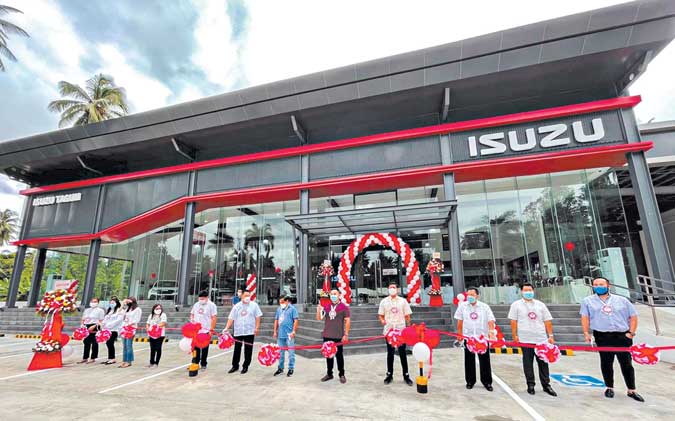
The ceremonial ribbon-cutting is headed by Image Motors Davao Del Norte President Walter Alvarez and Managing Director Edward Bangayan. Also shown are Davao Del Norte Governor Edwin Jubahib, Davao City Vice-Mayor Sebastian ‘Baste’ Duterte, Samal Mayor Al David Uy, and Tagum City Councilor Alderson Rellon. — PHOTO FROM ISUZU PHILIPPINES CORPORATION

By Aries B. Espinosa

ISUZU PHILIPPINES Corp. (IPC) marked another milestone in its drive for network expansion, as it celebrated on March 18 the opening of the Isuzu Tagum showroom — its 46th dealership overall.

In normal circumstances, members of the motoring and business media would have flown all the way to Davao del Norte to witness firsthand the dealership opening (and perhaps even get treated to the region’s delicacies such as durian, pomelo, and Malagos chocolates). Nevertheless, with the occasion set online, IPC executives’ pride and enthusiasm still showed. And rightly so, as IPC president Hajime Koso lauded the perseverance of dealer principal Walter Alvarez and his team at Image Motors Davao del Norte, Inc. to push for the establishment of Isuzu Tagum despite the obstacles presented by the ongoing pandemic.

“To Image Motors’ board, please accept our sincerest gratitude as we know this has not been an easy decision to open a dealership at this very challenging situation, but you kept to our schedule amid the delay due to the different community quarantines,” Mr. Koso explained.

For his part, Mr. Alvarez expressed gratitude for IPC’s support. “Despite the pandemic, IPC has always been extending their helping hand in making this grand opening possible,” he said.

Motivating the Alvarez team into establishing the Tagum dealership is the vast potential for the Isuzu brand to grow much more in the region. “We are confident that with Isuzu’s reputation of durability, fuel efficiency, and overall reliability, we will be able to capture a bigger market share in this area. We are reaching for more than the targets given to us by IPC. We would like to achieve a double-digit figure (in percentage share of the market) right away in our first year of operations,” Mr. Alvarez boldly projected.

The projections aren’t without basis. Isuzu Tagum is strategically located at Barangay Canocotan, along the road that connects to the three major road network systems — the Philippine-Japan Friendship Highway, the Davao-Mati-Agusan Road, and the Davao-Bukidnon Road — that links the city to other major destinations in the region and to the rest of Mindanao.

“Tagum has emerged into a booming city with a strong economic development brought by different businesses citywide. Isuzu Tagum can cater to more customers in the region,” Mr. Koso assessed.

The dealership’s dimensions reflect the anticipated volume of business. Isuzu Tagum sits on an expansive 11,000-sq.m. lot where the latest Isuzu Outlet Standard (IOS) showroom stands. The dealership boasts of a large service bay capacity that would be able to accommodate up to eight light commercial vehicles and two trucks at a time. During the online press conference, Mr. Alvarez disclosed that Isuzu Tagum could service a “minimum 20 vehicles a day.”

Asked if IPC will be able to realize a network of 50 dealerships within the year, Division Head for Sales Joseph Bautista replied that the dealer expansion program was “on track amid some delay due to the ongoing pandemic.”

He added, “Soon, we will be opening La Union, then Subic and Roxas City before the end of the year.”

SEC flags JPCompany Online Shop for unregistered investment solicitations

THE Securities and Exchange Commission (SEC) has issued an advisory against JPCompany Online Shop for collecting investments from the public without registering with the regulator and without securing the proper license.

JPCompany Online Shop or JP Company is said to be headed by a certain John Paul Acuzar Chan.

The SEC noted that the entity has acquired a certificate of business name registration in January from the Department of Trade and Industry (DTI) under business name number 2515205.

Its DTI registration is under the name of Mr. Chan with a limited scope within Brgy. Bangkal in Makati City.

“Nonetheless, JPCompany Online Shop or JP Company is not authorized to solicit investments from the public as it did not secure prior registration and/or license to solicit investments from the commission as prescribed under Section 8 and 28 of the SRC (Securities Regulation Code),” the corporate watchdog said.

The entity is offering the public an “IWE (invest, wait, and earn)” program, which promises returns worth 180% of initial investment within 15 to 20 days.

Recruiters of JPCompany are also guaranteed a five-percent direct-referral bonus from the initial investment of their recruits.

Brokers, dealers, or those who act for the unregistered entity may be prosecuted or held liable under the securities code and may be fined for P5 million at most, face 21 years behind bars, or both.

In April, the SEC issued a total of 11 advisories against multiple entities for offering unauthorized investment schemes.

WONKACASH or WONKA CASH App Financial Consultancy Services, IX Trade, Learn and Earn Online, 247 Cryptotrading FX, 247 Cryptotrade Online, ExchangeStock, Binary Options Trading, and Wolves Options have been flagged by the commission.

It also warned the investing public against Investrade Marketing or Investrade Digital Marketing Services, iWATCH Corp., Beyond Generations Digital Marketing Services, Big Dreams International and BDI Product Trading OPC, CASH FX Group, Doors Opportunity Online or Door Opportunity Digital Marketing Services, and Infinity PAYB or PAYB BILLS Payment and Remittance Center. — Keren Concepcion G. Valmonte

ADVERTISEMENT
ADVERTISEMENT