THE PLDT Home Fibr Hitters are currently in a “bubble” camp in Tagaytay where they are hoping to shape up in preparation for the Premier Volleyball League (PVL) which is targeted to start by the middle of this year.
The PVL-returning Power Hitters have set up camp at Splendido Hotel in Alfonso and will stay there until May 22 as part of their buildup.
PLDT coach Roger Gorayeb shared that the Tagaytay camp is crucial since the team only had limited training sessions prior since the National Capital Region was put under Enhanced Community Quarantine and then MECQ from late March to last week.
“This is big for us because we had a long break in practices with the ECQ. We were worried because other teams were already training in places like Subic (Zambales) and Clark (Pampanga),” said Mr. Gorayeb in Filipino.
“I really pushed our team officials to make the bubble training possible because we were being left behind.”
In the Splendido bubble are PLDT’s new recruits Rhea Dimaculangan, Isa Molde, Marist Layug, Eli Soyud, Chin Basas, Yeye Gabarda, and Nieza Viray.
Completing the team are holdovers Shola Alvarez, Jorelle Singh, Aiko Urdas, Joyce Sta. Rita, Vira Guillema, Kath Villegas, and Alyssa Eroa.
Mr. Gorayeb said that while the players are in shape, they are still finding their game form, something they hope to achieve with the ongoing training bubble.
“They went for almost a year without proper practice. While they are physically conditioned, they are still finding their way back on court,” said Mr. Gorayeb, who is joined in the camp by assistant coaches Clint Malazo and Ariel Dela Cruz.
Prior to proceeding to the bubble, the team made sure to have the needed requirements and approval from the Games and Amusements Board and the local government unit.
PLDT is returning to the PVL after years of parading its wares at the Philippine Superliga.
The PVL will be operating as a professional league, with an expanded field, when its new season kicks off after turning pro late last year. — Michael Angelo S. Murillo
REAL Madrid coach Zinedine Zidane has told his players he will leave the La Liga club at the end of the season, Spanish media reported late on Saturday.
Radio station Onda Cero said Zidane informed the players about his decision before last weekend’s 2-2 La Liga draw at home with Sevilla where Real missed the chance to top the table. Newspaper Marca said he addressed the team on May 8, a day before that game.
Real were dumped out of the Copa del Rey by third-tier Alcoyano in January and were defeated comfortably by Chelsea in their Champions League semifinal. — Reuters
AARON Judge hit a two-run homer and starter Domingo German threw six solid innings as the visiting New York Yankees defeated the Baltimore Orioles (8-2) on Saturday night.
Judge now has hit three homers in the first two games of the series, belting two in Friday’s victory over the Orioles. Gary Sanchez and Luke Voit each also drove in two runs as the Yankees took a big early lead and never looked back.
Those were Voit’s first two RBIs this season and his first two hits.
German (3-2) won his third straight decision. The right-hander gave up one run on four hits in his six innings. He struck out six and walked two while keeping the struggling Baltimore offense quiet. — Reuters
TOKYO — Critics of Japan’s plan to hold the Tokyo Olympics despite a fourth wave of coronavirus infections submitted a petition on Friday signed by 350,000 people over nine days calling for the Games to be cancelled.
“Stop Tokyo Olympics” campaign organiser Kenji Utsunomiya said the global festival of sport — already postponed from 2020 due to the coronavirus pandemic — should take place only when Japan can welcome visitors and athletes wholeheartedly.
“We are not in that situation and therefore the Games should be canceled,” he told a news conference. “Precious medical resources would need to be diverted to the Olympics if it’s held.”
The petition was submitted to the Olympic and Paralympic committee chiefs as well as Tokyo Governor Yuriko Koike.
It came as Japan added three more areas to a state of emergency now covering Tokyo, Osaka and four other prefectures amid surging case numbers, exactly 10 weeks from the scheduled July 23 opening of the Games.
Asked about the campaign against the Games, Tokyo Governor Koike said she would work towards a “safe and secure” Olympics.
“Though there is a global pandemic, it is important to hold a safe and secure Tokyo 2020 Games,” she told a regular news conference.
The new areas under the state of emergency include Hokkaido prefecture, where the Olympic marathon will take place, after it reported a record high of 712 new coronavirus cases on Thursday.
Nationwide, Japan has seen about 656,000 confirmed cases, with 11,161 deaths.
Opposition to the Games has also come from doctors, while some high-profile Japanese athletes have expressed concern, including Masters golf champion Hideki Matsuyama and top women’s tennis player Naomi Osaka.
Business leader Masayoshi Son, chief of SoftBank Group Corp, added his voice to the chorus of trepidation on Thursday, saying in unusually blunt remarks he was afraid of what might happen if the Games went ahead.
Dozens of towns that had been due to host visiting athletes at pre-Games events have canceled those plans, saying they could not guarantee medical help amid strains on the health system.
HUGS ‘NOT OK’ Economy Minister Yasutoshi Nishimura, asked whether the Games would go ahead despite the increase in COVID cases, said organisers were looking to the International Olympic Committee’s backing for the Games.
“I am aware that many are concerned that it will lead to an outbreak of cases,” Nishimura told parliament.
“The organizers are currently working together closely, based on the decision by the International Olympic Committee to hold the Tokyo 2020 Olympics,” he said.
Organisers are determined to host the Games with coronavirus mitigation measures in place. A skateboarding event on Friday was the latest test for their precautions.
Organizers told reporters after the event that athletes and coaches had been told to follow measures and avoid the usual celebratory hugs and cheers on the sidelines.
“This kind of behavior is not okay in terms of COVID-19 measures,” said Yasuo Mori, the deputy executive director of Tokyo 2020’s operations bureau.
“We’d usually take videos together but now we have to stay masked and two meters apart,” said skateboarder Ryuto Kikuta, 17, adding that he understood the measures were necessary but they still felt strange.
Spectators will not be allowed in from abroad, while a decision on Japanese-based spectors has yet to be made.
With the latest emergency measures, 19 out of Japan’s 47 prefectures fall under restrictions that include closures of eateries by 8 p.m. and a ban on alcohol at bars and restaurants. — Reuters
Los Angeles Lakers legend Kobe Bryant was inducted posthumously to the Naismith Memorial Basketball Hall of Fame on Saturday, as the class of 2020 was enshrined after months of delay due to the COVID-19 pandemic.
The five-time NBA champion died last year aged 41 in a helicopter crash alongside his daughter and seven others, shocking the world of professional sport and sending his legions of fans into mourning.
Bryant’s widow Vanessa, who started dating Kobe when she was 17, offered an acceptance on his behalf as presenter Michael Jordan stood nearby.
“Dear Kobe, thank you for being the best husband and father you could possibly be,” she said. “Thank you for never giving up on us. Thank you for all of your hard work.”
The 18-time All-Star joined the NBA straight out of high school and would go on to enjoy one of the most decorated careers in the history of the sport, claiming NBA Finals MVP honors twice and earning the adoration of fans for his larger-than-life persona.
Bryant, the fourth-highest scorer in league history with 33,643 points, grew up idolizing the five-time league MVP Jordan and the two superstars’ careers overlapped by a handful of years.
“Kobe would thank all of the people who helped him get here, including the people that doubted him and the people who worked against him and told him he couldn’t attain his goals… after all, he proved you wrong,” said Bryant, prompting a grin from Jordan.
Other honorees in the 2020 class included 10-time Women’s National Basketball Association (WNBA) All-Star and four-time Olympic gold medalist Tamika Catchings, 15-time NBA All-Star Kevin Garnett and three-time NBA Finals MVP Tim Duncan.
The ceremony at the Mohegan Sun Resort & Casino in Uncasville, Connecticut, was postponed from August due to the COVID-19 pandemic. — Reuters
Kyrie Irving scored 22 points as the Brooklyn Nets got a significant contribution from their reserves and pulled away down the stretch for a 105-91 victory over the visiting Chicago Bulls on Saturday afternoon in New York.
The Nets (47-24) won their fourth straight and remained one game ahead of the Milwaukee Bucks in the race for the No. 2 seed in the Eastern Conference. Milwaukee defeated Miami on Saturday night and holds the head-to-head tiebreaker over Brooklyn.
The game marked the first time Brooklyn’s three stars of Irving, James Harden and Kevin Durant played in the same game since Feb. 13 at Golden State. It was only the eighth time they played together this season and the trio were on the floor together for about 16 minutes.
Irving was the most effective of Brooklyn’s trio by scoring 20 points in the first half when the Nets shook off an early 12-point deficit. Durant finished with 12 on 4 of 17 from the floor while collecting nine rebounds and six assists, and Harden had five points, seven assists and five rebounds in 25 minutes.
Jeff Green added 19 points as Brooklyn got 48 points from its reserves. Bruce Brown chipped in 16 points and 12 rebounds as the Nets shot 47.1 percent and outscored the Bulls 105-79 after allowing the game’s first 12 points.
Chicago (30-41) was eliminated from postseason contention Friday night when the Washington Wizards beat the Cleveland Cavaliers so it held out Zach LaVine (knee soreness). Rookie Patrick Williams scored a career-high 24 points and former Net Thaddeus Young added 19 as the Bulls shot 34.7 percent and misfired on 30 of 41 3-point tries.
After Chicago’s opening 12-0 run, the Nets outscored the Bulls (28-17) the rest of the quarter and were within 29-28. Chicago held its last lead when Javonte Green’s free throw made it 41-40 with 7:58 remaining but Brooklyn outscored the Bulls (21-10) the rest of the half for a 61-51 lead at intermission.
Brooklyn allowed the Bulls to hang around throughout the third quarter and held a 79-71 lead into the fourth quarter. Chicago ripped off eight straight points to get within 85-81 on Young’s finger roll with 8:47 remaining but Jeff Green hit two 3-pointers and Landry Shamet capped a 15-2 run with a 3-pointer at the 5:27 mark to make it 100-83. — Reuters
ROME — A long-range screamer from AS Roma substitute Pedro crowned a 2-0 Rome Derby win on Saturday that mathematically ended Lazio’s hopes of a top-four finish in Serie A.
Lazio have another two games to play before the season ends next Sunday, but the sixth-placed side are eight points behind Juventus in the fourth and final Champions League place.
Roma are six points behind Lazio in seventh place and can finish no higher, but they moved five points clear of Sassuolo, who face Parma on Sunday.
Lazio started the stronger as Luis Alberto had a shot well saved by young goalkeeper Daniel Fuzato and Vedat Muriqi’s well-taken finish was ruled out for offside.
But Roma went ahead shortly before halftime when Edin Dzeko skipped past Lazio defender Francesco Acerbi to the byline and cut a pass back to Henrikh Mkhitaryan for a simple finish.
Pedro doubled their lead on the 78th minute with a superb individual goal as he dribbled past two defenders and fired a swerving shot into the bottom corner from outside the area.
Lazio’s night got even worse late on when Acerbi was shown a second yellow card for a shirt pull on Dzeko. — Reuters
TURIN, Italy — Juan Cuadrado scored twice as Juventus kept their Champions League qualification hopes alive with a 3-2 “Derby of Italy” victory over Serie A champions Inter Milan on Saturday despite spending most of the second half with 10 men.
The result lifted Andrea Pirlo’s side into fourth place with one game remaining, level on 75 points with AC Milan in third.
However, Napoli will knock the Turin club back into fifth if they beat Fiorentina on Sunday and Milan will be assured of a top-four finish if they beat Cagliari, thanks to their better head-to-head record against Juve.
“It was a difficult game against a great team like Inter. Even with a man down, we had to get the job done, make sacrifices, and I think that we got the result as a team,” Cuadrado told Sky Italia.
Both sides were awarded first-half penalties in a game dominated by VAR decisions. Cristiano Ronaldo scored on the rebound to put Juve ahead after his spot-kick was saved, and Romelu Lukaku scored his penalty for Inter soon after.
Juve regained the lead on the brink of halftime through a deflected Cuadrado strike, but the hosts were reduced to 10 men early in the second half when Rodrigo Bentancur picked up a second yellow.
Inter drew level through a Giorgio Chiellini own goal and Cuadrado responded with the winning penalty in the 88th minute. There was still time for Marcelo Brozović to be sent off for the visitors for a second booking.
Inter ended Juve’s nine-year stranglehold of the Serie A title with four games to spare and had the chance to land a huge blow to their rivals’ top-four hopes.
But Juve took the lead when Chiellini was wrestled to the ground at a corner and won a penalty following a VAR review. The spot-kick was saved, but Ronaldo tapped in the rebound.
VAR REVIEW Inter drew level when Matthijs de Ligt was judged to have fouled Lautaro Martinez in the box after a VAR review, and Lukaku converted the resulting penalty.
Juve edged back in front deep in first-half stoppage time when a powerful Cuadrado shot took a deflection and flew past Handanovic.
The hosts were reduced to 10 men on the 55th minute after Bentancur tripped Lukaku to earn a second yellow, and Pirlo decided to take Ronaldo off for the final quarter of the match in a bid to see out the game.
The match burst into life in the final 10 minutes. Chiellini bundled a cross into his own net but the goal was disallowed for a foul, only for the decision to be overturned following a VAR review.
Three minutes later, Cuadrado was tripped by Ivan Perišić to earn the third penalty of the game and the Colombian slotted it home before Inter’s night got worse when Brozović picked up a second yellow for a clumsy challenge. — Reuters
Tim Duncan came very close to missing out on a Hall of Fame career. If he was enshrined yesterday as the greatest power forward in hoops annals, it’s because another sport’s evident grasp on him was let loose by a hurricane. He could — perhaps even should — have been a swimmer had Hugo not interfered and destroyed the only Olympic-sized pool in the entire Saint Croix, Virgin Islands. The calamity became a blessing; fate turned his attention to basketball, and he would go on to stamp his class with, well, class.
Indeed, Duncan let his playing do the talking. He wasn’t one for aimless banter to begin with. He also knew that if he played the right way, even his most vociferous critics would have no choice but to sit up and take notice. And they did, first through a remarkable college career at Wake Forest that had him going first overall in the 1997 National Basketball Association draft, and then over the next 19 years as the principal reason for the Spurs’ competitiveness. Heck, he was so good that the franchise known for its commitment to winning first had to tank in order to secure his draft rights, and that the head coach who suffered no pleasantries went above and beyond the call of duty to woo him.
So influential was Duncan to Gregg Popovich that the latter purposely missed a game just to be at the Mohegan Sun in Uncasville, Connecticut for his induction. He deserved it, too, even as he himself was loath to toot his own horn. He spent most of his 12-minute speech doling out one Thank You after another, including to former teammate David Robinson, on stage to present him, and to Hall classmates Kevin Garnett and Kobe Bryant. And when the time came for the obligatory firing-squad photo sessions, he positioned himself exactly where he felt he needed to be: close to one side, in full cognizance of the fact that his was the biggest name under the spotlight no matter where he stood.
When Duncan was at his prime, he gladly accepted the moniker The Big Fundamental. If nothing else, it recognized his dedication to his craft, his commitment to success, his passion for perfection. And he continues to live by those tenets outside of the court. As he noted in professing his gratitude to Popovich, “You are an exceptional person. Thank you for teaching me about basketball, but, even beyond that, teaching me that it’s not all about basketball. It’s about what’s happening in the world, it’s about your family.” Enough said.
Anthony L. Cuaycong has been writing Courtside since BusinessWorld introduced a Sports section in 1994. He is a consultant on strategic planning, operations and Human Resources management, corporate communications, and business development.
The economist Paul Krugman wrote an essay in The New York Times (May 7, 2021) that explains how the interaction of monetary policy (specifically interest rate) and fiscal policy affects the economy.
For an opinion column, the essay gets technical and wonkish. Yet it is on point in elucidating a complicated issue being debated in the US and elsewhere. It is, in fact, a critical policy issue in the Philippines as the economy has remained in recession since the pandemic’s outbreak.
The context of the Krugman essay is to answer the fear or criticism that the Joe Biden administration’s massive relief package — amounting to $1.9 trillion — would cause overheating.
Overheating would mean inflation, leading to stagnation. Krugman argues that even if it turned out that the relief package or the stimulus was bigger than necessary, moderately increasing the interest rate would rein in overheating and inflation without inducing a recession.
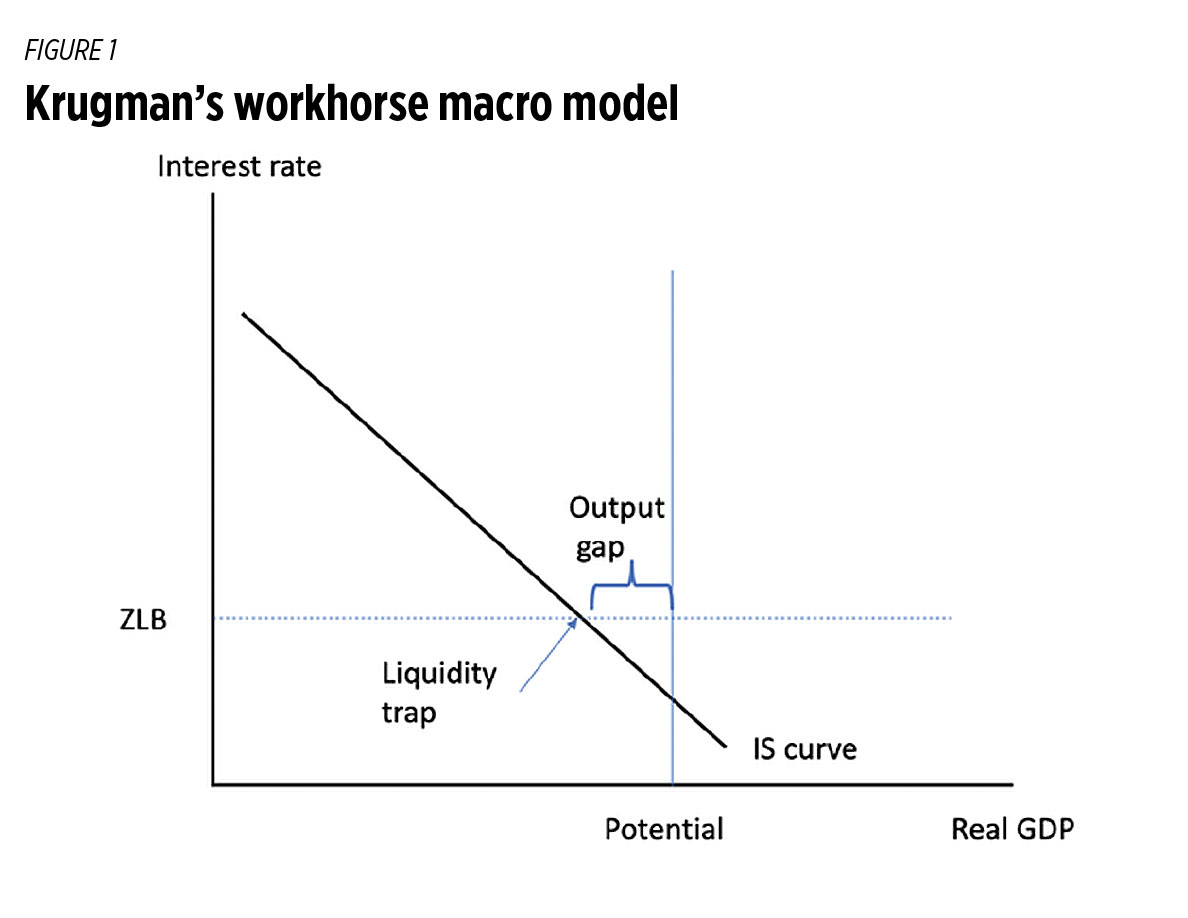
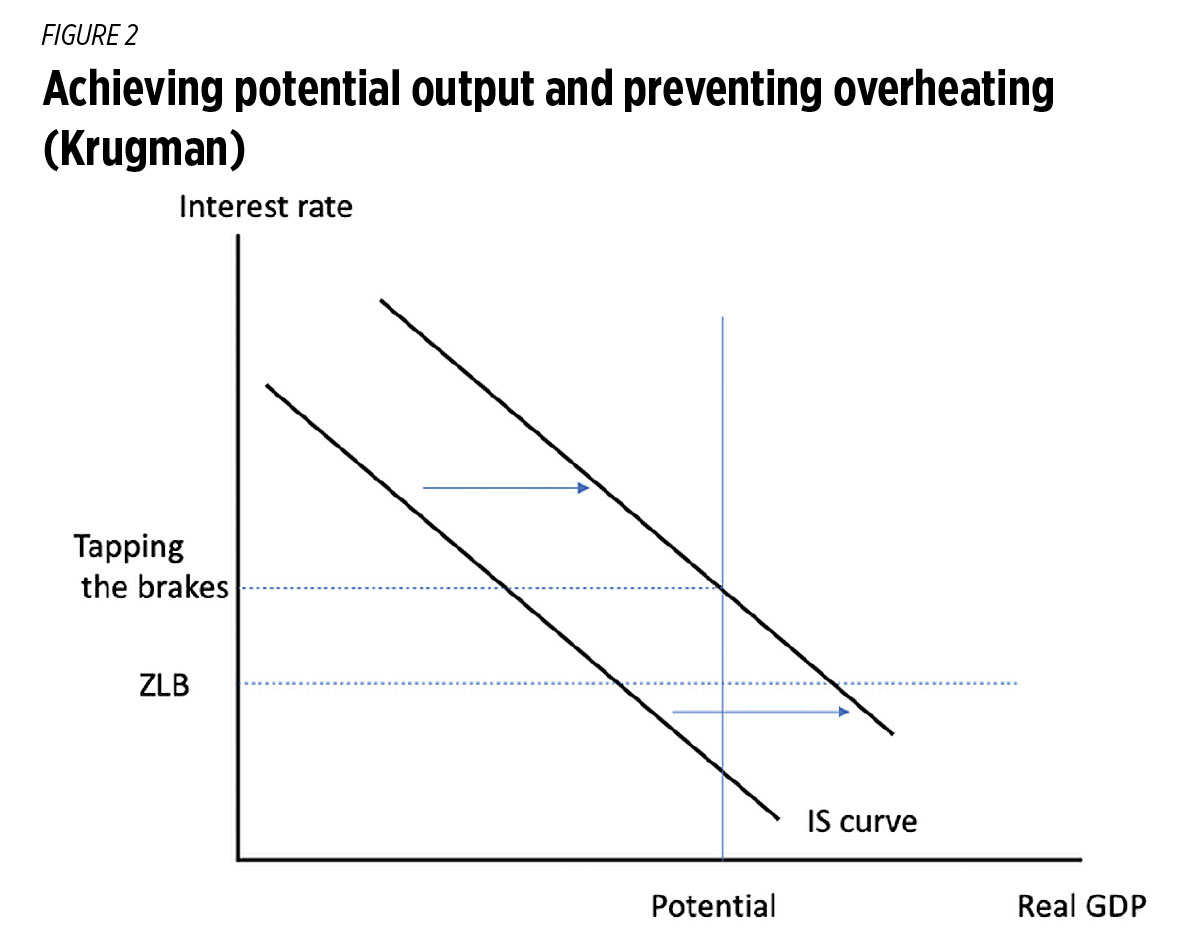
Krugman’s analysis is represented in the two graphs included with this piece. The two graphs likewise help illustrate the Philippine problem, although our situation is very different from the US conditions. Unlike the US government that has embarked on huge deficit spending, the Philippine government has avoided the heavy borrowing that is necessary to finance a huge stimulus or relief package.
Let me comment on the Krugman explanation as shown in his two graphs, but apply the annotation to the Philippine case.
In Krugman’s heuristic model, the I-S curve (Figures 1 and 2) is the investment demand. (It is called I-S because investment = saving). The sloping downward curve means that investment demand (which also has a positive effect on consumption through job creation) increases national income.
A decrease in interest rate (the vertical axis) means an increase in investment and in national income. So monetary policy through lowering interest rate can boost demand. But, as Krugman said, monetary policy can hit a brick wall and fail to achieve the goal of hitting potential output (or full employment). This is the situation (Figure 1) when the interest rate has reached the lowest point it can go — termed “zero lower bound.” Our Bangko Sentral [ng Pilipinas] (BSP) calls it the effective lower bound. Despite the interest rate having reached the zero lower bound, investment remains weak. Or the zero lower bound still fails to generate investment to meet potential output or full capacity.
The BSP has used all its policy instruments, including unconventional ones, to fight the crisis. It has sharply reduced the policy rate; expanded lending facilities; brought down reserve requirements; provided financing to the National Government by way of a repurchase agreement with the Treasury amounting to P300 billion; and has injected liquidity equivalent to almost P2 trillion. All in all, the increase in liquidity and loanable funds has brought down the interest rate to the effective lower bound. In a graph, this is represented by a sloping upward L-M (liquidity preference-money supply) curve, which is not shown in Krugman’s model.
Nonetheless, the BSP’s aggressive activist interventions have not stimulated consumption and investment. In other words, monetary policy is no longer effective. The liquidity trap, which Krugman mentions (Figure 1), refers to the reluctance of people to consume or invest despite money liquidity and low interest rates.
In the time of high pandemic transmission, consumption and investment are down because people are restricted or discouraged from engaging in normal activities. They fear the virus. The push of economic managers to reopen the economy in a situation of high COVID-19 transmission will not be enough for people to conquer their fear.
Depressed consumption and investment result in an output gap (Figure 1). The output gap means potential output or full employment has not been met. But because neither private consumption nor private investment can close the gap, government spending has to do the heavy lifting.
But government spending not only covers the huge output gap (as evidenced by the deep recession) but also the big expenditures to flatten the pandemic curve. Government must spend not only to protect the unemployed but also to save the sick, the dying, and the hungry.
Bold government spending is absolutely necessary, even if this would mean violating the conventional debt and deficit indicators. Since we are dealing with an extraordinary pandemic and economic crisis, the worry of the economic managers regarding higher debt and deficit is misplaced.
Another Krugman argument pertains to the US debate on deficit spending. Biden’s unprecedented government spending has been opposed not only by the Republican Right but also by conservative Keynesians associated with the Democrats. There are conservative Keynesians like Laurence Summers, who was the architect of the timid fiscal policy during Barack Obama’s term. Obama’s fiscal conservatism prolonged the high level of unemployment, which was a factor that explained Donald Trump’s rise.
The big Biden stimulus is working. It has aroused animal spirits. This early, it has boosted aggregate demand (moving the IS curve to the right, Figure 2). The conservative liberals fear that the big stimulus would overheat the economy and set the stage for stagflation. But Krugman shows that in case of overheating (which he doubts), policymakers have a way of preventing both stagnation and inflation.
“Tap the breaks” by adjusting interest rates. Growth, nay, potential output is met, notwithstanding the increase in interest rates (Figure 2).
The other criticism raised by Krugman is directed at Modern Monetary Theory (MMT). MMT is the new buzz that has become part of “left” heterodoxy. Quite a few think it’s a Keynesian variation. Keynesian thinking and MMT have common concepts and issues (e.g., fiscal stimulus, deficit spending, full employment), but they also have fundamental disagreements.
Principally, MMT, based on government issuing sovereign currency, does not recognize any financial constraint on government spending. The only constraint in creating money is inflation.
Claiming not to be constrained financially, MMT discards interest rate as a tool for stabilization or for full employment. Operationally, MMT assumes a zero interest rate (or the zero lower bound). To return to Krugman’s Figure 2, MMT’s zero interest rate will prevent an increase in aggregate demand (moving the IS curve to the right) to satisfy full employment. The increase in demand will result in increasing interest rate above zero (Krugman’s “tapping the brakes”). Ironically, that makes the MMT no different from the position of Summers, not to mention the Republicans. They all impede much higher government spending to achieve potential output.
We have shown that the US situation is far different from what is obtaining in the Philippines. The US has undertaken massive relief deficit spending. This, together with the vaccine rollout, has accelerated the US recovery. The burst of growth has caused concern about overheating the economy. Krugman convincingly shows that this is unlikely.
On the other hand, the Philippine authorities are reluctant to engage in bolder deficit spending even as the economy is stuck in a recession. Still, the relevance of Krugman’s model to the Philippines is undeniable. It shows the imperative for government to fill the output gap and provide relief through much bigger deficit spending.
Filomeno S. Sta. Ana III coordinates the Action for Economic Reforms.
Allow me to start by sharing with readers excerpts from a note that Christine Tang and I wrote for subscribers of GlobalSource Partners (GSP, globalsourcepartners.com) on May 11 on the grim first quarter GDP performance.
(GSP is a New York-based network of independent analysts providing macro, financial and political outlook in emerging market economies.)
“The on-the-ground feedback we were getting of the economy’s performance leading up to today’s (May 11) GDP announcement had suggested a more buoyant economy than the reported 4.2% year-on-year (yoy) contraction. The headline number implies that GDP grew by only 0.3% quarter on quarter, or an annualized rate of just a little over 1%, at a time when lockdown restrictions had become much less stringent (for the first 10 of the 12-week quarter)…
“The re-imposition of strict lockdown measures from the last week of March to date, with any lifting of restrictions later this month likely to be done cautiously, implies we will likely suffer sequential quarter-on-quarter decline in 2Q output (although the yoy growth clip will be high due to base effects). Economic managers* are pinning [their] hopes of recovering lockdown losses and reaching government’s 6.5-7.5% growth target on: a.) major relaxation of quarantine policies through improving health resources and automating contact tracing, b.) fully implementing the available budgetary resources, and c.) accelerating the vaccination program.
“We think the first will be difficult following the detection locally of the more transmissible ‘double mutant’ COVID-19 variant first found in India and continuing weaknesses in contact tracing efforts. The second would definitely help but may require additional budgetary action by Congress under the Bayanihan III, especially in the form of direct cash transfers to the poor. The third, despite benefiting from the private sector’s technical assistance and mentoring at the local government levels, remains clouded by uncertainties surrounding vaccine deliveries and their efficacy against the new variants.
“We had previously capped this year’s GDP growth rate at a relatively pessimistic 5%, a number that looks rather high now given unknown course of wild card mutant varieties and possible future on and off lockdowns. In the event, we cannot rule out a flattish growth scenario.”
On May 12, a day later, I attended a public-private forum on the vaccination roll out with over 700 participants from business and civil society present. This was masterfully organized and moderated by Philippine Disaster Resiliency Foundation (PDRF) Chief Resiliency Officer Bill Luz. On the basis of the presentations and discussions, I now think we have a fighting chance of achieving some form of “herd immunity,” at least in the National Capital Region (NCR), by year end. This will make economic outcomes in 2022 much brighter.
My takeaways:
1.) Per National Task Force Chief Implementor Charlie Galvez, there is now greater certainty over the arrivals of vaccines. Some 7.5 million doses have arrived, and ramping up very quickly as we get to the “-ber” months so that we expect to have enough to fully inoculate 70% of the NCR population towards yearend.
2.) Planning and execution are being done down to city and barangay levels for the NCR, from master listing to deployment to vaccination with the technical assistance of the private sector experts in supply chain management, superbly led by Jollibee Foods Corp. Chief Corporate Sustainability and Public Affairs Officer José Miñana.
3.) As enough vaccines come to cover health workers and the vulnerable elderly, there will be an earlier start, likely this month, of vaccination of A4 frontliners and others down the 12-tier list. Some thinking is being given to a simplified more simultaneous rollout, similar to Israel’s three-tiered system.
4.) As supplies build up and get used up, we need to overcome vaccine hesitation. Per the latest (February) Pulse Asia Survey, this is as high as 60% of the population. McDonald’s Managing Director and T3 Communications Lead Margot Torres is on top of a broad coalition which developed and are rolling out a compelling, even moving, Ingat Angat vaccination campaign some of us may have be seeing on media.
5.) If all goes well in the execution, we should achieve some form of “herd immunity” and thus greater mobility in the NCR by end November. The NCR with its 17 LGUs is, of course, the locus of the plague, and accounts for a substantial part of our country’s GDP. From there, the next roll out will be in the +6 provinces (Cavite, Laguna, Batangas, Rizal, Bulacan, Pampanga) and Metro Cebu and Davao. The thinking is that if case numbers are lowered in NCR+8 as a result of vaccinations, there will be less contamination throughout the country since the spread starts from these areas.
Stressing the importance of close monitoring and good execution for all these to happen, ADB Executive Director Paul Dominguez said that:
• the plan appears doable but good execution and close monitoring is needed to address any problems or bottlenecks that emerge;
• the private sector should engage with the LGUs where they do business to offer assistance as well as help replicate the vaccination plan developed for the NCR in other major cities and provinces.
Flagship Secretary and NTF Deputy Chief Implementor Vince Dizon ended the forum on a hopeful note:
“It’s been more than a year since T3 was formed to bring together the private and public sector in an unprecedented way to battle this pandemic. Our work has shown that working together brings in the best of both the private and government sector. Today, we saw again that working together will lead to the results that we need and what we want. With the leadership of Secretary Galvez, we now have the vaccines coming. And this was followed by Pepot’s (Miñana) fantastic work in putting things in perspective with respect to deployment. Now is the time to execute and put this in action and we will heavily rely on the private sector. Finally, thank you to Margot (Torres), George (Royeca) and the team for communications because the challenge we face is demand generation. We have seen in other countries that demand generation is critical with the vaccination roll out, but with the beautiful and poignant ad that shows where we are and we are headed, we will get there and all enjoy a happier Christmas in 2021.”
I am writing this column, May 13, the day after the forum, as my family and our Muslim brothers and sisters are celebrating Eid Al Fitr, the end of Ramadan, a time of hope. I do so with the fervent wish that, Inshallah, we will have the “better Christmas” that Presidential Peace Adviser Charlie Galvez envisions for us all.
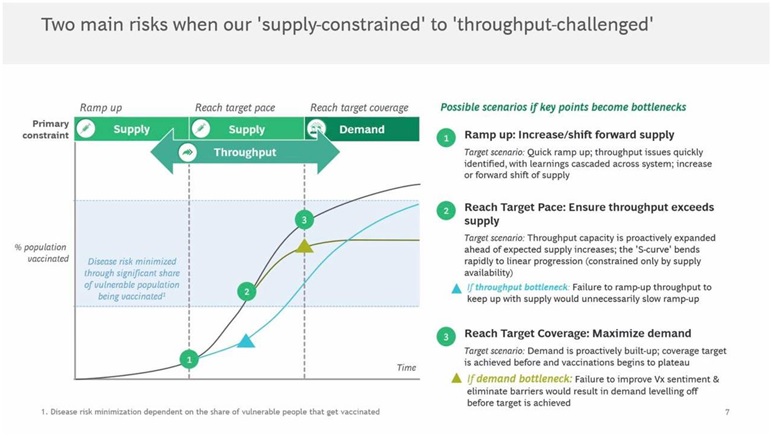
Source: Boston Consulting Group
Romeo L. Bernardo was finance undersecretary during the Cory Aquino and Fidel Ramos Administrations. He is a Trustee/Director of the Foundation for Economic Freedom, Management Association of the Philippines and FINEX Foundation
A SHOPPER checks out the processed meat products in a Quezon City supermarket. — BW FILE PHOTO
When it rains, it pours. As if COVID-19 has not caused enough death and anguish to the country, we now face another crisis that will surely bring the country to its knees. A food crisis.
Late last year, the Department of Agriculture (DA) imposed a ban on imports of Mechanically Deboned Meats (MDM) originating from Germany, France, the Netherlands, and the United Kingdom, among other European nations. The ban was raised due to an outbreak of the Avian Flu that swept the European poultry sector.
For those unaware, MDM are made of meats (mostly chicken for Philippine consumption) that are close to the bone and removed mechanically. It comprises 70% of raw material inputs in making hot dogs, luncheon meats, and other such products. Processed meats, in canned and frozen form, are considered basic commodities. Hence, their prices are controlled by the Department of Trade and Industry (DTI) through suggested retail prices and price caps. This is why they are affordable and why it comprises the bulk of the diet of the poor and middle class.
Since the ban was raised last year, our meat processors have begun channeling their orders to Brazil, Canada, and the United States. This kept both the supply and prices of processed meats on an even keel. But problems began to surface last March. Due to a violent second wave of COVID-19 infections in Brazil, production of MDM practically ceased in the South American nation. At that point, Brazil was supplying the Philippines with 24% of its MDM requirements.
With no other option, Filipino meat processors channeled their MDM orders to the United States and Canada. With the massive orders and a duopoly of supply, prices of MDM originating from America and Canada began to increase sharply. From a wholesale price of US$700 per ton when in competition with European suppliers, prices were jacked up to $1,500 per ton as a duopoly.
Utilizing MDM from US and Canada at $1,500 per ton is not an option for our meat processors. At this price level, finished goods can no longer stay within the price ceilings mandated by the DTI. With this, our meat processors are faced with a conundrum. Either they absorb the loss or temporarily cease production until raw material prices stabilize. Since our food processors are private corporations, most, if not all, will opt to temporarily cease operations to avoid losses. But this will come with frightful ramifications on the country’s food supply.
As I write this, the country’s biggest meat processors such as Century Pacific Foods, Foodsphere, Virgina Foods, Purefoods and RFM are all operating using MDM inventories purchased early this year. They are unable to replenish these inventories due to the continued ban on European imports and due to prohibitive costs from North American suppliers. I was told that remaining inventories are only good until next month.
In other words, within a matter of weeks, canned and frozen meats will disappear from supermarket shelves. Those that remain will be sold at premium prices. This will be a tragedy for the marginalized sector since processed meats are their principal source of protein.
Members of the Philippine Association of Meat Processors, Inc. (PAMPI) have made numerous appeals to the DA to lift the ban on European MDMs if only to avoid a food shortage. So far, the DA is not budging.
How did we get into this mess?
In the first place, the DA acted with a heavy hand when it banned all MDM products from Europe last year. See, when viral outbreaks like this occur, the standard procedure, as prescribed by the Organisation Mondiale de la Santé Animale (OIE) or the World Organization for Animal Health, is to ban suppliers from within a one-, three- or seven-kilometer radius from the infected animal farm, depending on the severity of the viral spread. This has happened many times before, so it is nothing new.
But instead of identifying the animal farms that were struck by the flu and banning suppliers from up to a seven-kilometer radius from them, the DA decided to ban all suppliers from entire countries, including the Netherlands, Germany, and the United Kingdom.
Foreseeing a food shortage coming last month, the DA, through its Bureau of Animal Industry, lifted the ban on MDM imports from the Netherlands. But it came with a proviso — that the chickens from which the MDMs were made must be born and bred exclusively in the Netherlands.
Unfortunately, the relief offered by the DA is of no utility. This is because the EU operates as a single economic bloc with supply chains extending across borders. Rich countries like the Netherlands, Germany, and France are not efficient in raising chickens since operating costs are high in their territories. Poultry raising is more efficient in lower cost countries such as Poland, Hungary, and Serbia. Thus, it makes more economic sense for Dutch, German, and French MDM producers to import their chicken supplies from lower-cost sources before processing these in their ultra-modern factories. This has been the standard operating model for decades.
Sure, the concern festers that some of the chickens imported from Poland or Hungary may be infected with the Avian Flu. But we must appreciate that the EU has one of the strictest food safety protocols on the planet. Chicken supplies that come from across borders are made to go through the most rigid inspections and pathological tests. Stocks that meet the standards are given food safety accreditations, those that do not are eliminated and disposed of.
The chicken stocks admitted to the Netherlands for processing are guaranteed to have been issued food safety accreditations. The Dutch government is even willing to issue official certifications to importing countries attesting that all its MDM products are indeed free of Avian Flu.
But these don’t seem to be enough for the DA.
There are a number of ways out of this. 1.) The DA can remove the proviso that all MDM imported from the Netherlands must use chicken that is born and bred in the country. 2.) It can deploy a Department of Agriculture Inspection Mission (DAIM) to other MDM-producing countries to widen the options from which our meat processors can import MDM from (Poland and Hungary are efficient suppliers capable of meeting our requirements). 3.) The DA can simply follow the policy of the OIE and confine the import ban to a seven-kilometer radius from an infected farm.
The ball is in the DA’s court. It can continue to be legalistic, thereby risking a food shortage, or it can show some flexibility to avert a food crisis.
******
My column last week was about the state of Philippine Education. Allow me to give credit to Author Arturo C. Domingo, who provided some of the fact and figures in that piece.