Home Blog Page 8080

Philippine Seven incurs nearly P300-M net loss as lockdown hits sales

BW FILE PHOTO

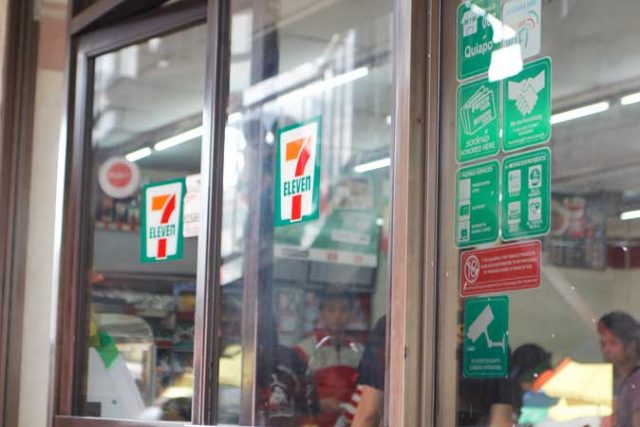
THE listed Philippine operator of 7-Eleven convenience stores incurred a net loss of P299.66 million in the first quarter, a reversal of the P103.82-million profit generated in the same period last year as pandemic restrictions continued to drag sales down.

Philippine Seven Corp. said in a regulatory filing on Friday that system-wide sales amounted to P11.11 billion for the period, 21.4% lower than the P14.13 billion seen last year due to a 20.1% decline in same-store sales.

“The company aims to grow sales by expanding product assortment and launching sales promotions,” it said.

System-wide sales cover retail sales and commission income from all 2,981 corporate-owned and franchise-operated 7-Eleven convenience stores.

Franchised-stores make up for 55% of the total stores, while 45% are corporate-owned.

“Out of 2,981 stores, most are operating 24/7, only less than 10% are temporarily closed and the rest are open during daytime by the end of the first quarter,” Philippine Seven said.

It launched 65 new stores during the period, which bumped up the total number of stores by 2.2% from last year’s 2,916.

“The company shall be ramping up store expansion to respond to competition and anticipate gradual reopening of the economy,” Philippine Seven said.

On Friday, Philippine Seven shares at the local bourse went down by 0.27% or 30 centavos to close at P110.20 each. — Keren Concepcion G. Valmonte

Intramuros to open Fort Santiago, Baluarte de San Diego to visitors today

EN.WIKIPEDIA.ORG

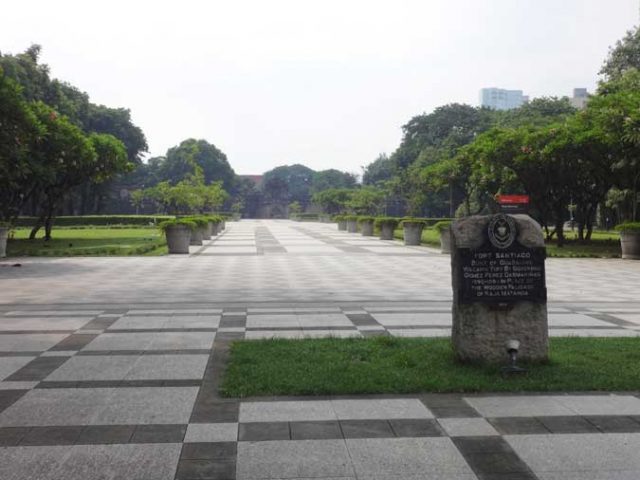
MANILA’s historic Walled City of Intramuros will open two of its most popular sites to visitors today, May 17, following the easing of quarantine restrictions in Metro Manila and neighboring provinces.

Department of Tourism Secretary Bernadette Romulo-Puyat said Fort Santiago and Baluarte de San Diego, two of the walled city’s most popular attractions, will be open to limited capacity and shortened operating hours under strict health and safety guidelines. This decision came following the decision of the Inter-agency Task Force for the Management of the Emerging Infectious Diseases (IATF) to place the National Capital Region and the provinces of Bulacan, Cavite, Laguna, and Rizal, collectively known as NCR Plus, under a General Community Quarantine with heightened restrictions.

Based on the IATF guidelines, tourist attractions can now operate at 30% of the venue capacity, subject to strict compliance with health and safety protocols. But Fort Santiago will accommodate only 200 visitors at a time while the Baluarte de San Diego will allow a maximum of 100 persons at a time, which are both below the 30% threshold but are deemed essential to ensure monitoring of proper protocols.

Fort Santiago will be open daily from 9 a.m. with last entry for visitors at 6:30 p.m. The Baluarte de San Diego garden will be open to the general public from 8 a.m. to 5 p.m. There will be a mandatory screening of temperature and symptoms, and sanitizing practices. All guests must register their visit through a QR code system for contact tracing prior to entry. Intramuros visitors must observe the minimum public health standards.

The dungeons, Museo ni Rizal, ASEAN Gardens, and some other sites within the two areas are still off-limits to visitors.

The entrance fee, which may be paid in cash or via Beep card or PayMaya, is P75. Seniors, students, and persons with disabilities may pay the discounted price of P50. The sites are limited to visitors aged 18 to 65 in compliance with the age restrictions set by the IATF.

Fort Santiago is one of the country’s most visited tourist destinations as is Baluarte de San Diego. The Walled City was visited by 3.3 million people in 2019.

Rates of Treasury bills, bonds to edge sideways on BSP move

BW FILE PHOTO

THE RATES of government securities on offer this week will likely move sideways after the central bank kept borrowing costs at their current record lows at its latest policy meeting.

The Bureau of the Treasury (BTr) is looking to raise P25 billion from its offering of Treasury bills (T-bills) on Monday, broken down into P5 billion via the 91-day debt, P8 billion from the 182-day papers and P12 billion via the 364-day instruments.

On Tuesday, the BTr will auction off P35 billion in reissued seven-year Treasury bonds (T-bonds) with a remaining life of six years and 11 months.

The first bond trader expects the T-bills’ rates to move sideways, while a second trader expects yields on these papers to drop by 5 basis points (bps) “amid strong demand for short-term securities.”

Meanwhile, for the seven-year bonds, both traders said they see its average rate ranging from 3.6% to 3.7%.

The 91-, 182- and 364-day T-bills were quoted at 1.304%, 1.545%, and 1.85% respectively, at the secondary market on Friday, based on the PHL Bloomberg Valuation Reference Rates published on the Philippine Dealing System’s website. Meanwhile, the seven-year T-bonds fetched a yield of 3.6%.

The second trader said in a Viber message that the market will factor in the Bangko Sentral ng Pilipinas’ (BSP) decision to keep benchmark interest rates steady at this week’s auctions of government securities.

The BSP held its key interest rate at a record low for a fourth straight meeting on Wednesday, as it continues to support the economy’s recovery from the pandemic.

The Monetary Board maintained the overnight reverse repurchase rate at a historic low of 2%. Both the lending and deposit rates were also kept at 2.5% and 1.5%, respectively.

The BSP’s decision to keep rates steady came a day after release of disappointing first-quarter gross domestic product (GDP) data. For the first three months of 2021, GDP output shrank by an annual 4.2%, keeping the economy in a recession for a fifth consecutive quarter.

Meanwhile, the central bank lowered its inflation outlook this year to 3.9%, from a previous estimate of 4.2%. On the other hand, the forecast for 2022 was raised to 3%, from 2.8% previously. This will put inflation back within the BSP’s 2-4% annual target range.

The bond trader added that the further reopening of the economy will also drive the movement of bond yields this week.

President Rodrigo R. Duterte last week placed Metro Manila and nearby provinces under general community quarantine with heightened restrictions for the rest of the month as coronavirus cases continued to drop.

The Health department reported 6,739 new coronavirus infections on Saturday, which brought the total number of active cases to 56,709.

The BTr last week hiked the volume of T-bills it awarded to P30.2 billion from the programmed P25 billion as demand hit P97 billion and yields dropped across the board. It also raised an additional P7 billion in one-year debt via the tap facility.

Broken down, the Treasury raised P7 billion via the 91-day T-bills, breaching the P5-billion program, at lower average rate of 1.278% versus the 1.306% seen at the May 3 auction.

It also upsized its award of 182-day debt to P11.2 billion from the programmed P8 billion. The average yield on the six-month papers dipped to 1.549% from 1.629% previously.

Lastly, the government made a full P12-billion award of the 364-day securities at an average rate of 1.829%, down from 1.863% previously.

Meanwhile, the Treasury first issued the seven-year bonds on offer on Tuesday on April 20, where it awarded P35 billion as planned as bids hit P90.386 billion. The notes fetched a coupon rate of 3.625%.

The BTr wants to raise P170 billion from the local bond market this month: P100 billion via weekly offerings of T-bills and P70 billion from T-bonds to be auctioned off fortnightly.

The government is looking to borrow P3 trillion this year from domestic and external sources to help fund its budget deficit seen to hit 8.9% of gross domestic product. — B.M. Laforga

Big kahuna 7-seater

PHOTO FROM SUBARU PHILIPPINES

Subaru Philippines brings in the marque’s largest SUV

SUBARU PHILIPPINES, through its official importer and distributor Motor Image Pilipinas, Inc., recently announced that its latest model on offer, the 2021 Subaru Evoltis, is now available for purchase in the Philippines.

The Evoltis is built in, and imported from, Indiana in the United States (where it is known as the Ascent), so it is no wonder that the Evoltis is also Subaru’s largest vehicle model in its lineup. The sole variant available in the Philippines is the top-of-the-line Subaru Evoltis Touring — with all the bells and whistles, and its lauded safety tech.

Knowing the demands of the American auto market, one can quickly and correctly assume that the Evoltis Touring will most certainly offer a very comfortable ride and have passenger-centric suspension. The vehicle is cavernous and affords loads of cargo space — with over 4,700 liters of cabin space in total — plus the option to stow additional cargo on its roof rails, if necessary.

The cabin follows a seating layout of 2-2-3, with the second row sporting luxurious captain seats — great for any size of adult. A three-zone automatic air-conditioning system with rear seat controls makes sure all passengers in all rows are well ventilated; and four USB ports distributed within the cabin also provide occupants with support for their devices. An impressive 19 cup and bottle holders are strategically located throughout the cabin. Moreover, the driver and passengers are pampered with a luxurious, 14-speaker Harman/Kardon sound system, supported by an eight-inch infotainment system that is already Apple CarPlay and Android Auto compatible.

For some added luxury, a generous 54-inch panoramic sunroof is also featured. And being a premium eight-seater SUV, families will likely appreciate its stain-resistant upholstery that make the Evoltis conveniently “active family-resistant.”

“We are entering the premium seven-seater SUV market with this spacious, feature-packed model. It has the best safety features in the segment with Eyesight as standard. It has excellent handling, drivability and power, possessing all the hallmarks of a Subaru vehicle built on the Subaru Global Platform and equipped with symmetrical all-wheel drive. It can even tow boats,” shared MIP Country Manager Gerry Hernandez. “It may not be the cheapest in its segment, but it has the best value proposition for the family.”

Indeed, customers have always valued Subaru vehicles especially for their standard symmetrical AWD with X-mode (a system that optimizes traction so that there is less wheel spin in slippery situations), which adds lots of safety value as AWD provides excellent road grip.

Among over 100 impressive tech features included in the 2021 Evoltis safety suite are: Subaru Eyesight (a stereo-camera based safety system), pre-collision braking, pre-collision throttle management, lane departure warning, lane sway warning, and lead vehicle start alert. Of course, we also add to that the classic solid and responsive driving feeling that Subaru vehicles have always given us.

Furthermore, the Evoltis is an important vehicle in the Subaru Philippines product lineup because it is the brand’s local debut of Subaru’s latest generation of award-winning boxer engines. The Evoltis Touring features a new FA24, 2.4-liter turbocharged boxer engine that spits out 260hp and 375Nm of torque. The vehicle also has a towing capacity of 5,000 pounds, and a vertical ground clearance of 220mm — making it a desirable companion to take the family on adventures off the beaten path.

The Subaru Evoltis 2.4 Touring Eyesight will have a price tag of P3.48 million and comes in colors of: Crystal White Pearl, Ice Silver Metallic, Crystal Black Silica, Crimson Red Pearl and a brand-new hue — Abyss Blue Pearl.

Davao Light ‘listening’ amid call for Nordeco takeover

THE electric cooperative distributing power in most parts of Davao del Norte, including the popular tourist destination Samal and the growing capital city of Tagum, said there is no ongoing formal talks on a possible takeover of Aboitiz Power Corp.’s Davao utility of their franchise area despite a call from consumers.

However, the head of Northern Davao Electric Cooperative (Nordeco), Inc., formerly Davao del Norte Electric Cooperative or Daneco, says Davao Light and Power Corp. is open to the prospect.

“I believe and until now they (Davao Light) are still interested. Maraming pag-uusapan pa diyan (There are many issues to discuss) and until right now there is no transaction made yet,” Nordeco General Manager Mario Angelo Sotto told BusinessWorld in a phone interview.

A takeover of the cooperative would expand Davao Light’s franchise area, which currently covers Davao City and adjacent parts of Davao del Norte, including Panabo City, Carmen, Dujali, and Sto. Tomas.

Davao Light President and Chief Operation Officer Rodger S. Velasco did not categorically say they are interested in taking over Nordeco’s franchise, but said they are listening to the voice of the community.

“We will always listen to our customers, our stakeholders, and our partners so together, we can drive economic progress and provide a better life for our community,” he said in a text message. — Maya M. Padillo

Janet Jackson’s Rhythm Nation jacket sells for more than $81,000

JULIENSLIVE.COM
JULIENSLIVE.COM

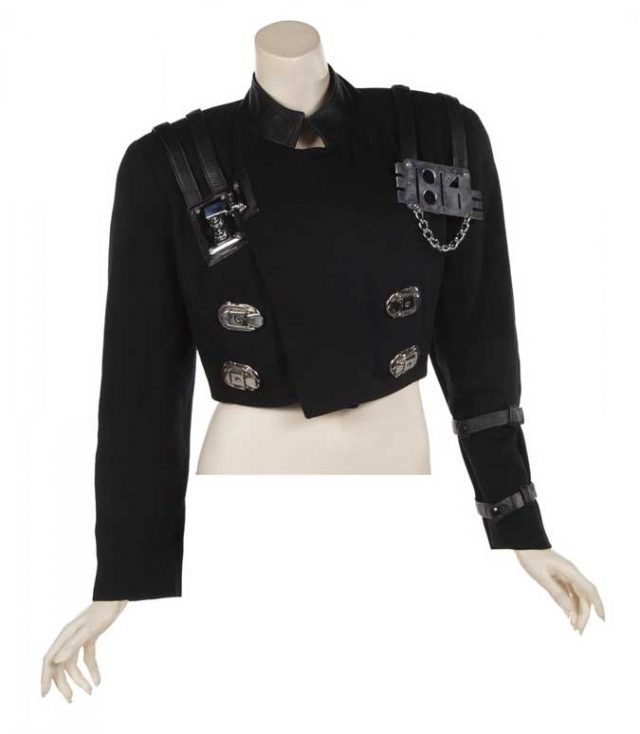
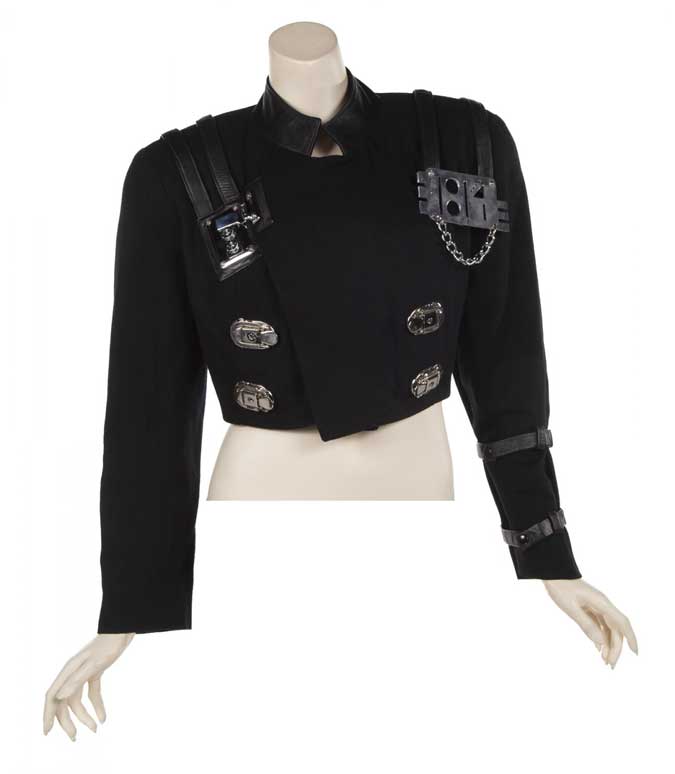
LOS ANGELES —  The military style jacket that Janet Jackson wore during her 1990 Rhythm Nation concert tour sold for $81,250 at a Beverly Hills auction on Friday, more than 20 times its pre-sale estimate. The Rhythm Nation cropped black jacket with metal hardware was one of the highlights of a three-day sale of stage costumes and other memorabilia amassed over four decades by the singer. The tour was her first as a headline solo artist. Julien’s Auctions said the jacket had been expected to sell for $4,000-$6,000. The buyer was not disclosed. A prototype of the same jacket went for $21,875. The five-time Grammy winner, who turns 55 on Sunday, was selling more than 1,000 of the costumes she wore on stage, on tour, on red carpets and in music videos. A single hoop earring with a key that she wore on tour in 1990 and at multiple other appearances was bought on Friday for $43,750. The singer’s most famous outfit —  the black leather bustier that was ripped, briefly exposing her breast at the 2004 Super Bowl halftime show —  is not included in the auction. — Reuters

Region II crops like mung beans evaluated for export potential

WIKIPEDIA

CROPS from Cagayan Valley (Region II) are being evaluated for export potential to East Asian markets, the Department of Trade and Industry (DTI) and the Philippine Trade and Investment Center (PTIC) said.

Kenneth T. Yap, a Tokyo-based PTIC commercial attache, said at a recent DTI webinar that mung bean is showing potential for export even by small farming operations.

“You don’t have to be a very big farmer to export mung bean. We just need to consolidate what we have in the region,” Mr. Yap said.

Jose I.C. Laquian, the agriculture attache at the Tokyo embassy, said that non-traditional channels are also being explored in Japan, such as vending machines, which have the potential to sell tropical fruit.

“If we could go on creating a niche market, say for Region II bananas, I’m sure we have a ready story to tell from Region II and that would make a lot of difference,” Mr. Laquian said.

According to Carol Pasion, the Department of Agriculture’s Region II specialist, the region is the leading producer of corn and is second in the production of palay, or unmilled rice.

“More than a third of Cagayan Valley region’s land area is dedicated to agricultural production. Bananas, pineapples, mung beans, purple yam, and citrus are among the region’s high-value crops that provide high net returns per hectare of land,” Ms. Pasion said.

Roberto B. Mabalot, Jr., PTIC-Hong Kong Vice Consul-Commercial, said Hong Kong can be tapped for fruit exports. Hong Kong imported $3.65 billion worth of fresh fruit in 2019.  

“Cherries, grapes, and oranges are the top three fresh fruit imports. Durian is number four. We really hope we can also bring in our durian to Mainland China and Hong Kong,” Mr. Mabalot said.

PTIC-Singapore OIC Rosa Katrina V. Banzon said exporters can start with supplying ingredients to Filipino food and beverage outlets in Singapore, which imports 90% of its agricultural products.

“There is opportunity for you not to directly export to Singapore but probably to go through these brands as an ingredient or component to their food that will be eventually exported to Singapore,” Ms. Banzon said.

The Philippine Statistics Authority data, the value of agricultural trade fell 7.1% to $18.78 billion in 2020.  Agricultural exports fell 7.1% to $6.2 billion, while imports dropped 7.1% to $12.58 billion. — Revin Mikhael D. Ochave

CA releases rules for AMLC inquiry into bank accounts

JANNOON028/FREEPIK

THE COURT of Appeals (CA) has released on Sunday its rule of procedure for the examination of deposit or investment accounts in financial institutions for suspected unlawful activity or money laundering.

The guidelines, approved by the Supreme Court (SC) on March 23 by then-Chief Justice Diosdado M. Peralta, will implement Republic Act (RA) No. 9160 or the Anti-Money Laundering Act of 2001, as amended, and will take effect on May 31.

According to the SC resolution on the rule of procedure, these guidelines will “complement the existing…rule of procedure in cases of civil forfeiture, asset preservation, and freezing of monetary instrument, property, or proceeds representing, involving, or relating to an unlawful activity or money laundering offense under RA 9160, as amended.”

These will apply to cases involving bank or nonbank financial institutions and their subsidiaries and affiliates.

The rule of procedure said the Anti-Money Laundering Council (AMLC), through the Office of the Solicitor General (OSG), may file with the CA an application for inquiry into particular deposit or investment accounts, including related accounts “when it has been established that there is probable cause that (such accounts) are related to an unlawful activity or a money laundering offense under RA 9160.”

The CA shall decide on the application within 24 hours from receipt.

If approved, the inquiry order of the CA will indicate the particular deposit or investment account to be examined, along with the name of the account owners or holders.

The court order will also direct the concerned financial institution to allow the AMLC or its authorized personnel “full access to all information, documents, and objects relating to the subject deposit or investment account within a specific period of time.”

The CA will also forbid the bank or nonbank entity and any of its directors, officers, and employees “from disclosing, divulging, or communicating, directly or indirectly, or in any manner, to the owners or holders of accounts inquired into, or to any other person, the fact that said accounts are being inquired into or examined, with warning that any violation thereof constitutes contempt of court.”

Lastly, the bank inquiry order will direct the OSG to inform the court of civil forfeiture proceedings related to the case within five calendar days from its filing.

The CA said a bank inquiry order will be valid for 120 days from its receipt by the AMLC, which may be extended to up to 120 more calendar days.

RA No. 11521, which amended the AMLA, was signed on Jan. 29, only two days before the Feb. 1 deadline given by the Financial Action Task Force (FATF) to the country to address gaps in its anti-money laundering and counter-terrorism financing measures.

The law allowed the AMLC to enforce targeted financial sanctions such as asset freezing in relation to the proliferation of weapons of mass destruction and their financing. Its provisions also expanded covered persons to include real estate developers and brokers, as well as Philippine offshore gaming operators

On Jan. 31, the AMLC published the updated implementing rules and regulations of the amended law as well as RA No. 11479 or the Anti-Terror Act of 2020.

The Philippines now has to prove its revised anti-money laundering and terrorism financing measures boosted safeguards and ensure it does not go back to the “gray list” of the FATF, AMLC Executive Director Mel Georgie B. Racela earlier said. — B.A.D. Añago

Toyota PHL dealerships remain ‘safely’ open

PHOTO FROM TOYOTA MOTOR PHILIPPINES

TOYOTA MOTOR Philippines Corp. (TMP) said it is taking a two-pronged approach to provide Filipinos with fast, reliable service while prioritizing safety for both customers and staff. As the company scales up its digital capabilities, its on-site operations are being adjusted to provide a “worry-free customer experience.” This effort, the company maintained in a release, is linked to kaizen, a Japanese concept that means continuous improvement, and is a Toyota philosophy “innate to its entire network.”

“As more Filipinos embrace online in their daily activities and transactions, Toyota has been proactive in developing digital access and shopping tools. MyToyota.ph, the TMP and respective dealers’ websites, and TMP’s virtual showroom all help vehicle owners and buyers with their needs from the comfort of their homes,” TMP said.

Launched in May 2020, MyToyota.ph allows customers to set appointments, choose a dealer and the service they need, and even make special requests.

Meanwhile, the virtual showroom facility enables users to more closely “inspect” the products while in the safety of their homes. Aside from a 3D virtual tour with a 360-degree view of the showroom, the virtual showroom lets visitors explore the interior and exterior of the vehicles.

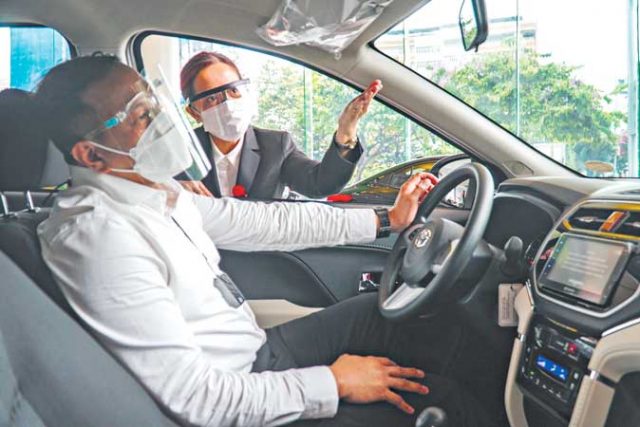
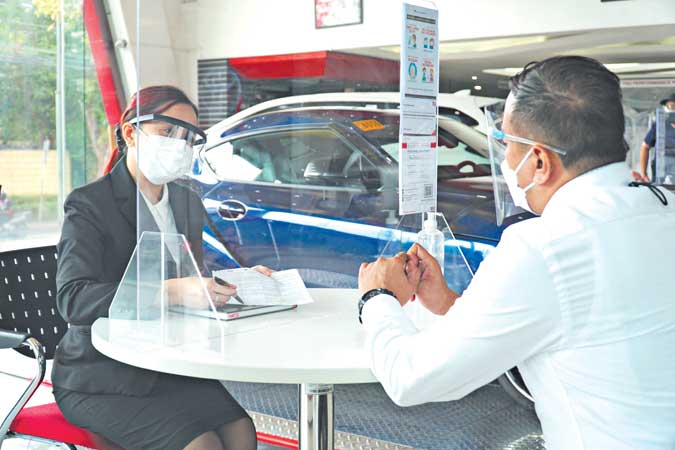
Toyota Makati, Inc. (TMI), the first Toyota dealership in the Philippines, believes that the business of selling cars cannot be purely “inanimate.” TMI General Manager Lee Junia maintained that ISO safety-compliant TMI implements IATF health and safety protocols. Aside from requiring staff and customers alike to wear face masks and face shields, temperature scanners and touchless alcohol dispensers can also be found in the dealerships. Clients and visitors are also required to fill out a health declaration form through a QR code.

Mr. Junia continued that the level of engagement with clients is no longer as direct as it was before the pandemic. There are now protective barriers and enforced one-meter distancing. A skeleton workforce has also been enforced.

“It’s a whole new ball game doing business in the new normal. I used to train the marketing professional to sit close to the customer to be able to engage or establish a relationship. That’s all out the door,” Mr. Junia remarked. “But despite the new challenges, we remain fully committed to providing our customers quality service from sales to maintenance while staying safe.”

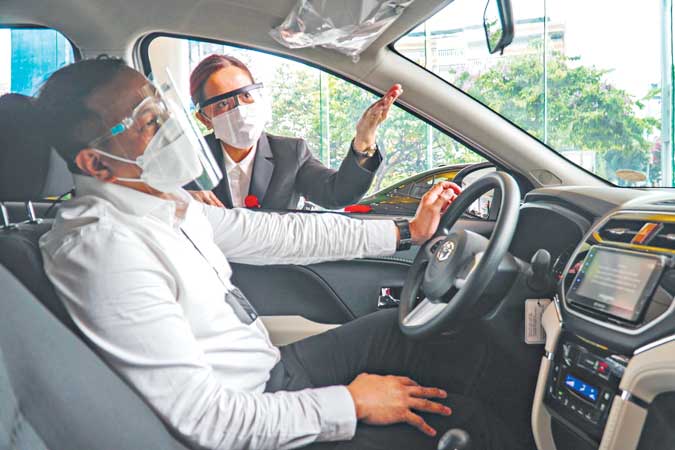
While TMI accepts walk-in customers, Mr. Junia “highly recommends” to set an appointment prior to a visit. This way, clients are assured of a well-prepared staff to assist them with their needs including test drives when they visit. TMI cleans and sanitizes all vehicles, including test-drive models, before these come in the branch and before they’re handed over to the customer. Test drives are available by appointment only, and only one customer may do the test drive accompanied by a TMI staff seated at the back to observe social distancing.

Mr. Junia assured clients that every service is available on-site from vehicle purchase to proper vehicle maintenance. To further assist clients’ inquiries and concerns online, TMI’s Customer Relations Department (CRD) is maximizing social media as a business tool to touch base with customers.

In line with TMP’s focus on making car ownership as affordable as possible, particularly in view of the financial challenges brought about by the pandemic, interested car buyers can avail of services offered by Toyota Financial Services Philippines.

“With Toyota’s various purchase programs such as low equity or low monthly payments depending on the kind of vehicle or payment method, people can acquire a car as easily as possible. We are able to create a package that will help customers especially during this time,” explained Mr. Junia.

Toyota also offers a standard warranty of three years or 100,000 kilometers, whichever comes first. TMP also reminds car owners of their window of protection within the warranty period, and that having cars maintained in Toyota dealers is important. Following the prescribed periodic maintenance schedule, which is usually every 5,000 kilometers or three to four months, is another sure-fire way to keep Toyota vehicles running smoothly.

As a newly implemented best practice for vehicle servicing, TMI technicians can go to the customer’s location serviced by van or motorcycle, with “all the parts and tools they need.” For retail clients, a minimum of two technicians are sent as long as their residence allows entry; for fleet accounts at least three to four technicians are on board. For parts, inquiries can be done online and arranged for delivery, if necessary.

TMI is just one of TMP’s 70 dealers nationwide, ready to serve customers. Each Toyota dealership applies its own measures based on the current situation in their areas to serve their customers better. Nonetheless, Toyota through its dealerships offer products and services to address the varying needs of its customers. Dealerships operate at regular hours — 7 a.m. to 5 p.m. for service, and 8 a.m. to 7 p.m. for vehicle sales depending on each facility’s local community guidelines. Customers are advised to keep in touch with the nearby dealership to know the specifics implemented.

For more information, follow Toyota Motor Philippines on Facebook and Instagram, visit www.toyota.com.ph, Twitter (ToyotaMotorPH), and Viber (Toyota PH) — for regular updates on products and services, dealer operations, announcements, and events. Check out Toyota models online at toyota.com.ph/showroom and inquire by choosing a preferred dealership. For after-sales needs and service appointments, MyToyota.ph is accessible online.


Citicore to supply 20-MW solar power to Shell Energy

HTTP://CITICOREPOWER.COM.PH/

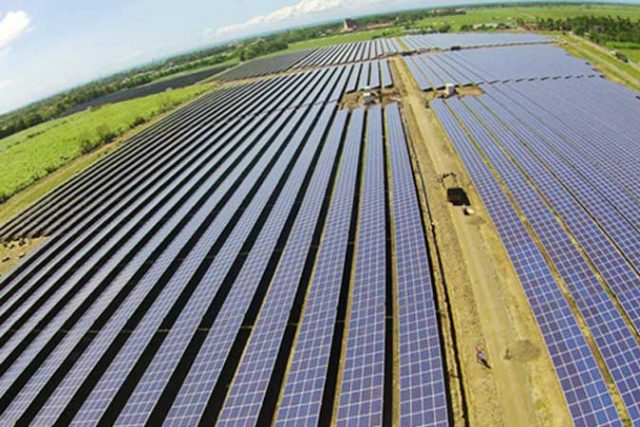
RENEWABLE energy (RE) firm Citicore Power, Inc. said over the weekend that it will be supplying up to 20 megawatts (MW) of solar power to Shell Energy Philippines, Inc. through its Bataan-based facility.

Shell Energy is a retail electricity supplier under the Shell Group.

“Citicore Solar Bataan, Inc. (CSBI) will supply Shell [Energy] with RE through its solar plant located in Mariveles, Bataan,” Citicore Power said in a press release issued on Saturday.

CSBI is one of the company’s eight solar facilities across the country with a total capacity of 163 MW.

Citicore Power President and Chief Executive Officer Oliver Y. Tan said that his firm and Shell Energy share a mission to provide clean and sustainable energy to meet the requirements of consumers.

“With this collaboration, we are looking forward to accelerate and expand the country’s shift to and utilization of RE,” he said.

Citicore Power plans to build its RE portfolio by five-fold over the next five years to help more customers reach net-zero emissions. To date, the company’s solar portfolio has generated around 1.08-billion kilowatt-hours of energy, translating in 763,200 metric tons of reduced carbon emissions.

Last month, Citicore Power’s retail supply arm Citicore Energy Solutions, Inc. secured an operating permit from the Department of Energy to participate in the green energy option program.

The program is a voluntary policy mechanism that allows users consuming at least 100 kilowatts of power to source their supply from eligible retail energy suppliers generating electricity from renewables.

In March, Mr. Tan said that Citicore Power had allocated P4 billion in capital expenditures for solar and hydro projects.

He added that the company hopes to tap into capital markets for what could be the country’s “first power REIT offering,” referring to a real estate investment trust or an entity with different types of assets bringing steady earnings to investors.

Citicore Power is a wholly owned subsidiary of Citicore Holdings, Inc. Its affiliates include Megawide Construction Corp. and GMR-Megawide Cebu Airport Corp, the airport operations vehicle of Citicore Holdings. — Angelica Y. Yang

Picasso oil painting sells for over $100 M at New York auction

Femme assise près d’une fenêtre (Marie-Thérèse) — CHRISTIES.COM

NEW YORK —  An oil painting by Pablo Picasso sold for $103.4 million at a Christie’s auction in New York, smashing its presale estimate of $55 million. The portrait of Picassos French lover Marie-Therese, Femme assise près d’une fenêtre (Marie-Thérèse), or Woman sitting near a window, led the 20th Century Evening Sale on Thursday. Keith Gill, head of the Impressionist and Modern Art department at Christie’s London, said the work may be familiar to art lovers from its appearance at a landmark Picasso 1932 exhibition at the Tate Modern in 2018. After an intense bidding war, the Picasso was snapped up by an online bidder in California, Christie’s said. Thursday’s auction, which was streamed live from the Rockefeller Center, marked the fifth work by the Spanish painter to have sold for more than $100 million. — Reuters

Coffee for Peace to open 2nd café in lease-free space at Ayala Abreeza Mall

COFFEE FOR PEACE

FELICITAS B. PANTOJA, founder and chief executive officer of Coffee for Peace, said the organization will open a new café on the third floor of the Ayala Abreeza Mall in Davao City, free of rent, which is expected to mitigate some of the risks from the pandemic-constrained market.

Coffee for Peace, which is seeking to promote local farmers, has been granted a rent waiver under an Abreeza program to support social enterprises working with indigenous communities.

Coffee for Peace’s café at Ecowest Drive reopened in April after being closed for more than a year due to coronavirus-related restrictions. 

Business “is still slow,” Ms. Pantoja said in an interview with BusinessWorld, but Coffee for Peace could not have passed up on the Ayala Abreeza opportunity.

The café will require two baristas. Beyond the coffee shop business, the location will also serve to promote a deeper appreciation of the farm-to-shop coffee loop and its impact on communities and the economy.

Coffee for Peace teams, restricted in their movements for most of 2020, have also resumed engagement with coffee farmers in various parts of the country.

“We are busy training again, we have three new communities,” she said.

The areas where the organization is active include Kalinga in the Cordillera region, Capiz in Western Visayas, Mt. Kitanglad in Northern Mindanao, Davao del Sur, and Kidapawan.

Byron Pantoja, Coffee for Peace vice-president for operations, said training now includes modules on using social media as a marketing and trading tool as well as cashless payment options.

“Anyone who can afford a cellphone, which is most of them now, has a Facebook and that’s where they contact their buyers, make arrangements,” he said, adding that he has personally seen improvements in mobile phone connectivity in some of the upland areas.

Mr. Pantoja, a certifed arabica and robusta quality grader who is among the judges in this year’s Philippine Coffee Quality Competition, said the digital platform has also kept the annual event vibrant with even more farmers participating.

“Our coffee circle (in the Philippines) is growing,” Ms. Pantoja said.

With the opening of such spaces as the Coffee for Peace café in Ayala Abreeza, she is hoping that the market for specialty and high-quality coffee will also grow. — Marifi S. Jara

ADVERTISEMENT
ADVERTISEMENT