Home Blog Page 8038

Percussions take the lead


FOLLOWING the beat of the family drum, Jonathan Nemesio Regalado III became a drummer as his brother and their father are. But there was no familial drum for Isaac De Alva III, who grew up with no musicians in the family. Still, he found the beat irresistible.

Nung high school ako, nakapanood ako ng marching band. Then, sumali akoHindi ko inakala na magugustuhan ko (When I was in high school, I was able to watch a marching band. I decided to join and didn’t realize that I would enjoy it),” Mr. De Alva III said.

Currently the Vice-President of the Percussive Arts Society Philippines (PAS PH), Mr. De Alva III pointed out that percussion is not limited to a drum set — there are, after all, various types of mallet percussion instruments such as xylophones, the marimba, and glockenspiel.

For Mr. Regalado III, the drums play an integral role in a band. “Malaki ang responsibility ng drums because of its power and [need for] consistency of dynamics (such as volume and tempo),” he said. “Ang laki ng effect ng percussionist sa isang group. Hindi magmo-move yung group kung walang rhythm yung percussionist or drummer (A percussionist brings a huge effect to a group. The group will not move when a percussionist or drummer has no rhythm),”

As the president of PAS PH Satur Tiamson said: “Basta tumugtog kami, ang nasa isip namin is to send the story to the audience (When we play music, we keep in mind to send a story to the audience).”

This weekend, percussionists and drummers from around the world will come together for a music festival that highlights percussion and drum instruments. The Cultural Center of the Philippines (CCP) and the PAS PH present PINTIG, A Percussion Festival, which will be held online from May 28 to 30.

Performances are scheduled at 7:30 p.m. during the three-day festival. These will be streamed via the CCP Office of the President Facebook Page (http://facebook.com/ccp.officeofthepresident).

PINTIG (which translates to “pulse” or “beat”) is a project of the Office of the President of CCP under the Sining Sigla virtual outreach program.

“Sining Sigla aims to continuously reach out to the public even in the midst of this pandemic by providing culturally relevant programs online,” CCP President Arsenio “Nick” Lizaso said during an online press launch on May 24 held via Zoom.

Past programs under Sining Sigla include Jazz Stay At Home (Jazz Festival), MALA (Movies Adapted from Literary Arts), Sigla ng Pasko, and Awit at Dula: Pagbabalik-tanaw sa Unang Hari ng Balagtasan.

The three-day virtual festival will also feature master classes and workshops on percussion, drum set, marching, keyboard music technology, and new music. 

The festival will have performances from over 30 big names in the world of drumming and percussion, including: Alexis Constantino (percussionist, ABS-CBN Philharmonic Orchestra), Aaron Awitan Reyes (FEU Drumline), Andrea Tanlapco (Temple Hill International School), Ernie Severino (Side A), Gian Vergel (UST Conservatory of Music), Junjun Regalado (Bamboo), Karmi Santiago (who has worked with Ebe Dancel, Baihana, and Richard Poon), Jayson Rivera (Philippine Philharmonic Orchestra), the Batukada De Negros Percussion Group, the Digos City Tribal Beatz, the UST Percussion Ensemble, and the Orchestra of the Filipino Youth Percussion Ensemble.

A series of workshops will be offered to Percussive Arts Society members. Keyboard percussionist Arthur Lipner will hold a Keyboard Percussion Masterclass on May 28, 8:30 p.m. Percussion educator John Wooton (also known as Dr. Throwdown), will give a lecture on “Understanding Rudiments and Clave” on May 29, 8:30 p.m. Those who would like to attend these workshops may sign up for PAS membership.  To register, visit https://www.pas.org/membership/individual-group or contact Satur Tiamson on Facebook and via e-mail at saturnino_tiamson@yahoo.com. — MAPS

Liquidity risk management framework set for Islamic banks

THE CENTRAL BANK released its liquidity risk management framework for Islamic banks that allows them the freedom to choose Shari’ah compliant instruments to mitigate liquidity risks.

Under Circular No. 1116 published on the website of the Bangko Sentral ng Pilipinas (BSP) on Tuesday, Islamic banks and banking units will be given an observation period until December 2024 to let them familiarize and strategize in accordance with the framework.

“The regulatory issuance is basically anchored on the existing liquidity risk management framework for conventional banks with additional provisions to cover the specificities of Islamic banking,” the BSP said in a statement.

“The aim is to create an enabling environment that will allow Islamic banks to operate alongside the conventional banks under the same regulatory approach, taking into consideration the unique features of Islamic financial activities/transactions,” it added.

The newly released rules also provide guidance on the treatment of Islamic banking accounts such as profit and loss sharing investment accounts.

Based on the circular, Islamic banks and banking units should consult their Shari’ah Advisory Council to develop a funding strategy and contingency plan that will be appropriate for use.

Until end-2024, Islamic banks and banking units are expected to submit quarterly reports for monitoring purpose. For its part, the central bank will engage with industry players to assess their readiness for the implementation of the circular by January 2025.

Currently, only Al Amanah Islamic Bank operates under Islamic banking principles in the Philippines. It has been under the control of the Development Bank of the Philippines since 2008.

The regulatory framework is in line with regulations released by the central bank in accordance with the implementation of Republic Act No. 11439 or the Act Providing for the Regulation and Organization of Islamic Banks, which was enacted in August 2019. — Luz Wendy T. Noble

Benguet Corp. income surges on higher nickel sales, gold prices

BENGUET Corp. posted a consolidated net income of P381.39 million in 2020, surging more than three times from the previous year, on the back of better nickel revenues and higher gold prices.

Its revenues reached P1.62 billion, a 102% increase from P802.07 million in the previous year. From the amount, nickel sales accounted for the biggest share at P818.34 million.

“Nickel sales, which accounted to 50% of gross revenues, grew by 1,165% to P818.34 million from P64.65 million in 2019,” the company said in a regulatory filing.

Benguet Corp. said its nickel subsidiary, Benguetcorp Nickel Mines, Inc. (BNMI), exported nine boatloads of 1.2% to 1.4% nickel ore aggregating 483,952 tons at an average price of $34.21 per ton – higher than the one boatload of 1.5% nickel ore aggregating 55,000 tons at $22.50 per ton recorded in 2019.

“Following resumption last October 2020 of mining operation of the nickel project in Zambales, BNMI was able to take full advantage of the upbeat market for low and mid grades at higher prices,” the company said.

Meanwhile, the company said its gold revenues for 2020 also rose 18.7% to P704.30 million compared to P593.30 million the year earlier on the back of better prices, while lime and other revenu es reached P97.09 million.

“The Acupan Gold Project (AGP) sold 8,080.71 ounces of gold at average price of $1,750.25 per ounce against 8,236.65 ounces of gold at an average price of $1,395.43 per ounce in 2019,” the company said.

“The gold output of the Acupan mine benefited from higher average gold price,” it added.

Benguet Corp.’s cost and operating expenses in 2020 rose 38% to P1.27 billion from the P923.78 million it had the previous year as a result of higher shipment tonnage of nickel ore this year.

Moving forward, the company said it does not predict any cash flow or liquidity issues in the next 12 months.

“BNMI resumed mining operations and continues to market saleable nickel ores inventory from old stockpile, Irisan Lime Project continues to maintain steady market for quicklime products, and AGP is expected to improve gold production,” the company said.

On Tuesday, shares of Benguet Corp. “A” was flat at P3 per share while Benguet Corp. “B” shares rose 1.70% or five centavos to end at P2.99 apiece. — Revin Mikhael D. Ochave

Arts & Culture (05/26/21)

A community pantry of art performances

YOUNG creators, writers, artists and performers will share a series of performances at the Community Pantry of Joy, an online show that features original songs, music videos, and photo essays, as well as jokes, monologues, and even prayers to bring hope and comfort amid trying times. Inspired by the Maginhawa Community Pantry, the event exercises the redemptive nature of the arts as it feeds the souls of the audience. Hosted by the Benilde Arts and Culture Cluster of the De La Salle-College of Saint Benilde, it will introduce a diverse line-up of entertainers from various disciplines. The event will be curated and moderated by cultural producer, interdisciplinary performance scholar, thespian, film artist, arts advocate and artistic director of DeviDiva Productions, Dr. Sunita Mukhi. The former Associate Dean for the Benilde Arts and Culture Cluster, she now serves as an instructor and consultant. The Community Pantry of Joy is free and open to the public. It will be livestreamed on May 27, 3 to 5 p.m. via Zoom. Interested participants may register through https://forms.gle/RBX4avSYUfM9pCDW7. For inquires, visit the official Facebook page of Benilde Arts and Culture Cluster at https://www.facebook.com/benildearts/.

Bersong EuroPinoy goes to Manila

THE CHARM and romance of the European and Filipino languages continue as Bersong Euro-Pinoy goes to Manila on May 28, 5 p.m., via facebook.com/EUDelegationToThePhilippines. Together with the Embassies of Belgium, the Czech Republic, Denmark, Germany, France, Hungary, Austria, Poland, Finland, and Spain, and Instituto Cervantes de Manila, the Philippine-Italian Association, and De La Salle University Manila (DLSU), the European Union Delegation to the Philippines is mounting the poetry recital Bersong Euro-Pinoy — Pagkakaibigan at Bayanihan: Verses Versus the Virus, in Manila. This time, Filipino literary luminaries mobilized by DLSU will join European poets and readers. Poems to be recited adhere to the theme of “Pagkakaibigan and Bayanihan.”

Exhibit of magazine covers illustrates ‘Peace Time’

THE ORTIGAS Foundation Library presents an exhibit of magazine covers called “Peace Time in the Country: 1930 to 1941” at the BenCab Museum in Baguio. The exhibit — which features the Ortigas Library collection of covers of a magazine that was progressive for its time — will run from June 12 to Aug. 1. In the span of less than 20 years, the editor and owner of Philippine Magazine, A.V.H. Hartendorp, invited the budding and rising stars of the literary and art world to publish in the magazine or on its cover. Many would become, 40 years later, National Artists. The covers give a sense of how the land, and its people were treated, looked at, and written about in a period called “Peace Time” before the horrendous “War Time” a decade later.

Penguin Random House SEA publishes thriller

WHAT happens when an innocent prank goes horribly wrong? That is the question tackled by author Nidhi Upadhyay in her new psychological thriller That Night: Four Friends. Twenty Years. One Haunting Secret, published by Penguin Random House SEA. Natasha, Riya, Anjali and Katherine were best friends in college until that night, which began with a bottle of whisky and a game of Ouija but ended with the death of Sania, their unlikeable hostel mate. The friends vowed never to discuss that fateful night, until, 20 years later, someone threatens to reveal the truth that only Sania knew. Is it a hacker playing on their guilt or has Sania’s ghost really returned to avenge her death? Author Nidhi Upadhyay is a Singapore-based engineer-turned-headhunter who spent her nights reading thrillers, until her husband pushed her into writing one. That Night is her debut novel. Penguin Random House SEA was established in 2018 to discover and publish local and international voices across English-language adult and children’s fiction and nonfiction formats for Singapore and Malaysia, Thailand, the Philippines, Indonesia, Vietnam, Cambodia, Laos, Brunei, and Myanmar.

Original tribal stories digitized

THE ORIGINAL indigenous stories of Tagum City’s cultural communities found new platforms for massive distribution by adopting digital tools that are attuned to the times. The Tagum City Historical and Cultural Center launched on May 21 the Digital Oman-Oman Series Project which aims to digitize the various tribal stories — or Oman-Oman in the language of the Tipanud — of the indigenous cultural communities of Tagum. A by-product of the Community-Based Pag-Indo Program, the project compiles hundreds of indigenous stories into various formats — a podcast hosted on Spotify, a fully illustrated children’s storybook, and a coloring book. Highlighting the launching event was the inaugural story entitled Kumang and Pait, an original Ata-Manobo fable as told by Bae Hermenia Maitem. The children’s storybook was conceptualized by Tagumenyo illustrator Precious Jade Asumbrado. Each month, an indigenous story will be uploaded on Spotify, along with the coloring book and storybook produced by Tagumenyo visual artists. The podcast can be accessed through bit.ly/kumangpait, while the illustrated children’s storybook and supplementary coloring book can be accessed at bit.ly/kumangmaterials.

Designer Ditta Sandico reinvents herself

FAMED for her ‘banaca” wraps, designer Ditta Sandico is launching an art exhibit, “METTA • MORPHE,” featuring a series of deeply personal paintings that tell her story of recovery, rediscovery, and rebuilding. Meticulously sculpted by hand, each painting is a joyful expression of a woman who is celebrating a second chance at life, blossoming out of a cocoon, and being wholly and unapologetically herself. Each woman is dressed in gracefully crafted indigenous fabric, woven by women of the Mangyan tribe and carefully draped by the designer’s expert hand. With the exhibit, Ms. Sandico continues to push the boundaries of Philippine heritage by bringing architectural pieces made of banaca fabric and habol weaving to life, radically stretching the limits of what indigenous fabrics can do and what they can express in fashion and the arts. “METTA • MORPHE” will go on view on May 26 May at the Dolce Ditta Gallery, No. 5 Mabolo St. corner Balete Drive, New Manila, Quezon City. To arrange for a private viewing, please contact (02) 8571 8922.

Responding to the pandemic through CSR

PHILSTAR

Since the coronavirus disease 2019 (COVID-19) pandemic, health workers continue to face risks due to their constant exposure to the SARS-CoV-2 virus. They work long shifts, care for several patients, and endure the psychological impact of seeing a number of people succumb to the virus or its serious complications. The pandemic surge in March and April only added to their burden, having to care for thousands who tested positive per day. Since the start of the pandemic, our frontliners have not rested and have certainly gone beyond their duty.

A study on the mathematical model of COVID-19 transmission between frontliners and the general public showed that both frontliners and the general public should be protected against COVID-19. Prioritizing only the protection of frontliners, the study showed, cannot flatten the epidemic curve. It added that if only the general public were to be protected, there would be a significant flattening of the epidemic curve but the infection risk faced by frontliners will remain high. This high infection risk would affect their ability to care for patients.

The World Health Organization (WHO) said that protecting health workers is key to ensuring a functioning health system and society. “Health workers play a vital role in keeping others safe, relieving suffering  and saving lives. No country, hospital or clinic can keep patients safe unless its health workers are safe,” the WHO said. 

It is for this reason that the Pharmaceutical and Healthcare Association of the Philippines (PHAP) and our corporate social responsibility (CSR) arm, the PHAPCares Foundation, launched the “We will not rest” campaign to help protect frontliners and communities affected by COVID-19. PHAP members collectively donated P120 million to the country’s COVID-19 response, benefiting more than 1.5 million families and 155 health facilities last year. Beneficiaries included government and private hospitals, charitable institutions, government agencies, and nongovernmental organizations (NGOs), among others.

This year, the PHAPCares Foundation continues to help support frontline healthcare workers. When the fire broke out at the Philippine General Hospital last week, the Foundation dispatched 100 cases of bottled water provided by its partner Save More Markets.   

PHAP member Sanofi also recently donated 1,000 personal protective equipment (PPE), which PHAPCares initially turned over to the Perpetual Help Medical Center DALTA Foundation in Las Piñas City, and Our Lady of Peace Hospital through its Foundation of Our Lady of Peace Mission, Inc., in Parañaque City.

Orient Europharma (OEP) likewise donated 6,530 boxes of anti-hypertension medicines worth P5.6 million, which PHAPCares distributed to eight health facilities. These are Dr. Jose N. Rodriguez Memorial Hospital; Our Lady of Peace Hospital and San Lazaro Hospital in Metro Manila; Ospital Ng Tagaytay in Cavite; Perpetual Help Medical Center DALTA Foundation, Las Piñas; La Union Provincial Health Office in La Union; Mariano Marcos Memorial Medical Center in Ilocos Norte; and Tolosa Rural Health Unit in Leyte.

Savemore Market, a longstanding PHAPCares partner, also donated 50 sacks of detergents needed in hospital facilities. PHAPCares distributed the donated detergents to Our Lady of Peace Hospital, University of Perpetual Help JONELTA Foundation, Biñan, San Lazaro Hospital, and Dr. Jose N. Rodriguez Memorial Hospital.

Since its founding, PHAPCares has donated P1B in medicine and financial assistance to Filipinos disadvantaged by sickness, poverty, conflicts and disasters. Under the leadership of its new officers and trustees, PHAPCares intends to form more partnerships to support the nation’s efforts to contain the spread of COVID-19, and to establish pharmaceutical security resilience in preparation for future pandemics.

The World Health Assembly, which runs till June 1 in Geneva, focuses on the urgency of ending the current pandemic and preventing the next one. Protecting frontliners must be on top of the agenda if this ambitious goal is to be achieved.


Teodoro B. Padilla is the executive director of the Pharmaceutical and Healthcare Association of the Philippines (PHAP). PHAP represents the biopharmaceutical medicines and vaccines industry in the country. Its Members are in the forefront of research and development efforts for COVID-19 and other diseases that affect Filipinos.   

Victorias Milling readies COVID-19 vaccines for employees

VICTORIAS Milling Co., Inc. said its 2,000 employees and service providers are set to be vaccinated against the coronavirus disease 2019 (COVID-19) in the coming months.

In a stock exchange disclosure on Tuesday, Victorias Milling President Minnie O. Chua said the company had submitted the names of its employees and other outsourced personnel who signed up for its vaccination program.

“The safety and well-being of our people will always be our top priority. As such, the vaccination program is necessary to protect their employees and their families from getting severely affected when infected by the virus,” Ms. Chua said in the disclosure.

“We’ve had a few employees who contracted the virus and thankfully, they are now fully recovered. The program will also help in restoring normalcy in our operations and allow us to continue serving our planters,” she added.

Ms. Chua said the company’s work force showed hesitation when initially asked regarding mass vaccination, but said more than 90% of them signed for the program after undergoing a week of advocacy and testimonials from those previously infected or those who lost loved ones after contracting the virus.

“This is one of the greatest challenges the company faced. We are thankful that despite the restrictions and protocols we’ve established, the employees and our clients cooperated,” she said.

Ms. Chua also said the company is creating mechanics that will allow the families and households of their employees to have access to the vaccines.

MANULIFE TO PROVIDE VACCINES FOR EMPLOYEES
Separately, global life insurer Manulife said in a statement on Tuesday that it will have a COVID-19 vaccination program for its 8,500 employees and active agents in the Philippines.

The company announced that the vaccination program will cover personnel from Manulife Philippines, Manulife China Bank Life, Manulife Investment Trust Corp., Manulife Business Processing Services, Manulife IT Delivery Center Asia, and other active insurance advisors and agency leaders.

According to Manulife, the vaccination support program is voluntary for employees and agents.

“As the COVID-19 situation in the country evolves, the safety and well-being of our team members remain our top priority. We want to give them the protection and peace of mind they need, as they continue to serve our customers and our communities,” said Richard Bates, Manulife Philippines president and chief executive officer. — Revin Mikhael D. Ochave

BSP set to release second phase of sustainable finance regulation

BW FILE PHOTO

THE central bank will unveil the second-phase regulation for sustainable financing, which will take into account climate change risk in the assessment of credit and operational risk management of the banking industry.

“This issuance will provide granular expectations on the integration of climate change and other environmental and social risks in banks’ credit and operational risk management frameworks,” Bangko Sentral ng Pilipinas Governor Benjamin E. Diokno said at the Investment Forum on Energy Transition held on May 20.

The upcoming regulation is anchored on expectations for banks to gear towards sustainability principles through pushing for strategic, concrete, and progressive actions to address climate change.

“The framework safeguards the stability of the financial system against potentially significant and protracted impact of climate change and other environment related risks,” Mr. Diokno said.

In April last year, the central bank launched its sustainable finance framework and gave banks a three-year transition period to adopt its provisions.

The regulation includes directing banks to adopt sustainability principles through environmental and social risk management systems as well as environmental, social and governance (ESG) considerations in their governance frameworks, risk management systems, strategies and operations.

Part of the sustainability drive is launching instruments to boost financing for sectors affected by the crisis such as micro-, small- and medium-sized enterprises (MSMEs), health, education and food security.

The central bank governor stressed that reducing greenhouse gas concentrations by shifting from fossil fuels to renewable sources is crucial to the climate change mitigation goal.

“We should note, however, that a successful transition is not just a matter of isolated changes in the energy sector. We must also consider the potential risks associated with this transition given the interplay among economic activities,” he said. — Luz Wendy T. Noble

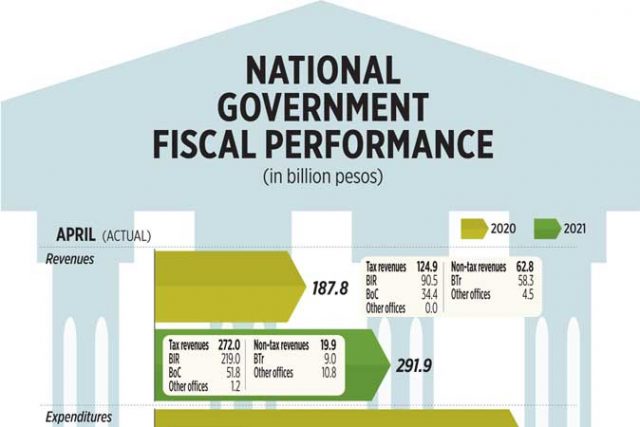
National Government Fiscal Performance

THE NATIONAL Government’s budget deficit shrank to P44.4 billion in April, following the sharp drop in spending and a base effect-induced spike in revenues. Read the full story.

National Government Fiscal Performance

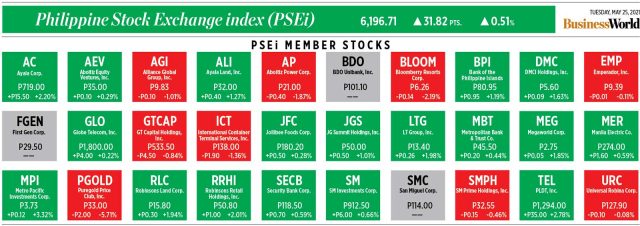
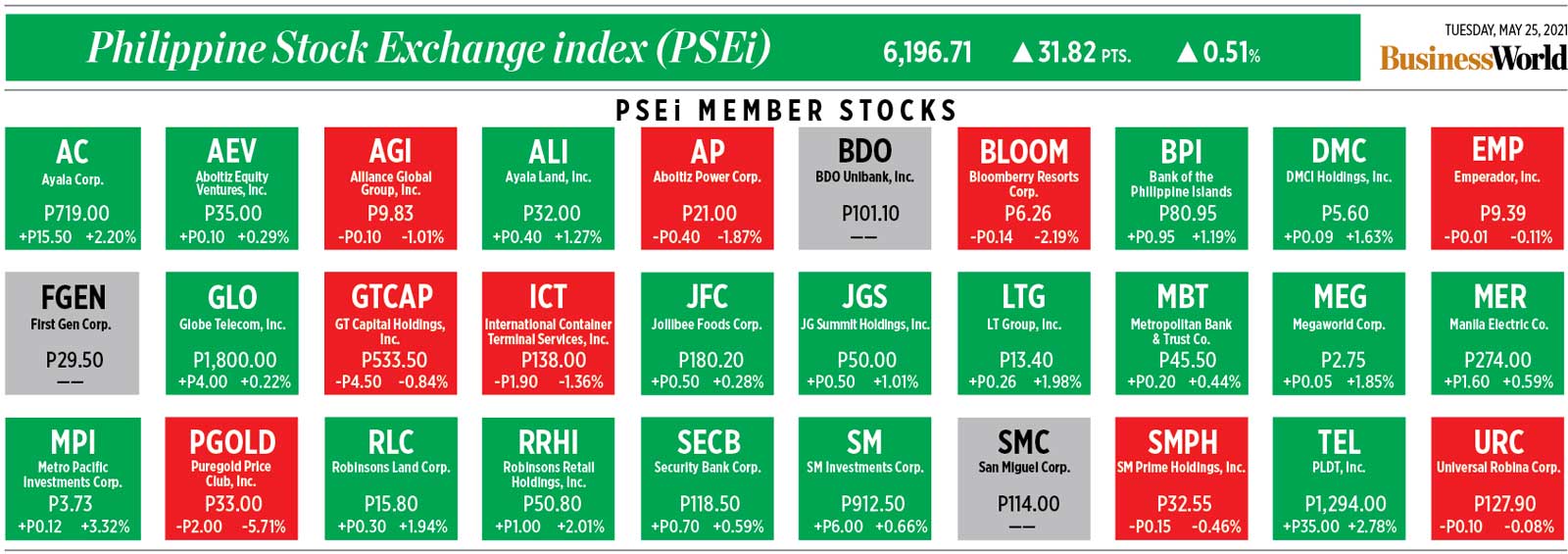
How PSEi member stocks performed — May 25, 2021

Here’s a quick glance at how PSEi stocks fared on Tuesday, May 25, 2021.


Global recovery signs, lower US virus cases lift stocks

BW FILE PHOTO

PHILIPPINE shares inched up on Tuesday despite cautious market sentiment as investors turned optimistic about global recovery after the United States reported lower cases of coronavirus disease 2019 (COVID-19).

The benchmark Philippine Stock Exchange index (PSEi) climbed 31.82 points or 0.51% to close at 6,196.71 on Tuesday, while the all shares index gained 13.51 points or 0.35% to end at 3,834.78.

“The local bourse ended higher together with most Asian markets, as overnight markets finished on green territory due to investors feeling optimistic over the recovery of the global economy,” Darren Blaine T. Pangan, trader at Timson Securities, Inc., said in a Viber message.

“This comes after reports circulated that the daily new COVID-19 cases in the US started to decline already,” Mr. Pangan said.

However, with the lack of developments at home, investors remained cautious.

“The market managed to end slightly higher, mainly flat despite increased trading and volatility in several blue-chips,” AAA Southeast Equities, Inc. Research Head Christopher John Mangun said in an e-mail, referring to some of the companies in the 30-member PSEi.

“The sentiment remains overly cautious as investors have not gained any optimism from the positive vaccine progress on the perception that the uncertainty risks, vastly outweigh the developments,” Mr. Mangun added.

Sectoral indices were split on Tuesday. Holding firms went up by 59.80 points or 0.97% to 6,192.66; financials improved by 7.05 points or 0.51% to 1,376.20; and property climbed 12.26 points or 0.41% to 2,962.65.

Meanwhile, mining and oil declined by 54.94 points or 0.59% to 9,197.88; services lost 3.18 points or 0.21% to finish at 1,447.10; and industrials shed 5.42 points or 0.06% to 8,535.10.

Value turnover went up to P6.02 billion with 1.16 billion shares switching hands on Tuesday, from the P4.48 billion with 1.09 billion issues traded on the previous trading day.

Advancers outnumbered decliners, 98 against 88, while 58 names closed unchanged.

Net foreign selling dropped to P88.89 million on Tuesday from the P667.86 million in net outflows logged on Monday.

Timson Securities’ Mr. Pangan said he expects the index to trade between 6,150 and 6,490.

“The market is expected to continue lower, and we highly encourage medium to long-term investors to start accumulating,” AAA Southeast Equities’ Mr. Mangun said. — Keren Concepcion G. Valmonte

Peso weakens for fifth day on rising oil prices

BW FILE PHOTO

THE PESO continued to weaken for a fifth straight trading day against the greenback on Tuesday amid rising global crude oil prices.

The local unit closed at P48.135 versus the dollar on Tuesday, dropping by 7 centavos from Monday’s finish of P48.065, data from the Bankers Association of the Philippines’ website showed.

This was the peso’s worst close in three weeks, or since the April 29 finish of P48.315 per dollar.

The peso opened Tuesday’s session at P48.05 against the dollar, while its intraday best was at 48. It dropped to as low as P48.16 versus the greenback.

Dollars traded went up to $1.039 billion on Tuesday from $937.64 million on Monday.

“The peso’s weak performance was partly brought about by the latest increase in global crude oil prices to a two-month high, thereby increasing the country’s import bill,” said Rizal Commercial Banking Corp. (RCBC) Chief Economist Michael L. Ricafort in a text message.

Goldman Sachs forecast oil prices to climb to $80 per barrel in the fourth quarter of this year, saying that the market has “underestimated a rebound in demand even with a possible resumption in Iranian supply.”

Mr. Ricafort said another factor that influenced the peso’s performance was the move from Moody’s Investors Service to cut its 2021 growth estimate for the Philippine gross domestic product to 5.3% from 6.3% due to the country’s faster inflation rate in the first quarter, among others.

Meanwhile, a trader said that expectations of an upbeat US consumer confidence report this month might support views of a strong economic recovery in the US. The local currency might depreciate further from a better report on durable goods in the US last April.

For Wednesday, the trader expects the peso to move between P48.05 and P48.25 versus the dollar, while RCBC’s Mr. Ricafort gave a forecast range of P48.08 to P48.18. — Isabel B. Celis with Reuters

DICT pitches telecom spectrum user fee to drive telco investment

BW FILE PHOTO

THE Department of Information and Communications Technology (DICT) said Congress needs to legislate a spectrum user fee (SUF) to ensure the sustainability of telecommunications industry development and improve access to the internet.

At a House hearing Tuesday, Information and Communications Undersecretary Emmanuel Rey R. Caintic said the SUF was on the DICT’s wish list when legislators were discussing the proposed third Bayanihan economic stimulus package. The DICT said the fee can only be imposed by law. The funding generated by the fee will allow more fiber connectivity in remote areas.

“If you will allow us… (to unlock the) spectrum users fee, we will be able to invest in digital infrastructure… so that it is sustainable, economical, and better,” he said, in response to Catanduanes Rep. Hector S. Sanchez’s question on the DICT’s plan to “fiberize” the telecom infrastructure.

The House Committee on Good Government and Public Accountability was holding the hearing Tuesday to debate House Resolution No. 1751, investigating irregularities in the implementation of the free public Wi-Fi program.

The DICT said the program has enabled up to 6,000 communities along the so-called last mile to access free internet services.

Mr. Caintic said the free Wi-Fi roll-out was carried out in partnership with the United Nations Development Program. It has led to the activation of 9,122 sites. Mr. Caintic said in 2021, more sites will be set up and funds are available to establish 14,000 more. — Gillian M. Cortez

ADVERTISEMENT
ADVERTISEMENT