Home Blog Page 8030

WhatsApp sues India govt, says new rules mean end to privacy — sources 

UNSPLASH
UNSPLASH

WhatsApp has filed a lawsuit in Delhi against the Indian government seeking to block regulations coming into force on Wednesday that experts say would compel the California-based Facebook unit to break privacy protections, sources said. 

The case, described to Reuters by people familiar with it, asks the Delhi High Court to declare that one of the new rules is a violation of privacy rights in India’s constitution since it requires social media companies to identify the “first originator of information” when authorities demand it. 

While the law requires WhatsApp to unmask only people credibly accused of wrongdoing, the company says it cannot do that alone in practice. Because messages are end-to-end encrypted, to comply with the law WhatsApp says it would have break encryption for receivers, as well as “originators,” of messages. 

Reuters, which first reported the story on Wednesday, could not independently confirm the complaint had been filed in court by WhatsApp, which has nearly 400 million users in India, nor when it might be reviewed by the court. The people with knowledge of the matter declined to be identified because of the sensitivity of the issue. 

A WhatsApp spokesman declined to comment. 

A government official said WhatsApp could find a way to track originators of disinformation, a long-standing stance of Prime Minister Narendra Modi’s government, and that the company was not being asked to break encryption. 

India’s technology ministry did not respond to a request for comment. 

The lawsuit escalates a growing struggle between Modi’s government and tech giants including Facebook, Google parent Alphabet, and Twitter in one of their key global growth markets. 

Tensions grew after a police visit to Twitter’s offices earlier this week. The micro-blogging service had labeled posts by a spokesman for the dominant party and others as containing “manipulated media,” saying forged content was included.   

The government has also pressed the tech companies to remove not only what it has described as misinformation on the coronavirus disease 2019 (COVID-19) pandemic ravaging India, but also some criticism of the government’s response to the crisis, which is claiming thousands of lives daily. 

The response of the companies to the new rules has been a subject of intense speculation since they were unveiled in February, 90 days before they were slated to go into effect.   

The Intermediary Guidelines and Digital Media Ethics Code, promulgated by India’s technology ministry, designates “significant social media intermediaries” as standing to lose protection from lawsuits and criminal prosecution if they fail to adhere to the code. 

WhatsApp, its parent Facebook and tech rivals have all invested heavily in India. But company officials worry privately that increasingly heavy-handed regulation by the Modi government could jeopardize those prospects. 

Among the new rules are requirements that big social media firms appoint Indian citizens to key compliance roles, remove content within 36 hours of a legal order, and set up a mechanism to respond to complaints. They must also use automated processes to take down pornography. 

Facebook has said that it agrees with most of the provisions but is still looking to negotiate some aspects. Twitter, which has come under the most fire for failing to take down posts by government critics, declined to comment. 

Some in the industry are hoping for a delay in the introduction of the new rules while such objections are heard. 

The WhatsApp complaint cites a 2017 Indian Supreme Court ruling supporting privacy in a case known as Puttaswamy judgement, the people familiar with it said. 

The court found then that privacy must be preserved except in cases where legality, necessity and proportionality all weighed against it. WhatsApp argues that the law fails all three of those tests, starting with the lack of explicit parliamentary backing. 

Experts have backed WhatsApp’s arguments. 

“The new traceability and filtering requirements may put an end to end-to-end encryption in India,” Stanford Internet Observatory scholar Riana Pfefferkorn wrote in March. 

Other court challenges to the new rules are already pending in Delhi and elsewhere. 

In one, journalists argue that the extension of technology regulations to digital publishers, including the imposition of decency and taste standards, is unsupported by the underlying law.  Joseph Menn/Reuters 

Biden looks abroad for electric vehicle metals, in blow to US miners 

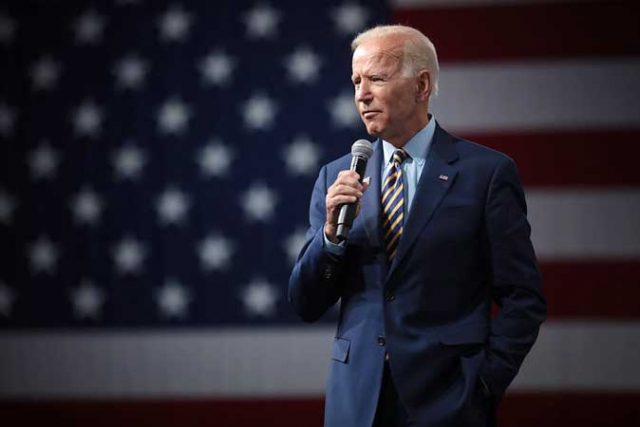
US President Joseph R. Biden, Jr. — Image via Gage Skidmore/CC BY-SA 2.0/Flickr

US President Joseph R. Biden, Jr., will rely on ally countries to supply the bulk of the metals needed to build electric vehicles and focus on processing them domestically into battery parts, part of a strategy designed to placate environmentalists, two administration officials with direct knowledge told Reuters. 

The plans will be a blow to US miners who had hoped Mr. Biden would rely primarily on domestically sourced metals, as his campaign had signaled last autumn, to help fulfill his ambitions for a less carbon-intensive economy. 

Rather than focus on permitting more US mines, Mr. Biden’s team is more focused on creating jobs that process minerals domestically into electric vehicle (EV) battery parts, according to the people. 

Such a plan would help cut US reliance on industry leader China for EV materials while also enticing unions with manufacturing work and, in theory, reduce pandemic-fueled unemployment. 

The US Commerce Department is organizing a June conference to attract more EV manufacturing to the country. Mr. Biden’s proposed $1.7 trillion infrastructure plan earmarks $174 billion to boost the domestic EV market with tax credits and grants for battery manufacturers, among other incentives. The department declined to comment. 

“It’s not that hard to dig a hole,” said one of the sources. “What’s hard is getting that stuff out and getting it to processing facilities. That’s what the US government is focused on.” 

Under the approach, the United States would rely on Canada, Australia and Brazil  among others  to produce most of the critical raw materials needed, while it competes for higher-value jobs turning those minerals into computer chips and batteries, according to the two sources. 

Securing the full supply chain from metals to batteries does not require the United States to be the primary producer of the raw materials, said one of the sources. 

A full strategy will be finalized after a year-long supply chain review involving national security and economic development officials. 

Biden officials want to ensure the administration’s EV aspirations are not imperiled as domestic mines face road blocks, the sources said, both from environmentalists and even some Democrats. 

“It rings hollow when I hear everyone use this as a national defense argument, that we have to build new mines to have a greener economy,” said US Representative Betty McCollum, a Democrat who has introduced legislation that would permanently block Antofagasta Plc’s proposed Twin Metals copper mine in Minnesota. 

“President Biden is focused on seizing the electric vehicle (EV) market, sourcing and manufacturing the supply chain here in America, and creating good-paying, union jobs,” said Ali Zaidi, the deputy White House national climate adviser. 

“Building American-made EVs and shipping them around the world will include leveraging American-made parts and resources. This includes responsibly pursuing, developing, and mining critical minerals and materials used for EV batteries.” 

Mr. Zaidi also said that the administration is invested in a strategy that includes recycling in the supply chain. 

While US projects from small and large miners alike will feel the impact, the pain from any blocked projects will fall disproportionately on smaller, US-focused companies. Many large miners also have global projects that could benefit from the administration’s plan. 

“We can no longer push the production of the products we want to places we cannot see and to people we will never meet,” said Mckinsey Lyon of Perpetua Resources Corp., which is trying to develop Idaho’s Stibnite mine to produce gold and antimony used to make EV battery alloys. 

INVESTMENTS
The US government in April became the largest shareholder in mining investment firm TechMet, which controls a Brazilian nickel project, a Rwandan tungsten mine and is a major investor in a Canadian battery recycler. 

Washington also funds research into Canadian cobalt projects and rare earths projects in Malawi, among other international investments. 

The State Department’s Energy Resource Governance Initiative (ERGI) is one of the main programs Washington plans to use to help allies discover and develop lithium, cobalt and other EV metals. 

To be sure, Washington is not ignoring domestic mining. 

The US Department of Energy has awarded grants to help old coal mines find ways to produce rare earths. US officials have also funded MP Materials Corp, which owns the country’s only rare earths mine, though it relies on Chinese processors. 

But the bulk of Mr. Biden’s approach is designed to sidestep battles with environmentalists and save capital for other fights, according to one administration source. 

During a visit to a Ford Motor Co. plant in Michigan on May 18, Mr. Biden called for government grants for new EV battery facilities. He mentioned Australia’s lithium reserves during the tour, but not large US supplies of the key battery mineral. 

Republicans say Biden’s EV plans will be impossible to achieve without more US mines. 

“These ‘not-in-my-backyard’extremists have made clear they want to lock up our land and prevent the mining of minerals,” US Representative Lauren Boebert, a Colorado Republican, told a House Natural Resources Committee forum held the same day as Mr. Biden’s Michigan visit. 

PLACATING LABOR
Mr. Biden’s approach comes with risks, including angering political supporters within the labor movement who want the administration to have an openness to resource extraction and the attendant jobs. 

“Let’s let Americans extract these minerals from the earth,” said Aaron Butler of United Association Local 469 union, which does work for Rio Tinto Ltd.’s proposed Resolution copper mine project in Arizona and endorsed Biden in the elections. “These are good-paying jobs.” 

Many of the skills that labor unions would use to build mines, including concrete and electrical work, can also be used to build EV metal processing plants. 

The National Mining Association, an industry trade group, has been lobbying the White House and Congress to support domestic projects, arguing that the coronavirus pandemic showed the importance of localizing supply chains. 

Mr. Biden’s White House is now quietly working to enlist labor support as it tries to build a case that its green policies are creating jobs, ahead of the 2022 midterm elections that could determine whether the strategy wins congressional backing, according to two organized labor sources familiar with the campaign 

Biden officials have reached out to unions across the country asking for specific job-boosting projects the administration can take credit for, the labor sources said.  Ernest Scheyder and Trevor Hunnicutt/Reuters 

DDB Group’s Agile Intelligence COVID-19 Dashboard marks first year of tracking pandemic

It has been a year since DDB Group Philippines’ data analytics unit Agile Intelligence, Inc. (Agile) launched a comprehensive COVID-19 tracker as a response to the growing need to understand the numbers behind the growing cases of novel coronavirus in the country.

Dubbed the Agile Intelligence COVID-19 Dashboard, the project sought to address the country’s lack of central dashboard with harmonized data and data visualization per region and city for COVID-19 stats such as areas with the longest “no cases reported,” doubling time, recoveries, new cases, healthcare facilities’ capacity, and bed occupancies. The tracker thus processed and presented these stats in congruent data sets that are more digestible for experts and the public at large. Primary data sources include the Department of Health and the local government units.

DDB Group Philippines’ resident data analytics guru and Agile Intelligence Managing Director Chewy Chua oversees the COVID-19 dashboard for better data visualization, analysis and interpretation. From another DDB Group PH Unit, Tribal Worldwide Philippines Head of Digital Services Ian Ong provides the logic, coding and graphs for the website. Both Chua and Ong are founders and, at the same time, “volunteers” of the project, devoting an hour or so of their hectic daily schedule to work on the tracker.

“We are passionate about data and digital platforms and more so if we are harnessing both to come up with a helpful project like the COVID-19 Dashboard. We would like to thank everyone for your support and feedback,” said Chua.

To date, the dashboard has about 100,000 unique local and foreign visitors, who appreciate its impressively organized data sets and charts on the country’s COVID-19 history and performance. It also received an award under the Communication for the Web category at the 18th Philippine Quill Awards.

Agile Intelligence’s COVID-19 dashboard’s companion viber group has about 300 members consisting of industry leaders from different sectors, and just about anyone who wants to get a more detailed daily situationer and insights on the pandemic. There is also a COVID-19 update thread in DDB Group Philippines’ Viber group where 200 plus employees conveniently get a daily snapshot of the pandemic.

The COVID-19 Dashboard is one of the corporate social responsibility projects of DDB Group Philippines during this pandemic. Check it out at https://covid19.agileintelligence.ph/.

Sweeping bill to counter China introduced in US House 

REUTERS

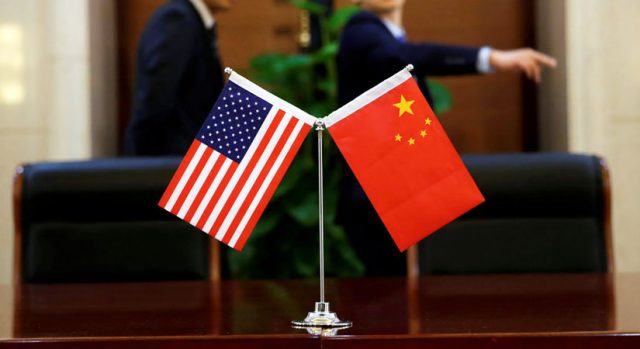
WASHINGTON  US efforts to address competition with China progressed on Tuesday when the chairman of the House of Representatives Foreign Affairs Committee introduced sweeping legislation to boost economic competitiveness and push Beijing on human rights. 

Representative Gregory Meeks introduced the “Ensuring American Global Leadership and Engagement Act,” or EAGLE Act, as the US Senate separately heads toward a vote on its own legislative package seeking to counter China. 

The desire for a hard line in dealings with China is one of the few truly bipartisan sentiments in the deeply divided US Congress, which is narrowly controlled by President Joseph R. Biden, Jr.’s fellow Democrats. 

The Biden administration supports efforts to counter China, with officials repeatedly listing competition with Beijing among their greatest strategic challenges. 

The 470-page bill introduced by Mr. Meeks addresses a range of issues, including increased investment to promote US manufacturing, trade, work with allies and partners, re-engagement in international organizations, and recognition of the treatment of China’s Uyghur Muslim minority as genocide. 

“The United States must coordinate closely with allies and partners to compete effectively with (China), including to encourage allies and partners to assume, as appropriate, greater roles in balancing and checking aggressive (Chinese) behavior,” the legislation said. 

A committee aide said Mr. Meeks intends to work with committee Republicans on the legislation, in the hope of committee passage as soon as next month. The measure would then be combined with legislation being considered by other House committees, and eventually combined with the Senate bill. 

The House bill includes provisions to increase US support for Taiwan and pro-democracy activists in Hong Kong. And it mandates a review to assess Chinese companies listing on US financial markets, including whether they have contributed to human rights violations. 

The measure also calls for cooperation with China in areas of common interest, especially climate change.  Patricia Zengerle and Michael Martina/Reuters 

UK’s COVID ‘disaster’ to be laid bare by PM Johnson’s ex-chief adviser

British Prime Minister Boris Johnson via Chatham House/Flickr

LONDON  British Prime Minister Boris Johnson’s former chief adviser will on Wednesday cast his former boss as a dithering leader surrounded by fools whose ineptitude led to a “disastrous” response to the most devastating global pandemic in decades. 

With almost 128,000 deaths, the United Kingdom has the world’s fifth worst official coronavirus disease 2019 (COVID-19) toll, and Mr. Johnson was slow to appreciate the significance of the threat from the virus in early 2020 as it spread from China towards Britain’s shores. 

Dominic Cummings, the strategist behind the 2016 Brexit campaign and Mr. Johnson’s landslide election win in 2019, will be quizzed by British lawmakers from 0830 GMT on the lessons that can be learned from the pandemic. 

Mr. Cummings, who left the government late last year, has said the British health ministry was a “smoking ruin,” that Western governments failed during the crisis, and that the secretive British state was woefully unprepared for the pandemic. 

“The COVID plan was supposed to be ‘world class’ but turned out to be part disaster, part non-existent,” Mr. Cummings said on May 18 in one of dozens of tweets forming a critique of Britain’s response. 

“If we’d had the right preparations + competent people in charge, we would probably have avoided lockdown1, *definitely* no need for lockdowns 2&3,” he said. 

Mr. Cummings, played by Benedict Cumberbatch in the film Brexit: The Uncivil War, casts the British state as an outdated system run by incompetent amateurs who are resistant to any innovation that would bring them closer to the modern world. 

British officials, he said, failed to learn the early COVID lessons from Asia, were resistant to new ideas from young scientists, overly secretive, overly bureaucratic and lacked any real scrutiny from a compliant domestic media. 

Asked about Mr. Cummings’ criticism, Mr. Johnson’s spokesman said: “At all times we have been guided by the data and the latest evidence we had.” 

In a series of investigations, Reuters has reported how the British government made several errors: it was slow to spot the infections arriving, it was late with a lockdown and it continued to discharge infected hospital patients into care homes. 

The government’s chief scientific adviser, Patrick Vallance, said in March 2020 that 20,000 deaths would be a good outcome. Soon after, a worst-case scenario prepared by government scientific advisers put the possible death toll at 50,000. The toll is now close to 128,000. 

Mr. Johnson has admitted that mistakes were made and that lessons need to be learned, but his ministers say they were working at pace in the biggest public health crisis in a century. 

Mr. Johnson has pointed to Britain’s vaccination program as a success that will allow the economy to rebound before its peers. 

Britain has the world’s fifth fastest vaccination program, based on shots per 100 people, behind the United Arab Emirates, Israel, Bahrain, and Chile.  Guy Faulconbridge/Reuters

Future-proof your business with Globe myBusiness: Reinvented and reimagined so you’re ready for anything

Even with the world slowly recovering from the COVID-19 pandemic, it is clear that the extended period of lockdown has caused a profound impact on consumer behavior. This palpable shift in consumer behavior has an implication on industries in consumer packaged goods, retail, and more. With customers preferring to go digital, businesses must be prepared and quick to adapt as well. At a time when your business must be ready for anything, Globe myBusiness helps make sure that your business delivers.

Globe myBusiness solutions allow businesses to reach more customers through different relevant channels and at the same time help the business achieve operational efficiency and streamline back-end operations to become more agile and deliver more value to its customers. In line with this, Globe myBusiness offers exclusive bundles to new and existing customers on any mobile or broadband plan. Products included in the bundle are digital solutions such as Amber — an SMS-based broadcast, GCash for Business, KonsultaMD, Rush Royalty, Google Workspace, Cloud Payroll and HR Information System (HRIS), and Vehicle Tracker.

So how exactly do these basic to complex digital solutions from Globe help businesses adapt to the digital age?

  • By digitizing traditional business processes for improved efficiency. One such solution is Google Workspace. It minimizes the need for physical documents and helps improve productivity, communication, and collaboration between employees through the in-meeting application Google Meet.
  • By streamlining internal processes with the help of GCash and Amber. GCash is used for contactless disbursement of allowances and salary to employees, whereas Amber is used for reminders and announcements to the workforce, and is also utilized by retail business owners as a means of reaching out to customers for updates and promotions.
  • By hastening business processes and providing up-to-date monitoring. For businesses handling deliveries or those in the logistics industry, Globe’s vehicle tracker is quite useful. With customers constantly following up on deliveries and the status of their orders, the vehicle tracker can provide continuous monitoring of the fleet and deliveries of the business.

Other than solutions, Globe myBusiness also offers Rush Royalty which is Globe’s loyalty platform where customers can earn and avail points, rewards, and stamps from merchants. The Globe bundle also offers KonsultaMD, which is a 24/7 health hotline service that ensures your business’ staff get access to medical assessment and information by licensed and skilled Filipino doctors over the phone.

Customers who are applying for new lines or those with an existing mobile or internet plan who avail any of the digital solutions (Amber, GCash for Business, KonsultaMD, Rush Royalty, Google Workspace, Cloud Payroll and HRIS, and Vehicle Tracker), are eligible for a cashback promo via GCash.

In Globe myBusiness, we believe that consumer behavior will continue to evolve. As such, businesses that are already adopting digital strategies are sure to be ready for anything. With the help of Globe myBusiness, your business can adapt and shift gears to stay competitive in a fast-paced, digital age.

Ready your business for anything

Reinvent your business with Digital Solutions that will make it better and stronger from Globe myBusiness. Learn more here https://glbe.co/mybizreadyforanything.

Airlines re-route to avoid Belarus, opposition says journalist beaten

Screenshot via Wikimedia Commons/YouTube

KYIV/VILNIUS  Airlines re-routed flights to avoid Belaruss airspace on Tuesday and Belarusian planes faced a possible ban from Europe, as international outrage mounted over Minsk forcing down a jetliner and arresting a dissident journalist on board. 

Western nations accused Belarus of hijacking and piracy over the interception of the Ryanair plane as it crossed the country on a flight from Greece to Lithuania, and diplomats said France, Ireland, and Estonia would raise the incident at a private meeting of the United Nations Security Council on Wednesday. 

The behavior of the Belarus regime is outrageous, illegal, and completely unacceptable … we also condemn this kind of dangerous interference in civil aviation, Canadian Prime Minister Justin Trudeau told reporters. 

A video released overnight showed 26-year-old Roman Protasevich  who was pulled from the passenger plane after Belarus scrambled a warplane to escort it to Minsk on Sunday  confessing to having organized anti-government demonstrations. 

German Chancellor Angela Merkel said the video was concerning. German Foreign Minister Heiko Maas said Belarusian President Alexander Lukashenko must pay a bitter price for detaining Mr. Protasevich. 

Exiled Belarusian opposition leader Sviatlana Tsikhanouskaya said the footage showed Mr. Protasevich had been tortured. 

He said that he was treated lawfully, but he’s clearly beaten and under pressure. There is no doubt that he was tortured. He was taken hostage, she told a news conference in the Lithuanian capital Vilnius. 

Belarus did not immediately comment on the torture allegation but has consistently denied abusing detainees. 

Rights groups have documented hundreds of cases of what they describe as abuse and forced confessions during a crackdown on pro-democracy opponents of Mr. Lukashenko since last year. 

Mr. Lukashenko, whose opponents accuse him of rigging an August 2020 election, has so far shrugged off Western sanctions, which mostly consist of barring various officials from travelling or doing business in the United States and EU. 

The Belarusian leader enjoys financial and security support from Russia. 

The White House said President Joseph R. Biden, Jr., would discuss the incident with Russian President Vladimir Putin at their summit next month, but added the United States did not believe Moscow had played any role in it. 

VIDEOTAPED CONFESSION 

Belarusian state media have reported that Mr. Lukashenko personally ordered the flight to be intercepted. Belarus says it was responding to a bomb scare that later proved to be a false alarm. 

Belarusian authorities on Tuesday released a transcript of a conversation between the plane and an air traffic controller in which the pilot repeatedly questioned information about the threat before agreeing to land at Minsk. 

The transcript, which Reuters could not independently verify, differs from excerpts previously released by Belarus state TV, which had suggested the pilot had asked to land in Minsk, rather than that the controller had advised him to do so. 

Mr. Protasevich and his girlfriend Sofia Sapega, 23, were arrested when the plane landed. Three other people also disembarked the flight in Minsk, suspected by Western countries of being spies involved in the operation. 

In the video released overnight, Mr. Protasevich can be seen seated at a desk in a dark hooded sweatshirt. 

I can state that I dont have any health issues, including diseases of the heart or any other organs. Police officers are treating me properly and according to the law, he says, adding that he had confessed to organizing mass protests in Minsk. 

Ms. Sapegas mother Anna Dudich told Reuters that her daughter, a student and a Russian citizen who is originally from Belarus, had steered clear of politics, but that she feared for her health and safety in detention. 

My hopes are now probably based on a miracle and on the knowledge that my daughter is definitely not guilty of anything, Ms. Dudich said. She simply showed up in the wrong place at the wrong time. 

Russias foreign ministry said Ms. Sapega may also face criminal charges. 

EUROPE IN ACTION 

In response to Minsks actions, the European air traffic control agency, Eurocontrol, recommended that EU and British carriers that fly over Belarus should re-route via the Baltic states. 

Britain also said it was banning Belarusian airlines from entering its airspace. 

European Union leaders at a summit on Monday had called for airlines based in the 27-member bloc to halt flights over Belarusian airspace, which is along a major corridor connecting Europe and Asia and earns hard currency from overflight rights. 

Lufthansa, KLM, SAS, Air France, LOT and Singapore Airlines were among carriers that announced they would stop flying over Belarus. 

Belgiums Charles Michel, who chairs EU summits, tweeted Europe in action, with a picture of a flight tracker map of the continent showing no planes flying over Belarus. 

EU leaders also directed officials to draw up unspecified new sanctions against Belarus, and to work out a way to ban Belarusian airlines from the bloc’s skies. 

Belarusneighbor, Ukraine, announced a ban on flights to or from Belarus, and on its own airlines using Belarusian airspace. 

If we let this go, tomorrow Alexander Lukashenko will go further and do something even more arrogant, more cruel, Ukrainian Foreign Minister Dmytro Kuleba said in a statement.  Matthias Williams and Andrius Sytas/Reuters 

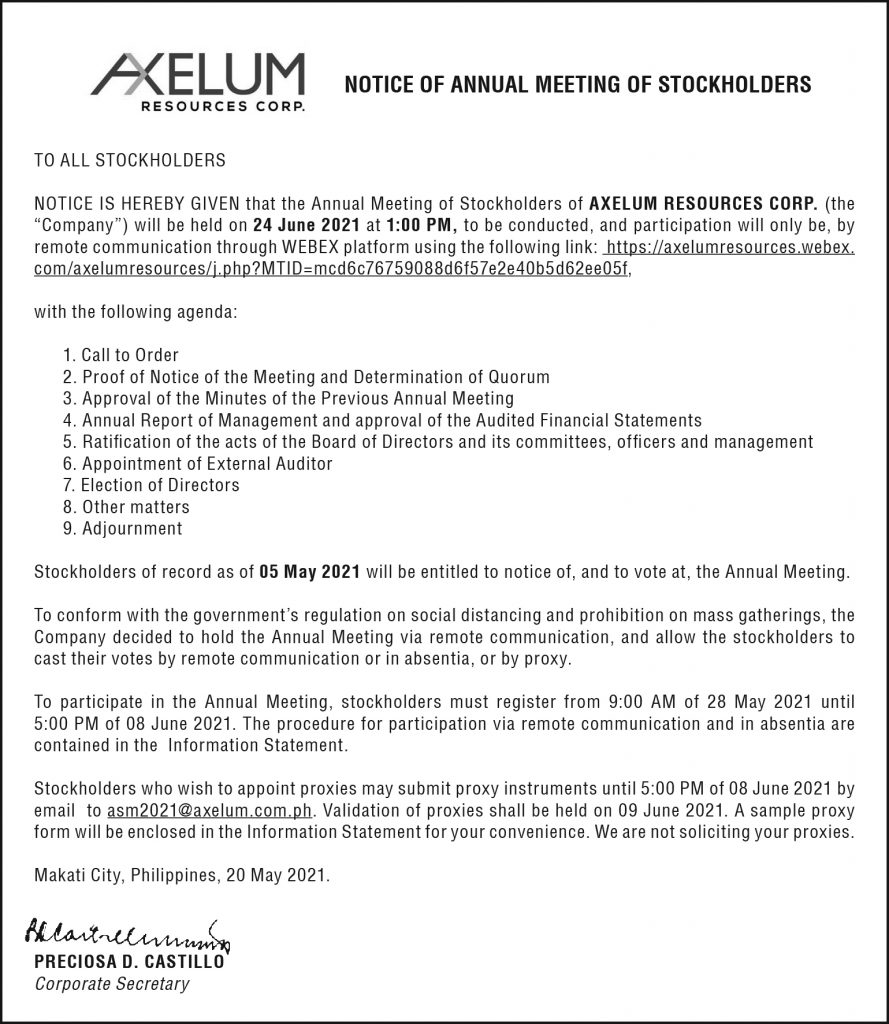
Axelum Resources Corporation sets schedule of annual stockholders’ meeting via remote communication

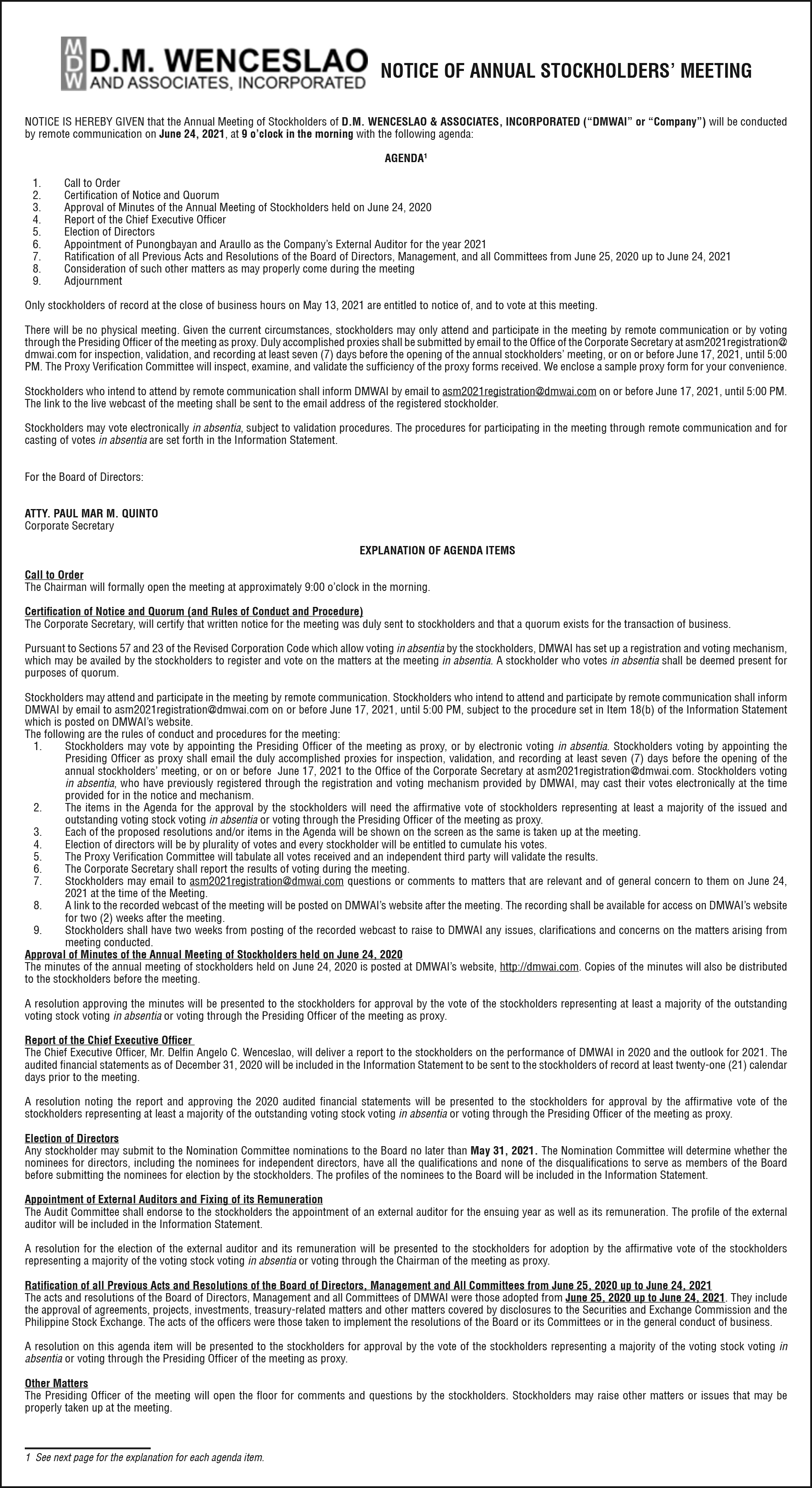
D.M. Wenceslao sets annual stockholders’ meeting via remote communication

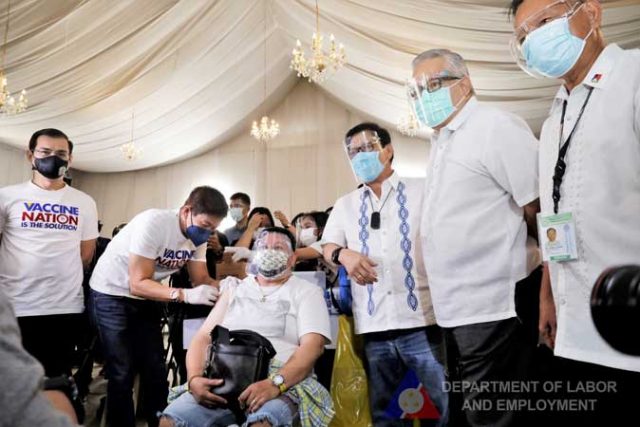
Gov’t asks towns, cities to pass local law punishing vaccine slot sellers

DOLE

THE PRESIDENTIAL Palace on Tuesday asked local governments to pass an ordinance that would penalize people selling coronavirus vaccination slots, a day after the Manila city government took such initiative.

“Our appeal to the local governments is to pass a similar ordinance that will impose penalties on those selling slots, so it will be clear that we have legal basis to punish those committing such act,” Presidential Spokesman Herminio L. Roque, Jr. said in Filipino during a televised news briefing.

The police are already looking into the reported sale of vaccination slots in the cities of San Juan and Mandaluyong, which was flagged by netizens last week by citing alleged transactions through social media posts.    

Police chief Guillermo T. Eleazar said on Tuesday that they are investigating the matter as an online scam and possibly with political motivation.

“We cannot also discount the possibility that this is politically motivated, probably employed to discredit the reputation of the LGU (local government unit) involved,” Mr. Eleazar said in a statement.

The police earlier said they already have the name of the person who could be involved in the scam but declined to divulge details.

Philippine National Police Spokesperson Ronaldo E. Olay said the suspect claimed to have connections within the LGUs.

The National Bureau of Investigation has also been directed to conduct a separate probe, according to Justice Secretary Menardo I. Guevarra. — Kyle Aristophere T. Atienza, Bianca Angelica D. Añago, and Emmanuel Tupas/PHILSTAR

Deficit narrows as spending drops

PHILIPPINE STAR/ MICHAEL VARCAS
PEOPLE line up for financial aid amid the lockdown in Metro Manila. — PHILIPPINE STAR/ MICHAEL VARCAS

By Beatrice M. Laforga, Reporter

THE NATIONAL Government’s budget deficit shrank to P44.4 billion in April, following the sharp drop in spending and a base effect-induced spike in revenues.

Preliminary data from the Bureau of the Treasury (BTr) showed April’s fiscal gap was more than six times lower than the P273.9-billion deficit recorded in the same month in 2020, and a 76.8% decline from the P191-billion deficit in March.

This marked the smallest budget deficit in three months or since the P14-billion gap in January.

The Treasury attributed the narrower deficit to base effects, with revenues surging from last year’s extremely low base while elevated spending from last year’s pandemic response dwarfing the April’s expenditures.

Government spending dropped by 27.1% to P336.3 billion last month from P461.7 billion a year ago.

Of which, primary expenditures, which is total spending less interest payments, plummeted by 28.9% to P312.5 billion in April from P439.8 billion a year ago.

The BTr attributed the decline to high base effect last year when the government rolled out a P275-billion relief package that included cash handouts and wage subsidy programs amid the strict lockdown.

Interest payments inched up by 8.86% year on year to P23.8 billion because of higher coupon payments for reissued Treasury bonds.

Meanwhile, overall revenues surged by 55.46% to P291.9 billion in April from P187.8 billion the year before, when the Bureau of Internal Revenue (BIR) deferred the filing of annual income tax returns (ITR).

This year, the BIR did not extend the deadline for 2020 ITR filing.

Tax revenues, which accounted for 91% of the total, more than doubled to P272 billion from a year ago’s P125 billion. This was driven by the 142% year-on-year spike in BIR collections to P219 billion and 50% rise in Customs revenues to P51.8 billion. Other tax-collecting agencies generated P1.2 billion, compared with zero collections a year ago.

Revenues from non-tax sources slid 68.4% to P19.9 billion, largely due to the 85% decline in BTr’s revenues to P9 billion. State-owned firms were asked to declare their dividends early last year as the government scrambled to source funds at the height of the pandemic.

This was offset by the 140% surge in income from other non-tax sources such as fees and proceeds from privatization activities to P10.8 billion.

From January to April, the budget deficit was flat at P365.9 billion from P360 billion a year ago amid muted growth in expenditures and revenues.

Total expenditures inched up by 3.3% to P1.35 trillion in the four-month period. Primary spending hit P1.2 trillion, up 3% year on year, while interest payments grew 6% to P150 billion.

Meanwhile, overall revenues went up by 3.95% to P988.4 billion, as the 20% surge in tax revenues offset the 56% decline in non-tax income.

Tax collections grew to P898.1 billion, with the BIR experiencing 23% growth in revenues to P688.7 billion, while Customs reported 11.8% increase to P201 billion.

Other tax-collecting offices generated P8.4 billion in those four months, up 29% year on year.

Income from non-tax sources fell 56% to P90.3 billion. BTr’s income dropped 71.46% to P48.4 billion while other offices booked 17% growth to P41.9 billion.

“Higher revenues may be one-off because April is usually personal income tax time. [The same is true for] expenditures because of the fiscal stimulus implementation in the same period last year,” Ruben Carlo O. Asuncion, chief economist at UnionBank of the Philippines, Inc., said via Viber.

Meanwhile, the narrower budget deficit bodes well for the country’s outstanding debt since this will limit new government borrowings moving forward, ING Bank N.V. Manila Senior Economist Nicholas Antonio T. Mapa said in an e-mail.

“However, the reluctance to bolster economic growth momentum via increased spending may cap growth prospects of the economy, which could potentially impact the debt-to-GDP ratios negatively,” Mr. Mapa said in an e-mail.

The government is looking to raise P3 trillion this year from domestic and external lenders to help fund its budget deficit seen to hit 9.4% of gross domestic product.

National Government Fiscal Performance

COVID booster shots, LGU assistance are 2022 budget priorities

PHILIPPINE STAR/ MICHAEL VARCAS
THE GOVERNMENT will continue to prioritize the mass vaccination program in next year’s national budget. — PHILIPPINE STAR/ MICHAEL VARCAS

THE DEPARTMENT of Budget and Management (DBM) identified six priority areas for next year’s P5.024-trillion national budget, such as the continuing coronavirus vaccine rollout and increased support for local governments, citing the need for belt-tightening measures amid “very limited fiscal space.”

At the same time, the DBM ordered government agencies to identify savings from their unspent 2020 budgets to augment pandemic relief measures.

Budget Secretary Wendel E. Avisado on Monday issued National Budget Memorandum No. 140, which laid out key programs that will receive priority funding in the 2022 budget, namely coronavirus disease 2019 (COVID-19) vaccines and booster shots, assistance for “disadvantaged” local government units (LGUs), establishment of a virology center, national identification system, and programs for family planning and nutrition.

“[The memorandum provides] information on the very limited FY 2022 fiscal space available for Tier 2 given the adverse effect of the coronavirus disease on economic activity and the revenue collections of the government since last year,” the DBM said.

“As a result, the selection of programs/projects to be prioritized for funding under the said fiscal space under Tier 2 has to be strategic and will yield the maximum results desired,” it added.

Agencies have to submit their proposals for new or increased spending under the Tier 2 budget, while those under Tier 1 refer to ongoing spending requirements.

The DBM said even those under Tier 1 can still be changed and adjusted given the limited fiscal space.

In a separate Viber message, Mr. Avisado had said that the agency will submit the proposed P5.024-trillion 2022 general appropriations measure to Congress “within the period prescribed in the Constitution.”

The Constitution mandates the Executive branch to submit budget proposals to Congress 30 days before the State of the Nation Address (SONA). President Rodrigo R. Duterte is scheduled to give his final SONA on July 26.

In the circular, the DBM said the government’s continuing vaccination program, particularly the COVID-19 booster shots, will be prioritized for Tier 2 funding.

“According to the Vaccine Expert Panel, there is a need for booster shots to strengthen the immunity of those who already received the COVID-19 vaccine to prevent the adverse symptoms of the disease. This will provide added protection against the other variants of the virus to keep the public safe,” the Budget department said.

The government will have to allocate P75 billion for the booster shots, in addition to the P72.5-billion budget to vaccinate at least 60 million Filipino adults this year, according to Finance Secretary Carlos G. Dominguez III.

Another key program to be prioritized under the 2022 budget is the National Government’s assistance to LGUs, since several projects will be devolved to them in response to the Supreme Court’s ruling on the Mandanas-Garcia Case, which increased their share from the National Government’s revenues or the Internal Revenue Allotment (IRA).

The government is proposing a Growth Equity Fund (GEF) which will be used to support LGUs with the highest poverty rate and which are struggling financially.

Once the fund is in place, the DBM said proposals for new and expanded local projects by National Government agencies that will be devolved next year will no longer be funded under the Tier 2 budget.

“The GEF aims to cover the funding and capacity development requirements of basic infrastructure and other programs, projects and activities of poor, disadvantaged and lagging LGUs to gradually enable them to implement the functions and services devolved to LGUs by pertinent laws more effectively and efficiently,” it said.

The DBM will also prioritize capacity development programs for LGUs.

The government is also giving top priority for the establishment of the Virology Science and Technology Institute of the Philippines, which aims to become the country’s “premier research institute on virology of humans, animals and plants.”

Programs for family planning and nutrition are also included in the priority list to address high population in cities and the persistent malnutrition problems faced by children.

The DBM said faster rollout of the Philippine Identification System (PhilSys) or the national ID system will also be prioritized next year.

“Interoperability across government agencies shall also be pursued by revisiting existing systems and databases to ensure that the PhilSys numbers will be utilized in generating and processing data information,” it added.

Other new and expanded programs to be considered for funding will be limited to those in the updated Philippine Development Plan (PDP), and the three-year Rolling Infrastructure Program of the National Economic and Development Authority (NEDA).

SAVINGS
Meanwhile, Mr. Avisado issued National Budget Circular No. 586 dated May 21 directing all government departments and agencies to identify savings from their unspent 2020 budgets as of May 15. These unobligated funds exclude those for the implementation of pandemic response programs.

“Within the Executive Branch, the President is authorized to declare and use savings to augment any deficient item related to measures intended to alleviate the effects of the COVID-19 pandemic, including provision for emergency subsidies to low-income households and disadvantaged or displaced workers affected by the pandemic,” he said.

The DBM requires agencies to submit their records by May 31. Mr. Duterte will then identify the savings that can be pooled and used to add to the government’s war chest against COVID-19.

Currently, the economic team estimated that P170 billion can be spent to fund a third stimulus package without ballooning this year’s budget deficit past the ceiling equivalent to 9.4% of gross domestic product (GDP).

The economic team expects GDP to grow by 7-9% next year, much slower than the previous estimate of an 8-10% expansion. — Beatrice M. Laforga

ADVERTISEMENT
ADVERTISEMENT