Home Blog Page 7983

More deforestation, less rain threaten Brazil agribusiness
REUTERS

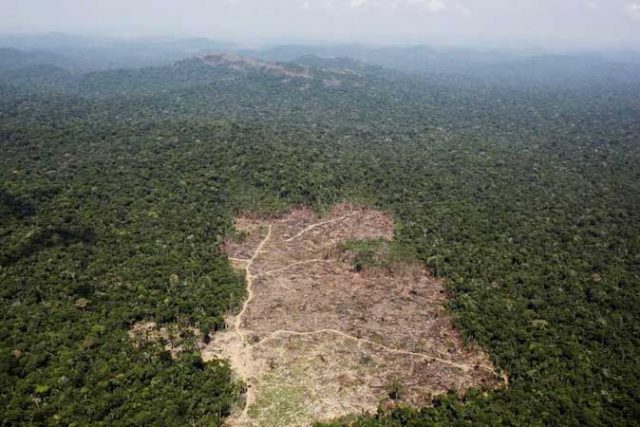
BRASILIA — Brazilian agribusiness is losing up to $1 billion a year as rising deforestation cuts rainfall in the southern Amazon — a problem set to expand if forest loss continues, a group of Brazilian and German researchers have warned.

In a study published in the journal Nature Communications in May, they found that smaller-scale forest losses can enhance rainfall on adjoining agricultural land — but once losses pass 55-60%, rainfall plunges.

Losses of tree cover in particular seem to delay the start and shorten the length of the rainy season, they found.

As Brazilian Amazon forest destruction continues, drier conditions could put a massive strain on the region’s mainly rainfed agricultural industry, the authors said.

Brazil is the world’s top soybean producer, and its second largest producer of beef, as well as the globe’s biggest beef exporter.

In parts of the country, Brazil’s farmers are already battling unusually dry weather this year, with government agencies warning in late May of drought threats as the country faces its worst dry spell in 91 years.

In the southern Amazonian state of Mato Grosso, Brazil’s main soy producer, irregular rainfall is reducing potential harvests, according to the Mato Grosso Institute of Agricultural Economics.

Aprosoja Brasil, the country’s main soy production association, similarly said farmers faced drought while planting last October and November, followed by excessively heavy rain at harvest time this year, lowering the expected harvest.

The new study looked at rainfall changes between 1999 and 2019 in the southern Brazilian Amazon, a 1.9 million sq. km. area that has so far lost about a third of its forests, as a model for future rainfall shifts.

Researchers predicted what might happen through 2050 under continued weakening of Brazil’s conservation policies and strong political support for agricultural expansion compared to effective enforcement of forest protection laws.

Co-author Britaldo Soares told the Thomson Reuters Foundation that the difference was stark.

Unless Brazil’s government quickly shifts its pro-development policies, which favor economic growth over conservation, agribusinesses could become victims of the measures many of them support.

The effect would be like “shooting yourself in the foot,” said Soares, who is project coordinator for the Centre for Remote Sensing at the Federal University of Minas Gerais (UFMG).

Environmentalists say President Jair Bolsonaro’s policies have weakened conservation efforts and his rhetoric has emboldened illegal ranchers, loggers and land speculators to cut down the Amazon forest to expand their business.

Bolsonaro’s office did not respond to a request for comment.

MORE FOREST LOSS
Amazon forest losses have soared to a 12-year high since Bolsonaro took office in 2019, with deforestation rising 43% in April compared to the same month a year ago, according to government data published in May.

Removing trees to plant crops and raise cattle reduces the forest’s ability to trap and store planet-heating carbon dioxide in the atmosphere, and can contribute to emissions if forests are burned.

But more fragmented forest, as losses grow, also is less able to produce the same volume of water vapor that rises to become rain, and can make the forest drier and more vulnerable to burning.

Less rainfall can mean lower yields and force farmers in the southern Amazon and beyond to adapt by moving to new areas or growing more drought-resistant crops, the study noted.

It did not discuss prospects for irrigating crops in the region.

Farmers in the Amazon also commonly profit from double-cropping, or growing at least two crops per year.

But that could become more difficult or impossible if continuing tree losses cause rainy seasons to become delayed and shorter, the study noted.

Researchers said that if Brazil’s government fails to act against deforestation, international responses — including potential sanctions and exclusion of Brazil from international treaties — could also result in lost revenue for Brazil’s farm-related businesses.

Stopping forest loss in the Amazon is vital not only to protect biodiversity and the global climate but to protect agribusiness itself, they said.

NEW MODEL?
As part of their study, the researchers used mathematical modeling to predict the economic losses that southern Amazonian agribusiness is expected to suffer if current policies continue and rainfall in the Amazon keeps dropping.

By 2050, the beef industry could lose more than $180 billion and the soy industry up to $5.6 billion in total due to the effects of decreased rainfall, the study found.

Soares said for long-term economic prosperity the Amazon region needed to find a more sustainable economic model not reliant on land-hungry commodities such as soy and beef whose expansion were leading to major forest loss.

A study he and other researchers carried out in 2018 found landowners could potentially earn more than $700 per hectare each year in international payments to keep climate-stabilizing forests standing as well as by created processed products from forest species such as Brazil nuts.

Cattle ranching on deforested land, by comparison, earns a landowner about $40 per hectare each year, it noted.

Brazil also needs better enforcement of its forest protection laws to preserve conservation zones and indigenous territories, he said.

As well, other nations need to put more pressure on the current Brazilian government to boost forest conservation, said Paulo Barreto, a researcher who has studied the Amazon for three decades and works at the nonprofit research institute Imazon.

That should include “immediate and concrete measures” such as refusing to purchase beef, soy or other products from deforested land, he said.

Argemiro Teixeira, one of the study’s co-authors and an environmental systems modeler, said profitable agriculture and forest protection in the Amazon did not have to be at odds.

Agribusiness can be profitable without continued expansion at the expense of the forest, he noted, calling it “possible and necessary to improve the industry while preserving the environment.” — Thomson Reuters Foundation

Food, Beverages, and Transport Chip in the Most to Inflation (Recreational Activities Still Negative)

Food, Beverages, and Transport Chip in the most to Inflation (Recreational Activities Still Negative)

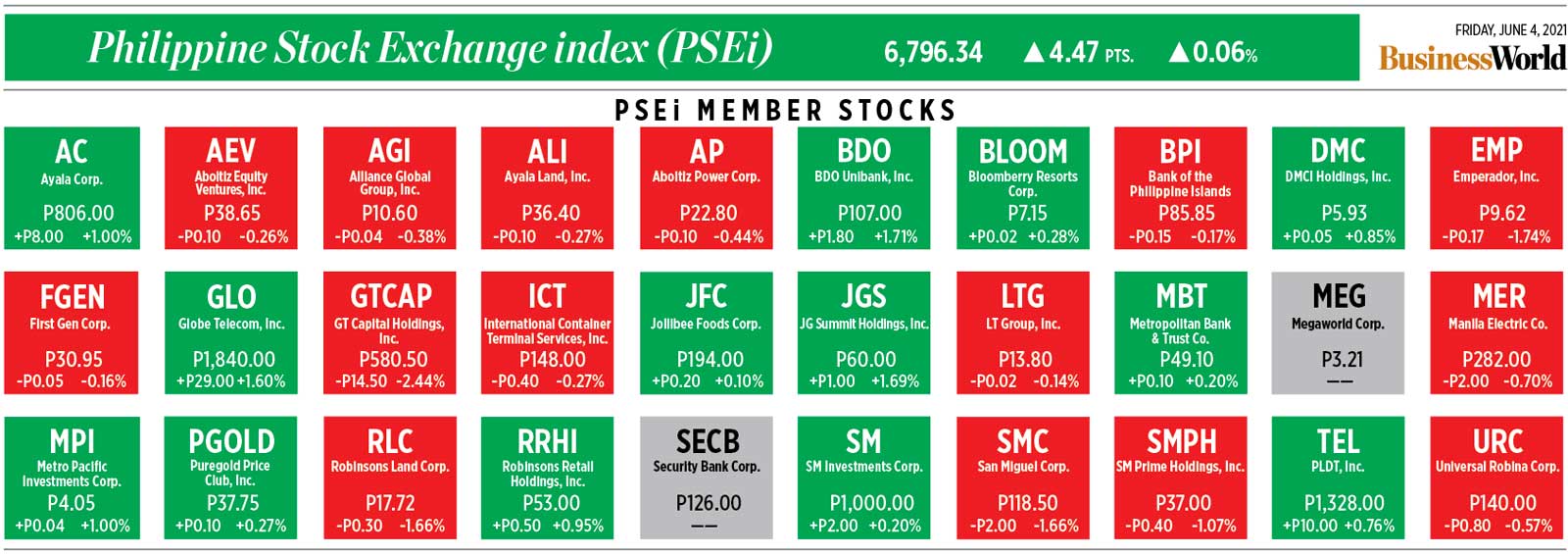
How PSEi member stocks performed — June 4, 2021

Here’s a quick glance at how PSEi stocks fared on Friday, June 4, 2021.


Peso may rise further as government continues COVID-19 vaccine rollout

BW FILE PHOTO

THE PESO could rise further versus the dollar this week as the government continues its coronavirus disease 2019 (COVID-19) vaccine rollout and as cases in Metro Manila showed a declining trend.

The local unit closed at P47.75 per dollar on Friday, gaining 7.5 centavos from its P47.825 finish on Thursday, based on data from the Bankers Association of the Philippines.

The local unit also strengthened by five centavos from its P47.80-per-dollar close on May 28.

Data showing steady inflation in May boosted the peso on Friday, Rizal Commercial Banking Corp. Chief Economist Michael L. Ricafort said.

Headline inflation was steady for the third straight month at 4.5% in May, the Philippine Statistics Authority reported on Friday, matching market expectations.

The figure was within the 4-4.8% estimate by the BSP for that month and also matched the median estimate in a BusinessWorld poll.

Year to date, inflation was 4.4%, higher than the 2-4% target of the central bank and its revised forecast of 3.9% for the year. May was the fifth month in a row that inflation went beyond target.

Meanwhile, a trader said the elevated global oil prices also affected peso-dollar trading last week.

For this week, Mr. Ricafort said the market will watch out for the release of April unemployment data on Tuesday, as well as trade data due to come out on Wednesday.

He added that the declining trend in new COVID-19 cases as well as progress in the government’s inoculation program could help drive market sentiment this week.

The Health department reported 6,955 new coronavirus cases on Saturday, which brought the country’s tally to over 1.26 million.

The department Mindanao accounted for 25% of the new cases reported last week.

Meanwhile, the trader said the market could take its cue from the US jobs data released last week, which was weaker than expected.

The dollar fell on Friday after US nonfarm payrolls data showed hiring increased in May as the pandemic eased, but not as much as expected, tempering expectations the Federal Reserve will tighten monetary policy sooner, rather than later, Reuters reported.

Nonfarm payrolls increased by a solid 559,000 jobs last month, helped by higher COVID-19 vaccination rates, but that was below the consensus forecast for 650,000 jobs added in May.

The softer-than-expected report means there is no urgency for the Fed to begin tapering its monthly purchase of $120 billion in bonds to support the economy.

At 3 p.m. ET on Friday, the dollar index was down 0.38% at 90.135, dropping from a three-week high earlier in the session.

The dollar had rallied on Thursday, notching up its biggest daily gain in a month, after weekly US jobless claims fell below 400,000 for the first time since the pandemic started more than a year ago and private payrolls increased by significantly more than expected.

For this week, Mr. Ricafort gave a forecast range of P47.90 to P48 per dollar, while the trader expects the local unit to move within the P47.70 to P48 levels. — IBC with Reuters

Stocks to move sideways on steady May inflation

PHILIPPINE STAR/KRIZ JOHN ROSALES

PHILIPPINE shares are expected to trade within a narrow range this week with an upward bias following the release of May inflation data, which showed that the average rise in prices was steady for a third straight month.

The Philippine Stock Exchange index (PSEi) went up by 4.47 points or 0.06% to close at 6,796.34 on Friday, while the broader all shares index increased by 4.57 points or 0.11% to 4,108.59.

Week on week, the benchmark index gained 121.83 points from its 6,674.51 finish on May 28.

“It’s been a sharp rally for the [last] this week that took off from a much oversold level, highlighting tactical opportunities for investors,” First Metro Investment Corp. (FMIC) Head of Research Cristina S. Ulang said in a Viber message on Friday.

Rizal Commercial Banking Corp. (RCBC) Chief Economist Michael L. Ricafort attributed the market’s gains last week to the progress on economic reform bills at the House of Representatives.

“Markets have already been pricing in developments/expectations related to the 2022 presidential elections (if this would create new excitement),” Mr. Ricafort said in an e-mail on Friday.

For this week, the analysts said the PSE index will move sideways due to May inflation data as ahead of the release of other economic reports, which, along with developments in the coronavirus disease 2019 (COVID-19) situation in the country, could dictate the pace of the economy’s reopening.

“[This] week, the PSEi will trade at a narrow range with an upward bias, propped by supportive inflation and dovish talk by the BSP (Bangko Sentral ng Pilipinas) governor,” FMIC’s Ms. Ulang said.

Inflation was steady for the third straight month at 4.5% in May, the Philippine Statistics Authority reported on Friday, matching market expectations.

The figure was within the 4-4.8% estimate by the BSP for that month and also matched the median estimate in a BusinessWorld poll.

Year to date, inflation was 4.4%, higher than the 2-4% target of the central bank and its revised forecast of 3.9% for the year. May was the fifth month in a row that inflation went beyond target.

“The BSP remains watchful over the evolving economic conditions and challenges brought about by the pandemic to ensure that the monetary policy stance remains consistent with its price and financial stability objectives,” BSP Governor Benjamin E. Diokno said in a statement on Friday.

Meanwhile, RCBC’s Mr. Ricafort said he expects the index to close between 6,300 to 6,900 this week ahead of the release of trade and unemployment data. Investors will also watch out for COVID-19 developments, particularly the trend in cases as well as the continued rollout of vaccines, he added.

“The expected increase in COVID-19 vaccine arrivals… could help further reduce new COVID-19 cases in a more meaningful manner, justify further reopening of the economy, including some hard-hit industries/sectors, thereby improve confidence by consumers and businesses, and provide greater support to the overall economic recovery prospects,” Mr. Ricafort said. — KCGV

1M more CoronaVac doses arrive from China

@PNAGOVPH

A MILLION more doses of CoronaVac from China arrived in Manila on Sunday, in a boost to the government’s vaccination drive.

The vaccines would be given out in areas experiencing a fresh surge in coronavirus infections including Metro Manila, Zamboanga, Cagayan de Oro, Butuan and provinces in Western Visayas, vaccine czar Carlito G. Galvez, Jr. told reporters on Sunday.

This brought the total CoronaVac doses made by Sinovac Biotech Ltd. that have arrived to 6.5 million, including a million doses donated by the Chinese government, the task force tweeted.

Sunday’s shipment is the first shipment of CoronaVac shots that arrived in the country after the World Health Organization (WHO) included the vaccine in its list of drugs approved for emergency use.

The WHO validated CoronaVac for emergency use after reviewing the latest clinical data on the vaccine’s safety as well as the company’s manufacturing practice.

It said the vaccine prevented symptomatic disease in 51% of those vaccinated and prevented severe COVID-19 and hospitalization in 100% of the studied population.

A WHO emergency listing allows CoronaVac to be distributed under a global initiative for equal access.

China has approved the emergency use of CoronaVac by people aged three to 17 years, Reuters reported at the weekend, citing Sinovac chairman Yin Weidong.

China had given out more than 720 million doses of vaccines to people aged 18 and above as of June 3.

Preliminary results from Phase I and II clinical trials showed the vaccine could trigger immune response in three to 17 year-old participants, and most adverse reactions were mild, Reuters said.

The presidential palace earlier said the WHO approval would boost vaccine confidence in the Philippines.

The Department of Health (DoH) reported 7,228 coronavirus infections on Sunday, bringing the total to 1.27 million.

The death toll rose by 166 to 21,898, while recoveries increased by 7,372 to 1.19 million, it said in a bulletin.

There were 59,337 active cases, 1.3% of which were critical, 93.5% were mild, 2.4% did not show symptoms, 1.7% were severe and 1.15% were moderate.

It said 23 duplicates had been removed from the tally, 18 of which were tagged as recoveries. A total of 109 recoveries were reclassified as deaths. Three laboratories failed to submit data on June 4, the agency said.

About 12.8 million Filipinos have been tested for the coronavirus as of June 4, according to DoH’s tracker website.

The coronavirus has sickened about 173.7 million and killed 3.7 million people worldwide, according to the Worldometers website, citing various sources including data from the World Health Organization.

About 156.6 million people have recovered, it said. The government is expected to take delivery of about 10 million vaccine doses from different brands this month. 

Last week, it took delivery of about 50,000 more doses of Sputnik V coronavirus vaccines from Russia on Sunday night, bringing the total to 80,000 shots.

The palace earlier said about 1.3 million doses of the vaccine made by Pfizer, Inc. and 900,000 doses of the shot made by AstraZeneca Plc would arrive by the second week of June.

The government is expecting about 200,000 doses of the vaccine made by Moderna, Inc.

About 5.38 million vaccines have been given out as of June 2. About 1.29 million people have completed their doses.

Meanwhile, foreign retirees with a special resident retiree’s visa may now enter the Philippines without an entry exemption document, according to the Immigration bureau. In a statement on Sunday, Immigration Commissioner Jaime H. Morente said the new rule is pursuant to an inter-agency task force order as recommended by the Tourism department.

He said those holding tourist visas must first get an entry exemption document from the Philippines’ foreign service posts overseas before they can enter the country.

A special resident retiree’s visa is given to foreign nationals who would like to make the Philippines their second home or investment destination, according to the Philippine Retirement Authority’s website.

The body is attached to the Department of Tourism and is in-charge of issuing such visas.

Immigration Port Operations Division chief Carlos B. Capulong said passengers arriving in the country must still present their 10-day quarantine hotel or facility booking, or a seven-day booking for those who have been fully vaccinated.

He added that passengers coming from seven countries with travel bans — India, Pakistan, Nepal, Sri Lanka, Bangladesh, Oman and the United Arab Emirates — are barred from entering the Philippines until June 15. — Kyle Aristophere T. Atienza and Bianca Angelica D. Añago

Political opposition told to consolidate to defeat ruling party

By Kyle Aristophere T. Atienza, Reporter

THE POLITICAL opposition should set aside their differences and welcome traditional politicians opposed to the ruling administration to defeat the latter’s bets in the 2022 elections, analysts said.

The opposition camp should embrace politicians who had “supported the Duterte administration but now realized that it is not worth supporting anymore,” said Antonio P. Contreras, a political science professor at the De La Salle University.

All critics of the administration are potential allies of formal opposition, he said by telephone. “The real agenda right now should be how to stop the Duterte administration.”

“There are people who switch alliances for principles,” Mr. Contreras said. “Unlike political butterflies who just go where the money is, politicians who want to enter into new alliances are people who have realized that they made the wrong decision before.”

“The problem in the opposition is that they are so idealistic and purist, so holier than thou that they box themselves in this very purist construct,” he said.

The newly formed opposition coalition 1Sambayan, which is composed by conservative, centrist, and progressive groups and individuals, is set to announce on June 12 its nominees for president and vice president.

The former ruling party should admit its failures in the previous years to avoid more political losses, said Dennis C. Coronacion, who heads the University of Santo Tomas Political Science Department.

“The political narrative of the Liberal party has been repudiated,” he said by telephone. “Their EDSA brand of democracy has been repudiated.”

“That’s partly because people have seen that the EDSA democracy is just the restoration of the elitist brand of democracy,” he said, citing Mr. Duterte’s hold on the popular imagination.

Mr. Coronacion said the opposition must recruit or tap leaders who have become popular because of their performance amid the coronavirus pandemic.

He cited two local chiefs in the capital region who, on several occasions, have criticized the government’s pandemic response.

“The Liberal Party may have failed in the sense that when it was in power, it did not push enough reforms that would have strengthened parties, including itself, and democratic elections,” said Maria Ela L. Atienza, a political science professor from the University of the Philippines.

As long as Philippine politics “remains personality-oriented and there are no laws punishing turncoats and favoring strong party programs over candidates and personalities, it will be difficult to focus so much on parties,” she said in an e-mail.

“If the opposition, and we are not talking just about the Liberal Party as it has few members now and there is a broad array of opposition groups with different ideological backgrounds, wants to win in 2022, they have to come up with a much broader coalition that will offer alternatives to people,” Ms. Atienza said.

While it is important for progressive sectors to enter into coalitions, there should be basic agreements about what principles and programs should be prioritized and cannot be sacrificed, she added.

“Otherwise, we might have a repeat of the anti-Marcos and anti-Erap coalitions composed of both some factions in the progressive sector plus elites, traditional politicians and other politicians,” she said. “These coalitions implode once in power and the elites are usually the ones that remain.”

Ramon C. Casiple, executive director of the Institute For Political and Electoral Reform, said the opposition might still win in the polls even if its ranks are divided.

“That would still depend on the actual strength of the candidates and the opposition,” he said by telephone. “The logic here is that you will have more chances of winning if you are more united.”

He cited the 2016 elections that Mr. Duterte won. “We have a long-standing experience that it’s difficult for a successor of a sitting administration to win.”

“The opposition should veer away from the anti-Duterte rhetoric,” said Michael Henry Ll. Yusingco, a lawyer and research fellow at the Ateneo de Manila University Policy Center.

It should have a “disciplined and laser-focused campaign” and there is “no room for silly grandstanding gimmicks,” he said in an email.

Mr. Yusingco said the opposition slate should unite behind a platform that embodies a post-pandemic recovery plan that should be “viable and coherent.”

“No room for slogans, soundbytes or pro-forma ideas. The challenge for them is how to communicate this clearly to the electorate,” he said.

Mr. Yusingco said the political message should “involve overhauling our public health system, instituting mechanisms to address climate change and establishing a blue economy.”

The opposition should focus on the Duterte administration’s human rights record and how it handled the sea dispute with China and the coronavirus pandemic, Ms. Atienza said.

“The opposition should focus on people’s righteous anger regarding poor pandemic response and the economic problems faced by a lot of people. But they should offer clear alternatives and long-term solutions, she added.

MinDA opposes Agus-Pulangi hydropower privatization

PSALM.GOV.PH

THE MINDANAO Development Authority (MinDA) has taken a stand against the privatization of the Agus-Pulangi Hydropower Complex, a major green energy source that is due for rehabilitation that could cost up to P20 billion.

In a statement on Sunday, Secretary Emmanuel F. Piñol said MinDA is putting forward a “policy push to keep the ownership and control of the state-owned Agus-Pulangi Hydroelectric Complex.”

“MinDA’s position is against the privatization of Agus-Pulangi Hydroelectric Complex, which is deemed best left in the hands of the government but defining its role in an era of market competition,” said Mr. Piñol who chairs the agency.

The Wholesale Electricity Spot Market, which has been operating for over a decade in Luzon and the Visayas, is scheduled to open in Mindanao on June 26. “We need these assets to not just tame future supply volatilities but also continue fulfilling its obligation to serve especially the marginalized areas,” he said.

Mr. Piñol issued the statement following the recent Mindanao Power Forum and last week’s power supply problems in the northern mainland Luzon.

The Mindanao-Visayas interconnection project, which will integrate the Mindanao supply into the national grid, is expected to be completed within the year.

“While our power supply is considered to be stable, we continue to pursue measures and approaches to support (the) expected rise in the demand for power while keeping energy rates cost-effective as the economy recovers from the pandemic, and industries reset operations to pre-COVID levels,” he said.

The World Bank is funding a feasibility study on the rehabilitation of Agus-Pulangi complex, which is composed of seven hydroelectric plants with a combined capacity of 1,001 megawatts (MW). It is currently operating with an output of less than half its capacity.

Rey S. Polestico, the National Power Corp.’s (NPC) focal person on the Agus-Pulangi rehabilitation, said the preparatory study is “nearly completed.”

The rehabilitation cost, he said, is estimated between P12.5 to P20 billion.

It is eyed for financing through either official development assistance or a multilateral funding source initiated by World Bank.

Mr. Polestico also reported during the Mindanao Power Forum that the World Bank has already approved the grant to finance the feasibility study and is awaiting Special Presidential Authority for the fund.

The hydropower complex is owned by the government through the Power Sector Assets and Liabilities Management Corp. (PSALM) and operated by NPC.

It is mandated for privatization under Republic Act 9136 or the Electric Power Industry Reform Act (EPIRA), which was passed in 2001.

The clean energy facility used to be Mindanao’s main power source. The southern islands’ energy mix has now tilted towards fossil fuel, with coal and oil-based plants accounting for 67% of supply. — Marifi S. Jara

Suspected Abu Sayyaf bomber killed in Basilan police operation

PNP

A SUSPECTED bomb-maker of the Islamic State-linked Abu Sayyaf group was killed Saturday morning by police after allegedly resisting arrest based on a court-issued warrant.

In a statement on Sunday, Police chief Guillermo T. Eleazar identified the suspect as Aroy “Oroy” Ittot whom he described as “one of the trusted bomb-makers” of the late Abu Sayyaf leader Furuji Indama.

“During the service of Warrant of Arrest, the suspect fired upon the arresting team using his M16 rifle which prompted the operating troops to return fire that eventually led in the neutralization of Oroy,” Mr. Eleazar said.

The warrant was based on a murder case filed at a local court.   

The police recovered various guns and ammunitions, grenade riffles, and components for making improvised bombs.

The police said the suspect was involved in various bombing incidents in Basilan, including attacks targeting local government officials.   

Group of more than 300 IP members rescued from suspected human trafficking syndicate

A GROUP of more than 300 members of an indigenous people (IP) community originally from the country’s south, suspected to have been brought to Manila “by a syndicate for manual labor,” were rescued Friday upon their arrival at the port.

The Inter-Agency Council Against Trafficking, in a statement on Sunday, said the 303 people from the Badjao ethnic community arrived at the Manila North Harbour Seaport on June 4, where they were immediately “secured and transferred” to a processing area for coronavirus testing.

A Philippine Navy vessel left the Manila port Sunday to bring 282 of them back to Zamboanga. The remaining 21 will “stay due to health reasons,” according to the council.

Before their arrival in Manila, the Women and Children Protection Center’s unit in Mindanao alerted authorities that some 340 Badjao members were reported to be leaving for Manila via sea travel “sponsored by an undisclosed individual.”

Anti-trafficking council Administrative Officer Nadine Bernardino said social workers and police officers interviewed 271 of those who arrived in Manila, most of whom claimed to be visiting a family member.

The Badjao are a seafaring community and traditionally lived in houseboats, according to the Bangsamoro Commission for the Preservation of Cultural Heritage.

They have long been the most marginalized ethnic group in the country and continue to be displaced by a growing population and fishing industry. — Bianca Angelica D. Añago

Cigarettes worth P4M bound for Australia seized in Manila

BOC

A SHIPMENT declared as “paper hand towel” but contained over 2,500 reams of cigarettes bound for Australia was seized at the Ninoy Aquino International Airport in Manila, the Bureau of Customs announced Sunday.

In a statement, the agency said the cargo was “commissioned for export by a local company based in Novaliches, Quezon City, to South Geelong Victoria, Australia.”

The 2,520 reams of cigarettes with an estimated market value of P4 million was discovered upon physical inspection of the cargo by a trade control examiner.

The bureau is now conducting further investigation in preparation for filing of charges against those behind the misdeclaration and illegal exportation of tobacco products.

Cebu mulls early lifting of ban on hog domestic export

CEBU-PIO

CEBU’s ban on selling live hogs outside the province, in effect until end-July, could be lifted earlier as local supply and market prices have stabilized, Governor Gwendolyn F. Garcia announced last week.

“Right now, I believe we have really enough supply such that we can send out live hogs again,” Ms. Garcia said partly in Filipino during a press conference on June 3 following a livelihood program awarding ceremony that was attended by Agriculture Secretary William D. Dar.

Mr. Dar, for his part, asked the province to further increase production for delivery to the capital. “I hope Cebu would increase its production level so that the excess here, pwedeng maibenta sa  (could be sold in) Manila,” Mr. Dar said.

Cebu and the rest of Central Visayas Region has remained free from the African Swine Fever (ASF) that has decimated the hog population in many parts of the northern mainland Luzon.

Ms. Garcia issued an executive order that took effect Feb. 1 prohibiting the sale of live hogs from Cebu’s big-scale and backyard farms to other provinces.

At that time, she cited that reserves of the province’s P11-billion hog and pork industry were dwindling and prices in local markets were reported to be increasing.

Meanwhile, Ms. Garcia said they are maintaining strict quarantine checks at the ports to ensure that the province remains ASF-free.   

“We have been very strict with our ports entry. That has helped us actually. We cannot face two pandemics at the same time. It’s difficult enough to be facing the COVID-19 (coronavirus disease 2019) pandemic,” she said. — Marifi S. Jara

ADVERTISEMENT
ADVERTISEMENT